Endometriosis Validation
Why does endometriosis validation seem so rare, even when your pain is screaming inside your body? How many times have you needed to have your feelings validated and instead felt brushed off, doubted, or told to push through it?
You feel invalidated because endometriosis is invisible, complex, and still badly misunderstood. Your pain doesn’t “look” dramatic on the outside, so people assume it can’t be that bad. They are wrong. Your pain is real, and you deserve to be believed.
I’ve watched my wife go through this again and again, and it still hurts me every time someone minimises what she lives with every single day. The world sees a “functioning” woman. But I see the way she curls up after a flare, the way she prepares herself to be dismissed, the way she apologises for having basic needs.
You might have started to question yourself, wondering if you’re exaggerating, if maybe you’re weak, if you should just “cope better” like people seem to expect. That quiet self-doubt is what this lack of validation does. It doesn’t just hurt your body, it chips away at your sense of self, at your trust in your own reality.
My wife used to be a dancer. Dancing was her career, and she used to make more money from teaching and performing than she currently does working as a medical secretary. She works from home because of the unpredictability of flares and fatigue.
- Are you in a similar situation?
- Did you have a career that endo took away?
I began writing about validation because I know how deeply endo can make you question your pain, your body, your emotions, your relationships, and even your own reality when you are dismissed for too long. This is the place I want you to begin before reading the deeper pages about why endometriosis is not your fault, losing your old self, feeling betrayed by your body, the invisible battles nobody sees, and endometriosis medical gaslighting.
What breaks my heart is that validation should not be some rare gift.
Endometriosis can affect the ovaries, bowel, bladder, and sometimes even areas outside the pelvis, and yet many women still get told it is just stress, just bad periods, or something they should push through quietly. Newer guidance has tried to improve earlier recognition and imaging, but the gap between symptoms and being truly heard is still painfully real.
I started my blog because I watched my wife carry pain that was real long before the world around her knew how to name it properly. Over time, I learned that what many women are starving for is not only information, but women’s pain validation, chronic pain validation, and the simple relief of hearing: your pain is real.
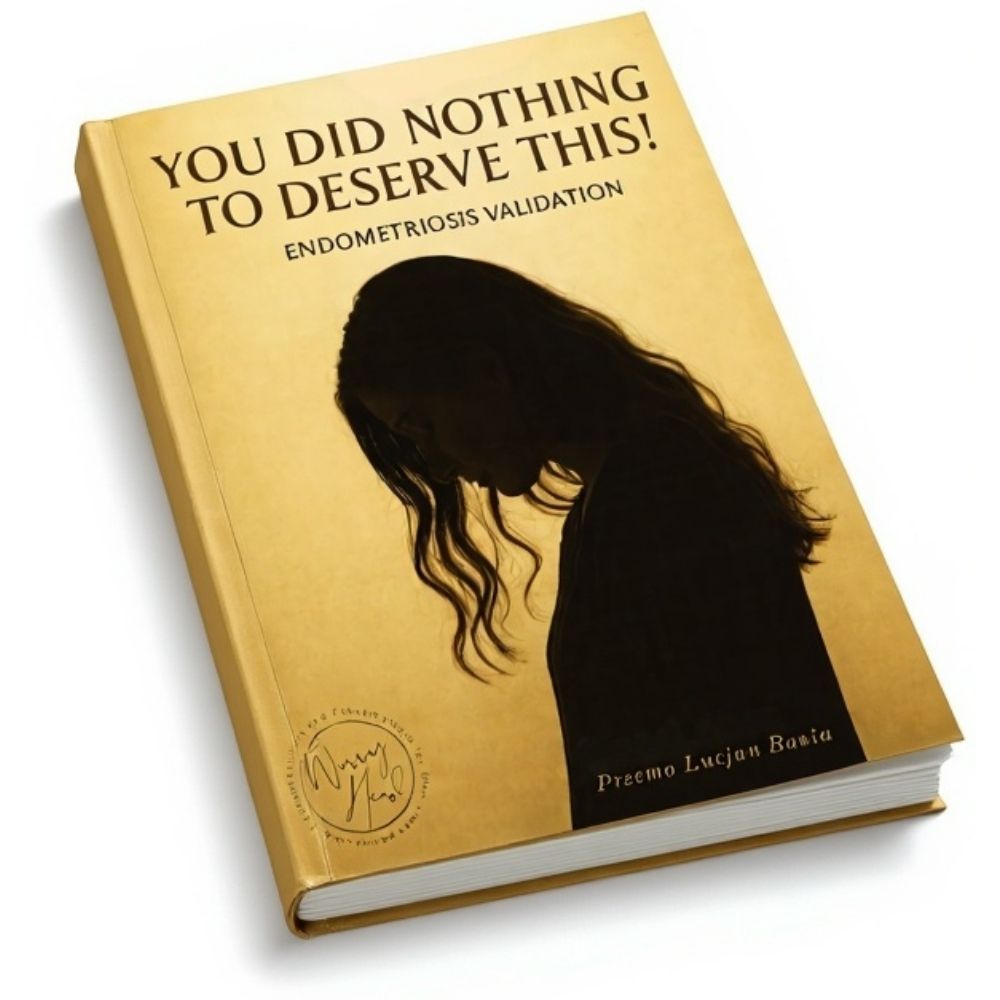
If this is where your heart feels tired, I’d love to invite you to grab my free 130+ page eBook, You Did Nothing To Deserve This! It was written to help women with endometriosis feel validated, and when you join us through that freebie, you also join our community, where we share more freebies, meaningful discounts on our books, and gentle emails full of support for the new normal chronic illness can bring to a relationship and to life.
The book is filled with 20 chapters of gentle validation for women with endo, written by yours truly, as I have seen it up close…
It’s my way of telling you, in much more detail, that your pain, your complex response to treatment, and your emotions around all of it are real, understandable, and never your fault.
It’s not a medical guide but a human one. Here’s what you will find inside:
- This Was Never Your Fault
- The Girl You Used To Be
- When Your Own Body Feels Like an Enemy
- The Invisible Battles Nobody Sees
- Am I Just Lazy? – The Lie You Have Been Taught
- Gaslighting, Dismissal and the Trauma of Not Being Believed
- Guilt: The Weight You Were Never Meant to Carry
- Love in the Middle of Pain
- Intimacy When Your Body Hurts
- The Loneliness of Being the Strong One
- You Are Allowed To Take Up Space
- Tiny, Gentle Hopes (Not Toxic Positivity)
- If You Could Hear My Voice Every Flare Day
- You Deserve Partners, Not Witnesses
- When You Wish He Understood
- Motherhood, Fertility and the Grief Nobody Sees
- When Anger Is the Only Honest Feeling
- Learning to Trust Your Body Again
- Building a Life That Fits Your Reality
- You Did Nothing To Deserve This
You Did NOTHING To Deserve This!
Endometriosis Validation for Women with Endo
- You Did NOTHING To Deserve This!
- Why Endometriosis Validation Needs to Start at Home?
- How Can Endometriosis Validation Start to Heal the Damage?
- How Validation Shapes the Life We Build Together?
- How Endometriosis Validation Helps Us Redesign Everyday Life?
- When Validation Becomes the Way We Love
- Letting Her Story Be the Center
- Speaking Up for Her When She Is Too Tired
- Keeping Intimacy Safe, Even When Touch Hurts
- Letting Her Dream Again Without Deadlines
- Building Routines That Protect Her Mental Health
- Refusing to Compare Her to Healthier Versions of Herself
- Letting My Own Vulnerability Sit Beside Hers
- Choosing Love That Stays, Even When It Is Quiet
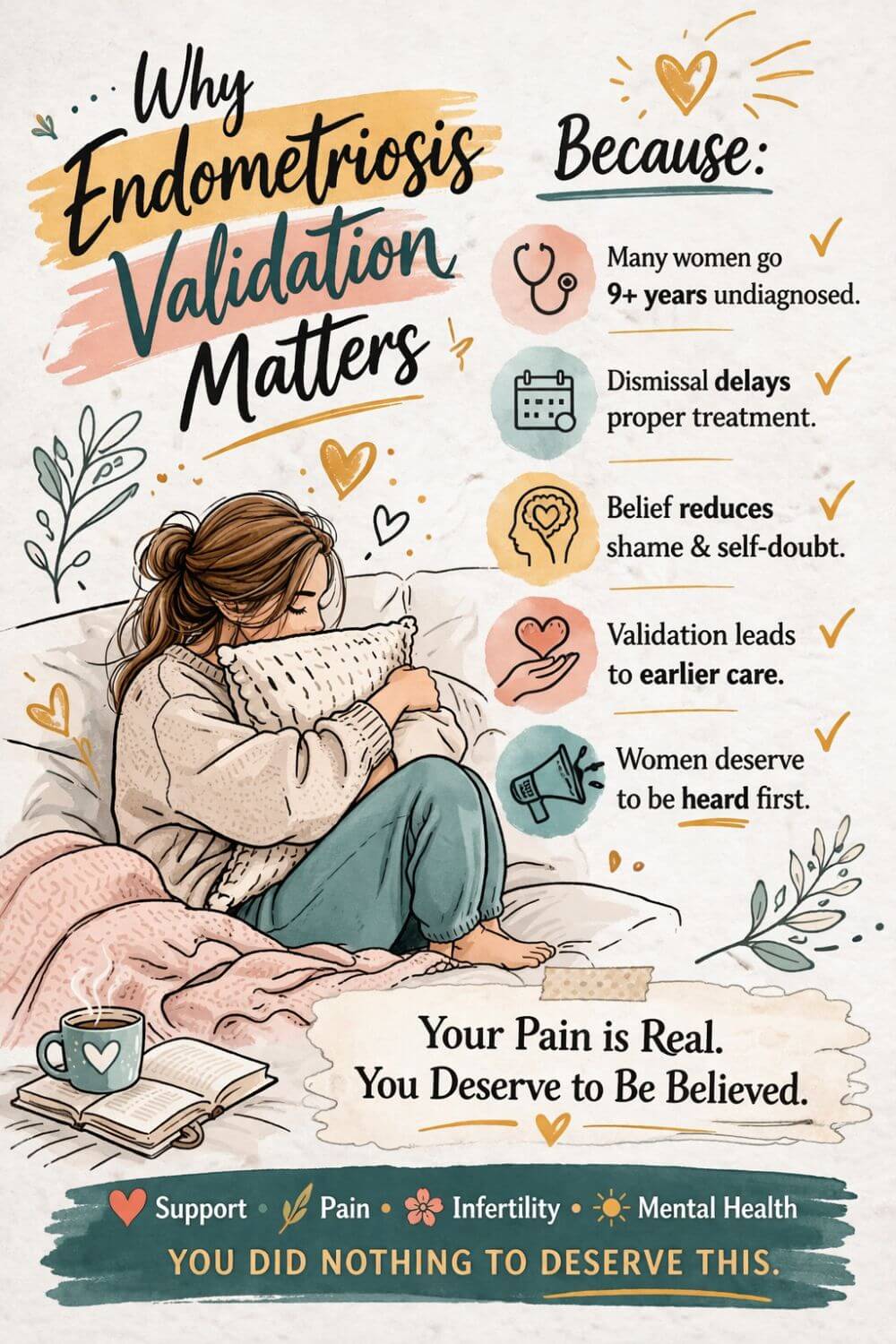
- Why Endometriosis Validation Matters So Much?
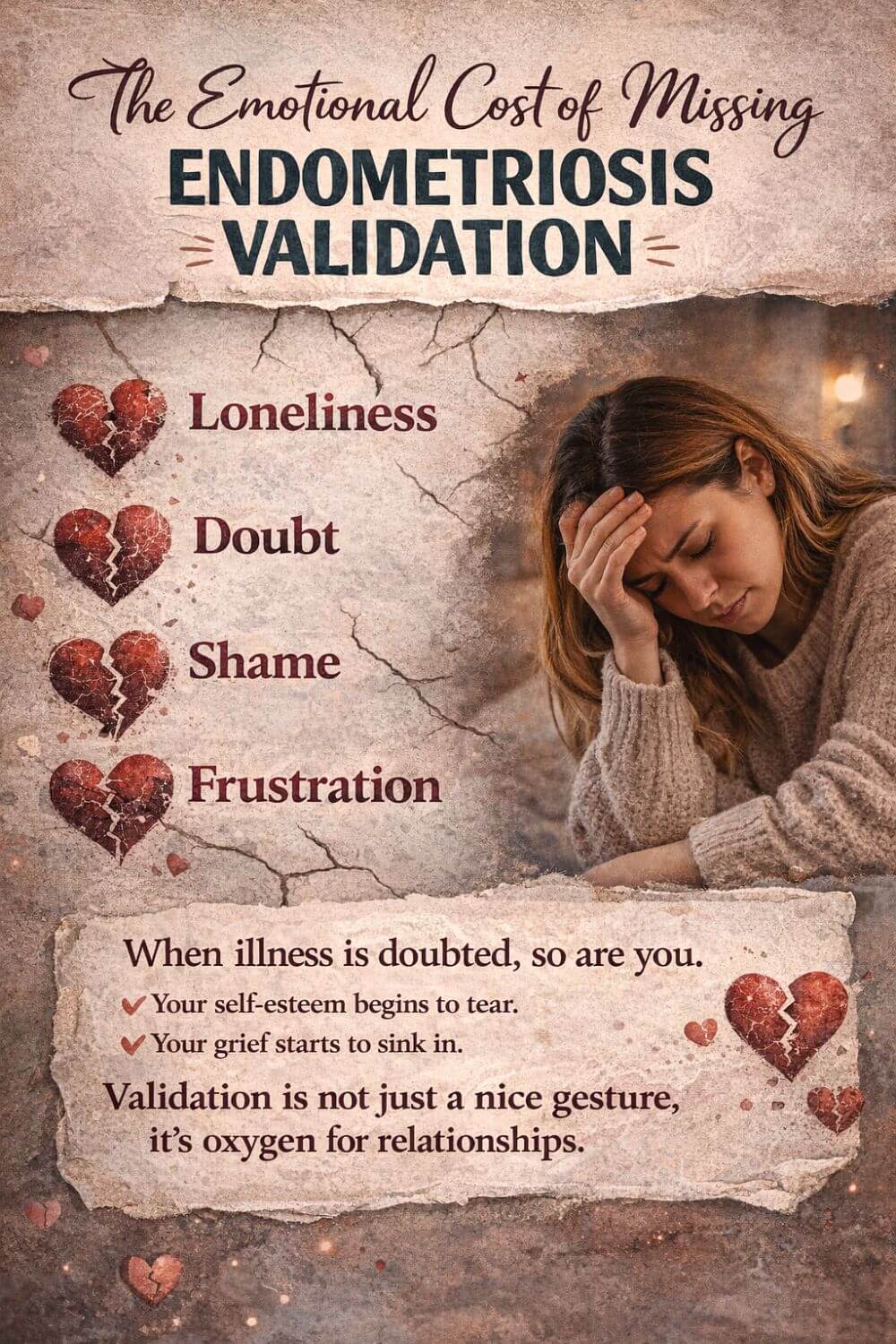
- The Emotional Cost of Missing Endometriosis Validation
- How to Rebuild Trust Through Endometriosis Validation?
- Final Word On Endometriosis Validation
- FREE eBook
Why Endometriosis Validation Needs to Start at Home?
When I first started to understand what my wife was living with, I thought love alone would somehow fix the loneliness she felt. Very quickly, I learned that love isn’t enough if she keeps stepping into a world that questions her pain at every turn.
Home had to become the one place where she didn’t have to prove anything, justify anything, or perform strength just to be taken seriously. That began with me listening differently, not just to the words she used, but to the way her shoulders dropped when a flare was coming, the way her voice went quiet when she tried to push through it.
I realised that my job wasn’t to cheerlead her into pretending she was fine, but to say, calmly and consistently, “I believe you, even when nobody else does.” This is what endometriosis validation looks like in real life: not grand speeches, but small, repeated moments of choosing to trust her experience over other people’s ignorance.
Sometimes that means cancelling plans without making her feel guilty, or telling family members that no, she’s not “flaky”, she’s in agony and resting is not a choice but a survival strategy. Sometimes it means sitting on the bathroom floor with her at 3 a.m., not offering solutions, just letting her know she doesn’t have to suffer in silence.
Living with chronic illness has changed everything about the way we organise our days, our work, even our dreams, and I’ve had to accept that this isn’t a phase we can simply power through. But inside that acceptance, there’s also a strange kind of freedom, because once you stop fighting her reality, you can start building a life that fits it.
For us, that has meant shifting toward working from home, reshaping our home into a softer, safer space, and quietly deciding that her body will never again have to fight for the right to be heard inside our four walls.
How Can Endometriosis Validation Start to Heal the Damage?
For a long time, my wife thought she was the problem. Not the disease. Not the system that missed her diagnosis for years. Not the people who told her it was “just bad periods.”
When you’re constantly dismissed, you start to internalise that message. You begin to wonder if you are too dramatic, too emotional, too much. Your body is screaming, but the world answers with a shrug, and that gap between what you feel and what you’re told becomes its own kind of wound.
Real healing doesn’t start with medication or surgery alone. It begins when someone finally says, “What you’re feeling makes sense.” When a doctor doesn’t rush you, when a partner looks you in the eyes and says, “I believe you,” something inside your nervous system loosens, even if the pain itself is still there.
The first time my wife said, “You’re the only one who really gets it,” I felt both honoured and heartbroken. Honoured, because I knew my listening mattered. Heartbroken, because it meant so many others had failed her long before I ever showed up with heat pads and late-night cups of tea.
This is why endometriosis validation is not some soft, fluffy concept.
It’s a form of emotional first aid, a way of stopping the bleeding that happens when you are doubted again and again. It tells your brain, “You’re not crazy, you’re not weak, you’re not imagining this,” and that message can be the difference between coping and collapsing.
When women are believed, they advocate differently. They walk into appointments with more calm, more clarity, more strength, because they know at least one person stands solidly in their corner. They feel safer asking for adjustments at work, saying no to social events, or choosing rest without drowning in guilt.
As partners, we can’t fix the disease, but we can stop adding to the harm. We can stop minimising flare-ups, stop comparing pain, and stop pushing toxic positivity when what she really needs is a witness. We can create a life where her body is not treated as an inconvenience, but as something worth protecting, even if that means changing the way we live, work, and plan our future.
And in that new kind of life, validation becomes part of the daily routine, not a big speech, but a steady, quiet “I see you” woven into the way we talk, the way we schedule, the way we love.
Next, I want to break this down into smaller pieces and look at the different layers of feeling believed, from the medical side to the home, so you can see where your own validation has been missing and where it can gently begin.
Being Believed at Home First
When my wife tells me, “Today is a bad pain day,” I treat that sentence like a fact, not a debate. That is where healing quietly begins. Endometriosis has already forced her to argue with doctors, employers, and even friends who meant well but didn’t understand how brutal this pain can be. She cannot also fight for belief at home.
So I try to show her, in small daily ways, that she never has to convince me. If she cancels plans, I back her up instead of making her feel guilty. If she says, “I just can’t today,” I do not ask her to prove it; I ask, “What would help?”
Over time, this kind of endometriosis validation starts to soften that constant readiness to defend herself. Her shoulders drop a little sooner. She apologises less for needing rest. She begins to feel like home is not another exam to pass, but the one place where her body’s truth is enough.
Undoing the Harm of Medical Gaslighting
The hardest stories my wife tells are not always about the physical pain, but about the appointments where she walked in hopeful and left humiliated. Being told “it is just stress” or “some women just have lower pain tolerance” cuts deeper than most people realise. It teaches you that your suffering is inconvenient, that you should shrink it down to make professionals more comfortable.
I cannot rewrite her medical history, but I can stand beside her while we slowly reclaim her reality. That might look like helping her prepare notes before an appointment, reminding her she is not “overreacting” when she asks follow-up questions, or simply saying, “You were not treated fairly today, and it is okay to feel angry about that.”
When someone you love mirrors back the truth you feel in your bones, it starts to stitch together the parts of you that were torn by disbelief. Bit by bit, the story shifts from “maybe I am crazy” to “I was badly let down, and I still deserve proper care.”
Relearning to Trust Your Own Body
After years of not being believed, many women begin to doubt their own signals. My wife used to say things like, “Maybe it is not that bad, maybe I am just weak,” even when I could see the pain written all over her face. That self-doubt is a quiet side effect of living with an illness that is constantly minimised. You stop trusting your own body because everyone else has treated it like an unreliable narrator.
One of the most powerful forms of validation I have seen is when she starts naming her pain without apology. When she says, “This is not just a period, this is a flare,” and nobody argues, something shifts. I answer with, “Okay, then we adapt today,” instead of “Are you sure?”
Slowly, she begins to trust that her body is telling the truth, even when others have not. That trust matters. It helps her notice patterns, advocate for better treatment, and protect her energy before she crashes. It also reminds her that she is not weak for hurting; she is strong for surviving what most people will never fully understand.
Calming a Nervous System on High Alert
Living with chronic pain feels a bit like having the fire alarm stuck on. Your nervous system is constantly scanning for the next wave, the next dismissal, the next “you are exaggerating.” My wife does not just brace for the cramps; she braces for the reactions to them. That double stress wears down even the strongest person.
Endometriosis validation gently lowers that alarm. When she knows she will be believed, she does not have to waste energy rehearsing explanations in her head. She does not lie there thinking, “How do I justify this?” but instead, “How do I care for myself through this?”
A calm, honest response from me, like “Your pain makes sense, let us adjust our day,” signals to her body that she is not about to be attacked or judged. It does not erase the pain, but it removes a layer of fear wrapped around it. Over time, this can be the difference between a life lived in constant defence mode and a life where, even in pain, she can exhale.
Turning Home Into a Soft Place to Land
For many women, home is where they push the hardest to appear “fine” because they feel guilty for how much their illness has already changed everything. I have watched my wife apologise for lying on the sofa, apologise for not cooking, apologise for existing in pain. It broke my heart, because the person I love most was treating herself like a burden in her own house.
So we started changing the script. We rearranged our home office so she could rest between tasks without feeling like she was “slacking.” We added softer lighting, blankets and small comforts so flare days felt less like failure and more like allowed recovery. I began saying things like, “You are not lazy, you are injured,” and backing that up by taking over chores without sighs or martyrdom.
Slowly, the atmosphere shifted. Our home stopped being the place where she had to catch up with everyone else’s expectations and became the one place where her body set the pace. That is what validation looks like in bricks and furniture and daily routine.
Letting Go of Guilt Around Rest
One of the cruellest lies endometriosis whispers, especially when society repeats it, is that resting makes you weak or selfish. My wife used to push through days that would flatten most people, then cry from exhaustion and shame when her body finally collapsed. She felt guilty for every nap, every cancelled plan, every task left undone. It was like her worth was measured only in productivity, never in survival.
Validation challenges that lie. When I tell her, “You are allowed to rest before you break,” I am not being kind; I am being accurate. Her body is doing heavy work behind the scenes, fighting inflammation, coping with chronic pain, and handling the emotional weight of it all.
Of course, she needs more downtime. When we treat rest as responsible management rather than failure, the guilt slowly loosens. She starts to choose pacing over crashing, gentle pauses over dramatic shutdowns. And in those moments, I see something beautiful: a woman who is no longer apologising for the care her body needs, but claiming it as a normal, worthy part of her life.
How Validation Shapes the Life We Build Together?
At some point I realised that believing my wife was only the starting point; the real test was how our whole life reflected that belief. If I said I understood her pain but kept expecting her to live like someone who is healthy, my words meant nothing.
So I began to look at our days differently. I asked myself, if a doctor fully accepted her pain levels and limitations, what would they tell her to change, and why was I expecting anything less at home? That question became a quiet guide for how we organised work, rest, and even our dreams.
This is where endometriosis validation turns into practical choices. She chose remote work so she does not have to commute in agony. Setting up a home office where she can lie down between tasks instead of forcing herself to sit at a desk while her body is screaming. Redefining what a “productive” day looks like so it includes surviving a flare, not just ticking off a to-do list.
I want you to know that you deserve that same level of care in your own life. If you were my sister, my best friend, I would not tell you to push harder; I would ask how we can redesign things so your body has half a chance to breathe. You are not high maintenance for needing adjustments; you are living with a condition that demands respect.
When we finally started honouring my wife’s limits instead of resenting them, something softened between us. There was less secret pressure, less silent disappointment, more honesty about what she could and could not do. Our plans became more flexible, our home more gentle, and our future more about what was possible with her body, not in spite of it.
How Endometriosis Validation Helps Us Redesign Everyday Life?
When I look back at how our life used to run, I can see how much of it was built for a healthy body, not the one my wife actually lives in now. We woke to alarms that ignored her night of pain, rushed through mornings, and treated her flares like an interruption instead of the central reality they are.
Learning to slow down started with simple, uncomfortable honesty: asking her what a survivable day really looks like, not what she thinks others expect. Sometimes that means starting later, sometimes it means doing just one meaningful thing instead of ten, and sometimes it means admitting that today is about nothing but breathing through the waves.
It is not laziness or giving up; it is finally aligning our schedule with her body instead of constantly dragging her body behind the schedule.
Work had to change too, which is why I fought so hard to build our online life and home office, so she could earn and create without fluorescent lights, rigid hours, and painful commutes.
There is a different kind of dignity in knowing she can close the laptop, lie down with a heat pack, and still be allowed to call that a valid working day. Designing our space around her needs has turned the house from a battlefield of expectations into something closer to a sanctuary where she is not punished for being ill.
This is what endometriosis validation looks like in our world now: not just saying the right things, but building a life that stops arguing with her body. You deserve that same gentle redesign, a life that bends toward your reality instead of demanding that you constantly betray yourself just to keep up.
Rewriting Mornings Around Her Body
For years, our mornings were ruled by alarms and obligations, not by how much pain she woke up with. I watched her drag herself out of bed after nights of stabbing pelvic pain, pretending she was fine because that is what the world expected. Now we start by asking one simple question: “What does your body need this morning?”
Some days it is a slow start, soft clothes, and quiet. Other days, she feels strong enough to move more, to stretch, to work earlier.
Instead of judging the day as “good” or “bad” based on productivity, we look at how kindly we responded to her symptoms. Coffee might wait while she lies with a hot water bottle.
Emails can be answered later, so panic attacks are less likely to creep in. Our mornings are no longer about beating the clock. They are about meeting her where she is, and that small shift carries a huge message: that her body is not an enemy to overcome but a partner we listen to.
Designing a Home Office That Does Not Punish Pain
When we first started working from home, I realised our setup still copied the old office world. Rigid chair, standard desk, long stretches of sitting that left her doubled over. It made no sense to escape the traditional job and then recreate the same torture at home. So we began to design a space around her illness instead of around some magazine idea of productivity.
The desk became adjustable, the chair softer, and the sofa part of the workspace, not a symbol of defeat.
We added small things that make a big difference, like a basket with heating pads, medication, and a cosy blanket within arm’s reach, so she does not have to “earn” comfort. Lighting grew warmer and kinder, so migraines from fluorescent bulbs were less likely.
A laptop stand lets her work from bed on the worst days without destroying her posture. This is not about being spoiled. It is about refusing to let pain be punished by the environment. Our home office now says, “Your body is welcome here,” and that changes how she feels about every task.
Planning Social Life With Built-In Exit Plans
Before we accepted how serious her symptoms were, we treated social plans like fixed promises. Say yes, show up, stay the whole time, smile through it. I remember watching her sit at dinners while cramps and nausea twisted through her, too scared to be the one who ruined the evening.
Now we plan everything with flexibility as the default, not as an awkward afterthought. When we agree to meet friends, we are honest that we might need to leave early or switch to a quieter setting.
Sometimes we choose places close to home, so getting back quickly is easy if a flare hits. Sometimes we invite people to us, where she can lie down if she needs to, without feeling like a spectacle.
I let her know from the start that I care more about her comfort than finishing a night out. When your partner backs your decision to leave, the shame about listening to your body softens. Social life becomes less of a performance and more of a space where you are allowed to exist as you really are.
Letting Work and Money Follow Health, Not the Other Way Around
Money fear is very real when chronic illness changes everything. There was a time I was scared that if we did not keep chasing the traditional path, we would lose safety. But the truth is, she was already losing herself trying to keep up with a world that did not fit her body.
That is why I poured my energy into blogging, building online income streams, and turning our skills into something we could do from home. It was not about chasing luxury. It was about buying her breathing room.
When income comes from writing, creating, and sharing our story instead of sitting in an office chair for eight painful hours, her body pays a smaller price each day. We can adjust workloads around her flare schedule, not the opposite. Of course, it is still stressful at times, and I carry a lot of responsibility, but it feels different when every pound we earn supports a life that does not crush her.
Work now follows her health. That is the opposite of how the world taught us to live, and yet it is the only way this makes sense.
Making Rest a Normal Part of the Schedule
For a long time, rest in our house arrived only after she had fully crashed, usually in tears, exhausted and angry with herself. It felt like a failure, like proof she could not keep pace with “normal” people. But living with chronic illness means your body uses energy differently, and pretending otherwise just adds more harm. So we started to build rest into the day on purpose, not as an emergency stop but as a normal, scheduled thing.
She now has planned pauses, small windows where she can lie down, stretch, or simply breathe without screens or demands. I treat those breaks as non-negotiable, just like a meeting or a deadline, because they keep her from sliding into full burnout. When she sees me protecting those times, she slowly believes that her needs are not a nuisance but a priority.
Rest is not something she has to apologise for any more. It is one of the ways we show respect to a body that has been through surgery, trauma, and constant pain, yet still fights to carry her through each day.
When Validation Becomes the Way We Love
If we ever sit across from each other with a cup of tea between us, I want you to know this: I do not see you as “too much” because of your pain. I see you as someone who has carried far more than most people ever will, often in silence, and is still here, still trying, still loving the people around you. That alone deserves more respect than the world has given you so far.
As a husband, I had to unlearn a lot of what I was taught about strength. I grew up thinking love meant fixing things, stretching yourself thin, and staying quiet about your own fears.
But loving a woman with a chronic illness has taught me that real strength looks different. It looks like slowing down when it would be easier to rush. It looks like sitting in the dark with her during a panic attack instead of throwing empty reassurances from the doorway. It looks like building a home office and a new kind of life, so she is not forced to choose between survival and a paycheck.
I am still learning every day, and I will make mistakes, but one thing will not change: I refuse to treat her symptoms as an inconvenience or a drama. I will not downgrade her experience to make others comfortable. And I want you to know you deserve that same standard.
You deserve people in your life who take your words seriously the first time, who adapt plans without resentment, and who see your worth beyond how much you can do in a day.
If any part of this resonates with you, please know you are not asking for too much when you ask to be believed. You are asking for something basic that every human being deserves, and you do not have to apologise for needing it. My hope is that as you read this, you start to feel a little less alone, a little more certain that your reality is valid, and a little more willing to imagine a life that bends gently toward your body instead of breaking you to fit everyone else’s expectations.
Letting Her Story Be the Center
When my wife tells me her story, I try to treat it like a book with her on the cover, not a chapter squeezed into everyone else’s schedule. For so long, she had to shorten her truth to fit ten-minute appointments or quick conversations in hallways, and that trained her to make herself smaller.
At home, I want the opposite. I want her to be able to ramble, contradict herself, circle back, and still feel like every word is welcome. This is my private version of endometriosis validation.
There are evenings when we sit on the sofa,and she shares memories of surgeries, missed diagnoses, or friendships that quietly faded when her illness became inconvenient. I do not rush to add my perspective; I let the silence stretch so she knows I am not going anywhere. That kind of listening is slow and sometimes heavy, but it tells her she is not an interruption in my life. She is the main story, and everything else can wait while she speaks.
Speaking Up for Her When She Is Too Tired
There are days when pain, fatigue, and anxiety weave together until even forming sentences feels like lifting weights. On those days, asking my wife to advocate loudly for herself is not love; it is cruelty dressed up as empowerment. So sometimes, loving her means gently taking the speaking role when she nods in my direction with that tired look in her eyes.
I become the one who explains to family that we need to cancel, or to a waiter that she needs to sit somewhere quieter, or to a doctor that no, this is not “just” period pain.
I do not speak over her, I speak beside her, checking in with her eyes and her small gestures so I do not hijack her agency. My goal is not to be her saviour but her microphone on the days her voice has been shredded by years of not being believed. Knowing that I will step in without resentment gives her permission to rest, not just physically, but emotionally, from constantly justifying her own suffering.
Keeping Intimacy Safe, Even When Touch Hurts
Nobody talks enough about how much pressure chronic illness puts on intimacy. When pain flares in her pelvis, even the gentlest touch can feel like a threat instead of comfort.
At the start, I took that personally, like a rejection of me, and that only added shame to her pain. I had to learn to separate my ego from her nervous system. Loving her meant saying, “Your no is safe with me,” and meaning it every single time, even when my own needs felt loud.
We found new ways to be close that did not demand a pain-free body: lying side by side listening to music, holding hands, sharing quiet conversations in the dark, kissing her forehead while she curled up with a heat pack. When she saw that I would not sulk or withdraw affection because sex was off the table, her whole body softened a little.
Intimacy stopped being a test she could fail and became a place where her limits were honoured, not negotiated away, and that has been one of the purest forms of endometriosis validation in our relationship.
Letting Her Dream Again Without Deadlines
Illness stole so many dreams from my wife that she stopped daring to make new ones, just to protect herself from more disappointment. Watching that light dim was one of the hardest parts for me. Love, for us, has meant carefully inviting dreams back in, but without turning them into pressure or proof of progress.
We talk about places she might one day visit, work she could do on her better days, and small creative projects that make her eyes shine for a moment.
When we dream like that, I do not secretly think, “So when will you be well enough?” I hold the possibilities loosely, knowing some plans may stay as gentle maybes, and that is still valid.
Chronic illness already weighs on her with heavy expectations from doctors, family, and society. She does not need mine added on top. So I remind her that a few pages written, a short walk in the sun, even simply allowing herself to imagine Italy again, are all real wins. Our dreams now move at the pace of her body, and that softer rhythm keeps hope alive without breaking her heart.
Building Routines That Protect Her Mental Health
Endometriosis did not only attack my wife’s body; it also wrapped itself around her mind with depression, anxiety, OCD spirals, and nights where intrusive thoughts scared both of us. Loving her means treating mental health as part of the illness, not a side note once the physical pain is handled. We build routines around this reality, not around some fantasy version of her who never struggles. Mornings might include a check-in about her mood, evenings a small ritual that grounds her before sleep.
On harder days, we deliberately lower the bar for what counts as success so she is not crushed by impossible standards. Making a phone call, taking a shower, or sending one honest message to a friend might be the win of the day, and that is enough. When I respond to her spirals with steadiness instead of frustration, she feels less ashamed of needing support.
Over time, these quiet, repeated responses tell her she is not broken for needing help; she is human in a life that would shake anyone’s mind.
Refusing to Compare Her to Healthier Versions of Herself
There is a grief that comes with loving someone whose body has changed so much from the years before illness took over.
I remember how she danced, travelled lightly, said yes to almost everything. But if I constantly hold up that past version of her as the standard, I turn our love into a quiet competition she can never win. So I make a conscious choice not to say, “You used to…” as a weapon, even when I miss the way things were. Instead, I honour who she is now, in this body, with these scars.
We look at old photos not as evidence of what has been lost, but as proof of how much she has already survived. I remind her that the strength it takes to endure daily pain is as real as the strength it took to dance for hours on stage. When she sees that I am not secretly waiting for her to “go back” to the woman she was, she feels safer being the woman she is today. That safety is a deep form of love, one that does not demand she rewind her life to deserve affection.
Letting My Own Vulnerability Sit Beside Hers
For a long time, I thought my job was to be unshakable, the solid rock that never cracks. But pretending I was never scared, never tired, never overwhelmed only created distance between us. She felt guilty watching me carry everything in silence, and I felt alone inside my own armour.
Love became more tender when I started sharing my feelings without making them her responsibility to fix. I could say, “Today I feel afraid of the future too,” while still holding her hand firmly.
Letting my vulnerability sit beside hers does not mean collapsing on her shoulders when she is already drowning. It means being honest enough that she knows we are facing this as a team, not as a patient and a perfect carer. When she sees that I can admit fear and still stay, still plan, still show up for the next flare, it strengthens trust between us.
Our honesty becomes another kind of safety net, one where neither of us has to pretend to be less human than we really are.
Choosing Love That Stays, Even When It Is Quiet
Illness has a way of stripping relationships down to their foundations. The grand gestures, the glamorous trips, the big nights out all become rarer when pain and fatigue dictate the schedule.
What remains are the quiet, unphotogenic acts of love: making her tea at 2 a.m., rubbing her back during a panic attack, sending emails so she does not have to explain again why she cannot make it. From the outside, it might look ordinary. From the inside, it is everything.
I have learned that the most powerful declarations of love in our lives rarely come as big speeches. They arrive as consistency, as showing up on the hundredth difficult day as faithfully as on the first. Staying when you are tired of waiting lists. Staying when the future feels uncertain, and the present is heavy.
That decision to remain, to keep choosing her in all her reality, is the quiet heartbeat of our relationship, and it is where she finds the deepest sense of being truly loved.
Why Endometriosis Validation Matters So Much?
One of the cruelest parts of this illness is that many women are forced to prove pain that is already disrupting their whole life. Endometriosis is not rare, and major health bodies estimate it affects about 1 in 10 women and girls of reproductive age, yet people still get treated as if they are describing something unusual or exaggerated.
That gap between how common it is and how often it is dismissed is where so much damage begins. A woman can be dealing with painful periods, chronic pelvic pain, bowel pain, bladder pain, pain during sex, fatigue, nausea, heavy bleeding, low mood, and even fertility worries, and still walk out of an appointment feeling smaller than when she walked in.
What makes this worse is time. In the UK, Endometriosis UK reported in March 2026 that the average diagnosis time has reached 9 years and 4 months, and that number is even worse than the figure reported a few years earlier.
Think about what that really means in human terms. It means years of second-guessing your body, years of being told it might just be stress or normal period pain, years of planning life around flares, toilets, heating pads, cancelled plans, and the fear of not being believed.
This is why endometriosis validation is not some soft extra. It is often the first step that helps a woman stop blaming herself for symptoms that were never her fault in the first place.
When proper validation happens, something shifts. The conversation moves from “maybe you are overreacting” to “these symptoms fit a known disease and deserve proper assessment,” and that changes how fast someone gets referred, investigated, and supported. NICE has updated its guidance to improve earlier recognition and reduce the symptom-to-diagnosis gap, which matters because being heard sooner can change the whole path that follows.
I also think validation matters because endometriosis does not always look the way people expect. It can involve the bowel, the bladder, deep tissues in the pelvis, and in some cases even areas outside the pelvis, so a woman’s symptom pattern may sound messy or confusing when in fact it is deeply consistent with the disease.
That is where medical gaslighting becomes especially dangerous. Once a woman starts hearing “you look fine” or “it cannot be that bad,” she may begin trimming her own truth down into something easier for other people to hear, and that can delay help even more.
I have seen how much damage disbelief can do before treatment even begins. Pain is one wound, but being made to feel dramatic, lazy, weak, or emotionally unstable because of that pain can become another wound sitting right on top of it.
My wife taught me that validation is not only about saying the right sentence. It is about noticing patterns, believing what keeps happening, protecting her dignity on hard days, and not making her carry the extra burden of defending her suffering to the person who is meant to love her most.
So many women do not need another cold explanation first. They need someone to say your pain is real, your symptoms are real, your exhaustion is real, and you deserve to be believed.
I still remember seasons when my wife was carrying more than pain alone. She was carrying the mental weight that comes when a body keeps breaking your routine, your confidence, your work, your intimacy, and your sense of safety, and I learned the hard way that tenderness is not weakness in a relationship like this, it is part of survival.
That is why the next part matters so much to me. I want to give you practical things that can help a woman feel seen instead of questioned, safe instead of cornered, and loved instead of reduced to her symptoms.
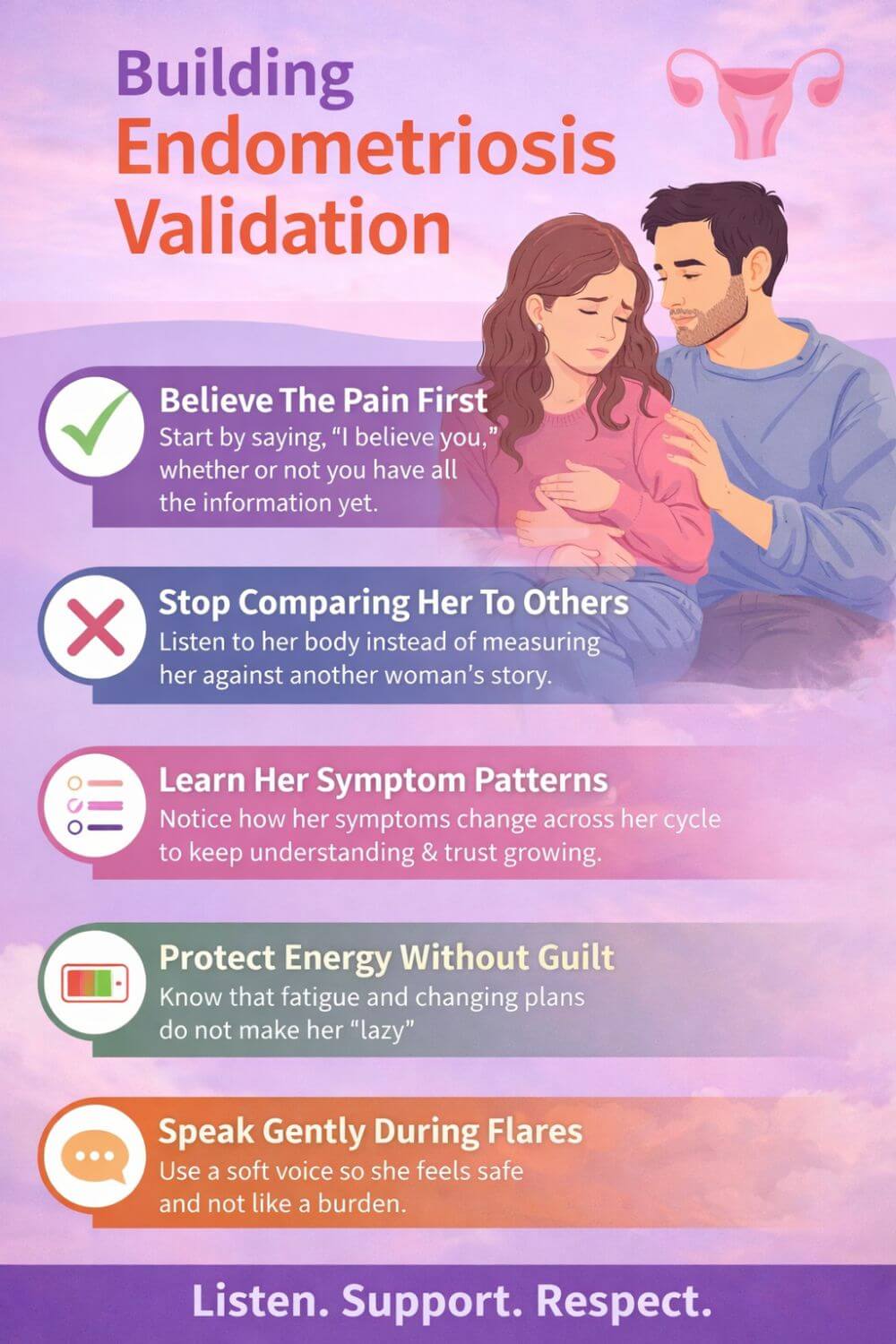
- Believe the pain first
- Stop comparing her to others
- Learn her symptom patterns
- Protect energy without guilt
- Speak gently during flares
- Help at appointments calmly
- Validate grief and anger
- Support intimacy with patience
- Stay steady when she doubts herself
Believe The Pain First
The first thing I want to say to any partner, doctor, friend, employer, or family member is to believe her before you fully understand every detail. Endometriosis can cause painful periods, chronic pelvic pain, pain during sex, pain when using the toilet, fatigue, nausea, heavy bleeding, and fertility problems, but symptoms do not always arrive in a neat little pattern that makes other people comfortable. That does not make them less real.
I learned that one of the deepest injuries in this disease is not only the pain itself, but the way a woman starts to doubt her own body after enough people question it. If the woman you love says something hurts, start there.
Start with trust. You do not need to become a specialist overnight to offer women’s pain validation. Sometimes the most healing sentence in the room is simply, “I believe you.” That sentence can steady a heart that has spent years shaking. And when disbelief has followed her from appointment to appointment, hearing it at home can feel like finally being allowed to breathe again.
Stop Comparing Her to Others
Comparison is one of the quietest forms of invalidation, and many people do it without even noticing. They say things like, “My sister has bad periods too,” or, “Other women still go to work,” as if pain becomes less serious when somebody else carries a different version of it. But endometriosis is a complex disease with a very wide range of symptoms and severity, and even the amount of visible disease does not always match the amount of suffering someone feels.
My wife taught me that comparing women to each other is cruel because it erases the body in front of you. It erases her threshold, her inflammation, her fear, her exhaustion, her bowel symptoms, her sleeplessness, and the emotional toll of living inside a body that feels unsafe.
Validation for women starts when you stop measuring her pain against somebody else’s story and start listening to her own. You are not helping by shrinking her reality into something more convenient. You help when you let her experience stand on its own feet, without forcing it to compete for permission to matter.
Learn Her Symptom Patterns
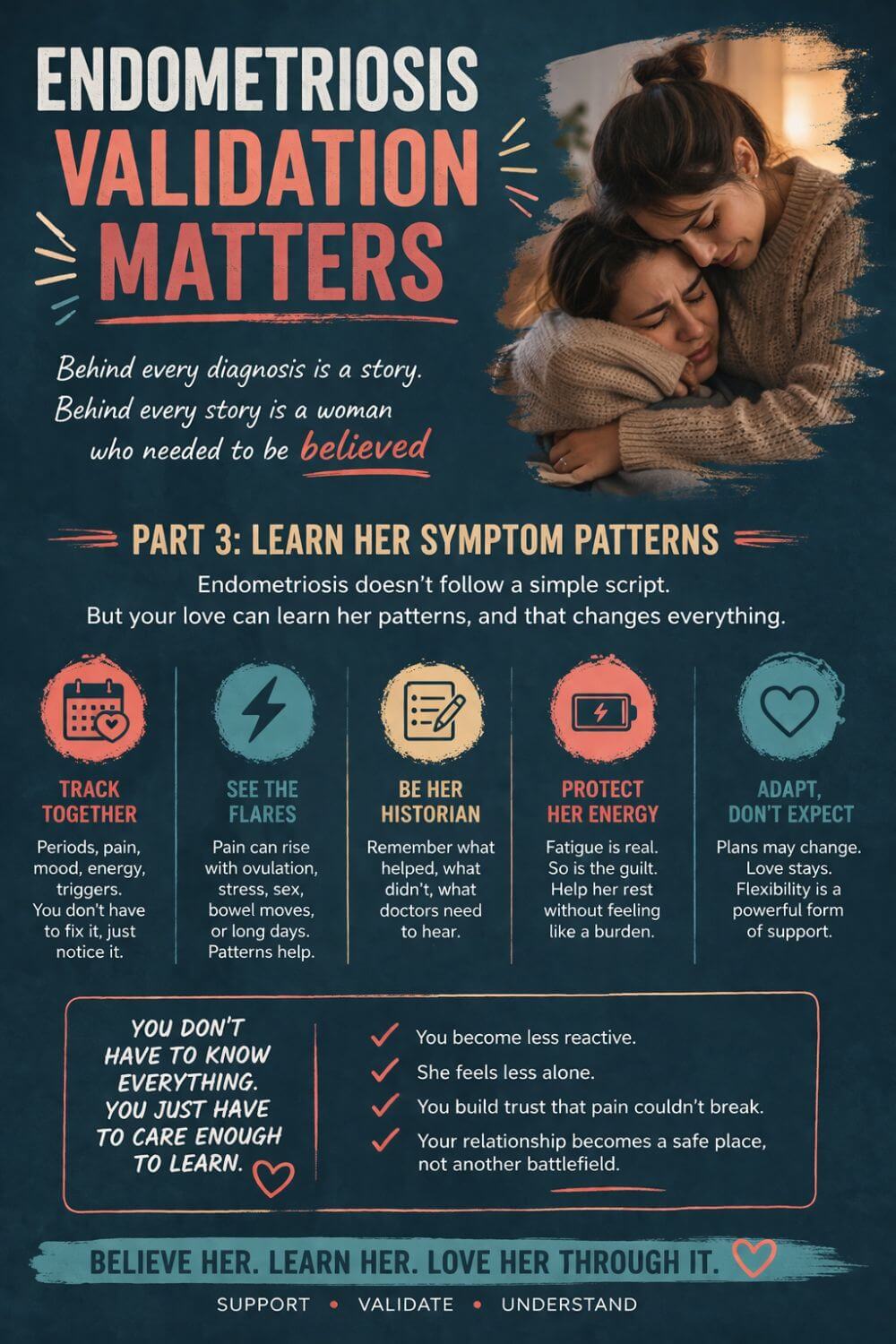
One of the most loving things I ever learned to do was stop treating symptoms as random complaints and start noticing patterns. Endometriosis can flare around periods, ovulation, sex, bowel movements, urination, stress, poor sleep, and even after long days of pushing through pain.
Some women have endo belly, some have lower back pain, some have bladder symptoms, some have bowel symptoms, and some are hit hardest by crushing fatigue and nausea. The point is not to force every woman into the same picture. The point is to study the picture her body keeps painting.
When I began noticing my wife’s patterns, I became less reactive and more useful. I could see when a flare was building instead of waiting until she was already overwhelmed. That changed the tone of our home. It created chronic illness support instead of chaos. It also helped me understand that validation is practical, not only emotional.
When you learn her pattern, you stop acting surprised by the same storm every month, and that alone can make a woman feel less alone in her own life. She should not have to be the only historian of her pain.
Protect Energy Without Guilt
Fatigue and endometriosis can be a brutal combination because exhaustion is one of the symptoms people are quickest to judge. If a woman looks “fine,” the world often assumes she should still perform normally, smile normally, socialise normally, and recover normally. But endometriosis is a chronic condition that can affect physical health, emotional wellbeing, daily routine, and work, and forcing the body to act healthy does not magically reduce inflammation or pain.
I wish more women heard this without shame attached to it, that protecting their energy is not laziness and rest is not failure. Cancelling plans, sitting down, asking for help, or doing less on a flare day is not weakness.
My wife has had days when the bravest thing she did was stop pretending she could carry the day the way healthy people can. I think endo validation has to include that truth. Your exhaustion is real, your body is not betraying you because it needs limits. Sometimes the kindest thing a partner can do is remove guilt from the room and make rest feel safe instead of something that must be earned.
Speak Gently During Flares
A flare changes the whole emotional temperature of a room. Pain narrows patience, steals language, and can make even simple questions feel heavy. During bad symptoms, a woman may not need solutions first. She may need softness first. That matters because endometriosis is not only linked with pain and fatigue, but also low mood and anxiety, especially when symptoms are repeated, severe, and poorly understood by others.
I had to learn that my tone mattered almost as much as my effort.
A sharp voice, too many questions, or acting frustrated with changed plans can make a woman feel like she is now managing your emotions on top of her own pain. Gentle speech is a form of pelvic pain validation. It says, “You are safe with me even when your body is hard to live in.”
My wife did not need me to become dramatic. She needed me to become steady, speak slower, ask less, offer water, heat, quiet, food, medication, or space without making her feel like a burden. On some days, tenderness is more useful than problem-solving.
Help At Appointments Calmly
Medical appointments can be draining because many women arrive already expecting dismissal. That fear is not irrational…
Diagnosis delays remain far too long, and NICE has had to update guidance to improve earlier recognition, imaging, referral, and care. Even now, many women spend years between first symptoms and a diagnosis, which means some walk into clinics carrying not only questions, but a long history of disappointment.
A calm, prepared partner can make a real difference. I do not mean taking over her voice. I mean helping her hold onto it. Write symptoms down. Note timing, bleeding, bowel pain, bladder pain, painful sex, fatigue, and what makes symptoms worse. Help her remember what she wanted to ask. Stay grounded if she becomes upset.
Good support in that moment is not performance. It is quiet backup. It is saying, “You do not have to carry this whole conversation alone.” For women who have experienced medical gaslighting, having one steady person beside them can feel like borrowed strength until their own returns.
Validate Grief and Anger
There is grief woven through this illness that many people never see. It is the grief of lost normality, lost confidence, lost spontaneity, lost work, lost intimacy, lost energy, and sometimes lost fertility or fear around it. WHO and NHS information both reflect that endometriosis can affect fertility, daily life, emotional wellbeing, and mental health, and that means grief is not an overreaction to pain. It is often a reasonable response to repeated loss.
I think women are too often expected to carry this grief beautifully, quietly, and without making anyone uncomfortable. But anger can be valid. Sadness can be valid. Numbness can be valid. Tears can be valid.
When my wife struggled, I learned not to rush her toward gratitude or positivity just because pain made me feel helpless. Invisible illness validation sometimes looks like making room for emotions that do not fit a neat recovery story. Let her mourn what this disease has taken. Let her be angry at what it has interrupted. Love does not always fix grief, but it can stop her from feeling ashamed of having it.
Support Intimacy with Patience
Painful sex is one of the symptoms that can wound in two directions at once. It hurts physically, and then it can hurt emotionally because it touches closeness, confidence, femininity, desire, and the fear of disappointing the person you love. NHS and other clinical sources list pain during or after sex as a common symptom, especially when deeper tissues are involved.
For some women, this is not occasional discomfort. It is a real part of living with endometriosis. This is where a partner can either deepen the wound or protect her heart.
Patience matters, and pressure destroys safety. If intimacy becomes something she braces for, then love has to slow down and rebuild trust around her body, not demand access to it.
My wife taught me that real closeness is not proven by how much you take, but by how safe you make her feel when pain interrupts what both of you wanted. Endometriosis support inside a relationship means remembering that tenderness, reassurance, and emotional closeness are not lesser forms of intimacy. Sometimes they are the form of love that keeps everything else from breaking.
Stay Steady When She Doubts Herself
Years of dismissal can teach a woman to talk herself down before anybody else gets the chance. She may say she is being dramatic, weak, lazy, oversensitive, or impossible, even while her symptoms are still controlling large parts of her life. That is one of the cruelest effects of a misunderstood illness. The pain does not only live in the pelvis. It can start living inside identity.
This is why steady love matters so much. Not loud speeches, not forced positivity, but steady truth. Remind her gently that her pain is real, her symptoms are real, her exhaustion is real, and she deserves to be believed. Remind her on ordinary days too, not only on the worst ones.
I wrote about endometriosis awareness because I saw how often women were given facts without comfort. But comfort counts. A stable partner can become the voice that slowly challenges the cruel script she has learned from years of being dismissed. Sometimes she will borrow your belief before she can fully hold her own. And sometimes that borrowed belief is exactly what gets her through the next day.
The Emotional Cost of Missing Endometriosis Validation
There is a kind of loneliness that grows when pain keeps showing up, but belief does not come with it. The NHS is clear that endometriosis can affect work, relationships, fertility, mood, and everyday life, yet many women still spend years trying to explain symptoms that already fit a known condition.
That mismatch can start changing the way a woman sees herself. She may begin to wonder whether she is dramatic, difficult, weak, lazy, or too sensitive, when in truth she may be living with painful periods, pelvic pain, pain when using the toilet, fatigue, painful sex, or heavy bleeding that medicine itself recognises as part of this disease.
What hurts me is that this suffering often becomes layered. There is the physical pain, then the waiting, then the explaining, then the disappointment, and after enough of that, shame starts attaching itself to symptoms that were never a character flaw.
That is why endometriosis validation is not only about hearing the right words in a clinic. It is also about protecting a woman from the quiet self-erasure that can happen when her body keeps interrupting life and the world keeps acting as if she should manage it more gracefully.
NICE guidance has tried to improve recognition, referral, and diagnosis, and that matters because earlier recognition does more than open the door to tests or treatment. It can interrupt years of self-doubt before that self-doubt hardens into identity.
I think many people do not realise how much emotional damage comes from being forced to translate pain into something acceptable for others. A woman starts editing her sentences, softening her symptoms, smiling through distress, and apologising for the inconvenience of her own suffering.
My wife carried that kind of weight for far too long. I watched her try to stay composed on days when her body was clearly asking for mercy, and I saw how dangerous it becomes when a woman feels she must look calm enough to be believed.
That does something to a relationship too. If the person beside her becomes impatient, dismissive, or solution-obsessed too quickly, home stops feeling like shelter and starts feeling like another place where she has to prove herself.
I had to learn that love was not only helping with tasks or researching symptoms. Sometimes love was making sure she did not feel emotionally abandoned inside her own pain.
Worry Head grew from those lessons. On my about page, I say I built this space for partners who want to support the woman they love without losing themselves, and for women who need to feel deeply seen by a man who is genuinely trying to understand.
That part matters to me deeply, because women often receive facts in a cold voice, while what they needed first was dignity, tenderness, and someone steady enough to say, “I am not frightened off by what this illness has done to your life.”
I still think about the hardest nights with my wife, the quiet grief after plans we could not keep, the fear in the room, and the way pain can make even a loved woman feel unwanted if the people around her do not handle it with care. No woman should have to earn compassion by becoming easier to look at.
And that is where this story has to go next, because once a woman begins to feel believed, another question appears right behind it: how do you actually rebuild safety, trust, and closeness inside a relationship that chronic illness has already shaken?
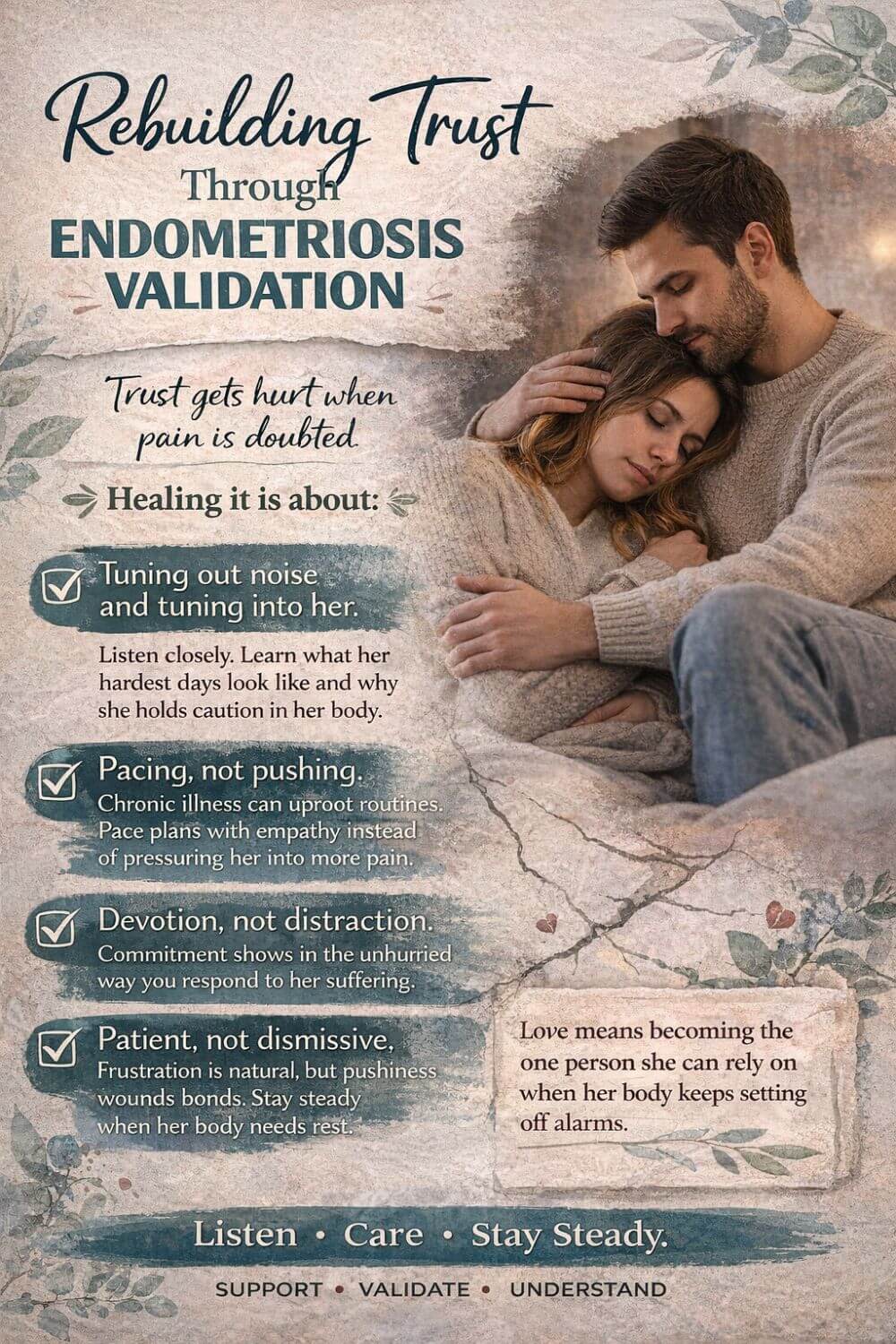
How to Rebuild Trust Through Endometriosis Validation?
One thing I have learned the hard way is that once a woman has been dismissed enough times, pain is no longer the only problem in the room. Trust gets hurt too. This illness can affect daily life, work, relationships, fertility, mood, and anxiety, so when disbelief is added on top, the damage can spread far beyond the body.
That is why endometriosis validation matters so much inside a relationship. It helps a woman stop feeling like she has to perform her suffering well enough to earn care.
Trust is rebuilt in small moments more than big speeches. It is rebuilt when you believe her before she has perfect words, when you do not act irritated by changed plans, and when you stop treating symptoms like an inconvenience that ruined the day.
I saw this with my wife. On the hardest days, what steadied her most was not me pretending I could fix everything, but me staying present, calm, and gentle enough that home still felt safe.
The truth is, chronic illness can make a woman feel as if her body has become a problem for everyone around her. That feeling can quietly touch intimacy, confidence, routine, and even the way she sees her own worth.
So I think support has to become very practical. Listen carefully. Keep note of patterns. Help her pace without making her feel guilty. Ask what would help instead of assuming. Let your consistency speak louder than one perfect sentence.
The NHS also notes that treatment and support may include help for long term pain, fatigue, fertility concerns, and mental health, and I think partners need to understand that this disease is rarely only about cramps.
It can shape the whole emotional climate of a home. That means your patience matters, your tone matters, and your ability to stay steady matters more than you may realise.
I say that as a husband who has watched the woman he loves carry pain, fear, and exhaustion at the same time. There were moments when I knew that if I responded with frustration instead of tenderness, I would be adding weight to a body already struggling to carry enough.
So if you love a woman with this illness, do not underestimate the healing power of making her feel safe, wanted, and believed. Sometimes the relationship starts breathing again not when the pain disappears, but when she no longer feels alone inside it.
And if you are the woman reading this, I want you to know this from the bottom of my heart: needing reassurance does not make you needy, and needing care does not make you difficult. My wife has taught me that behind so much fear is a woman who is not asking for too much at all, only for the kind of love and steadiness that should have met her pain much earlier.
Final Word On Endometriosis Validation
When I think about endometriosis validation, I do not think first about a slogan. I think about a woman sitting in pain, already tired, already second-guessing herself, already wondering whether she has explained it badly because people keep hearing her symptoms but not truly hearing her.
If you are reading this with tired eyes and an aching body, I want you to know something simple before anything else. You are not difficult, dramatic, or weak for needing to be believed. You are a human being who has carried pain for far too long in a world that often insists on looking the other way. You deserve gentleness, you deserve respect, and you deserve safety inside your own life.
What I have learned walking beside my wife is that being believed is not a small extra on top of treatment; it is a pillar that holds everything else together. When someone finally says, with their words and with their actions, that your experience makes sense, your whole system starts to breathe differently.
It does not erase the disease, but it eases that constant inner war where you are forced to choose between your body and other people’s comfort. That is what endometriosis validation really offers: a chance to live in alignment with your truth instead of constantly arguing with it.
For us, that truth has reshaped everything, from how we wake up in the morning to how we earn our living. It is why I built a life around working from home, so she does not have to drag herself through commutes and harsh office lights while pretending she is fine.
It is why our home office has blankets and heat pads within reach, why our schedule bends instead of breaking, and why Italy and Poland remain gentle possibilities instead of impossible dreams. Our life is not perfect, but it finally fits the body she actually lives in.
I have seen how lack of validation can feed depression, anxiety, panic, and that terrible sense that maybe the world would be better off without you. I have also seen the way a single steady voice saying, “I believe you, and I am not going anywhere,” can pull someone back from the edge.
My wife’s darkest nights taught me that love is not a slogan, it is a series of quiet decisions to stay, to listen, to keep building something softer even when the outside world feels brutally hard.
If nobody has told you this yet, let me be the one. Your pain is real. Your exhaustion is real. Your fears about the future are real. You are not a burden for needing help, for cancelling plans, for crying on the kitchen floor when it all feels too much. Anyone who makes you feel ashamed for surviving something this heavy does not understand the strength it takes just to stand up each day.
My hope is that this piece has not only described your reality, but held up a mirror that feels kind rather than critical. I want you to walk away with a little more courage to ask for what you need, whether that is a softer chair, a later start, a partner who listens, or a doctor who finally takes you seriously.
You are allowed to design a life that honours your body instead of breaking it in the name of being “normal.”
From one husband who refuses to look away from the woman he loves, to you who may feel unseen where you are, I promise this: you are not alone, and you are not asking for too much. You are asking for the minimum every person deserves: to be heard, to be believed, and to be treated as worth adjusting for.
Hold on to that. Let it guide your choices. And little by little, surround yourself with people and spaces that prove with their behaviour that your story matters. A life that fits your body is not a selfish dream. It is a fair one. You are worthy of building it, slowly, gently, on your own terms.
You are not crazy, you are not weak, and you are certainly not alone. Your story is valid, your body is telling the truth, and you deserve a future that finally listens.
In the end, this is what I want for you, a life where you no longer apologise for existing in pain, but feel deeply, quietly proud of how far you have come and how bravely you continue to stay.
Your pain is real. Your voice matters. You are worth believing. Your story does not end here.
You deserve a life that matches your reality, people who take your words seriously the first time, and days shaped around your body instead of everyone else’s expectations. Please do not shrink yourself to fit a world that refuses to see you. Let your truth reshape your world instead.
If this resonated with you, I would love to hear your story in the comments, and if you want to feel even more seen and understood, you can also check out the free eBook waiting for you.
What to read next?
If one part of this page feels especially close to what you are carrying right now, start with the section that speaks to you most.
- Why Endometriosis Is Not Your Fault? Start here if endometriosis has made you blame yourself, doubt your pain, feel lazy because of fatigue, feel like a burden, carry fertility guilt, or wonder whether stress caused your illness.
- Endometriosis and Losing Your Old Self. Read this if you miss the version of yourself who had more energy, more freedom, more confidence, and a life that did not revolve around pain, appointments, symptoms, or constant adjustment.
- Feeling Betrayed by My Body with Endometriosis. This is for the days when your body feels like the enemy, when flare-ups make you feel unsafe inside yourself, when body image hurts, or when you are tired of hating the body you are trying to survive in.
- The Invisible Battles Nobody Sees with Endometriosis. Read this if the hardest parts of endometriosis are hidden from everyone else: the mental toll, the loneliness, the private fear, the exhaustion, and the pain you carry while still looking “fine.”
- Endometriosis Medical Gaslighting. Start here if you have been dismissed, rushed, told your scan was normal, told period pain is normal, or left an appointment feeling like you had to prove pain that should have been taken seriously.
If this spoke to your heart, please leave a comment and tell me your experience. And please check out the free chapter of my eBook, You Did Nothing To Deserve This!, if you need a little more validation, comfort, and support today.


About Me
Hi, I’m Lucjan! The reason why I decided to create this blog was my beautiful wife, who experienced a lot of pain in life, but also the lack of information about endometriosis and fibromyalgia for men…
READ MORE
Grab a FREE eBook!
“You Did NOTHING To Deserve This!”
Finally hear the words nobody ever said to you, that your pain is real, your tears make sense, and you did nothing to deserve endometriosis, the dismissal, or the way it has rewritten your life.
Frequently Asked Questions About Endometriosis Validation
1. What does endometriosis validation actually mean?
It means a woman is believed when she says her pain, bleeding, fatigue, bowel symptoms, bladder symptoms, painful sex, or emotional distress are real and affecting her life. It also means she is not dismissed as dramatic, weak, lazy, or overreacting while trying to explain symptoms that match a recognised chronic condition. Endometriosis affects about 1 in 10 women and girls of reproductive age worldwide, so validation should not be rare.
2. Why is validation such a big part of endometriosis care?
Because delayed belief often delays help. NICE says the guideline aims to improve recognition, referral, diagnosis, and management, and updated guidance highlights earlier ultrasound and clearer referral pathways for suspected endometriosis. When a woman is believed sooner, she is more likely to get properly assessed instead of spending years doubting her own body.
3. Can someone have endometriosis even if tests were normal before?
Yes. NICE guidance makes clear that ultrasound can help identify ovarian endometriomas and deep endometriosis, but normal imaging does not automatically rule the condition out. In some cases, laparoscopy is still considered to diagnose endometriosis, especially when symptoms continue and the picture remains suspicious.
4. Is endometriosis only about painful periods?
No. Painful periods are common, but the condition can also cause chronic pelvic pain, heavy bleeding, painful sex, fatigue, nausea, infertility, abdominal bloating, bowel symptoms, bladder symptoms, and pain that can continue outside the period itself. WHO also notes that endometriosis most commonly occurs in the pelvis but can sometimes occur elsewhere in the body.
5. How can a partner give real endometriosis support?
Start by believing her. Then learn her symptom patterns, speak gently during flares, help her prepare for appointments, protect rest without making her feel guilty, and do not make her keep proving her pain to you. A partner cannot remove the disease, but he can help make home feel like the one place where her symptoms are not questioned.
Endometriosis Validation References
- https://www.who.int/news-room/fact-sheets/detail/endometriosis
- https://www.nhs.uk/conditions/endometriosis
- https://www.nice.org.uk/guidance/ng73
- https://www.nice.org.uk/guidance/ng73/resources/visual-summary-on-first-presentation-initial-management-diagnosis-referral-and-ongoing-care-of-pdf-13559822461
- https://www.endometriosis-uk.org/endometriosis-uk-release-new-report-highlighting-alarming-increase-endometriosis-diagnosis-times
