
Impact of Endometriosis
Have you ever wondered how far the impact of endometriosis can reach beyond the days when the pain is at its worst? Maybe you have had to cancel plans, push through work while exhausted, avoid intimacy because it hurts, or wonder why a condition people still reduce to “bad periods” seems to touch nearly every corner of your life.
If that has been your reality, you are not imagining the scale of it, and you are not asking too much when you want someone to understand the whole picture.
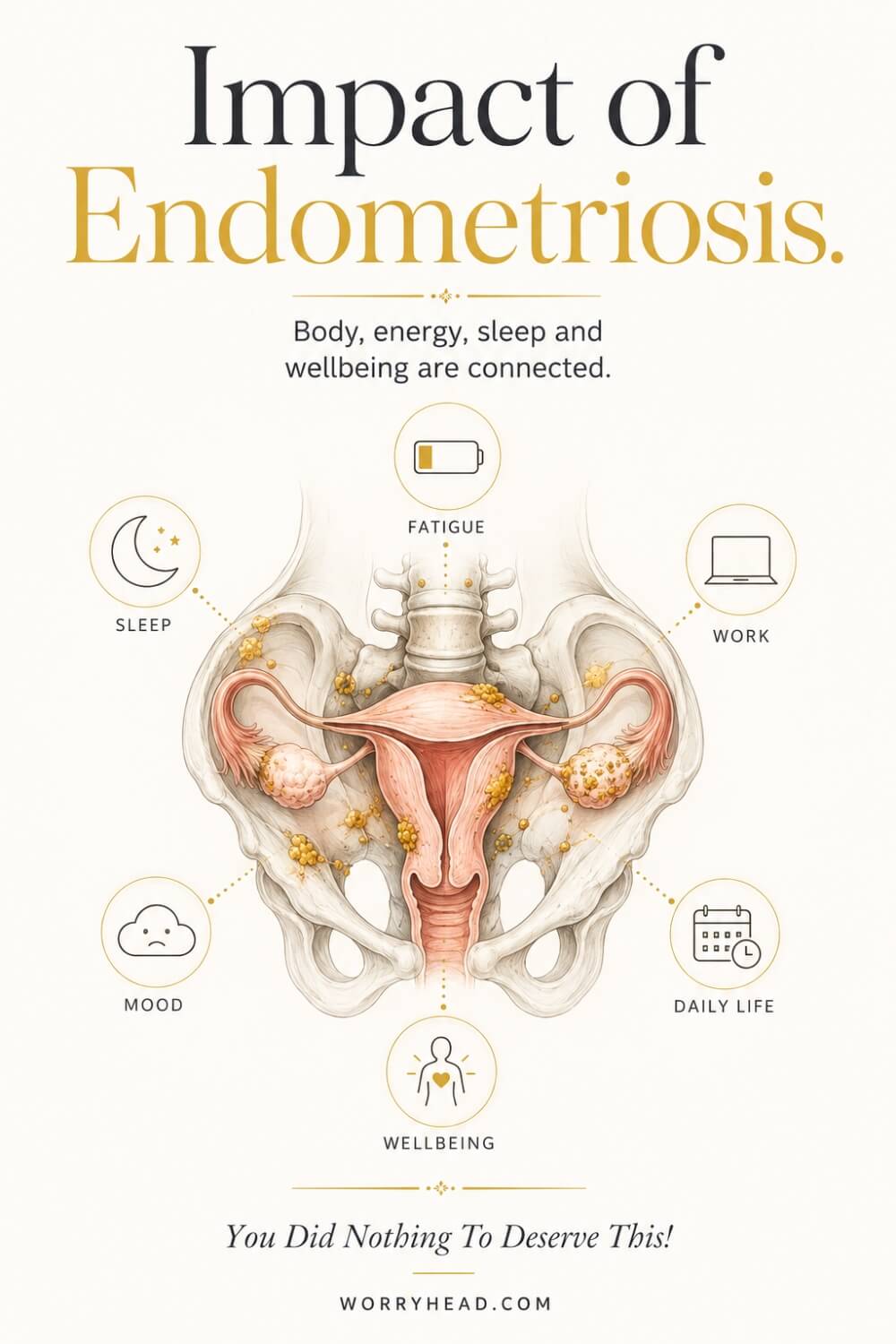
Endometriosis can affect far more than periods: chronic pelvic pain, fatigue, painful sex, bowel/bladder symptoms and fertility problems can disrupt sleep, work, study, relationships, mental wellbeing and finances. Its impact varies widely, and symptom severity does not always match disease stage.
I am not a clinician; I write as a husband, blogger and researcher who has spent years trying to understand what my wife lives through, and I have placed the medical sources behind this piece at the end, drawing on WHO, NICE, the NHS and ESHRE guidance together with published research where it adds useful context.
If you need the wider medical foundation first, my guide to how endometriosis affects the body explains the basics of the condition, its symptoms and diagnosis, so what I am about to say has a clearer frame.
What is easy to miss is that the burden is not measured only by pain scores, scans or surgical findings.
A 2024 review of systematic reviews found effects reaching physical and emotional health, family and social life, education, work, sexual wellbeing and long-term life choices, which means a diagnosis alone tells you very little about the life someone is actually trying to hold together.
And the financial effect is no longer something we only hear about in personal stories.
New ONS data published in 2026 found that women aged 25 to 54 in England with an NHS hospital diagnosis were earning, on average, £130 less per month five years after diagnosis compared with the two years before it, while the likelihood of paid employment fell by around three percentage points. That does not prove endometriosis caused every part of that change, but it shows why reducing this disease to several painful days each month can miss what is happening to an entire life.
That was one of the hardest lessons in our marriage: I could not take the disease out of my wife’s body, but I could refuse to let her carry its weight alone. I watched endometriosis take pieces of ordinary life from her, plans, energy, intimacy and confidence in her own body, and I learned that loving her well meant noticing the losses that a medical record would never fully describe.
I want to show you what that wider impact can look like in real life, because once those pieces have names, they become easier to understand, explain and ask for help with. You may recognise parts of your own life that nobody has ever connected back to endometriosis before.
The impact of endometriosis is difficult to measure only through symptoms, operations or days missed from work. My free eBook gives room to the personal losses, unseen effort and emotional changes that figures alone cannot capture.
You Did NOTHING To Deserve This!
Endometriosis Validation for Women with Endo
How Does the Impact of Endometriosis Reach Into Daily Life?
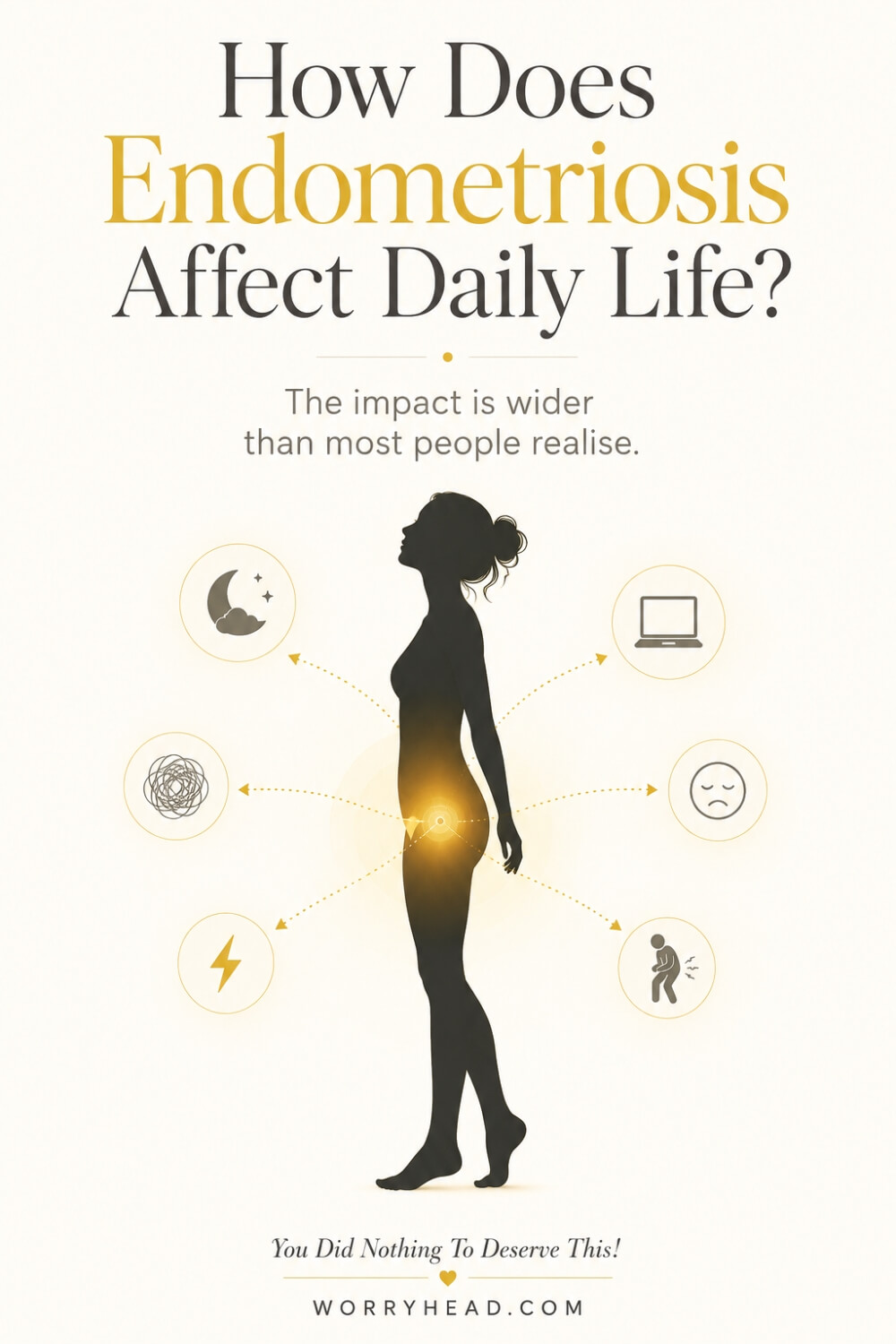
The impact of endometriosis becomes clearest when you stop asking only where the lesions are and start asking what symptoms prevent you from doing. Pain can alter how you sit, walk, sleep, exercise, travel, work and make plans, while fatigue can make even the hours between painful episodes feel smaller. That matters because you may look perfectly well in a waiting room and still be rationing every bit of energy you have left.
Bowel or bladder symptoms can quietly change where you go, what you eat before leaving home, how long you stay out and whether you feel safe being far from a toilet. Pain during or after sex can affect intimacy too, not because love has disappeared, but because your body can begin to connect closeness with pain. For some couples, that creates grief, awkwardness or distance that neither person wanted.
Fertility concerns can add another layer, especially when every conversation about treatment seems to require thinking about pregnancy plans you may not even be ready to make. Work and education can be affected by absence, reduced concentration, disrupted sleep, medical appointments and the exhausting effort of pretending everything is fine.
The financial cost is therefore not limited to prescriptions or procedures; it can include lost hours, missed opportunities, travel to appointments and the price of adapting everyday life around symptoms.
Mental wellbeing can suffer for understandable reasons when pain is recurrent, plans keep changing and you repeatedly have to prove that what you feel is real. That does not mean the illness is psychological, and it does not mean anxiety or low mood explains away pelvic pain. It means a long-term physical condition can place a heavy emotional load on someone who is already using enormous energy just to function.
Another thing I wish more people understood is that disease stage does not reliably tell you how much somebody hurts or how much support she needs. A person with less extensive disease can be severely affected, while another with extensive disease may report different or fewer symptoms, so comparison between women is rarely helpful.
If the fear has ever gone as far as wondering whether this condition itself could end your life, I have explained what endo does and does not mean for survival separately, because frightening symptoms and frightening thoughts deserve a clear answer rather than reassurance that brushes you off. What matters most in ordinary life is not winning an argument about whose disease looks worse, but recognising what your own symptoms are costing you and getting care that responds to those needs.
I learned this beside my wife long before I learned how to put it into medical language. There were days when I could not remove a single lesion or take a minute of pain from her, but I could believe her, change the plan without making her apologise, sit beside her when the night was long, and make sure the woman I loved never mistook needing help for being a burden.
That is why the next section is not about telling you to be stronger; it is about giving you and the people who love you practical ways to recognise what this condition is changing, explain those changes to others and stop carrying every part of the weight alone.
- Track What Endometriosis Changes
- Measure More Than Pain
- Protect Energy Before You Crash
- Plan Around Unpredictable Symptoms
- Make Work More Sustainable
- Talk About Intimacy Without Shame
- Bring Your Partner Into Care
- Prepare for Better Appointments
- Protect Your Emotional Wellbeing
- Ask for Specialist Support
Track What Endometriosis Changes
Pain is only one part of what endometriosis can change, so I would not track symptoms as if your life were a pain chart. Write down what happened to your sleep, appetite, concentration, movement, bowel or bladder habits, work, social plans and recovery time, because those details show the real cost of a flare far better than a number from one to ten.
I learned this from watching my wife struggle to explain days that looked ordinary from the outside but were anything but ordinary inside our home. A short note such as “needed two hours in bed after shopping” or “cancelled dinner because sitting hurt” can be more useful than writing “pain 7/10.” Over several weeks, patterns may appear that help you prepare for appointments and help the people close to you understand what you are managing. The goal is not to make your life revolve around illness, but to stop important changes disappearing simply because you have become used to surviving them.
Measure More Than Pain
When somebody asks how you are doing, pain is often the first thing you are expected to measure, but it is not the only thing that matters. Ask yourself how long symptoms lasted, what they stopped you doing, how much recovery you needed afterwards, whether you slept, whether you could concentrate, and whether your body felt safe enough for intimacy or exercise.
That wider picture matters because two days with the same pain score can be completely different days. One may allow you to work slowly from home, while another may leave you unable to stand long enough to shower or cook. I wish I had understood earlier that function is information too, because my wife often pushed through things that looked “manageable” until the effort caught up with her later. When you describe what pain actually costs you, you give your doctor, partner and even yourself a more honest picture of how deeply endometriosis is affecting daily life.
Protect Energy Before You Crash
One of the hardest habits to change is waiting until your body forces you to stop. If you know that certain errands, journeys, long meetings or household jobs regularly leave you wiped out, try planning rest before and after them instead of treating rest as something you have to earn once you are already exhausted.
That is not giving in to endometriosis. It is learning the difference between using your energy and repeatedly borrowing from tomorrow. I have seen my wife push through because she did not want illness deciding what she could do, only to pay for it with hours or days of recovery afterwards. Sometimes protecting energy means sitting instead of standing, breaking one task into three, accepting help, or choosing the most important thing and leaving the rest. The aim is not to shrink your life, but to make more of it sustainable enough that you are not constantly rebuilding yourself after every ordinary demand.
Plan Around Unpredictable Symptoms
Endometriosis can make planning feel almost cruel because you may genuinely want to attend something when you say yes and feel very different when the day arrives. Give yourself plans with escape routes: flexible travel, shorter visits, a place to sit, access to a toilet, medication or heat if prescribed or helpful to you, and permission to leave without explaining your whole medical history.
I used to think good planning meant making sure everything happened as expected. Living beside my wife taught me that good planning can also mean making room for the possibility that her body changes the plan. That small shift removes a surprising amount of shame. Tell trusted people in advance that symptoms can fluctuate and that a cancellation is not a lack of care or effort. When the people around you understand this, you spend less energy performing wellness for them and more energy responding to what your body actually needs that day.
Make Work More Sustainable
If work is draining you faster than you can recover, the answer is not always to keep proving that you can cope until you break. Think about which parts of the working day make symptoms worse: commuting, prolonged sitting, standing, lack of toilet access, rigid breaks, heavy lifting, early starts, fatigue or the difficulty of concentrating through pain.
Then turn those problems into specific requests rather than one vague statement that you are struggling. Depending on your job, that might mean altered hours, home working, a different workstation, more frequent breaks, easier toilet access or temporary changes during severe periods. My wife has worked from home for years, and I have seen how much the environment can change what a difficult day demands from her. You are not asking for special treatment when you are trying to make work possible; you are asking for conditions that let you contribute without repeatedly damaging your ability to function afterwards.
Talk About Intimacy Without Shame
Painful sex can create silence surprisingly quickly. You may avoid initiating intimacy because you fear pain, while your partner may avoid asking because they fear pressuring you, and before long both people can be protecting each other in ways that accidentally create distance.
What helped me understand this was realising that intimacy is not a test of how much pain someone can tolerate. If sex hurts, say what hurts, when it tends to happen, what feels safe and what does not, without turning the conversation into blame. Closeness can include touch, affection, lying together, talking, kissing or anything else that feels comfortable and wanted. There is nothing loving about asking a woman to endure pain so a relationship can look “normal.” A supportive partner should want honesty more than performance, because being trusted with the truth of her body is part of intimacy too. If pain during or after sex persists, it deserves to be discussed with a clinician rather than carried quietly.
Bring Your Partner Into Care
A good partner cannot feel your pain for you, but they can help you carry the practical weight around it. If you want them involved, let them come to appointments, help remember questions, take notes, describe changes they have witnessed and listen to the answers beside you rather than waiting for a shortened version when you are already exhausted.
I have learned a great deal simply by being present. Sometimes my wife remembered details I missed, and sometimes I remembered details she was too overwhelmed or tired to retrieve in the moment. The point is never for a partner to speak over you or become the authority on your body. It is to give you another pair of ears and another person who understands what was said, especially when decisions feel complicated. Support should leave you feeling more heard, not less independent. When a man truly understands what his partner is facing, he is far better equipped to respond with patience instead of taking symptoms personally.
Prepare for Better Appointments
A medical appointment can feel painfully short when you have months or years of symptoms to explain. Before you go, write down your three biggest concerns, the symptoms that interfere most with daily life, what has changed recently, what you have already tried and what you need from the appointment, whether that is investigation, symptom relief, referral or simply a clearer explanation.
Bring dates or patterns if they are useful, but do not feel you need to produce a perfect case file to deserve care. I would also write down the questions you are most afraid you will forget once you are in the room. If something is dismissed without explanation, calmly ask what else could cause the symptom, what warning signs should change the plan and what the next step will be if symptoms continue. You are not being difficult by asking for clarity. You are trying to understand your own healthcare, and you deserve to leave knowing what has been decided and why.
Protect Your Emotional Wellbeing
Living with recurrent pain can change the way you think about your body, your future and even yourself. When plans repeatedly collapse, sleep is poor, sex hurts or you feel disbelieved, frustration and grief can build quietly, and pretending those feelings do not exist does not make you stronger.
I have watched my wife need emotional support not because endometriosis was “in her head,” but because living with a body that can hurt unpredictably asks a lot from a person. Give yourself somewhere safe to say the ugly things too: that you are angry, fed up, frightened, jealous of people who seem free, or tired of explaining yourself. That might be a partner, friend, counsellor, support group or another trusted person. Your emotional wellbeing deserves attention alongside physical symptoms, especially if distress is becoming difficult to manage. Being supported mentally does not make the physical disease less real; it recognises that you are a whole person living through it.
Ask for Specialist Support
There comes a point when repeatedly managing symptoms without a clear plan is not enough. If pain persists, treatment is not helping, symptoms affect your bowel or bladder, fertility is a concern, or daily life is becoming harder, ask which specialist assessment or referral options are appropriate for you.
Specialist care is not only about surgery. It may involve gynaecology, pain management, pelvic health physiotherapy, fertility support or other services depending on your symptoms and priorities. What matters is that your care matches the complexity of what you are experiencing rather than expecting one treatment to solve every problem. I have learned from my wife’s journey that being referred onward can feel both hopeful and frightening after years of coping. You are allowed to ask why a referral is or is not being considered, what expertise is available and what happens next. Good care should help you understand your options, not leave you feeling that you must simply endure more.
Why Can the Impact of Endometriosis Continue Between Flares?
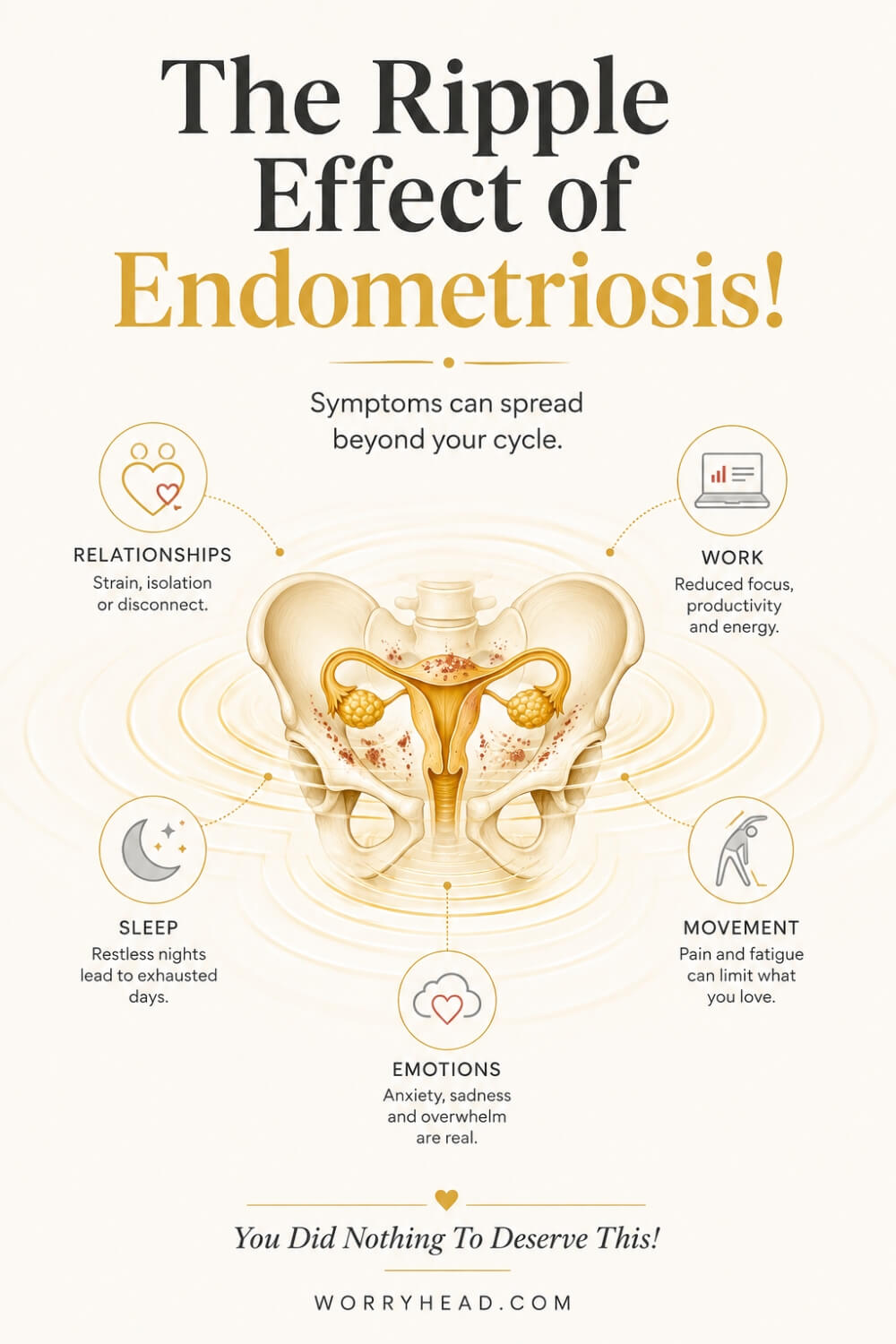
The impact of endometriosis does not always switch off when bleeding stops or a severe pain episode settles. Pain, fatigue, bowel or bladder symptoms and painful sex can occur outside menstruation, while symptoms may fluctuate enough that a relatively good morning tells you very little about how the evening will feel. This means part of living with the condition can become the constant calculation of what your body might allow later, not simply responding to what hurts right now.
That uncertainty can slowly change the relationship you have with your own body because planning starts to come with a question mark attached. Some women begin protecting themselves from disappointment by saying no before symptoms even arrive, carrying extra medication, locating toilets, avoiding long journeys or leaving space after activities in case recovery takes longer than expected.
Spontaneity can disappear so gradually that you may not realise how much you miss it until somebody asks why you cannot simply “see how you feel on the day.”
Relationships can feel that uncertainty too, particularly when affection, sex, social occasions or holidays become tangled with the possibility of pain. Work and study may require another version of you, the one who smiles, concentrates and finishes what needs doing while privately calculating how much energy will be left when you get home.
Over time, it is possible to become very skilled at looking functional while your quality of life is shrinking in ways that nobody around you can measure.
Treatment can improve symptoms and quality of life for many people, but better days do not automatically erase the habits built during years of expecting pain, rearranging plans or wondering whether your body will cooperate.
This is one reason good endo care needs to look beyond lesions and prescriptions towards physical, sexual, psychological and social wellbeing, something both NICE and ESHRE recognise when discussing longer-term support. Needing that wider support is not weakness and it does not suggest your symptoms are psychological; it acknowledges that a long-term physical disease can change how a person lives, thinks, plans and relates to the people she loves.
I saw this in my wife long before I had the language to explain it, because sometimes the hardest thing to watch was not a dramatic flare but an ordinary decision becoming another negotiation with her body. There were moments when I could see she wanted to say yes to life before she had even finished wondering what saying yes might cost her, and as her husband, I never wanted my disappointment, plans or expectations to become one more weight she had to carry.
What I wanted her to know, and what I want you to hear too, is that the person who loves you should not only stand beside you when you are visibly hurting; they should also understand the quieter days when you are choosing, adapting and giving things up that nobody else even realises you wanted.

When to Seek Medical Help?
One of the difficult things about living with endometriosis is deciding when a symptom is something you already know and when it deserves another medical conversation. When pain has been part of your life for years, it is frighteningly easy to normalise things that are having a serious effect on how you live.
You do not have to wait until you are completely unable to cope before asking for help.
Make an appointment with your GP or endometriosis team if your symptoms are becoming more frequent, lasting longer, changing from their usual pattern or interfering with ordinary things such as working, sleeping, walking, exercising, having sex, eating normally or going to the toilet. NICE specifically recommends referral for further gynaecological assessment when symptoms persist or return, initial treatment is ineffective or unsuitable, or endometriosis is having a detrimental effect on daily activities.
That last point matters to me because you should not have to prove that your pain is unbearable before your quality of life counts. If you are repeatedly cancelling work, planning your life around toilets, avoiding intimacy because it hurts or losing days to recovery after a flare, tell your clinician exactly that. Those details explain something a simple pain score cannot.
And please do not let a previous normal scan convince you that there is nothing more to discuss. Current NICE guidance says endometriosis should not be ruled out simply because an examination or ultrasound is normal, and referral may still be appropriate when symptoms continue.
You should also ask about specialist endometriosis care if an endometrioma is suspected or confirmed, if there may be deep disease involving structures such as the bowel, bladder or ureter, or if disease outside the pelvis is suspected. Those situations can require clinicians with more specialised imaging, surgical and multidisciplinary experience.
There are also symptoms that should not simply be labelled as another endometriosis flare without assessment. Contact NHS 111 for urgent advice if pelvic pain occurs with difficulty passing urine or opening your bowels, blood in your urine or stool, unusual vaginal bleeding or discharge, fever or feeling hot and shivery, vomiting, or if you are pregnant or might be pregnant.
Seek emergency help through 999 or A&E if pelvic pain becomes severe or rapidly worsens, particularly if you also feel faint or pass out, have heavy vaginal bleeding, difficulty breathing, shoulder-tip pain or become suddenly confused. These symptoms do not automatically mean something dangerous is happening, but they can occur with conditions that need urgent assessment, and this is not the moment to assume that endometriosis explains everything.
Pregnancy deserves particular care. If you might be pregnant and develop pelvic or abdominal pain with vaginal bleeding, especially alongside dizziness, fainting or shoulder pain, seek urgent medical assessment because pregnancy-related complications such as ectopic pregnancy need to be excluded.
Heavy periods deserve attention as well, even when heavy bleeding has become your normal. If you regularly need to change a pad or tampon every one to two hours, need two menstrual products together, bleed through clothing or bedding, or find that bleeding is affecting everyday life, speak with your GP. Blood tests may be appropriate because prolonged heavy bleeding can contribute to iron deficiency and anaemia.
I learned from loving my wife that there is a difference between knowing your usual symptoms and becoming so accustomed to suffering that you stop mentioning them. She should never have to become “sick enough” to deserve another conversation with a doctor, and neither should you.
If something has changed, say that. If treatment is no longer helping, say that. If you cannot do things you could do six months ago, say that too.
And if you have that uncomfortable feeling that something is different from your normal endometriosis pain, you do not need to diagnose the reason before asking someone to assess it. Knowing your body does not mean knowing every possible cause of a new symptom.
Sometimes seeking medical help is not about discovering an emergency at all. It is simply about refusing to let another year pass while your world becomes smaller around symptoms that deserve a better plan.
Questions to Ask Your Doctor
When you live with endometriosis for long enough, medical appointments can become strangely difficult. You may have months of pain, fatigue, disrupted work, altered intimacy and cancelled plans to explain, then find yourself sitting in a room with ten minutes and no idea where to begin.
I learned from going through this beside my wife that a useful appointment is not about arriving with fifty symptoms and hoping the doctor somehow joins every dot. It helps to arrive knowing which parts of your life have changed, what you want help with and what you need to understand before agreeing to the next step.
Current NICE guidance also makes something important clear: symptoms affecting everyday life are themselves a reason to consider further gynaecological assessment, and a normal examination or ultrasound does not automatically exclude endometriosis.
So take the questions below and use the ones that actually fit your situation. You do not need to ask every one of them, and you certainly do not need to sound medical. Your job is not to impress your doctor. Your job is to help them understand what living in your body has become.
“Could endometriosis explain the symptoms that are affecting my everyday life?”
This is often a better starting point than simply saying that you are in pain. Tell your doctor what has changed because of that pain. Perhaps you cannot sit comfortably through a working day, sex has become painful, bowel movements hurt, exercise is difficult, you are exhausted after ordinary activities or you are arranging your life around your cycle.
The more clearly you describe function, the easier it becomes to understand the real burden. I would say, “I can still do this, but this is what it costs me afterwards,” because many women technically remain capable of working, cooking or travelling while paying for it later with pain and exhaustion.
“Could anything else be contributing to these symptoms?”
Having endometriosis does not mean every new symptom must come from endometriosis. That is worth remembering without allowing somebody to use it as an excuse to dismiss the condition altogether.
Ask whether another gynaecological, gastrointestinal, urinary, musculoskeletal or other problem should be considered based on your particular symptoms. Good medical care should be able to hold two thoughts at once: endometriosis can cause significant problems, and a woman with endometriosis can still develop something unrelated that deserves investigation.
I would rather my wife have a changing symptom properly considered than have somebody automatically stamp “endometriosis” across everything she feels.
“What does my scan tell us, and what can it not tell us?”
This is a question I wish more women felt comfortable asking. An ultrasound or MRI can provide valuable information, particularly when looking for ovarian endometriomas or deep disease, but imaging has limitations.
If your scan is reported as normal while your symptoms continue, ask what that result actually means in your circumstances rather than assuming the conversation is over. NICE now specifically advises that endometriosis should not be excluded simply because examination and ultrasound findings are normal, and laparoscopy may still be considered in appropriate circumstances.
Ask your doctor, “What have we ruled out, what have we not ruled out, and what happens if my symptoms continue?” That question turns a result into a plan.
“Do my symptoms justify a specialist endometriosis referral?”
You do not need to decide for yourself whether your disease is complicated enough for specialist care. Ask.
This becomes particularly important when symptoms persist despite initial treatment, keep returning, significantly interfere with everyday life, or when an endometrioma or deep disease affecting areas such as the bowel, bladder or ureter is suspected or confirmed. NICE distinguishes between general gynaecology referral and situations where a specialist endometriosis service may be appropriate.
I would not ask this aggressively. I would simply say, “Given what these symptoms are stopping me from doing, would specialist assessment add anything to my care?” If the answer is no, it is reasonable to ask why and what the alternative plan will be.
“What are we actually trying to improve with this treatment?”
This question can completely change a conversation.
Is the goal fewer painful days? Less bleeding? More comfortable sex? Better bowel or bladder symptoms? Improved ability to work? Better sleep? Trying to conceive? Reducing recurrence after surgery?
There may not be one treatment that fixes every part of the problem, so knowing the goal gives you something meaningful to judge. ESHRE recommends shared decision-making when considering treatment for endometriosis-associated pain, taking account of preferences, effectiveness, side effects, availability and other individual factors.
For my wife, I learned that “How is the pain?” was sometimes too small a question. I became far more interested in “What can you do now that you could not do before?” because getting part of your life back matters just as much as changing a number on a pain scale.
“What are the benefits, drawbacks and alternatives?”
Whether you are discussing hormonal treatment, pain management, surgery or another approach, you deserve more than “this is what we usually prescribe.”
Ask what improvement might realistically look like, how long you would normally try the treatment, which side effects matter, what alternatives exist and what happens if you decide it is not right for you. There may be several reasonable options rather than one correct answer.
You can also ask a wonderfully simple question: “If I were your sister or partner, what would you want me to understand before making this decision?” It does not guarantee a perfect answer, but it often moves the conversation away from a list of treatments and towards what the decision actually means for a human being.
“How long should we try this before reviewing it?”
I dislike open-ended plans for chronic symptoms because “give it some time” can quietly become another six or twelve months of struggling.
Ask when you should expect to notice an improvement, which changes would mean the treatment is working and when you should come back if it is not. Put that review point somewhere you can see it.
You might ask, “If I am still living like this in three months, what will our next step be?” Suddenly you have a pathway rather than another prescription followed by uncertainty.
Treatment does sometimes need time. What you should not be left with is indefinite waiting without knowing what happens next.
“How could this treatment affect my fertility plans?”
Not every woman wants children, and nobody should assume that you do. But if pregnancy matters to you now or may matter later, tell your clinician because fertility priorities can change which treatment choices make sense.
Ask how medication, ovarian endometriomas, ovarian surgery or other proposed treatment could affect your options. If you are actively trying to conceive, make that clear too, because hormonal suppression used for symptom control is not used in the same way when pregnancy is the immediate goal. NICE and ESHRE both separate fertility-focused management from treatment primarily aimed at controlling pain.
You deserve to understand those trade-offs before a decision is made, not discover them afterwards.
“Should my bowel or bladder symptoms be investigated further?”
If you experience cyclical or persistent pain when opening your bowels or passing urine, blood associated with these functions, difficulty emptying, or other meaningful changes, describe them specifically.
Do not simply say, “I have bowel problems.” Tell your doctor when they occur, whether they change around menstruation, where the pain feels located, whether your habits have changed and whether symptoms are progressing.
Deep endometriosis can involve the bowel, bladder or ureter, and suspected involvement of these structures is one of the situations NICE identifies for specialist endometriosis services.
That does not mean every bowel or bladder symptom indicates deep disease. It means those symptoms deserve proper context rather than embarrassment or silence.
“What can we do about symptoms beyond pelvic pain?”
Sometimes the loudest symptom gets all the attention while everything around it is slowly wearing you down.
Tell your doctor about painful sex, fatigue, disturbed sleep, low mood, anxiety around symptoms, bowel or bladder problems, heavy bleeding or difficulty functioning at work if those things apply to you. The NHS recognises that endometriosis may affect everyday life, work and relationships as well as causing symptoms such as fatigue, painful sex and urinary or bowel pain.
You may need different forms of support for different problems. Asking about the wider picture does not mean you expect one doctor to fix your entire life. It means you do not want the parts that matter to disappear because they are not the headline symptom.
“How will we know whether I am actually improving?”
Before treatment begins, decide what improvement would mean to you.
Perhaps it means getting through a working week without needing the weekend to recover. Perhaps it means sleeping through more nights, walking farther, having fewer days when you cancel everything, becoming intimate without expecting pain or simply feeling less frightened of your next period.
Write two or three of those goals down.
A treatment can change symptoms without restoring every part of life, and sometimes the opposite is true: pain has not disappeared, but you are functioning considerably better. Both pieces of information matter when deciding whether to continue, adjust or reconsider your plan.
“Which changes should make me contact you sooner?”
Do not leave an appointment without knowing what would change the plan.
Ask which worsening or new symptoms should prompt another GP appointment, contact with your specialist, NHS 111 or urgent assessment. You are not asking because you expect something terrible to happen. You are removing the burden of having to make that decision alone when you are already frightened or in pain.
I like this question because it gives you boundaries. Instead of wondering at two in the morning whether you are overreacting, you have already discussed which changes deserve attention.
“Can my partner be involved in these conversations?”
If that would help you, ask.
Your partner should never take over your appointment or speak as though they understand your body better than you do. But they can listen, take notes, remember something you forgot, ask a question when you become overwhelmed and hear directly what the next plan involves. NICE recommends involving partners in discussions when the person with endometriosis wants them included.
Being beside my wife taught me how valuable that can be. I could not feel what she felt, but I could remember the night she barely slept, the plan we cancelled, the way certain symptoms changed and the questions we had talked about at home.
More importantly, I could hear the medical explanation with her.
Then she did not have to come home after a difficult appointment and somehow find the energy to teach me everything while she was still processing it herself.
Before you leave, there is one final question I would always want answered:
“What happens next?”
Not merely what medication you are taking. Not merely what the scan showed. What happens next?
Who is reviewing you? When? What are you watching for? What happens if this treatment helps? What happens if it does not? Who do you contact if symptoms change?
You should be able to walk out knowing the next step.
I have sat beside my wife through enough uncertainty to know how different that feels from being sent home with another vague instruction to cope. You may not leave every appointment with the answer you wanted, but you should leave with a clearer understanding of what your doctor thinks, what choices you have and where the road goes from here.
And if pain has spent years teaching you to minimise what you are going through, write your questions down before you enter the room. You do not need to be confrontational, medically knowledgeable or unusually brave.
You just need to tell the truth about what endometriosis is doing to your life.
Final Word on the Impact of Endometriosis
If there is one thing I hope you take from everything above, it is that endometriosis is never just a collection of symptoms written on a medical chart. The impact of endometriosis can reach into work, sleep, movement, sex, relationships, confidence, finances, plans, fertility decisions and the simple freedom to say yes to something without first calculating what your body might do.
That does not mean every woman will experience the disease in the same way. Some people live with severe pain, others struggle more with fatigue, bowel or bladder symptoms, painful sex, heavy bleeding, fertility concerns or the emotional exhaustion of never knowing which version of their body they will wake up with. Disease stage alone cannot tell another person how difficult your life is.
This is something I had to learn as a husband. I could look at my wife and see the woman I loved, but I could not always see the effort behind an ordinary day. I learned that support begins when you stop measuring somebody by what she still manages to do and start noticing what doing it costs her.
There were things I could not fix. I could not remove her pain with reassurance, restore every cancelled plan or promise that tomorrow would be easier. What I could do was believe her without requiring proof, change plans without making her feel guilty, sit beside her when she was frightened, learn enough to understand what doctors were discussing and remind her that needing help never reduced her worth in my eyes.
That is also what I want partners reading this to understand. Loving someone with endometriosis is not about becoming her doctor, rescuing her or making every decision for her. It is about becoming a safe person beside her, someone who listens before solving, adapts without resentment and understands that intimacy, work, household responsibilities and social life may sometimes need to change.
And if you are the woman living through this, please do not compare your suffering with somebody else’s scan, surgery, stage or diagnosis. Your quality of life matters even when another person appears to have more extensive disease. If symptoms are changing what you can do, how you feel, how you sleep, how you work or how safely you experience your own body, those changes deserve to be taken seriously.
Ask questions. Write down what symptoms actually stop you doing. Tell your clinician when treatment is not giving you enough of your life back. Ask what happens next rather than accepting an endless cycle of coping without a plan.
Most of all, do not reduce yourself to the illness. You are still the woman your partner fell in love with, the friend people miss when you cannot come, the person with ideas, humour, needs, boundaries and plans that exist beyond pain.
Endometriosis may force adjustments you never asked for, but adjustment is not surrender. Sometimes it is how you protect enough of yourself to keep building a life that still feels like yours.
Endometriosis may change what your days look like, but it does not decide your worth, strength or right to be supported. Your pain deserves care, your limitations deserve understanding, and the parts of life this disease has changed deserve attention too. You do not have to minimise any of it just to make other people comfortable.
If something here felt familiar, I would genuinely love you to tell me about it in the comments. And if you need more validation on the difficult days, you can also find my FREE 130+ page eBook at the bottom of this post.


About Me
Hi, I’m Lucjan! The reason why I decided to create this blog was my beautiful wife, who experienced a lot of pain in life, but also the lack of information about endometriosis and fibromyalgia for men…
READ MORE
Grab a FREE eBook!
“You Did NOTHING To Deserve This!”
Finally hear the words nobody ever said to you, that your pain is real, your tears make sense, and you did nothing to deserve endometriosis, the dismissal, or the way it has rewritten your life.
Related Questions You May Be Asking About the Impact of Endometriosis
1. Can Endometriosis Affect You Between Periods?
Yes. The effect can continue between periods because endometriosis is not simply a menstrual condition. Some people experience non-menstrual pelvic pain, fatigue, painful sex, bowel or bladder symptoms, sleep disruption or lingering recovery after a flare. Symptoms may also fluctuate, so having several better days does not mean the condition has stopped affecting your body or daily life.
2. Does Endometriosis Stage Show How Badly You Are Affected?
Not reliably. The amount or stage of disease seen during surgery does not consistently match how much pain someone experiences or how severely daily life is affected. A woman with less extensive disease can still have disabling symptoms, while someone with more extensive disease may experience a different pattern. Your symptoms, function and quality of life deserve attention regardless of stage.
3. Can Endometriosis Affect Your Ability to Work?
Yes, it can. Recurrent pain, fatigue, unpredictable symptoms, medical appointments and recovery time can affect attendance, concentration, productivity and the type or hours of work someone can manage. The important question is not whether you can force yourself through a working day, but what doing so costs afterwards and whether reasonable adjustments could make work more sustainable.
4. How Can Endometriosis Affect a Relationship?
It can, but the effect is different for every couple. Painful sex, fatigue, cancelled plans, fertility worries and unpredictable flares can change intimacy and shared routines, while repeated misunderstanding may create distance. None of that means the relationship is failing. Clear communication, flexibility and a partner who believes what you are experiencing can make an enormous difference to how supported you feel.
5. Can Endometriosis Affect Your Mental Wellbeing?
Yes. Living with persistent or unpredictable symptoms can affect mood, confidence, body image and feelings of control, particularly when pain interferes with work, relationships, sleep or future plans. That does not make endometriosis psychological. Emotional distress can be a consequence of living with a demanding physical condition, and mental wellbeing deserves support alongside investigation and treatment of physical symptoms.
Impact of Endometriosis References
- https://www.who.int/news-room/fact-sheets/detail/endometriosis%E2%81%A0
- https://www.nice.org.uk/guidance/ng73/chapter/Recommendations
- https://www.nice.org.uk/guidance/ng73/evidence/full-guideline-pdf-4550371315
- https://www.nice.org.uk/guidance/ng73/resources/visual-summary-on-first-presentation-initial-management-diagnosis-referral-and-ongoing-care-of-pdf-13559822461
- https://www.nhs.uk/conditions/endometriosis/
- https://www.nhs.uk/symptoms/pelvic-pain/
- https://www.nhs.uk/conditions/periods/period-problems/
- https://www.nhs.uk/conditions/heavy-periods/
- https://www.nhs.uk/conditions/ectopic-pregnancy/symptoms/
- https://www.eshre.eu/Guidelines-and-Legal/Guidelines/Endometriosis-guideline
- https://www.eshre.eu/-/media/sitecore-files/Guidelines/Endometriosis/ESHRE-GUIDELINE-ENDOMETRIOSIS-2022_2.pdf
- https://pubmed.ncbi.nlm.nih.gov/39300399/
- https://pubmed.ncbi.nlm.nih.gov/38512699/
- https://www.ons.gov.uk/aboutus/usingpublicdatatoproducestatistics/examplesofhowdataandstatisticsbenefityou/onsdatashowthehiddencostsofendometriosis
