Can Orgasm Hurt with Endometriosis?
Can orgasm hurt with endometriosis even when penetration itself does not hurt?
If pleasure suddenly turns into deep cramping, stabbing pelvic pain or an ache that arrives minutes afterwards, you may be left wondering what your body is doing and whether anyone will take such a private symptom seriously. And if you have begun to fear climax, avoid intimacy or feel guilty because something that should feel good has become another trigger, I want you to know that this deserves to be heard, not brushed aside.
Yes. Endometriosis can make orgasm painful for some women. Orgasm involves rhythmic pelvic floor contractions and may include uterine contractions that trigger pain. Research links the symptom particularly with pelvic floor myalgia and central sensitisation, though other causes should be considered.
I am not a clinician; I write as a husband, blogger and researcher who has spent years trying to understand this illness because of what my wife lives through, and I have checked the health context here against sources including the NHS, NICE, WHO, ESHRE and published research, all of which I list at the bottom of the full article.
And because one painful climax rarely exists separately from everything surrounding it, understanding how endometriosis can reshape intimacy can also help you make sense of changes in desire, touch, fear, closeness and the way both partners may begin anticipating pain before anything has even happened.
Here is something important that gets missed when painful sex and painful orgasm are treated as though they are the same thing. In a 2024 study of 358 people with surgically confirmed endometriosis, 14% reported pelvic or lower abdominal pain that worsened with orgasm, and that pain was associated more strongly with pelvic floor myalgia and greater central sensitisation than with particular anatomical findings seen during surgery.
A woman can even experience pain specifically around orgasm without painful penetration, so describing everything simply as dyspareunia can hide a useful clue. Rare published cases have also described post-orgasm pain associated with endometriosis affecting structures around the uterosacral ligament and hypogastric nerve, reminding us that pelvic muscles, pain-processing pathways and nerves may sometimes be part of a much more complicated picture.
Living beside my wife through years of endometriosis has taught me not to judge intimacy by what a healthy body is supposed to tolerate. When pain changes the rules, my job as her husband is not to take that personally or expect her to push through it, but to believe what her body is telling her and help make closeness feel safe again.
If orgasm has become something you brace yourself for instead of something you can simply enjoy, I want to help you understand what may be happening inside the pelvis and nervous system, and why the timing and character of that pain can matter. You deserve better language for what you are experiencing than simply saying that “sex hurts”.
Why Can Orgasm Hurt with Endometriosis?
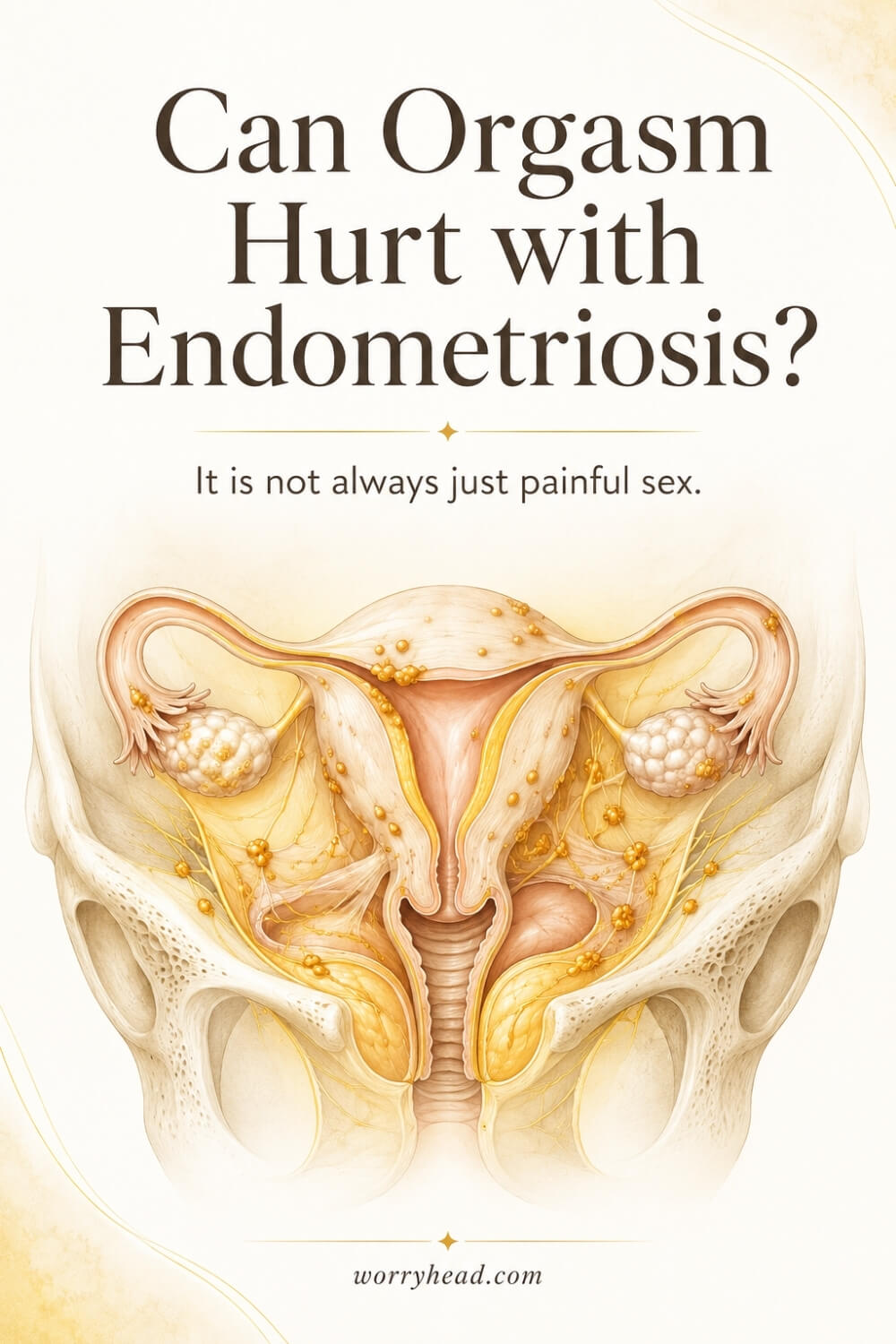
When you are trying to understand why orgasm hurts with endometriosis, it helps to begin with what your body actually does at climax instead of assuming the pain must be caused by penetration. An orgasm sets off repeated involuntary contractions of the pelvic floor muscles, and those contractions can matter when the muscles are already tense, tender or guarding against chronic pelvic pain.
In a pelvis that has spent months or years responding to pain, pelvic floor muscles can become painful themselves, meaning an otherwise normal contraction may suddenly feel like cramping, pulling, stabbing or deep pressure. In the 2024 study I mentioned earlier, pelvic floor myalgia was found in 55% of those whose pelvic pain worsened with orgasm, compared with 35% of those who did not report that symptom.
That association does not mean pelvic floor myalgia explains every painful climax, because endometriosis pain rarely gives us one neat cause to blame. Orgasm may also be accompanied by rhythmic contractions involving the cervix and uterus, creating another possible source of discomfort in an already sensitive pelvis.
In theory, tenderness around the uterus or nearby pelvic structures could therefore contribute to the deep aching or cramping some women feel around climax. Yet that same study did not find a significant association between orgasm-related pain and either uterine tenderness or adenomyosis, which is a useful reminder not to assume the most obvious explanation is automatically the correct one.
Researchers also found no significant difference in the anatomical findings seen during endometriosis surgery between women who reported orgasm-worsened pain and those who did not. That matters because the intensity of what you feel cannot simply be read from the location of lesions or from how impressive your surgical findings appear on paper.
Another part of this picture is central sensitisation, where repeated pain can change the way the nervous system processes signals and make ordinarily tolerable sensations produce a much stronger pain response. Women reporting pain worsened by orgasm in that study also had substantially higher central sensitisation scores, suggesting that the nervous system may sometimes be participating alongside pelvic disease and muscle pain rather than there being one isolated culprit.
This does not mean your pain is psychological or somehow created by worrying about sex; nerves, muscles and pain-processing pathways are physical parts of your body, and all of them can become involved in persistent pelvic pain. The timing of the pain can also give useful clues because one woman may hurt as she climaxes, another immediately afterwards, and another may be left with pelvic aching that lingers long after intimacy has finished.
A woman can even experience severe post-orgasm pain without experiencing painful penetration, something that has been documented in published endometriosis case reports, so those two symptoms should not automatically be bundled together as simply “painful sex”. Recording where the pain begins, whether it feels like cramping, burning, stabbing or pulling, how long it lasts, whether it travels, and whether it changes around your cycle can give your doctor far more useful information than saying only that intimacy hurts.
Watching my wife live with endometriosis has taught me that pain can take away confidence before it takes away the activity itself, because eventually you begin wondering which ordinary moment your body might turn against you next. As her husband, I never want the price of closeness to be her hiding pain, enduring something for my benefit or worrying that saying “this hurts” will somehow make her less desirable to me.
If your own body has made you nervous about reaching a moment that other people casually call pleasure, there are practical things I believe every woman, and every partner who truly loves her, should understand before fear begins making decisions for them:
- Notice When the Pain Starts
- Describe What the Pain Feels Like
- Track Where the Pain Travels
- Separate Orgasm Pain from Penetration
- Look for Cycle Related Patterns
- Give Your Pelvic Floor Attention
- Slow Down Before Your Body Braces
- Talk Without Blame or Pressure
- Bring Useful Details to Appointments
Notice When the Pain Starts
The timing of pain can tell you more than simply saying that orgasm hurts. Notice whether discomfort begins as arousal builds, at the exact moment of climax, seconds afterwards, or later when the pelvic muscles should be relaxing again. Also notice how long it stays with you, because a sharp ten-second spasm is different from a deep pelvic ache that follows you for the next hour.
I would write these details down rather than trusting yourself to remember them during an appointment. Pain that appears with orgasm but not with touch or penetration may point your clinician towards a different conversation than pain that begins as soon as intercourse starts. You are not overanalysing your body by noticing timing; you are giving language to a symptom that is often reduced to the vague phrase “painful sex”, when your experience may be much more specific.
Describe What the Pain Feels Like
Try to describe the sensation itself, even if finding the right words feels awkward. Cramping, stabbing, pulling, burning, throbbing, pressure, an electric jolt and a deep internal ache do not all describe the same experience, and those differences may help a clinician think about muscles, nerves and other pelvic structures rather than treating every sexual pain as identical.
I have watched my wife become incredibly precise about pain because years of endometriosis forced her to learn a vocabulary she never asked for. You deserve that same precision without feeling dramatic. If the pain feels as though something is tightening, tearing, gripping or radiating, say exactly that, and note whether it settles quickly or leaves tenderness behind. The clearer you can be, the less room there is for somebody else to replace your experience with a convenient assumption.
Track Where the Pain Travels
Where the pain starts is important, but where it goes can be just as useful. You might feel it low in the pelvis, around the rectum, deep behind the vagina, in the lower back, groin, hip or down a leg, and you should mention that pattern rather than reporting only the place where it hurts most. Radiating pain does not prove that a particular nerve or lesion is involved, but it gives your healthcare team more information to work with.
I would make a simple body map if words become frustrating. Mark the first point of pain, then draw where it spreads and whether the sensation changes as it travels. My wife taught me how different “pelvic pain” can look from one episode to another, and that is why I never think a woman is being fussy when she describes every inch of it. Your body is giving you information, and the detail matters.
Separate Orgasm Pain from Penetration
Pain with penetration and pain with orgasm can happen together, but they are not the same symptom. If penetration is comfortable yet climax triggers deep cramping or pain afterwards, tell your clinician exactly that, because simply saying that sex hurts can hide the most useful part of your story. The reverse matters too: pain at the vaginal opening, pain with deeper penetration and pain caused by pelvic muscle contractions deserve to be described separately.
This distinction can also help between partners. If orgasm itself is the trigger, avoiding all affection or assuming every intimate touch must end in pain may take away closeness unnecessarily. I would never want my wife to feel that she has to complete some expected sequence for intimacy to count. When you know which part actually hurts, you can begin protecting your body without automatically surrendering every form of closeness that still feels safe.
Look for Cycle-Related Patterns
Endometriosis symptoms can change across the menstrual cycle, so it is worth noticing whether orgasm-related pain becomes worse before a period, during bleeding, around ovulation or at no predictable time at all. Do not force a pattern where there is none; non-cyclical pain is still real and still worth discussing. The aim is simply to see whether your body repeats itself often enough to give you another clue.
Track several episodes if you can, including the date, cycle stage, pain intensity and how long recovery takes. A single bad experience can frighten you, but a small record can show whether that experience was isolated or part of something consistent. I know how exhausting it is to turn private life into symptom data, especially when you already organise so much of life around pain. Still, a few careful notes can sometimes explain more in ten minutes with a doctor than months of trying to remember everything at once.
Give Your Pelvic Floor Attention
The pelvic floor deserves attention because orgasm involves involuntary contractions of these muscles, and chronic pelvic pain can sometimes leave them tender, overactive or constantly guarding. That does not mean every woman with painful orgasm has pelvic floor dysfunction, and it certainly does not mean you should start doing endless strengthening exercises on your own. A muscle that is already tense may need a very different approach from one that is weak.
If pelvic floor myalgia or overactivity is suspected, ask whether assessment by a properly trained pelvic health physiotherapist would be appropriate for you. The goal is not to tell you to “relax” as though pain is a choice; it is to understand how your muscles are behaving and whether treatment could reduce one contributor to the pain. I find that distinction important because women with endometriosis have already been told far too often that symptoms are somehow caused by not coping well enough.
Slow Down Before Your Body Braces
Pain can teach the body to anticipate danger, so after several painful experiences you may notice yourself tensing before anything has even happened. That reaction is not you being difficult or failing at intimacy; it is a protective response to something your nervous system has learned may hurt. Rushing because you feel guilty, pressured or determined to prove that you are still “normal” can make it harder to notice what your body is asking for.
Give yourself permission to stop, change pace, change position or end the moment altogether. There is no medal for pushing through a painful orgasm, and no loving partner should need you to earn affection by enduring one. With my wife, I would rather lose the plan for the evening than have her silence her body for my sake. Safety and trust matter far more than finishing what was started, particularly when pain has already made intimacy feel unpredictable.
Talk Without Blame or Pressure
Orgasm pain can create misunderstandings surprisingly quickly if nobody says what they are frightened of. She may worry that her partner feels rejected, while the partner may become afraid to initiate any closeness because he does not want to cause pain. Silence can make both people guess, and guesses are rarely kinder than the truth.
I believe the conversation should be simple: what hurts, what still feels safe, what needs to stop, and what kind of affection is welcome today. A partner does not need to solve endometriosis in the bedroom; he needs to listen without sulking, bargaining or making her reassure him while she is the one hurting. I have learned that loving my wife sometimes means removing expectation completely. When a woman knows that “stop” will be respected without punishment or disappointment, intimacy has a chance to become a place of trust again rather than another place where she has to perform through pain.
Bring Useful Details to Appointments
A medical appointment is easier to use when you arrive with more than “sex is painful”, especially because that phrase can mean several completely different things. Bring notes on when the pain begins, where it is felt, whether it radiates, what it feels like, how severe it becomes, how long it lasts, whether penetration also hurts, and whether the pattern changes with your cycle. Mention any bowel, bladder or other pelvic symptoms that occur at the same time rather than deciding for yourself that they must be unrelated.
You do not need a perfect diary or a medical vocabulary. A few honest observations can help your clinician decide what deserves further assessment and whether other causes of pelvic or sexual pain need considering alongside endometriosis. If you have ever left an appointment remembering the one detail you forgot to say, write it down beforehand. Your appointment should be about understanding your pain, not testing how well you can recall it under pressure.
How Can Orgasm Hurt with Endometriosis Change Intimacy?
One of the cruellest parts of this symptom is that the physical pain can finish long before the emotional impact does. You may find yourself lying beside someone you love while your pelvis is still aching, trying to act as though everything is fine because you do not want an intimate moment to become another conversation about illness.
That is where orgasm hurt with endometriosis can begin changing more than sex itself. After enough painful experiences, you may stop looking forward to pleasure because part of you is already calculating what it could cost afterwards.
You might avoid arousal, pull away from touch or stop initiating intimacy even when you still deeply desire your partner. From the outside that can look like lost attraction, but inside it may simply be your body trying to protect you from repeating something it remembers as painful.
This is something I wish more partners understood before taking withdrawal personally. When the woman you love hesitates, freezes or says she cannot continue, that moment is not automatically a judgement on your relationship, your attractiveness or how much she loves you.
I have watched endometriosis force my wife to make decisions around pain that healthy couples rarely have to think about. As her husband, I learned that protecting our closeness sometimes meant removing the expectation of sex completely and making sure she knew affection would never come with a hidden price.
There is something heartbreaking about watching the person you love apologise for pain she never chose. No woman should have to look at her partner after hurting and wonder whether her body has disappointed him.
For me, that is where a man has to step up rather than retreat into wounded pride. She needs to know that if her body suddenly says no, she is still wanted, still attractive and still the woman you chose before that painful moment interrupted everything.
That reassurance cannot be something you offer once and assume the fear has disappeared. Trust is rebuilt in small moments when you stop without complaint, check how she feels afterwards and show through your behaviour that her safety matters more than finishing.
Over time, those moments can separate intimacy from obligation again. They cannot cure endometriosis, but they can stop the condition from convincing both of you that every form of closeness has been taken away.
What Can Help When Orgasm Hurts with Endometriosis?
What I have learned from living beside my wife is that managing sexual pain is rarely about discovering one perfect position or one trick that suddenly makes everything normal again. It is often about understanding what her body is capable of on that particular day and accepting that the answer can change without either of us doing anything wrong.
Some days fatigue, pelvic tenderness, bowel symptoms or a general flare can make intimacy feel completely different from another day when her body is calmer. That unpredictability taught me not to treat yesterday’s experience as permission for today, because chronic pelvic pain does not follow relationship rules.
When orgasm hurt with endometriosis becomes part of your intimate life, I think one of the most useful changes is removing the assumption that every intimate moment must have a destination. Pleasure can stop before climax, change direction or simply become touching, holding each other or being physically close without either person treating that as a failed attempt at sex.
I also learned to pay attention to what happens afterwards rather than assuming the difficult part is over when intimacy finishes. If my wife needs warmth, rest, space, pain relief she already uses appropriately, a different position in bed or simply somebody beside her who understands why she has suddenly gone quiet, that matters too.
There can also be grief involved that nobody prepares couples for. You may miss spontaneity, resent having to think about symptoms before something intimate, or feel angry that a condition has managed to enter another private corner of your relationship.
My wife never chose any of that, and neither did I, but I refuse to let her believe that needing adjustments makes her difficult to love. I would rather change what we do a hundred times than have her endure pain once because she is frightened of disappointing me.
As the healthy partner, I also have to recognise the limits of what love can fix. I can listen, notice patterns, accompany her to appointments if she wants me there and help her feel safe, but I cannot diagnose the cause of a painful climax or decide that every new symptom must automatically be endometriosis.
That distinction protects both of us because support and medical assessment have different jobs. When a symptom is persistent, worsening, new or affecting your ability to enjoy intimacy, bringing it to an appropriate healthcare professional is not admitting defeat; it is giving your body the attention it has been asking for.
And through all of it, I want my wife to know something that I hope you hear too: pain does not make you less feminine, less sexual or less worthy of being wanted. Your body may require patience and different boundaries, but you are still deserving of tenderness that never asks you to hurt in order to prove that you love someone.
When to Seek Medical Help?
If orgasm occasionally leaves you with mild pelvic aching that settles quickly, you do not need to convince yourself that something terrible is happening. But if the pain keeps returning, is becoming stronger, lasts well after intimacy or is beginning to make you avoid sexual activity altogether, I would bring it up with your GP or gynaecologist rather than learning to live around it. The NHS recommends medical review when pelvic pain keeps coming back, does not go away or begins affecting everyday life and relationships.
Please be specific about what happens. Tell them whether the pain occurs during arousal, exactly at orgasm or afterwards, whether penetration hurts separately, where the pain is located, how long it lasts and whether it changes around your menstrual cycle. If you already have diagnosed endometriosis, do not assume that every new sexual or pelvic symptom must automatically come from it, because other pelvic conditions can produce overlapping pain.
I would also ask for another review if treatment that previously helped is no longer controlling your symptoms, or if the pain is interfering with your relationship, sleep, work or ability to enjoy intimacy. NICE recognises that endometriosis can have significant sexual, psychological and social effects, so the impact on your intimate life is a legitimate part of your medical care, not an embarrassing side issue you are supposed to manage privately.
Seek more urgent medical advice if pelvic pain appears alongside unusual vaginal bleeding or discharge, difficulty passing urine or opening your bowels, blood in your urine or stool, pain when urinating, fever, shivering, vomiting or feeling significantly unwell. In the UK, NHS 111 can help you decide what level of assessment you need when these symptoms occur.
If pregnancy is possible and you develop pelvic pain, particularly with vaginal bleeding, dizziness, faintness or shoulder-tip pain, please seek urgent medical advice rather than assuming endometriosis explains it. Severe or rapidly worsening pelvic pain, fainting, heavy vaginal bleeding or difficulty breathing also needs immediate assessment through A&E or 999.
Most importantly, you do not need to wait until orgasm pain becomes unbearable before mentioning it. Pain that repeatedly steals pleasure, makes you frightened of climax or changes how you relate to someone you love has already become important enough to discuss.
I have learned this through my wife in a much wider sense: women with endometriosis become extraordinarily good at tolerating things because they have had to. Sometimes the most caring thing you can do for yourself is stop asking, “Can I cope with this?” and start asking, “Why should I have to keep coping with it without somebody properly investigating why it hurts?”

Questions to Ask Your Doctor
Talking about pain with orgasm can feel more exposing than talking about period pain, bowel symptoms or even painful intercourse. I understand why a woman might reach the end of an appointment and leave this particular symptom unspoken, but your doctor cannot investigate a detail they never hear, and you deserve to be able to describe what is happening without feeling embarrassed.
You do not need to arrive sounding medical. Tell them where the pain is, when it begins, what it feels like, how long it lasts and what other symptoms appear alongside it. NICE guidance recognises pain during or after sex as part of the symptom picture that can warrant assessment for endometriosis, while pelvic pain can also have several other causes, so a good consultation should look beyond one convenient explanation.
These are the questions I would want my wife to feel comfortable asking:
- Could endometriosis be causing this orgasm pain?
Ask what makes endometriosis a likely explanation in your individual case and what might point towards something else. Already having the diagnosis should not mean every pelvic symptom is automatically attributed to it without thought. - Could my pelvic floor muscles be involved?
Orgasm causes involuntary pelvic floor contractions, and research has found an association between orgasm-related pain in people with endometriosis and pelvic floor myalgia. Ask whether muscle tenderness, overactivity or guarding could be contributing and whether a pelvic floor assessment would be useful. - Should I see a pelvic health physiotherapist?
If your clinician suspects pelvic floor involvement, ask whether referral to a physiotherapist experienced in pelvic pain and endometriosis would be appropriate. I would also ask what they are looking for, because pelvic floor treatment should be individualised rather than reduced to somebody casually telling you to do more strengthening exercises. - Does where I feel the pain matter?
Tell them if the pain feels central, one-sided, deep behind the vagina, around the rectum, in your lower back or if it travels towards your hip, groin or leg. Location alone cannot diagnose the cause, but it may help your clinician decide what examination, imaging or specialist assessment is appropriate. - Does it matter that penetration does not hurt?
If this applies to you, say it clearly. Pain triggered by orgasm can occur even when penetration itself is comfortable, so do not allow the whole conversation to become simply about dyspareunia if that does not accurately describe what happens to you. - Could another condition be causing the pain?
This is an important question even when you already know you have endometriosis. Pelvic-floor disorders, ovarian cysts, infections, bladder or bowel conditions and other gynaecological problems can overlap with pelvic pain, and sometimes more than one problem exists at the same time. - Would an examination or scan be useful?
Ask what information a pelvic examination, ultrasound or MRI could realistically provide in your circumstances and, just as importantly, what it cannot rule out. Current NICE guidance recommends imaging as part of the diagnostic pathway for suspected endometriosis, but normal imaging does not automatically exclude the condition. - Could nerves or sensitisation be contributing?
If you experience burning, electric, shooting or radiating pain, or if ordinary sensations have become unusually painful, tell your doctor rather than assuming those details are irrelevant. Research into orgasm-related pain in endometriosis has found an association with greater central sensitisation, although that does not prove sensitisation is the cause in an individual woman. - Should my current endometriosis treatment be reviewed?
If orgasm pain is new, worsening or appearing despite treatment that previously controlled your symptoms, ask whether the overall management plan needs another look. Treatment decisions can involve pain relief, hormonal options, surgery or other approaches depending on your symptoms, priorities, previous treatment and fertility wishes, so there is no single answer that suits everybody. - What should make me come back sooner?
Before you leave, ask which changes they want you to report and what symptoms should prompt urgent assessment. Having that conversation while you are calm is far better than trying to make the decision yourself when you are frightened and hurting later.
I would also take a small symptom record with you. It does not need to become another exhausting job: a few notes showing when the pain happens, where you feel it, its intensity, how long it lasts, whether penetration hurts, where you are in your cycle and whether bowel, bladder or bleeding symptoms occur at the same time can make the conversation much more useful.
And if you struggle to say the words out loud, write them down and hand the note to your doctor. There is nothing ridiculous about saying, “I can have sex without pain, but when I orgasm I get a severe deep pelvic cramp that lasts forty minutes.” That one sentence may tell them far more than simply saying intimacy has become painful.
If I were sitting beside my wife in that room, there is one thing I would never want her doing: minimising the symptom because talking about orgasm feels embarrassing. You can talk about periods, bowel movements, urination and surgery in a medical room, and you are equally entitled to talk about sexual function and pain.
Your ability to experience intimacy without being frightened of what happens afterwards is part of your quality of life. It deserves the same seriousness as any other symptom that endometriosis has taken from you.
Conclusion on Why Orgasm Can Hurt with Endometriosis
If you have reached this point because something pleasurable has become painful, I hope you leave with one thing firmly in your mind: you are not imagining it, and you do not have to minimise it just because the symptom happens during intimacy. Understanding why an orgasm can hurt with endometriosis begins with recognising that climax is a physical event involving pelvic muscles, nerves, the uterus and a nervous system that may already be living with persistent pain.
That does not mean every painful orgasm has one simple explanation. Pelvic floor myalgia, sensitised pain pathways, tenderness within the pelvis and other gynaecological or pelvic conditions can overlap, which is why your individual pattern matters. Where the pain starts, when it appears, how long it lasts, whether it radiates and whether penetration hurts separately are all pieces of information worth taking seriously.
What I would never want you to do is turn those pieces into another reason to blame yourself. Pain can make you hesitate before intimacy, pull away from touch or fear the exact moment you once looked forward to, and none of that means you have stopped loving your partner or lost some important part of yourself. Sometimes your body is simply trying to protect you from an experience it has learned may hurt.
Partners need to understand that too. I have learned through loving my wife that support is not measured by how quickly you can fix the problem, because sometimes you cannot fix it at all. It is measured by whether she feels safe enough to say stop, whether she knows disappointment will not follow, and whether affection remains available when sex has to change.
There have been times when endometriosis has forced us to adjust things that other couples probably never need to discuss. What matters to me is that my wife never feels she has to trade her comfort for my reassurance. I would rather change the plan, stop completely or simply hold her than know she endured pain because she was frightened of letting me down.
You also deserve medical support that treats sexual pain as part of your health rather than an embarrassing extra. If the symptom is persistent, worsening, new or beginning to control your decisions around intimacy, speak to a GP, gynaecologist or appropriate pelvic health professional. Describe it clearly, bring notes if that helps, and ask what possibilities should be considered instead of accepting a vague explanation that leaves you exactly where you started.
Most of all, please do not measure your worth through what your body can tolerate. Endometriosis can alter intimacy, but it does not make you less desirable, less feminine or harder to love. The right partner will not ask you to prove love through pain. He will listen, adapt, protect the trust between you and remind you, especially on the days your body makes you doubt it, that you are still completely worthy of tenderness. That truth matters far more than any expectation placed on intimacy.
Pain after or during orgasm can be frightening, but it does not define your sexuality, your relationship or your worth. Your symptoms deserve investigation, your boundaries deserve respect, and you deserve a kind of love that never asks you to suffer quietly just to protect somebody else’s feelings.
If this feels painfully familiar, I would genuinely love you to leave a comment and share what your experience has been. And at the bottom of this post, you can also get my FREE 130+ page eBook, created to give you the validation and support I believe every woman living with endometriosis deserves.


About Me
Hi, I’m Lucjan! The reason why I decided to create this blog was my beautiful wife, who experienced a lot of pain in life, but also the lack of information about endometriosis and fibromyalgia for men…
READ MORE
Grab a FREE eBook!
“You Did NOTHING To Deserve This!”
Finally hear the words nobody ever said to you, that your pain is real, your tears make sense, and you did nothing to deserve endometriosis, the dismissal, or the way it has rewritten your life.
Related Questions You May Be Asking About Why Orgasm Can Hurt with Endometriosis
1. Can endometriosis cause pain after orgasm rather than during it?
Yes. Some women experience pelvic pain immediately after climax or several minutes later rather than during orgasm itself. Pelvic floor contractions and other muscular or nervous system responses may leave an already sensitive pelvis aching or cramping afterwards. Note how quickly the pain begins, how long it lasts and whether anything else triggers the same sensation.
2. Can you have painful orgasms without painful penetration?
Yes. Pain with penetration and pain triggered by orgasm are different symptoms, although they can occur together. Some women can tolerate penetration comfortably yet develop deep pelvic cramping or pain when they climax. That distinction is worth explaining clearly to your doctor because describing everything simply as “painful sex” may hide an important part of your symptom pattern.
3. Can pelvic floor problems make orgasms painful?
They can. Orgasm involves repeated involuntary contractions of the pelvic floor muscles, and muscles that are already tense, tender or guarding because of chronic pelvic pain may hurt when they contract. Research in people with endometriosis has linked orgasm-related pain with pelvic floor myalgia, although this does not mean pelvic floor dysfunction explains every painful orgasm.
4. Does painful orgasm mean my endometriosis is getting worse?
Not necessarily. A new or worsening symptom deserves assessment, but the severity of pain does not reliably tell you how extensive endometriosis is or whether lesions have progressed. Pelvic muscles, sensitised nerves and other pelvic conditions may contribute too. If the pattern has clearly changed, tell your healthcare professional rather than assuming disease progression is the only explanation.
5. Should I avoid orgasms if endometriosis makes them painful?
You do not have to force yourself through pain simply because orgasm is considered a normal part of intimacy. If climax repeatedly hurts, it is reasonable to stop, change what you are doing or avoid that trigger while you seek medical advice. Intimacy does not have to end in orgasm, and protecting your comfort does not make your relationship less loving or complete.
Orgasm Hurt with Endometriosis References
- https://pmc.ncbi.nlm.nih.gov/articles/PMC11372072/
- https://pubmed.ncbi.nlm.nih.gov/37517255/
- https://www.nice.org.uk/guidance/ng73/chapter/Recommendations
- https://www.nhs.uk/conditions/endometriosis/
- https://www.nhs.uk/symptoms/pelvic-pain/
- https://www.who.int/news-room/fact-sheets/detail/endometriosis
- https://www.eshre.eu/-/media/sitecore-files/Guidelines/Endometriosis/ESHRE-GUIDELINE-ENDOMETRIOSIS-2022_2.pdf
