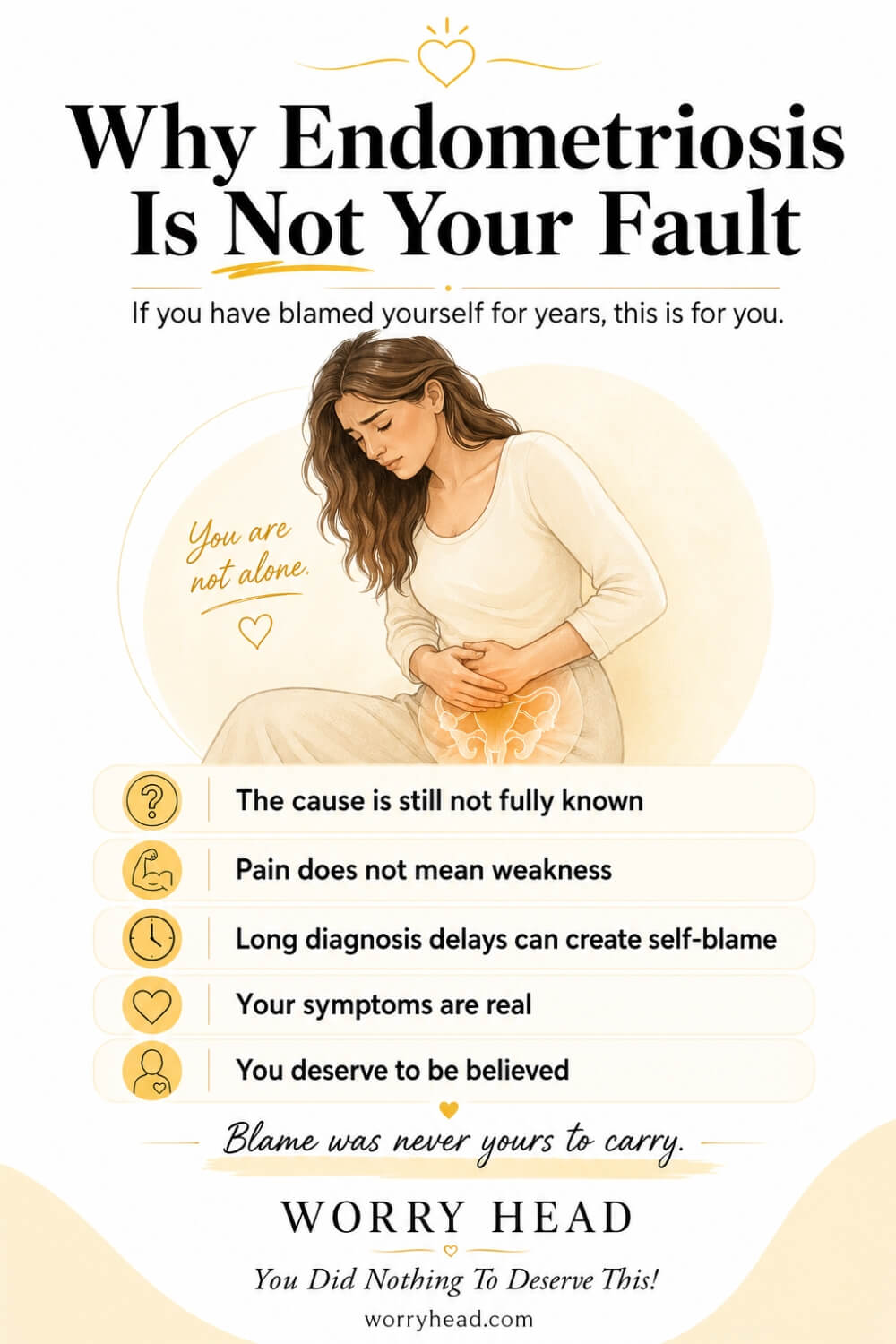
Why Endometriosis Is Not Your Fault?
What if endometriosis is not your fault at all, even though years of pain may have made you question yourself? What if one of the heaviest things you have been carrying was blame that never belonged to you in the first place?
This is where endometriosis validation is very important. Let’s begin with the basics and answer the question of fault directly…
No, endometriosis is not your fault. Medical guidance says its cause is still unknown, and trusted sources stress it does not happen because of anything you did or failed to do. Genetics, hormones, immune factors, menstruation-related processes, and inflammation may contribute to its development.
What makes this even harder is that endometriosis is still so often reduced to “just bad periods,” when major medical sources describe a chronic disease that can bring pelvic pain, bowel or bladder symptoms, painful sex, fatigue, fertility problems, and even disease outside the pelvis in some cases.
It affects about 10% of women and people assigned female at birth of reproductive age worldwide, yet diagnosis still commonly takes years, which leaves many women doubting their own bodies before anyone finally names what is happening.
That gap between symptoms and answers is where shame often grows, even though the evidence never said this was something you caused. You should not start doubting yourself or your endometriosis. You may even begin to apologise for being chronically ill, even though endo was never your fault. That is exactly why this conversation matters so much!
I have watched my wife suffer through pain that was real long before the world had the right words for it. One of the cruellest parts was not only what endometriosis did to her body, but how easily it can make a good woman wonder whether she is weak, dramatic, broken, or somehow to blame.
If that part of your heart needs gentleness, grab my free 130+ page eBook, “You Did Nothing To Deserve This!” Born from what I kept saying to my wife, and by joining us, you also become part of our community, where I send more freebies, real support, big discounts on our books, and emails full of value to help you and your relationship adjust to the new normal chronic illness can bring.
The book is filled with 20 chapters of gentle validation for women with endo, written by yours truly, as I have seen it up close…
It’s my way of telling you, in much more detail, that your pain, your complex response to treatment, and your emotions around all of it are real, understandable, never your fault, and that you should never blame yourself for endometriosis.
It’s not a medical guide but a human one. Here’s what you will find inside:
- This Was Never Your Fault
- The Girl You Used To Be
- When Your Own Body Feels Like an Enemy
- The Invisible Battles Nobody Sees
- Am I Just Lazy? – The Lie You Have Been Taught
- Gaslighting, Dismissal and the Trauma of Not Being Believed
- Guilt: The Weight You Were Never Meant to Carry
- Love in the Middle of Pain
- Intimacy When Your Body Hurts
- The Loneliness of Being the Strong One
- You Are Allowed To Take Up Space
- Tiny, Gentle Hopes (Not Toxic Positivity)
- If You Could Hear My Voice Every Flare Day
- You Deserve Partners, Not Witnesses
- When You Wish He Understood
- Motherhood, Fertility and the Grief Nobody Sees
- When Anger Is the Only Honest Feeling
- Learning to Trust Your Body Again
- Building a Life That Fits Your Reality
- You Did Nothing To Deserve This
You Did NOTHING To Deserve This!
Endometriosis Validation for Women with Endo
Prefer to listen?
I’ve turned this article into a brief, gentle podcast-style conversation, so you can absorb it without having to read everything on a hard day. The discussion is AI-assisted and based on this article, but the care, research, and intention behind it are mine.
Why Endometriosis Is Not Your Fault?
When I say endometriosis is not your fault, I mean that as plainly and seriously as I can. The cause is still not fully known, and major medical guidance points instead to a mix of genetic, immune, hormonal, inflammatory, and menstruation-related processes rather than anything you did wrong.
That matters because so many women quietly turn mystery into self-blame. They start wondering whether they caused this by working too hard, eating the wrong thing, waiting too long, stressing too much, being too sensitive, or not being “strong enough,” when the evidence simply does not say that.
Many women miss their old versions of themselves, like my wife, who used to be a professional dancer, but lost her career and dance business due to endometriosis.
I have seen how that blame grows in the dark space between symptoms and answers. Many women blame themselves, saying that stress caused their endometriosis, even though it didn’t. In the UK, women with endo still face an average diagnosis time of 8 years and 10 months, and during those years, many are dismissed, doubted, or taught to speak about severe pain as if it were normal.
And when a woman is told for years that she is exaggerating, dramatic, anxious, lazy, hormonal, or just “bad with pain,” shame starts settling into places that pain has already injured. It makes you feel like a burden just because you have endometriosis.
What should have been women’s pain validation becomes a lonely habit of apologising for symptoms that deserved careful attention from the beginning.
The truth is that this disease can show up as painful periods, heavy periods, chronic pelvic pain, painful sex, bowel pain, bladder pain, fatigue, nausea, low mood, fertility struggles, and pain that stretches into the back, legs, or even beyond the pelvis. That is one reason it can be missed so easily: it does not always look neat, and it does not always stay in one place.
NICE now recommends ultrasound even if an examination is normal, because ovarian endometriomas and deep disease involving the bowel, bladder, or ureter may still be present. That detail alone says something important to me: a normal first look does not mean your suffering was imagined.
I think many women have been hurt not only by the illness, but by how misunderstood illness changes the way they see themselves. When pain keeps interrupting work, intimacy, sleep, plans, confidence, and even the simple ability to trust your own body, it becomes very easy to confuse limitation with failure. But endometriosis is not some kind of character flaw.
But symptoms are not a moral verdict. Fatigue and endometriosis do not mean you are lazy, pelvic inflammation does not mean you are weak, and needing rest does not mean you are letting anyone down.
My wife taught me that one of the deepest wounds of endo is not always the scan, the lesion, or the surgery. Sometimes it is the quiet way a woman begins to say “sorry” for pain she never chose, for tears she never wanted, and for a body that is fighting a battle nobody else can see.
I wish more women heard this sooner: your pain is real, your symptoms are real, your exhaustion is real, and you deserve to be believed. Endometriosis awareness matters, but endometriosis validation matters too, because information without warmth can still leave a woman feeling alone. Especially after 7-8 years of waiting.
And if those lost years have left you wondering whether you should have recognised the signs sooner or pushed harder for answers, understanding why a late endometriosis diagnosis was not your fault can help you stop judging your past with knowledge you only gained later.
In the next section, I want to give you the kind of practical, life-useful guidance I wish more people had offered us earlier. Not cold tips, but steady ones that can help you protect your heart, speak more clearly, and hold onto dignity while living with endometriosis support that feels real.
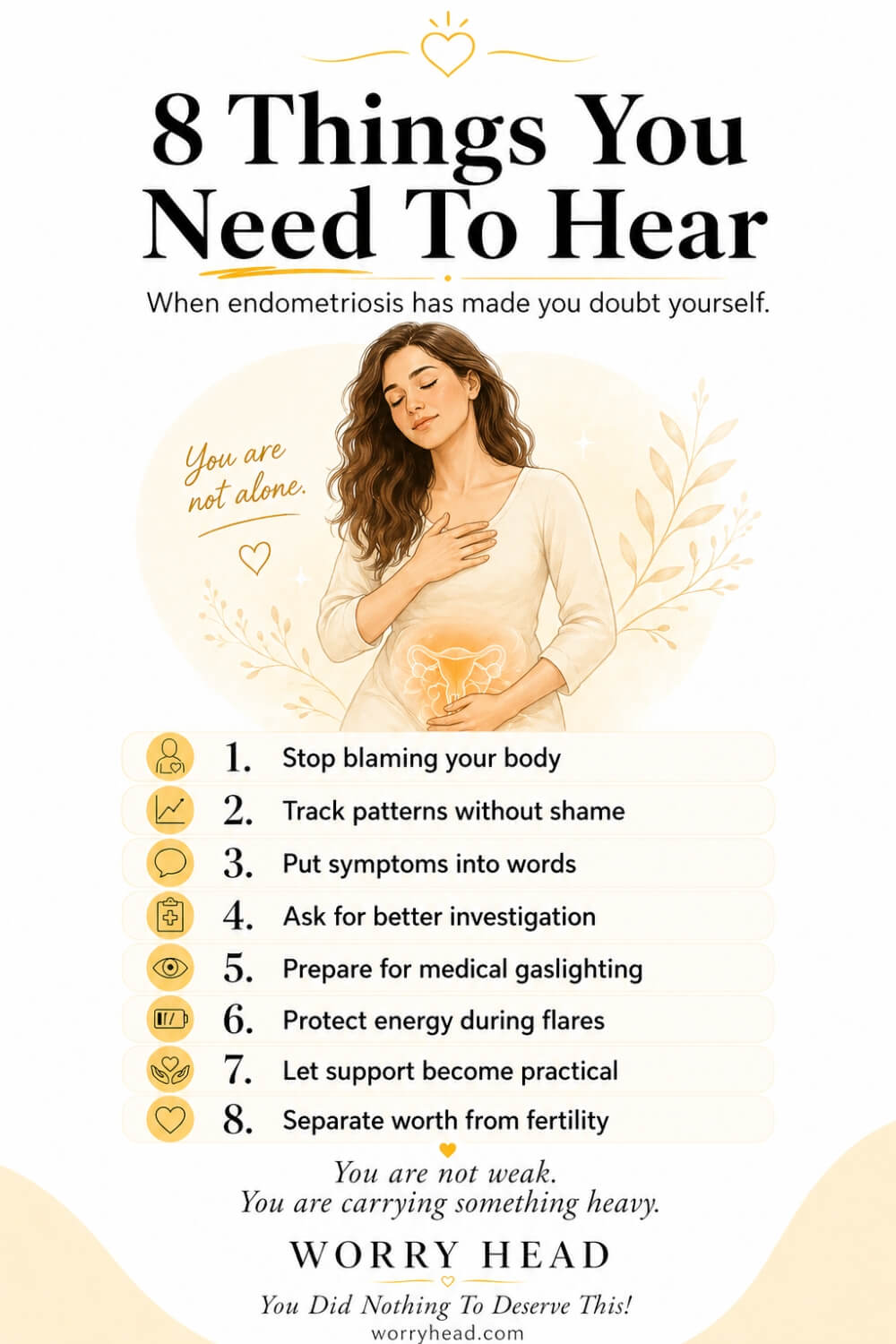
- Stop blaming your body
- Track patterns without shame
- Put symptoms into words
- Ask for a better investigation
- Prepare for medical gaslighting
- Protect energy during flares
- Let support become practical
- Separate worth from fertility
Stop Blaming Your Body
One of the first things I wish I could place gently into your hands is this: your body did not betray you on purpose. Major medical sources still say the exact cause of endometriosis is not fully known, and trusted organisations are very clear that it is not something you cause by being too stressed, too emotional, too busy, too ambitious, or not healthy enough.
I know how cruel self-blame can become when pain keeps coming back and nobody explains it properly. But remember that endometriosis pain is not in your head; it’s real.
I watched my wife go through moments where the illness hurt her once, and then shame tried to hurt her again by whispering that maybe she was weak, maybe she was failing, maybe she should just cope better.
But pain is not proof of weakness. Heavy periods, painful sex, bowel pain, bladder symptoms, fatigue, nausea, and chronic pelvic pain are recognised features of this disease, which means your struggle deserves endometriosis validation, not suspicion.
Track Patterns Without Shame
Tracking symptoms is not about becoming obsessed with illness. It is about turning confusion into something visible, because when pain moves around the body or changes with your cycle, it can be hard to explain in the short, pressured space of a medical appointment. NICE specifically says a pain and symptom diary can help discussions, and patient resources from Endometriosis UK explain that recording symptoms may support management and diagnosis.
I would write down what happens on period days, ovulation days, bowel days, bladder days, intimacy days, and flare days. Note where the pain is, what it feels like, whether you had endo belly, heavy bleeding, lower back pain, exhaustion, nausea, or pain when you used the toilet, because those details help paint the fuller picture of a misunderstood illness.
There is no shame in needing evidence for pain that should have been believed sooner. Sometimes a diary becomes the quiet proof that helps a woman stop minimising her own suffering and start speaking about it with more confidence.
Put Symptoms Into Words
A lot of women have symptoms, but not always the words for them. This is when, sometimes, endometriosis makes you feel that you failed somehow. That matters more than people realise, because endometriosis can involve painful periods, chronic pelvic pain, bowel pain, bladder pain, lower back pain, fatigue, painful sex, and bleeding or pain in other areas too, which is one reason it gets mistaken for other conditions.
So instead of saying only “I get bad pain,” it can help to say, “I get sharp pain before my period, pulling pain during bowel movements, deep pain during sex, and exhaustion that wipes me out for days.” That is not being dramatic. That is clear. It gives shape to your lived experience in a system that too often responds better to detail than distress.
I learned this beside my wife. The more precise we became, the harder it was for anyone to flatten her story into “just normal period trouble,” and that shift alone can bring a little woman’s pain validation back into the room.
Ask for a Better Investigation
If your symptoms are affecting daily life, asking for more investigation is not overreacting. NICE guidance says ultrasound should be offered even when an examination is normal, because endometriomas and deep endometriosis involving the bowel, bladder, or ureter may still be there, and the guideline also supports referral to a gynaecology service for suspected or confirmed endometriosis.
That is important because many women are sent away after one normal exam, one normal blood test, or one conversation that never really explores the full story. A normal first step does not cancel your symptoms. It does not erase pelvic inflammation. And it does not mean your body has nothing serious going on.
I want you to hear this in a steady voice: asking for a scan, a referral, a second opinion, or better follow-up is not making trouble. It is what women’s health awareness should have taught you to do from the start.
Prepare for Medical Gaslighting
I hate that this even needs to be said, but many women like my wife walk into appointments already braced to defend themselves. In the UK, the diagnosis had worsened to an average of 8 years and 10 months in 2024, and women were feeling “dismissed, ignored and belittled.” Parliament’s Women and Equalities Committee later said menstrual ill health symptoms must never be normalised or dismissed.
So prepare like your peace matters. Bring notes, bring your symptom diary, bring questions, and if you can, bring one calm person who knows what this illness has been doing to your life. Not because you should have to prove your pain, but because sometimes preparation protects you in rooms that have not always protected women.
I say that with a heavy heart, because I have seen what medical gaslighting does. It not only delays diagnosis. It teaches good women to mistrust themselves, and that kind of wound can run deep.
Protect Energy During Flares
Flares are not only about pain. They can drain concentration, sleep, mood, appetite, digestion, patience, and the basic ability to function like your usual self. WHO and the NHS both recognise that endometriosis can bring chronic pain, fatigue, bloating, nausea, and low mood or anxiety, which is why rest is not laziness here. It is part of living with a chronic illness support mindset that respects what the body is carrying.
I wish more women were told they do not need to earn rest by collapsing first. During bad days, protecting energy may mean cancelling, asking for help, eating simply, using heat, keeping plans small, and lowering the expectation that you should perform wellness while hurting.
My wife has had days where even speaking felt like an effort. On those days, love looked less like big speeches and more like quiet protection, softer demands, and making home feel safe enough for her body to stop fighting for one minute.
Let Support Become Practical
Support sounds beautiful in theory, but in real life, it needs hands and shape. It may mean learning your patterns, helping with meals, picking up prescriptions, going to appointments, asking how pain feels today instead of assuming, or understanding that intimacy may need tenderness, patience, and safety when painful sex is part of the picture.
I say this especially to partners like me. Love is not only feeling bad that she is suffering. Love is becoming observant enough to notice what lightens the load and disciplined enough to do it consistently. Sometimes the most healing thing a woman hears is not “tell me what you need” but “I noticed this is getting worse, and I’ve already started helping.”
That kind of endometriosis support can make a woman cry, because it tells her she is still loved as she is, not just when she is functioning well enough to look easy to care for.
Separate Worth From Fertility
Fertility worries can cut straight into identity, womanhood, grief, fear, and the future you thought you were walking toward. Endometriosis is associated with fertility problems, and both WHO and NICE now recognise the need for dedicated fertility care pathways, but it is also true that many people with endometriosis can still conceive, sometimes naturally.
That is why I believe worth must be protected from this part of the illness with everything we have. Your value does not rise or fall with a scan, a timeline, a treatment outcome, or whether your body gives you the path you hoped for. Grief may be real. Fear may be real. But your dignity is not up for negotiation.
I have seen how deeply this question can hurt. And if this part of your story feels tender, I hope you let this truth stay close: you are not less of a woman, less lovable, or less worthy because endometriosis touched your future and made it feel uncertain.
Why Endometriosis Is Not Your Fault After Diagnosis?
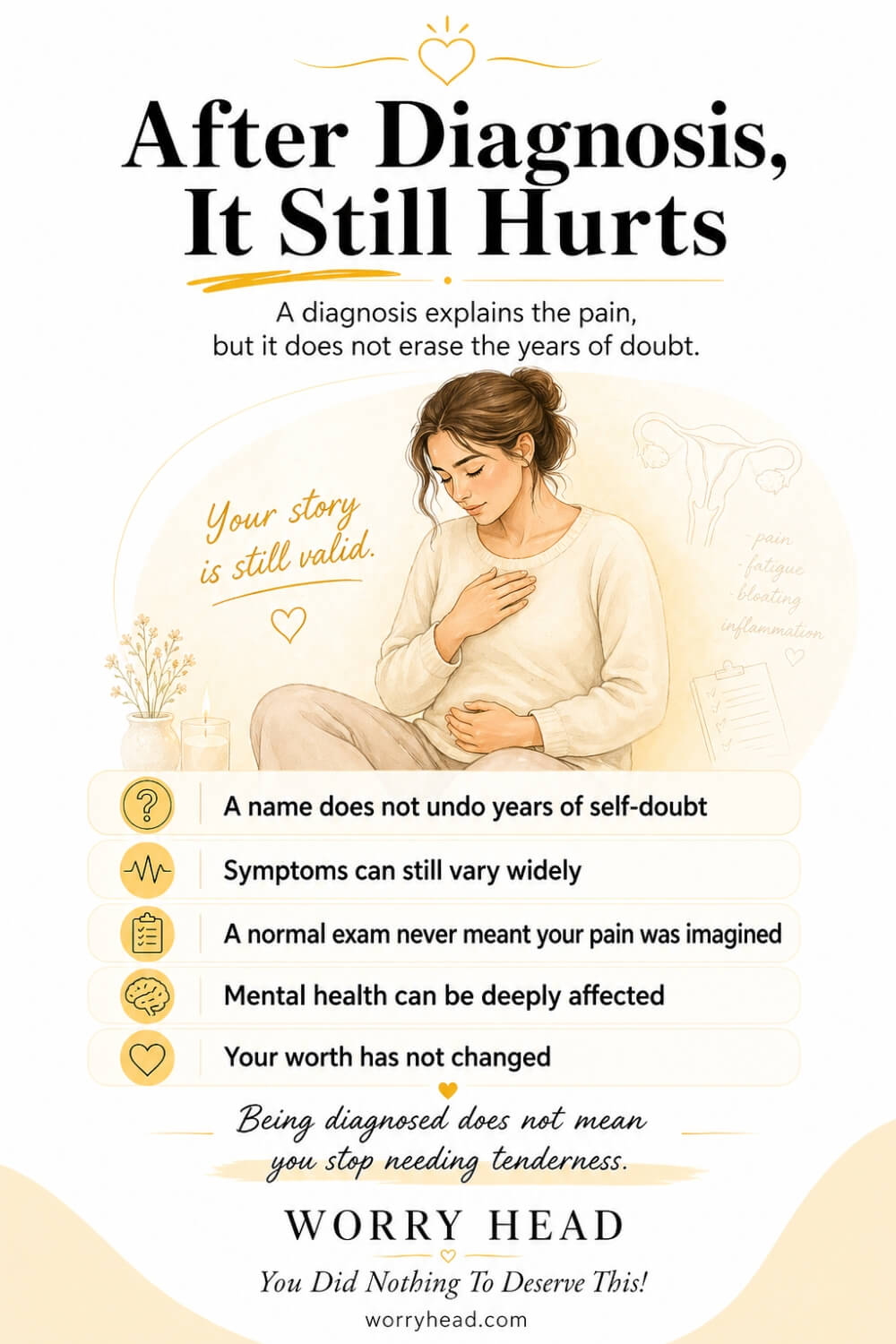
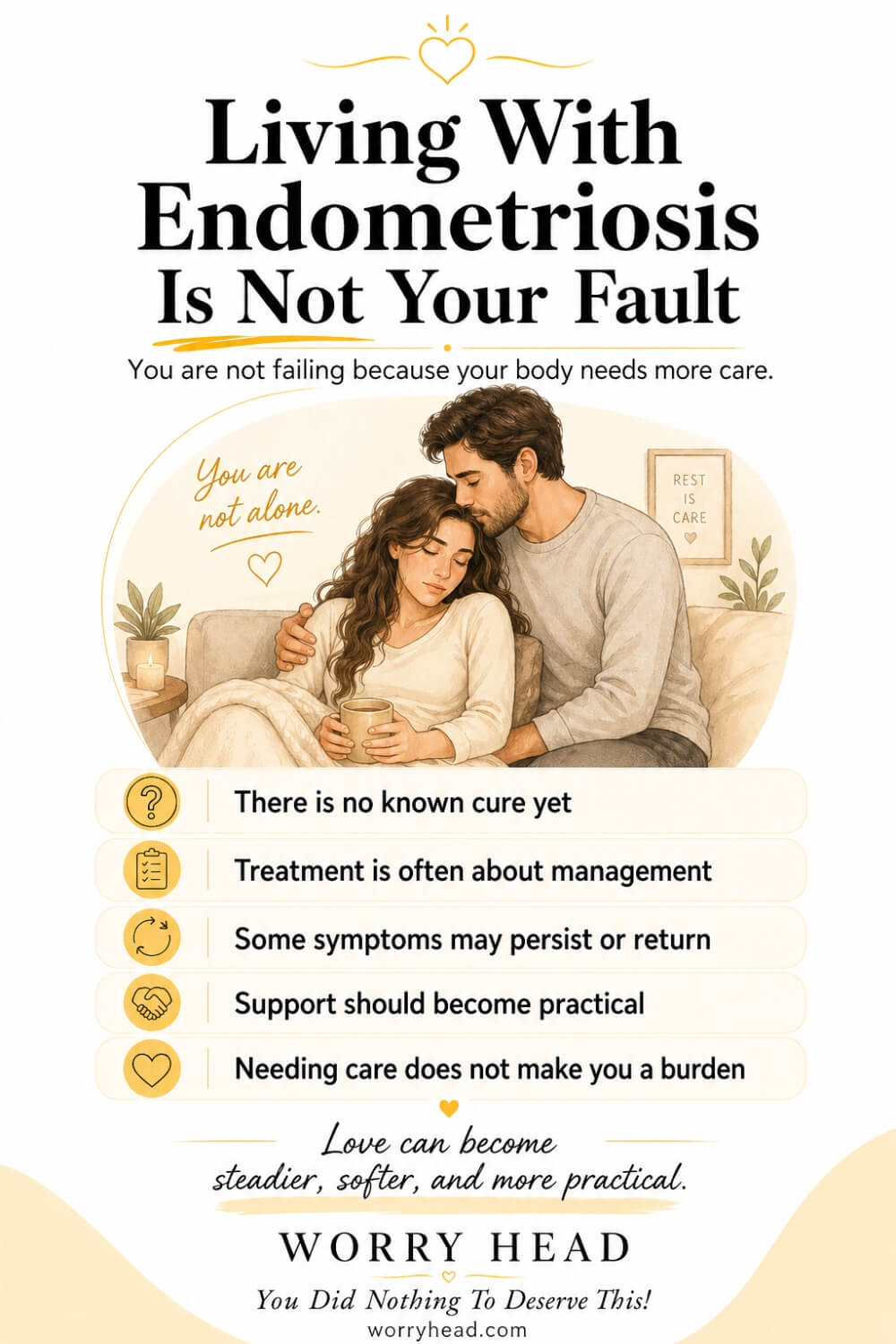
Sometimes the hardest part comes after the name is finally given, because even though endometriosis is not your fault can still feel difficult to believe when you are left living with pain, appointments, waiting lists, and decisions that do not come with certainty. Diagnosis can explain a lot, but it does not automatically undo the years of doubt that built up before anyone took your symptoms seriously.
One of the most painful truths is that endometriosis does not always behave in neat, reassuring ways. The WHO describes it as a chronic inflammatory disease, and both the WHO and ESHRE note that symptoms and severity can vary widely from person to person, which helps explain why one woman may have severe pain with smaller visible disease while another may have extensive disease found during imaging or surgery.
That matters emotionally as much as medically, because many women have spent years trying to earn belief by looking “ill enough.” When symptoms shift between pelvic pain, bowel trouble, bladder symptoms, fatigue, nausea, painful sex, and lower back pain, it can leave you feeling as if your own body is speaking in a language nobody around you wants to learn.
Care can also feel confusing because medicine has changed. NICE updated its guidance to push earlier detection and says ultrasound should be offered even if an abdominal or pelvic examination is normal, while ESHRE explains that laparoscopy is no longer the automatic diagnostic gold standard in every case because imaging can identify ovarian and deep disease in many patients.
So if you were once told nothing was wrong because an exam seemed normal, that should never have been turned into a judgment on your honesty. It is one more reason women need validation as much as they need tests, because a normal first step does not cancel suffering that keeps returning month after month.
I think about my wife here in a way that still hurts my chest. There were moments when having a label did not bring relief straight away, because the label came with the grief of realising how long she had been carrying something serious while still trying to smile, cope, explain, and hold herself together for the world.
And then there is the cruel mental side of all this. Endometriosis is linked with reduced quality of life, and patient guidance from ESHRE specifically notes anxiety and depression among the burdens women may experience, which means the emotional fallout is not some separate weakness but part of the real weight this illness can place on daily life.
That is why I never want a woman to measure her worth by how well she performs through pain. If this disease has changed your energy, your work, your sex life, your plans, your sleep, your confidence, or your hope for pregnancy, those losses are painful enough already without you turning them into evidence against yourself.
For some, fertility becomes another silent battlefield. WHO and ESHRE both recognise that endometriosis can be associated with infertility and that management may need to take fertility priorities into account, but even here the story is not simple, and uncertainty does not make you less feminine, less valuable, or less worthy of being deeply loved.
I have seen what that fear can do inside a marriage. A woman can start apologising for a future that has not even happened yet, and a man who loves her has to learn how to hold her without trying to reduce her to ovaries, timelines, or outcomes.
The more I have learned, the more I believe that part of healing is not only treatment but truth. The truth is that long delays remain common in the UK, women’s symptoms have repeatedly been described by campaigners and Parliament as dismissed or normalised, and the wider culture of minimising pain can sink so deeply into a woman that she keeps doubting herself even after diagnosis.
So when I tell you to be gentle with yourself, I do not mean it as a soft slogan. I mean it as something earned by evidence, by experience, and by the tears I have seen in my own home when my wife needed someone to remind her that being sick did not make her a burden, difficult, broken, or to blame.
Final Word on Why Endometriosis Is Not Your Fault
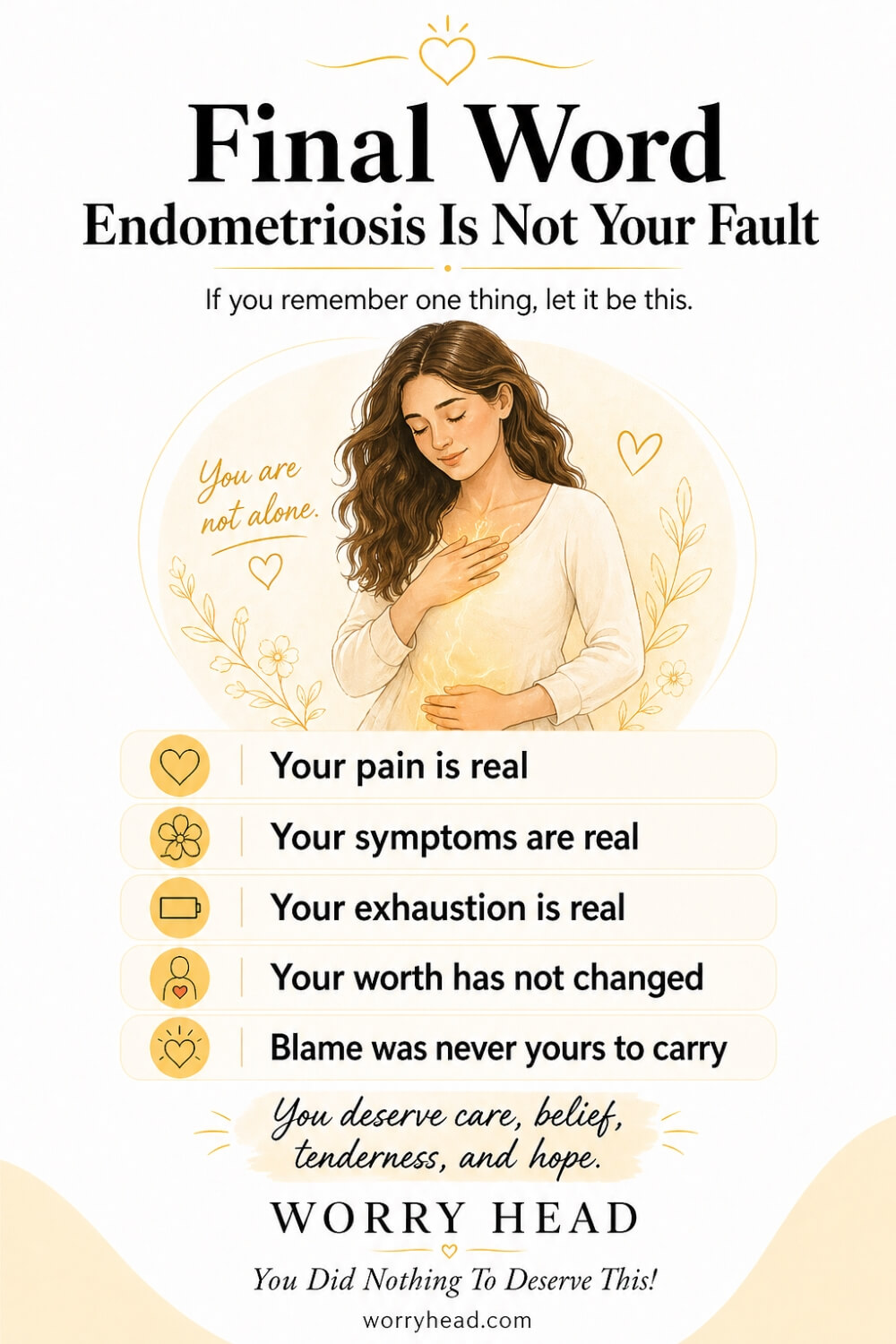
If there is one thing I hope stays with you after reading this, it is that pain can distort the way you see yourself when it goes unnamed, untreated, or repeatedly dismissed. Endometriosis is a real chronic inflammatory disease, not a character flaw, not a lack of resilience, and not some punishment for how you lived, loved, ate, worked, or coped.
Trusted guidance is still clear that the exact cause is not fully known, there is no known cure yet, and symptoms can continue even after treatment, which means blame was never the right place to put your energy in the first place.
What I want for you is not only better care, but a gentler relationship with your own body. When doctors, relatives, workplaces, or even your own thoughts have made you feel dramatic, weak, or difficult, that message can start living inside you. It can shape the way you apologise for resting, the way you explain pain, and the way you shrink yourself in rooms where you should have been protected.
But your body is not the enemy here. Your body is carrying something heavy. Too many women have been trained to minimise what hurts, to smile through flares, and to measure their goodness by how little support they ask for. That lesson is cruel, and it is wrong from the start.
I say that as a husband who has watched the woman he loves try to stay brave through things she should never have had to prove. I have seen how endometriosis can steal ease from ordinary life. It can touch sleep, work, intimacy, confidence, fertility hopes, digestion, movement, mood, and the quiet sense of safety a woman is meant to feel inside herself. That is why validation matters so much. Information helps, scans help, surgery may help, treatment may help, but being believed matters too.
The phrase endometriosis is not your fault is not just comforting language to me. It is a correction. It pushes back against diagnostic delays, against medical gaslighting, against the old habit of treating severe period and pelvic pain as something women should simply absorb and endure. In the UK, diagnosis times remain far too long, and that reality has consequences far beyond medicine because every delayed answer gives shame more time to grow.
So please hear me clearly. You are not lazy. You are not weak. You are not overreacting. Your pain is real. Your symptoms are real. Your exhaustion is real. And even if your path has been messy, uncertain, expensive, lonely, or full of heartbreak, your worth has not moved.
I want more for you than survival. I want care that listens sooner, partners who learn better, families who become softer, and a world that stops asking women to earn compassion by suffering perfectly. Until that world catches up, I hope this article has helped you set one burden down. Not the illness itself, because I know it is real, but the blame. That part was never yours to carry.
None of this was your doing. The illness is real, the delay is real, and the hurt is real, but blame does not belong on your shoulders. Let this be the place where you stop apologising for pain and start remembering that your body deserves care, belief, tenderness, and a future not defined by shame.
If this spoke to your heart, leave a comment and tell me what part felt most true for you, and please check out the free chapter of my eBook, You Did Nothing To Deserve This!, for more validation, comfort, and support.


About Me
Hi, I’m Lucjan! The reason why I decided to create this blog was my beautiful wife, who experienced a lot of pain in life, but also the lack of information about endometriosis and fibromyalgia for men…
READ MOREWhy Endometriosis Is Not Your Fault FAQ
1. Is endometriosis really not my fault?
No. Everything we know from trusted medical sources points away from blame. The exact cause is still not fully understood, and experts describe endometriosis as a chronic inflammatory disease linked to factors such as hormones, immune function, genetics, and menstrual-related processes, not something you caused by being stressed, weak, emotional, or “bad at coping.”
2. Can stress cause endometriosis?
Stress can make pain feel heavier, sleep worse, mood lower, and flares harder to manage, but that is not the same thing as saying stress caused the disease. Endometriosis is a real physical condition, and blaming yourself for being under pressure only adds another layer of hurt to something that already takes enough from you.
3. Can I still have endometriosis if an ultrasound or exam looks normal?
Yes, you can. NICE says transvaginal ultrasound should be offered even if a pelvic or abdominal examination is normal, and it also says not to exclude endometriosis just because the examination or ultrasound is normal. NICE further says laparoscopy can still be considered even if the ultrasound or MRI after specialist referral is normal.
4. Does an endometriosis diagnosis automatically mean infertility?
No, not automatically. Endometriosis is associated with fertility problems, and fertility may need specialist input in some cases, but it does not mean every woman with endometriosis will be unable to conceive. This is one of those areas where fear can run ahead of the facts, so it helps to speak with a clinician about your own situation rather than assuming the worst.
5. Can symptoms be severe even if scans do not look dramatic?
Yes, and this is one reason so many women end up doubting themselves when they should have been believed. ESHRE’s patient guidance explains that some women with endometriosis have severe pelvic pain while others have no symptoms at all, and NICE’s pathway makes clear that normal examination or imaging does not automatically rule the disease out. Your pain does not need to look impressive to be real.
Why Endometriosis Is Not Your Fault References
- World Health Organization: Endometriosis
- NHS: Endometriosis
- NICE: Endometriosis Diagnosis and Management Recommendations
- NICE: Visual Summary on First Presentation, Initial Management, Diagnosis, Referral and Ongoing Care
- NICE: Updated Guideline to Improve the Diagnosis of Endometriosis
- Endometriosis UK: FAQs
- Endometriosis UK: Diagnosis Report
- Endometriosis UK: The State of Endometriosis Care Report (PDF)
- ESHRE Patient Guideline: Information for Women With Endometriosis (PDF)
