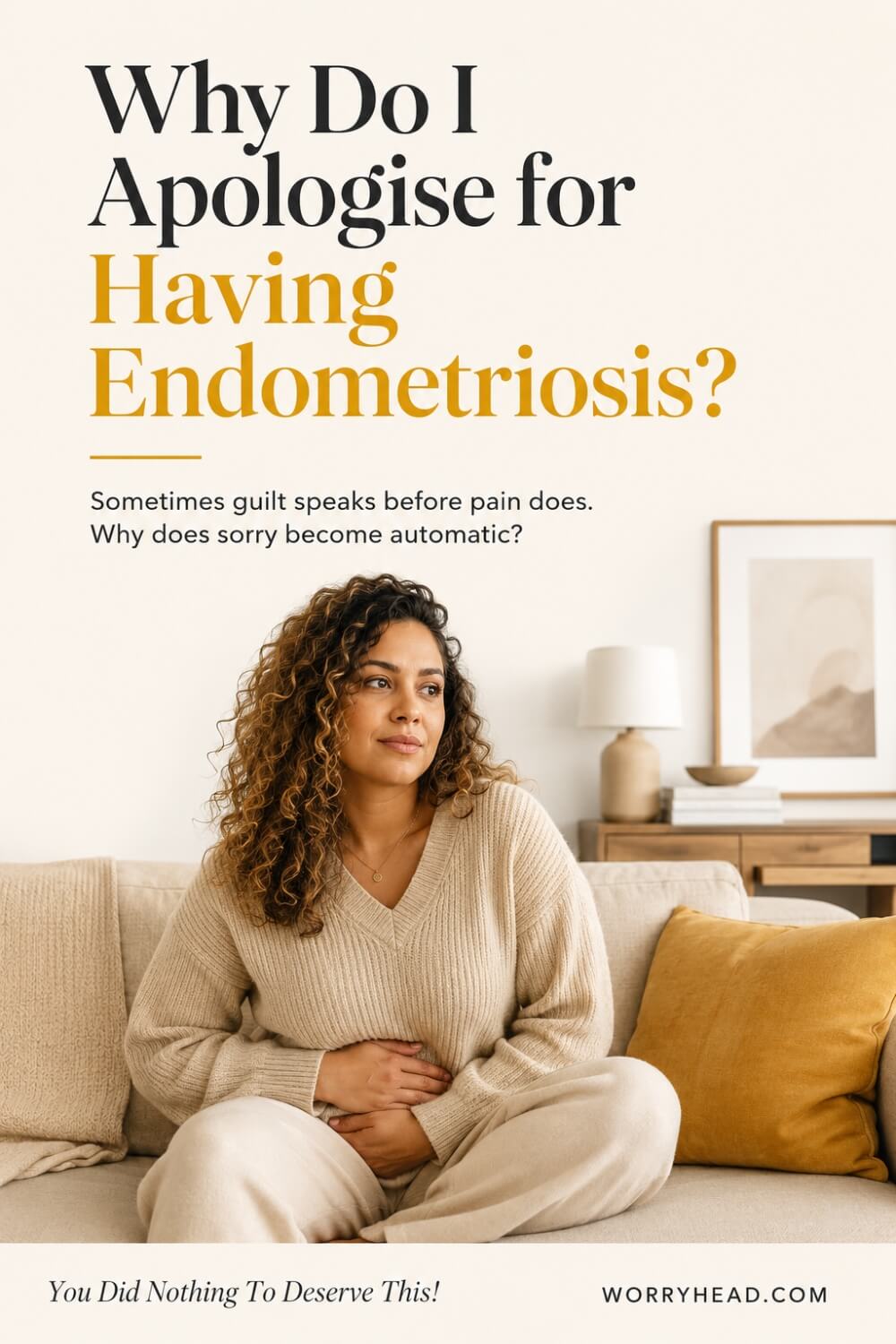
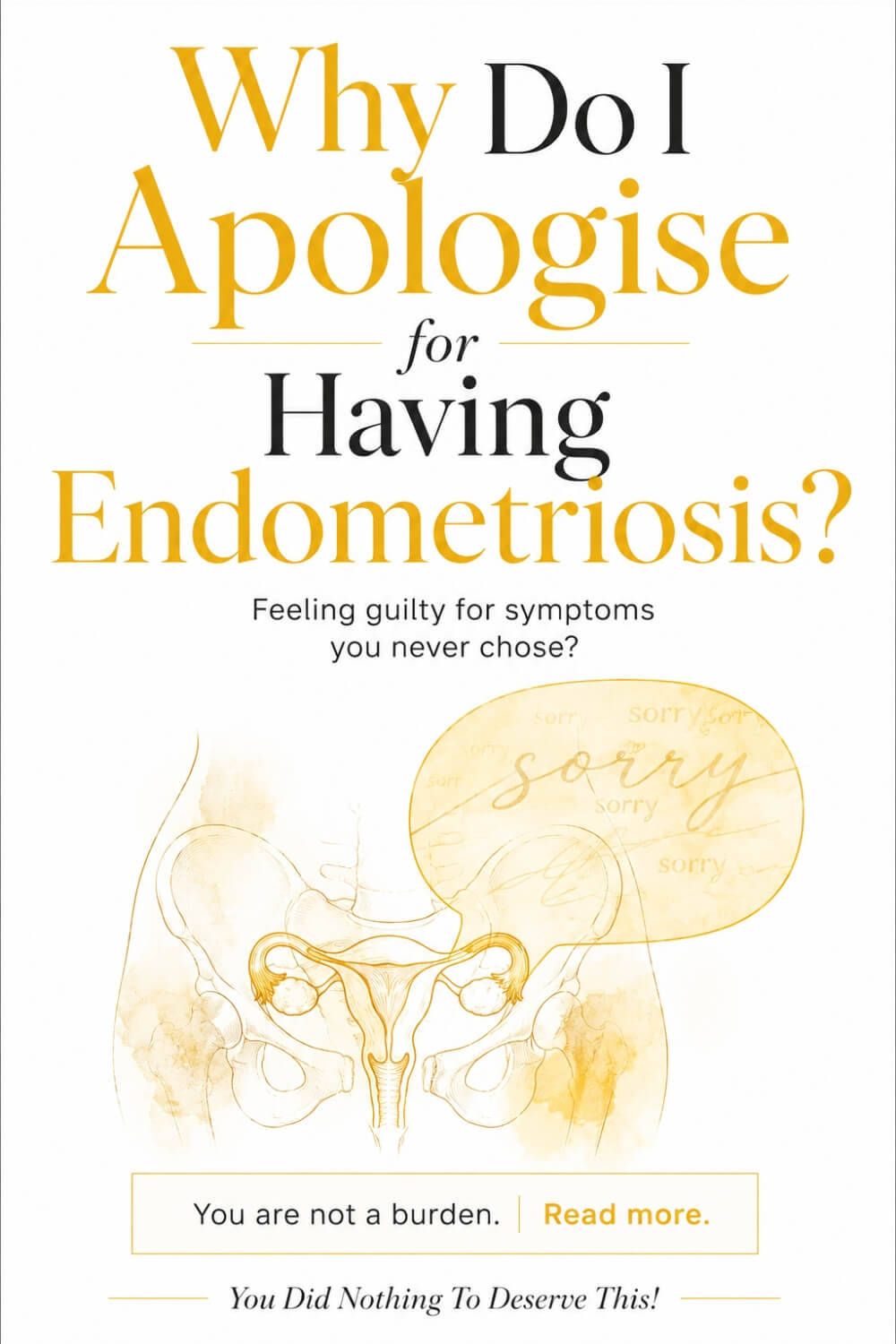
Why Do I Apologise for Having Endometriosis?
Have you ever caught yourself asking, “Why do I apologise for having endometriosis?” when you know, somewhere underneath the guilt, that you did not choose this?
Maybe you say sorry for cancelling plans, needing another lift to an appointment, missing work, resting while somebody else carries the load, or having pain change intimacy again. Maybe the hardest part is that the apology slips out before anyone has even blamed you, as though you have learnt to explain your body’s needs before you are allowed to have them.
You may apologise because repeated pain, cancelled plans, needing help, stigma and being doubted can turn illness into guilt and self-blame. Research links endometriosis with shame, self-judgement and reduced quality of life. But having it is not your choice, your failing, or something you caused.
I am not a clinician; I write as a husband, blogger and researcher who has spent years learning because of what my wife has lived through, and at the bottom of this article I have included the medical and health sources that informed me, including WHO, NICE, NHS, ESHRE and published research where relevant.
That is why I also want you to understand how endometriosis turns into undeserved self-blame, because seeing where that blame came from can be the first step towards putting down something that never belonged to you.
What may surprise you is that apologising is not always about believing you have actually done something wrong. It can become a learned way of trying to protect your relationships, softening disappointment before plans are cancelled, making yourself seem less difficult before asking for help, or reducing the chance of being judged for needs you cannot simply switch off.
Research into the lived experience of endometriosis describes guilt, self-judgement, isolation, anticipated stigma and the constant work of managing symptoms around employment, relationships and other people’s reactions.
And there is another cruel layer to this. When severe pain is repeatedly normalised, doubted or treated as something you should simply tolerate, the question inside you can slowly change from “Why am I hurting?” to “Why can’t I cope like everybody else?”
WHO now specifically recognises that stigma and beliefs that downplay period pain can worsen mental wellbeing, while NICE describes endometriosis as a long-term condition with significant physical, sexual, psychological and social effects.
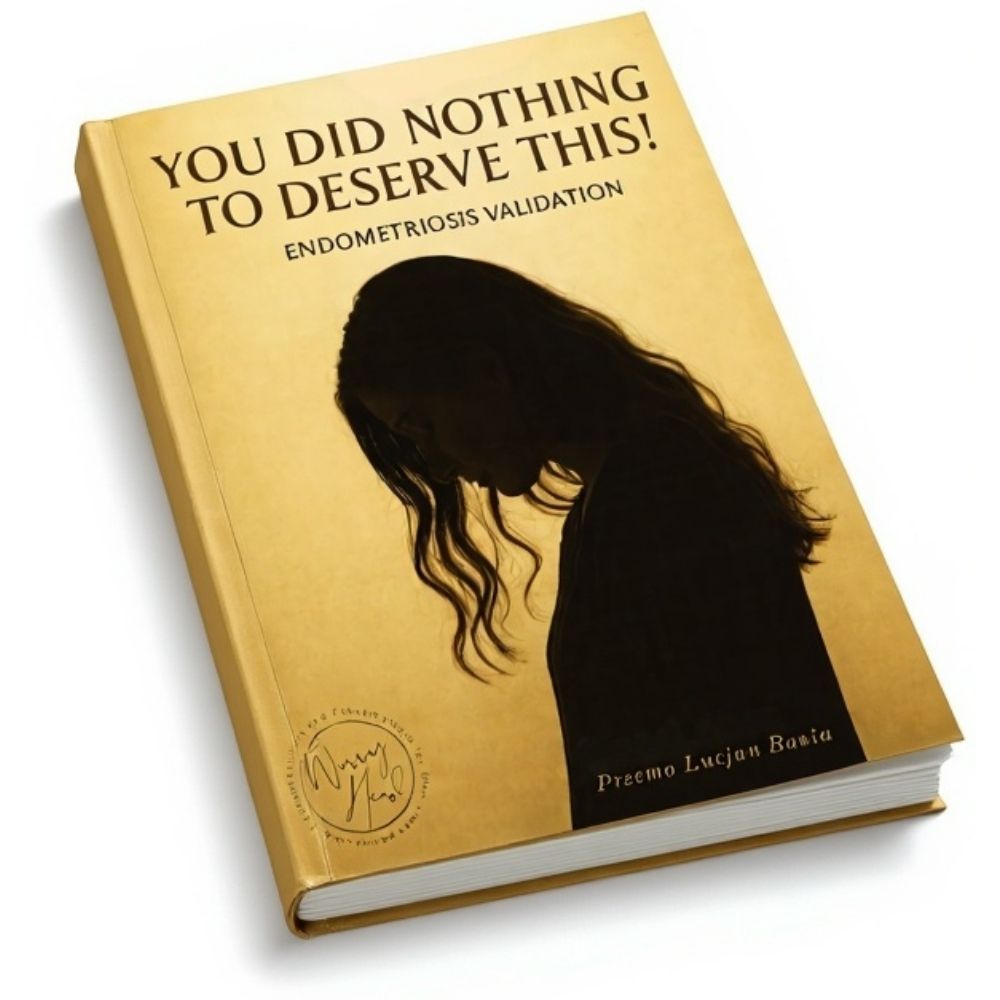
I have spent years watching my wife need support for a condition she never asked for, and the words “You Did Nothing To Deserve This!” became something I kept saying until they eventually became the title of my book. For me, loving her has never meant keeping score of appointments, changed plans or days when I needed to carry more; it has meant refusing to let illness turn her need for care into evidence against her.
If “sorry” has become almost automatic for you, I want to help you notice what sits underneath that word before you blame yourself again. The rest of this conversation is about separating genuine responsibility from illness-shaped guilt, so you can begin asking yourself one much fairer question: what, exactly, did I do wrong?
When you find yourself apologising for pain, fatigue or cancelled plans, it may feel as though your needs are an inconvenience. My free eBook reminds you that needing care and making adjustments does not require an apology.
You Did NOTHING To Deserve This!
Endometriosis Validation for Women with Endo
- Why Do I Apologise for Having Endometriosis When I Need Support?
- Notice What You Are Apologising For
- Separate Illness From Personal Responsibility
- Replace Sorry With Clear Information
- Ask for Help Without Shame
- Stop Explaining Every Cancelled Plan
- Set Boundaries Around Others’ Disappointment
- Talk Honestly With Your Partner
- Challenge Guilt After Pain Flares
- Practise Receiving Care Without Repayment
- Why Do I Apologise for Having Endometriosis Even When Nobody Blames Me?
- Why Do I Apologise for Having Endometriosis in My Relationship?
- When to Seek Medical Help?
- Questions to Ask Your Doctor
- Final Word on Why Do I Apologise for Having Endometriosis
- FREE eBook
- You Did NOTHING To Deserve This!
Why Do I Apologise for Having Endometriosis When I Need Support?
If you find yourself wondering, “Why do I apologise for having endometriosis?” every time pain changes a plan, start by noticing when that little word appears. It often comes out when you need rest, ask for help, leave early, miss work, turn down intimacy, or cannot be the version of yourself somebody expected that day. In those moments, you are not necessarily confessing to wrongdoing; you may be trying to manage the discomfort created when illness collides with other people’s expectations.
You may have become so used to measuring yourself by what you can produce, give, tolerate or push through that a physical limit begins to feel like a character flaw. That is one reason guilt can survive even after diagnosis: a medical explanation may validate the pain, but it does not instantly erase years of being expected to cope, minimise symptoms or treat severe pain as something normal.
Research on endometriosis stigma describes self-stigma in terms that include shame, blame and guilt, while qualitative research has also identified guilt around needing support, cancelling social plans and the effect symptoms can have on relationships.
In everyday life, this can make you apologise for taking medication, lying down, asking somebody else to cook, changing weekend plans or needing your partner to carry more during a flare. None of those actions make you selfish; they are adjustments to a condition that can affect physical health, emotional wellbeing, relationships, sexuality, work and everyday activities. The difficulty is that when disruption happens repeatedly, you can slowly begin to feel as though the disruption is you.
There is also a social layer many women are never warned about. Because endometriosis is often invisible, somebody may see you standing, smiling or answering messages and assume you are capable of everything else too, which can leave you feeling pressured to justify needs that would seem obvious if your illness were visible.
WHO specifically recognises that stigma and social beliefs that downplay menstrual pain can negatively affect mental wellbeing, and that matters because repeated disbelief can eventually change the way you speak to yourself.
Over time, “sorry” can become less of an apology and more of a safety behaviour, something you say to soften a boundary before anybody has the chance to challenge it. You say it before asking to sit down, before declining sex, before cancelling dinner, before taking another sick day, sometimes because you are trying to reduce another person’s disappointment before it reaches you.
That habit may protect you from conflict in the moment, but it can quietly teach you that your legitimate needs require somebody else’s permission.
Relationships can make this guilt especially sharp because you may genuinely love your partner and still hate watching illness affect plans, finances, housework or intimacy. Yet research involving partners shows that endometriosis can affect both people within a relationship, which is precisely why coping with its consequences works better as something shared rather than something the person in pain must somehow repay.
Support is not a debt you accumulate because your body is struggling; in a caring relationship, giving more on one day and receiving more on another is part of being a team.
I learnt this beside my wife in the small moments that nobody outside our home sees, because I have heard her apologise on days when I was not thinking, “You have let me down,” but, “How can I make today easier for you?”
Hearing a woman you love say sorry for needing help can hurt, because what she sees as being a burden, you may simply see as an opportunity to stand beside the person you chose to love. I wish I had understood sooner that telling her not to feel guilty was not always enough, so the next step is learning what you can actually do when that guilt appears.
- Notice What You Are Apologising For
- Separate Illness From Personal Responsibility
- Replace Sorry With Clear Information
- Ask for Help Without Shame
- Stop Explaining Every Cancelled Plan
- Set Boundaries Around Others’ Disappointment
- Talk Honestly With Your Partner
- Challenge Guilt After Pain Flares
- Practise Receiving Care Without Repayment

Notice What You Are Apologising For
Start paying attention to the exact moment “sorry” leaves your mouth. Is it when you need to sit down, cancel dinner, ask for a lift, turn down sex, take medication, leave work early, or say that today is too much? That moment tells you far more than the apology itself, because it shows you which needs you have quietly started treating as inconveniences.
I would never want my wife to apologise for pain she did not create, yet I learnt that simply saying “stop saying sorry” was not enough. What helped more was noticing the pattern with her, gently and without making her feel watched. When you catch yourself apologising, pause and ask, “What exactly am I taking responsibility for?” If the answer is your body needing care, rest or protection, that is not guilt asking for accountability. It is a habit asking to be questioned.
Separate Illness From Personal Responsibility
There is a huge difference between causing harm and living with a condition that sometimes changes what you can do. If you snap at somebody, forget something important or hurt someone’s feelings, you can own that behaviour like anyone else. But you do not need to take moral responsibility for pain, fatigue, bleeding, bowel symptoms, an appointment, a flare or a body that suddenly forces you to stop.
That distinction matters because guilt becomes dangerous when everything gets thrown into one basket. My wife can be responsible for how she speaks to me, but she is not responsible for endometriosis taking away an evening we had planned. I can feel disappointed that the evening changed without making her the cause of that disappointment. When you learn to separate behaviour from illness, you stop turning symptoms into evidence that you are difficult, unreliable or somehow less worthy of love.
Replace Sorry With Clear Information
Sometimes the easiest way to reduce automatic apologising is not to force yourself into silence but to give yourself different words. Instead of “I’m sorry I can’t come,” you might say, “My pain is bad today, so I need to stay home.” Instead of “Sorry I need you again,” try, “I need some help with this today.” The message becomes clearer, and you are no longer placing blame on yourself before the other person has even responded.
I have found this useful with my wife because information gives me something I can respond to, while an apology can make me think she believes she has done something wrong. Clear language tells your partner, family or colleague what is happening and what you need. You are not being rude, cold or demanding by speaking plainly. You are giving the people who care about you a fair chance to understand the situation without asking you to shrink yourself first.
Ask for Help Without Shame
Needing help can feel especially uncomfortable when you are used to being capable, independent and the person who normally gets things done. Endometriosis can interrupt that identity in very ordinary ways, from needing someone to carry shopping to asking your partner to take over dinner because standing at the cooker hurts. The practical request may be small, but emotionally it can feel enormous.
When my wife needs me, I do not see a list of debts building up beside her name. I see the woman I love having a difficult day, and I step in because that is what partnership means to me. Try making requests specific: “Can you make dinner tonight?” or “Could you drive me to the appointment?” Specific help is easier for another person to understand and easier for you to receive. You do not have to explain your entire medical history each time before you are allowed to need a hand.
Stop Explaining Every Cancelled Plan
You are allowed to be considerate without putting yourself on trial every time your symptoms change a plan. A simple explanation such as, “I’m having a bad pain day and I cannot make it tonight,” can be enough. You do not always owe a detailed account of your bleeding, bowel pain, exhaustion, medication or why you looked fine yesterday but cannot manage today.
I know cancelled plans can hurt, especially when you were looking forward to them too. My wife has missed things she genuinely wanted to do, and that matters because people sometimes assume cancellation means lack of interest when the truth is the opposite. You can acknowledge someone’s disappointment without taking ownership of their entire emotional reaction. The people who deserve access to your life should gradually learn that unpredictability is part of living with chronic illness, not proof that your care, friendship or love is unreliable.
Set Boundaries Around Others’ Disappointment
One of the hardest lessons is accepting that someone can be disappointed and you still may have made the right decision for your body. If a friend is sad you cancelled, your partner misses an evening out, or a relative wishes you could stay longer, those feelings can be real without meaning you should have pushed through pain to prevent them. Their disappointment is not automatically evidence that you behaved badly.
A boundary may sound like, “I know this is frustrating, but I cannot stay today,” or, “I understand you were looking forward to this, but I need to go home.” You can be warm without negotiating against your own body. I would rather my wife tell me the truth early than force herself through hours of pain because she is frightened of letting me down. Love should make room for honesty, not reward suffering performed quietly for everyone else’s comfort.
Talk Honestly With Your Partner
If you have a partner, do not make every conversation about endometriosis happen in the middle of a flare. Pain is a terrible meeting room. Choose calmer moments to talk about what makes you feel guilty, what kind of help actually helps, which reactions make you withdraw, and what your partner worries about too. Honest conversations outside crisis can make the difficult days far less lonely.
I had to learn that support is not only doing things for my wife. Sometimes it is listening without fixing, believing her without questioning the severity, and telling her clearly that needing me does not reduce her value in our marriage. Your partner may need permission to be honest as well, because love and frustration can exist in the same relationship without cancelling each other out. The aim is not perfection. It is creating enough safety that neither of you has to hide what the illness is doing.
Challenge Guilt After Pain Flares
A flare can leave an emotional hangover long after the sharpest pain has eased. You may replay the day and think about what you cancelled, who had to help, what work was left undone or how much of the weekend disappeared. That is often when guilt starts rewriting the story, turning “I was unwell” into “I ruined everything.” Try catching that change in language before it settles as truth.
After a difficult day, ask yourself what you would say to another woman living through the same symptoms. You probably would not tell her she was lazy, selfish or a burden because she could not function through severe pain. Give yourself the same standard. I have seen my wife judge herself far more harshly than I ever would, and that taught me something important: pain already takes enough from you. It does not deserve to take your dignity as well.
Practise Receiving Care Without Repayment
Receiving care can feel strangely vulnerable when you are used to earning your place by being useful. You may want to repay every meal cooked, every lift, every hospital visit and every chore somebody takes from your hands. Gratitude is beautiful, but turning care into an invoice can keep you trapped in the belief that love must always be balanced immediately.
When I support my wife, I am not purchasing future work from her. I am caring for my partner because there are days when her body asks more of both of us, and marriage was never meant to be a daily spreadsheet of equal tasks. You can say thank you without saying sorry. You can appreciate somebody without promising to make it up to them. Allowing a trusted person to care for you is not taking advantage of them; sometimes it is also allowing them to love you in the way they have been trying to show you.
Why Do I Apologise for Having Endometriosis Even When Nobody Blames Me?
There comes a point where the apology can become so familiar that you no longer need another person to criticise you before you criticise yourself. You may walk into a room already preparing to justify why you are tired, why you cannot stay long, or why your body needs something different from everyone else’s.
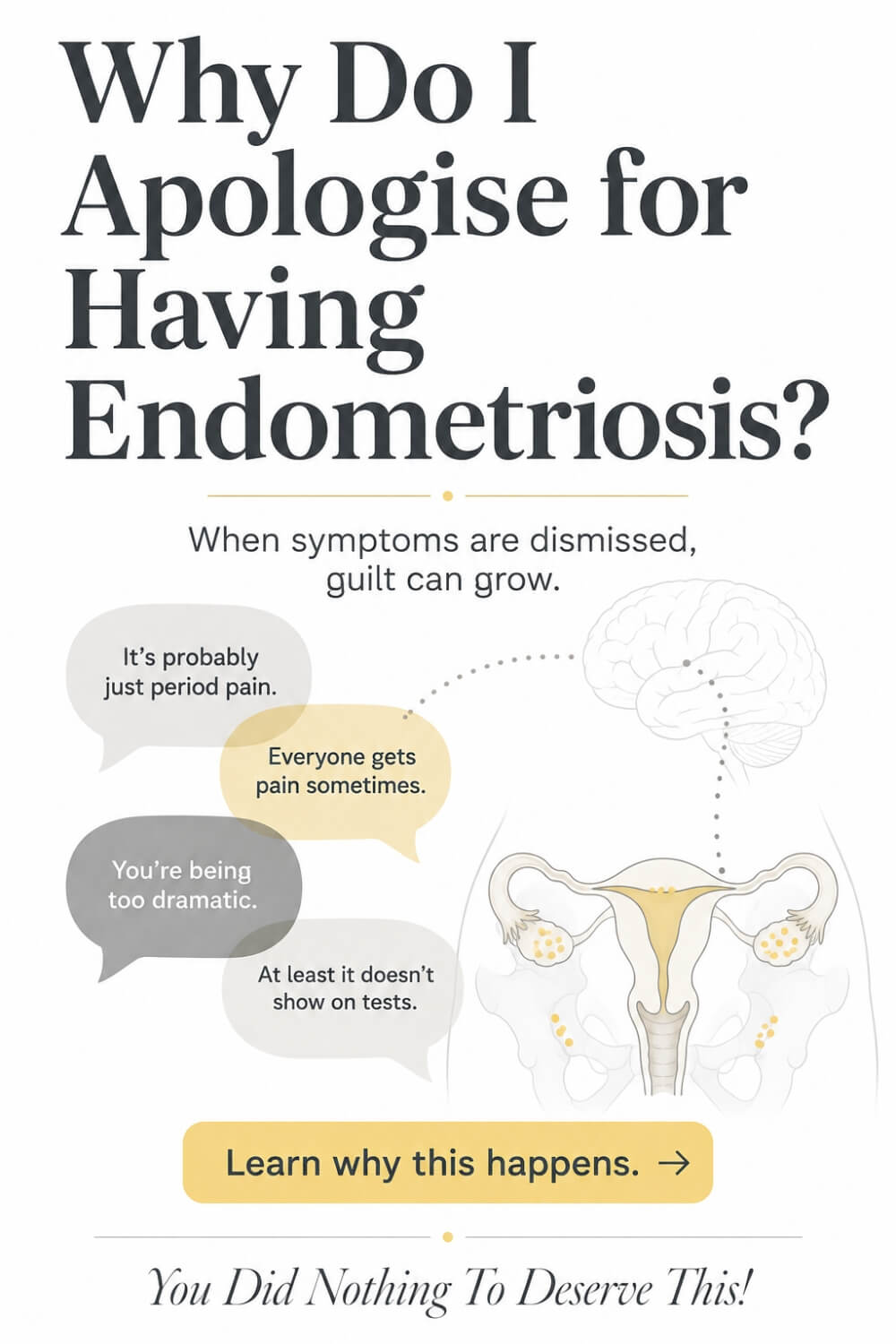
That is one of the saddest answers hidden inside the question, “Why do I apologise for having endometriosis?” because sometimes the person demanding the apology is no longer standing in front of you. Their voice may have become part of your own inner conversation after years of hearing that periods hurt, everybody gets tired, tests look normal, you should exercise more, you seemed fine yesterday, or perhaps you are simply worrying too much. When messages like these are repeated often enough, you can begin policing yourself before anybody else gets the chance.
Diagnosis does not automatically remove that conditioning. You can finally have a name for what has been happening inside your body and still feel embarrassed when you need accommodations, frightened of being considered dramatic, or uncomfortable when somebody rearranges their day around you.
I have watched something similar happen with my wife, and what stays with me is not only what endometriosis has physically taken from her but how easily a loving, capable woman can start feeling guilty for consequences she never chose. There have been times when her body simply could not cooperate with what we had planned, yet somehow she was the one saying sorry while I was looking at her thinking that the last thing I wanted was an apology.
That changes something in you as a husband. You begin to understand that support is not merely making tea, driving to appointments, helping with practical things or staying beside someone when the pain gets bad; sometimes it means protecting the woman you love from the idea that her worth has fallen because her capacity has changed.
I never want my wife measuring her place beside me by how much she can cook, clean, earn, travel, socialise, endure or give physically on a particular day. I married a woman, not a list of tasks she promised to perform regardless of what illness did to her body.
And I wish more women living with endometriosis could see themselves for a moment through the eyes of somebody who genuinely loves them. Your partner may miss the spontaneous evenings, the trips that had to change or the intimacy that pain interrupted, but missing parts of your old life is not the same as wishing you were someone else.
You are still allowed to be wanted when you need help. You are still allowed to take up space in a relationship on the days when all you can bring is yourself, and perhaps one of the deepest things you can begin learning is that being loved does not require you to apologise for surviving a difficult day.
Why Do I Apologise for Having Endometriosis in My Relationship?
One of the most painful things chronic illness can do inside a relationship is make you feel as though love has become something you have to compensate for. You may notice your partner cooking more, changing plans, attending appointments, taking over practical jobs or adjusting intimacy around your pain, and instead of seeing partnership, you begin seeing a growing list of things you owe them for.
That is where the thought “why do I apologise for having endometriosis?” can become much bigger than the word sorry itself. You may start trying to compensate on your better days, pushing yourself too hard because you feel you need to prove that you are still useful, still attractive, still independent and still worth the effort somebody is making for you. I have watched my wife try to do more than her body was comfortably allowing, and there have been moments when I wished she could see that I did not need repayment from her, I needed her to feel safe enough to tell me when she had reached her limit.
Endometriosis affects me too, of course, because I love the person who is hurting, plans sometimes change and there are things I wish I could take away from her but cannot. But my feelings about the illness are not evidence that she has failed me, and I think that distinction matters enormously for couples because a partner is allowed to find the situation difficult without making the woman living with it responsible for making everyone comfortable.
There have been evenings when what I wanted most was not for my wife to somehow overcome the pain so that our original plans could survive. I wanted her beside me, even if that meant we stayed home, changed everything or did absolutely nothing, because her value to me has never depended on how successfully she can perform normality.
Endometriosis can also reach into intimacy, spontaneity, travel, household roles and the small rituals that once happened without much thought, so both partners may sometimes grieve what has changed. What matters is whether that grief becomes something you carry together or something that gets placed onto your shoulders as another reason to feel guilty.
For me, being her husband means taking my share of that weight without making her feel indebted for it, while also being honest about my own needs so resentment is not allowed to grow silently between us. And for you, receiving that kind of love may eventually mean accepting something that illness has perhaps made difficult to believe: you do not need to earn your place beside someone every day, because a relationship built on care is not weakened whenever one person temporarily needs more of it.

When to Seek Medical Help?
Feeling guilty or apologising for needing support does not automatically mean something is wrong with your mental health. But if that guilt is becoming constant, if you are avoiding medical care because you feel like a burden, or if you are pushing through severe symptoms simply because you do not want to inconvenience anyone, it is worth telling a healthcare professional exactly what is happening.
You should also seek medical advice if your endometriosis symptoms are changing, becoming harder to manage, interfering more with work or daily life, or affecting sleep, eating, bowel movements, urination or intimacy. You do not need to wait until everything becomes unbearable before asking for help, and you do not need to prove that your pain is severe enough to deserve another conversation.
Tell your GP, gynaecologist, endometriosis specialist or pain team if fear of disappointing others is causing you to ignore your own limits. Sometimes the most useful sentence you can say is simply, “I keep pushing myself because I feel guilty when I need help.” That gives them information not only about your symptoms, but also about how the condition is affecting the way you cope with them.
If low mood, anxiety, shame or self-blame is becoming difficult to manage, mention that too. Emotional support is not separate from endometriosis care simply because the disease is physical; living with ongoing pain, uncertainty, disrupted plans and repeated limitations can affect how safe and confident you feel in your own life.
There are also times when physical symptoms need more urgent assessment. Sudden severe or unusual pelvic pain, fainting, very heavy bleeding, difficulty breathing, persistent vomiting, fever with significant pelvic pain, or feeling acutely unwell should not be dismissed as “just endometriosis.” If something feels dramatically different from your usual pattern, seek medical advice rather than assuming you simply need to endure it.
And please do not apologise when you do. You are not wasting anyone’s time by asking why something has changed, requesting better symptom control, discussing how pain affects your relationship, or admitting that you are struggling emotionally.
I have watched my wife live with symptoms for long enough to know how easily a woman can become accustomed to tolerating more than she should. The question I would rather you ask is not, “Am I making too much of this?” but, “Has this changed enough that I deserve some help understanding it?”
You do.
Questions to Ask Your Doctor
When you have spent years minimising pain or apologising for needing help, a medical appointment can become another place where you automatically make yourself smaller. You may say, “It’s probably nothing,” laugh while describing something that is seriously affecting you, or leave out symptoms because you are frightened of sounding difficult.
Please do not measure whether something deserves discussion by how well you have managed to endure it. NHS and NICE guidance both recognise that endometriosis can affect daily life, work, relationships and emotional wellbeing, and persistent or severe symptoms can justify further assessment or specialist care.
I have learnt from appointments with my wife that having questions written down can change the conversation completely. You do not have to ask every question below, but take the ones that fit your situation and make them your own.
1. Could these symptoms be coming from endometriosis, or should we investigate another cause too?
This is a particularly useful question when something has changed. Having endometriosis does not mean every pelvic, bowel, bladder or abdominal symptom automatically comes from it. Asking this keeps the conversation open and helps prevent both you and your clinician from overlooking another possible explanation.
2. Has anything about my symptoms changed enough to need further investigation?
Tell them what is different, not simply that you are “still in pain”. Explain whether the pain is stronger, lasts longer, occurs at a different time, has moved somewhere new, or is affecting things you previously managed. Changes in bleeding, bowel symptoms, bladder symptoms, fatigue, intercourse or daily functioning can also be worth discussing rather than silently adapting to them.
3. Would an ultrasound or another scan be useful for the symptoms I am having?
Ask what the investigation is looking for and, just as importantly, what it cannot tell you. Current NICE guidance recommends transvaginal ultrasound in suspected endometriosis, while assessment may sometimes involve other imaging depending on the circumstances.
If previous imaging was described as normal but you remain symptomatic, ask what that result means in your individual case rather than assuming that a normal scan automatically explains away everything you feel.
4. Do my symptoms suggest I should see an endometriosis specialist?
This can be important when symptoms remain difficult despite treatment or when there is concern about more extensive disease. NHS guidance notes that people with very severe symptoms or treatment that is not working may be referred to a specialist endometriosis service.
You are not being demanding by asking whether specialist input would add something to your care. You are asking what level of expertise best matches what your body is currently dealing with.
5. What are my realistic treatment options at this point?
Ask your doctor to explain the choices rather than simply telling you what they recommend. Depending on your circumstances, management can involve pain relief, hormonal treatment, surgery and support for other effects of the condition, but the right balance is individual.
Ask what each option is intended to improve, what its limitations are, what side effects matter, and what happens if it does not help. A treatment decision makes far more sense when you understand the reason behind it.
6. How will we know whether this treatment is actually working?
This is one I particularly like because “give it a try” should not leave you without a plan. Ask what improvement would reasonably look like, how long you are expected to continue before reviewing it, which side effects should make you contact the team, and what the next step would be if your symptoms remain unacceptable.
You deserve to know where the road goes before being asked to walk down it.
7. Could my bowel, bladder or painful-sex symptoms be relevant to where the disease is located?
Do not leave these symptoms outside the consultation because they feel embarrassing. Pain during bowel movements, urinary symptoms and pain during or after sex can form part of the clinical picture of endometriosis, and telling your clinician about them can help them decide what assessment may be appropriate.
You do not need polished medical language. “Going to the toilet hurts badly around my period” is useful information.
8. What can we do about the pain between major treatments?
Sometimes the conversation becomes so focused on diagnosis, hormones or surgery that everyday pain gets pushed into the background. Ask what you can safely do during flares, whether your current pain medicines are appropriate, whether long-term pain support may help, and what you should avoid combining.
The NHS specifically includes support for long-term pain and fatigue among the forms of help that may be needed alongside treatment for endometriosis.
9. Could I have support for the emotional impact as well as the physical symptoms?
If pain, uncertainty, disrupted intimacy, work problems or years of fighting to be believed have left you anxious, low, frightened or overwhelmed, say so. That does not mean anybody is suggesting the endometriosis is psychological. NHS guidance recognises mental-health support as one part of the wider support some people living with endometriosis may need.
Your mind lives through every difficult day your body lives through. It deserves care too.
10. What should make me contact you sooner rather than waiting for my next appointment?
This gives you something incredibly valuable: a plan. Ask which changes should prompt another GP appointment, which symptoms should lead you to contact your specialist team, and what would require urgent medical assessment.
When you know those boundaries beforehand, you do not have to make the decision while frightened, exhausted or in severe pain.
11. When should we review this plan if nothing improves?
Before you leave, try to establish what happens next. Ask when treatment should be reviewed, who you should contact if it fails, whether further investigation would then be considered, and whether another referral might become appropriate.
A clear follow-up plan can stop months from disappearing while you keep telling yourself you should simply tolerate another little bit more.
And there is one question I would encourage you to ask yourself before the appointment too: “What am I most frightened to tell them?”
Sometimes that is the symptom that sounds embarrassing. Sometimes it is painful sex, bowel problems, struggling at work, feeling unable to cope, or admitting just how much your life has narrowed around the disease.
I have sat beside my wife often enough to know how easy it is for a woman who has endured an extraordinary amount to describe it in an ordinary voice. If that sounds like you, take the full truth into the room with you.
You are not there to be the easiest patient your doctor sees that day. You are there to help them understand what living in your body is actually costing you, so the two of you can make better decisions about what happens next.
Final Word on Why Do I Apologise for Having Endometriosis
If you have reached the point where apologising feels automatic, I want you to remember what sits beneath it. You are not saying sorry because endometriosis is your fault. You are often saying it because pain has interrupted plans, changed your energy, affected intimacy, complicated work, required help, or made other people adjust around you. After enough repetition, the difference between “my illness changed this” and “I ruined this” can become frighteningly small.
That is why the question why do I apologise for having endometriosis matters so much. The apology may look harmless, even polite, but underneath it can sit years of being expected to cope, doubts about whether your pain is serious enough, fear of disappointing people, and the belief that needing care somehow lowers your value. None of those beliefs appeared because you are weak. They can grow quietly when you spend years trying to function inside a body that does not always give you predictable choices.
I have seen that conflict in my wife. I have watched a woman I love struggle physically and still worry about how her difficult day might affect me. There were times when I wanted to take the word “sorry” out of the room completely, because I was not looking at her and seeing a burden. I was seeing my wife in pain.
That distinction matters to me as her husband. Supporting her does not mean pretending endometriosis never affects me or our relationship. It does. Plans move, responsibilities change, intimacy can become complicated, and some days are heavier than others. But love is not a courtroom where the person with the illness has to defend every limitation before receiving compassion.
You can be accountable for how you treat someone without being accountable for having a chronic condition. You can apologise when you have genuinely hurt somebody without apologising because your body needed rest. You can be grateful for help without treating care as a debt. You can acknowledge another person’s disappointment without making yourself responsible for removing every uncomfortable feeling they have.
These are small distinctions, but they can change the way you speak to yourself:
- Instead of “I’m sorry I’m difficult,” you can say, “Today is difficult.”
- Instead of “I’m sorry you have to help me,” you can say, “Thank you for helping me.”
- Instead of “I’m sorry I ruined our plans,” you can say, “I hate that the pain changed our plans too.”
That is not selfishness. It is accuracy.
And if nobody has told you this clearly enough, I will: needing more care on a bad day does not make you less lovable on that day. You are not valuable only when you are productive, cheerful, sexually available, independent or easy to accommodate. The person underneath the symptoms is still there.
Endometriosis may force adjustments into your life. It does not get to decide what you are worth.
And you do not need to apologise for wanting your body, relationships, and life treated with tenderness, dignity and respect.
You are not the problem your illness created. You are a woman adapting to something difficult, unpredictable and exhausting, and that deserves understanding rather than shame. Let the apology belong only where real wrongdoing exists. Your pain, your limits and your need for support are not moral failures.
If any part of this felt familiar, I would genuinely love to hear your experience in the comments. And if you need more of this kind of validation, you can also find my FREE 130+ page eBook at the bottom of this post.


About Me
Hi, I’m Lucjan! The reason why I decided to create this blog was my beautiful wife, who experienced a lot of pain in life, but also the lack of information about endometriosis and fibromyalgia for men…
READ MORE
Grab a FREE eBook!
“You Did NOTHING To Deserve This!”
Finally hear the words nobody ever said to you, that your pain is real, your tears make sense, and you did nothing to deserve endometriosis, the dismissal, or the way it has rewritten your life.
Related Questions You May Be Asking About Why Do I Apologise for Having Endometriosis
1. Is it normal to feel guilty about having endometriosis?
Yes, guilt can become very common when pain repeatedly changes plans, work, intimacy, family responsibilities or social life. You may start feeling responsible for consequences you never chose. The important distinction is that feeling guilty does not mean you are guilty. Endometriosis is a medical condition, not evidence that you have failed the people around you.
2. Why do I feel like a burden to my partner because of endometriosis?
You may notice how much your partner adjusts during difficult periods and mistakenly translate their effort into a debt you must repay. But needing more support at certain times does not make you a burden. Healthy relationships naturally change with circumstances, and care sometimes becomes uneven. What matters is communication, mutual respect and whether both of you can speak honestly about your needs.
3. How can I stop saying sorry every time endometriosis changes our plans?
Begin by replacing apologies with accurate information. Instead of saying, “I’m sorry I ruined tonight,” try, “My pain has become too much, so I need to change our plans.” You can still acknowledge another person’s disappointment without accepting blame for becoming unwell. Over time, this helps separate compassion for others from unnecessary responsibility for symptoms you cannot control.
4. Can being dismissed about endometriosis make me blame myself?
It can. If your symptoms have repeatedly been minimised, questioned or described as normal, you may eventually begin doubting your own judgement. You can start wondering whether you are exaggerating, coping badly or asking for too much. That self-doubt can survive even after diagnosis, which is why validation and learning to trust what your body is telling you can matter enormously.
5. How can my partner help when I feel guilty about needing support?
A supportive partner can listen without making you defend your symptoms, ask what would genuinely help, and remind you that care is not something you must earn. From my experience with my wife, reassurance works best when actions match the words. Sharing practical responsibilities, respecting physical limits and talking openly can make it easier for you to receive help without turning every difficult day into an apology.
Why Do I Apologise for Having Endometriosis References
- https://www.who.int/news-room/fact-sheets/detail/endometriosis
- https://www.nice.org.uk/guidance/ng73/chapter/recommendations
- https://www.nice.org.uk/guidance/qs172/documents/briefing-paper
- https://www.nhs.uk/conditions/endometriosis/
- https://pmc.ncbi.nlm.nih.gov/articles/PMC10465859/
- https://pmc.ncbi.nlm.nih.gov/articles/PMC11106211/
- https://pubmed.ncbi.nlm.nih.gov/32781264/
- https://endometriosis.net/living/having-guilt
- https://worryhead.com/about-us/
