How Does Endometriosis Affect Sex and Intimacy?
How does endometriosis affect sex and intimacy when the person you love is right beside you, yet your body has learnt that closeness may end in pain?
You may still want sex, affection and that old sense of spontaneity, while also dreading penetration, tightening before touch, or wondering how long the pain might last afterwards. And when you start saying no more often, avoiding kisses because you fear where they may lead, or feeling guilty for protecting your own body, the loss can reach far beyond the bedroom.
Endometriosis can affect sex and intimacy through pain during or after penetration, pelvic pain, fatigue, bleeding, reduced desire, fear of pain and treatment side effects. These effects can lower arousal and satisfaction, make orgasm harder, and place emotional strain on both partners over time.
I am not a clinician; I write as a husband, blogger and researcher who has spent years learning because of what endometriosis has put my wife through, and I have listed at the bottom the medical sources I used for context, including WHO, NICE, NHS, ESHRE and published research where they apply.
Sex is only one part of what can change, and I have written more broadly about how endometriosis can reshape closeness because affection, trust, safety and communication may be affected even on nights when intercourse is not part of the conversation.
Something I wish more women were told is that sexual pain with endometriosis is not necessarily one pain in one place. Research describes deep pain, pain nearer the vaginal entrance, positional pain, pain around orgasm and pain that may continue after sex has finished, which helps explain why simply being told to “try another position” can feel painfully inadequate.
There is another layer that deserves much more attention. A 2024 study found that pelvic pain worsened by orgasm was associated with pelvic floor myalgia and greater central nervous system sensitisation, while the visible anatomical findings at surgery did not clearly distinguish the women who experienced orgasm-related pain from those who did not. A woman can therefore deeply want her partner while her body becomes tense, cautious or protective because sexual activity has repeatedly been associated with pain.
The years beside my wife have taught me that love does not become smaller because her body has limits, and those limits should never become something she feels she has to apologise for. As her husband, I would rather protect the safety between us than have the woman I love believe she must hurt herself just to prove that she still wants me.
If any of this feels painfully familiar, I want you to understand the difference between pain, fear, desire, arousal and rejection, because they are not the same thing. Once you can recognise what endometriosis may be doing to each of them, intimacy stops looking like something you have failed at and starts becoming something you and your partner can understand differently.
- How Does Endometriosis Affect Sex and Intimacy Beyond Pain?
- Separate Desire From Pain
- Remove Pressure From Penetration
- Talk Before Pain Takes Over
- Learn Your Personal Pain Patterns
- Protect Affection Without Expectations
- Change Positions Without Feeling Broken
- Give Your Body More Control
- Rebuild Safety Around Sexual Touch
- Involve Your Partner in Solutions
- Ask for Specialist Sexual Support
- How Does Endometriosis Affect Sex and Intimacy Emotionally?
- How Does Endometriosis Affect Sex and Intimacy Between Partners?
- When to Seek Medical Help?
- Questions to Ask Your Doctor
- Final Word on How Endometriosis Affects Sex and Intimacy
- FREE eBook
How Does Endometriosis Affect Sex and Intimacy Beyond Pain?
The hardest thing to understand from the outside is that sexual pain can begin affecting intimacy long before anything sexual actually happens. When sex has hurt repeatedly, your body can start preparing for pain before your mind has decided whether you even want to have sex.
That reaction does not automatically mean you have lost attraction to your partner, because expecting pain can create fear, tension and avoidance even when desire is still there.
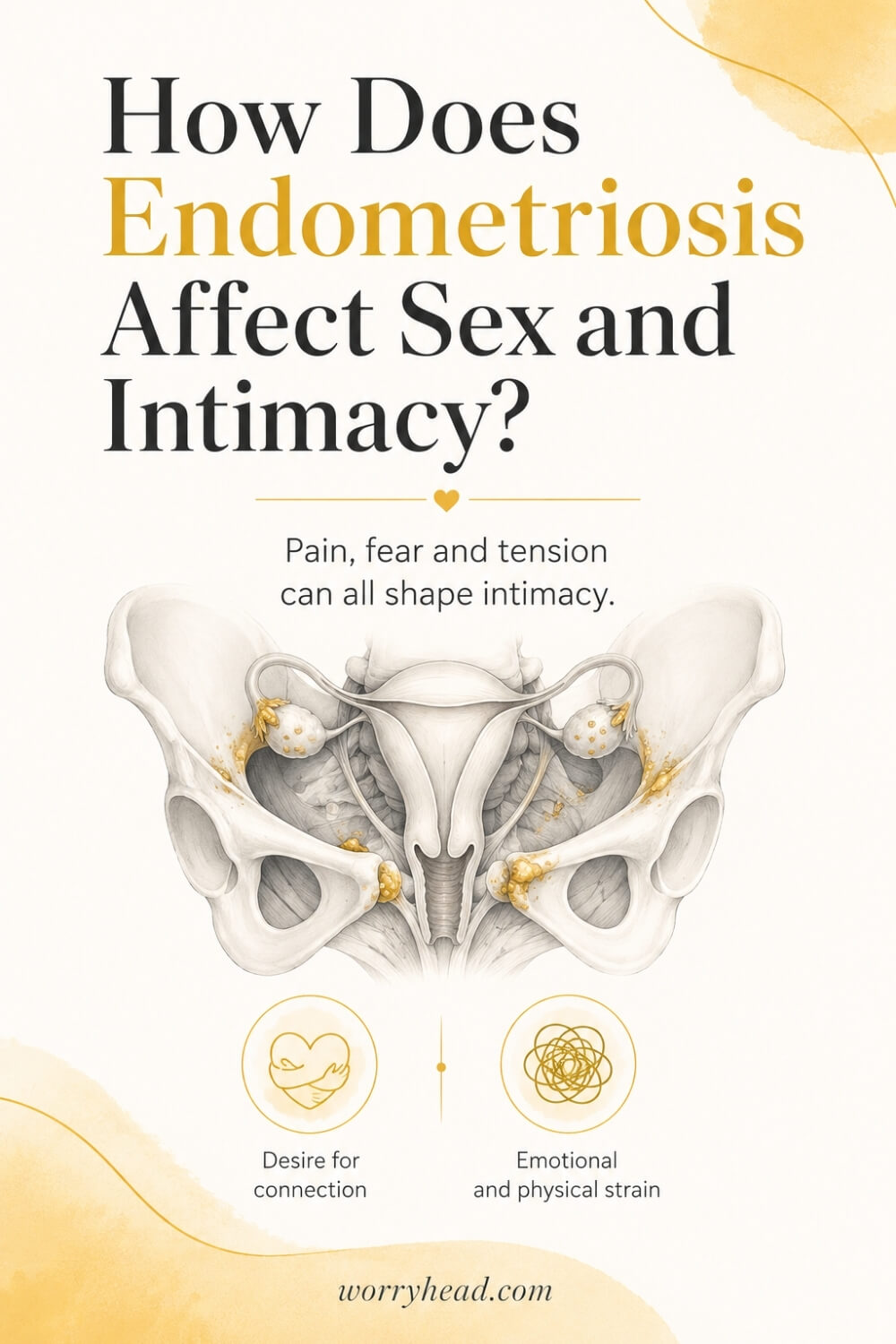
For some women, the problem is deep dyspareunia, where penetration causes pain deeper inside the pelvis rather than simply discomfort at the vaginal entrance. Deep pain has been associated particularly with endometriosis involving areas such as the uterosacral ligaments, posterior vaginal fornix, Pouch of Douglas and rectovaginal region, although the relationship between lesion location and an individual woman’s pain is far from perfect.
But anatomy is only part of what may be happening. Superficial pain can coexist with pelvic floor dysfunction or conditions affecting the vulval and vaginal entrance, which means two women with endometriosis may describe completely different experiences when they both say that sex hurts. Orgasm can also be painful for some women, and research has linked orgasm-related pain particularly with pelvic floor muscle pain and greater nervous-system sensitisation rather than simply with what surgeons can see inside the pelvis.
This matters because treating intimacy as nothing more than a question of finding a less painful sexual position can miss half of the problem. There is also what happens after the bedroom goes quiet: wondering whether it will hurt next time, worrying that your partner feels unwanted, feeling pressure to compensate, or becoming frightened that saying no again will somehow damage the relationship.
Repeated pain can teach the nervous system to become increasingly protective, while anticipating penetration may encourage pelvic muscles to tighten rather than relax. Soon, asking how does endometriosis affect sex and intimacy becomes less about intercourse itself and more about what happens to safety, trust, anticipation and the freedom to respond naturally to touch.
Desire may fall because your brain is being asked to become excited about something your body has repeatedly associated with pain, and that is very different from simply no longer wanting your partner. Arousal and lubrication may also become more difficult when you are tense, frightened of pain or unable to relax, while research comparing women with and without endometriosis has found poorer average scores across desire, arousal, lubrication, orgasm, satisfaction and pain domains of sexual function.
Fatigue, chronic pelvic pain, bleeding, treatment effects, and simply spending so much energy getting through ordinary life can leave very little physical or emotional capacity for sex. From the partner’s side, uncertainty can create its own damage when he mistakes pain avoidance for rejection, while she mistakes his disappointment or silence for proof that she is failing him, even though neither interpretation may be true.
Research involving couples has found that endometriosis can affect sex, intimacy and emotional wellbeing on both sides of the relationship, which is one reason NICE specifically recognises its sexual and psychosexual impact and recommends considering partners in support when the woman wants them involved.
The most useful shift I have learnt is to stop measuring a healthy intimate relationship by how often penetration happens and start asking whether both people still feel safe, wanted, listened to and free to say what their bodies need.
With my wife, I have learnt that there are moments when loving her properly means understanding that the closeness she needs from me may have absolutely nothing to do with sex. I cannot imagine asking the woman I love to pay for my reassurance with her pain, and I wish every woman frightened of disappointing her partner could hear a man say that without hesitation.
So before you blame your body, your libido or your relationship, there are practical ways to protect intimacy without asking you to push through pain:
- Separate Desire From Pain
- Remove Pressure From Penetration
- Talk Before Pain Takes Over
- Learn Your Personal Pain Patterns
- Protect Affection Without Expectations
- Change Positions Without Feeling Broken
- Give Your Body More Control
- Rebuild Safety Around Sexual Touch
- Involve Your Partner in Solutions
- Ask for Specialist Sexual Support
Separate Desire From Pain
One of the cruelest things painful sex can do is convince you that your desire has disappeared when what may really have disappeared is your sense of safety. You can love your partner, find them attractive and miss being close to them, yet still feel your stomach tighten when a kiss begins to suggest sex.
Try separating two questions that often become tangled together: “Do I want my partner?” and “Does my body feel safe doing this tonight?” They are not the same question. If pain, bleeding, pelvic pressure or exhaustion is making your body say no, that does not automatically mean your heart is saying no too. Naming that difference out loud can protect both of you from turning symptoms into rejection. I have learnt that a woman should never have to injure herself to prove desire, and a loving partner should never need pain as evidence of love.
Remove Pressure From Penetration
Penetration can quietly become the test by which a couple judges whether their sex life is “working”, and that can make intimacy feel like an exam your body keeps failing. If penetration is painful, taking it off the table for a while can remove the countdown that sometimes begins the moment affection starts.
That does not mean intimacy has ended. Kissing, holding one another, massage, lying skin to skin, mutual touch and other forms of sexual closeness can still belong to you if they feel comfortable and genuinely wanted. The important part is that affection is not treated as a contract that must eventually lead somewhere else. When my wife needs closeness without escalation, I want her to know my arms are still safe. Removing pressure is not surrendering your sex life; sometimes it is how you create enough trust for desire to breathe again.
Talk Before Pain Takes Over
Do not wait until you are already hurting to explain what you need. Pain can make anyone quieter, sharper, frightened or desperate to stop, and that is a difficult moment to negotiate boundaries that could have been discussed earlier when both of you felt calm.
Talk about what pain feels like, what usually triggers it, what “stop” means, whether you prefer your partner to ask questions or simply pause, and what helps afterwards. You can even agree on simple words for slow down, change position and stop completely, so neither of you has to interpret facial expressions in the middle of a painful moment. Partners need to listen without becoming defensive, because the purpose is not to assign blame. I have made mistakes by thinking support meant finding solutions; sometimes the more loving thing is hearing exactly what her body is telling us and respecting it the first time.
Learn Your Personal Pain Patterns
Endometriosis does not give every woman the same sexual pain, which is why generic advice can feel so useless. Your discomfort may change with your cycle, depth of penetration, position, bowel symptoms, bladder fullness, pelvic floor tension, fatigue or a flare that began hours before intimacy was even considered.
A simple symptom diary can help you notice patterns that memory misses. You might record when pain happens, where you feel it, whether it is sharp, burning, cramping or deep pressure, what position you were in and whether symptoms continued afterwards. This is not about scheduling your relationship around disease like a military operation. It is about giving yourself information instead of blame, and it can also make conversations with a clinician more specific. Your pattern matters because treatment should follow your symptoms and priorities, not somebody else’s version of endometriosis.
Protect Affection Without Expectations
When sex has become painful, even innocent affection can start carrying a question mark. A cuddle on the sofa, a long kiss or getting into bed together may feel risky if you worry your partner will assume that affection is permission for sex, so you may begin avoiding the very closeness you miss.
That is why couples sometimes need affection that is deliberately expectation-free. Hold hands, cuddle, kiss, stroke her hair, lie together or give a back rub while making it clear that none of it has to progress to penetration or sexual activity. For the woman in pain, that can return touch to something comforting rather than something she must monitor. For the partner, it creates a chance to show that tenderness was never only a route to sex. I want my wife to feel wanted when nothing else happens afterwards, because being cherished should never depend on what her pelvis can tolerate that night.
Change Positions Without Feeling Broken
Position can matter because depth, angle and pressure change what happens inside the pelvis, but changing position should never become another way of telling yourself that your body is defective. Some women find shallower penetration, slower movement or positions that give them greater control more comfortable, while another woman may discover that even gentle penetration is painful during a flare.
Treat experimentation as information, not a performance challenge. Use pillows if they improve comfort, slow everything down, agree that stopping is always allowed and avoid pushing through pain just because a position was comfortable last time. Symptoms can vary from one day to another, so there is no “correct” position you have failed to discover. The goal is not to outsmart endometriosis long enough to complete intercourse. The goal is for both of you to remain safe, connected and able to change your minds without guilt.
Give Your Body More Control
Pain can feel especially frightening when you do not know when pressure will deepen, movement will speed up or your body will suddenly object. Giving you more control over pace, depth, position and whether sexual activity continues can reduce some of that uncertainty and make communication much easier.
That might mean choosing a position where you control movement, guiding your partner’s hand, deciding when penetration begins or agreeing that you can stop instantly without needing to explain yourself. Control is not about one partner dominating the other; it is about making room for the person whose body is receiving the painful sensation to respond in real time. As a husband, I would rather stop ten times unnecessarily than have my wife stay silent once because she is worried about disappointing me. Your comfort is not an inconvenience that has to be negotiated away.
Rebuild Safety Around Sexual Touch
After repeated painful experiences, your body may react to sexual touch before you have consciously decided that anything is wrong. You might tense, pull away, lose arousal or feel anxious even on a day when pelvic pain is relatively quiet, because bodies learn from repetition as surely as minds do.
Rebuilding safety usually works better when there is no demand to rush back to what hurt. Begin with forms of touch that feel neutral or pleasurable, communicate throughout, stop before discomfort becomes significant and allow good experiences to exist without using them as proof that you should now be “fixed”. Progress may be uneven, especially during flares. What matters is replacing unpredictability with choice and pressure with trust. When a woman knows that “stop” will be respected immediately, her body no longer has to fight quite so hard to make itself heard.
Involve Your Partner in Solutions
Endometriosis belongs to your body, but the relationship consequences should not become yours to solve alone. If you want your partner involved, let them learn what painful sex can involve, what your symptoms are like and what kind of support actually helps instead of leaving both of you to guess.
A good partner can help notice patterns, attend an appointment if you want company, support treatment decisions, check in after painful sex and learn not to personalise every change in intimacy. They also need space to communicate honestly without turning their feelings into pressure on you. NICE guidance recognises that endometriosis can have sexual and psychosexual effects and says partners can be included in discussions when the woman wants that. I have never believed my job is to rescue my wife; my job is to stand beside her, learn, adjust and make sure she does not have to carry every consequence of this disease alone.
Ask for Specialist Sexual Support
Pain during sex deserves more than being dismissed as something you simply have to tolerate with endometriosis. If it persists, worsens or is affecting your relationship, desire or ability to be intimate, tell your GP, gynaecologist or endometriosis team specifically that sexual activity is painful and explain whether the pain is deep, superficial, during orgasm or afterwards.
Depending on what is contributing, assessment may involve endometriosis treatment, pelvic pain care, pelvic floor physiotherapy, psychosexual support or another specialist pathway. The right approach is individual because lesions, pelvic floor muscles, sensitisation, hormonal treatment and emotional responses can overlap rather than producing one simple cause. Asking for help does not mean the problem is “in your head”. Sexual wellbeing is part of health, and you deserve care that takes it as seriously as any other symptom.
How Does Endometriosis Affect Sex and Intimacy Emotionally?
There is a point where painful sex stops being only a physical symptom and begins changing how you see yourself as a sexual person. When pain repeatedly interrupts something that once felt natural, you may start wondering whether you are still desirable, whether your body has become too complicated, or whether your partner secretly misses the woman you were before intimacy became difficult.
For some women, that loss can feel like grief because sexuality may have been part of how they expressed affection, confidence, playfulness and connection. That change can affect self-esteem even when a partner has never once said that anything is wrong with her.
A 2023 systematic review and meta-analysis found that women with endometriosis had a greater risk of sexual dysfunction and, on average, lower scores for desire, arousal, lubrication, orgasm, satisfaction and pain than women without the disease. That matters because it shows that the sexual impact can spread across several parts of sexual wellbeing rather than being explained by painful penetration alone.
What statistics cannot show you is what it feels like to hesitate before undressing because you no longer completely trust what your body will allow. You may start watching your partner’s face for disappointment, apologising when you are hurting or trying to give more than your body comfortably can because you are terrified that another “not tonight” will eventually become too much.
Your partner can become frightened too, sometimes becoming hesitant to initiate affection because he does not want you to think that every cuddle carries an expectation of sex. The question I hear underneath “how does endometriosis affect sex and intimacy?” is therefore often much more painful than a question about intercourse: “Can somebody still want all of me when my body keeps changing what I can give?” Research involving couples has found that painful sex can create relational distress even though the experience and sexual consequences are not identical for both partners.
I have seen versions of that fear in my own marriage, and one of the most important things I have learnt is that my wife’s worth to me has never been measured by access to her body. There have been times when pain has changed what was possible between us, but I never wanted her lying beside me believing that my love was becoming conditional because endometriosis had taken something away from us.
Those are the moments when I want her closer, not because I expect sex, but because I know how easily a woman can start feeling guilty for symptoms she never chose. If you are reading this with tears in your eyes because you have quietly wondered whether your partner would be happier with a healthier woman, please understand that illness can change the shape of intimacy without making you less feminine, less desirable or less deserving of tenderness.
The relationship may need to learn a new language of closeness, but that is very different from saying that closeness itself has disappeared.
How Does Endometriosis Affect Sex and Intimacy Between Partners?
One reason how does endometriosis affect sex and intimacy becomes such an important relationship question is that the disease may be happening inside one body, but its consequences can quietly enter the space between two people. For the woman living with it, sex may involve calculations her partner cannot see: how painful today has been, whether penetration might trigger deeper pelvic pain, whether she has enough energy, and whether saying no again will hurt the person she loves.
For the partner, there can be a different kind of uncertainty, because he may want to initiate closeness while also being frightened of causing pain or making her feel pressured. When neither person says these things aloud, two people who desperately love each other can begin protecting one another by becoming quieter, and that silence can sometimes create more distance than the lack of sex itself.
Research examining couples affected by endometriosis has found that the effects can reach beyond sexual function into intimacy and the wider relationship, which is why the partner should not simply be treated as an irrelevant observer. But supporting your woman does not mean becoming her doctor, solving every symptom or constantly asking whether she is well enough for sex; sometimes it means giving her enough emotional safety that she can tell you exactly what she wants without worrying about managing your reaction too.
I have had to learn this in my own marriage, because there is an enormous difference between hearing my wife’s body say “I cannot” and hearing those words as “I do not want you”. When her endometriosis makes intimacy difficult, I do not want another burden placed on her shoulders by making her responsible for reassuring my masculinity as well.
Of course it affects me too, because I love her, I miss things with her, I worry about hurting her and I hate seeing something that should feel loving become another place where she has to think about pain. What protects us is remembering that we are on the same side, rather than turning her body into the problem, my needs into the problem, or sex into a scoreboard telling us whether our marriage is healthy.
For both of us, intimacy has mattered most when it has remained a place where she is completely free to be honest and I am strong enough to hear that honesty without making her pay emotionally for something her body did not choose.
When to Seek Medical Help?
Pain during sex is common enough in endometriosis that many women begin treating it as something they simply have to live with. Please do not make that bargain with your body. If sex regularly hurts during penetration, causes deep pelvic pain, leaves you hurting afterwards, or pain around orgasm is becoming a pattern, it is worth discussing specifically with your GP, gynaecologist or endometriosis team. NHS and NICE guidance both recognise pain during or after sex as an important symptom of endometriosis, particularly when symptoms are affecting everyday life or relationships.
You also deserve another review if pain that used to be manageable is getting worse, your usual treatment is no longer helping, or sexual activity has become something you avoid because you know what your body will go through afterwards. Tell the clinician exactly where the pain occurs and when it starts. “Sex hurts” is useful information, but “I feel a deep stabbing pain with deeper penetration that continues for three hours afterwards” gives them much more to work with.
Mention pain at the vaginal entrance, deep pelvic pain, rectal pressure, bladder symptoms, pain with orgasm, pelvic floor tightness and pain that continues after sex if any of these apply to you. It can also help to explain whether symptoms change around menstruation, ovulation or other parts of your cycle. Different causes can overlap, so having endometriosis does not mean every new sexual symptom should automatically be blamed on existing lesions without assessment.
Bleeding after sex should also be checked rather than assumed to be another normal part of endometriosis. There are several possible causes, many of which are not serious, but NHS guidance recommends medical assessment for bleeding between periods or after intercourse.
And please tell your clinician when the effect is emotional as well as physical. If you have stopped having sex, become frightened of penetration, are struggling with desire because you expect pain, or intimacy is creating significant distress between you and your partner, those consequences matter medically too. NICE has recognised that endometriosis can have substantial sexual and psychosexual effects, so you are not wasting anybody’s time by bringing them into the consultation.
There are a few situations where I would not advise sitting at home telling yourself, “It is probably just my endometriosis.” Seek urgent medical advice if pelvic pain suddenly becomes severe or much worse than usual, particularly if it comes with vomiting, fever or shivering, difficulty passing urine or stool, unusual vaginal bleeding or discharge, or if you may be pregnant. NHS guidance advises calling 111 for several of these combinations.
Severe worsening pelvic pain accompanied by fainting, marked dizziness, shoulder-tip pain, breathing difficulty or heavy vaginal bleeding needs emergency assessment. Those symptoms can have causes other than endometriosis, and this is one of those times when being cautious is sensible rather than dramatic.
What I have learnt beside my wife is that women with chronic pelvic pain can become extraordinarily good at enduring things. That strength can unfortunately make you wait far longer than you should because you compare every new pain with worse pain you have survived before.
You do not need to prove that you can tolerate painful sex. You do not need to wait until intimacy has completely disappeared before asking for help either. If something has changed in your body, tell somebody, describe it properly and ask what can be investigated or treated, because sexual wellbeing is part of your health too.
Questions to Ask Your Doctor
Appointments can feel ridiculously short when you are trying to explain something as personal and complicated as painful sex. I would go in with the questions that matter most to you already written down, because pain during or after intercourse is recognised in current NICE guidance as an important endometriosis symptom, and its effect on your sexual and emotional wellbeing deserves to be discussed properly.
You do not have to ask every question below. Choose the ones that sound most like what your body has been trying to tell you.
Could my endometriosis be causing the pain I feel during or after sex?
Describe exactly where you feel it rather than simply saying intercourse hurts. Tell your doctor whether the pain feels deep inside your pelvis, close to the vaginal entrance, on one side, towards your rectum or bladder, during orgasm, immediately afterwards, or several hours later. Those details can help your clinician think beyond one generic label of “painful sex”.
Does the location of my pain suggest deep endometriosis?
This is particularly worth asking if deeper penetration causes strong pelvic pain or if sexual pain occurs alongside painful bowel movements, urinary symptoms or other cyclical pelvic problems. NICE recommends specialist referral when deep endometriosis involving structures such as the bowel, bladder or ureter is suspected or confirmed.
Do not diagnose the location yourself from pain alone, though. Symptoms can provide clues, but they cannot reliably tell you exactly where lesions are.
Could something besides endometriosis be contributing to my painful sex?
I think this is one of the most valuable questions you can ask. Having endometriosis does not make you immune to pelvic floor dysfunction, vaginal or vulval pain, infection, hormonal dryness, bladder problems, bowel problems, adhesions or other causes of pelvic pain.
You deserve an assessment that asks, “What is causing this particular pain?” rather than automatically placing every symptom into the endometriosis box.
Could my pelvic floor muscles be part of the problem?
Repeated pelvic pain can affect the muscles surrounding the pelvis, and some women develop tenderness, guarding or difficulty relaxing those muscles. If penetration feels tight, burning, increasingly painful as you anticipate sex, or painful even when endometriosis treatment has improved other symptoms, ask whether pelvic floor involvement should be assessed.
I would also ask whether referral to a pelvic health physiotherapist would be appropriate. That does not mean anyone believes your pain is psychological; it means another physical part of the pain system may deserve attention.
Would an ultrasound or MRI help investigate this pain?
Ask what imaging is appropriate for your particular symptoms and who should perform it. NICE currently recommends transvaginal ultrasound for suspected endometriosis to help identify ovarian endometriomas and deep disease, including possible bowel, bladder or ureter involvement.
One question I would definitely add is, “If my scan is normal, what happens next?” A normal examination or ultrasound does not rule out endometriosis, and NICE specifically states that referral may still be necessary when symptoms persist.
Could my current treatment be affecting my sexual wellbeing?
If your desire, lubrication, bleeding pattern, vaginal comfort or general sexual response changed after beginning medication, tell your clinician when the change happened. Ask what is likely to be caused by the disease, what might be related to treatment and whether there are reasonable alternatives.
Do not stop prescribed hormonal treatment simply because you suspect it is contributing. This is exactly the kind of decision to make with the clinician who knows your treatment history, symptoms, priorities and whether pregnancy is something you are trying to achieve.
What treatment could specifically help the pain during sex?
Ask for a plan aimed at the symptom that is actually affecting you rather than accepting a vague instruction to “manage the endometriosis”. Depending on what is contributing to the pain, that conversation may include hormonal treatment, pain management, investigation of deep disease, surgery in selected cases, pelvic health physiotherapy or support addressing the sexual consequences of chronic pelvic pain.
Then ask the question that often gets forgotten: “How will we know whether this treatment is working?” You deserve something more useful than endlessly trying treatments without knowing what improvement you are looking for.
Should I be referred to an endometriosis specialist?
If symptoms remain persistent, recurrent or significantly affect everyday life despite initial treatment, ask whether gynaecology or specialist endometriosis referral is appropriate. NICE recommends specialist endometriosis services for certain forms of suspected or confirmed disease and says these services should have access to expertise including specialist imaging and multidisciplinary pelvic pain management.
You are not being difficult by asking what level of care your symptoms require.
Would psychosexual support help without dismissing my physical pain?
I would phrase it exactly like that if you are worried about being misunderstood. Psychosexual support is not an admission that endometriosis pain is imaginary.
Sexual pain can create fear, avoidance, loss of confidence, difficulties with arousal and strain between partners even when the original problem is completely physical. Treating those consequences alongside the underlying pelvic pain can make sense precisely because your body and your emotional experience do not exist as two separate people.
Can my partner be involved in these conversations?
If you want your partner there, ask. NICE recommends involving partners or other important people in discussions when the woman wishes them to be involved, and recognises the physical, sexual, psychological and social impact endometriosis can have.
Sometimes hearing the explanation from a specialist can help a partner understand that avoiding penetration is not rejection, that pain may continue after sex, and that supporting you means responding to what your body needs rather than trying to persuade it to behave differently.
What symptoms should make me come back sooner?
Before leaving the appointment, ask what changes your clinician wants you to report and what should trigger another assessment. If your sexual pain becomes substantially worse, changes character, begins happening outside your usual pattern, or appears alongside new bowel, bladder or bleeding symptoms, you should know whether they want to review you again.
That question gives you something enormously valuable when you go home: a plan instead of another period of wondering whether you are “bad enough” to ask for help.
What can I track before my next appointment?
Ask whether a pain and symptom diary would be useful. Record when sexual pain happens, where you feel it, its intensity and character, whether it occurs with penetration or orgasm, how long it lasts afterwards, what part of your cycle you are in, and any bowel, bladder, bleeding or pelvic symptoms happening alongside it.
Take that information back with you. You are giving the clinician a much clearer picture than somebody could ever get from the sentence, “Sometimes sex hurts.”
And if you freeze during appointments, take this section with you or write your three most important questions on your phone before you walk through the door. I have watched my wife live with symptoms complicated enough to fill an entire consultation, and I know how easily the question that mattered most can disappear when you are sitting opposite someone in a clinical room.
Your sexual wellbeing is not an embarrassing extra to mention if there happens to be time at the end. It is part of how endometriosis affects your quality of life, your body and sometimes your relationship, and you have every right to ask for it to be taken seriously.
Final Word on How Endometriosis Affects Sex and Intimacy
If there is one thing I hope you take away from all of this, it is that painful or changed intimacy does not mean your relationship is broken, your desire has disappeared. Endometriosis can interfere with sex through deep pelvic pain, pain during or after penetration, pelvic floor tension, fatigue, bleeding, fear of pain and changes in sexual response, but none of those things define your ability to love or be loved.
When women ask how does endometriosis affect sex and intimacy, they are often asking much more than a medical question. They are asking whether their partner will still want them, whether saying no will eventually create distance, whether their body can ever feel safe again, and whether intimacy can survive when spontaneity disappears.
Those fears deserve to be taken seriously. Pain can teach your body to anticipate danger, and anticipation can change arousal, muscle tension, desire and the way you respond to touch. Once that happens, pushing through pain rarely proves anything useful. It can instead reinforce the fear and guarding that make sexual experiences harder.
This is why communication matters. Your partner needs to understand that wanting him and tolerating penetration are not the same thing, just as you need to know that a loving relationship does not have to be measured by how often intercourse happens. Intimacy can include sex, but it can also include kissing, holding one another, laughter, tenderness, touch, vulnerability and knowing you are safe enough to say either yes or no without consequences.
I have learnt that beside my wife. There have been moments when endometriosis has changed what her body could comfortably do, and I would be lying if I said illness never changes a couple. It does. But change does not have to mean abandonment.
For me, being her husband means that her pain matters more than proving that our relationship looks normal from the outside. I do not need her to hurt herself so I can feel wanted. I want the woman, not access to her body, and I wish more women living with painful sex heard that from the person lying beside them.
You also do not have to accept persistent sexual pain without asking for help. Describe what happens, where you feel it, when it occurs, what makes it worse and whether symptoms continue afterwards. Ask whether endometriosis, pelvic floor dysfunction, treatment effects or another cause might be contributing, and ask what can actually be done.
Most importantly, stop turning a medical condition into a judgement about your worth. Your body may need different boundaries now. Your relationship may need different conversations. Your sex life may need patience, treatment and creativity.
None of those things make you difficult.
You are still worthy of desire without performing through pain, worthy of tenderness when intercourse is impossible, and worthy of a partner who understands that protecting you is not the opposite of intimacy. Sometimes, protecting the safety between two people is one of the forms of intimacy there is.
Endometriosis may change what intimacy looks like, but it does not make you less desirable, less feminine or harder to love. Pain deserves care, boundaries deserve respect, and the right partner will not ask you to prove love by suffering. You are allowed to protect your body and still expect tenderness, desire and closeness.
If something here felt like your own story, I would genuinely love you to leave a comment below. And if you need more of the validation I wish every woman with endometriosis heard regularly, you can also find my FREE 130+ page eBook at the bottom of this post.


About Me
Hi, I’m Lucjan! The reason why I decided to create this blog was my beautiful wife, who experienced a lot of pain in life, but also the lack of information about endometriosis and fibromyalgia for men…
READ MORE
Grab a FREE eBook!
“You Did NOTHING To Deserve This!”
Finally hear the words nobody ever said to you, that your pain is real, your tears make sense, and you did nothing to deserve endometriosis, the dismissal, or the way it has rewritten your life.
Related Questions You May Be Asking About How Endometriosis Affects Sex and Intimacy
1. Does More Pain During Sex Mean My Endometriosis Is Getting Worse?
No. Pain during or after sex does not reliably tell you how much endometriosis is present or whether the disease is progressing. Symptoms can be influenced by lesion location, pelvic floor tension and the way the nervous system processes persistent pain. If your sexual pain becomes more frequent, severe or different, however, it deserves a fresh medical assessment rather than an assumption.
2. Can Having Sex Make Endometriosis Worse?
Sex itself is not known to make endometriosis worse or cause lesions to spread. What it can do is temporarily trigger pain when penetration, pelvic movement, muscle contraction or orgasm irritates already sensitive areas. If you repeatedly experience significant pain afterwards, do not treat suffering as the price of intimacy. Changing what you do and discussing the symptom with a clinician is reasonable.
3. Why Can Orgasm Hurt with Endometriosis?
Orgasm causes rhythmic contractions involving the pelvic floor and uterus, and those contractions can be painful for some women with endometriosis. Research has also linked orgasm-related pelvic pain with pelvic floor muscle tenderness and greater nervous-system sensitisation. This means painful orgasm may involve more than the visible location of endometriosis lesions, which is worth explaining clearly when you seek medical help.
4. Can Endometriosis Reduce Desire Even When Sex Does Not Hurt?
Yes. Desire can fall even when penetration is not currently painful because endometriosis can bring fatigue, chronic pelvic discomfort, bleeding, anxiety about triggering symptoms and the emotional burden of an unpredictable body. Some treatments may also affect sexual wellbeing for certain women. Reduced desire therefore deserves curiosity rather than blame, especially when you still feel emotionally attracted to your partner.
5. Can Sex and Intimacy Improve After Endometriosis Treatment?
They can, but there is no single treatment that restores sexual intimacy for every woman. Hormonal treatment or surgery may reduce endometriosis-associated pain for some people, while others may also need pelvic floor physiotherapy, pain management or psychosexual support. Improvement may mean comfortable penetration, but it may equally mean less fear, greater control and finding forms of intimacy your body can enjoy again.
How Does Endometriosis Affect Sex and Intimacy References
- https://www.who.int/news-room/fact-sheets/detail/endometriosis
- https://www.nice.org.uk/guidance/ng73/chapter/Recommendations
- https://www.nice.org.uk/guidance/qs172/documents/briefing-paper
- https://www.nhs.uk/conditions/endometriosis/
- https://www.nhs.uk/symptoms/pelvic-pain/
- https://www.nhs.uk/symptoms/vaginal-bleeding-between-periods-or-after-sex/
- https://www.eshre.eu/Guidelines-and-Legal/Guidelines/Endometriosis-guideline.aspx
- https://pmc.ncbi.nlm.nih.gov/articles/PMC8623407/
- https://pmc.ncbi.nlm.nih.gov/articles/PMC11372072/
- https://pmc.ncbi.nlm.nih.gov/articles/PMC5850214/
- https://academic.oup.com/jsm/article/21/9/807/7717967
- https://academic.oup.com/smoa/article/11/2/qfad026/7185492
- https://academic.oup.com/humrep/article/31/11/2577/2274319
- https://pubmed.ncbi.nlm.nih.gov/37256217/
- https://pubmed.ncbi.nlm.nih.gov/41375589/
- https://pubmed.ncbi.nlm.nih.gov/33123695/
- https://pubmed.ncbi.nlm.nih.gov/41338448/
- https://pubmed.ncbi.nlm.nih.gov/35275272/
- https://www.endometriosis-uk.org/faqs
