Why Endometriosis Is an Invisible Illness?
Have you ever wondered why endometriosis is an invisible illness when it can take over so much of your day without leaving anything obvious for other people to see?
You may have learnt to smile, work, answer messages, or sit through a conversation while your pelvis is screaming and your energy is disappearing. What hurts even more is realising that looking composed can make other people underestimate what it took for you simply to be there.
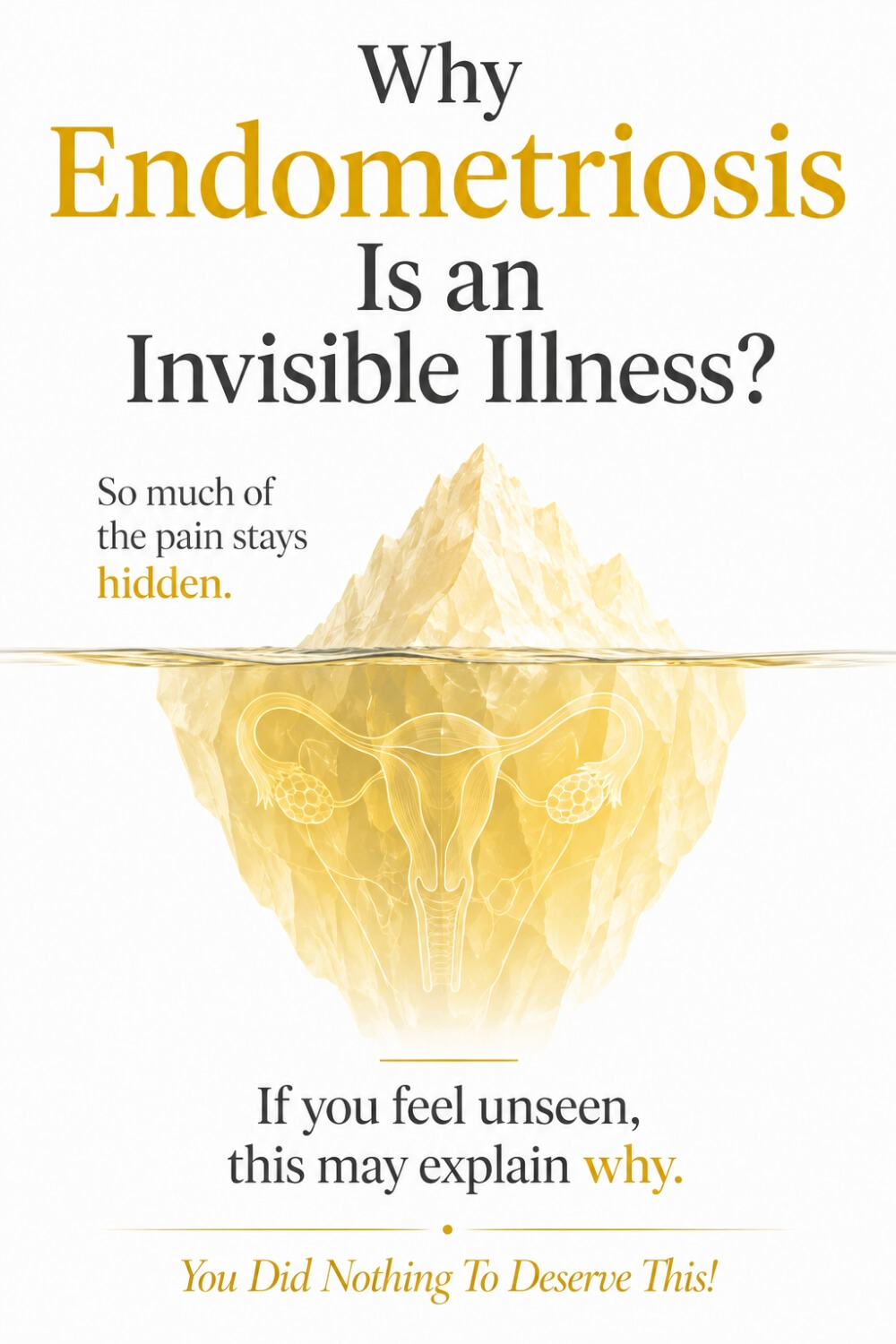
Endometriosis is called an invisible illness because the disease grows inside the body while many of its effects cannot be seen from the outside. Severe pelvic pain, fatigue, bowel or bladder symptoms, painful sex and fertility problems can disrupt your life even when you appear well to others.
I am not a clinician; I write as a husband, blogger and researcher who has spent years learning because of what my wife has lived through, and I have listed the WHO, NICE, NHS, ESHRE, and published research I used for the medical context at the bottom of this article.
And when the world judges your health by what it can see, that invisibility becomes part of the wider hidden battles endo creates, because being misunderstood can change how you work, socialise, ask for help and even trust your own symptoms.
Here is the part that surprises many people: endometriosis can be invisible to more than the eye. ESHRE warns that a negative ultrasound or MRI does not exclude endometriosis, particularly superficial peritoneal disease, while WHO reports that diagnosis still takes an average of 4 to 12 years and notes how broad and variable the symptoms can be.
Pain does not neatly advertise the amount of disease inside your body either. A 2025 systematic review found no significant difference in pain intensity between earlier and more advanced rASRM stages, which is an important reminder that nobody can measure how badly you are hurting simply by looking at you, your scan or a disease stage written in your notes.
Years of supporting my wife through stage IV deep infiltrating endometriosis taught me how enormous the gap can be between what a woman feels and what everybody else sees. That gap is one reason I stopped believing medical information alone was enough, because you can know the name of your disease and still desperately need somebody beside you who understands that what cannot be seen can still change almost everything.
If you have ever wondered whether you should have to look sicker before somebody takes you seriously, I want the rest of this conversation to give you a much clearer answer. There is far more hiding beneath “you look fine” than most people realise, and understanding it can change the way you see your symptoms, your limits and yourself.
When an illness is invisible, other people may assume you are coping simply because they cannot see what hurts. My free eBook, You Did NOTHING To Deserve This!, offers validation for the unseen battles and the exhaustion of having to explain yourself.
You Did NOTHING To Deserve This!
Endometriosis Validation for Women with Endo
- Why Endometriosis Is an Invisible Illness Beyond What Others Can See?
- Why Endometriosis Is an Invisible Illness Even When Tests Look Reassuring?
- Why Endometriosis Is an Invisible Illness Within a Relationship?
- When to Seek Medical Help?
- Questions to Ask Your Doctor
- Final Word on Why Endometriosis Is an Invisible Illness
- FREE eBook
- You Did NOTHING To Deserve This!
Why Endometriosis Is an Invisible Illness Beyond What Others Can See?
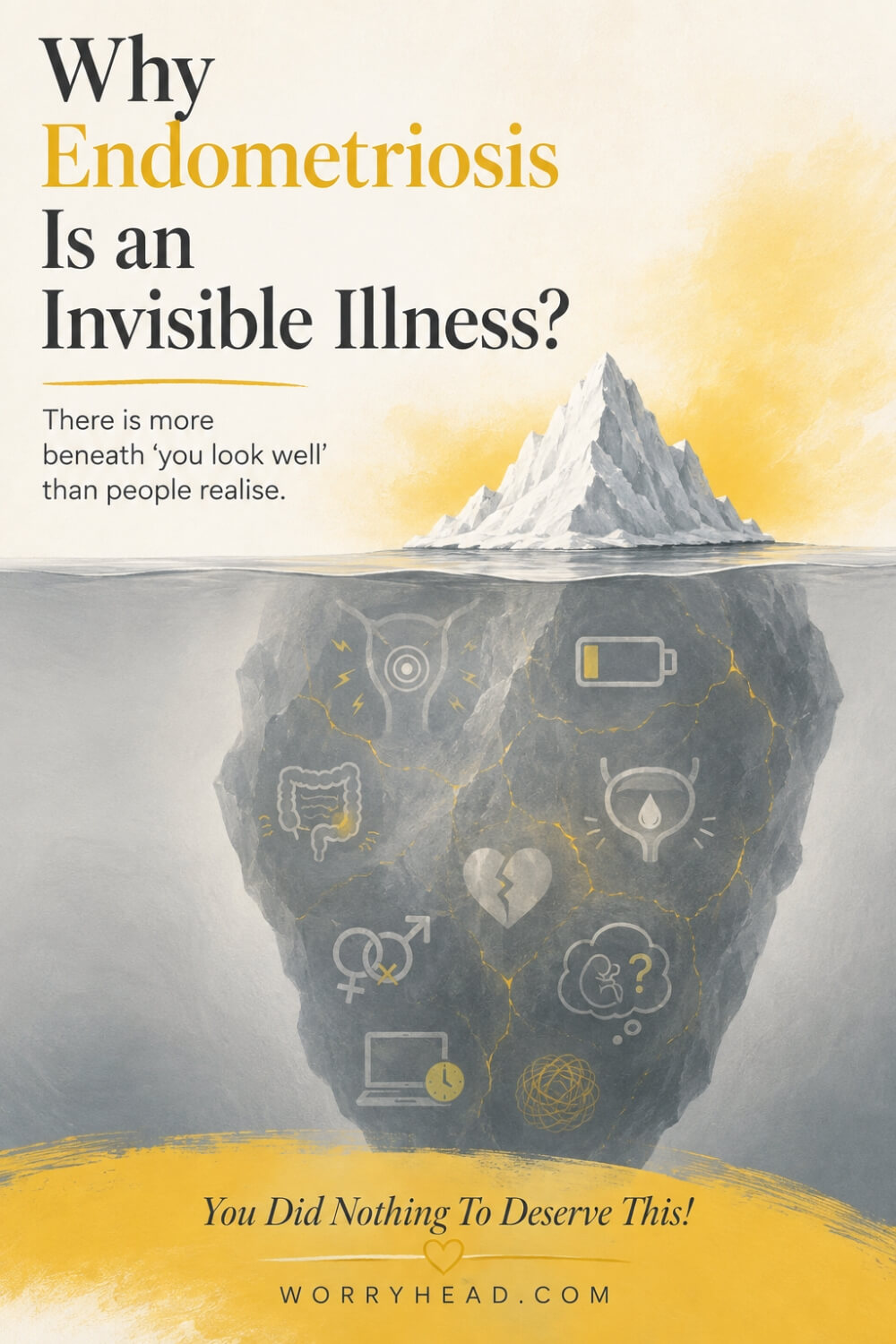
To understand why endometriosis is an invisible illness, you have to separate what your body is experiencing from what another person can observe. Someone looking at you cannot see chronic pelvic pain, painful bowel movements, bladder symptoms, nausea, abdominal bloating, heavy bleeding, exhaustion or pain during sex, yet all of these can be part of the burden of the disease.
That matters because illness is often judged through visible evidence: a cast, a wound, a mobility aid, swelling, a monitor beside a hospital bed or some other sign that tells the world something is wrong. With endometriosis, you can walk into work looking exactly as you did yesterday while the physical effort required to get through that same working day has changed completely.
Symptoms can also fluctuate, which makes the condition even easier for somebody on the outside to misunderstand. You may manage dinner with friends on Saturday and barely manage a shower on Monday, and neither day proves that the other one was exaggerated.
Endometriosis can affect much more than menstruation too, because recognised symptoms include chronic pelvic pain, painful intercourse, cyclical bowel and urinary symptoms and fertility problems, while WHO also describes fatigue, poor sexual health, depression, anxiety and social isolation among its wider effects. That means the part another person notices, perhaps that you cancelled plans again, can be only the final visible consequence of several symptoms they never witnessed.
This hidden burden follows you into employment as well as your private life. Research has repeatedly linked endometriosis-related pain with poorer quality of life, difficulty carrying out everyday activities and reduced work performance and productivity, so being physically present at work does not necessarily mean you are functioning normally.
There is even a name for part of what can happen when your account of your own body collides with somebody else’s assumptions: symptom invalidation. In a study involving responses from 1,038 patients with endometriosis, researchers found that feelings of invalidation were connected with clinicians appearing to misunderstand the nature, duration, consequences or control of patients’ symptoms, and sometimes with symptoms not being properly investigated.
Think about what repeated experiences like that can teach you to do: minimise your words, rehearse what you are going to say, question whether your pain is bad enough, or wait until you can no longer cope before asking for help. A 2025 systematic review and meta-analysis identified both patient-related barriers and provider-related factors, including misdiagnosis and reliance on non-specific investigations, as important contributors to delayed diagnosis.
And this is where invisibility becomes more than a description of a medical condition, because it can begin shaping your behaviour. You may become extremely good at appearing capable precisely because you have spent years learning how to function around symptoms other people cannot see.
That ability to carry on should never be confused with evidence that the disease is having little effect on your life. Sometimes the woman who looks the most composed is simply the woman who has had the most practice at calculating where the nearest toilet is, how long she can stand, whether sitting will hurt less, what she can cancel later and how much energy she has left before her body demands that she stop.
I have watched my wife get dressed, answer a work call and look perfectly ordinary while knowing how much effort could sit behind that ordinary-looking moment. The hardest part for me was never that strangers could not see everything she was carrying, but watching how easily an invisible struggle can make someone feel they must prove their pain, and I learnt that my job as her husband was not to interrogate what she felt but to believe her before she had to defend it.
That is why the practical steps below are about helping you protect yourself from that constant pressure, while giving the people who truly care about you a better chance of understanding what a smile, a photograph or a good day can never tell them.
- Believe What Your Body Tells You
- Track Patterns Beyond Pain Scores
- Stop Performing Wellness for Others
- Describe Function Instead of Appearance
- Plan for Unpredictable Flare Days
- Ask for Practical Work Adjustments
- Protect Your Limited Energy
- Choose Safe People to Tell
- Let Your Partner See More
Believe What Your Body Tells You
Living with an illness other people cannot see can slowly teach you to distrust yourself. If pain has been dismissed as a bad period, stress or something you should simply tolerate, you may start asking whether you are overreacting even when your body is clearly struggling. Your symptoms do not become less real because somebody else cannot measure them from across the room.
I have seen how powerful it can be when my wife does not have to convince me first. I may not feel the pelvic pain inside her body, but I can believe what she tells me and respond to what she needs that day.
Give yourself that same permission: notice what is happening, take changes seriously, and describe them honestly rather than reducing them to make other people comfortable. Believing yourself is not the same as diagnosing yourself; it is recognising that your lived experience is valuable information worth taking to a clinician.
Track Patterns Beyond Pain Scores
A number from zero to ten can be useful, but it cannot explain everything endometriosis is taking from you. Alongside pain, notice what happens to sleep, concentration, bowel or bladder symptoms, bleeding, nausea, movement, sex, work, social plans and recovery time. A day rated “five” may still be a day when you could not stand long enough to cook dinner.
Try recording patterns in a simple diary or phone note without turning your life into a medical project. Dates, cycle timing, what the symptom felt like, how long it lasted and what it stopped you doing can give a much clearer picture than “my pain was bad”.
I learnt from my wife that function often tells the story people miss: whether she could walk comfortably, sit through work, sleep, eat normally or make plans without paying for them afterwards. That information can also help you explain changes more clearly at appointments.
Stop Performing Wellness for Others
You do not owe anybody a convincing performance of being well. Many women become so skilled at smiling through pain that friends, colleagues and even family begin to assume the smile is evidence that everything is fine. Then, when you finally say you cannot manage something, the response can be, “But you looked okay earlier.”
There is nothing wrong with enjoying a good hour, dressing nicely, laughing or posting a happy photograph. None of those things cancel an illness that may be hurting you before, during or after that moment. I would rather my wife tell me, “I can do this, but I am struggling,” than feel she must protect me from the truth by pretending.
You are allowed to be honest without looking devastated enough to satisfy somebody else’s idea of sickness. The goal is not to prove how ill you are; it is to stop wasting precious energy pretending you are less affected than you really are.
Describe Function Instead of Appearance
When somebody says, “You look well,” arguing about how ill you look rarely helps because appearance was never the best measure in the first place. A clearer way to explain invisible symptoms is to describe function: “I can sit for twenty minutes before the pain builds,” “I woke four times last night,” or “I had to cancel because walking became difficult.” Specific effects help another person understand what the illness is actually changing.
This is also useful in medical appointments because words such as “bad”, “awful” and “severe” can mean different things to different people. Explain what the symptom prevents, interrupts or forces you to change.
I learnt to listen for those details with my wife because “I am in pain” could mean anything from needing a slower evening to being unable to do something she had planned all week. Function makes the invisible more concrete without asking you to exaggerate a single thing.
Plan for Unpredictable Flare Days
One of the cruel parts of an unpredictable condition is that you can make a sensible plan while feeling relatively well and still wake up unable to follow it. That does not make you unreliable. It means your plans sometimes need room for a body whose symptoms can change faster than your diary does.
Build flexibility where you realistically can. Leave recovery space around demanding days, have easier meals available, know what can be postponed, and avoid filling every better day simply because you finally have some energy. In our home I learnt that changing a plan is not failure if changing it protects my wife from pushing until she crashes.
We can still want a normal life while admitting that some days need a different version of normal. A backup plan cannot remove endometriosis, but it can remove some of the panic, guilt and explaining that often arrives when symptoms suddenly become louder.
Ask for Practical Work Adjustments
Work can make an invisible illness especially difficult because being present can hide how much effort your body is using just to stay present. Instead of feeling you must disclose every private medical detail, think about the practical barriers created by your symptoms. You may need easier toilet access, flexibility for appointments, changes to sitting or standing, short breaks, altered hours or some capacity to work differently during difficult periods. WHO and NICE both recognise that endometriosis can interfere substantially with work, daily activities and quality of life.
What is appropriate will depend on your job, your symptoms and the support available where you live, so discuss your needs with your clinician and employer rather than assuming one arrangement fits everyone. My wife has worked through years when people could see a capable employee while I could see what the working day sometimes cost her afterwards.
That taught me something important: an adjustment is not special treatment when its purpose is to help you do your job without unnecessarily worsening the burden you already carry.
Protect Your Limited Energy
Pain is not the only thing that can empty your tank. Poor sleep, heavy bleeding, fatigue, medication effects, bowel symptoms, appointments, stress and the effort of constantly managing discomfort can all take energy before your day has properly started. WHO recognises fatigue as part of the wider burden of endometriosis, alongside pain and effects on emotional and social wellbeing.
If you spend that limited reserve proving that you can keep up with everybody else, there may be very little left for yourself. I used to think support mainly meant stepping in once my wife was visibly struggling. Over time I understood that better support can mean noticing the load earlier, taking something off her plate and not waiting until she reaches the point where she has nothing left.
You can do a similar thing for yourself by deciding what genuinely needs your energy today and what can wait. Rest is not something you must earn by becoming completely exhausted first. Protecting energy is often what allows you to stay connected to the parts of life that still matter to you.
Choose Safe People to Tell
Not everybody deserves the full story of what happens inside your body. Some people will listen, remember what you told them and adjust their expectations with kindness; others may compare, minimise, offer unwanted cures or turn your most vulnerable information into a debate. Being selective is not secrecy.
It is a boundary, and you are allowed to decide who gets access to the most vulnerable parts of your experience. Start with the people who make you feel safer after you speak rather than smaller.
You can tell one person more, another person only what they need to know, and somebody else nothing beyond “I have a chronic health condition that sometimes affects what I can do.” I have learnt that validation is often remarkably simple: listening without correcting, believing without demanding proof and asking what would actually help. When your illness is invisible, having even one person who does that can reduce the exhausting feeling that you must explain yourself from the beginning every single time.
Let Your Partner See More
If you have a loving partner, try not to protect them from every difficult part of your illness. I understand why you might do it. You may worry that talking about pain too often will make you a burden, change how they see you or make your relationship revolve around endometriosis, so you hide more than you realise.
But a partner cannot support what they are never allowed to see. Some of the most important things I learnt about my wife did not come from a medical leaflet; they came from listening when she told me what a symptom felt like, noticing what drained her and learning what actually helped.
I also had to accept that loving her did not mean I could fix everything. You deserve a relationship where illness does not make you less wanted, less feminine or less worthy of tenderness. Letting someone close enough to understand your harder days is not asking them to save you; it is giving love the chance to become practical, informed and real.
Why Endometriosis Is an Invisible Illness Even When Tests Look Reassuring?
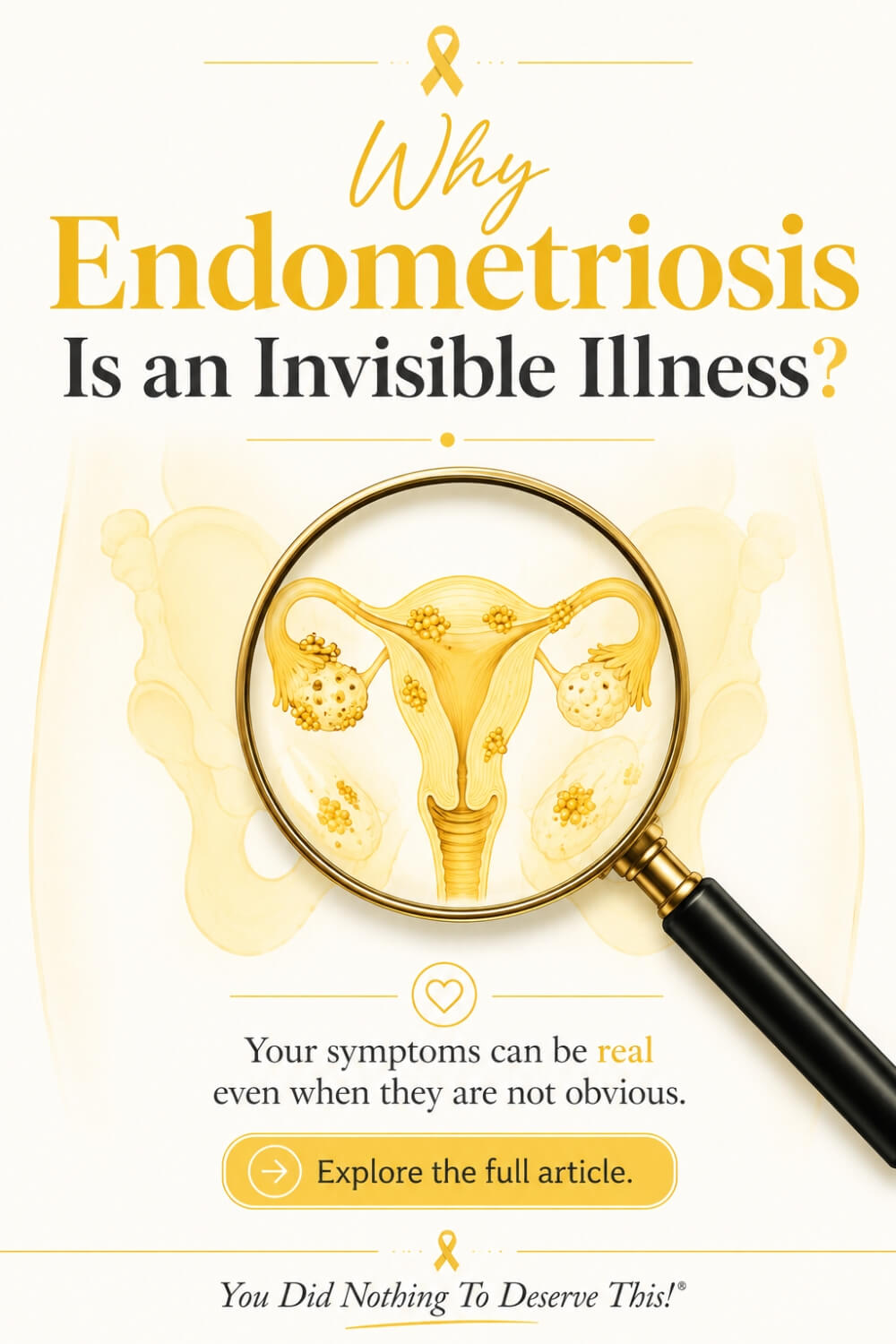
One of the hardest parts of understanding why endometriosis is an invisible illness is realising that medicine itself cannot always make the disease visible on demand. A normal examination, ultrasound or MRI can feel reassuring on paper while still failing to explain the pain that brought you through the clinic door in the first place.
ESHRE specifically warns that negative imaging does not exclude endometriosis, particularly superficial peritoneal disease, because ultrasound and MRI are much better at identifying some forms of disease than others. NICE guidance in the UK makes the same practical point: a normal examination or ultrasound should not be used as a reason to dismiss ongoing symptoms when endometriosis is still suspected.
There is no routine blood test that can simply confirm or exclude the disease either, which means your history, symptom pattern, examination, imaging and response to treatment all become pieces of a much larger clinical puzzle. That matters enormously when you have already spent years hearing some version of, “Everything looks normal,” because normal-looking results and normal health are not always the same thing.
The stage written beside a diagnosis cannot reliably tell another person how much pain you live with either. A systematic review and meta-analysis published in 2026 found that pain intensity did not significantly differ between earlier rASRM stages I and II and advanced stages III and IV, although chronic pelvic pain was more common in advanced disease.
This matters because a woman should never have to earn the right to be believed by having enough visible disease, a dramatic enough scan or a sufficiently high stage number. Medicine needs measurements, but you are more than a measurement, and the effect a condition has on your ability to sleep, work, move, have sex, use the toilet, make plans or simply feel safe inside your body belongs in that clinical picture too.
My wife’s experience made that lesson painfully real for me because her eventual diagnosis involved severe, deep disease, yet the suffering that came before diagnosis had already been real every single day it went unnamed. By the time surgery revealed how extensive things were inside her pelvis, no discovery in an operating theatre could give back the years when what she felt was happening long before the outside world could properly see it.
I remember thinking how strange it was that evidence could suddenly make suffering more believable to other people when the woman I loved had been living inside that evidence all along. That experience changed the way I listen to her, because I never want her to feel that she needs a scan, a surgical photograph or another doctor’s sentence before her husband takes her seriously.
If you are still waiting for answers, please do not turn an inconclusive test into a verdict on your own honesty; let it be one piece of information that you discuss with a clinician who is willing to look at the whole pattern rather than asking one image to tell your entire story.

Why Endometriosis Is an Invisible Illness Within a Relationship?
Another reason why endometriosis is an invisible illness is that some of its deepest effects happen behind the closed doors of a relationship, where nobody else sees the conversations, changed plans, difficult nights or quiet adjustments that become part of ordinary life. WHO recognises that endometriosis can affect sexual health, social life and quality of life, and painful sex can lead to interruption or avoidance of intercourse, affecting both the person with the disease and her partner.
Research involving couples has found effects on intimacy, working life, household income, plans for children and the support roles partners take on, yet almost none of that is visible when somebody sees a couple smiling together outside their home. But a relationship is rarely affected by one dramatic event; more often, it is hundreds of small decisions that nobody else notices.
A cancelled dinner might look insignificant from the outside, while inside your relationship it may follow hours of pain, exhaustion, bleeding or anxiety about whether your body will cope. You may be calculating whether sex will hurt tonight, whether you have enough energy for the weekend, whether you are disappointing the man you love, or whether mentioning the pain again will make you sound as though illness is all you ever talk about.
Research also shows that endometriosis-related pain can affect intimate relationships while supportive partners can become an important source of practical and emotional support. My wife has lived on the harder side of that reality, and I have seen how easily pain can make the woman you love question whether she is still desirable, still fun to be around or somehow asking too much simply because her body needs more understanding than it once did.
There have been times when I could see that she was struggling before anybody else would have noticed, not because I possess some special ability, but because years beside her taught me to recognise the smaller changes in how she moves, rests, speaks and decides what she can manage.
I learnt that being her husband does not mean trying to rescue her from a disease I cannot remove; it means carrying more of the practical load when necessary, protecting her from unnecessary pressure, listening properly and making sure that pain never becomes evidence in her mind that she is less loved.
Endometriosis affects her body first, and I never want my own frustration or helplessness to compete with that truth, but loving somebody also means acknowledging that a chronic illness enters the shared parts of life and asking how we face those changes together rather than leaving her to manage them alone.
What protects us is not pretending that the disease has no effect on our relationship; it is making sure that when it does affect us, my wife never has to wonder whether being ill has made her less wanted, because some of the most powerful validation a partner can give is simply showing, again and again, “I still see you, not just what endometriosis has changed.”
When to Seek Medical Help?
One difficult consequence of living with an invisible illness is that you can become used to functioning through symptoms that would make somebody else stop and ask for help. After months or years of pelvic pain, fatigue, painful periods or bowel and bladder problems, it is easy to develop your own version of “normal” and tell yourself you will mention it at the next appointment.
You do not have to wait until you look seriously unwell before speaking to a doctor. The NHS advises seeing a GP if you think you may have endometriosis, if symptoms are affecting everyday life, work or relationships, or if treatment has not helped or symptoms are getting worse.
I think the words “affecting everyday life” are important because they give you a much better measure than appearance. If pain regularly changes how you walk, sleep, work, exercise, have sex, use the toilet, socialise or plan your month, tell your doctor that. Those details explain the true burden of something that may be almost completely invisible during a ten-minute appointment.
You should also go back for medical review if a treatment that once controlled your symptoms is no longer helping, your symptoms repeatedly return, or you are developing a pattern that is different from the one you normally experience. NICE recommends referral to gynaecology when symptoms persist or recur, significantly affect daily life, or initial treatment is ineffective, not tolerated or unsuitable.
And please do not assume that a previous normal examination, ultrasound or MRI means there is nothing more to discuss. Current ESHRE guidance specifically states that negative imaging does not exclude endometriosis, particularly superficial peritoneal disease, while NICE advises that endometriosis should not be ruled out simply because examination or ultrasound findings are normal.
There are situations where specialist endometriosis care becomes particularly important. NICE recommends referral to a specialist endometriosis service when an endometrioma or deep endometriosis is suspected or confirmed, including disease involving the bowel, bladder or ureter, as well as endometriosis outside the pelvis. If your symptoms suggest these areas may be involved, asking whether specialist assessment is appropriate is a reasonable question, not an overreaction.
There is also something I would want my wife, and any woman reading this, to remember: having endometriosis does not mean every new pain must automatically be endometriosis. Pelvic pain can have many causes, and a noticeable change deserves assessment rather than being written off simply because you already have a diagnosis.
Some symptoms need more urgent advice. In the UK, NHS 111 advises urgent assessment when pelvic pain is accompanied by difficulty passing urine or opening your bowels, blood in your urine or stool, unusual vaginal bleeding or discharge, fever or shivering, vomiting, or if you are pregnant or could be pregnant. These signs do not automatically mean something dangerous is happening, but they are good reasons not to sit at home trying to decide whether you are “ill enough” to ask.
Seek emergency help if pelvic or abdominal pain suddenly becomes severe or rapidly worsens, especially if you are faint, dizzy, struggling to breathe, experiencing heavy vaginal bleeding or becoming seriously unwell. If pregnancy is possible, sudden intense abdominal pain with bleeding, shoulder-tip pain, dizziness or fainting also needs urgent assessment because an ectopic pregnancy must be ruled out rather than assuming the symptoms are related to endometriosis.
I would apply the same principle to unusual chest symptoms. ESHRE includes cyclical chest pain, shoulder-tip pain, coughing blood and cyclical breathing-related symptoms among signs that can warrant consideration of endometriosis, but breathlessness and chest symptoms can have many other causes too. New or significant difficulty breathing should therefore be assessed urgently rather than self-diagnosed as thoracic endometriosis.
What years beside my wife have taught me is that knowing your usual pattern matters. She knows her own body in a way that I never could, and if she tells me, “This is different,” I do not think the right response is to remind her how much pain she normally tolerates. The fact that you have survived worse pain before does not mean today’s change deserves less attention.
You also do not need to arrive at an appointment with a perfect explanation. Bring the pattern instead: where it hurts, when it happens, whether it follows your cycle, what other symptoms come with it, what has changed, what treatments you have tried and what the symptoms now stop you from doing. ESHRE notes that symptom diaries can help organise this history even though they have not been proven to shorten the time to diagnosis.
Most importantly, do not measure whether you deserve medical help by how sick you look. That would repeat the very mistake this whole discussion is trying to challenge. Endometriosis can remain hidden behind ordinary clothes, a normal conversation and even some reassuring test results, but a change in what your body is telling you still deserves to be heard.
Questions to Ask Your Doctor
When endometriosis is largely invisible, an appointment can feel strangely unfair. You may have spent weeks living with pain, exhaustion, bowel problems, bladder symptoms or disrupted sleep, then suddenly have ten or fifteen minutes to explain something that has been affecting almost every corner of your life.
I have learnt from going through this journey beside my wife that preparation can make those minutes much more useful. You do not need to arrive sounding like a medical professional, and you should never feel that you have to present a courtroom case proving that you are suffering. You simply need questions that help your doctor understand what is happening, what has already been investigated and what the next sensible step should be.
These are the questions I would want my wife to feel comfortable asking.
“Could these symptoms still be endometriosis even if my examination or ultrasound is normal?”
This is one of the most important questions you can ask if your symptoms and test results seem to be telling two different stories. NICE specifically advises clinicians not to exclude endometriosis simply because an abdominal or pelvic examination or ultrasound is normal, while ESHRE warns that negative imaging cannot reliably exclude the disease, particularly superficial peritoneal endometriosis.
That does not mean a normal scan should be ignored. A reassuring result can still provide useful information. It simply means that “nothing obvious was seen” and “there is definitely no endometriosis” are not the same statement.
If you leave an appointment remembering nothing else, remember that distinction.
“What type of endometriosis can this scan actually detect?”
I think this is a much better question than simply asking whether your scan was “normal”. Ultrasound and MRI can be particularly useful for identifying ovarian endometriomas and deep endometriosis, while superficial disease remains harder to identify reliably with imaging.
You can also ask who will perform and interpret the scan and whether they regularly assess patients for suspected endometriosis. Imaging is not just about owning the machine. The type of disease being looked for and the experience of the person performing and interpreting the examination matter.
If bowel, bladder, ureteric or other deep disease is suspected from your symptoms, ask whether the imaging being arranged is appropriate for assessing those areas. You deserve to understand what a test can tell you as well as what it cannot.
“Can I explain what these symptoms stop me doing?”
Please ask this even if your doctor has already asked you for a pain score.
Saying that your pain is seven out of ten gives one piece of information. Saying that you cannot sit through a meeting, wake repeatedly during the night, cannot comfortably empty your bowel during your period, avoid sex because penetration causes deep pain, or need a day to recover after an ordinary outing gives a much fuller picture.
NICE uses the effect of symptoms on daily living as one of the reasons referral to gynaecology may be appropriate. Your ability to function therefore matters clinically, not only emotionally.
This is something I wish more women knew because looking composed inside a consulting room can hide an enormous amount. Tell the doctor what your body prevents you from doing when nobody from that clinic is there to see it.
“My symptoms are persistent. Should I be referred to gynaecology?”
There is nothing confrontational about asking this.
Current NICE guidance recommends referral to a gynaecology service when initial treatment is ineffective, unsuitable or not tolerated, when symptoms persist or recur, when they significantly affect everyday life, or when there are pelvic signs of endometriosis. The NHS similarly advises going back when treatment has not helped or symptoms are worsening.
You are not demanding a particular diagnosis by asking whether referral is appropriate. You are asking what the next level of assessment should be when the problem has not been solved.
Those are two very different things.
“Do my symptoms suggest I need a specialist endometriosis service?”
This question becomes particularly important when there is an ovarian endometrioma, suspected deep endometriosis, disease outside the pelvis, or possible involvement of organs such as the bowel, bladder or ureter. NICE recommends specialist endometriosis services for suspected or confirmed disease in these situations.
Do not panic if your doctor discusses specialist referral. It does not automatically mean that your condition is becoming dangerous or that surgery is inevitable.
Specialist care simply brings access to clinicians and multidisciplinary expertise appropriate for more complex disease. My wife’s endometriosis involved several pelvic structures, and seeing how complicated this illness can become taught me why the right expertise matters.
Sometimes the most valuable question is not simply, “What treatment do I need?” but, “Am I in the right place to make that decision?”
“Could something else be contributing to these symptoms too?”
Having suspected or confirmed endometriosis should not make every new symptom automatically belong to endometriosis.
The NHS notes that its symptoms can overlap with conditions including adenomyosis, fibroids, pelvic inflammatory disease and irritable bowel syndrome. There can also be more than one condition present at the same time.
Asking about alternative or additional explanations does not invalidate your endometriosis. It protects you from the opposite problem, where a known diagnosis becomes the explanation for everything and another treatable problem is overlooked.
I would want a doctor caring for my wife to take her endometriosis seriously while still remaining curious when something changes.
You deserve that same balance.
“What are we actually trying to achieve with this treatment?”
Pain relief? Fewer bleeding problems? Better day-to-day function? Trying to conceive? Preventing troublesome symptoms from returning? Managing symptoms while avoiding surgery?
Those priorities matter because endometriosis treatment is not one straight road that every woman follows. The NHS describes medicines, hormonal treatment and surgery among management options, while fertility goals can change which choices are appropriate.
Ask your doctor what success would realistically look like for the option being discussed and how long you should give it before deciding whether it is helping.
I like this question because it moves you away from simply being handed another prescription and hoping for the best. It gives you something concrete to judge later.
If three months from now your life is no easier, you should know whether that means the treatment needs more time, needs adjusting or needs reconsidering.
“What are the benefits, limitations and side effects of my options?”
You are allowed to ask this about medication, hormonal treatment, pain management and surgery.
You are also allowed to say what matters to you. Perhaps a previous treatment caused side effects you could not tolerate. Perhaps fertility is important to you. Perhaps your biggest problem is bowel pain rather than menstrual bleeding. Perhaps pain during sex is affecting your relationship more than anyone has realised because nobody has asked.
The right decision should involve more than the name of your diagnosis.
If surgery is being discussed, ask exactly what is planned, what the surgeon expects to treat, what could be found, what might require another specialist, what recovery usually involves and what surgery cannot promise. NICE specifically recommends discussing the potential benefits and risks of laparoscopic surgery and the possibility that further planned surgery may sometimes be required when deep disease involves the bowel, bladder or ureter.
You deserve informed choices, not false certainty.
“If this treatment does not work, what happens next?”
I love this question because it prevents you from leaving with a plan that simply ends.
Ask when you should return, what would count as treatment failure, which symptoms should trigger earlier review and what the next option might be. If imaging has been negative but symptoms remain strongly suggestive of endometriosis and empirical treatment is unsuccessful or inappropriate, ESHRE advises that clinicians can consider laparoscopy as part of the diagnostic and treatment pathway. NICE also says laparoscopy can be considered even where ultrasound, or MRI when performed, has been normal.
That does not mean everybody with pelvic pain needs an operation. Laparoscopy is invasive and its benefits, risks and suitability need individual discussion.
What matters is knowing that one unsuccessful step does not have to become the end of the conversation.
“Which changes should make me seek help sooner?”
Before leaving, ask your doctor what would be unusual enough for you to contact them sooner rather than waiting for the next routine appointment.
This is especially valuable when you live with chronic pain because your threshold for tolerating discomfort may have become much higher than you realise. You can become so accustomed to getting through difficult days that a genuinely important change gets absorbed into your normal coping routine.
Ask what symptoms would need urgent assessment in your particular situation and whether there are specific concerns related to any endometrioma, previous surgery, bowel or bladder involvement, medication or other findings you already have.
Knowing what deserves urgent attention does not make you frightened of your body. Done properly, it can do the opposite because you no longer have to treat every flare as an emergency while also knowing which changes you should not ignore.
“Can we write down what the next step is?”
This sounds almost too simple, but I think it is one of the most useful questions on this page.
Pain, anxiety and the pressure of trying to remember everything can make an appointment blur together afterwards. Before you leave, make sure you understand what is happening next: medication, imaging, blood tests, referral, follow-up, specialist review or simply a period of monitoring.
Ask when you should expect that next step to happen and what you should do if you hear nothing.
If you can access your results or appointment letters, keep them. Keep a simple symptom record too, particularly when there are clear changes around menstruation or when symptoms affect your bowel, bladder, sex, sleep or ability to function. ESHRE notes that symptom diaries or apps can be useful during history taking.
And please remember this when you walk into that room: you are not difficult because you arrived with questions.
I watched my wife live with symptoms that no appointment could fully reproduce. A doctor saw minutes of her day; I saw the hours before that appointment, the nights when sleep was broken, the plans pain changed and the strength it sometimes took merely to appear fine.
That is why I would never want you to believe that being calm, dressed, smiling or able to walk into a consultation makes your suffering less worthy of attention.
Your doctor brings medical knowledge to that conversation. You bring something nobody else can bring: the lived history of your own body.
The best appointments happen when both are allowed to matter.
Final Word on Why Endometriosis Is an Invisible Illness
If there is one thing I want you to take away, it is that visibility is a terrible measure of suffering. Endometriosis can affect pain, bleeding, bowel and bladder function, intimacy, fertility, sleep, energy, work, relationships and emotional wellbeing while leaving no obvious sign on your face. You can look fine while using enormous strength to get through a day.
Understanding why endometriosis is an invisible illness matters because the problem is not only that the disease develops inside the body. The harder part is what happens when symptoms cannot be seen, tests do not show the full picture, pain changes from one day to another, and the world begins using your appearance as evidence against your experience.
That can make you question yourself. You may wonder whether you are being dramatic, whether you should push through another day, whether you have mentioned the pain too often, or whether somebody would finally believe you if you looked as unwell as you feel. Please do not let another person’s inability to see your symptoms become the ruler you use to measure them.
I learnt this slowly beside my wife. There were appointments, working days, family moments and ordinary evenings where somebody looking from the outside would have seen a woman carrying on with life. I saw what happened before and afterwards. I saw the energy required, the plans quietly changed, the pain hidden behind concentration and the calculation involved in doing things other people could do without thinking twice.
That changed me as her husband. I stopped thinking support meant waiting until she visibly could not cope. I began understanding that love sometimes means believing the sentence before you see the evidence, noticing the cost before somebody collapses, taking pressure away without making her feel incapable, and never making her illness compete for permission to be taken seriously.
You deserve that kind of understanding too.
You deserve clinicians who listen to the pattern of your symptoms rather than judging your health by one appointment. You deserve relationships where cancelling a plan does not require an apology worthy of a courtroom defence. You deserve to say that sex hurts, that exhaustion is crushing you, that your bowel or bladder symptoms frighten you, or that today is simply harder without feeling that you must soften every sentence.
And you deserve to have good days without those days being used against you.
Laughing does not erase chronic illness. Working does not prove that you are well. Makeup does not cancel pelvic pain. A holiday photograph does not show what happened later that evening. A normal scan does not automatically explain every symptom away.
Endometriosis may be hidden from other people’s eyes, but your experience is not imaginary. You know what your body asks you to carry.
The right people will not demand that you suffer visibly enough before they care. They will listen, learn and stand beside you.
That is the kind of support I want every woman with endometriosis to know she deserves.
You do not need to look broken for your pain to matter. Endometriosis can hide beneath an ordinary face while changing how you move, work, love, rest and plan your life. Believe what your body tells you, ask for help when you need it, and hold close the people who never make you prove that your suffering is real.
If something here made you feel seen, I would genuinely love you to leave a comment and share what living with an invisible illness has meant for you. You can also check out my FREE 130+ page eBook at the bottom of this post if you need more of the validation, understanding and support I wish every woman with endometriosis received.


About Me
Hi, I’m Lucjan! The reason why I decided to create this blog was my beautiful wife, who experienced a lot of pain in life, but also the lack of information about endometriosis and fibromyalgia for men…
READ MORE
Grab a FREE eBook!
“You Did NOTHING To Deserve This!”
Finally hear the words nobody ever said to you, that your pain is real, your tears make sense, and you did nothing to deserve endometriosis, the dismissal, or the way it has rewritten your life.
Related Questions You May Be Asking About Why Endometriosis Is an Invisible Illness
1. Can endometriosis be invisible on ultrasound or MRI?
Yes. Ultrasound and MRI can identify some forms of endometriosis, especially ovarian endometriomas and deep disease, but they cannot reliably rule out every form. Superficial peritoneal endometriosis can be particularly difficult to detect on imaging. That is why NICE and ESHRE advise that persistent symptoms should still be taken seriously even when scans appear normal.
2. Can severe endometriosis symptoms be invisible to other people?
Absolutely. The intensity of your symptoms is not determined by whether somebody can see that you are struggling. Pain, fatigue, bowel or bladder symptoms and painful sex can disrupt daily life while you still look well, hold a conversation or go to work. A better measure is often what the symptoms stop you doing, change, or force you to recover from afterwards.
3. Why do other people underestimate invisible endometriosis?
Because most of the burden happens privately. Other people may see you arrive at work, meet a friend or smile for a photograph, but they do not see the painful night, cancelled plans, bathroom problems, exhaustion or recovery afterwards. WHO recognises that endometriosis can affect work, relationships, sexual health, mental health and social participation, even when those effects are not outwardly obvious.
4. Can invisible endometriosis affect your mental health?
Yes. Living with chronic pain, uncertainty, delayed recognition and repeated misunderstanding can place a real emotional burden on you. WHO lists depression, anxiety and social isolation among the wider impacts associated with endometriosis. That does not mean your emotions are causing the disease. It means living with a painful, disruptive and frequently underestimated condition can affect how safe, confident and understood you feel.
5. How can I explain invisible endometriosis to someone who does not understand?
Start with what the illness changes rather than trying to make somebody imagine the pain itself. Explain that you may look fine while struggling to sit, sleep, work, use the toilet, have sex or recover from ordinary activities. Give one or two real examples from your week. Someone who cares about you does not need to experience your symptoms personally in order to believe what they cost you.
Why Endometriosis Is an Invisible Illness References
- https://www.who.int/news-room/fact-sheets/detail/endometriosis
- https://www.nice.org.uk/guidance/ng73/chapter/Recommendations
- https://www.nice.org.uk/guidance/ng73/resources/endometriosis-diagnosis-andmanagement-pdf-1837632548293
- https://www.nice.org.uk/guidance/ng73/resources/visual-summary-on-first-presentation-initial-management-diagnosis-referral-and-ongoing-care-of-endometriosis-pdf-13559822461
- https://www.nhs.uk/conditions/endometriosis/
- https://www.nhs.uk/symptoms/pelvic-pain/
- https://www.nhs.uk/conditions/ectopic-pregnancy/
- https://www.eshre.eu/-/media/sitecore-files/Guidelines/Endometriosis/ESHRE-GUIDELINE-ENDOMETRIOSIS-2022_1.pdf
- https://www.eshre.eu/-/media/sitecore-files/Guidelines/Endometriosis/ESHRE-GUIDELINE-ENDOMETRIOSIS-2022_2.pdf
- https://academic.oup.com/hropen/article/2022/2/hoac009/6537540
- https://pubmed.ncbi.nlm.nih.gov/41338448/
- https://pubmed.ncbi.nlm.nih.gov/39116403/
- https://pubmed.ncbi.nlm.nih.gov/30444220/
- https://pmc.ncbi.nlm.nih.gov/articles/PMC12321876/
- https://pmc.ncbi.nlm.nih.gov/articles/PMC5850214/
- https://pmc.ncbi.nlm.nih.gov/articles/PMC12794361/
