Does Endometriosis Cause an Emotional Burnout?
Have you ever found yourself asking, “Does endometriosis cause an emotional burnout?” because you are not only tired, but tired of hurting, explaining, cancelling, recovering and trying to look all right?
If your patience is thinner, your tears come faster, or you sometimes feel strangely numb after years of coping, that does not make you weak or dramatic. When pain keeps interrupting sleep, work, intimacy, plans and your sense of safety in your own body, it can feel as though your emotional battery never gets a proper chance to recharge.
Endometriosis can contribute to emotional exhaustion, but “emotional burnout” is not a formal endometriosis diagnosis. Chronic pain, fatigue, poor sleep, fertility stress, uncertainty and repeated dismissal can strain mental health, increasing anxiety and depression while reducing quality of life.
I am not a clinician; what I bring here comes from being a husband, blogger and researcher who has spent years trying to understand what my wife was living through, and I have placed the medical sources that guided me at the bottom of this article, including WHO, NICE, NHS, ESHRE and published research where it is relevant.
And when nobody around you can see how much energy simply coping is taking from you, understanding the invisible battles endometriosis makes you carry can help you see this exhaustion as part of a much wider hidden burden, rather than another reason to judge yourself for not coping better.
One thing I want you to know is that “burnout” has a narrower medical meaning than the way we often use the word in everyday life. WHO uses burnout specifically for chronic workplace stress, so there is no recognised diagnosis called “endometriosis emotional burnout”; in this setting, the phrase is better understood as a human way of describing emotional exhaustion that can build under the repeated strain of chronic illness.
That distinction is not me minimising what you feel. One systematic review found that women with endometriosis reported more depression and anxiety symptoms than healthy controls, yet the differences disappeared when they were compared with women living with other forms of chronic pelvic pain, which tells us something important about how heavily persistent pain, poor sleep, fatigue and disrupted daily life can weigh on emotional health.
I saw that kind of wearing down in my wife long before I had the right words for it. Worry Head began in 2019 because I was watching years of pain, exhaustion, uncertainty and having to push through ordinary life leave marks that did not always show on the outside, and I could not accept the idea that the woman I love should have to carry those marks alone.
The next thing I want to put into words is how this emotional depletion builds so quietly that you can mistake it for becoming weaker, more irritable or less like yourself. Once you recognise what is actually happening, you can begin responding to yourself with care instead of adding another layer of blame to a body and mind already carrying enough.
- How Does Endometriosis Cause an Emotional Burnout?
- Why Does Endometriosis Cause an Emotional Burnout Even on Better Days?
- How Does Endometriosis Cause an Emotional Burnout Within a Relationship?
- When to Seek Medical Help?
- Questions to Ask Your Doctor
- Final Word on Does Endometriosis Cause an Emotional Burnout?
- FREE eBook
How Does Endometriosis Cause an Emotional Burnout?
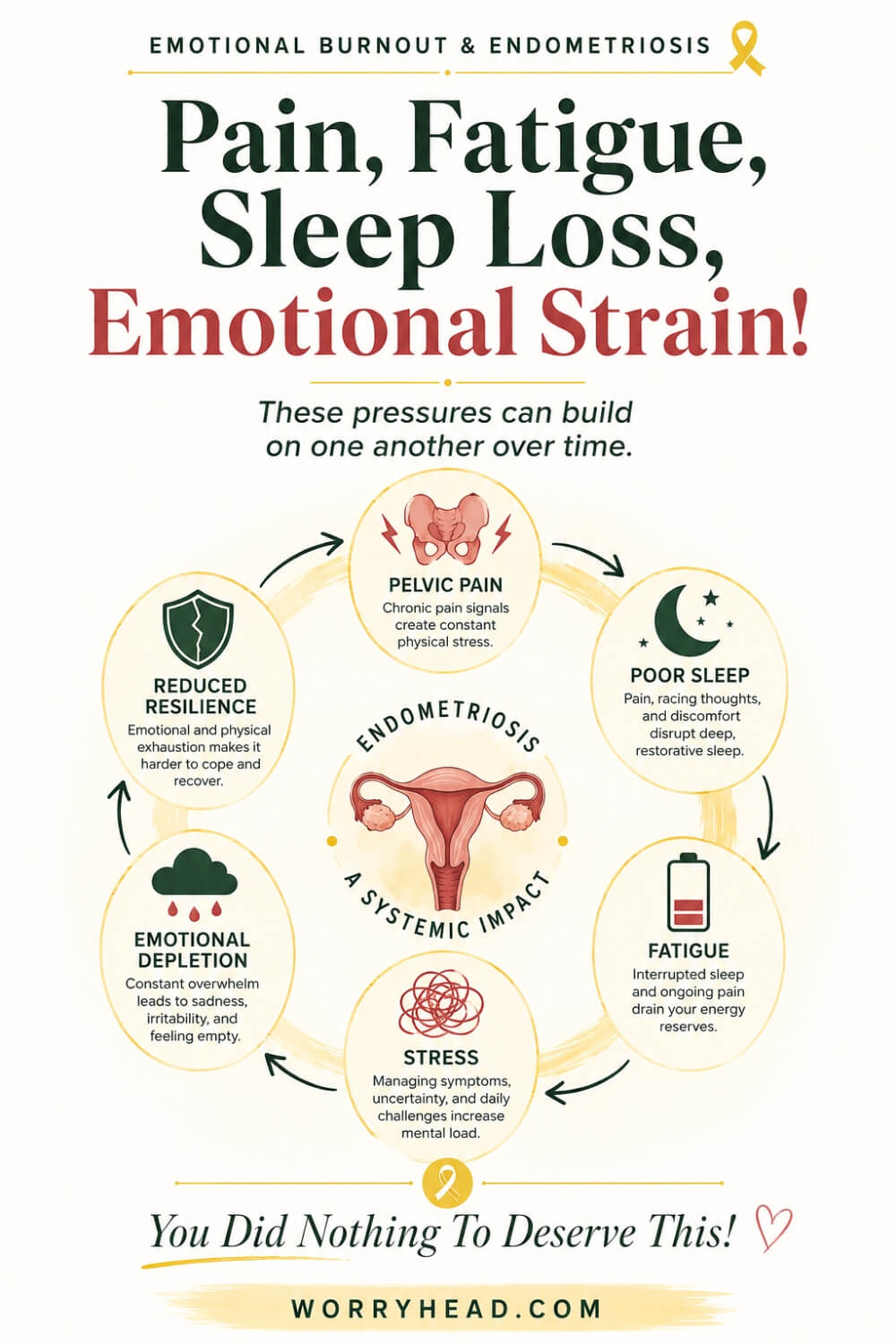
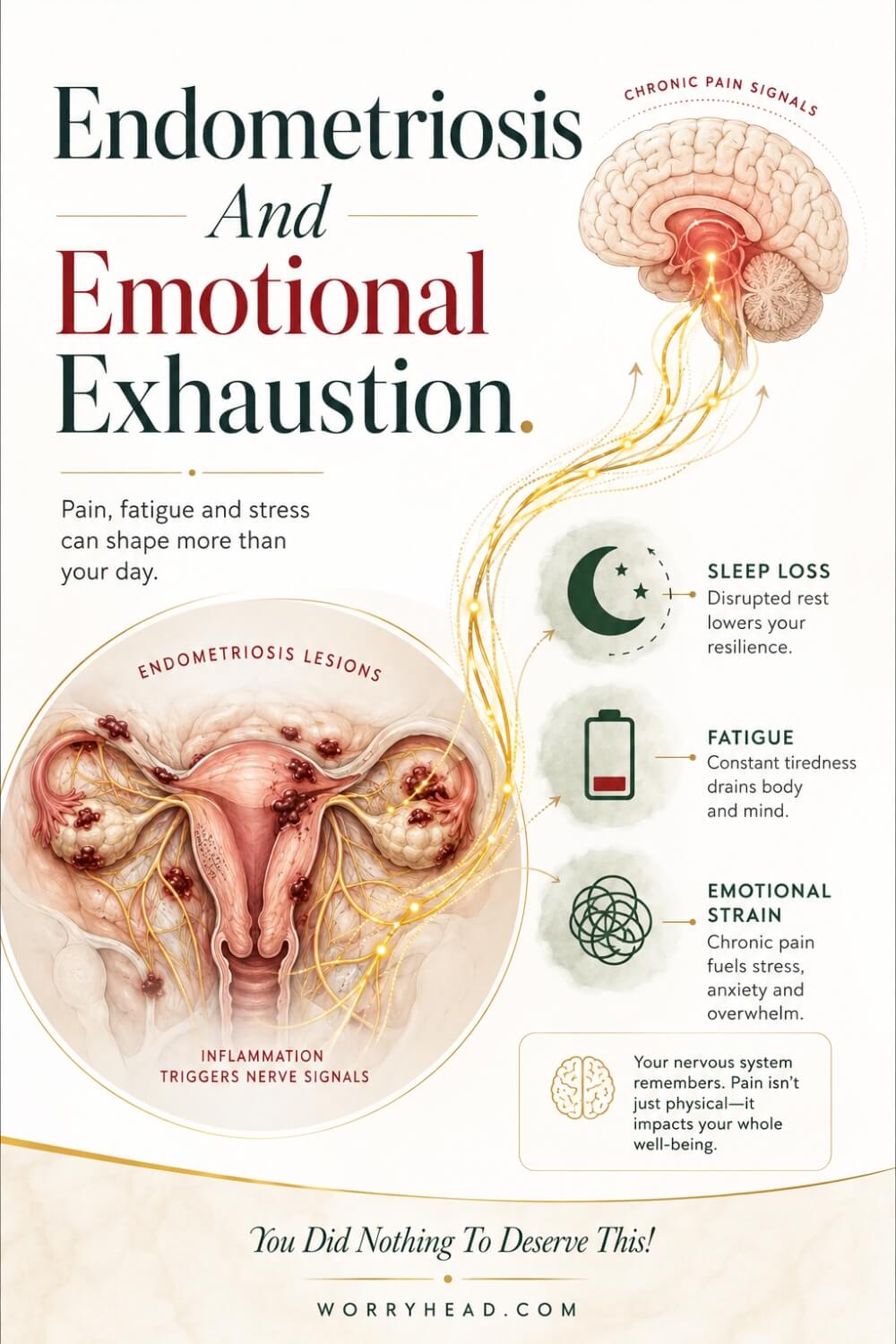
If you have reached the point of asking yourself, “does endometriosis cause an emotional burnout?”, what you may be describing is the accumulated psychological load of living with persistent symptoms rather than a separate disease process called burnout. The important distinction is that endometriosis does not need to create one specific psychiatric condition to wear you down emotionally; chronic pelvic pain, fatigue, disrupted sleep, uncertainty and the restrictions placed on ordinary life can all contribute to psychological distress.
Pain itself consumes attention because part of your brain is repeatedly being asked to notice it, interpret it, respond to it and decide whether you can continue what you were doing. When that pain interrupts your sleep, your work, sex, exercise, social plans or even something as simple as sitting comfortably through dinner, recovery is no longer only about getting through a painful hour; you are constantly adjusting your life around what your body might do next.
Research into endometriosis-related fatigue has found strong associations with insomnia, pain, depression and occupational stress, and importantly, fatigue did not simply follow the stage of the disease.
That matters because you can be emotionally and physically exhausted even when somebody looking at your medical notes thinks your disease should not be affecting you “that much”. The unpredictable nature of symptoms adds another burden because planning becomes a calculation involving pain, bleeding, energy, toilets, medication, travel, recovery time and whether you may have to disappoint somebody again.
Studies examining the day-to-day experience of endometriosis describe significant effects across physical health, emotional wellbeing, social life and functional ability, with unpredictability itself adding to the distress.
A cancelled evening may look insignificant from the outside, but to you it can represent another promise broken by a body you cannot fully control. After enough cancellations, explanations and last-minute changes, you may begin protecting yourself by making fewer plans, expecting less from the week ahead or withdrawing before anybody gets the chance to be disappointed. That kind of shrinking life is one reason emotional exhaustion can become much bigger than the pain happening on any single day.
Then there is the medical workload that rarely appears on a prescription: remembering symptoms, attending appointments, repeating intimate details, trying treatments, managing side effects, waiting for referrals and wondering whether the next person will actually listen. NICE recognises that endometriosis can have a significant physical, sexual, psychological and social impact, while its guidance emphasises access to information, support and appropriate referral rather than treating the condition as pain alone.
ESHRE also recommends that clinicians discuss non-medical approaches aimed at quality of life and psychological wellbeing, although the guideline is careful not to pretend that one particular psychological or lifestyle intervention has enough evidence to work for everybody. Relationships can become part of this emotional load too, especially when you feel you must repeatedly justify why you cannot have sex, go out, work at the same pace, keep the house running or simply be cheerful because somebody else wants you to be.
If you are constantly calculating how much of yourself you can give before your symptoms take the rest, your emotional reserve can become painfully small. Emotional exhaustion may then appear as irritability, numbness, difficulty making decisions, withdrawing from others, crying more easily or simply feeling that you have nothing left to give, but none of those experiences on its own tells us exactly what diagnosis, if any, is present.
Research consistently shows higher levels of anxiety, depressive symptoms and impaired quality of life in endometriosis, while also showing that chronic pain and several connected factors play an important part, which is why your emotional health deserves to be considered alongside your physical symptoms rather than treated as something separate from them.
None of these reactions proves that endometriosis has somehow changed who you are. What they can tell you is that you have been spending emotional energy on pain, uncertainty and adaptation for so long that simply demanding more resilience from yourself may be the exact opposite of what you need.
I learnt this by watching my wife have days when getting through the pain was only half the battle, because afterwards there was still the disappointment of what the pain had taken from her and the effort of trying to act as though she was fine. I could not remove endometriosis from her body, but I could stop expecting her to carry the practical and emotional consequences of it alone, and sometimes love looked less like finding another clever solution and more like quietly taking something off her shoulders before she had to ask.
If you recognise yourself in that, these are the things I would want you, or the man standing beside you, to start paying attention to:
- Name the load you carry
- Track pain and emotional crashes
- Protect sleep without blaming yourself
- Reduce decisions on flare days
- Build recovery into your week
- Ask for practical support early
- Separate guilt from responsibility
- Create a medical support plan
- Know when you need help
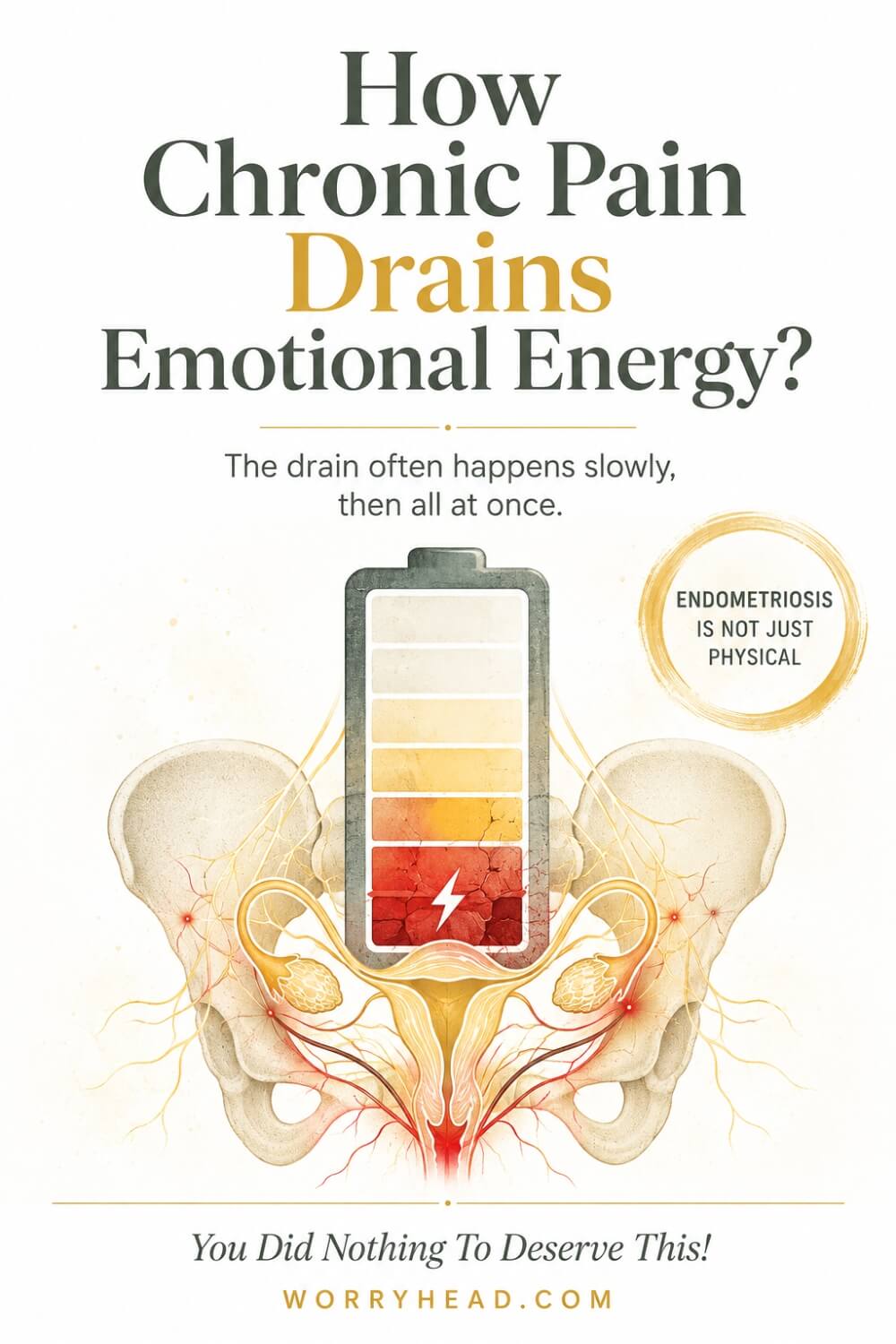
Name the Load You Carry
One of the first things I would encourage you to do is stop calling everything “just tiredness”. There is a difference between needing an early night and carrying pain, appointments, uncertainty, cancelled plans, relationship worries and the constant mental work of deciding what your body can manage. When you name those pressures properly, you stop treating your reaction as a character flaw.
I learnt this watching my wife push herself long after her body had already asked for less. From the outside, she could look as though she was coping, while inside she was spending energy on things nobody else could see. Try writing down what drains you in an ordinary week, not only the pain itself but the planning, explaining, recovering and worrying around it.
Seeing the whole load on paper can be confronting, but it can also be freeing because you finally have evidence that you are not failing at life. You are carrying more than most people realise.
Track Pain and Emotional Crashes
Your emotional low points may not arrive at the exact same time as your worst pain. Sometimes you hold yourself together through a flare, an appointment or a difficult day, then fall apart hours later when you are finally somewhere safe. That delayed crash can make you wonder why you are crying “for no reason”, when there may be a very understandable pattern underneath it.
A simple symptom diary can help you notice links between pain, sleep, bleeding, medication changes, work pressure, social demands and the days when you feel unusually flat or overwhelmed. I would keep it simple enough that it does not become another job. A few words each day can be enough. When my wife and I began noticing patterns rather than treating every bad day as an isolated failure, it gave us something practical to work with. Patterns can help you plan gentler days, explain changes to your doctor and recognise that an emotional crash is often part of a larger physical and psychological load.
Protect Sleep Without Blaming Yourself
Poor sleep can make almost everything harder to carry. Pain may wake you, bladder symptoms may interrupt you, anxiety can keep your mind active, and sometimes you simply cannot find a position that feels comfortable enough to stay asleep. Then morning comes and the world expects you to function as though those missing hours do not matter.
This is why I dislike advice that turns sleep into another test you can fail. You can create a quieter evening, reduce unnecessary demands, keep medication and comfort measures organised, and protect time for rest, but you cannot always “sleep better” by trying harder.
My wife has had nights where exhaustion was obvious and sleep still would not come easily. On those mornings, compassion matters more than judgement. If sleep problems are frequent or worsening, tell your clinician, because treating pain, mood symptoms or other causes may matter more than simply changing bedtime habits. Rest is part of care, not a reward you must earn.
Reduce Decisions on Flare Days
A painful day can turn very small choices into surprisingly heavy work. What to eat, whether to shower now or later, whether to cancel something, which medication to take, whether you can drive or whether you should answer a message can all feel harder when your attention is already being pulled towards pain. Decision fatigue is easy to miss because none of those choices looks dramatic by itself.
One thing that helped me support my wife better was learning not to make her manage me while she was already struggling. Instead of repeatedly asking, “What do you need me to do?”, I could notice the obvious things and take care of them. You can do something similar for yourself by preparing simple meals, keeping essentials together, having comfortable clothes ready and deciding in advance what can be postponed during a flare. Removing ten small decisions will not cure the pain, but it can leave a little more mental space for getting through the day.
Build Recovery Into Your Week
Many of us plan around activity and treat recovery as the empty space left afterwards. With endometriosis, that can backfire because a demanding day may continue costing you energy long after the event itself has finished. If you repeatedly fill every better day with catching up, errands, work and social commitments, you may never actually experience a day that restores you.
I had to learn that helping my wife was not only about stepping in once a flare became severe. Sometimes better support meant looking at the week before it became too full and protecting space where nothing urgent was expected from her. You can do this for yourself as well. Leave breathing room after appointments, travel, long workdays or social events when possible. Recovery might mean lying down, being alone, eating something easy, taking a warm shower or simply not having to perform normality for anyone. A quieter day is not wasted time when it helps you remain part of your own life.
Ask for Practical Support Early
It is much easier to ask for help before you have reached the point where everything feels impossible. Yet I know why you may wait. You may worry about becoming a burden, sounding demanding or having to explain again why something manageable yesterday is not manageable today. That hesitation can leave you using your last bit of energy trying to prove you can still do everything yourself.
The men and partners beside you need to understand that support is often practical before it is profound. Cook the meal. Pick up the prescription. Cancel the reservation. Carry the shopping. Handle the phone call. I learnt that love becomes far more useful when it notices work and quietly shares it. You should not need to collapse before somebody takes your struggle seriously. If you have people you trust, tell them specific things they can do on difficult days. Clear requests reduce guessing, and receiving help before crisis point can protect both your energy and your dignity.
Separate Guilt from Responsibility
Guilt has a cruel way of attaching itself to things you never chose. You may feel guilty because plans changed, sex hurts, the house is untidy, work has suffered or somebody you love has had to do more. Responsibility is different. It means doing what reasonably can be done with the body and circumstances you actually have, not punishing yourself because illness has limits.
This distinction mattered enormously in my marriage. My wife did not create her disease, and I never wanted her apologising to me for consequences she would have removed in a heartbeat if she could. Both partners remain responsible for communicating honestly and treating each other with care, but symptoms are not a moral failure. When guilt appears, ask yourself: “Did I choose this, or am I adapting to something difficult?” That question will not erase every painful feeling, but it can stop you turning illness into evidence that you are somehow letting everyone down.
Create a Medical Support Plan
When emotional exhaustion is building, trying to remember every symptom and every question during an appointment can become overwhelming. A simple medical support plan can make those conversations easier. Keep a short list of your main symptoms, what has changed, what treatments you have tried, what is affecting daily life most and the questions you do not want to forget.
I would also include the emotional side when it matters. If pain is affecting sleep, concentration, relationships, work or your ability to cope, say so plainly rather than assuming the clinician will work it out from your pain score. If you trust someone enough, consider taking them to an appointment so they can listen, take notes and help you remember what was said. I have learnt that support is not about speaking over my wife; it is about making sure she does not have to carry every detail alone. A plan gives you something steady to return to when your mind is tired and the medical system feels far too complicated.
Know When You Need Help
There is strength in recognising when self-care and partner support are no longer enough. If emotional exhaustion becomes persistent, you are withdrawing from nearly everything, anxiety is difficult to control, your mood stays low or everyday tasks feel increasingly impossible, tell a GP or another clinician who knows your health. You do not have to reach breaking point before your emotional wellbeing deserves attention.
This matters even more if hopelessness is growing or you begin feeling unsafe with your own thoughts. I have seen how deeply chronic illness can affect the person I love, and one lesson I carry seriously is that emotional pain should never be dismissed because a physical diagnosis sits underneath it.
Asking for professional support does not mean the pain is “in your head”. It means your mind has been living with a difficult body for a long time, and both deserve care. Support may include medical review, psychological therapy, pain services or other appropriate care.
Why Does Endometriosis Cause an Emotional Burnout Even on Better Days?
One of the hardest things to understand is that emotional exhaustion does not always disappear simply because your pain is quieter today. When your body has taught you that a good morning can turn into a difficult afternoon without warning, part of you may remain watchful even while everything seems relatively calm.
This is where the question does endometriosis cause an emotional burnout becomes more complicated than simply counting painful days. Your nervous system, your thoughts and your habits can all become shaped by months or years of preparing for symptoms, rearranging life around them and trying to prevent the next setback.
You may wake feeling reasonably well and immediately start calculating how much you should do before your energy changes. Instead of enjoying the better day, you may feel pressure to catch up on housework, reply to messages, work harder, see friends, exercise, be intimate or somehow compensate for everything the illness interrupted before.
I watched my wife do this, and for a long time I misunderstood what I was seeing. When she had a better spell, part of me naturally felt relieved, but I gradually realised that she did not experience that improvement as complete freedom because she knew her body could change the rules again without asking her permission.
There is a particular sadness in watching someone you love hesitate before enjoying something because experience has taught her not to trust how long feeling better will last. I have seen my wife want to make plans and, almost in the same breath, begin considering where she could sit down, how tired she might become afterwards and what would happen if pain arrived halfway through.
That constant anticipation can steal emotional energy before anything has even gone wrong. You are not necessarily imagining disaster; you may simply be remembering what your own body has repeatedly done and trying to protect yourself from being caught unprepared again.
Then another layer appears when the people around you assume that a better day means you are better. They may see you laughing, walking normally or enjoying dinner and never see the recovery afterwards, which can leave you feeling as though you must prove that yesterday’s suffering was real.
I think this is one of the loneliest parts for many women with endometriosis because illness can force you to live between two versions of yourself in other people’s eyes. On the difficult days you may fear being seen as unreliable, while on the better days you may fear that looking well will make somebody doubt how badly you struggle when symptoms return.
I never wanted my wife to have to perform sickness for me in order to deserve support. If she felt good enough to laugh, I wanted her to laugh without worrying that I would use that moment tomorrow as evidence that she could not really have been struggling.
That is something partners need to understand deeply. Loving a woman through chronic illness means allowing her good moments to remain good moments, rather than turning them into a test of whether her illness was ever serious enough.
You deserve that same permission from yourself. A better afternoon does not invalidate a terrible week, and enjoying your life whenever your body allows it is not proof that you exaggerated the pain that came before.
When I finally understood this, support became less about constantly asking how much pain my wife was in and more about making our home somewhere she did not have to justify either version of herself. She could hurt without apologising, and she could feel better without proving anything.
That kind of safety cannot remove endometriosis, but it can remove one unnecessary burden from the woman already carrying it. And sometimes the most loving thing a man can give his partner is the certainty that whether today is painful, peaceful or somewhere in between, his care does not disappear when her symptoms change.
How Does Endometriosis Cause an Emotional Burnout Within a Relationship?
If you are wondering, “does endometriosis cause an emotional burnout?”, one place you may notice the exhaustion most painfully is inside the relationship you care about, because chronic illness does not stop at the edge of your body. For you, there can be the physical symptoms themselves, but also the worry that pain has made you less spontaneous, less affectionate, less sexual or somehow harder to love, even though none of those fears describes your worth as a woman.
Research involving couples has found that endometriosis can affect intimacy, everyday routines, social life, work, finances and plans for having children, while relationship coping and informed partner support are associated with better relationship satisfaction and psychological wellbeing.
The disease can therefore create shared problems without meaning that both partners are suffering in the same way, because you are the one living inside the painful body and your partner’s responsibility is to understand that difference rather than compete with it.
In our marriage, I have watched my wife lose energy for things that once required no calculation at all, and I have seen how easily a woman can begin apologising for the very symptoms she would give anything not to have. There were moments when what hurt me most was not what endometriosis required me to do, but seeing the woman I loved worry that needing me somehow made her less desirable, less independent or less of the woman I married.
Endometriosis can also enter the most private part of a relationship because pain during sex is common and can affect sexual functioning, self-esteem and intimacy, which means avoiding intercourse may sometimes be an act of protecting a hurting body rather than rejecting the person beside you.
Studies of couples show that sexuality may change considerably while affection and relationship satisfaction can still remain strong, something I think partners need to hear because closeness was never supposed to be measured by intercourse alone.
For me, loving my wife properly meant learning that my disappointment could never become another symptom for her to manage, so if plans changed, intimacy was impossible or our lives needed rearranging, I had to process my own feelings without making her responsible for comforting me about what her disease had taken from her.
The healthier lesson for both of us was that support is not one person endlessly sacrificing for another; it is two adults protecting the relationship while recognising that the woman in pain sometimes needs the stronger pair of shoulders beside her to carry more for a while.
Our infertility became one of the clearest examples of that, because endometriosis changed a future we once imagined together, yet I never looked at my wife and saw a woman who had failed to give me something; I saw the same woman I chose, now having to grieve something that hurt her deeply too.
Research on couples living with endometriosis describes exactly this kind of disruption to anticipated futures, including intimacy, parenthood, working lives and social lives, with couples often having to reshape expectations together.
What I want you to feel in your bones is that being exhausted by what this illness demands does not make you a disappointing partner, and being loved through those demands does not leave you owing anybody a performance of wellness, sex, gratitude or cheerfulness in return.
When to Seek Medical Help?
You do not need to wait until you completely fall apart before asking for medical help. If the emotional exhaustion around endometriosis is beginning to affect your ability to work, sleep, concentrate, maintain relationships, care for yourself or experience any enjoyment in ordinary life, I would take that seriously and speak to your GP or another clinician involved in your care. The NHS specifically advises seeing a GP when endometriosis symptoms are affecting everyday life, work or relationships, or when treatment is no longer helping.
I would especially mention it if you notice that you are no longer recovering emotionally between difficult periods or flares. Maybe you are waking already exhausted, crying much more easily, becoming unusually irritable, withdrawing from people you normally love being around, feeling constantly anxious about the next flare, or finding that even simple decisions seem overwhelming. These experiences do not automatically mean you have depression, anxiety or another mental health condition, but they are worth discussing rather than assuming this is simply something you have to tolerate because you have endometriosis.
Please tell your doctor about the physical side at the same time. Pain, extreme fatigue, heavy bleeding, poor sleep, painful sex, bowel or bladder symptoms and treatment side effects can all contribute to how depleted you feel, and the NHS recognises fatigue, low mood and anxiety among the problems that can accompany endometriosis. Emotional health should not be separated from the rest of your symptoms as though your mind exists in one room and your pelvis in another.
This is where a short symptom record can become useful. You could take a few weeks of notes showing your pain, bleeding, sleep, energy, mood, medication and anything important you had to cancel or stop doing. You are not building a legal case for why you deserve care. You are simply giving your clinician a clearer picture of what your life actually looks like outside a ten-minute appointment.
I would also ask for another review if your existing treatment is no longer controlling your symptoms, your pain is becoming harder to manage, fatigue has changed noticeably or new symptoms have appeared. NHS guidance says that worsening symptoms or symptoms that do not improve with GP treatment are reasons to return for further medical assessment, and more severe or persistent symptoms can lead to specialist referral. Sometimes what feels emotionally impossible becomes slightly more manageable when an untreated physical contributor is identified and addressed.
Do not be afraid to say the words, “This is affecting me mentally.” That sentence does not tell your doctor that your pelvic pain is psychological. It tells them that living with physical illness has consequences, and the NHS specifically includes mental health support for low mood or anxiety among the forms of support that someone living with endometriosis may need. You can ask whether support for sleep, persistent pain, anxiety, low mood or coping with chronic illness would be appropriate alongside your gynaecological care.
As a husband, I would want to know if the woman beside me was reaching the point where everything felt too heavy. I would much rather my wife tell me, “I am not coping very well at the moment,” than watch her spend another month pretending she is fine because she thinks everyone else has already heard enough about her illness. Asking for help sooner does not make your experience more dramatic; it gives the people who care about you a chance to respond before exhaustion becomes a crisis.
There is one situation where I would not suggest waiting for the next routine appointment. If hopelessness becomes so intense that you are thinking about harming yourself, ending your life, or you do not feel confident that you can keep yourself safe, please seek urgent professional help immediately and tell somebody you trust what is happening. NHS guidance treats this as a medical emergency when someone is in immediate danger or may be about to harm themselves, and advises urgent emergency care rather than trying to manage those feelings alone.
Most emotional exhaustion does not reach that point, and I do not want you reading this section frightened that it will. What I want is almost the opposite: for you to recognise much earlier that emotional health belongs in your endometriosis care, just as pain, bleeding, fatigue and fertility concerns do. You deserve the opportunity to say, “This condition is wearing me down,” and have that sentence treated as useful clinical information rather than something you are expected to hide.
Questions to Ask Your Doctor
When emotional exhaustion has become part of living with endometriosis, walking into an appointment and saying, “I am tired” may not communicate what is actually happening to you. You may be tired from pain, tired because you are sleeping badly, tired from heavy bleeding, mentally exhausted from constantly managing symptoms, frightened about another flare, low because your life has become smaller, or several of these things at once.
That is why I would go into the appointment with questions rather than feeling that you must somehow deliver the perfect explanation. NICE recognises that endometriosis can have significant physical, sexual, psychological and social effects, so talking about how you are coping emotionally is part of discussing the condition, not changing the subject away from it.
You do not need to ask every question below. Take the ones that sound like your life.
“Could my emotional exhaustion be connected to the way my endometriosis is affecting me?”
I would start here because it opens the conversation without trying to diagnose yourself. Tell your doctor what “exhaustion” means for you. Perhaps you are increasingly irritable, crying more easily, losing interest in things, feeling overwhelmed by simple decisions or reaching the end of a flare with absolutely nothing left emotionally.
The NHS recognises that endometriosis can be associated with extreme tiredness, low mood and anxiety, while ESHRE guidance acknowledges the importance of quality of life and psychological wellbeing alongside physical symptoms. You are therefore not wasting appointment time by explaining what the condition is doing to your mind as well as your body.
“Could something physical be making this exhaustion worse?”
This is an important question because I would never want you or your doctor to assume that every feeling of depletion is simply emotional. Ask whether your pain, disrupted sleep, bleeding pattern, medication, nutrition or another health problem could be contributing and whether anything needs investigating based on your particular symptoms.
You are not asking for every test available. You are asking your clinician to look at you as a whole person instead of deciding in advance that being exhausted is simply what happens when you have endometriosis.
“Can we review how well my pain is actually being controlled?”
Sometimes you become so accustomed to functioning through pain that you stop describing its true impact. Instead of giving only a number out of ten, tell your doctor what the pain prevents you from doing.
Say that you cannot sleep through the night. Say that you have stopped exercising, cannot concentrate at work, avoid sex, cancel plans or need the following day to recover. NICE specifically places importance on symptoms that affect daily activities and quality of life when assessing and managing suspected or confirmed endometriosis.
The question is not simply, “Does this treatment reduce my pain a little?” It is also, “Is my life becoming more manageable?”
“Could my sleep problems be part of why I am struggling emotionally?”
If pain regularly wakes you or you go to bed already anxious about whether you will sleep, tell your doctor. Poor sleep can become part of a difficult circle where pain disrupts rest, reduced rest makes coping harder, and the next difficult day arrives before you have recovered from the previous one.
I watched my wife have nights where being exhausted did not mean being able to sleep properly. The morning did not care how many times she had woken during the night, and neither did the responsibilities waiting for her.
That is why I would ask what may be driving your disturbed sleep rather than accepting another instruction to simply improve your bedtime routine.
“Could any of my current treatments be affecting my mood or energy?”
Bring a list of what you take, including hormonal treatment, pain medication and anything else relevant, and explain when you noticed changes. Do not stop prescribed treatment because you suspect a connection without discussing it first, but do not assume that you have to tolerate a treatment that is making everyday life significantly harder either.
Treatment choices for endometriosis are individual, and guidelines emphasise discussing benefits, side effects, preferences and their impact on quality of life. A treatment can look sensible on paper and still need reviewing if the person taking it is struggling.
“Do my symptoms suggest that I need specialist endometriosis care?”
I would ask this directly if symptoms remain persistent, recur, significantly interfere with daily life or are not responding adequately to treatment. NICE guidance includes referral pathways to gynaecology and specialist endometriosis services depending on symptoms, treatment response and suspected disease involvement.
Do not think that asking about referral means telling your GP how to do their job. You are allowed to understand the next step in your own care.
You can simply say, “At what point would you consider referring me, and do you think I have reached that point?”
“Can I get psychological support without my physical symptoms being dismissed?”
I particularly want you to have this question because I know how frightening the word “psychological” can become after somebody has spent years being told that pain is stress, anxiety or something they should simply cope with better.
Psychological support should never mean that endometriosis has become imaginary.
ESHRE discusses approaches aimed at improving psychological wellbeing and quality of life as part of wider endometriosis management, while also recognising that evidence does not support pretending there is one psychological intervention that works for every woman. Support for anxiety, low mood, chronic illness adjustment or pain coping can sit alongside proper investigation and treatment of your physical disease.
I would want my wife to have access to both without being forced to choose which part of her suffering was “real”.
“What should I track before my next appointment?”
This one can save you months of trying to remember everything afterwards. Ask your clinician which symptoms would be most useful to record and then keep the system simple enough that you will actually use it.
I would note pain, bleeding where relevant, sleep, fatigue, bowel or bladder symptoms if you experience them, medication use, emotional crashes and what the symptoms stopped you from doing. NICE specifically recommends using a pain and symptom diary as something that can help discussions about endometriosis.
Do not turn it into another responsibility you must perform perfectly. Three honest lines written on a difficult day can tell your doctor more than a beautifully completed chart that became too exhausting to maintain.
“What can we improve now while we investigate the bigger picture?”
I like this question because chronic illness can trap you in waiting. Waiting for imaging. Waiting for a referral. Waiting for another appointment. Waiting to see whether a treatment works.
Ask what can reasonably be done in the meantime.
Perhaps pain management needs reviewing. Perhaps sleep deserves attention. Perhaps you need support for low mood or anxiety. Perhaps your workload needs adjusting, or you need documentation for work. Perhaps there is another symptom your GP can investigate instead of making you wait for every problem to be dealt with by gynaecology.
You may not be able to solve the whole condition during one appointment, but you should be able to leave knowing what happens next.
“What is our plan if I continue getting worse?”
Please ask this before you are desperate.
You want to know who you should contact, when you should return, which changes should prompt another assessment and what the next treatment or referral step would be. Endometriosis is a long-term condition for many women, and both NHS and NICE guidance recognise that symptoms can have substantial effects on everyday life and may require ongoing care rather than one isolated appointment.
Having a plan will not remove every uncertainty, but it can remove that awful feeling of being sent home with nothing except instructions to somehow continue coping.
And if your appointment is short, I would reduce everything above to one sentence you can say before anything else:
“My endometriosis is no longer only causing symptoms; managing those symptoms is wearing me down emotionally and affecting how I function, and I need help looking at both.”
If my wife said that to me, I would not hear weakness. I would hear a woman who has carried something difficult for too long finally telling me exactly where the weight has landed.
Your doctor needs the opportunity to hear it too.
Final Word on Does Endometriosis Cause an Emotional Burnout?
By the time you reach this point, I hope one thing feels clearer: emotional exhaustion around endometriosis is not proof that you are weak, difficult or failing to cope. It can grow when pain, poor sleep, fatigue, uncertainty, cancelled plans, medical appointments and the constant need to adapt keep taking from the same emotional reserve.
When you ask, “does endometriosis cause an emotional burnout?”, the most accurate answer is that emotional burnout is not a formal diagnosis of endometriosis, yet the condition can create circumstances in which emotional exhaustion becomes real. Chronic pain can wear down concentration. Disturbed sleep can reduce patience and resilience. Repeated disappointment can make you stop looking forward to things you once loved.
What matters to me is that you do not turn any of that into a judgement about yourself.
I have watched my wife cope with days when her body changed the plan before the day had begun. I have watched her push through because she did not want to disappoint anyone, then have almost nothing left for herself afterwards. Those moments taught me that support is not about admiring how much a woman can endure. Sometimes the most loving thing I can do is notice when endurance has cost too much.
Your partner cannot remove endometriosis, but the right partner can stop adding weight to it. He can believe you without requiring proof, change plans without making you feel guilty, understand that painful sex is not rejection, take jobs from your hands and listen without trying to fix everything. That support does not make you dependent. It gives you somewhere safe to stop performing strength.
You also deserve that gentleness from yourself.
There may be days when rest is the productive choice. There may be appointments where saying, “I am not coping well emotionally,” is as important as explaining where you hurt. There may be friendships, expectations or routines that need changing because proving you can still do everything is costing you more than it gives back.
Please remember that emotional exhaustion can overlap with anxiety, depression, sleep problems, uncontrolled pain or other health concerns, so you do not have to diagnose yourself from an article. If the way you are feeling is persistent, worsening or affecting how you function, bring it into your medical care. Your emotional wellbeing deserves attention alongside your physical symptoms.
And if you are the man beside a woman living through this, do not wait until she breaks before you become useful. Learn her patterns. Notice what drains her. Carry what you can without turning your help into a debt she must repay.
My wife never needed me to rescue her from being a woman with endometriosis. She needed me to remain beside her while life became harder than either of us expected.
That is the difference I want you to remember. You are not asking for permission to give up. You are learning how to stop spending yourself completely just to prove that you are still strong.
You are allowed to be tired of managing something you never chose. Endometriosis can take energy, plans and certainty from you, but it does not take your worth. You deserve care that sees the pain, the emotional cost and the woman underneath both. Being supported is not weakness. It is part of living well with something difficult.
If any part of this felt like your own life being put into words, I would genuinely love you to leave a comment below and share what emotional exhaustion has looked like for you. You can also find my FREE 130+ page eBook at the bottom of this post, written for the moments when you need reminding that you did nothing to deserve this.

About Me
Hi, I’m Lucjan! The reason why I decided to create this blog was my beautiful wife, who experienced a lot of pain in life, but also the lack of information about endometriosis and fibromyalgia for men…
READ MORE
Grab a FREE eBook!
“You Did NOTHING To Deserve This!”
Finally hear the words nobody ever said to you, that your pain is real, your tears make sense, and you did nothing to deserve endometriosis, the dismissal, or the way it has rewritten your life.
Related Questions You May Be Asking About “Does Endometriosis Cause an Emotional Burnout?”
1. Is emotional burnout from endometriosis the same as depression?
No. Emotional exhaustion and depression can overlap, but they are not automatically the same thing. You might feel depleted, irritable or mentally overwhelmed because managing pain and uncertainty has consumed your energy without having clinical depression. If low mood, hopelessness, loss of interest or difficulty functioning persists, however, it is worth discussing those changes with your GP.
2. Can endometriosis emotionally exhaust you even when pain is manageable?
Yes. Pain is only one part of the load. You may also be dealing with unpredictable symptoms, disturbed sleep, fatigue, medical appointments, fertility worries, painful intimacy, cancelled plans and the constant effort of deciding what your body can manage. Even during quieter periods, anticipating another flare can leave you mentally tired and reluctant to trust a good day completely.
3. Can treating endometriosis improve emotional exhaustion?
It can help some women, particularly when treatment reduces pain, improves sleep or makes everyday life more predictable, but emotional recovery may not happen immediately. Years of adapting to symptoms can leave habits of worry, overexertion or fear behind. That is why physical treatment, appropriate psychological support, better pacing and practical help may sometimes need to work alongside one another.
4. How can my partner help when I feel emotionally exhausted?
A supportive partner can reduce the invisible workload rather than repeatedly asking you to explain it. That may mean taking over practical jobs, accepting changed plans without guilt, listening without immediately trying to fix you and understanding that needing rest is not rejection. In my experience, being believed consistently can remove an enormous emotional burden before any grand gesture is needed.
5. Can emotional exhaustion make endometriosis pain feel harder to cope with?
It can. Pain is influenced by more than tissue alone, and factors such as poor sleep, stress, anxiety, low mood and prolonged exhaustion can affect how difficult pain feels and how much energy you have to cope with it. That does not mean the pain is psychological. It means your physical symptoms and emotional wellbeing can influence one another in both directions.
Does Endometriosis Cause an Emotional Burnout References
- https://www.who.int/news-room/fact-sheets/detail/endometriosis
- https://www.who.int/standards/classifications/frequently-asked-questions/burn-out-an-occupational-phenomenon
- https://pubmed.ncbi.nlm.nih.gov/34077695/
- https://pubmed.ncbi.nlm.nih.gov/29947766/
- https://pmc.ncbi.nlm.nih.gov/articles/PMC8714740/
- https://pubmed.ncbi.nlm.nih.gov/32377820/
- https://www.nice.org.uk/guidance/ng73/chapter/recommendations
- https://www.eshre.eu/-/media/sitecore-files/Guidelines/Endometriosis/ESHRE-GUIDELINE-ENDOMETRIOSIS-2022_2.pdf
- https://www.nhs.uk/conditions/endometriosis/
- https://pubmed.ncbi.nlm.nih.gov/28637285/
- https://pubmed.ncbi.nlm.nih.gov/17609078/
- https://pubmed.ncbi.nlm.nih.gov/29706579/
- https://pubmed.ncbi.nlm.nih.gov/26679773/
- https://www.nhs.uk/mental-health/feelings-symptoms-behaviours/behaviours/help-for-suicidal-thoughts/
