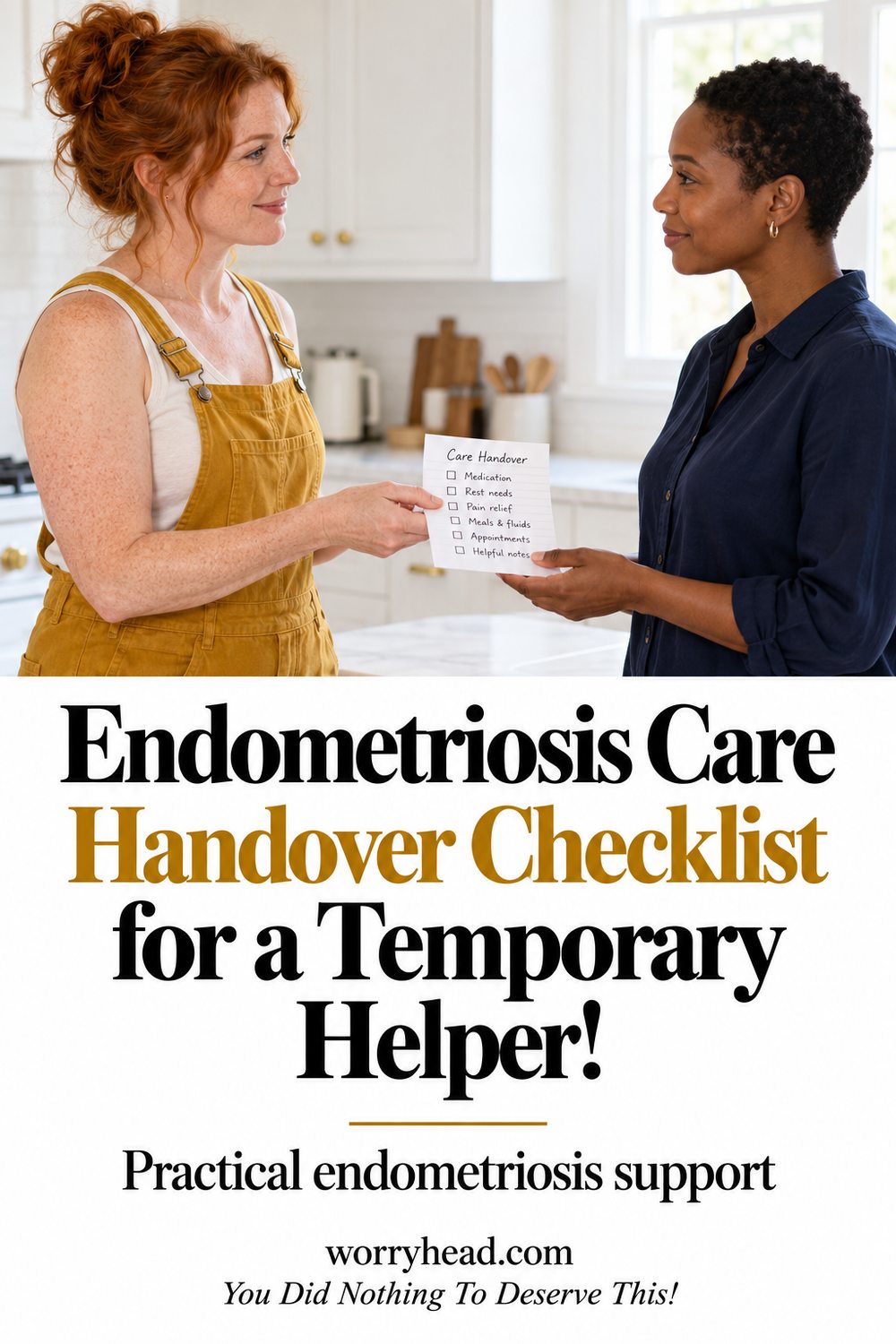
Endometriosis Care Handover Checklist for a Temporary Helper
What belongs in an endometriosis care handover checklist when somebody else is helping for a few hours or days? You may be tired of explaining the same small details whenever a different person steps in. You deserve support that understands enough to be useful without asking you to surrender your privacy or become an instructor while you are in pain.
A handover is one part of helping a partner feel supported through endometriosis. Your usual partner can help prepare the practical details, while you decide what another person needs to know and which choices remain private.
A care handover should state your agreed tasks, preferences, contacts and current professional instructions, with a date and clear limits on what the helper may do. Share only the necessary information, check that it is understood and keep medicines advice with the prescribing team or pharmacist.
Years of learning alongside my wife inform my writing as a husband, blogger and researcher rather than a clinician, and I have listed the health and care sources used for this discussion at the end.
A clear handover makes more sense once you have agreed how support will continue during an absence, including who is actually available to help.
The note is not a shortened autobiography or a test of whether your illness is serious enough. It is a way to move useful information out of one person’s memory so you do not have to keep supplying it on demand.
It should also tell the helper where their responsibility stops. “Please collect this prescription” is a different request from “Please decide what I should take.”
Seeing how much can be missing from information about chronic illness is one reason I began Worry Head. I want my wife’s voice to remain clear when practical arrangements involve somebody who does not know our everyday life.
A short note can be both useful and respectful when it starts with your choices rather than another person’s assumptions about your body.

What to Put in an Endometriosis Care Handover Checklist
Write for the particular person and task, not an imaginary helper who needs to know everything. Someone bringing groceries may need delivery instructions and agreed food preferences. A person providing more involved support may need relevant care information as well.
Start with your name, the date and how you want to be contacted. Explain the hours the arrangement covers so nobody assumes it continues indefinitely. An endometriosis care handover checklist should make the next action clear without turning your private life into an open file.
Include the tasks you have actually agreed. State which ones you prefer to do yourself, even if they take you longer. Add any relevant instructions from your current care team without rewriting their meaning.
If there is uncertainty about medicines, ask your pharmacist or prescribing team rather than allowing different helpers to improvise. Record important contact details and who should be called for each kind of problem. Keep clinical urgency separate from a late shopping delivery or a missing key.
Use plain, short sentences that someone can understand when they are tired. Ask the helper to repeat the important points back so you can spot unclear wording. Give them a way to ask a question without assuming your unavailable partner will answer immediately.
Keep one clearly marked current version. Then agree when the information should be returned, deleted or updated after the arrangement ends.
I would not want my wife to spend a painful afternoon correcting a story someone else has written about her. The handover should help her receive support with fewer explanations, while leaving her free to say that today is different.
- Describe the Agreed Help
- Separate Medicines from Guesswork
- Record Contacts and Escalation
- Protect Privacy and Choice
- Date and Check the Note
Describe the Agreed Help
Give the helper a clear task, a time or time window, and any preference that changes how it should be done. “Bring the prepared meal at six and leave it on the kitchen table” is easier to follow than “sort out dinner”. Use an example that fits your life rather than copying somebody else’s routine.
Include what you want left alone. A person helping with laundry does not automatically have permission to tidy a bedroom, open letters or invite someone else inside. You can write these boundaries politely without apologising for having them. I would want a helper to understand that my wife remains the person directing what happens in her home. If a task changes, ask whether the helper can accept the new request instead of silently expanding their role. Clear limits protect both people and make it easier to recognise when a different arrangement or professional input is needed.
Separate Medicines from Guesswork
A household note must not become a new prescription. If medicine information is relevant to the agreed help, use the current instructions and ask a pharmacist or prescribing clinician about anything unclear. Do not copy an old dose from memory, recommend extra tablets or assume that two products are safe together because they are familiar.
State whether the task is collection, a reminder or another specifically agreed form of support. A friend should not take on a clinical task they are not prepared or authorised to perform. Keep any necessary record of medicines already taken in the agreed place, especially when more than one person helps. I want practical support to remove confusion, not introduce another person’s guesses into my wife’s treatment. If the note conflicts with current professional instructions, stop and seek clarification; a tidy checklist cannot make an uncertain medicine instruction safe.

Record Contacts and Escalation
List the contacts that match the arrangement, and label their purpose. The person who can bring a spare key may not be the person to ask about symptoms. Include the usual service’s opening hours if known and where to find its out-of-hours instructions, without presenting a routine number as an emergency line.
For health concerns, refer to your individual clinical advice and current urgent-care guidance rather than inventing a home scoring system. The helper should know that a new problem is not automatically endometriosis. A separate practical question is who gets called if they cannot complete the agreed visit or task. I would rather have that limit written honestly than expect my wife to solve it while unwell. Confirm telephone numbers when preparing the note and keep the details you may need within reach, with a paper alternative if relying only on a phone would leave a gap.
Protect Privacy and Choice
Ask what information this person needs for the job, then leave out what they do not. A lift to an appointment rarely requires someone to know the details of your fertility history or intimate symptoms. Share sensitive information deliberately, with the people you choose, instead of putting it into a family message group by default.
NICE’s approach to involving partners and other important people depends on your agreement. A helper should speak to you, even when your partner has prepared the note with your permission. If you want someone to manage particular GP services online, ask the practice about authorised family and carer access rather than sharing your password. I want support around my wife to respect her as an adult whose privacy has value. You can change your mind about an arrangement, and the information shared should change with it rather than remain available indefinitely.
Date and Check the Note
Put the date near the top where it is easy to see. If several copies exist, mark which one is current and agree how updates reach the people who need them. Important changes should be checked when they happen, not left until a distant reminder because the document already looks finished.
Ask the helper to describe what they would do first and what would make them ask for advice. This can reveal a vague instruction without making either of you feel criticised. Check the note together while there is time to correct it, rather than during a rushed departure. I would want this conversation to save my wife effort later, not give her another complicated household project. When the temporary arrangement ends, remove access that is no longer needed and keep only the information you have a reason to retain. A smaller accurate note is more useful than a large collection of outdated instructions.
Making Your Endometriosis Care Handover Checklist Easy to Use
A practical format is one short page with clearly labelled fields, supported by current clinical documents only when they are relevant. Put immediate tasks first, because that is what a helper arriving at the door needs to find. Your endometriosis care handover checklist can use the following prompts as a starting point, with unnecessary fields removed.
Write “Help agreed for” followed by the date and hours, then “What I want help with” and “What I will manage myself”. Add “How to contact me”, “People or services to call” and “Where relevant current instructions are kept”. Include a separate line for information you do not want shared and for the person responsible for updating the note.
Avoid putting access codes, account passwords or an entire medical history on a page that may be copied widely. A task can be clear without giving someone unrestricted access to your home or records. If the helper asks a sensible question, treat that as a chance to improve the wording rather than proof that the arrangement has failed.
I would want my wife’s correction to carry more weight than a line in a document written last week. If you discover that no suitable person can carry out the essential tasks, the next issue is finding practical support without an available carer, rather than adding more instructions to the same page.

Final Word on Your Endometriosis Care Handover Checklist
You should not have to become easier to care about before someone helps you. There is a difference between explaining a practical detail and defending the reality of your illness. A handover belongs to the first of those things. It should help another person understand what to do, while leaving your dignity and your right to decide where they were before they arrived.
An endometriosis care handover checklist can take some pressure off a difficult day, but it is only as good as the conversation behind it. A helper needs to agree to the task, understand the limits and listen when you say something has changed. The document cannot replace that respect. Nor should it become a reason to insist that you receive yesterday’s version of support when today’s needs are different.
As a husband, I think about how easy it would be to mistake knowing someone well for having the right to speak for them. I can help organise information without becoming its owner. My wife’s experience belongs to her, including the parts she does not want repeated to somebody else. A useful note should make that distinction clearer, especially when everyone is trying to help and nobody asks what she wants.
Start small if this feels like another demand on your energy. Write one task that often needs explaining, then add the detail that would save you a question later. You might discover that the most valuable sentence is not about illness at all. It might explain where to leave something, when to send a message or that you would prefer the helper to leave after the agreed job is finished.
There is no need to turn your home into a clinical setting to receive thoughtful assistance. There is also no shame in needing professional advice where a task is more complicated than a friend can safely manage. Being honest about those limits protects you and the person helping. Love does not give somebody medical knowledge, and confidence does not make an uncertain instruction correct. Asking a qualified professional can be the most caring next step.
If you are the partner preparing this alongside the woman you love, notice who is doing the work. Offer to type, check a contact or organise the current copy, then let her decide what it says about her. Do not ask her to reassure you that you are irreplaceable. You can matter deeply while helping another person carry out a practical task well.
And if you are the woman wondering whether all these preferences make you difficult, I want to say this plainly: having boundaries does not cancel your need for help. You can want privacy and company at different times. You can accept a meal and decline advice. You can appreciate someone’s effort and correct a misunderstanding. The point of preparing a handover is to make support fit your life with less effort from you, not to make you fit whatever another person finds easiest to provide on a particular day.
Your preferences belong in the plan as much as the practical tasks. Begin with a short, accurate note and share only what the agreed helper needs. You do not have to explain everything to receive useful support, and you are allowed to correct, update or refuse an arrangement that no longer fits what you need today.
Tell me in the comments which small detail makes help feel more thoughtful for you, and you will find my FREE 130+ page eBook, “You Did Nothing To Deserve This!”, at the bottom of this post.
Grab a Free eBook!
Get the free 130+ page eBook, You Did Nothing To Deserve This!, for more of my perspective on supporting the woman you love through chronic illness.
Related Questions You May Be Asking About an Endometriosis Care Handover Checklist
1. Does the Note Have to Be Typed?
No. A legible handwritten note may be enough for a simple arrangement. Choose a format that you and the agreed helper can access and update. If handwriting, eyesight or language makes it difficult to use, ask what would work better. Clarity matters more than producing a polished document that becomes another exhausting task.
2. Can I Write It in My Own Voice?
Yes. Plain first-person wording can make your preferences clear without sounding clinical. For example, state what you want help with and how you would like someone to contact you. Keep clinical instructions faithful to the professional advice you have received, and ask for clarification rather than translating uncertain advice into a confident instruction.
3. Should Every Helper Receive the Same Information?
Not necessarily. Share information relevant to the agreed task and your wishes. A person delivering shopping usually needs less health detail than someone providing more involved support. Avoid creating contradictory versions of essential instructions, and make clear which dated document is current when more than one person legitimately needs the same information.
4. Can My Partner Prepare a Draft?
Yes, if you want that help. He can organise practical information, but you should be able to review what it says about your needs and privacy. Preparing the note does not give him authority to decide for you. Ask him to mark uncertain details for checking rather than filling gaps with assumptions about your wishes.
5. What If I Disagree with the Helper?
Explain the specific difference and restate the agreed task or boundary. If the arrangement cannot meet your needs safely and respectfully, consider another option. A checklist should not be used to pressure you into unwanted care. For concerns about clinical instructions, seek clarification from the relevant professional rather than trying to settle them through a household disagreement.
Endometriosis Care Handover Checklist References
- https://www.nice.org.uk/guidance/ng73/chapter/Recommendations
- https://www.carersfirst.org.uk/help-and-advice/topics/planning-for-emergencies-as-a-carer/
- https://www.wokingham.gov.uk/care-and-support-adults/support-carers/contingency-and-emergency-planning/emergency-plan-what-include
- https://www.nhs.uk/nhs-services/gps/health-services-for-someone-else-family-carer-access/how-to-get-family-carer-access-adults/
- https://www.nhs.uk/social-care-and-support/support-and-benefits-for-carers/carer-breaks-and-respite-care/
