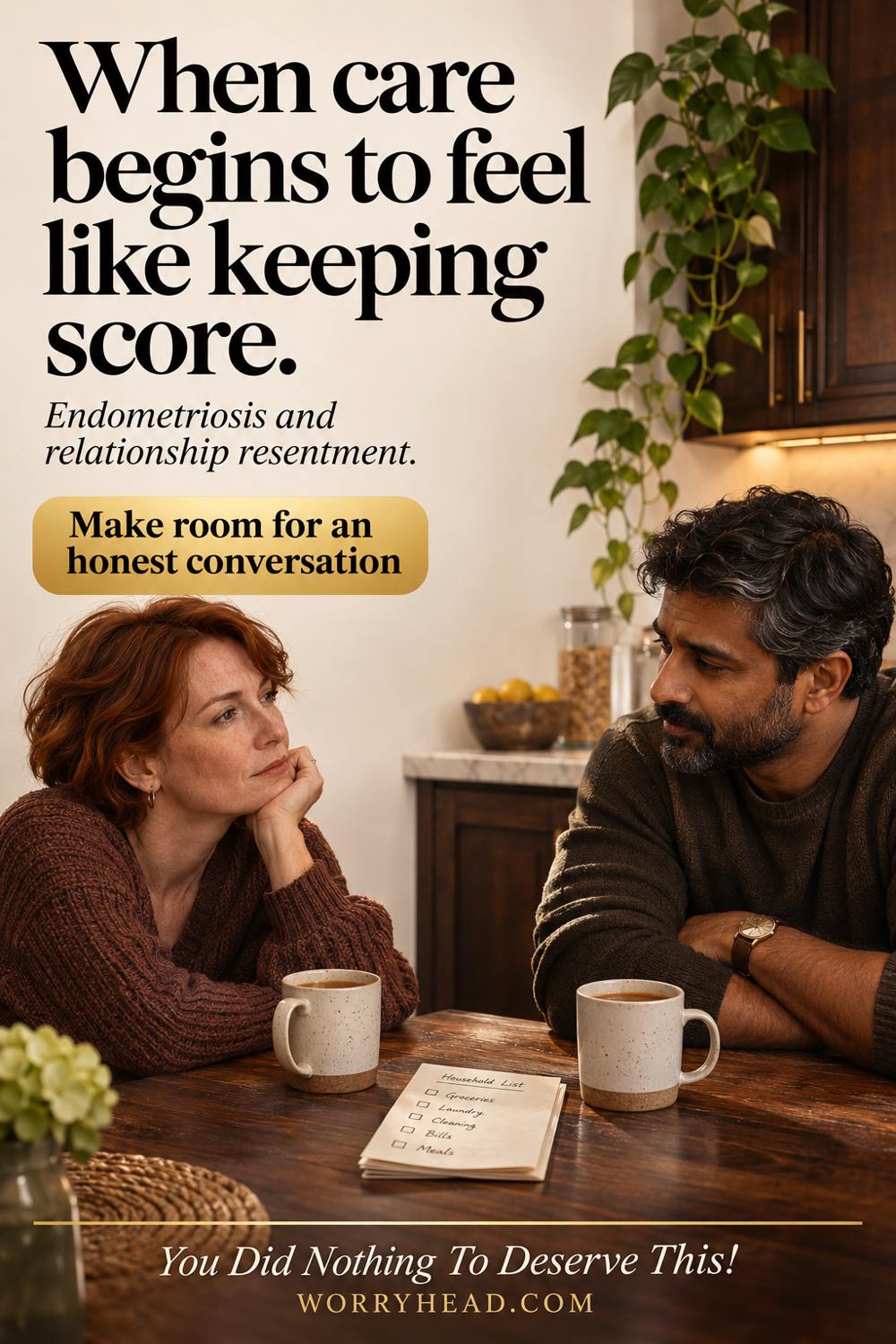
Endometriosis Resentment in Relationships: Care, Fairness and Finding Your Way Back
Have you ever worried that asking for help will leave another unspoken hurt between you? Endometriosis resentment can grow around changed plans, care and the exhausting work of explaining what your body needs. If you love your partner but feel increasingly alone in the relationship, your experience deserves attention without making you the person to blame.
Endometriosis resentment can develop when pain, changed roles, unmet needs and uneven responsibilities remain unspoken. It is a relationship difficulty, not proof that the person with endometriosis is a burden. Clear boundaries, practical changes and appropriate support can help couples address it.
I am not a clinician; I write as a husband, blogger and researcher who has spent years learning through my wife’s experience, with the health guidance and research used for this article listed in the references below.
This guide sits within our wider look at endometriosis and relationships.
The same offer of help can feel caring to one person and controlling to another. The difference may lie in whether you still have a choice about how your day unfolds.
A disagreement about dinner may therefore need more than a new meal plan. It may need an honest conversation about independence, invisible work or the fear of being unwanted.
My wife’s illness has changed our hopes for children and the dancing life she loved. I do not want the practical demands of care to make her feel that her place beside me has become conditional.
You may recognise a feeling here before you find the words for it. There is room to understand that feeling and decide what would make daily life more respectful.
When illness has made you question what you deserve, finding words can be a first step towards feeling less alone. My free eBook, You Did NOTHING To Deserve This!, offers the perspective of a husband learning to understand the person behind the condition. Take what feels useful, at a pace that suits you.
You Did NOTHING To Deserve This!
Endometriosis Validation for Women with Endo
- Understanding Endometriosis Resentment Without Blaming the Person in Pain
- Where Endometriosis Resentment Can Begin in Everyday Life
- Separating Endometriosis Resentment From Control and Cruelty
- Making Hidden Work Visible Before Endometriosis Resentment Builds
- What Fairness Can Mean When Endometriosis Resentment Centres on Chores
- Talking About Money Without Feeding Endometriosis Resentment
- Making Room for Grief Alongside Endometriosis Resentment
- Protecting Intimacy From Endometriosis Resentment
- How to Begin a Conversation About Endometriosis Resentment
- Repairing Hurt After Endometriosis Resentment Has Been Spoken
- Finding Support Beyond the Couple for Endometriosis Resentment
- A Small Review Can Help Keep Endometriosis Resentment From Becoming the Default
- When to Seek Medical Help?
- Questions to Ask Your Doctor
- Conclusion on Endometriosis Resentment
- You Did NOTHING To Deserve This!
- FREE eBook
Understanding Endometriosis Resentment Without Blaming the Person in Pain
Resentment often begins with an accumulating sense that something important is unfair. The visible disagreement may be about an unfinished task, while the deeper hurt is about being disbelieved or left alone with responsibility. Identifying that difference helps you choose a response that addresses the real problem.
A difficult week does not establish what your partner feels about you. A sigh could reflect frustration, tiredness or a worry that has nothing to do with your symptoms. Start with behaviour you can describe rather than deciding that you already know the motive behind it.
Endometriosis resentment can affect either person without affecting them in the same way. You may need recognition of what illness has taken from you, while your partner needs a different arrangement around a recurring task. Both concerns can be heard without treating your condition as something you chose.
Endometriosis UK recognises that everyday responsibilities and emotional support can place pressure on couples. That does not mean every relationship follows the same course. It does mean that a practical problem and an emotional hurt may each need attention.
You can ask for respect while acknowledging help that has been given. Your partner can describe a limit without attacking your worth. Neither conversation should require you to promise that you will stop needing care.
The most useful starting point is a change small enough to discuss clearly and meaningful enough to make your day easier.
My wife has lost parts of the life she once expected, including the dancing life that mattered so much to her. I do not want a conversation about chores to make her feel that her place beside me depends on what she can still do. These are practical ways to begin making care feel more respectful, with room for both honesty and tenderness.
- Name What Feels Unfair
- Describe One Recent Moment
- Choose What Needs Changing
- Ask Before Taking Over
- Set a Practical Limit
- Agree a Way to Pause
- Keep Support Wider Than Us
- Check What Actually Changed
Name What Feels Unfair
Before you ask your partner to change something, give yourself a moment to identify what hurts. Is it the amount of work, the way help is offered, or the feeling that your symptoms are being doubted? These are different needs, and you do not have to solve all of them in one conversation.
Try finishing the sentence, “I feel most alone when…” with one honest example. You may appreciate the meals your partner prepares and still need them to stop commenting on how long you rest. Gratitude does not remove your right to ask for respect.
Seeing how illness has changed my wife’s independence makes me careful about assuming that practical help answers every emotional need. I would rather understand the part I have missed than insist that my effort should have been enough. Your experience deserves that same curiosity, even when you cannot explain it neatly.
Describe One Recent Moment
Choose an incident that both of you can recognise instead of opening with “you always” or “you never”. Explain what happened, how it affected you and what you hoped would happen instead. A small, specific example gives the conversation somewhere to begin.
You might say that a lift was agreed, the time changed, and you were left unsure how to get home. Leave space to hear what happened at the other end before deciding that the change meant you were unwanted. Understanding an explanation does not require pretending the impact disappeared.
As a husband, I know that supporting someone includes taking ordinary arrangements seriously. If a promise affects whether you can attend an appointment or get safely home, it is more than a minor detail. Ask for a clear plan for that situation, rather than trying to settle every disappointment you have ever carried in the same evening.
Choose What Needs Changing
A useful conversation ends with a request that someone can understand and act on. “Please care more” expresses real pain, but it may leave you arguing about intentions. “Please take responsibility for the shopping order this week” identifies a practical change you can discuss.
Make the request proportionate to the problem and to what is possible for both of you. If money, work or another health condition limits the options, name that reality rather than turning it into a test of devotion. Sometimes the next step is finding outside help or dropping an unnecessary task.
I want support for my wife to make her day easier, not give her another project to supervise. Agree who will do the next step and when you will check whether it helped. You can start with one change without claiming that one grocery order will repair all the hurt underneath it.
Ask Before Taking Over
Help can feel uncomfortable when it arrives as a decision already made about your life. A partner might cancel an outing, answer a medical question or move your belongings because they believe they are protecting you. Good intentions still leave room for asking what you want.
Try distinguishing a task you want handled from a decision you want to keep. You may welcome someone booking agreed transport while wanting to choose who attends the appointment. Being tired does not mean you have surrendered your voice or your privacy.
My wife is a person with preferences, ambitions and experience of her own body that I cannot replace. I can offer help without appointing myself the person in charge. A simple agreement about what requires asking first can prevent care from becoming another place where you feel you have to fight to be heard.
Set a Practical Limit
Either person may need to say that an arrangement is no longer manageable. A limit should describe what you can do and what needs another solution, rather than threaten the other person with withdrawal of love. You can care deeply and still have finite time, energy or money.
For example, a partner might be unable to provide transport during a particular shift. The next conversation is about alternatives, not whether your appointment matters enough. If no easy alternative exists, acknowledge the difficulty honestly instead of demanding an impossible promise.
I do not want my wife to hide a need because she fears that mentioning it will overwhelm me. Nor would an agreement built on promises I cannot keep help her feel secure. Clear limits are useful when they lead to shared planning and respect; they are not permission to deny essential care as punishment.
Agree a Way to Pause
A difficult conversation may need a break when pain, fatigue or anger makes listening harder. If it is safe to do so, explain that you need to pause and suggest when you can return. A pause should protect the conversation rather than disappear into days of silence.
You might agree to continue after dinner, the following morning or by a short written message if speaking feels too demanding. Choose something realistic for your symptoms and circumstances. Neither person needs to prove commitment by staying in an exhausting argument.
The distinction I care about as a husband is whether a break leaves my wife reassured that she will be heard. Repeatedly leaving and refusing to return can feel like punishment, even when it is called “space”. Keep the next contact clear, and recognise that a threatening situation needs safe outside support rather than another couples exercise.
Keep Support Wider Than Us
Your relationship does not have to contain every difficult feeling with no support from anyone else. A trusted friend, appropriate support group or counsellor may offer another place to think. Practical help can also reduce a pressure that talking alone cannot remove.
Agree what private information may be shared and with whom. A partner can describe their own feelings without distributing your medical history or telling others details you wanted kept private. Support should not become a public argument about who is the better partner.
Writing helped me begin to understand more about my wife’s illness, but my role is still to listen to her rather than assume that learning makes me an expert on her feelings. You deserve support chosen for your needs, too. If your partner will not seek help, you can still explore individual support without taking responsibility for changing them.
Check What Actually Changed
After an agreement, look for a practical difference rather than a perfect conversation. Are there fewer reminders, more reliable arrangements or less fear about asking for rest? These observations can help you see whether the change is addressing the problem you named.
If it has not helped, say which part remains difficult and reconsider the arrangement. An occasional mistake that is acknowledged differs from repeated promises followed by the same hurt. You do not have to ignore a pattern simply because an apology sounded sincere.
I would want my wife to be able to tell me that my proposed help was not helping. That feedback is information about her day, not an insult to my intentions. Choose one next adjustment together where mutual effort is possible, and seek support if the relationship leaves you repeatedly unheard, controlled or afraid.

Where Endometriosis Resentment Can Begin in Everyday Life
It can help to identify where the strain first becomes noticeable. Is it around morning routines, the journey home from work, an appointment, a cancelled evening, or the moment one person asks for rest? These details are more useful than the conclusion that the whole relationship has become a disaster. They show where an adjustment might make a difference and where a deeper disagreement needs attention.
Consider an illustrative couple who repeatedly argue about dinner. One person expects the other to choose meals because that is how the household used to work. The person with endometriosis is still expected to notice what has run out, decide what is manageable, write the list and explain the plan, even when someone else shops. Both may say they are doing everything because each sees a different part of the work. The disagreement needs a description of the whole task, not a contest over who cares more.
Another couple may have a different problem. They have agreed on responsibilities, but one partner responds to every changed plan with coldness for the rest of the evening. The unresolved issue is then not merely the calendar. It is whether disappointment can be expressed without making the other person feel punished for being unwell. A practical solution may help, but it will not replace the need to address that behaviour directly.
A third situation involves uncertainty. A partner wants to book a holiday while the person with endometriosis cannot promise how she will feel. One wants reassurance; the other hears a demand to guarantee a body she cannot control. If neither names this difference, the conversation can slide into “you never want to do anything” and “you never understand”. The underlying needs may be a sense of possibility on one side and protection from an impossible promise on the other.
Try writing down a recent incident using four plain facts: what was expected, what changed, what each person did, and what remained unresolved. Leave motives out of the first version. “The appointment ran late and the collection was missed” is a fact you can discuss. “You wanted to make my day harder” is an interpretation that needs evidence. This exercise is an optional way to prepare, not a requirement to document your whole life.
As a husband, I find it important to keep the actual person in view while thinking about systems. A better list might prevent a missed task, but it will not answer the hurt of feeling unloved. Ask which problem you are trying to solve before choosing the tool. Often there is both a practical problem and an emotional one, and each needs a response of its own.

Separating Endometriosis Resentment From Control and Cruelty
Not every difficult relationship conversation is safe to approach as a shared communication problem. Feeling disappointed, requesting time alone and discussing an unsustainable workload are different from intimidation, humiliation, sexual pressure or controlling access to money and healthcare. Illness does not excuse those behaviours. A person can be under real strain and still be responsible for choosing not to threaten or degrade someone else.
The NHS describes domestic abuse as involving power and control, and its guidance includes emotional, financial and sexual forms as well as physical harm. You do not have to wait for a physical assault before asking privately for support. If speaking honestly leads you to fear retaliation, the priority is not finding a more persuasive sentence or completing a couples exercise. Seek advice from a trusted professional or specialist domestic abuse service in a way that is safe for you.
Examples that deserve serious attention include withholding essential money to punish you, preventing appointments, insisting that care creates an obligation to have sex, monitoring your communications, or threatening you when symptoms change a plan. These are not signs that you have failed to appreciate your partner properly. No list of chores, gratitude or improved organisation makes coercion acceptable.
If this distinction is difficult to make, you do not need to decide on a label before seeking help. You can describe what happens and how safe you feel. A GP or specialist support worker can hear the concrete behaviour rather than requiring you to prove a whole diagnosis of the relationship. If you are in immediate danger, contact local emergency services when it is safe to do so.
Joint counselling is not the automatic first step when coercion or fear is present. Private specialist advice can help you consider whether joint conversations would be safe. Do not use the suggestions elsewhere in this article as instructions to confront a threatening partner, announce plans to leave, or keep a written record where it could put you at greater risk. Safety and individual circumstances matter more than completing an exercise.
I include this boundary because warm language about teamwork can otherwise place an unfair responsibility on the person being harmed. Mutual effort is meaningful only when each person has room to say no, disagree and ask for help. You deserve respect even if the household is under pressure, even if your condition is difficult, and even if someone else has done a great deal for you.
Making Hidden Work Visible Before Endometriosis Resentment Builds
Many households notice a task only when it is left unfinished. That can hide the work of remembering that it exists. Shopping includes checking supplies, deciding what to buy, travelling or arranging delivery, carrying it in and putting it away. An appointment may involve booking, paperwork, transport, time off work, questions, prescriptions and recovery afterwards. If one person does the visible final step while the other coordinates everything, the workload has not necessarily been shared in the way either person imagined.
For a calm discussion, choose one recurring task and describe its beginning and end. Avoid making a complete inventory of each other’s failures. You might ask: who notices this needs doing, who decides the approach, who carries it out, and who follows up? The purpose is to expose a gap in the arrangement, not to calculate which person has earned more affection.
A useful change may be whole-task ownership. If a partner takes responsibility for an agreed grocery order, that includes checking the shared list, placing the order and resolving ordinary substitutions within the agreed budget. It should not routinely require the person resting to answer ten avoidable questions. Equally, ownership is not permission to ignore dietary needs, overspend or make major decisions without discussion. Agree the important boundaries, then allow reasonable independence inside them.
Health-related decisions need particular care. A partner can help organise documents or collect a prescription with permission, but your body and treatment choices remain yours. Support becomes intrusive when it turns into surveillance of whether you have taken every suggestion, rested enough, or performed illness in an acceptable way. The question is what help you want, not what level of control makes someone else less anxious.
There may be tasks you want to keep because they matter to your identity. Being unwell does not mean you want every responsibility removed. You might enjoy cooking on some days or want to manage your own appointments. A flexible agreement can protect that choice while making clear that choosing a task on Tuesday does not create an obligation to perform it during a flare on Friday.
In my view, good support makes life less administratively exhausting. It does not create a second management job for the person already dealing with symptoms. After trying a change, ask whether it reduced the number of decisions, reminders and explanations required. That is often a more useful measure than asking whether the chores were divided into perfectly equal columns.

What Fairness Can Mean When Endometriosis Resentment Centres on Chores
Equal numbers of tasks are not always a fair arrangement. Tasks differ in effort, timing, physical demands and consequences if they are missed. People also have different capacities, paid work obligations, disabilities and recovery needs. A workable agreement starts with those realities. It does not assume that a person can produce a fixed amount of energy because the division looks balanced on paper.
Try discussing essentials separately from preferences. Feeding yourselves, necessary care and basic hygiene may need a reliable plan. A spotless home, elaborate meals or hosting visitors may be negotiable. If the available energy cannot meet every expectation, lowering an unnecessary standard can be more useful than arguing about who should stretch further. Neither person needs to win a debate about character before a nonessential task can be dropped.
You might create two versions of a day: an ordinary plan and a reduced-capacity plan. The second should describe what can be simplified, postponed or handed over, with the person’s consent. It is not a medical treatment plan and should not dictate activity beyond clinical advice. Its purpose is to prevent every difficult day from requiring a fresh negotiation about whether symptoms are serious enough to justify change.
For example, a reduced-capacity evening might mean a simple meal already available, postponing laundry and cancelling a nonessential errand. If the supporting partner is also unwell or overloaded, the plan needs to account for that rather than assuming they have unlimited capacity. It may reveal the need for help outside the couple, a different budget decision or a smaller set of commitments. Sometimes the honest answer is that both people are under-supported.
Avoid treating a better day as evidence that earlier limitations were exaggerated. Capacity can vary, and spending energy on something meaningful may have consequences that an observer does not see. You can discuss how to plan without turning each outing or pleasant moment into a prosecution of whether someone could have cleaned instead. Joy is not a confession that care was unnecessary.
My wife still works, and the wish to feel useful matters to her. I would not want a household agreement to reduce her to a passive recipient of help. Fairness should leave room for contribution, choice, rest and changing circumstances. A person can contribute deeply to a partnership without matching the other person’s physical output, income or hours of housework on any particular day.
Talking About Money Without Feeding Endometriosis Resentment
Money can make every other disagreement feel more urgent. Lost hours, appointment costs, transport and uncertainty about future work can narrow the options available to a couple. Even when both people are working, one may feel anxious about keeping up and the other may fear becoming financially dependent. A conversation about a purchase can then carry the weight of security, independence and self-worth.
Begin with the practical facts you both need to know. What must be paid, what is flexible, and what decision needs attention now? A discussion about this month’s transport costs does not need to become a judgement on whether the person with endometriosis will ever earn enough. Keep the immediate decision within a manageable boundary. If there is a wider financial problem, give it its own time and, where needed, qualified advice.
It can help to distinguish shared financial strain from blame. “Our income does not cover this plan” describes a problem. “You cost too much” makes a person the problem. The first leaves room to look for options; the second can make someone afraid to mention a symptom, request an appointment or buy an ordinary necessity. Words matter because they influence what becomes speakable in the relationship.
Neither partner should have to surrender all privacy or autonomy to demonstrate responsibility. Depending on your circumstances, you may agree a shared budget and an amount each person can spend without negotiation. Where money is very tight, the amount may be small, but the principle of respectful access remains important. If one person controls essentials to punish or restrict the other, refer back to the safety distinction rather than treating it as ordinary budgeting tension.
I am building my blogs partly because I want to ease the pressure on my wife. That is an aim, not an income outcome I have already achieved, and we both still work. I mention this because a supportive intention must not become another promise that the ill person has to wait patiently for while their present needs go unanswered. Future plans are useful when they sit beside realistic decisions for today.
If you cannot resolve a financial issue together, getting independent information can reduce the pressure on the relationship. Ask an appropriate adviser about your actual circumstances rather than relying on generic promises about benefits, insurance or work rights. This article cannot determine those entitlements. The relationship task is to approach the uncertainty without turning your health into a personal failure or a debt owed to your partner.
Making Room for Grief Alongside Endometriosis Resentment
Some resentment is tangled with loss. You may miss spontaneity, a social life, sexual ease, a career, the possibility of children or the version of yourself that did not have to plan around illness. Your partner may also be grieving changes in the life you imagined together. These losses can overlap without being identical. Neither person has to pretend they are the same in order to care about the other.
In our life, endometriosis and other conditions have affected dreams of children and the dancing life that mattered so much to my wife. I cannot turn that history into a lesson that makes everything worthwhile. Nor would I want another woman to feel she must find a positive meaning in a loss before she is allowed to speak about it. Some things remain painful even in a loving relationship.
It may help to separate “I miss that life” from “I wish I had a different partner”. Those statements are not interchangeable. A supporting partner who is grieving needs to express that grief without making the person with endometriosis feel she is being compared with a healthier replacement. The woman living with illness also needs room to say that she misses things without immediately reassuring everyone else that she is coping.
You could ask one another what the loss represents. Missing a dance class may mean missing movement, identity, friends or a particular feeling of freedom. Missing a holiday may mean missing time together rather than that exact destination. Understanding the meaning can sometimes reveal another way to meet part of the need. It does not require claiming that a substitute replaces what has been lost.
Be wary of turning every expression of sadness into a project. Sometimes the most useful response is to listen and acknowledge that the change is real. Practical options can follow if the person wants them. The same applies to reassurance: “we can still have a good life” may be sincerely meant, but it can feel rushed if it arrives before anyone has acknowledged how different that life has become.
Grief does not follow a household timetable. One person may want to talk on an anniversary while the other is distracted by an ordinary working day. A reminder can help, but nobody should have to organise every moment of emotional recognition alone. Notice meaningful dates where you can, ask rather than assume, and leave room for the answer to be different from last year.

Protecting Intimacy From Endometriosis Resentment
Closeness can become complicated when touch is associated with pain, expectation or disappointment. You may want affection but worry that accepting it will be interpreted as agreeing to sex. Your partner may hold back because they fear hurting you or being rejected. These uncertainties deserve direct, gentle discussion. They should not be settled by testing what someone will tolerate or waiting until a vulnerable moment to demand reassurance.
Support never creates a sexual obligation. Doing the shopping, providing care or staying in a relationship does not earn access to another person’s body. Consent is specific and can change. A person can want a cuddle and decline any further touch. They can change their mind after beginning an activity. Neither choice needs to be repaid with an apology for being ill.
An optional conversation outside an intimate moment can make expectations clearer. You might identify kinds of affection that currently feel welcome, those that require asking first, and those you do not want. The list can change. This is not a prescription for activities or an instruction to endure discomfort. It is a way to reduce guessing and preserve the possibility of closeness that feels chosen.
If pain during or after sex is affecting you, discuss it with an appropriate healthcare professional. Endometriosis UK recognises that intimacy can be affected by several factors, including symptoms, fatigue, mood and treatment-related concerns. You do not need to solve the medical aspect through relationship communication alone. Equally, treating a symptom does not automatically resolve pressure, mistrust or hurt that has developed around it.
My role as a husband is not to decide which level of discomfort is acceptable for my wife. It is to listen to her boundaries and help create a relationship in which those boundaries can be spoken without fear. That can include hearing disappointment without treating it as a demand. A partner is allowed to have feelings about changes in intimacy; they are responsible for expressing those feelings without coercion.
For couples who want additional support, a suitably qualified clinician or psychosexual therapist may help explore the specific difficulties. Ask about experience with pelvic pain and chronic illness, accessibility, costs and whether the approach respects your choices. You do not have to commit to a service merely because it is offered, and no professional should frame enduring unwanted or painful sex as proof of commitment to a relationship.
How to Begin a Conversation About Endometriosis Resentment
Choose a moment with enough privacy and capacity for both people to listen. That does not mean waiting for a perfect pain-free day that may never arrive. It means avoiding, where possible, the middle of a task, an urgent departure or a moment when either person is already overwhelmed. Ask whether now is workable and agree a specific alternative if it is not. Repeatedly postponing without returning is itself something that needs addressing.
Start with one recent moment rather than a catalogue of the relationship. An illustrative opening might be: “When the plan changed yesterday and we stopped speaking, I felt I was being punished for being unwell. I want us to find a way to talk about disappointment without that happening.” This describes an event and an impact. It leaves room for your partner to explain their experience without requiring you to withdraw yours.
Then name what you need to understand. You might ask whether the difficult part was extra work, uncertainty, missing an event or feeling unable to say no. These are different concerns. Resist filling in the answer before the other person speaks. If the response becomes a broad accusation, ask for one concrete example that you can both examine.
Listening does not require immediate agreement. You can reflect back the issue as you understand it: “You are saying the last-minute transport is becoming difficult around work.” Then explain your own constraint: “I cannot always predict when I will need it.” The next question is what arrangement could account for both facts. This is more productive than demanding certainty from a condition that does not provide it.
A pause can be useful if the conversation becomes too heated, provided it is not used as indefinite punishment. Agree when and how you will return, taking symptoms and safety into account. A brief written message may be easier for some people than an immediate spoken discussion. Do not insist on an exhausting conversation to demonstrate that you care; the method should help people communicate, not test their endurance.
End with one decision small enough to remember. Who will do what, by when, and what happens if the plan becomes unworkable? You do not need a formal contract for every exchange. The point is to leave with something more concrete than “we should try harder”. As someone who writes to understand complicated experiences, I value useful words most when they lead to a manageable change in daily life.

Repairing Hurt After Endometriosis Resentment Has Been Spoken
An apology can open a door, but it does not erase what happened. A helpful apology identifies the behaviour, acknowledges its impact and avoids making the injured person responsible for causing it. “I spoke as though you chose to be unwell, and that was unfair” is clearer than “I am sorry you took it that way”. The exact wording can vary; the willingness to own the action matters.
Explanations may be relevant without becoming excuses. A partner can explain that they were exhausted and still accept responsibility for speaking cruelly. The person with endometriosis can apologise for an unfair remark without apologising for having symptoms. Separating these things protects both accountability and dignity. It also prevents the conversation from collapsing into the idea that one person must be entirely innocent and the other entirely wrong.
Ask what would make the apology visible in practice. If the problem was repeated criticism about cancelled plans, the change might be agreeing a fallback without blame. If it was a missed responsibility, the change may be taking ownership of that task. If private medical details were shared without consent, repair includes stopping the disclosure and agreeing future boundaries, not merely saying the intention was to seek support.
The person who was hurt does not have to offer immediate reassurance or forgiveness to make the apology count. Trust may take time, especially when the same behaviour has happened repeatedly. You can acknowledge the apology while saying that you need to see the change continue. A request for patience is different from a demand that the past never be mentioned again.
Look for patterns over time rather than one impressive evening. Is it easier to ask for help? Are responsibilities carried out with fewer reminders? Can you decline something without being punished? Does a disagreement stay connected to the issue rather than becoming an attack on your worth? These observations are more meaningful than whether the conversation sounded perfect.
I would also leave room for ordinary imperfection. A missed task after a sincere agreement does not automatically prove that nothing has changed. It is worth distinguishing an occasional mistake that is acknowledged and corrected from a repeating pattern of promises without follow-through. You are allowed to notice the difference, and to seek help when the relationship remains painful despite repeated attempts to repair it.
Finding Support Beyond the Couple for Endometriosis Resentment
A relationship can be loving and still need more support than two people can provide alone. Practical help, reliable medical care, individual emotional support and relationship counselling serve different purposes. You do not need to choose one explanation for every difficulty. A household may need a better transport arrangement at the same time that one partner needs somewhere private to discuss fear or grief.
NICE recommends considering the individual information and support needs of people with suspected or confirmed endometriosis, and involving partners or other important people when the person agrees. That consent matters. Bringing someone to an appointment should support your voice, not replace it. You can agree beforehand what you want them to help with and whether there are matters you prefer to discuss alone.
Research also needs to be read carefully. A 2020 systematic review of partners’ experiences included only five studies and 399 male partners. It described varied impacts and some positive experiences, while noting how limited the evidence remained. This supports taking partners’ needs seriously; it does not give a universal resentment rate or predict what will happen to your relationship. Much of the available work does not represent every kind of couple equally.
A 2026 qualitative study interviewed 49 couples together about coping with endometriosis. Its themes included shared challenges, agency and mutual support. These accounts can help us recognise experiences, but interviews do not establish that one suggested communication technique will work for everyone. I use this research as context for listening more carefully, not as a formula that you must follow to deserve a good outcome.
If you consider counselling, ask how the practitioner works with chronic illness, differing capacities and any safety concerns. You may want individual support even if your partner will not attend, or because some thoughts are easier to explore privately. If there is coercion or fear, seek specialist individual advice about safety rather than assuming joint counselling is appropriate.
Support does not have to begin with telling everyone everything. You might ask one trusted person for a specific practical favour, find a moderated community, or ask your healthcare team what local services are available. Preserve privacy and avoid giving another person a role they have not agreed to take. The aim is to widen the support available, not to create a new chain of unspoken obligations around your illness.
A Small Review Can Help Keep Endometriosis Resentment From Becoming the Default
Once you have made an adjustment, give it a realistic chance and then review it. A short check-in can be enough: what became easier, what still feels difficult, and what needs to change next? There is no need to turn your relationship into a weekly performance appraisal. The point is to notice a problem before it becomes another month of silent frustration.
Choose measures that reflect daily life. Perhaps you no longer have to remind your partner about an agreed task. Perhaps a cancelled plan can be discussed without an argument. Perhaps you feel able to ask for rest without preparing a defence. These are meaningful improvements even if symptoms remain difficult and the household is not perfectly organised.
Be equally honest if the change has not helped. A shared calendar will not solve disbelief. A meal plan will not repair sexual pressure. More reassurance will not create money that is not available. Identifying the limit of a solution is useful information; it does not mean you failed to use it correctly. Return to the actual problem and consider whether different or outside support is needed.
If both people keep making good-faith efforts but feel stuck, that may be a reason to seek professional help rather than keep repeating the same argument. If only one person is expected to adapt, acknowledge that imbalance. You cannot create mutual respect through enough effort on your own. Your responsibility is not to become so easy to care for that the other person never experiences frustration.
I want a review to leave room for what is still good between you, too. You may share humour, affection, values or ordinary moments that are not about illness. Noticing these does not cancel the difficult parts. It helps prevent the relationship from being described only through problems. There is a person you love here, and there is also a person whose needs include your own.
Choose one next step rather than promising a completely different life by Monday. That might be a private conversation, a revised task, an appointment for support or a boundary you need respected. The size of the action matters less than whether it addresses something real and can be carried out without asking either person to deny their limits.

When to Seek Medical Help?
If symptoms, disrupted sleep or distress are making daily life harder, speak with your GP or the team managing your endometriosis. Explain the practical effect as well as how you feel, and ask what support or review is appropriate. A relationship conversation should not replace care for pain or other health concerns.
You can also ask about individual psychological support or relationship counselling when it is safe and appropriate. You do not need to wait until the relationship reaches a crisis before seeking help. If you feel controlled, threatened or afraid, seek private specialist advice about safety rather than assuming a joint appointment is the right first step.
Questions to Ask Your Doctor
You might ask: “Which symptoms or treatment concerns should we review because they are affecting daily life?” and “What support is available for the emotional impact?” These questions connect the relationship strain to the care you need without suggesting that your feelings are the cause of your illness.
If you want your partner involved, ask how they can support the appointment while keeping your decisions and privacy central. You can also ask whom to contact if the recommended support is unavailable or the situation worsens. I would rather help my wife bring the question that matters to her than arrive with an answer I have chosen for her.
Conclusion on Endometriosis Resentment
You can love someone and still reach a point where the way you are living together needs to change. Endometriosis resentment deserves attention because it can make requests feel loaded with hurt. It does not mean you are difficult to love, and it does not establish that your relationship is beyond repair. It means there is something to understand about care, expectations, respect or the support available to you both.
Begin with the part you can describe honestly. Perhaps a responsibility needs another arrangement. Perhaps help is being offered in a way that leaves you feeling watched rather than supported. Perhaps you are grieving a life you expected and need someone to acknowledge the loss before suggesting another solution. You do not need a explanation before your experience matters. One example can be enough to begin a conversation that has been avoided.
I think about my wife when I write this, and about everything illness has asked her to carry. The loss of our hopes for children and the changes to her dancing life cannot be reduced to a lesson in positive thinking. I cannot remove those losses by loving her. What I can do is refuse to make her feel that needing care has reduced her place in our marriage or made her less deserving of tenderness.
That does not require either partner to pretend they have unlimited capacity. Honest limits can make support more reliable when they lead to a workable plan. They become harmful when they are used to threaten, punish or bargain for control. You can acknowledge your partner’s tiredness without agreeing that your illness is your fault. A partner can ask for help without presenting the woman they love as the problem that needs to be solved for them.
Look for changes that reach your actual day. Does an agreed task happen without repeated reminders? Can you say that you need rest without preparing a defence? Can disappointment be discussed without days of silence or an attack on your character? These questions tell you more than a worded promise. If the same hurt keeps returning, you are allowed to notice it and to seek support rather than keep explaining yourself in careful ways alone.
Where there is fear, coercion or danger, prioritise safe individual advice. Where there is mutual respect and willingness, choose one practical next step and return to it together. You may need outside help, more information or time to rebuild trust. There is no requirement to resolve every feeling tonight, forgive immediately or prove that your relationship is strong by managing everything privately. Asking for support can be part of caring for the life you share.
You are still a person with preferences, humour, hopes and something to give. Your contribution is not measured only in money, chores or days without symptoms. I want you to have room to be honest about what hurts, to remain involved in decisions, and to feel wanted without having to earn your place through being well.
You do not have to become easier to care for before you deserve kindness. Start with the need you can name, protect the choices that belong to you, and notice whether actions follow the promises. Your illness may have changed daily life, but it has not removed your right to respect, tenderness or a voice in the relationship.
If you feel comfortable, share a practical change that helped you in the comments, while protecting your privacy. My free 130+ page eBook, You Did NOTHING To Deserve This!, is available below when you would like a little more support.


About Me
Hi, I’m Lucjan! The reason why I decided to create this blog was my beautiful wife, who experienced a lot of pain in life, but also the lack of information about endometriosis and fibromyalgia for men…
READ MORE
Grab a FREE eBook!
“You Did NOTHING To Deserve This!”
Finally hear the words nobody ever said to you, that your pain is real, your tears make sense, and you did nothing to deserve endometriosis, the dismissal, or the way it has rewritten your life.
Related Questions You May Be Asking About Endometriosis Resentment
Does resentment mean my partner no longer loves me?
Not necessarily. It can reflect an unresolved difficulty, but you cannot determine your partner’s feelings from one reaction. Ask about the specific pattern you have noticed, if it is safe to do so. Love also does not make hurtful or controlling behaviour acceptable; how you are treated matters alongside what someone says they feel.
Can I feel resentful even when my partner helps a lot?
Yes. You may appreciate practical help and still feel unheard, monitored or deprived of choice. Try to identify what is missing rather than judging yourself for not feeling grateful enough. The aim is to describe a need accurately, not to deny the help that has been given.
Should we divide everything equally?
A useful arrangement considers capacity, the demands of each task and the responsibilities each person already carries. An identical number of chores may still be unfair. Agree what is essential, what can be simplified and how the arrangement changes when either person is unable to manage their usual responsibilities.
What if my partner will not discuss the problem?
You can ask for a specific time and explain why the issue matters. If discussion is repeatedly refused, individual support may help you consider your needs and options. You cannot make another person participate by taking all responsibility yourself. If raising the issue makes you afraid, prioritise safe specialist advice.
Can treatment alone fix relationship resentment?
Symptom improvement may ease some pressures, but it does not automatically address patterns of blame, unequal responsibility or lost trust. Medical care and relationship support can have different roles. Neither should require you to promise a particular health outcome before your present needs are taken seriously.
Endometriosis Resentment References
- https://www.endometriosis-uk.org/resources/endometriosis-and-couples
- https://www.nice.org.uk/guidance/ng73/chapter/Recommendations
- https://www.nhs.uk/live-well/getting-help-for-domestic-violence/
- https://pubmed.ncbi.nlm.nih.gov/32781264/
- https://pubmed.ncbi.nlm.nih.gov/42532418/
