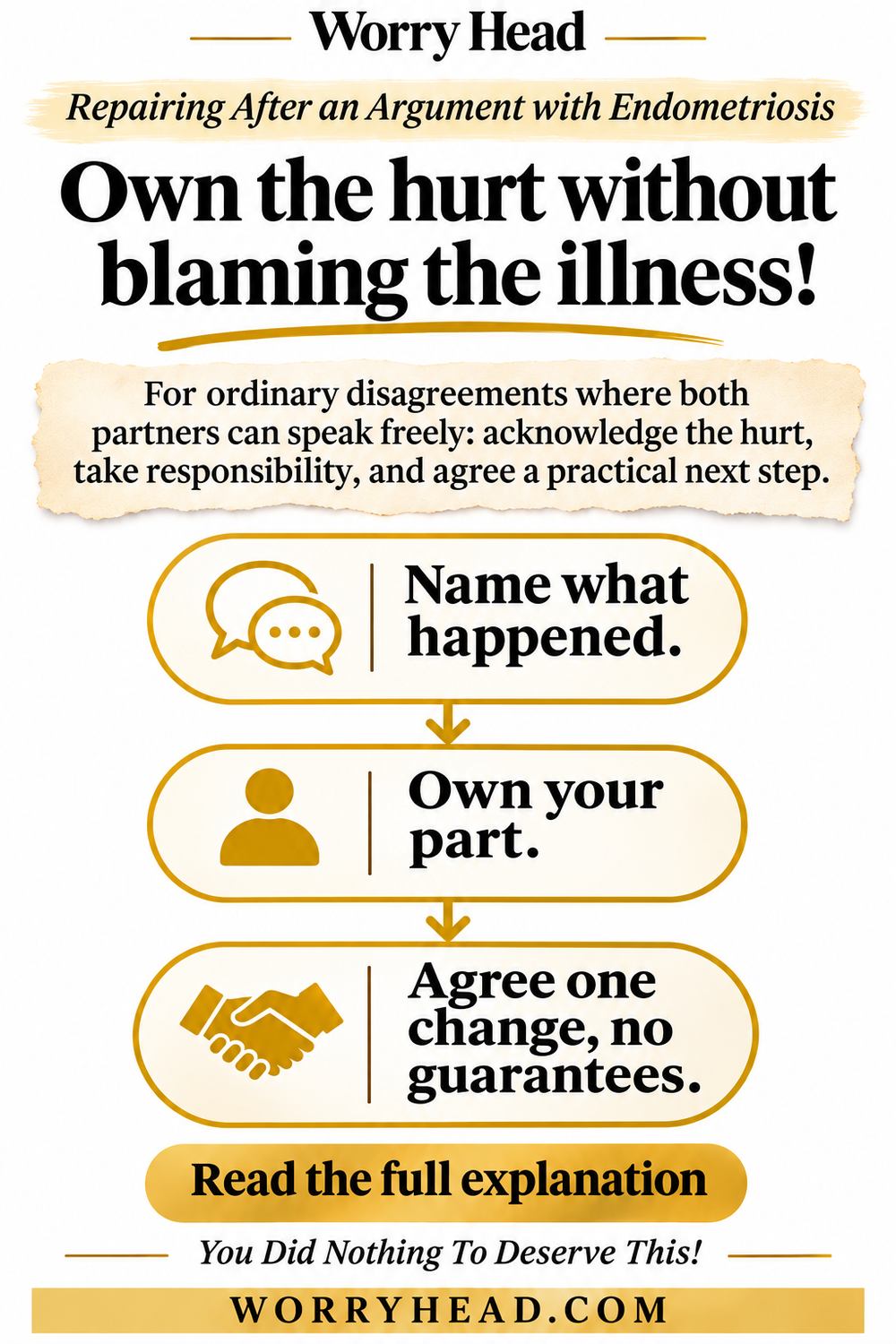
Repairing After an Argument with Endometriosis: Owning the Hurt Without Blaming the Illness
Have you reached the quiet after an argument and felt unsure how to return to each other without reopening everything? Repairing after an argument with endometriosis can become complicated when pain, tiredness and practical needs are mixed with words that hurt. You can acknowledge the strain of a difficult day while still being clear about what each person needs to take responsibility for.
Repair can begin with naming what happened, owning your part and listening to its effect. Having endometriosis or needing support is not something to apologise for; hurtful behaviour can still need an apology. Choose one realistic change, allow time for a response and do not demand reassurance.
I am a husband, blogger and researcher, not a clinician or relationship therapist. These reflections draw on years alongside my wife and the relationship guidance linked below.
This article follows the broader discussion of talking about endometriosis without starting a fight. Here, the focus is what happens after an ordinary disagreement: returning to the conversation, acknowledging hurt and making a practical repair without treating the illness itself as wrongdoing.
If an argument leaves you feeling guilty for having needs at all, my free eBook, You Did NOTHING To Deserve This!, offers understanding. Your need for support can remain valid even when the way a conversation unfolded needs attention.
You Did NOTHING To Deserve This!
Endometriosis Validation for Women with Endo
- Separate the Issue from the Hurt When Repairing After an Argument with Endometriosis
- Before Repairing After an Argument with Endometriosis, Choose a Time to Talk
- A Specific Apology Helps When Repairing After an Argument with Endometriosis
- Repairing After an Argument with Endometriosis Does Not Invalidate Your Needs
- Why Repairing After an Argument with Endometriosis Requires Listening
- Make Repairing After an Argument with Endometriosis Lead to One Realistic Change
- Know the Limits of Repairing After an Argument with Endometriosis
- Final Word on Repairing After an Argument with Endometriosis
- You Did NOTHING To Deserve This!
- FREE eBook
Separate the Issue from the Hurt When Repairing After an Argument with Endometriosis
An argument can contain more than one problem. There may be an unresolved practical issue, such as a task that was not done, and there may be hurt caused by how you spoke to each other. If those are treated as the same thing, an apology can feel like agreeing to drop the original need. It does not have to mean that.
You can say, “I want to apologise for interrupting. I still want us to discuss the help we agreed.” That names a behaviour and preserves the practical question. It avoids making the person choose between accountability and being heard about something that remains important.
Likewise, accepting an apology does not automatically settle the underlying arrangement. You may appreciate the acknowledgement and still need a clear answer about what will happen next. Keeping the two parts separate can make the conversation more specific: first the hurt, then the decision that still needs attention.
As a husband, I would not want my apology to become a shortcut past my wife’s concern. If I spoke dismissively, I need to own that. If there is also a task or agreement to revisit, I need to return to it rather than treating a warmer atmosphere as proof that the practical problem has disappeared.
Before Repairing After an Argument with Endometriosis, Choose a Time to Talk
Wanting to repair quickly can come from care, discomfort or both. The other person may not be ready for a full conversation immediately. Ask rather than assume: “I want to come back to what happened. Is now a workable time?” That gives them a choice without pretending that the issue no longer matters.
Relate advises choosing a time when both people can focus and allowing a heated discussion to pause. For a repair conversation, the same practical consideration applies. Trying to resolve everything while one person is leaving, distracted or unable to engage may make it harder to hear each other.
If you agree to return later, make the arrangement clear enough that the pause does not feel like disappearance. You might choose a time to check whether a conversation is possible, rather than demanding that everything be resolved by then. A check-in can be realistic even when you cannot predict how much energy or attention either person will have.
Do not make waiting into a punishment or a test of who cares more. A pause can protect the possibility of a useful conversation; indefinite silence used to pressure someone is a different matter. This article assumes an ordinary disagreement in which both people can speak freely, not a situation involving fear, threats or coercion.
A Specific Apology Helps When Repairing After an Argument with Endometriosis
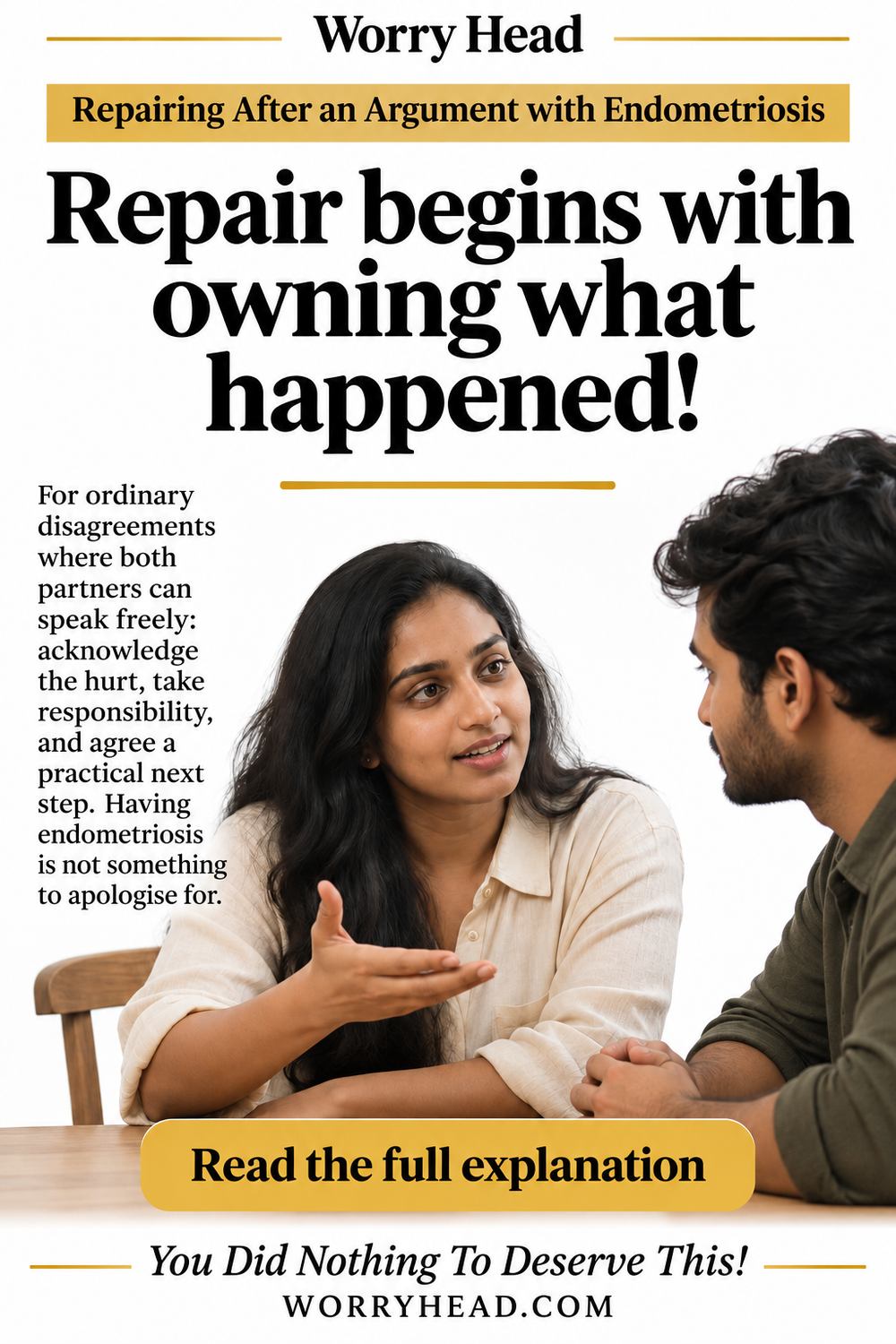
Name what you did rather than apologising for the other person’s reaction. “I am sorry I dismissed your request before listening” identifies a behaviour. “I am sorry you were upset” may leave unclear whether you recognise any responsibility. You do not need elaborate language, but the apology should make sense without requiring the other person to fill in the missing acknowledgement.
Avoid adding a defence before the apology has had room to land. You may have relevant context to explain, but “I am sorry, but you…” quickly moves responsibility elsewhere. Separate the context from the acknowledgement. Both people can discuss what was happening without making one person’s hurt disappear under the explanation.
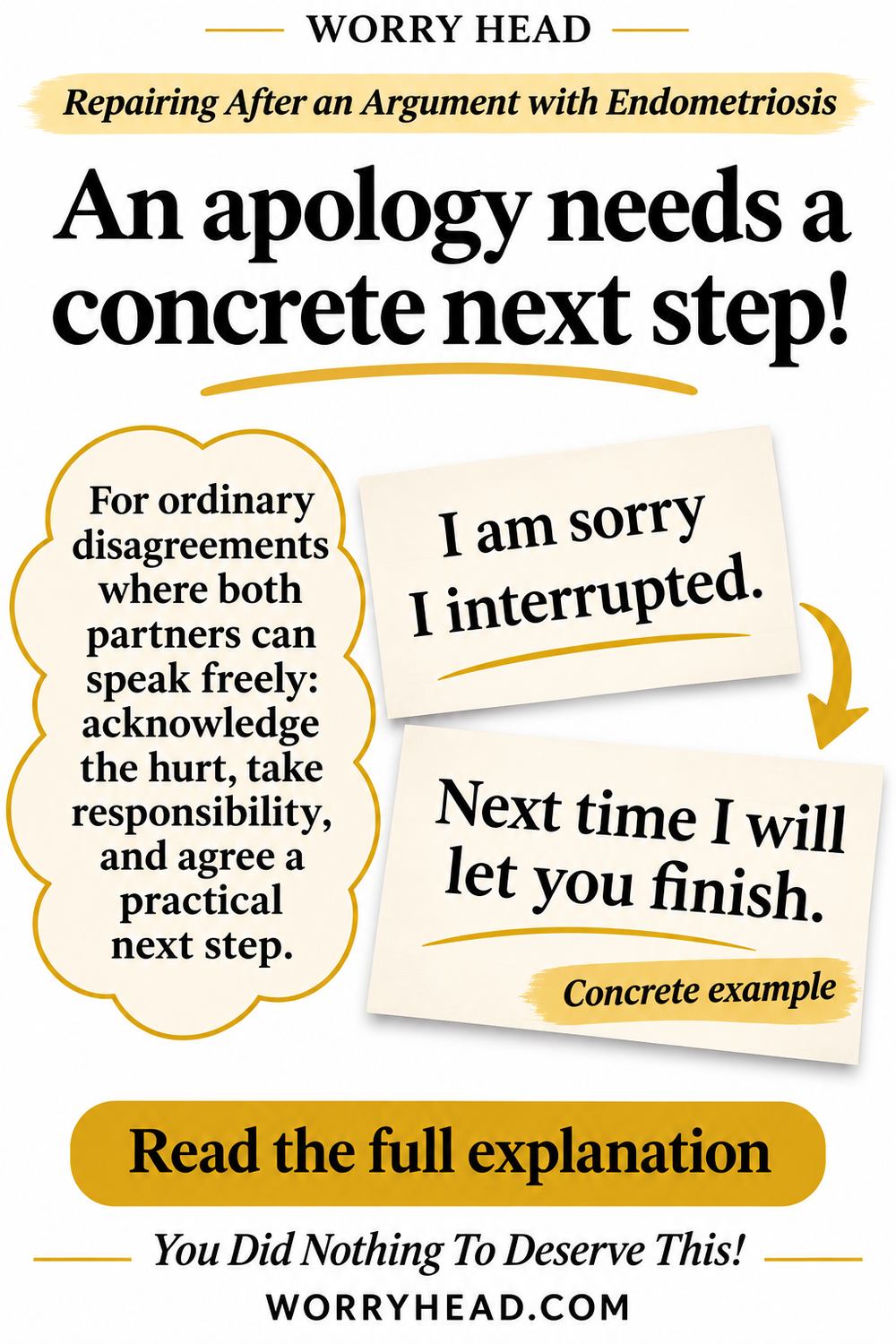
Do not promise that you will never make a mistake again. A more useful commitment concerns something you can practise: letting the person finish, checking an agreement or saying when you need a pause. Specific follow-through gives the apology a practical direction without requiring an impossible guarantee.
If you are receiving the apology, you can take time. You may want to say, “Thank you for acknowledging that; I am still upset.” That is not the same as refusing repair. An apology can be offered sincerely without giving the speaker control over how quickly the other person feels settled.
Repairing After an Argument with Endometriosis Does Not Invalidate Your Needs
It can be easy to apologise for the whole situation because that seems the quickest route back to peace. You might find yourself saying sorry for being ill, needing help or changing a plan, when the actual issue was a sharp remark or a misunderstanding. Try to keep the apology connected to the behaviour you mean to address.
“I am sorry I spoke harshly” does not need to become “I am sorry you have to deal with me.” The first can support accountability. The second turns your existence or illness into the problem and may leave the practical need unspoken. You can take responsibility without making yourself smaller than the situation requires.
The same distinction applies to the supporting partner. Feeling tired, disappointed or limited does not automatically make someone uncaring. They can describe their own capacity while taking responsibility for dismissive words or broken agreements. A useful conversation makes room for limits without using them to invalidate the other person’s experience.
Endometriosis UK’s couples resource recognises that the condition can place strain on everyday relationships. Context can help explain why a discussion was difficult, but it should not be used as a blanket excuse for hurtful behaviour. The illness can be part of the circumstances without becoming the person to blame for everything that happened.
Why Repairing After an Argument with Endometriosis Requires Listening
After acknowledging your part, leave room for the other person’s account. They may describe a different moment from the one you thought mattered most. You do not have to agree with every interpretation immediately to listen carefully. Start by understanding what they experienced before preparing a correction or another account of your intention.
Relate encourages couples to give each person space to speak without interruption. In a repair conversation, that might mean letting one person explain the effect of a remark, then checking that you understood. “You felt I had already decided your request was unreasonable before hearing it” is a check, not a script you must use word for word.
If you remember the event differently, say so without turning the whole conversation into a contest over whose memory is perfect. You may be able to acknowledge the effect of your words even while clarifying a factual detail. Focus on the part you can take responsibility for rather than using uncertainty to avoid all responsibility.
I would want to notice when I am listening only for the point at which I can defend myself. That habit can make an apology feel hollow. Repair asks something more useful of me: enough attention to understand why the moment hurt, and enough honesty to change the part of my behaviour that belongs to me.
Make Repairing After an Argument with Endometriosis Lead to One Realistic Change
A conversation can end with more than a promise to “communicate better”. Identify one change connected to what happened. If a task was misunderstood, clarify who is doing it and when. If interruptions were the problem, agree how you will make space to finish a thought. If the timing was poor, discuss how to ask for a pause clearly.
Keep the step small enough to be real. A complicated relationship system can become another source of work, especially if one person is expected to design and maintain it. The person taking responsibility should also take responsibility for remembering their part, rather than asking the person who was hurt to supervise the improvement.
You can review whether the change helped after a relevant situation arises. That does not require keeping a ledger of every mistake. It means noticing whether the same practical problem is being handled differently. If the agreement does not work, revise it honestly instead of repeating the same promise with more emotional force.
Do not use a kind gesture as a substitute for the agreed change. A cup of tea, affectionate message or shared activity may be welcome, but it does not automatically complete the task that was left undone or address a pattern of dismissal. Warmth and follow-through can support each other; one need not replace the other.
Know the Limits of Repairing After an Argument with Endometriosis
Not every disagreement will feel resolved in one conversation. You may understand each other better and still need time, further information or a different practical arrangement. It is possible to end a discussion respectfully without declaring that everything is fine. Say what has been agreed and what remains open so neither person has to guess.
If the same argument keeps returning, consider whether the problem is larger than the wording of an apology. Repeatedly broken agreements, unequal responsibilities or ongoing difficulty listening may need a fuller discussion or support from a qualified relationship professional. Relate offers relationship support, but no single article can assess what is happening in your particular relationship.
Where there is fear, intimidation or pressure to accept hurtful behaviour, ordinary communication tips may not fit. You do not owe a repair conversation that requires you to feel unsafe, and joint discussion should not be treated as the automatic answer to coercion. The scope here is mutual accountability in a relationship where each person can disagree freely.
Even in a generally caring relationship, you are allowed to have boundaries about how you are spoken to. Repair should make those boundaries clearer, not ask you to abandon them in order to restore closeness. A sincere apology can coexist with a firm expectation that a particular behaviour must change.
Final Word on Repairing After an Argument with Endometriosis
Repair begins with something concrete: what happened, what part belongs to you and what you will do differently. It can include an apology without blaming the illness, listening without immediate defence and a practical change that survives beyond the conversation.
You do not need to apologise for having endometriosis or needing support. You can still take responsibility for words or actions that hurt someone. My free eBook, You Did NOTHING To Deserve This!, is there if separating those truths feels difficult. Accountability should leave room for your dignity as well as the other person’s.


About Me
Hi, I’m Lucjan! The reason why I decided to create this blog was my beautiful wife, who experienced a lot of pain in life, but also the lack of information about endometriosis and fibromyalgia for men…
READ MORE
Grab a FREE eBook!
“You Did NOTHING To Deserve This!”
Finally hear the words nobody ever said to you, that your pain is real, your tears make sense, and you did nothing to deserve endometriosis, the dismissal, or the way it has rewritten your life.
Related Questions You May Be Asking About Repairing After an Argument with Endometriosis
Can I Apologise and Still Ask for the Original Help?
Yes. An apology for how you spoke does not automatically withdraw the need or settle the practical issue. Name the behaviour and the remaining request separately.
Do I Have to Accept an Apology Immediately?
You can acknowledge it while taking time to process what happened. Repair does not require instant reassurance, affection or a declaration that you are no longer upset.
What if We Both Said Something Hurtful?
Each person can take responsibility for their own behaviour without making their apology conditional on receiving one first. That does not require pretending the effects were identical or abandoning your boundaries.
Repairing After an Argument with Endometriosis References
- https://www.relate.org.uk/get-help/we-cant-stop-arguing
- https://www.relate.org.uk/get-help/trouble-communicating
- https://www.endometriosis-uk.org/resources/endometriosis-and-couples
