Endometriosis and Sitting Out Dancing: You Still Belong in the Evening
Have you watched people move towards a dance floor and felt your place in the celebration suddenly become uncertain? Endometriosis and sitting out dancing can bring grief, awkwardness or pressure when everyone assumes joining in is the obvious next step. You are allowed to stay part of the evening without making your body perform belonging for other people.
You can sit out dancing without owing anyone a performance or a detailed explanation. Decide what participation you want, ask for practical inclusion and let a no remain a no. Enjoying the music, wanting company and grieving what you miss can all belong to the same evening without contradiction.
I am a husband, blogger and researcher, not a clinician. Years of learning alongside my wife inform this reflection, and I have linked the research behind the wider discussion of activity loss below.
This article explores a specific moment within missing your old life with endometriosis. It concerns belonging at celebrations and responding to social pressure, not advising whether dancing is medically suitable for you or how much movement to attempt.
If the edge of a dance floor brings up more than other people can see, my free eBook, You Did NOTHING To Deserve This!, offers understanding. You do not have to hide the loss or turn it into a positive lesson before you deserve company.
You Did NOTHING To Deserve This!
Endometriosis Validation for Women with Endo
- Notice What Endometriosis and Sitting Out Dancing Mean to You
- Choose Your Place with Endometriosis and Sitting Out Dancing
- Discuss Endometriosis and Sitting Out Dancing Without Negotiating Your No
- What Company Means for Endometriosis and Sitting Out Dancing
- Endometriosis and Sitting Out Dancing Call for Practical Inclusion
- When Endometriosis and Sitting Out Dancing Bring Grief
- Let the Evening End on Your Terms with Endometriosis and Sitting Out Dancing
- Final Word on Endometriosis and Sitting Out Dancing
- You Did NOTHING To Deserve This!
- FREE eBook
Notice What Endometriosis and Sitting Out Dancing Mean to You
For one person, sitting out is a simple preference. For another, it touches a part of identity, a shared memory or a way of feeling free. You may miss the movement itself, the closeness with a partner or the ease of joining without planning. Someone watching from the outside may not know which part matters most.
Qualitative research with women who reported endometriosis has explored losses involving activities and connection. That supports taking these changes seriously, without assuming every person experiences the same loss. Dancing may matter deeply to you, a little, or not at all. The meaning comes from your life rather than from what a celebration is supposed to look like.
Try to identify the feeling without immediately correcting it. You might be disappointed, relieved, self-conscious, content or several of those at once. Naming the feeling does not oblige you to change the plan. You can want to sit and still wish the decision were easier or came with fewer limitations.
As a husband, I would want to ask rather than assume. “Would you like company here?” leaves room for an answer. “You must be devastated” or “You are better off sitting” decides the emotional meaning for someone else. The most caring response begins with the person in front of me, not the story I imagine about the dance floor.
Choose Your Place with Endometriosis and Sitting Out Dancing
You may want to stay close to the music, sit somewhere quieter or spend time with people who are not dancing. You might prefer to leave. These choices concern how you want to participate socially; they do not need to be ranked as more or less successful ways of attending an event.
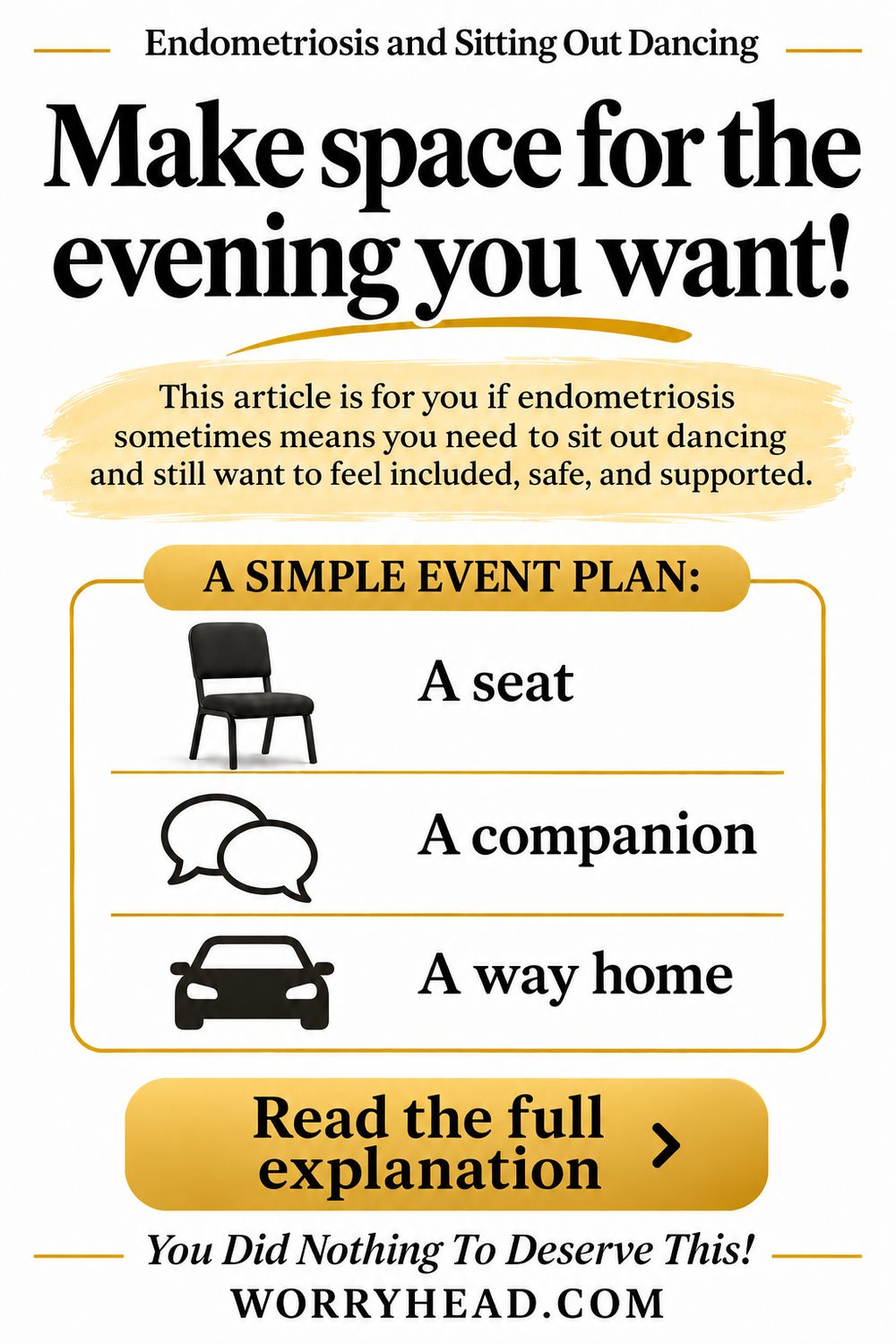
If practical details matter, ask about them before you arrive where possible. Knowing whether seating is available or how you will travel home can help you make a clearer decision. You do not need to predict the whole evening perfectly. Information creates options, and you can still decide differently when you are there.
Consider what would make sitting feel like being included rather than being parked at the edge. A chair near conversation may suit you better than a distant seat chosen only because it is available. If you want someone to join you for a while, ask. The location and company can matter as much as the fact that there is somewhere to sit.
You can also choose privacy. You may prefer not to discuss why you are sitting out with a host, an acquaintance or the whole table. A partner can help communicate practical arrangements if you want, but should not turn your health into the explanation offered to everyone who notices.
Discuss Endometriosis and Sitting Out Dancing Without Negotiating Your No
“Come on, just one dance” can be intended as an invitation and still feel like pressure. You can answer briefly: “No, thank you. I am happy to stay here.” You do not have to soften the answer by promising to join later unless that is genuinely what you want to say.
If the invitation is repeated, repeat the boundary rather than adding increasingly personal reasons. “I have decided not to dance tonight” makes the decision clear. A person does not need to agree with your reason before respecting your answer. Friendly enthusiasm should leave room for refusal.
If someone reaches for your hand or tries to pull you up, you can say, “Please do not pull me; I am staying seated.” That names the action you want stopped without requiring a lecture about the illness. Someone supporting you can reinforce your words if you have asked them to, rather than taking over the conversation automatically.
You may find it difficult to respond in the moment, particularly with music and attention around you. A delayed clarification is still possible: “Earlier, I felt pressured when my no kept being challenged.” You are not responsible for producing the perfect boundary at exactly the moment somebody else ignores an ordinary answer.
What Company Means for Endometriosis and Sitting Out Dancing
You may want your partner to stay beside you, join you occasionally or enjoy the dancing while you spend time elsewhere. The right arrangement cannot be inferred from the fact that you are seated. Discuss what you want rather than hoping the other person reads your expression accurately across a busy room.
A clear request might be, “I would like some company for a while, and then you can decide what you want to do.” Another might be, “Go and enjoy yourself; I will be talking with these friends.” Only use reassurance that feels true. You can support another person’s enjoyment and still ask for connection at some point in the evening.
If your partner wants to dance and you feel sad about that, the feeling does not automatically decide the plan. You can say what is difficult without making them guess whether you are asking them to stay. The practical arrangement and the emotional experience deserve separate attention, even when they are connected.
I would want to avoid both extremes: disappearing into the event without checking in, or hovering so closely that my wife feels responsible for my enjoyment. Asking what company she wants gives us a more respectful starting point. It also leaves room for her answer to change as the evening unfolds.
Endometriosis and Sitting Out Dancing Call for Practical Inclusion
If you are organising an event, think about how people can remain part of it without joining every activity. Seating that allows conversation, clear information about the programme and invitations that do not become persuasion can make participation less dependent on one expected behaviour. Ask guests about relevant preferences instead of assuming you know them.
During the event, remember the people who are not on the dance floor. Spend time with them because you want their company, not only to check whether they are all right. An ordinary conversation about something interesting can feel more inclusive than repeated concerned questions that keep drawing attention to the difference.
Avoid publicly announcing why somebody is sitting unless they have asked you to share that information. You can bring a chair, make room or invite conversation without narrating their health. Practical inclusion does not require turning the person into a lesson for everyone else at the celebration.
If a photograph or group activity is planned, offer the person a choice about joining and how. Do not assume they want to be excluded, and do not assume they can participate in the usual way. A simple question leaves room for a practical adjustment while respecting their right to decline.
When Endometriosis and Sitting Out Dancing Bring Grief
Music can bring back an earlier version of life very quickly. You may remember the ease of staying out late, the confidence of moving without much thought or the feeling of sharing a favourite song. Missing that does not make you ungrateful for the company or celebration you have now.
You do not have to replace the feeling immediately with a different activity. Sometimes a quiet moment, an honest sentence or a little space is what you want. You may also enjoy part of the evening while carrying sadness in the background. Mixed feelings do not mean you made the wrong decision about attending.
Be cautious with comparisons to other people who appear to be doing more. You do not know the full circumstances behind what you see, and their choices do not set an obligation for yours. The useful question is what you want from this event and what arrangement you have chosen, not whether somebody else’s participation proves you should try harder.
If you are listening to someone describe the loss, resist rushing to an alternative. “You can still watch” may be true but may not answer what they are grieving. Ask what they miss. Understanding can come before problem-solving, and the person does not need to finish the conversation feeling cheerful for it to have been worthwhile.
Let the Evening End on Your Terms with Endometriosis and Sitting Out Dancing
Before leaving, you may feel tempted to prove that attending was worth it by staying longer or joining one last activity. Notice whether that is something you want or something you feel you owe. You do not need a visible achievement to justify having been present. Conversation, music or simply sharing part of an occasion can be enough if it mattered to you.
If you arranged a way home, keep the practical discussion clear. You can say that you are ready to use it without giving a public explanation. Where another person’s plans are involved, communicate directly and use the arrangement you agreed. Do not rely on hints that may be missed in a noisy, busy setting.
Afterwards, avoid reducing the whole evening to whether you danced. Ask what felt good, what felt difficult and what you would want handled differently another time. Perhaps the seat was poorly placed or you wanted more ordinary company. Those observations can guide a future choice without turning this event into a failure.
You may decide to attend a similar event again, make a different arrangement or decline next time. One evening does not set a permanent rule. The next invitation can be considered on its own terms, with the information and preferences you have then. Your choices are allowed to remain responsive rather than becoming a promise about the future.
Final Word on Endometriosis and Sitting Out Dancing
You still belong in the evening when you are not on the dance floor. You can enjoy the music, want company, miss what has changed or decide to leave. None of those choices requires you to perform a version of yourself that makes other people more comfortable.
Let your next decision begin with what you want from the occasion, not what you think you must prove by attending. My free eBook, You Did NOTHING To Deserve This!, is there if the loss feels difficult to explain. Your place with the people you love is larger than one activity.


About Me
Hi, I’m Lucjan! The reason why I decided to create this blog was my beautiful wife, who experienced a lot of pain in life, but also the lack of information about endometriosis and fibromyalgia for men…
READ MORE
Grab a FREE eBook!
“You Did NOTHING To Deserve This!”
Finally hear the words nobody ever said to you, that your pain is real, your tears make sense, and you did nothing to deserve endometriosis, the dismissal, or the way it has rewritten your life.
Related Questions You May Be Asking About Endometriosis and Sitting Out Dancing
Can I Enjoy a Party Even if I Do Not Dance?
Yes, if the parts available to you are enjoyable. You can also find it difficult or decide not to attend. There is no required response that proves you are coping well.
What Can I Say When Someone Keeps Insisting?
Try a short, clear answer: “I have decided not to dance tonight.” You do not need to keep offering new reasons after you have already declined.
Should My Partner Stay Seated with Me?
Discuss what company you want and what each person would like from the evening. Do not assume the answer from your position in the room. A clear arrangement can include time together and different activities.
Endometriosis and Sitting Out Dancing References
