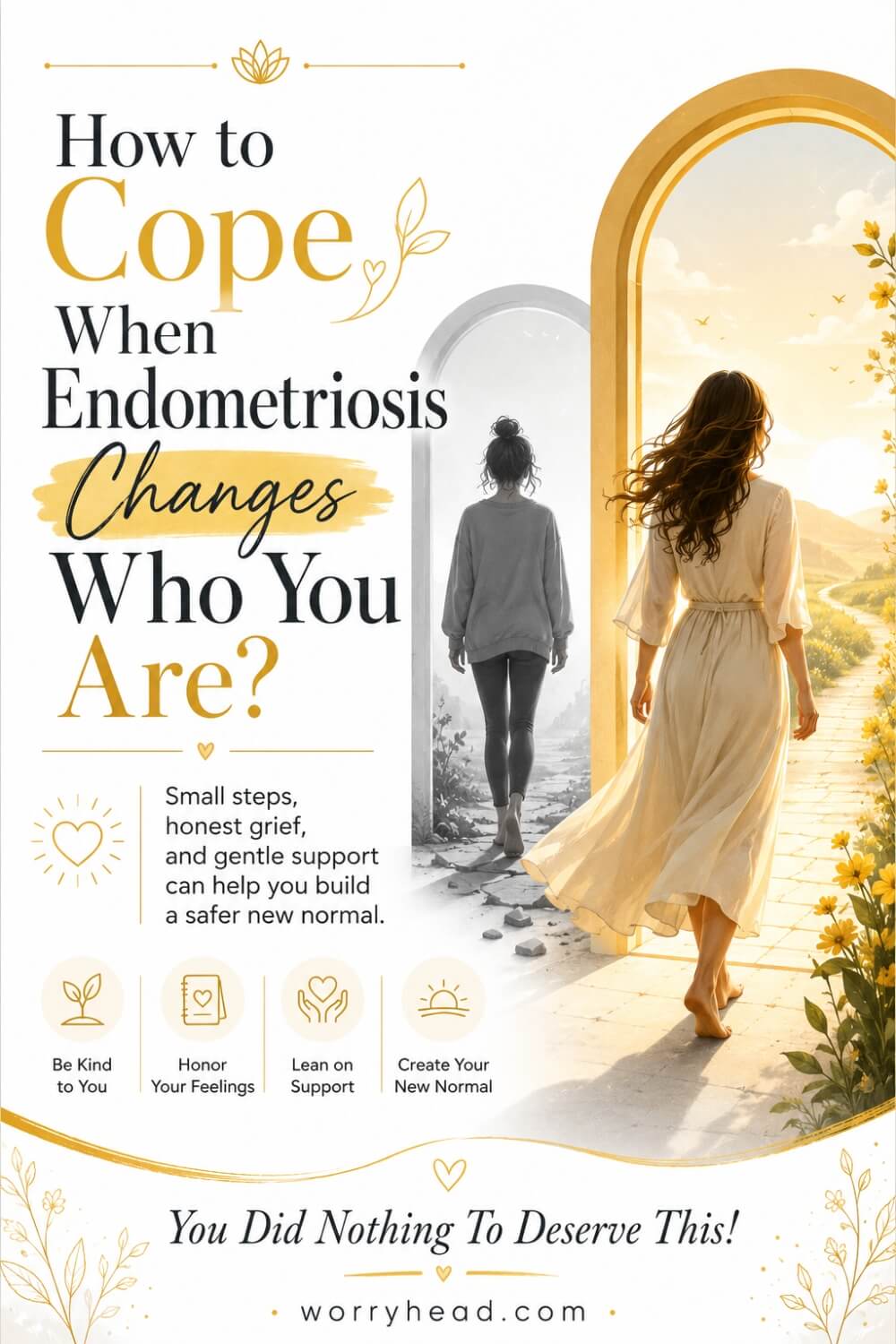
How to Cope When Endometriosis Changes Who You Are?
Learning how to cope when endometriosis changes who you are is not about pretending the pain is small, or telling yourself to stay positive when your body, plans, relationships, work, intimacy, energy, and confidence have all been touched by this disease.
Have you ever looked at the woman you used to be and quietly wondered where she went?
If you feel like endometriosis has taken pieces of your old self, I want you to know this before anything else: you are not being dramatic; you are grieving something real.
Endometriosis can change who you feel you are because chronic pain, fatigue, bleeding, uncertainty, intimacy changes, fertility fears, and repeated dismissal can shrink your old routines, confidence, work, relationships, and sense of safety. Coping begins by gently separating you from the disease.
I am not a clinician, and I do not write to diagnose, prescribe, or replace your doctor. I write as a husband, blogger, and researcher who has spent years learning beside my wife, and at the bottom of this article I have attached the medical and health sources I used to understand the facts behind this topic, including WHO, NICE, NHS, ESHRE, and research studies.
One of the hardest parts of endo is that it does not only hurt your pelvis. It can reach into your identity, your future, your confidence, your sexuality, your work, your friendships, your sleep, your energy, your sense of womanhood, and the private relationship you have with your own body.
And that is where many medical articles feel cold to me.
They tell you what endometriosis is, where lesions may grow, what treatment options may be offered, and what symptoms to report, but they often skip the moment when you sit on the edge of your bed thinking, “I don’t recognise myself anymore.”
I have seen that look in my wife’s eyes.
Not because she became less of herself, but because pain kept asking her to live smaller, cancel more, explain more, defend herself more, and mourn versions of life she never asked to lose.
And if this is where you are today, I gently invite you to grab my free 130+ page eBook, “You Did Nothing To Deserve This!”, written to validate the feelings of women with endometriosis who have been dismissed for too long. When you grab it, you also join our community, where I send more freebies, big discounts on our books, and gentle, practical emails to help you adjust to the new normal chronic illness can bring to your relationship and life.
The book is filled with 20 chapters of gentle validation for women with endo, written by yours truly, as I have seen it up close...
- This Was Never Your Fault
- The Girl You Used To Be
- When Your Own Body Feels Like an Enemy
- The Invisible Battles Nobody Sees
- Am I Just Lazy? – The Lie You Have Been Taught
- Gaslighting, Dismissal and the Trauma of Not Being Believed
- Guilt: The Weight You Were Never Meant to Carry
- Love in the Middle of Pain
- Intimacy When Your Body Hurts
- The Loneliness of Being the Strong One
- You Are Allowed To Take Up Space
- Tiny, Gentle Hopes (Not Toxic Positivity)
- If You Could Hear My Voice Every Flare Day
- You Deserve Partners, Not Witnesses
- When You Wish He Understood
- Motherhood, Fertility and the Grief Nobody Sees
- When Anger Is the Only Honest Feeling
- Learning to Trust Your Body Again
- Building a Life That Fits Your Reality
- You Did Nothing To Deserve This
You Did NOTHING To Deserve This!
Endometriosis Validation for Women with Endo
- You Did NOTHING To Deserve This!
- How to Cope When Endometriosis Changes Who You Are Without Losing Yourself?
- How to Cope When Endometriosis Changes Who You Are Around the People You Love?
- How to Cope When Endometriosis Changes Who You Are Inside Your Own Body?
- When to Seek Medical Help?
- Questions to Ask Your Doctor
- Final Word On How to Cope When Endometriosis Changes Who You Are
- FREE eBook
How to Cope When Endometriosis Changes Who You Are Without Losing Yourself?
There is a strange kind of grief that comes when your body starts setting rules you never agreed to. You may still look like you, speak like you, smile like you, and carry on for everyone else, yet inside you may feel as if your old self is standing behind glass.
Endometriosis can do this because it does not only interrupt painful days. It can interrupt the way you plan, love, rest, dress, work, socialise, travel, exercise, eat, hope, and trust your own body.
This is why how to cope when endometriosis changes who you are begins with understanding that you are not losing your personality; you are reacting to repeated pain, fear, fatigue, medical uncertainty, and disappointment.
When life keeps becoming smaller around symptoms, it is normal to feel confused about who you are without the energy, freedom, confidence, and spontaneity you once had.
You might miss the woman who could say yes without checking her cycle, her pain level, her bleeding, her bloating, her bowel symptoms, or whether she would crash afterwards. You might miss intimacy that felt easy, clothes that felt comfortable, plans that did not need an escape route, and mornings that did not begin with scanning your body for danger.
I want you to hear this gently: missing your old life does not mean you are ungrateful for the life you still have. It means you are honest enough to recognise that chronic illness can create real emotional loss, even when you are still trying your hardest to keep going.
One of the most important things I have learned beside my wife is that coping is not the same as surrendering. Coping means you stop blaming yourself for needing a different pace, different boundaries, different support, and sometimes a completely different version of normal.
You are still allowed to have dreams, but you may need to build them around your body instead of against it. You are still allowed to be loved, but you may need people around you who understand that love is not proved by how much pain you can hide.
You are still allowed to feel beautiful, desirable, intelligent, useful, feminine, strong, and whole, even if endometriosis has changed your relationship with sex, fertility, energy, work, or your reflection in the mirror.
The disease may affect parts of your life, but it does not get to become the full definition of you.
I have watched my wife lose parts of her old rhythm, and I have also watched her fight to keep the parts of herself that pain could not reach. Some nights, the strongest thing I could do as her husband was not to fix anything, but to sit beside her and make sure she did not have to feel alone inside a body that had become frightening.
That is why the next part matters so much.
Before you try to “move on”, you need small, practical, human ways to steady yourself again, not because you are weak, but because you deserve tools that meet you where you actually are.
- Name what endometriosis changed
- Grieve without blaming yourself
- Separate yourself from symptoms
- Build a flare-safe identity
- Protect intimacy with honesty
- Let support become practical
- Rebuild confidence in small steps
- Create a gentler new normal
Name What Endometriosis Changed
One of the first gentle steps is to name what endometriosis has changed, because unnamed grief often becomes shame. You may think you are simply “not coping”, when in reality you are carrying losses in your body, your routine, your confidence, your plans, your sex life, your friendships, your work, your energy, and the way you see your future.
When my wife began changing around her symptoms, I did not understand at first that she was not becoming negative or difficult. She was adapting to pain that kept stealing certainty from her day. This is why I believe you deserve to name it plainly: “This disease changed how safe I feel in my body”, “It changed how I plan”, “It changed how close I feel to people”, or “It changed how much I trust tomorrow.”
Naming it does not make you weak. It gives your pain a proper place, so it stops secretly defining every part of you.
Grieve Without Blaming Yourself
Grief is not only for death. You can grieve the version of yourself who had more energy, more freedom, more confidence, more desire, more patience, more trust in doctors, more excitement about the future, and more ease inside your own skin. That grief is real, even if nobody around you knows how to recognise it.
Please do not turn that grief into self-blame. You did not choose the flare that cancelled the plan, the pain that interrupted intimacy, the fatigue that made you quiet, or the fear that arrived before another appointment.
I have seen my wife blame herself for things her body was fighting through, and it broke my heart because from the outside I could see what pain hid from her. She was not failing life. She was trying to live while life kept changing the rules. You deserve to mourn what changed without punishing yourself for needing time to adjust.
Separate Yourself From Symptoms
When symptoms become loud, it is easy to start believing they are your personality. Pain can make you quieter, fatigue can make you less sociable, bloating can make you avoid mirrors, painful sex can make you feel distant, and brain fog can make you doubt your own mind. But these are symptoms and reactions, not proof that the real you has disappeared.
I wish more partners understood this. I wish more men knew that when the woman they love pulls away, cancels plans, cries suddenly, gets irritable, or stops feeling like herself, it may not be rejection. It may be survival.
You are not your pelvic pain. You are not your flare. You are not your exhaustion. You are not the version of yourself that appears when you are scared, dismissed, under-supported, and running on empty. The woman underneath is still there, and she deserves people who look for her with patience, not judgement.
Build a Flare-Safe Identity
A flare-safe identity means you stop building your worth around only the things you can do on your best days. It means you give yourself a way to feel like yourself even when you cannot perform, produce, socialise, exercise, work, or keep up in the way you once did. That is not lowering your standards. That is protecting your dignity.
This can look very simple. You may have a soft version of your morning routine, a low-pain outfit that still makes you feel like you, a comfort list for bad days, a phrase you say when guilt appears, or a small creative habit that reminds you that you are more than symptoms.
My wife taught me, without meaning to, that identity has to become flexible around chronic illness. On a good day, you may feel brave by going out. On a hard day, you may feel brave by resting before your body breaks. Both versions count. Both versions are still you.
Protect Intimacy with Honesty
When endometriosis changes intimacy, it can reach into places that feel too private, too painful, or too embarrassing to explain. Pain during or after sex, fear of triggering symptoms, low desire, bleeding, bloating, fatigue, pelvic floor tension, and emotional shutdown can make you feel as if your body is betraying both you and your partner. But painful intimacy is not a character flaw, and it is not a lack of love.
This is where honesty becomes protection, not rejection. You should not have to pretend, endure, tense your body, or smile through pain to keep someone close. A loving partner needs to understand that intimacy may need new language, slower pacing, more reassurance, different forms of closeness, and sometimes medical support.
As a husband, I had to learn that being wanted is not the same as being physically able. Love should never demand that your body pays the price for someone else’s comfort.
Let Support Become Practical
Support cannot stay as pretty words if your life has changed. “I’m here for you” is kind, but it becomes much more meaningful when it turns into help with appointments, food, housework, childcare, forms, medication reminders, flare plans, emotional check-ins, transport, research, or simply believing you without making you prove the pain again. Practical support tells your nervous system, “I do not have to carry all of this alone.”
I learned this the hard way beside my wife. There were times when I wanted to comfort her with words, but what she really needed was for me to notice the washing, make the tea, cancel the plan, sit through the appointment, or stay calm when her body and mind were overwhelmed.
You deserve that kind of support too. Not because you are helpless, but because love should become useful when illness makes life heavier. Real support reduces the load; it does not ask you to explain why the load is heavy.
Rebuild Confidence In Small Steps
Endometriosis can quietly damage confidence because it makes your body feel unpredictable.
After enough flares, cancellations, painful episodes, dismissed appointments, and days where you cannot do what you planned, you may start shrinking before life even asks you to. You may stop trusting your energy, your body, your decisions, your attractiveness, or your ability to cope.
Confidence often comes back in small, almost private steps.
- One gentle walk.
- One honest conversation.
- One appointment where you ask the question you were afraid to ask.
- One boundary you keep.
- One day where you dress for comfort without apologising.
- One moment where you look at yourself and refuse to speak cruelly to the woman in the mirror.
I have seen how important these small steps can be for my wife. They may look tiny to someone outside chronic pain, but inside your life they are not tiny at all. They are evidence that endometriosis changed things, but it did not take all of you.
Create a Gentler New Normal
A gentler new normal does not mean you give up on healing, treatment, hope, love, work, intimacy, or joy. It means you stop forcing yourself to live by rules that were made for a body that is not carrying what yours is carrying. It means your life may need more space, more rest, more honesty, more planning, more softness, and more people who understand that your needs are not inconveniences.
This is not easy, because part of you may still be waiting for the old normal to come back exactly as it was. I understand that ache. I have watched my wife miss pieces of herself that pain made harder to reach, and I have wished I could hand them back to her with both hands. But sometimes love, coping, and healing begin when you stop treating your changed life as a failure.
You can build a life that respects your body, protects your heart, and still leaves room for beauty. Different does not mean over. Changed does not mean ruined.
How to Cope When Endometriosis Changes Who You Are Around the People You Love?
One of the most painful parts of chronic illness is not only what it does inside your body, but what it makes you fear inside your relationships. You may start wondering whether you are still easy to love, still fun to be around, still desirable, still patient, still the woman your partner first fell in love with.
That fear can become very heavy when endometriosis keeps changing plans, moods, intimacy, energy, and the way you show up for ordinary life. You might apologise too much, explain too much, or hide too much because deep down you are terrified of becoming a burden.
I want you to hear this from a husband who has sat beside his wife through days she could not dress up, go out, be intimate, stay cheerful, or pretend her body was fine. Love does not disappear because your body needs more care.
The right kind of love becomes more awake. It notices the little changes, the forced smiles, the way you go quiet when pain rises, the way you say “I’m fine” when you are trying not to ruin the evening.
But I also know that support can be imperfect, because partners are human too. There were times when I did not understand quickly enough, did not ask the right question, or thought I was helping when really I was trying to make the situation less frightening for myself.
That is why honest communication matters so much, not the harsh kind, but the soft kind that says, “I need you to believe me before I have to prove it.” You should not have to perform pain convincingly before someone decides you deserve tenderness.
When my wife changed, I had to learn not to chase the old version of her so tightly that I missed the woman still standing in front of me. She was not less worthy because illness made life smaller.
She was still my wife when she was exhausted. She was still my wife when anxiety sat in the room with us.
She was still my wife when pain changed our plans, our intimacy, our future, and our normal. And if you are reading this with tears in your eyes because you worry someone will love you less when they see the full truth of your life, please let me say this gently: the right person will not need the polished version of you to stay.
You are allowed to be supported without feeling guilty for needing support. You are allowed to ask for reassurance without feeling needy.
You are allowed to change and still be loved deeply. You are allowed to be scared of losing yourself, while someone safe holds your hand and reminds you that you are still here.
How to Cope When Endometriosis Changes Who You Are Inside Your Own Body?
There is a private kind of pain that happens when your body no longer feels like home. Learning how to cope when endo changes who you are means learning to speak to that body with less hatred, even when you are angry at what it has taken from you.
You may look at your stomach during endo belly, feel the ache after intimacy, notice the exhaustion after doing something small, or feel pain in places that make no sense, and suddenly your body can feel like an enemy. But your body is not trying to betray you, even when it feels unpredictable, frightening, and unfair.
I have watched my wife go through moments where the woman in the mirror did not match the woman she remembered inside. The bloating, the pain, the fatigue, the cancelled plans, and the fear of another flare did not only affect her physically, they affected how safe she felt being herself.
And as her husband, I had to understand that saying “you are beautiful” was not always enough. Sometimes love had to sound like, “I believe you”, “we can change the plan”, “you do not have to pretend with me”, and “I still want you, even when your body needs gentleness instead of pressure.”
This disease can affect both of you, but not in the same way. You carry the pain in your body, while a loving partner carries the responsibility of learning how not to make that pain heavier.
For me, that meant learning to stop measuring closeness by old routines and start protecting the woman I love in the life we actually had. It meant understanding that if endometriosis changed her energy, her confidence, her intimacy, or her mood, my role was not to mourn the old version of our relationship so loudly that she felt guilty for being ill.
Your body may need different clothes, different timing, different intimacy, different rest, different treatment, different boundaries, and different expectations now. But none of that means you are less feminine, less worthy, less lovable, or less yourself.
A changed body still deserves tenderness. A tired body still deserves respect.
And a woman living with endometriosis still deserves to be looked at as a whole woman, not as a collection of symptoms, limitations, or medical appointments.
When to Seek Medical Help?
Please do not wait until you feel “bad enough” to deserve help.
If endometriosis is changing who you are, how you live, how you work, how you love, how you sleep, how you move, or how safe you feel in your own body, that is already enough reason to speak to a doctor. You do not have to collapse before your pain counts.
You should seek medical help if your periods are so painful that you cannot function normally, if you need to plan your life around pain, if bleeding is heavy, if sex hurts, if bowel movements hurt, if passing urine hurts, if pain spreads into your back, hips, legs, rectum, or bladder, or if fatigue is making ordinary life feel impossible.
You should also ask for help if your symptoms are affecting your mental health. This matters deeply. When pain takes away confidence, intimacy, energy, work, social life, and the version of yourself you miss, your mind can begin to feel trapped too.
I have seen that emotional weight in my wife, and I wish more doctors asked about it with real care. Not only “How bad is the pain from 1 to 10?” but “What has this taken from your life?”
Please seek urgent medical advice if you have sudden severe pelvic or abdominal pain, pain with fainting, dizziness or collapse, heavy bleeding that feels unsafe, fever, vomiting with severe pain, symptoms that are rapidly worsening, pain or bleeding when you might be pregnant, or shoulder tip pain with pelvic pain.
That does not mean every bad flare is an emergency. It means your body deserves to be taken seriously when something feels different, frightening, extreme, or not like your usual pattern.
You also deserve review if your current treatment is not helping, if side effects are making life harder, if pain keeps returning after surgery, if you are struggling with fertility worries, or if you feel you are being dismissed because scans, examinations, or basic tests looked “normal”.
A normal result does not automatically mean your pain is not real. Many women with endometriosis know this painful sentence too well: “Everything looks fine.” But looking fine on one test is not the same as being fine in your life.
If you feel lost, start simple. Write down your symptoms, when they happen, how long they last, what triggers them, what helps, what does not help, how they affect work, intimacy, sleep, bowel movements, urination, mood, and daily life.
Bring that list to your appointment. You are not being dramatic by preparing. You are giving your doctor a clearer picture of the life you are trying to survive.
And if you are a partner reading this, please do not let the woman you love carry the appointment alone if she wants support. Sit beside her. Help her remember details. Believe her before the room does. Sometimes your calm presence can give her the strength to say the thing she has been swallowing for years.
Questions to Ask Your Doctor
Going to the doctor can feel intimidating when you have already been dismissed, rushed, or made to feel as if you are exaggerating.
So I want you to go in with questions that protect your voice. Not aggressive questions. Not confrontational questions. Just clear, grounded, human questions that help you understand what is happening and what your next step could be.
You can ask, “Based on my symptoms, could this be endometriosis, deep endometriosis, adenomyosis, pelvic floor dysfunction, bowel involvement, bladder involvement, nerve-related pain, or another condition that needs checking?”
You can ask, “If my scan is normal, what does that rule out, and what does it not rule out?”
That question matters because many women are told their scan is clear, then they are left emotionally stranded. A clear scan may be useful, but it should not be used to dismiss symptoms that are still affecting your life.
You can ask, “Do my symptoms suggest I should be referred to a gynaecologist or a specialist endometriosis service?”
You can also ask, “What are my options for pain relief, hormonal treatment, imaging, pelvic floor physiotherapy, fertility support, mental health support, and surgery, and what are the benefits and risks of each one?”
If sex hurts, ask directly, even if it feels embarrassing: “Could endometriosis, pelvic floor tension, inflammation, scarring, deep disease, or nerve sensitivity be contributing to pain during or after sex?”
You deserve to discuss intimacy without shame. Painful sex is not a small detail. It can affect confidence, closeness, desire, relationships, and the way you feel inside your own body.
If bowel or bladder symptoms are part of your life, ask, “Could my bowel, rectum, bladder, ureters, or surrounding tissues be involved, and do I need specialist imaging or referral?”
If you are worried about your future, ask, “How might this condition affect fertility, work, daily life, mental health, and long-term management, and what can we do now to protect my quality of life?”
That is the phrase I wish more women used in appointments: quality of life.
Because endometriosis is not only about what can be seen inside the pelvis; it is also about what pain has taken from your mornings, evenings, relationships, sleep, choices, energy, body confidence, and peace.
You can ask, “What should I do if my pain becomes severe, different, or frightening, and when should I seek urgent help?”
You can ask, “Can we make a written plan for flares, medication, follow-up, referral, and what happens if this treatment does not work?”
And if you feel your doctor is not listening, it is okay to say, “I understand tests matter, but these symptoms are seriously affecting my life, and I need help finding the next step.”
That sentence is not rude. It is self-protection.
I have watched my wife sit in medical spaces where she needed to be believed, not brushed aside. And if you have been made to feel small in those rooms, I want you to know something very clearly: you are allowed to ask questions, you are allowed to take notes, you are allowed to bring someone with you, and you are allowed to keep seeking answers when your body keeps telling you something is wrong.
Final Word On How to Cope When Endometriosis Changes Who You Are
If endometriosis has changed who you feel you are, I want you to pause for a moment and stop treating that feeling as weakness. You are not overreacting because you miss the woman who had more energy, more freedom, more confidence, more trust in her body, or more ease in her relationship. You are responding to a condition that can reach into parts of life other people may never see.
This is why how to cope when endometriosis changes who you are cannot be answered with one simple tip. It has to begin with validation. You need to know that grief, anger, fear, sadness, frustration, body distrust, intimacy worries, and identity loss can all make sense when pain keeps interfering with ordinary life.
But I also want you to know this: changed does not mean ruined.
You may need a different pace now. You may need better boundaries, more rest, clearer medical support, gentler intimacy, more honest conversations, and people who stop expecting the old version of you to perform through pain. That does not mean you have failed. It means your life needs to be shaped around truth, not pressure.
I have learned this beside my wife. I have watched illness take pieces of normality from our home, and I have also watched love become more practical, more patient, and more awake because of it. I have seen how much it matters when a woman is not told to “be strong” in a way that forces her to hide, but instead is reminded that she is still worthy when she cannot be the version everyone else found easier.
You are not only your symptoms. You are not only your flare days, your cancelled plans, your painful sex, your bloating, your fatigue, your scans, your appointments, your tears, or your fear of being too much. You are still a whole woman living through something deeply difficult.
And if you are a partner reading this, please understand that she may not need you to rescue her from every symptom. She may need you to believe her, adjust with her, learn with her, and stop making her feel guilty for a body she did not choose to fight.
The goal is not to become your old self again at any cost. The goal is to protect the parts of you that illness never had the right to take, while gently building a life where your body is not punished for needing care.
Endometriosis may change your routines, but it does not get to decide your worth. It may change your relationship with your body, but it does not erase your beauty. It may change your future, but it does not remove your right to be loved, believed, supported, and held with tenderness.
You are still here. You are still you. And you did nothing to deserve this.
You are allowed to grieve the old version of your life while still building a softer, safer, more honest one. Take one small step today: believe your pain, protect your energy, ask for support, and stop measuring your worth by what illness made harder.
If this touched something in you, please leave a comment below and tell me what endometriosis has changed for you. And if you need more validation, you can check out the free chapter of my eBook at the bottom of this post.

About Me
Hi, I’m Lucjan! The reason why I decided to create this blog was my beautiful wife, who experienced a lot of pain in life, but also the lack of information about endometriosis and fibromyalgia for men…
READ MORE
Grab a FREE eBook!
“You Did NOTHING To Deserve This!”
Finally hear the words nobody ever said to you, that your pain is real, your tears make sense, and you did nothing to deserve endometriosis, the dismissal, or the way it has rewritten your life.
Related Questions You May Be Asking About How to Cope When Endometriosis Changes Who You Are
1. Can endometriosis really change how you see yourself?
Yes, it can, because endometriosis can affect far more than your periods. When pain, fatigue, bloating, intimacy changes, fertility worries, and medical dismissal keep touching your daily life, your confidence can begin to shift. You may feel less like your old self, not because you are weak, but because your body has been asking you to survive too much for too long.
2. Why do I feel guilty when endometriosis changes my plans?
You may feel guilty because you still remember the version of yourself who could say yes more easily. But cancelling, resting, needing support, or changing plans because of pain is not selfish. It is your body asking for care. The people who truly love you should not need you to damage yourself just to prove you still care about them.
3. How can my partner support me when I feel like I am losing myself?
Your partner can support you by believing you without making you explain every symptom, noticing when you are struggling, helping practically, and reassuring you that you are still loved when your body changes the plan. Support should not only sound kind. It should become useful, patient, calm, and steady, especially on the days when you cannot perform being “fine”.
4. Is it normal to miss the woman I was before endometriosis?
Yes, it is completely normal to miss her. You may miss her energy, freedom, confidence, desire, spontaneity, body trust, social life, or plans for the future. That grief does not mean you are ungrateful or stuck. It means something real changed, and your heart is trying to process a loss that many people around you may not even recognise.
5. What if endometriosis makes me feel less feminine or less desirable?
Endometriosis can affect body image, intimacy, bleeding, bloating, pain, scars, fertility fears, and confidence, so it can absolutely touch how feminine or desirable you feel. But your worth is not measured by how painless, available, fertile, energetic, or easy your body is. You are still a whole woman, and the right love should meet you with tenderness, not pressure.
6. How do I rebuild my life when endometriosis has changed everything?
Start smaller than your grief tells you to. Rebuild through honest routines, softer boundaries, symptom tracking, medical support, safer intimacy, practical help, and tiny choices that make your body feel less like an enemy. You may not rebuild the exact old life, but you can build a real, meaningful, gentler life where your needs are respected instead of constantly apologised for.
How to Cope When Endometriosis Changes Who You Are References
- https://www.who.int/news-room/fact-sheets/detail/endometriosis
- https://www.nhs.uk/conditions/endometriosis/
- https://www.nice.org.uk/guidance/ng73
- https://www.nice.org.uk/guidance/ng73/chapter/recommendations
- https://www.nice.org.uk/guidance/ng73/resources/endometriosis-diagnosis-and-management-pdf-1837632548293
- https://www.nice.org.uk/guidance/ng73/resources/visual-summary-on-first-presentation-initial-management-diagnosis-referral-and-ongoing-care-of-pdf-13559822461
- https://www.eshre.eu/Guidelines-and-Legal/Guidelines/Endometriosis-Guideline
- https://www.eshre.eu/-/media/sitecore-files/Guidelines/Endometriosis/ESHRE-GUIDELINE-ENDOMETRIOSIS-2022_2.pdf
- https://www.eshre.eu/-/media/sitecore-files/Guidelines/Endometriosis/ESHRE-ENDOMETRIOSIS-patient-Guideline_21032022.pdf
- https://en.wikipedia.org/wiki/Endometriosis
- https://www.endometriosis-uk.org/endometriosis-facts-and-figures
- https://www.endometriosis-uk.org/getting-diagnosed-0
- https://www.mayoclinic.org/diseases-conditions/endometriosis/symptoms-causes/syc-20354656
- https://womenshealth.gov/a-z-topics/endometriosis
- https://pmc.ncbi.nlm.nih.gov/articles/PMC10571435/
- https://pmc.ncbi.nlm.nih.gov/articles/PMC10512020/
- https://pmc.ncbi.nlm.nih.gov/articles/PMC11649631/
- https://pmc.ncbi.nlm.nih.gov/articles/PMC12703484/
- https://pmc.ncbi.nlm.nih.gov/articles/PMC12794361/
- https://pmc.ncbi.nlm.nih.gov/articles/PMC12194382/
- https://keele-repository.worktribe.com/OutputFile/456044
- https://cdn.who.int/media/docs/default-source/bulletin/online-first/blt.24.292660.pdf
