Why Endometriosis Makes You Feel Like a Patient, Not Yourself?
Have you ever wondered why endometriosis makes you feel like a patient, not yourself, even on a day when you are nowhere near a clinic?
When pain, fatigue, bleeding, scans, appointments, and treatment decisions keep taking turns at the front of your mind, your days can begin to feel organised around what your body needs medically rather than what you want as a person. You may begin to feel like you are losing your old self.
And if you are tired of being asked for pain scores, dates, symptoms and medical history while the rest of you seems to disappear from the conversation, that feeling deserves to be understood.
Living with endometriosis can push illness into the centre of daily life because pain, fatigue, appointments and treatment choices demand daily attention. Over time, those demands can reshape your routines, roles, body trust and sense of identity, even though the disease never defines your worth.
I’m not a clinician; I write as a husband, blogger and researcher who has spent years learning beside my wife, and at the bottom of this article I include the WHO, NICE, NHS, ESHRE and medical research sources I used to check the health facts and medical context.
What surprised me most while researching this was how strongly the evidence supports something many women already feel in their bones: the impact of endometriosis reaches far beyond physical symptoms. WHO estimates that around 190 million reproductive-age women worldwide are affected, and recognises chronic pain, fatigue, depression, anxiety, infertility, poor sexual health and social isolation among the burdens that can dramatically reduce quality of life.
A qualitative study published in 2025, based on reflections from 157 women with endometriosis, found changes across personal, social and physical self-concept, including feelings of inadequacy, isolation, being misunderstood and feeling like a burden.
In March 2026, Endometriosis UK reported that the average UK diagnosis time had reached 9 years and 4 months; 39% of respondents had visited a GP 10 or more times before endometriosis was suspected, while 55% had attended A&E and 46% of those were sent home without treatment, so it is not difficult to understand how years of seeking care can make the patient role grow louder than the person living inside it.
I have watched this change in my wife in a way no scan report or appointment letter can capture: after enough years of pain conversations, examinations, procedures and decisions, there are days when the medical system seems to speak to the condition first and the woman I love second. I refuse to let our home do the same; she is not a diagnosis I care for, she is my wife, the woman I chose, and endometriosis does not get to take that place from her.
If you have started to feel as though your real name has been replaced by appointments, symptoms and treatment plans, keep reading. I want to show you why that shift can happen, how the patient role can quietly crowd out the rest of who you are, and how you can begin making room for yourself again without pretending that endometriosis is small.
- Understand Why Endometriosis Makes You Feel like a Patient, Not Yourself
- Why Endometriosis Makes You Feel Like a Patient, Not Yourself in Everyday Life?
- Why Endometriosis Makes You Feel Like a Patient, Not Yourself in Your Relationship?
- When to Seek Medical Help?
- Questions to Ask Your Doctor
- Final Word on Why Endometriosis Makes You Feel like a Patient, Not Yourself
- FREE eBook
Understand Why Endometriosis Makes You Feel like a Patient, Not Yourself
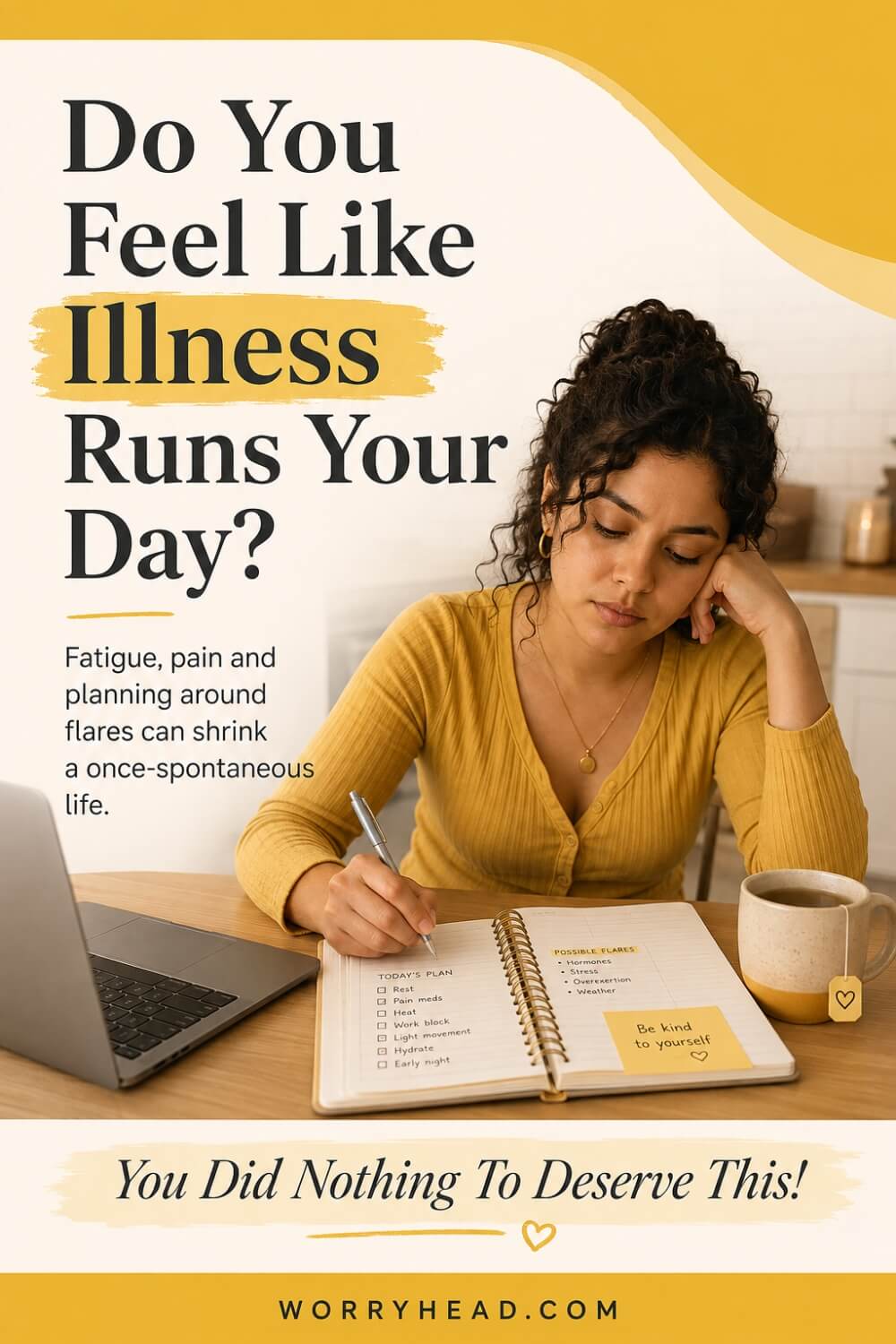
Understanding this shift begins with noticing how much of your attention a long-term condition can demand from you. You start tracking pain, bleeding, bowel or bladder symptoms, medication, cycle dates, appointments and test results because those details matter and can help your medical team understand what is happening. None of this means you are obsessed with illness; it means you have been forced to become fluent in a body that no longer feels completely predictable.
The harder part begins when necessary symptom monitoring starts occupying space that once belonged to spontaneity. Meeting a friend for coffee can quietly become a calculation about pain, toilets, fatigue, bleeding and how quickly you could get home if your body suddenly changes the plan. A weekend away may require more thought about medication, heat, rest and the possibility of a flare than about what you actually want to see or enjoy.
Research into endometriosis and self-concept helps explain why this can become so deeply personal. In a qualitative study involving written reflections from 157 women with self-reported endometriosis, researchers found effects across personal, social and physical self-concept, including identity disturbance, isolation and becoming heavily identified with the illness. Another UK qualitative study described experiences centred around a disrupted life, a lost sense of self and complicated emotional responses, which tells us this is far more than simply feeling low after another painful day.
When work, sex, movement, sleep, social plans and fertility decisions can all be touched by the condition, your diagnosis can become a lens through which you are forced to make ordinary choices. That is one reason why endometriosis makes you feel like a patient, not yourself: the disease keeps asking something from you even when you desperately want one afternoon where you do not have to think about it.
You may even begin describing yourself inwardly through limitations, such as how far you can walk, whether sex will hurt, how much energy you have left, what you can commit to or what you might need to cancel.
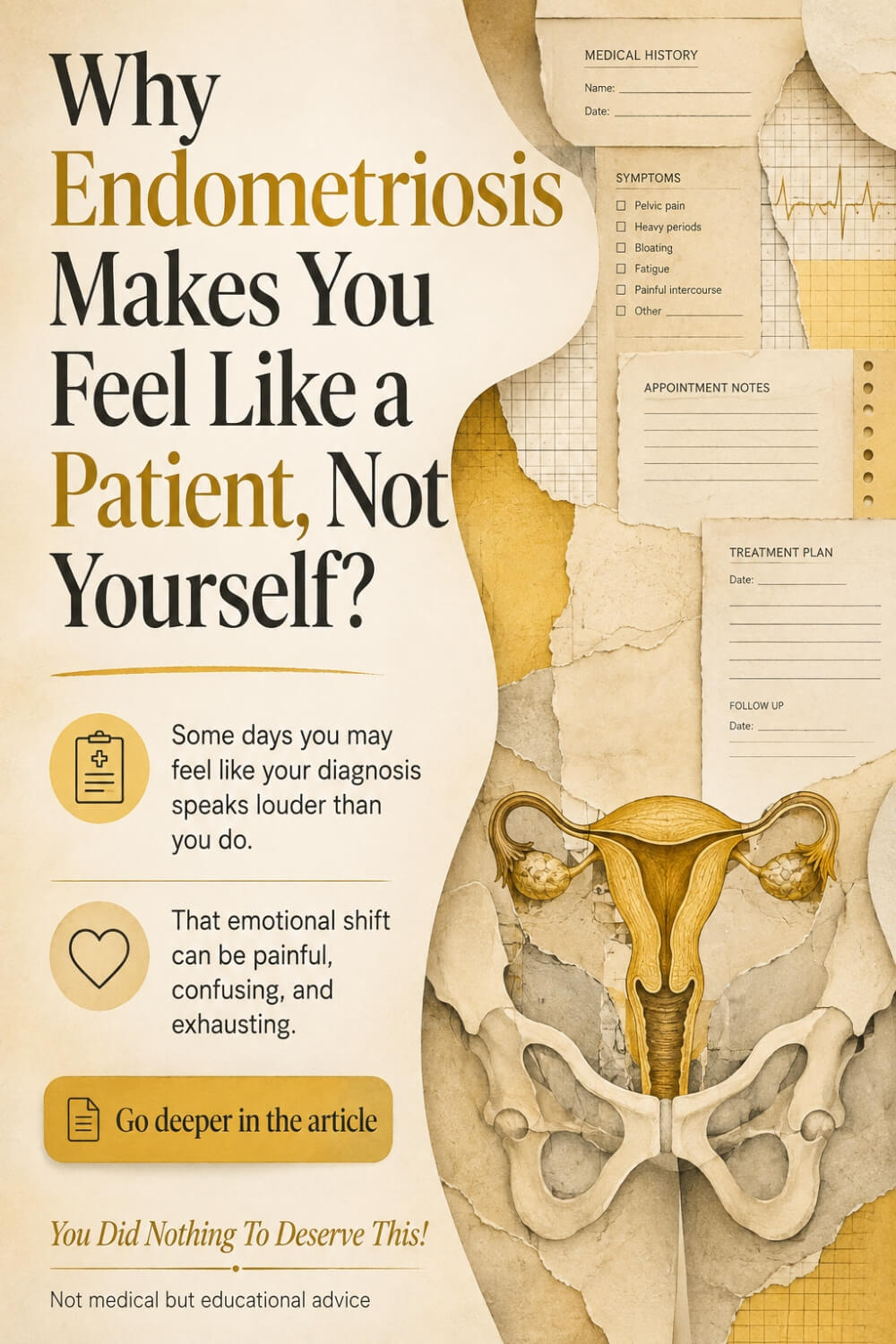
Then there is the medical language itself: lesions, adhesions, scans, surgery, hormones, pain scores, fertility, recurrence and referrals. Those words are necessary inside a consultation room, but when they follow you home, your entire life can begin to feel like a case file that never quite closes. WHO recognises that endometriosis can affect mental health, work or education, sexual health, social life and overall quality of life, which is why reducing the experience to a purely gynaecological problem misses an enormous part of what living with it actually means.
What I want you to remember is that your identity has not disappeared simply because illness has been taking up more room. The part of you that laughs, desires, dreams, gets annoyed, loves certain music, wants intimacy, changes her mind, makes plans and has opinions that have absolutely nothing to do with endometriosis is still there, even if pain has pushed her into the background for a while.
I have watched this happen to my wife, and there have been moments when I could see how tired she was of having to explain what hurt, what changed, what she could manage and what her body had taken away from the day, but when I look at her I do not see a patient first; I still see the woman I fell in love with on a dance floor.
I think partners sometimes need to understand that one of the most loving things we can do is remind the woman beside us that we still see all of her, especially on the days when illness has made it difficult for her to see herself. That is why the next part is about small, useful ways to make more room for the person behind the symptoms, without denying the seriousness of what your body is dealing with.
- Separate Yourself from the Diagnosis
- Keep Something That Is Yours
- Dress for Yourself, Not Illness
- Protect Plans That Still Matter
- Let Rest Support Your Identity
- Speak About More than Symptoms
- Ask Loved Ones to See You
- Make Appointments Serve Your Life
- Notice What Endometriosis Cannot Take
Separate Yourself from the Diagnosis
A diagnosis can explain part of your life without becoming the whole definition of who you are. One thing I learned from watching my wife is how easily medical language can start replacing ordinary language. Instead of asking what you want to do, conversations become about pain levels, bleeding, appointments and whether your body will cope.
Those questions matter, but they should never be the only questions you are asked. Try deliberately using words that describe you beyond illness. You may be funny, stubborn, creative, affectionate, ambitious, quiet, adventurous, protective, curious or deeply loyal.
Write those words down if you need to. Endometriosis may affect your body and your choices, but it does not get ownership of your personality. When someone you love reminds you of who you were before the diagnosis, do not hear it as pressure to “go back”. Hear it as proof that the person underneath all this is still here.
Keep Something That Is Yours
Chronic illness can slowly turn your days into a series of things you have to manage, so keeping one small part of life that belongs only to you matters more than it sounds. It does not need to be productive, impressive or useful. It might be reading, drawing, gardening, music, learning something, watching a favourite programme or having twenty quiet minutes with a cup of tea.
The point is not what you choose; the point is that it is yours. I have seen how important this can be when so much of my wife’s energy has to go towards symptoms and recovery. A small pleasure can become a reminder that life still contains choice.
Protect that space without guilt. You are allowed to do something simply because it makes you feel more like yourself. Illness may demand a great deal from your body, but it should not be allowed to turn every remaining minute into treatment, monitoring or survival.
Dress for Yourself, Not Illness
Clothing can become another place where endometriosis quietly changes your identity. Bloating, tenderness, pelvic pain and pressure may make waistbands, fitted clothes or certain fabrics unbearable, and suddenly getting dressed can feel less like self-expression and more like symptom management. There is nothing shallow about missing clothes that once made you feel confident.
Your appearance can be tied closely to how you recognise yourself. The answer is not forcing your body into clothes that hurt just to prove something. It is finding ways to feel like you within what your body can tolerate now.
Softer waistbands, layers, looser shapes or adaptable outfits can still reflect your taste rather than announce that you are unwell. I want my wife to feel comfortable, but I also want her to feel attractive, feminine and seen as herself. Comfort and identity do not have to be enemies.
Protect Plans That Still Matter
Endometriosis can train you to stop looking forward to things because cancellation hurts. After enough ruined evenings, missed events or last-minute changes, it can feel safer not to plan at all. I understand that instinct, but there is a cost when protecting yourself from disappointment also removes anticipation, connection and the little pieces of life that make a week feel like yours.
Choose plans that matter enough to protect, then make them more flexible instead of abandoning them. Have a shorter version, a nearby version, an exit plan or permission to leave early. A good partner or friend will understand that changing the plan is not the same as spoiling it.
I would rather adjust an evening around my wife’s body than watch her believe she should stay home because she might inconvenience me. Your life should have room for uncertainty, but it should still have things worth looking forward to.
Let Rest Support Your Identity
Rest can feel frightening when you already feel that illness has taken too much from you. You may look at a day on the sofa and think, “This is not me,” especially if you were once active, social, athletic or constantly busy. But rest is not an identity.
It is something your body sometimes needs, and confusing the two can make you judge yourself every time you slow down. I had to learn not to treat my wife’s rest as evidence that she was disappearing. Sometimes helping her protect the person she is means helping her preserve enough energy to enjoy something later, not pushing her through exhaustion now.
Rest can be strategic, not surrender. If twenty minutes lying down gives you enough strength to cook, laugh with someone, go outside or finish something you care about, then that rest has served your life. You are not becoming less of yourself by responding intelligently to your body.

Speak About More than Symptoms
When illness is complicated, conversations can become dominated by updates: how bad the pain is, whether the bleeding changed, what the consultant said, what medication helped and what the next appointment might bring. Those conversations are necessary, especially with someone supporting you, but they can accidentally make you feel as though your body is the most interesting thing about you.
Make room for conversations where endometriosis is not invited. Talk about films, stupid memories, work gossip, books, food, politics, travel, things you want to buy or the strange thought you had in the shower. I still want to hear what my wife thinks, not only what she feels physically.
That difference matters. Being cared for should not mean being constantly assessed. Ask the people close to you to speak with you as a whole person, because sometimes ordinary conversation is one of the simplest ways to feel normal again.
Ask Loved Ones to See You
The people around you may care deeply and still get this wrong. Once they know you are unwell, they can begin checking on symptoms every time they see you, watching your face for pain or asking whether you are “better” yet. Their concern may come from love, but constant concern can make you feel observed as a patient rather than welcomed as yourself.
You are allowed to tell them what kind of support helps. You might say that you appreciate being asked how you are, but you also want to be asked about your plans, opinions, interests and ordinary life. Partners need to hear this too.
I never want my wife to feel that I have become her nurse instead of her husband. Caring for her means noticing pain, but loving her means noticing everything else as well. The person you were before illness still deserves eye contact, affection, humour and genuine interest.
Make Appointments Serve Your Life
Medical appointments can begin to organise your calendar, your emotions and even the weeks leading up to them. You may spend days preparing questions, remembering symptoms, worrying about being believed and then recovering from what was discussed. It can make healthcare feel like the centre of your life even when the entire point of healthcare should be helping you live more of it.
One useful shift is to treat appointments as tools rather than events that define you. Keep notes, bring your priorities, ask what each test or treatment is meant to change, and write down what happens next so you do not have to replay the whole consultation in your head.
If you can, plan something gentle and personal afterwards, even if it is only a favourite meal or quiet time with someone safe. The appointment belongs in your life; your life does not belong to the appointment.
Notice What Endometriosis Cannot Take
There may be days when the list of what endometriosis has affected feels painfully long, and pretending otherwise would be insulting. It can alter work, sex, fertility plans, movement, sleep, confidence and relationships. But when illness becomes loud, it helps to deliberately notice what remains untouched, because loss can make the mind overlook what is still yours.
It cannot decide whether you are kind. It cannot take your humour, your taste, your values, your intelligence, the way you love, the way you comfort someone or the memories you have built. I have watched my wife lose freedoms I wish I could give back to her, but I have never looked at her and seen less of a woman.
If anything, I see more clearly what pain cannot remove. Start collecting those parts of yourself again, especially the quiet ones. They are evidence that you are still here, even on the hardest days.
Why Endometriosis Makes You Feel Like a Patient, Not Yourself in Everyday Life?
By the time illness has changed enough ordinary parts of your life, the patient role can follow you long after you have left the hospital or GP surgery. The emotional cost is not simply frustration with symptoms; it can be the gradual loss of freedom to make decisions without first consulting your body.
Research into self-concept has found that endo can affect how a person sees herself physically, socially and personally, with some describing isolation, inadequacy, being misunderstood and becoming heavily identified with illness. That matters because identity is built partly from what you do, the relationships you have, the roles you fulfil and the choices you believe are available to you, and endometriosis can interfere with all four.
This is where why endometriosis makes you feel like a patient, not yourself, becomes much more understandable, because repeated pain can make you approach life through risk before desire. You may want sex, a career opportunity, a holiday, an evening out or simply a spontaneous walk, yet another voice inside you has already started calculating pain, fatigue, toilets, recovery time and what happens if your body refuses halfway through.
Intimacy can change particularly deeply because pain during or after sex may turn something connected with desire, closeness and femininity into another situation where you have to monitor your body. Endometriosis research consistently shows effects that reach into sexual wellbeing, relationships, work and wider quality of life, rather than remaining confined to pelvic symptoms.
The painful part is that eventually other people may begin making the calculation for you, asking whether you can manage something before asking whether you actually want it. If everyone around you becomes protective without realising it, you can slowly become the person who is cared for, accommodated and worried about, instead of the friend, lover, colleague, sister or partner you still know yourself to be.
I have watched that danger appear in our own marriage, and there were times when my wife needed so much practical help that it would have been very easy for our relationship to revolve around what hurt and what she could no longer do. Research involving male partners has also found that endometriosis can reach into couples’ everyday lives, emotional wellbeing, sex lives and relationships, which is something I recognised immediately because illness does not stop at one person’s side of the bed.
There were evenings when I would look at my wife exhausted from pain, and see how much she had already surrendered that day, and the last thing I wanted to take from her was the feeling that she was still my woman rather than somebody I merely looked after. I could carry bags, rearrange plans, make food, help when she struggled and protect her when she had nothing left, but I never wanted my care to become another reminder that her body was ill.
That distinction changed the way I understood love because support should give you more dignity, not quietly remove your independence. Sometimes loving someone with endometriosis means helping when help is needed, but sometimes it means stepping away from the illness for an hour, teasing each other, discussing something completely ridiculous, holding her because I desire her rather than because she is hurting, and allowing our marriage to feel like a marriage again.
For me, that is the part medicine cannot prescribe: reminding the woman beside me that needing care has never made her less capable of being loved, wanted, respected or taken seriously. And if you recognise yourself in these words, please remember that becoming accustomed to being treated as a patient does not mean the rest of you has gone anywhere; sometimes she simply needs enough safety, choice and love to come forward again.
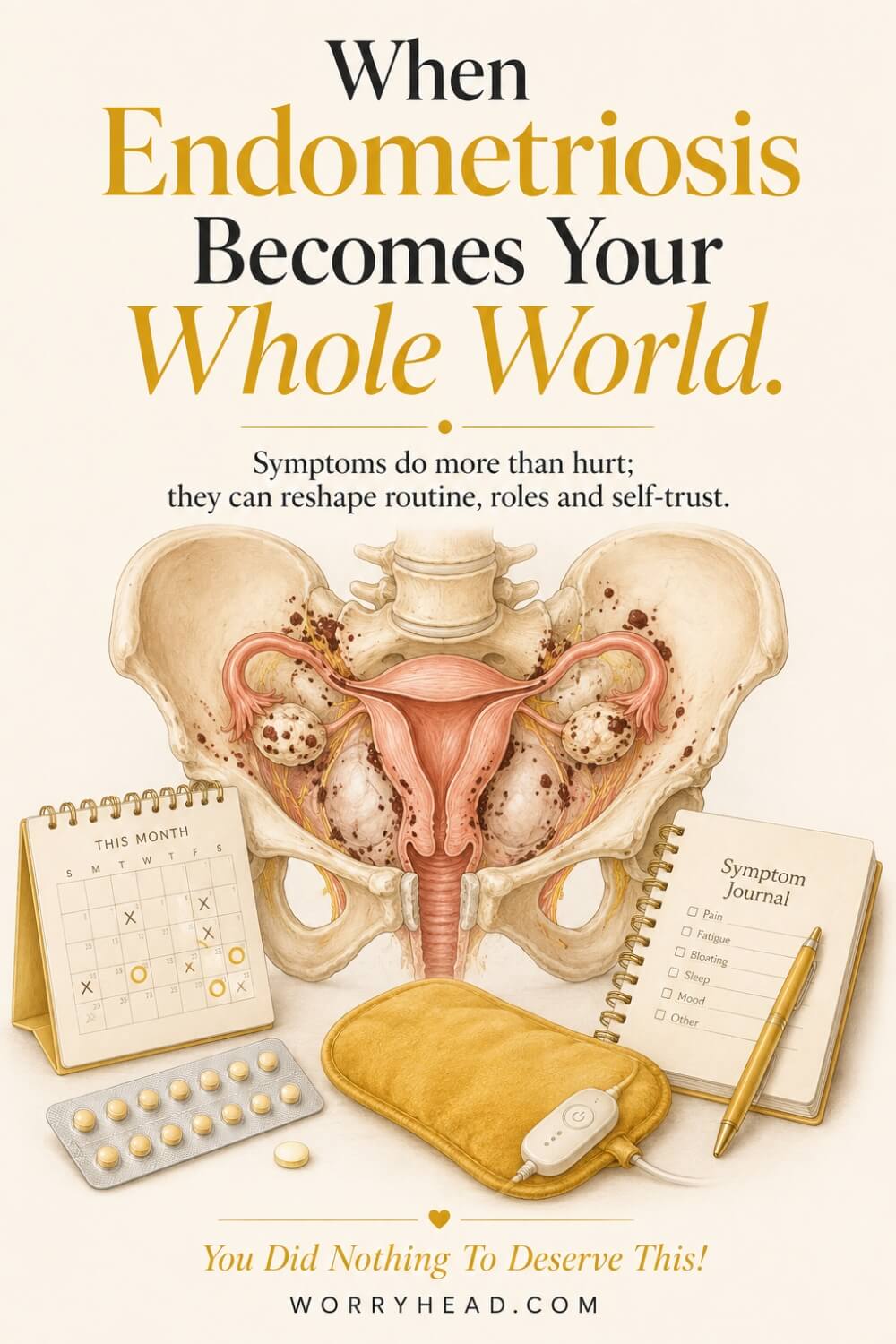
Why Endometriosis Makes You Feel Like a Patient, Not Yourself in Your Relationship?
One of the hardest changes I have witnessed is how illness can quietly alter the roles inside a relationship without either person deciding that it should happen. You may notice your partner asking whether you have taken medication, eaten enough, rested, packed what you need or have enough energy before you leave the house, and although those questions can come entirely from love, hearing them every day can leave you feeling watched rather than simply loved.
The problem is not being cared for; the problem begins when care becomes the main language of the relationship and everything else gets quieter.
This is another reason why endometriosis makes you feel like a patient, not yourself, because needing regular help can sometimes make you question whether your partner still sees you as an equal adult, a lover and the same complicated woman he originally chose.
I learned this with my wife when I realised that there were moments when I was trying so hard to make things easier that I started solving problems before asking what she actually wanted. Sometimes she genuinely needed me to take over, but at other times she needed something just as important: for me to trust her judgement, respect her decisions and allow her to decide what her body could manage.
That distinction matters because independence is not only about doing everything yourself; it is also about retaining a voice in what happens to you. For me, supporting my wife means helping when she wants help without automatically behaving as though I understand her body better than she does simply because I have watched her suffer.
It also means remembering that our marriage still needs reciprocity, because she may live with endometriosis, but she is still someone who comforts me, challenges me, makes me laugh, notices when something is wrong and gives something back to our relationship that no illness can measure. I never want her to look at us and see one healthy man endlessly giving and one ill woman endlessly receiving, because that would erase everything she continues to bring into my life.
The strongest version of us has never been one patient and one carer; it is two adults who love one another, with one of us sometimes carrying more when the other’s body cannot. Endometriosis may change what you can physically carry on a particular day, but it should never erase your right to be desired, consulted, trusted, needed and loved as the whole person you still are.
When to Seek Medical Help?
One thing I never want you to do after living with endometriosis for years is become so accustomed to pain that you automatically explain every new symptom with the words, “It is probably just my endo.” Knowing your condition well is valuable, but knowing it well should never mean that you have to diagnose yourself.
If your usual symptoms are becoming harder to control, are interfering more with work, relationships, sleep or everyday life, or the treatment that previously helped is no longer helping, it is reasonable to book another appointment with your GP or specialist. The NHS specifically recommends medical review when endometriosis symptoms are affecting everyday life, work or relationships, or when treatment has not improved them or they are getting worse.
This matters to the subject of this article because I know how exhausting another appointment can feel when you already feel as though your life revolves around being a patient. You may think, “I cannot face explaining everything again.” You may even put off asking for help because you desperately want to have a week where you are simply yourself rather than the woman discussing her pelvis in another consultation room.
But seeking medical help when something changes does not make you more of a patient. It is one of the ways you protect the life you are trying to get back.
I would particularly want my wife to arrange a medical review if there were a meaningful change from what is normal for her. That might mean pain becoming more frequent, stronger or occurring in a different place; periods becoming substantially heavier; increasing pain with sex; worsening bowel or bladder symptoms; persistent fatigue; or symptoms increasingly restricting normal activities. Endometriosis can involve the bowel or bladder and can also cause symptoms outside menstruation, so changes deserve to be described properly rather than silently tolerated.
It can help to take a short symptom record rather than trying to remember months of information while sitting under fluorescent lights in a consultation room. Note what changed, when it happens, whether it follows your cycle, how long it lasts, what makes it worse, what helps and what it prevents you from doing. That last part matters because saying, “My pain is seven out of ten” tells one story, while saying, “I now miss work twice every month and cannot sleep when this happens” tells another.
There are also situations where I would not wait for a routine appointment.
- Seek urgent medical advice if pelvic pain is accompanied by difficulty passing urine or opening your bowels, blood in your urine or stool, unusual vaginal bleeding or discharge, a very high temperature, vomiting, or if you are pregnant or could be pregnant.
- Go to A&E or seek emergency help for pelvic pain that is severe and worsening, especially if you feel faint, dizzy or actually pass out, have very heavy vaginal bleeding, shoulder-tip pain, difficulty breathing or sudden confusion.
- New chest pain, significant breathlessness or coughing blood should not simply be assumed to be endometriosis. The NHS recognises that endometriosis can occasionally affect areas outside the pelvis, including the chest, but potentially serious symptoms still need proper medical assessment.
I would use the same principle with mental health. Living for years with pain, uncertainty, disrupted sleep, lost opportunities and repeated medical appointments can wear you down emotionally, and the NHS recognises low mood and anxiety as problems that can accompany endometriosis and for which support is available. If you notice that you are withdrawing from everyone, losing interest in things you once cared about, struggling to cope emotionally or feeling increasingly hopeless, tell your GP rather than waiting until you reach breaking point.
And if you ever feel that you might harm yourself or you do not believe you can keep yourself safe, treat that as something requiring urgent help, not something you should carry privately until your next endometriosis appointment.
I say this because I have learned something important beside my wife: being strong does not mean becoming endlessly tolerant of suffering. Sometimes strength is knowing your normal well enough to recognise when something is no longer normal for you.
You also do not have to earn another medical review by becoming “sick enough”. If something has changed, if your quality of life is shrinking, if treatment is no longer doing enough, or if your instincts keep telling you that something needs another look, you are allowed to say so.
That appointment is not proof that endometriosis has become your identity.
It is simply healthcare doing what it is supposed to do: helping protect the person you are outside the consultation room.
Questions to Ask Your Doctor
When you have spent years being examined, scanned, referred and asked to describe your pain, it is surprisingly easy to enter an appointment already feeling smaller than the person sitting behind the desk. You answer the questions, listen to the medical language, nod at the plan and sometimes only remember what you really wanted to ask when you are halfway home.
I have watched this happen with my wife. There were appointments where we walked out carrying more information but somehow fewer answers about what that information actually meant for her life.
That is why I would never prepare only a list of symptoms now. I would also prepare questions about what she wants to protect: her independence, comfort, sex life, energy, work, sleep, fertility if relevant, relationships and ability to enjoy ordinary days.
NICE specifically recommends taking symptoms, preferences and priorities into account when making decisions about endometriosis treatment, while NHS guidance says doctors should discuss the risks and possible side effects of treatment options. In other words, you are not supposed to sit quietly while somebody else decides what matters most to you.
These are the questions I would want beside us.
“What do you think is causing the symptoms that are affecting me most?”
Do not be afraid to make your doctor separate the important symptoms from the background noise. Instead of trying to discuss twenty problems at once, explain which two or three are changing your life most severely and ask what might be driving them.
You deserve more than “that can happen with endometriosis”. Ask what the clinician thinks is happening anatomically or physiologically, what else could produce similar symptoms and whether anything needs investigating separately. Endometriosis can coexist with other conditions, and NHS guidance notes that its symptoms can resemble problems such as adenomyosis, fibroids, pelvic inflammatory disease and irritable bowel syndrome.
“What are we actually trying to achieve with this treatment?”
This is one of the most useful questions you can ask because treatment can begin to feel like an endless sequence of things being done to your body.
Ask whether the goal is reducing pain, controlling bleeding, improving function, protecting fertility, treating a particular lesion, reducing recurrence risk or improving another specific problem. Then ask how you will know whether it is working.
I would want my wife to know why she is taking something or considering a procedure, not simply that it is the next option on a pathway. A treatment plan should have a purpose that matters to your life.
“What are the benefits, downsides and alternatives?”
You do not become difficult by asking this. You become informed.
Ask what improvement is realistically expected, how long it may take to notice a difference, which side effects matter most, what happens if you decline the treatment and what reasonable alternatives exist. NHS guidance confirms that treatment options can include pain relief, hormonal treatment and surgery, depending on the circumstances, and that risks and possible side effects should be discussed with you.
Sometimes the most important sentence in an appointment is simply, “I need to understand my choices before I decide.”
“How does this option fit what matters to me?”
Maybe your greatest concern is pain. Maybe it is preserving fertility, being able to work, improving painful sex, reducing bowel symptoms, sleeping properly or avoiding side effects that previously made you miserable.
Say that clearly.
NICE guidance makes patient preferences and priorities an explicit part of endometriosis decision-making, including priorities around pain and fertility. A medically reasonable treatment can still be the wrong treatment for you if its consequences conflict badly with something central to your life.
Your priorities are not an inconvenience attached to the disease. They are part of deciding how the disease should be managed.
“Could these symptoms suggest deeper or different involvement?”
If you have significant bowel symptoms, bladder problems, pain when opening your bowels, pain when urinating, unusual cyclical symptoms or pain in a location that has changed, describe the pattern rather than assuming your doctor already understands what you mean.
Endometriosis can involve structures such as the bowel and bladder, and specialist management may be needed in more complex disease. The NHS also recognises that endometriosis can occasionally occur outside the pelvis.
This does not mean every unusual symptom is endometriosis. In fact, that is precisely why asking matters.
I would rather my wife say, “This is different from my usual pain, what else should we consider?” than spend months trying to fit every new symptom into an old diagnosis.
“If my scan is reassuring, what happens next if my symptoms continue?”
This is an important question because you live inside your body between appointments. You know whether something is still interfering with your life even when a test has not provided a neat explanation.
Ask what the next step would be if symptoms continue despite the current investigation or treatment plan. Do you need follow-up, another type of assessment, a gynaecology referral or specialist input?
Endometriosis diagnosis can involve several forms of assessment, including ultrasound, MRI and, in selected circumstances, laparoscopy. The diagnostic approach has also evolved, with ESHRE guidance placing less emphasis than older practice on laparoscopy being required in every case.
The important thing is not demanding a particular test. It is leaving with an agreed next step rather than another vague instruction to simply tolerate what is happening.
“Would a specialist endometriosis service be appropriate for me?”
Not everyone needs specialist-centre care, but there are situations where asking about it is entirely reasonable.
If symptoms are severe, treatment is failing, surgery is becoming complex or there is suspected involvement of structures such as the bowel, bladder or ureter, ask whether specialist input would change your care. NHS guidance notes that referral to a specialist endometriosis service may be appropriate when symptoms are very severe or treatment is not working.
Do not hear referral as proof that you have somehow become a more serious patient. Think of it as getting the right expertise for the problem so you can spend less of your life fighting to manage it alone.
“What else can help me function while we manage the disease?”
I wish more conversations about chronic illness began with the word function.
Pain matters, but so does whether you can sleep, work, walk, exercise, have sex, concentrate, leave the house and enjoy your relationships. Ask whether additional help with long-term pain, fatigue, fertility concerns or emotional wellbeing would be appropriate alongside your gynaecological treatment.
The NHS recognises these areas as legitimate parts of endometriosis support, including help for long-term pain and fatigue, fertility referral when needed and mental health support for low mood or anxiety.
That does not mean your symptoms are psychological. It means your entire life deserves support, not just the lesions somebody can see.
“What should make me contact you sooner?”
Before leaving, ask what changes should prompt another appointment rather than waiting for the next planned review.
Ask what would count as an unexpected side effect, worsening symptom, treatment failure or reason for urgent assessment. This gives you something chronic illness often steals from you: a little certainty about what to do next.
You should not have to spend every difficult evening wondering whether you are overreacting.
“Can we agree on what happens next?”
This may be the question I value most.
Before you leave, try to understand what is happening next, who is responsible for arranging it, what you should do if you hear nothing, how long treatment should be tried before reviewing it and what the next option might be if it does not help.
Write it down. Ask your partner to write it down if your mind is exhausted.
When I have accompanied my wife through difficult medical periods, one of the most frustrating feelings has been leaving an appointment knowing a great deal about what happened today but very little about what happens tomorrow. A clear plan cannot remove endometriosis, but it can remove some of the uncertainty surrounding it.
And there is one question I think deserves to sit above all the medical ones:
“How can this plan help me live more like myself?”
You may never phrase it exactly like that in the consultation room, but I want you to carry the thought with you.
Because the aim cannot only be another prescription, another procedure or another appointment. The point of managing a chronic condition is to protect as much of your life as medicine reasonably can.
When my wife sits opposite a doctor, I want that doctor to see her symptoms properly. But when she walks back out through those doors with me, I want her to remember that she is leaving as far more than somebody receiving treatment.
She is still a woman with preferences, boundaries, relationships, desires, humour, intelligence, plans and a life that matters enormously.
Your doctor needs to understand your disease.
But they also need to understand what you are trying to get your life back for.
Final Word on Why Endometriosis Makes You Feel like a Patient, Not Yourself
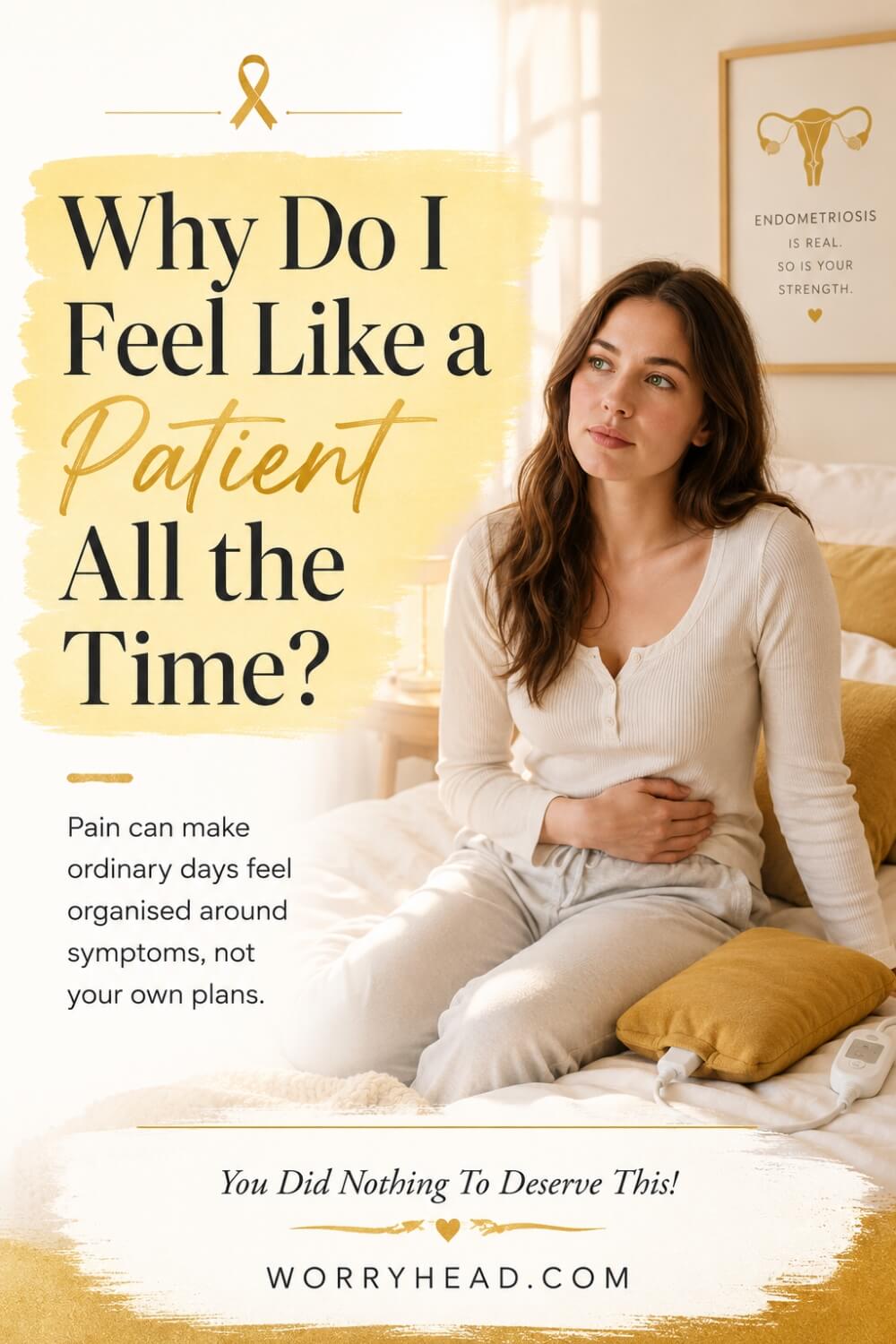
There is a strange point in long-term illness when you realise the hardest part is not always the pain itself. Sometimes it is the way pain changes the shape of your days, the way appointments creep into your calendar, the way your body becomes something you monitor, explain and prepare around.
That is why endometriosis makes you feel like a patient, not yourself, becomes such an important question, because the answer is not simply that you have a chronic condition. It is that the condition can gradually occupy the places where identity, choice and spontaneity used to live.
You may start measuring yourself by what you can tolerate, how much energy you have, whether sex will hurt, whether you can work, whether you can travel, whether you can keep plans, whether you will need help. None of those calculations make you weak. They are the practical consequences of living in a body that can become unpredictable, painful and exhausting.
But practical adaptation can quietly turn into emotional narrowing if you are not careful. You can begin to believe that the version of you who needs rest, medication, flexibility or support is somehow less real than the woman you remember before symptoms became so loud. I do not believe that for a second.
I have watched my wife change because of what endometriosis has demanded from her, but I have never watched her become less herself. I have watched her become tired, frustrated, frightened, limited and sometimes deeply fed up with a body that refused to cooperate. I have also watched the same woman laugh, argue, love, care, make decisions, comfort me, surprise me and remain unmistakably herself underneath everything illness tried to place on top.
That is why support matters so much. The person beside you should help carry what is heavy without making you feel fragile. Good support does not speak over you, decide everything for you or turn every conversation into a symptom check. It notices when you need help, but it also remembers to notice your humour, opinions, desires, boundaries, ambitions and the things that still light you up.
You deserve healthcare that takes your symptoms seriously, but you also deserve a life that is not organised entirely around healthcare. You deserve to ask questions, make informed choices, change your mind, protect your energy and seek another opinion when something does not feel right. You deserve relationships where care does not erase attraction, independence or equality.
Most of all, I want you to stop treating your need for support as evidence that you have disappeared. You have adapted because you had to. You have become knowledgeable because your body forced you to learn. You have survived days that other people never saw.
Endometriosis may influence your routine, your confidence and even the way you see yourself for a while, but it does not get the final word on who you are. Your life is still yours. And the woman behind the appointments is still there today.
You are allowed to need treatment without becoming your treatment. You are allowed to rest without losing your identity, ask for help without losing your strength, and change your life without losing yourself. Endometriosis may demand adjustments, but it does not decide your value, your femininity, your relationships or who you still get to become.
If any part of this felt like somebody finally put words around what you have been carrying, leave me a comment below. And if you need more validation and support, you can also find my FREE 130+ page eBook, “You Did Nothing To Deserve This!”, at the bottom of this post.

About Me
Hi, I’m Lucjan! The reason why I decided to create this blog was my beautiful wife, who experienced a lot of pain in life, but also the lack of information about endometriosis and fibromyalgia for men…
READ MORE
Grab a FREE eBook!
“You Did NOTHING To Deserve This!”
Finally hear the words nobody ever said to you, that your pain is real, your tears make sense, and you did nothing to deserve endometriosis, the dismissal, or the way it has rewritten your life.
Related Questions You May Be Asking About Why Endometriosis Makes You Feel Like a Patient, Not Yourself
1. Can Endometriosis Really Change How You See Yourself?
Yes. When pain, fatigue, bleeding, appointments and treatment decisions repeatedly interrupt ordinary life, you can begin seeing yourself through what your body can or cannot manage. That does not mean your personality has disappeared. It means illness has been taking up too much mental and practical space, and your sense of self may need deliberate room to become visible again.
2. Can Losing Yourself Affect Your Mental Health?
It can. Chronic pain, uncertainty, disrupted sleep, fertility worries, reduced independence and repeated medical experiences can contribute to anxiety, low mood and emotional exhaustion. Feeling unlike yourself does not automatically mean you have depression, but if hopelessness, withdrawal or loss of interest is becoming persistent, it is worth discussing this with your GP or another appropriate healthcare professional.
3. How Can Partners Avoid Treating You like a Patient?
A supportive partner can help by caring without turning every interaction into monitoring. Ask about pain when it matters, but also ask about her opinions, plans, interests, desires and ordinary life. Offer help without automatically taking control. The aim is not to pretend endometriosis is absent, but to make sure the relationship still contains affection, attraction, humour, equality and choice.
4. How Can Medical Appointments Feel Less Consuming?
Prepare a short list of what matters most to you, not only a catalogue of symptoms. Explain what pain or fatigue is stopping you from doing, ask what each treatment is meant to improve, and request a clear next step. Bringing notes or someone you trust can reduce the pressure of remembering everything and help the consultation serve your life rather than dominate it.
5. Can You Rebuild Your Identity with Endometriosis?
Start smaller than you think. Reconnect with one interest, choice, routine, relationship or part of your appearance that makes you recognise yourself again. Adapt it around your body instead of abandoning it because you cannot do it exactly as before. Rebuilding identity is not about becoming your old self overnight; it is about making sure illness is no longer the only voice in the room.
Why Endometriosis Makes You Feel Like a Patient, Not Yourself References
- https://www.who.int/news-room/fact-sheets/detail/endometriosis
- https://www.nhs.uk/conditions/endometriosis/
- https://www.nhs.uk/symptoms/pelvic-pain/
- https://www.nice.org.uk/guidance/ng73/chapter/Recommendations
- https://pubmed.ncbi.nlm.nih.gov/39618124/
- https://pubmed.ncbi.nlm.nih.gov/37358039/
- https://pubmed.ncbi.nlm.nih.gov/28637285/
- https://onlinelibrary.wiley.com/doi/10.1111/jan.16645
- https://www.endometriosis-uk.org/endometriosis-uk-release-new-report-highlighting-alarming-increase-endometriosis-diagnosis-times
