Endometriosis and Low Ferritin Levels
Have you ever wondered whether endometriosis and low ferritin levels are connected when your tiredness feels far bigger than a bad night’s sleep? If you already live with pelvic pain, difficult periods and exhaustion, it is easy for another layer of fatigue, weakness or brain fog to be brushed off as “just endometriosis”. You may even be told your haemoglobin is normal, yet still feel that something in your body is running on empty.
Low ferritin means depleted iron stores. Endometriosis is linked with a higher risk of iron deficiency, often alongside heavy bleeding, but deficiency can occur without it. Endometriosis itself is not a proven direct cause, so blood loss, inflammation, diet and absorption still need consideration.
I am not a clinician; I write as a husband, blogger and researcher who kept learning because of what endometriosis has put my wife through, and I have listed at the bottom the WHO, NICE, NHS, ESHRE and published research I used to understand the medical context wherever each source is relevant.
This question becomes even more important when you place it within the wider health problems that can sit alongside endometriosis, because iron deficiency can add its own fatigue, weakness and reduced capacity to symptoms you may already be trying to carry.
Here is the part I think many explanations miss: you can have too much iron in one place and too little available to the rest of your body. Research has found increased iron and ferritin around endometriosis lesions and within peritoneal fluid, yet this local iron accumulation is different from the iron stored and available systemically throughout your body.
In a multicentre study of 251 symptomatic patients, 53.4% met the researchers’ criteria for iron deficiency and 13.5% had iron-deficiency anaemia; remarkably, 47% of those who did not report heavy menstrual bleeding were still iron-deficient. Ferritin adds another complication because inflammation can push it upwards, so a result that appears reassuring may sometimes need to be interpreted alongside transferrin saturation, haemoglobin and the wider blood picture rather than treated as a number that tells the whole story.
That is one reason this subject matters so much to me after years of watching my wife live with endometriosis. Loving her taught me not to automatically place every new weakness, exhausted day, or change in how she feels underneath the convenient label of “just endometriosis”, because sometimes another problem is sitting beside it and deserves to be recognised too.
There is a difference between feeling drained because pain has taken everything out of you and having depleted iron stores that need proper attention, and understanding where those two experiences overlap can make your symptoms much less confusing. Once you understand what ferritin can tell you, and where it can mislead you, the questions worth asking become much clearer.

Living with low ferritin alongside endometriosis can add another layer of fatigue and worry to an already difficult daily life. My free eBook does not replace testing or treatment, but it offers emotional validation for women who feel their exhaustion is constantly underestimated.
You Did NOTHING To Deserve This!
Endometriosis Validation for Women with Endo

- What Do Endometriosis and Low Ferritin Levels Mean for Your Body?
- How Endometriosis and Low Ferritin Levels Can Affect Everyday Life?
- How Endometriosis and Low Ferritin Levels Affect You and Your Partner?
- When to Seek Medical Help?
- Questions to Ask Your Doctor
- Final Word on Endometriosis and Low Ferritin Levels
- FREE eBook
- You Did NOTHING To Deserve This!
What Do Endometriosis and Low Ferritin Levels Mean for Your Body?
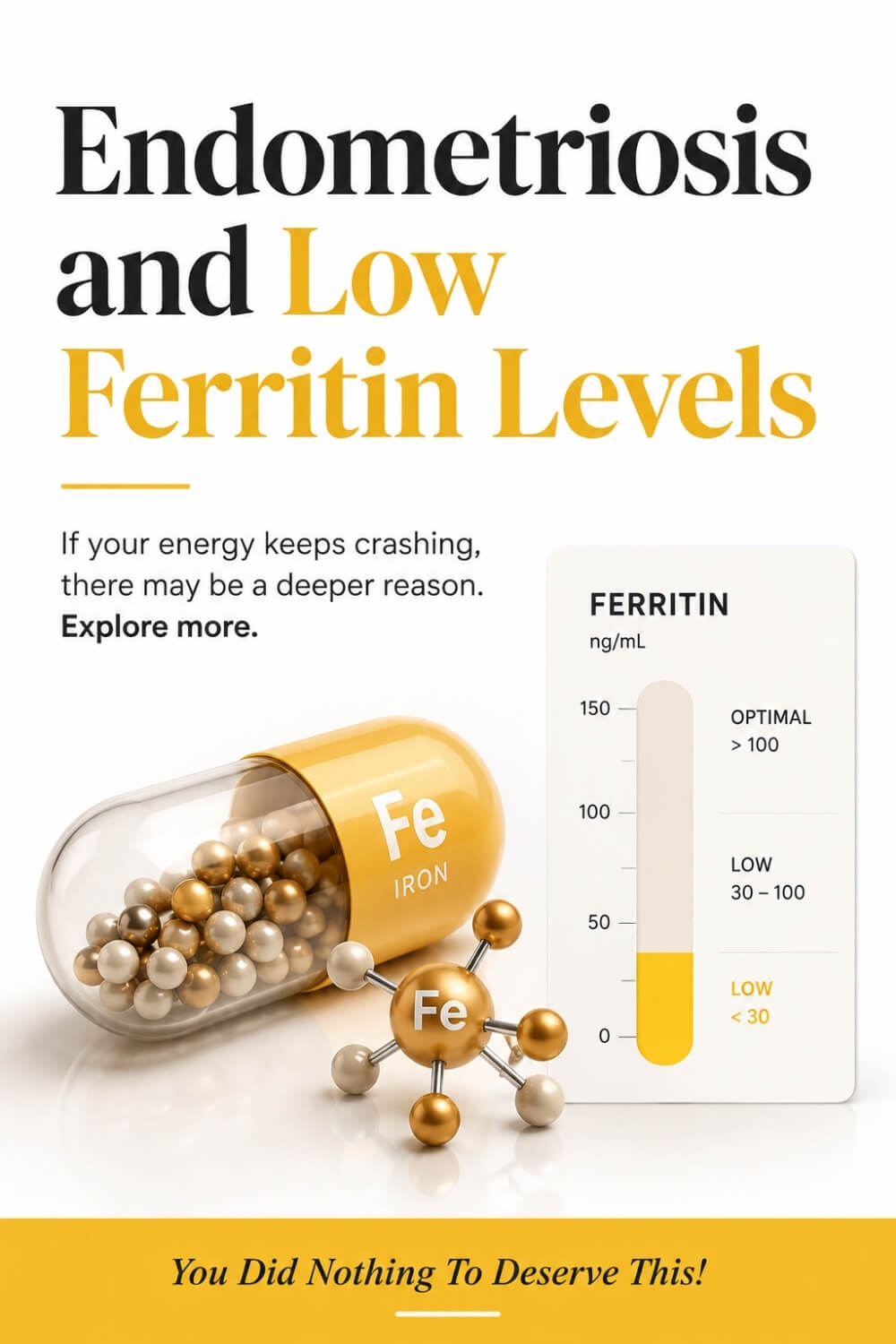
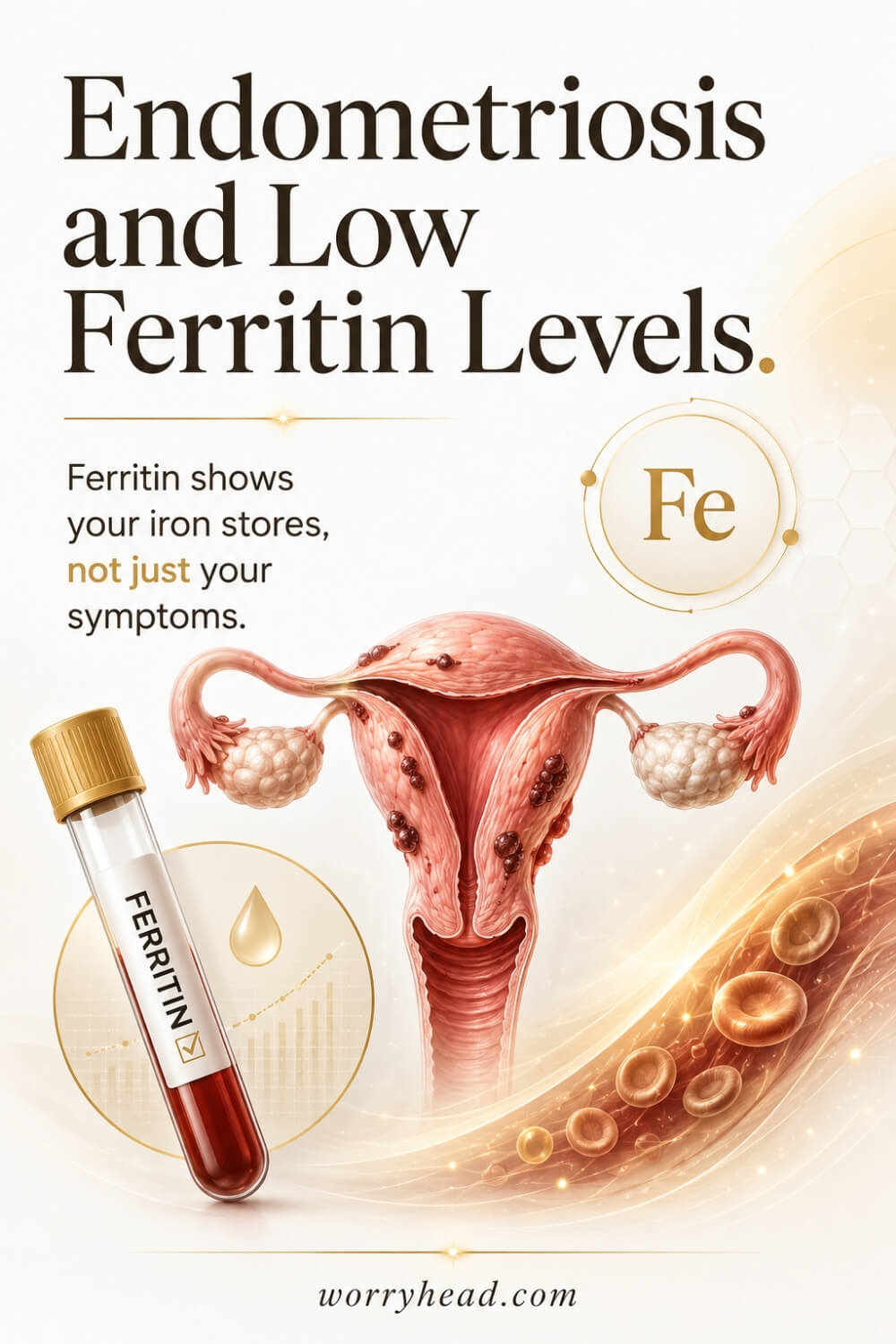
Ferritin is a protein that stores iron, so when your ferritin drops, it usually means the iron reserve your body can draw on is becoming depleted. You can reach this stage before your haemoglobin falls far enough for a blood test to label you anaemic, which is one reason feeling exhausted with a “normal” haemoglobin result should not automatically end the conversation.
That is why endometriosis and low ferritin levels deserve attention separately from anaemia, especially when fatigue, weakness or reduced stamina has begun changing what you can manage each day.
A 2025 multicentre study involving 251 patients with symptomatic endometriosis found iron deficiency in 53.4% of those tested. Only 13.5% had reached iron-deficiency anaemia, which means many of the iron-deficient patients would have been missed if somebody looked only for established anaemia. Just as strikingly, 47% of participants who did not report heavy menstrual bleeding were still iron-deficient, so assuming that iron problems matter only when your periods are obviously heavy may leave some women without an explanation for part of what they feel.
A separate prospective study following 3,294 Australian women found that those with endometriosis had 46% higher adjusted odds of reporting iron deficiency than women without it.
Adjusting for heavy menstrual bleeding weakened that association by only around 8%, suggesting that menstrual blood loss may explain some of the relationship without necessarily explaining all of it. That does not prove endometriosis directly drains iron from your bloodstream, and researchers have specifically highlighted heavy bleeding, inflammation and other possible mechanisms as areas that still need better investigation.
Heavy periods remain one of the most important causes to consider because every month of substantial blood loss also means losing iron that eventually has to be replaced. But iron can also run low because of inadequate dietary intake, problems absorbing it, pregnancy or blood loss elsewhere in the body, so I would never want you to assume that every abnormal result must automatically be blamed on endometriosis.
If your iron stores keep falling, particularly without clearly heavy periods, finding out why matters just as much as replacing what has been lost.
Ferritin also needs context because it behaves as an acute-phase protein, meaning inflammation can sometimes raise the result and make stored iron look more reassuring than it really is. In the 2025 endometriosis study, transferrin saturation identified iron deficiency in 63 of 176 participants whose ferritin was at least 30 ng/mL, which is a reminder that one laboratory number cannot always tell the complete story. In UK guidance, NICE recommends a full blood count for every woman presenting with heavy menstrual bleeding and does not advise routine ferritin testing for heavy bleeding alone, so your symptoms, bleeding history and individual circumstances still matter when deciding whether further iron studies are appropriate.
The difficult part for you is that tiredness, headaches, reduced energy and sometimes breathlessness can sit beside the fatigue and physical burden you may already associate with endometriosis, making one problem almost disappear inside the other. The practical message is not that every exhausted woman with endometriosis must be iron-deficient, but that persistent or changing exhaustion deserves curiosity rather than another shrug and another assumption that this is simply what living with the disease feels like.
Watching my wife live with endometriosis has taught me how dangerous that word “just” can become, because once everything is called “just endometriosis”, you can stop asking whether something else deserves attention. As her husband, I never want her to become so accustomed to functioning while unwell that a treatable problem simply becomes another burden she believes she has to carry quietly. If you recognise yourself in that sentence, these are the practical things I would want you to take into your next conversation about your health:
- Ask What Your Ferritin Means
- Check More Than Haemoglobin
- Track Heavy Bleeding Carefully
- Notice New Fatigue Patterns
- Discuss Transferrin Saturation Too
- Look Beyond Endometriosis Alone
- Review Medicines and Bleeding
- Treat the Cause Properly
- Recheck Iron After Treatment
Ask What Your Ferritin Means
When you receive a ferritin result, do not stop at “normal” or “low”. Ask what the actual number is, what reference range the laboratory uses, and how your symptoms, menstrual history and other blood results affect its meaning. Ferritin reflects stored iron, and a clearly low result supports depleted iron stores, but inflammation can sometimes push ferritin upwards and make the picture look more comfortable than it really is.
This is where I would want you to ask one more question rather than walk away confused: “Does this result fit how I actually feel?” WHO guidance recognises that ferritin needs different interpretation when inflammation is present. You are not being difficult by wanting context around a number. You are trying to understand whether your body has enough iron in reserve, and that is a reasonable thing to ask.
Check More Than Haemoglobin
A normal haemoglobin result does not automatically mean your iron stores are healthy. Haemoglobin tells you whether anaemia is present at that moment, while ferritin can fall earlier, so iron deficiency may exist before you cross the threshold for iron-deficiency anaemia. That difference matters when you feel profoundly tired but are told your full blood count looks acceptable.
I have learned from my wife’s care that one reassuring result can sometimes close a conversation far too quickly. Ask whether ferritin and, when clinically appropriate, a broader iron profile would add useful information. The endometriosis study discussed earlier found many iron-deficient patients who were not anaemic. Your symptoms still need proper interpretation, not because every tired day means iron deficiency, but because haemoglobin alone does not answer every iron question.
Track Heavy Bleeding Carefully
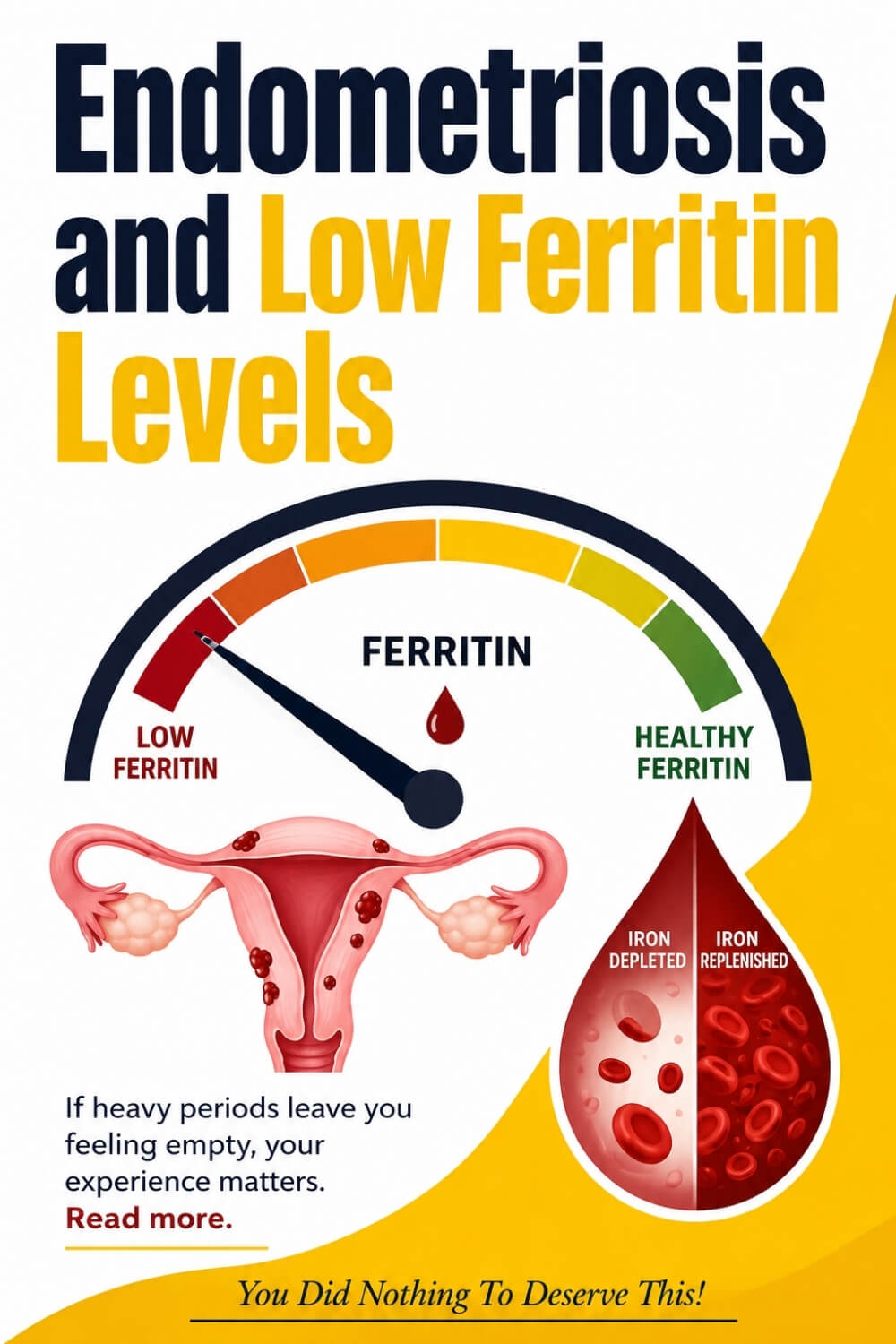
Heavy menstrual bleeding is one of the clearest ways iron can be lost month after month, but it is surprisingly easy to underestimate your own bleeding when a difficult period has become your normal. Write down how often you change pads, tampons, cups or period underwear, whether you bleed through protection, pass large clots, need double protection, wake at night to change, or organise your day around access to a toilet.
Do not worry about producing a perfect medical diary. You are simply turning “my periods are heavy” into information a clinician can actually work with. NICE recommends assessing the nature of heavy bleeding and how much it affects quality of life, not judging it by blood volume alone. If menstruation repeatedly takes away your sleep, work, movement or sense of safety outside the house, that impact deserves to be heard.
Notice New Fatigue Patterns
Endometriosis can already leave you exhausted, which makes it tempting to treat every tired day as more of the same. Instead, pay attention when the pattern changes: perhaps stairs suddenly feel harder, you become unusually breathless with ordinary effort, headaches increase, your heart feels more noticeable, your concentration worsens, or recovery after your period takes much longer than it used to. None of these proves iron deficiency on its own.
What matters is recognising a change in your baseline. I have watched how easily chronic illness teaches you to tolerate things that would make somebody else seek help immediately, simply because you are used to pushing through. Write down what is new, when it began and whether it follows bleeding. A changing pattern gives your doctor far more useful information than simply saying, “I am always tired.”
Discuss Transferrin Saturation Too
Ferritin is useful, but it is not the only way clinicians can look at iron availability. Transferrin saturation, often shortened to TSAT, estimates how much of the iron-transport protein transferrin is actually carrying iron. In the recent endometriosis study, some participants met criteria for iron deficiency through low transferrin saturation even though their ferritin was at least 30 ng/mL, which is why context can matter when symptoms and ferritin do not seem to agree.
This does not mean everyone with endometriosis needs every iron test available. It means you can reasonably ask whether a broader iron profile is appropriate in your situation, particularly if inflammation, ongoing bleeding or unexplained fatigue complicates the picture. I would rather see my wife ask one sensible extra question than leave believing her symptoms are imaginary because one result looked reassuring.
Look Beyond Endometriosis Alone
Once you have an endometriosis diagnosis, there is a real risk that every new symptom gets placed underneath it. Iron deficiency can be related to menstrual blood loss, but clinicians may also need to think about diet, pregnancy, gastrointestinal bleeding, problems with absorption or other causes depending on your age, history and symptoms. The NHS specifically notes that bleeding from the stomach or intestines is another important cause of iron-deficiency anaemia.
That does not mean you should frighten yourself by searching for the worst explanation. It means persistent deficiency deserves a cause, not just a supplement and a shrug. If your periods are not particularly heavy, your levels keep falling, or treatment is not working as expected, ask what else should be considered. Endometriosis may be part of your medical story without being the answer to every single chapter.
Review Medicines and Bleeding
Bring an up-to-date list of medicines and supplements when you discuss low iron, including painkillers you buy yourself. This matters because some medicines can contribute to bleeding or affect the digestive system, while iron tablets themselves can cause constipation, diarrhoea, nausea, heartburn or stomach discomfort. The NHS also lists regular use of non-steroidal anti-inflammatory medicines such as ibuprofen and aspirin among possible contributors to gastrointestinal bleeding in some people.
Please do not stop prescribed medicine because you read that sentence. The useful move is to ask whether anything you take changes your individual bleeding risk, affects iron absorption, or could make treatment harder to tolerate. When pain already forces you to rely on medication, you deserve a plan that considers the whole picture rather than making you choose between controlling pain and protecting another part of your health.
Treat the Cause Properly
Replacing iron can rebuild what your body has lost, but it does not automatically stop the reason it was lost. If heavy bleeding keeps draining your iron stores, or another source of blood loss or poor absorption is present, simply taking tablets without addressing the cause can turn treatment into a frustrating cycle of improvement followed by another fall. NHS guidance therefore emphasises finding and treating the reason for iron-deficiency anaemia as well as replacing iron.
This is one lesson I wish more chronically ill women heard clearly: needing treatment again does not mean you failed the first time. Sometimes the tap is still running while everyone is concentrating on refilling the bucket. Ask what is being done about both sides of the problem. You deserve a plan that aims not only to raise a laboratory value, but also to reduce the chance that you end up depleted again.
Recheck Iron After Treatment
Iron treatment should have a follow-up plan rather than ending when you finish a packet of tablets or start feeling slightly better. Repeat blood tests can show whether haemoglobin is responding and whether iron stores are recovering, while persistent abnormalities may suggest ongoing blood loss, poor absorption, treatment intolerance or another problem that still needs attention. The NHS notes that blood tests may be repeated over the following months.
Ask when your results should be checked again and what improvement your clinician expects to see. I would also keep a simple note of energy, breathlessness, bleeding and treatment side effects because numbers and lived experience belong in the same conversation. The aim is not to chase ferritin endlessly. It is to make sure treatment has actually helped you and that the reason you became deficient has not quietly continued in the background.
How Endometriosis and Low Ferritin Levels Can Affect Everyday Life?
What makes endometriosis and low ferritin levels so difficult to live with is that both can drain your physical capacity while looking almost invisible from the outside. Iron helps your body make haemoglobin, but it is also involved in enzymes and cellular processes needed for energy and normal function. Research increasingly recognises that iron deficiency can be associated with fatigue, poorer exercise capacity and reduced quality of life even before anaemia develops.
That can translate into a life where the stairs feel steeper, concentration takes more effort, a normal workday costs more recovery, and tasks you once did without thinking suddenly need planning. You may still get dressed, answer messages, go to work and smile at somebody, which makes everyone around you think you are managing. They do not see the calculation happening underneath it all: if I cook dinner tonight, will I still have enough energy to shower, tidy up, or make it through tomorrow?
This overlap becomes especially confusing when pelvic pain, poor sleep and the sheer work of living with chronic symptoms can already leave you exhausted. When several things are taking from the same energy reserve, it becomes much harder to identify which part of your exhaustion is coming from pain, which from disrupted sleep, and which may have another treatable contributor. In the recent endometriosis cohort, patients who were iron-deficient had significantly worse fatigue scores than those without iron deficiency, although the study cannot prove that low iron was the sole cause of that fatigue.
That distinction matters because replacing iron is not a cure for endometriosis, and treating endo does not automatically restore depleted iron stores. Two problems can coexist, feed into the same exhausted day, and still need different parts of your care plan. I learned to think this way through loving my wife, because once endometriosis had already taken so much from ordinary days, I could not accept that every extra layer of exhaustion should simply be added to the pile and called normal.
What stays with me most is how easily a woman can become used to rationing herself, saving energy for work, cancelling something she wanted to do, lying down when nobody is watching, then apologising because she thinks she has somehow let everyone else down. As her husband, I do not see a woman failing to keep up; I see a woman whose body has been asking far more of her than most people will ever understand, and I believe you deserve that same kindness when your own capacity changes.
If your world has quietly become smaller because you are constantly choosing what you can afford to do with the energy you have left, that change is worth bringing into the medical conversation rather than accepting it as the price of having endometriosis.
How Endometriosis and Low Ferritin Levels Affect You and Your Partner?
Living with endometriosis and low ferritin levels can affect far more than a laboratory result because depleted iron stores may add fatigue, poorer concentration and reduced physical capacity to a body already dealing with pain and other demanding symptoms. Iron deficiency can cause meaningful symptoms even before anaemia develops, so struggling more than usual does not require your haemoglobin to have fallen dramatically before it deserves attention. When that extra physical drain sits on top of endometriosis, the amount of life you can comfortably fit into one day may become smaller without anybody around you understanding why.
From the outside, your partner might see cancelled plans, less interest in going out, an earlier bedtime, difficulty concentrating during conversations or a need to rest after something that once seemed easy. You might start saying no because your body cannot comfortably give any more, then feel guilty because someone you love receives the no without feeling everything that happened inside your body before you said it. That is where a supportive partner needs to understand that reduced capacity is not laziness, lack of love or rejection, because exhaustion caused by illness does not become less real simply because it cannot be seen.
I have learned this beside my wife, because loving someone with endometriosis means learning that sometimes support is not motivating her to push harder but recognising when she has already pushed enough. When her body has less to give, I do not need her to prove that to me by collapsing first, and I certainly do not want her spending precious energy trying to convince me that she is genuinely exhausted. A woman who spends so much of her life fighting her own symptoms should be able to come home to someone who believes her before she has to explain herself for the hundredth time.
That understanding changes something between two people because you stop measuring love by how much your partner can physically do and start protecting the life you are trying to build together around what her body genuinely needs. For us, that has meant recognising that supporting my wife is not about treating her as fragile, but about standing beside her strongly enough that when pain, bleeding, iron deficiency or exhaustion steals part of her strength, she never has to wonder whether it has also made her less loved.
When to Seek Medical Help?
If you have endometriosis and you are becoming increasingly tired, weak, breathless or aware of your heartbeat, I would not automatically put those symptoms down to the condition you already know you have. The NHS advises seeing a GP if you think you may have iron-deficiency anaemia, and that is especially sensible if your periods are heavy or your energy has noticeably changed.
I would also make an appointment if your periods are affecting the way you live. Needing to change period protection every one to two hours, using two products together, bleeding for more than seven days, passing clots larger than roughly a 10p coin, bleeding through clothes or bedding, or regularly missing normal activities are all recognised signs of heavy menstrual bleeding.
Please mention bleeding between periods or after sex rather than assuming endometriosis explains it. These symptoms have several possible causes and are often not serious, but NHS guidance still recommends getting them checked.
The same applies if your ferritin remains low after treatment or repeatedly falls again. At that point, the useful question becomes not only, “How do we replace my iron?” but also, “Why am I continuing to lose it or not restore it properly?” Heavy periods are one possibility, but gastrointestinal blood loss and other causes of iron deficiency may need consideration depending on your individual circumstances.
If you have already been prescribed iron, tell your clinician if side effects make it difficult to take consistently rather than quietly abandoning treatment. Constipation, diarrhoea, stomach discomfort, heartburn and nausea can occur with oral iron, and your healthcare professional may be able to help you find a more manageable approach.
There are also situations where I would not wait for an ordinary appointment. If you have very heavy vaginal bleeding together with severe or worsening pelvic pain, feel faint or extremely dizzy, pass out, or have difficulty breathing, NHS guidance advises urgent emergency assessment.
If you have missed a period or could possibly be pregnant and develop unusual vaginal bleeding together with abdominal or pelvic pain, seek urgent medical advice through NHS 111 because an ectopic pregnancy needs to be ruled out.
Most importantly, you do not need to wait until you are barely functioning before you ask for help. I have watched my wife become incredibly skilled at carrying symptoms because chronic illness gives you very little choice, but being able to endure something does not mean you should have to ignore a change in your health.
Take your bleeding pattern, symptoms, previous ferritin and haemoglobin results, medicines and any iron treatment you have already tried to the appointment. You are not asking your doctor to blame everything on endometriosis or iron deficiency. You are simply asking them to look carefully enough to work out what is contributing to the way you feel and what can realistically be improved.
Questions to Ask Your Doctor
Going into an appointment with low ferritin can feel strangely difficult because you may know something is wrong without knowing which questions will actually move the conversation forward. You do not need to arrive knowing every laboratory range or medical term. What helps is being able to explain what has changed in your body and then ask questions that separate iron deficiency, anaemia, menstrual blood loss and endometriosis rather than allowing everything to be placed under one label.
These are the questions I would want my wife to feel comfortable asking, and the questions I would encourage you to write down before your appointment.
- “What does my actual ferritin result mean for me?”
Ask for the number rather than simply accepting that it is “fine”, “borderline” or “a little low”. Ferritin reflects your stored iron, but its interpretation depends on your health and clinical situation. WHO also recognises that inflammation can increase ferritin, which means the result sometimes needs context rather than being judged in isolation. - “Could I be iron deficient without being anaemic?”
This is an important distinction. Anaemia and depleted iron stores are related, but they are not identical stages of the same problem. If your haemoglobin is within range yet you have low ferritin or symptoms that fit iron deficiency, ask what your results mean together rather than allowing one normal figure to end the investigation. - “Do we need to look at more than my haemoglobin?”
A full blood count is important, and NICE recommends one for women presenting with heavy menstrual bleeding. However, routine ferritin testing is not recommended simply because somebody has heavy periods, so the decision to investigate iron stores further should be based on your individual symptoms, history and existing results. - “Could inflammation be affecting my ferritin result?”
This is worth asking when the laboratory result seems inconsistent with the way you feel or with the rest of your iron results. Ferritin is an acute-phase protein, which means inflammation can raise it. WHO specifically advises that inflammation should be considered when ferritin is being interpreted, so asking whether this matters in your particular situation is completely reasonable. - “Would a wider iron profile help clarify the picture?”
You do not need to demand a particular test. Simply ask whether measurements such as transferrin saturation or other iron studies would add useful information in your case, particularly if ferritin, haemoglobin and symptoms do not seem to tell the same story. Your doctor can decide which investigations are clinically appropriate rather than you having to diagnose yourself from numbers online. - “Could my menstrual bleeding explain how much iron I am losing?”
Tell your doctor what your periods actually do to your life. Mention bleeding through protection, changing products frequently, passing large clots, waking during the night, bleeding for many days or cancelling plans because leaving home feels unsafe. NICE stresses that heavy menstrual bleeding should be judged by its impact on quality of life rather than reducing the entire experience to an estimated volume of blood. - “If my bleeding does not explain this, what else should we consider?”
This is one of the questions I would particularly want you to ask if your iron keeps falling despite periods that are not especially heavy. Iron deficiency can have causes unrelated to endometriosis, including blood loss elsewhere and problems affecting iron intake or absorption. The NHS notes that bleeding from the stomach or intestines is another recognised cause of iron-deficiency anaemia, so persistent deficiency deserves an explanation rather than an automatic assumption. - “Could any medication I take be contributing?”
Bring a list of everything you use, including over-the-counter painkillers and supplements. This is particularly relevant because the NHS identifies regular use of NSAIDs such as ibuprofen and aspirin as one possible cause of gastrointestinal bleeding in some people. That does not mean you should suddenly stop medication that helps your pain. It means your doctor should know what you take so the risks and benefits can be considered properly. - “How are we treating the reason my iron became low?”
Replacing missing iron is only one half of the conversation. If ongoing heavy bleeding or another source of loss continues, your stores may fall again after treatment. Ask what is being done about the cause as well as the result because you deserve something better than repeatedly rebuilding your iron without anybody asking why it keeps disappearing. - “When should we test again, and what improvement are we looking for?”
Do not leave without knowing what follow-up looks like. Ask when another blood test is appropriate, which results will be reviewed and what should happen if your levels do not improve as expected. NHS guidance notes that repeat blood tests may be carried out over the following months during treatment for iron-deficiency anaemia.
I would also tell your doctor what the numbers cannot show. Say that walking to work has become harder, that you need to lie down after your period, that you cannot concentrate as you normally can, or that ordinary tasks suddenly feel disproportionately exhausting. Those details are not irrelevant extras. They explain what the problem is costing you.
One thing years beside my wife have taught me is that you should never have to perform illness convincingly enough to earn curiosity from the person sitting across the desk. At the same time, a good appointment does not have to become a battle. You can calmly say, “I know endometriosis can make me tired, but this feels different from my usual baseline, and I would like to understand why.”
That one sentence can change the direction of a conversation because it does not tell your doctor what diagnosis to make. It simply asks them not to stop looking too soon.
And if I were sitting beside my wife while she asked these questions, that is exactly what I would want for her. Not unnecessary tests, not frightening possibilities, and not somebody promising that iron will fix everything. I would want someone to look at her bleeding, symptoms, ferritin, haemoglobin, treatment and wider health together and say, “Let us work out what is happening.”
You deserve that same seriousness.
Final Word on Endometriosis and Low Ferritin Levels
Living with endometriosis can teach you to normalise far too much. Pain becomes expected, heavy bleeding becomes something you plan around, exhaustion becomes part of your calendar, and eventually you can stop noticing how much your body is asking you to carry. That is why endometriosis and low ferritin levels deserve a proper conversation rather than another assumption that feeling drained is simply part of the condition.
Low ferritin usually points towards depleted iron stores, and that can happen before haemoglobin falls enough for you to be diagnosed with anaemia. Heavy menstrual bleeding is an important reason this can happen, but it is not the only explanation. Research in women with endometriosis has also found iron deficiency in some who did not report heavy bleeding, which is why repeated or unexplained deficiency deserves investigation rather than guesswork.
What I hope you take from this is not a fear of every tired day. Fatigue has many possible causes, particularly when you already live with chronic pain, disturbed sleep, inflammation, medication effects and the emotional effort of managing an unpredictable illness. The useful question is whether something has changed. If your energy has dropped, ordinary activity feels harder, you are more breathless than usual, or your recovery after bleeding seems different, those changes are worth describing to your clinician.
Ferritin is valuable, but it is not a verdict on its own. Your haemoglobin, bleeding history, symptoms and, where appropriate, other iron studies may all help build a better picture. If treatment is needed, replacing iron matters, but understanding why your stores became depleted matters too. Otherwise you can end up treating the consequence while the reason continues in the background.
I have learned this lesson beside my wife. Chronic illness can make a strong woman question whether she is allowed to say that something feels worse because she has already spent years adapting to things most people would find overwhelming. I never want her strength to become the reason somebody overlooks her suffering.
You are allowed to notice that your body has changed. You are allowed to ask what your ferritin number means. You are allowed to say that your endometriosis fatigue feels different this time, and you are allowed to ask what else should be considered without being made to feel dramatic.
And if you are the partner sitting beside her, understand how powerful it is when she does not have to prove any of this at home. Believe her when she says she has nothing left. Help her protect the energy she does have, encourage her to seek advice when something changes, and never measure her worth by what her body can produce on a difficult day.
A blood result may help explain one part of what she is experiencing, but it can never measure how hard she has worked simply to keep going. Sometimes the most valuable thing you can give her is the certainty that, whatever the next result shows, she will not have to face it alone.
Your exhaustion deserves curiosity, not dismissal. Low ferritin may explain only one part of what you are carrying, but that part still matters. Ask questions, notice changes, accept support and remember this: needing rest, treatment or help does not make you difficult. It means your body is asking to be listened to.
If something here felt painfully familiar, I would genuinely love you to leave a comment below and share your experience. You can also find my FREE 130+ page eBook at the bottom of this post, written to give you the validation and support I believe every woman living through this deserves.


About Me
Hi, I’m Lucjan! The reason why I decided to create this blog was my beautiful wife, who experienced a lot of pain in life, but also the lack of information about endometriosis and fibromyalgia for men…
READ MORE
Grab a FREE eBook!
“You Did NOTHING To Deserve This!”
Finally hear the words nobody ever said to you, that your pain is real, your tears make sense, and you did nothing to deserve endometriosis, the dismissal, or the way it has rewritten your life.
Related Questions You May Be Asking About Endometriosis and Low Ferritin Levels
1. Can You Have Low Ferritin Without Being Anaemic?
Yes. Ferritin reflects your stored iron, and those reserves can become depleted before your haemoglobin falls enough for you to meet the criteria for anaemia. This means you may experience fatigue, reduced stamina or difficulty concentrating while your haemoglobin still appears normal. Your symptoms and wider iron results therefore matter alongside a full blood count.
2. Are Heavy Periods the Only Reason Iron Becomes Low with Endometriosis?
No. Heavy menstrual bleeding can certainly contribute to iron loss, but research has found iron deficiency in women with endometriosis who did not report heavy periods. Diet, gastrointestinal blood loss, problems absorbing iron and other medical causes can also matter. If your ferritin repeatedly falls without an obvious explanation, it is reasonable to ask your doctor what else should be investigated.
3. Can Ferritin Look Normal When Your Available Iron Is Low?
It can. Ferritin usually reflects stored iron, but it is also an acute-phase protein, meaning inflammation can push the level upwards. In some situations, a seemingly reassuring ferritin result may therefore need to be interpreted alongside your symptoms and other tests, such as transferrin saturation. This is why one laboratory number should not always be treated as the whole answer.
4. Can Low Iron Make Endometriosis Fatigue Feel Worse?
Potentially, yes. Endometriosis itself can be associated with substantial fatigue, while iron deficiency can independently contribute to tiredness, poorer concentration and reduced physical capacity. When both occur together, it may be difficult to know which problem is responsible for which symptom. Treating confirmed iron deficiency may improve that particular contribution, although it does not treat the underlying endometriosis.
5. Will Raising Ferritin Make Endometriosis Symptoms Go Away?
No. Correcting iron deficiency can help restore depleted iron stores and may improve symptoms related to that deficiency, but it does not remove endometriosis lesions or cure the disease itself. If your energy improves after treatment, that is valuable, but persistent pelvic pain, bleeding or other endometriosis symptoms may still need their own assessment and management plan.
Endometriosis and Low Ferritin Levels References
- https://www.who.int/tools/elena/interventions/ferritin-concentrations
- https://www.nhs.uk/conditions/iron-deficiency-anaemia/
- https://www.nhs.uk/conditions/heavy-periods/
- https://www.nhs.uk/symptoms/vaginal-bleeding-between-periods-or-after-sex/
- https://www.nhs.uk/symptoms/pelvic-pain/
- https://www.nice.org.uk/guidance/ng88
- https://pubmed.ncbi.nlm.nih.gov/39564807/
- https://pubmed.ncbi.nlm.nih.gov/38658289/
- https://pubmed.ncbi.nlm.nih.gov/37638130/
- https://pubmed.ncbi.nlm.nih.gov/42569155/

there are new increased ferritin guidelines – might want to update that in your post!