Told Endo Pain Is Just Part of Being a Woman?
Have you been told endo pain is just part of being a woman, then left wondering why everyday life feels impossible?
You may have learnt to smile through pain that empties your energy, interrupts your sleep and steals ordinary plans. If those words made you doubt yourself, I want you to know that your suffering deserves careful attention, not a shrug.
No. Ordinary menstrual cramps can occur, but pain that is severe, worsening, persistent, or stops you working, studying, sleeping, moving, resting or living normally deserves assessment. Endometriosis is one possible cause, and a normal examination or ultrasound does not automatically rule it out.
I am not a clinician, but a husband, blogger and careful researcher, and the authoritative medical sources used for this article are linked at the bottom.
- The NHS lists severe period pain that stops normal activities among the symptoms of endometriosis.
- NICE also says a normal examination and ultrasound should not be used to exclude the condition, and referral may still be needed.
- ESHRE guidance no longer treats laparoscopy as the automatic diagnostic starting point; imaging and treatment based on symptoms can be considered, with surgery discussed when imaging is negative or treatment is unsuitable or unsuccessful. It also notes that pain severity often does not match the visible extent of disease.
I started WorryHead in 2019 after watching years of symptoms and dismissal affect my wife physically and emotionally. I have seen what medical gaslighting does to a woman with endo. By the summer of 2026, more than 72,000 followers had gathered around my Facebook community, and the words I had repeated to my wife, “You Did Nothing To Deserve This!”, had become the heart of what I write.
Keep reading; the next step is not to prove yourself harder, but to make your pattern, impact, and unanswered questions easier to see...
Being told that severe pain is simply part of being a woman can make you feel trapped between suffering and silence. My free eBook gives voice to that hurt and offers validation without normalising or minimising what you are going through.
You Did NOTHING To Deserve This!
Endometriosis Validation for Women with Endo
- What It Means When You Are Told Endo Pain Is Just Part of Being a Woman?
- Why Being Told Endo Pain Is Just Part of Being a Woman Delays Care?
- How Being Told Endo Pain Is Just Part of Being a Woman Affects Relationships?
- When to Seek Medical Help?
- Questions to Ask Your Doctor
- Conclusion on Being Told Endo Pain Is Just Part of Being a Woman
- FREE eBook
- You Did NOTHING To Deserve This!
What It Means When You Are Told Endo Pain Is Just Part of Being a Woman?
When you are told endo pain is just part of being a woman, a cultural belief is being used as though it were a clinical finding. Menstruation can involve cramping, but pain that regularly prevents normal activities is not something you should be expected to endure without assessment.
NHS guidance lists severe period pain that stops usual activities as a symptom of endometriosis. Endometriosis-related pain may also occur outside bleeding days, during or after sex, or when you urinate or open your bowels. Some women have heavy bleeding, fatigue or difficulty getting pregnant, while others have different or few symptoms.
No single pattern proves endometriosis, because pelvic pain can come from several gynaecological, bowel, bladder, and even musculoskeletal or pregnancy-related causes.
That overlap is a reason for careful reasoning, not a reason to dismiss you. NICE recommends ultrasound in suspected endo, but says a normal examination and normal scan do not exclude it.
Referral may still be appropriate when symptoms persist, recur, disrupt daily living, or initial treatment fails or cannot be used. Specialist ultrasound or MRI can help assess suspected deep disease, while laparoscopy may be considered in selected cases even after normal imaging.
Treatment decisions can also begin while investigations continue, based on your symptoms, priorities, risks and preferences. The amount of pain does not neatly reveal how much disease is present.
Pain is a personal nervous-system experience, yet its effect on function can be described clearly. A short symptom diary can show timing, triggers, treatment response and lost activities that one appointment may miss.
A useful consultation should leave you with a working explanation, a plan, a review point and safety-net advice. Being believed is not a substitute for investigation, but respectful listening is where sound investigation starts.
When my wife had to explain the same pain again, I could see how exhausting it was to ask for care while also defending her credibility. I learnt that practical support means helping her prepare without taking over her story. The following steps are not a script for forcing a diagnosis; they are ways to make a careful appointment more useful.
- Record patterns, not just pain.
- Describe lost function clearly.
- Prepare a one-page timeline.
- Ask what has been ruled out.
- Discuss imaging limits calmly.
- Request a documented next step.
- Bring support without losing your voice.
- Seek another clinical opinion.
- Protect your energy after appointments.
Record Patterns, Not Just Pain
A pain score alone can flatten what you are living through. For two or three cycles, record when pain begins, where you feel it, how long it lasts, what it feels like, and whether it changes around bleeding, sex, bowel movements, urination, exercise or sleep. Add medicines used, the dose, any benefit and unwanted effects, but do not change prescribed treatment without medical advice.
Also note what the pain makes impossible. Missing work, cancelling plans, needing help to wash, waking at night or avoiding food because opening your bowels hurts gives your clinician information that “eight out of ten” cannot provide. A diary does not prove endometriosis, and you should never feel responsible for building a legal case for your own body.
It simply helps reveal patterns that a short appointment may hide. Keep it readable, bring one printed page if possible and circle the two or three changes that concern you most. Your lived experience is clinical information, not background noise.
Describe Lost Function Clearly
Clinicians need to know not only that pain exists, but what it does to your day. Instead of saying only “my periods are painful”, explain that you cannot stand through a shift, drive safely, concentrate in a meeting, sleep for more than an hour, or care for yourself without support. Functional detail turns an invisible symptom into a clear picture of severity and impact.
Choose two recent examples and keep them factual. You might say, “Last month I missed two days of work and woke four times despite taking the medicine we discussed.” Avoid minimising your words to seem easy-going, but you do not need dramatic language to be taken seriously.
If embarrassment makes you edit out pain during sex, bowel movements or urination, write those symptoms down and hand the note over. You can also say that the subject is difficult and ask the clinician to read before discussing it. You are not asking for special treatment. You are giving the information needed for a safer, more useful assessment.
Prepare a One-Page Timeline
Repeated appointments can leave your history scattered across different notes, clinicians and years. Make a one-page timeline beginning with the first symptoms you remember, then add major changes, previous treatments, scans, referrals, and how each step affected you. Use approximate dates when needed, and label anything uncertain.
Keep the page simple enough to scan in under a minute. A useful structure is date, symptom or event, action taken and result. Include relevant family history and current medicines, but leave out details that do not help answer today’s question.
At the top, write your main concern and the outcome you hope for, such as a review of worsening cyclical pelvic pain or a clear plan after treatment has not helped. Offer the timeline at the start rather than trying to remember everything under pressure. It cannot guarantee a diagnosis or referral, but it reduces repetition and helps you see whether care is moving forward or circling the same point.
Ask What Has Been Ruled Out
Endometriosis can resemble or coexist with other causes of pelvic pain, so a good assessment should not force every symptom into one answer. Ask, “What possibilities are you considering, and what makes each one more or less likely?” This invites clinical reasoning without telling the doctor what conclusion to reach.
Depending on your symptoms, the discussion may include gynaecological, bowel, bladder, musculoskeletal or pregnancy-related causes. Ask which features would change the plan and whether any examination, test or referral is intended to investigate those alternatives. A test result should be explained in context, including its limits.
If the answer is “everything is normal”, calmly ask what has actually been assessed and what remains unresolved. Normal findings can be reassuring while your symptoms still deserve management. You are not demanding endless tests; you are asking for a reasoned pathway that addresses both possible endometriosis and other important explanations.
Discuss Imaging Limits Calmly
A scan can be valuable without being the final word. NICE recommends transvaginal ultrasound for suspected endometriosis, or a transabdominal scan when the internal scan is declined or unsuitable, but it also states that normal examination and ultrasound findings do not exclude the condition. Specialist imaging may be considered when deep endometriosis is suspected.
Before the scan, ask what type has been arranged, what the clinician is looking for, and who will interpret it. Afterwards, request the written report and ask how its findings fit your symptoms. “Normal” may mean no visible endometrioma, deep disease or other abnormality was found; it does not mean that your pain is imaginary.
Avoid treating imaging as either useless or perfect. Its value depends on the question, the technique and specialist expertise. A calm question such as, “Given my ongoing symptoms, what is the next step if this scan does not show a cause?” keeps the focus on a complete pathway rather than one result.
Request a Documented Next Step
An appointment should end with more than “see how you go” when symptoms are persistent or disrupting life. Ask what the working explanation is, what treatment or investigation is being tried, how long to try it, what improvement would look like and when the plan will be reviewed. If there is no immediate test or referral, ask what clinical reasoning supports that choice.
Write the plan down before you leave, or ask for it to be included in your notes. Confirm who will arrange any scan, blood test or referral and what you should do if you hear nothing. Clear responsibility matters because vague handovers can add months.
You can also ask what would justify an earlier review, especially if pain worsens or new symptoms appear. This is not being difficult; it is safety-netting. A documented next step gives you something concrete to follow, helps another clinician understand the pathway and prevents your care from depending on how much you can remember while exhausted or upset.
Bring Support, Keep Your Voice
A trusted person can help when pain, anxiety, or previous dismissal makes appointments hard. Before you go, agree on their role: taking notes, reminding you of questions, describing changes they have witnessed, or simply helping you feel steady. Ask them not to speak over you or turn the visit into an argument.
At the beginning, you might say, “I would like to answer first, and my partner will add anything I miss.” This keeps your experience at the centre while using another pair of ears. Your supporter can note unfamiliar terms, confirm the follow-up plan and gently return the conversation to an unanswered concern.
After years beside my wife, I have learnt that support is not about becoming her expert or rescuer. It is about helping create enough space for her own words to land. If you prefer to attend alone, that choice deserves equal respect; you may ask for a chaperone, an interpreter or reasonable communication support where available.
Seek Another Clinical Opinion
Seeking another opinion is reasonable when symptoms remain disabling, explanations do not fit, treatment repeatedly fails, or communication has broken down. It does not guarantee a different answer. It gives another clinician the chance to review the history, findings and options.
In NHS care, start by asking your GP whether another GP, gynaecology review or specialist referral is possible. Bring your timeline, reports and medicine list so the consultation can build on existing work. Explain what remains unresolved instead of focusing only on the previous clinician’s manner.
A second opinion is most useful when you ask a clear question, such as whether further investigation is appropriate despite normal imaging or what alternatives should now be considered. Keep urgent symptoms out of a routine second-opinion pathway and seek timely care instead. Persistence is not proof of a diagnosis, but persistent suffering still deserves thoughtful review.
Protect Your Energy After Appointments
A dismissive or intense appointment can leave you tense and replaying every sentence. Plan a softer landing where possible: avoid stacking demanding tasks afterwards, arrange transport if pain makes driving difficult and keep food, fluids, heat or prescribed medicines nearby. Recovery is not an admission that the appointment defeated you.
When you are home, write down the agreed plan while it is fresh, then stop analysing it for the day if you can. Share what happened with one safe person rather than repeatedly proving your case to everyone. If the consultation was upsetting, separate the clinical outcome from the emotional impact; both matter, but they may need different responses.
You can follow up factual errors in your record or unanswered administrative points later. You do not have to solve the whole system before bedtime. Protecting your energy helps you return to the next step with clearer questions, and reminds you that your worth is not decided by how one appointment went.
Why Being Told Endo Pain Is Just Part of Being a Woman Delays Care?
Being told endo pain is just part of being a woman can teach you to delay your own request for help. If relatives, teachers, friends or clinicians have always described severe periods as ordinary, you may assume everyone is coping better than you.
By the time you book an appointment, you may already have adapted your work, food, sleep, sex life and social plans around pain. Diagnostic delay rarely comes from one mistake; it can grow through social normalisation, overlapping symptoms, short appointments, fragmented records and long waits.
Qualitative research has found that both patients and family doctors may normalise symptoms, especially when pain begins in adolescence. Repeated non-specific tests can be useful for excluding some problems, yet they may still leave the cause of pain unresolved.
Hormonal treatment may reduce symptoms for some people, but response or non-response alone does not prove or disprove endometriosis. A normal ultrasound can become a false full stop when nobody explains what the scan was designed to find and what it may miss.
Each new clinician may see one visit rather than the pattern across several years, particularly when notes are brief or spread across services. Waiting for certainty before offering any support can also leave you without adequate pain management, review or referral.
The cost is not only time to diagnosis; it can include lost education, employment, confidence, intimacy and trust in your own body. You may stop making plans because cancelling feels more painful than never arranging them.
I watched my wife question whether she was weak when the real problem was that her daily reality had been treated as ordinary for too long. That is why this phrase matters: it can shape what you tolerate, what you report, and how quickly the system responds.
How Being Told Endo Pain Is Just Part of Being a Woman Affects Relationships?
When you are told endo pain is just part of being a woman, the message can enter your relationship long after the appointment ends. For my wife, dismissal could turn physical pain into self-questioning, because she was left wondering whether she was overreacting to something she should somehow manage alone.
She could feel guilty when plans changed, intimacy became painful, or everyday tasks needed more time. My role was not to decide what her symptoms meant, but to believe what she described and help her reach appropriate care.
I also had to notice my own fear, frustration and tiredness without making them her burden. A partner can become too watchful, too solution-focused or too quick to speak, even when love is the reason.
That can leave you feeling managed rather than understood. We learnt that support works better when I ask what she needs now: practical help, quiet company, note-taking, reassurance or space.
The relationship needs honest conversations about pain, sex, money, work and cancelled plans, but those conversations should never frame you as the problem. Partners also need rest, boundaries and support so care remains steady rather than resentful.
The aim is not to make illness the centre of the marriage; it is to keep you at the centre while both of you adapt with dignity.
When to Seek Medical Help?
Pelvic pain should not automatically be labelled as endometriosis, even when you already have the condition. New, sudden or unusually severe symptoms can have other causes, so use the urgency of what is happening now rather than waiting for a routine endometriosis appointment.
Book a Routine GP Review
Arrange a GP appointment if pelvic pain comes and goes, does not settle, becomes more painful, or starts affecting work, sleep, relationships or normal activities. You should also seek review for increasingly heavy or irregular periods, bleeding between periods, pain during sex, pain when urinating or opening your bowels, or symptoms that continue despite treatment.
Bring your symptom pattern, medicine list and examples of lost function. You do not need to wait until every day is unbearable, and you do not need a perfect diary before asking for help.
Seek Prompt Assessment
Ask for an urgent GP appointment or contact NHS 111 if pelvic or period pain is severe or worse than usual and painkillers have not helped. Prompt advice is also appropriate for sudden severe pelvic pain, abdominal pain with nausea or vomiting, difficulty passing urine or stool, blood in urine or stool, unusual vaginal discharge or bleeding, a very high temperature, shivering, or pain when you might be pregnant.
These signs do not mean that something dangerous is definitely happening. They mean the cause should not be assumed to be your usual endometriosis pain without timely assessment.
Get Urgent or Emergency Help
Call 999 or go to A&E for pelvic pain that is severe and worsening, especially if movement or touching the area makes it worse, or if you feel faint, dizzy, light-headed or lose consciousness. Emergency warning signs also include shoulder-tip pain, breathing difficulty, heavy vaginal bleeding or sudden confusion.
If you are pregnant or might be pregnant, seek urgent advice for one-sided lower abdominal pain, bleeding or shoulder-tip pain. Call 999 for sudden intense abdominal pain with severe dizziness, fainting, marked paleness or heavy bleeding, because pregnancy complications such as ectopic pregnancy require immediate assessment.
Questions to Ask Your Doctor
You do not need to ask every question below in one appointment. Choose the three or four that best match what remains unclear, write them at the top of your notes and begin with the most important.
- What possible causes are you considering?
This invites the clinician to explain the differential diagnosis rather than treating one normal test as the end of the discussion. - Which parts of my pattern suggest or do not suggest endometriosis?
Ask for reasoning based on timing, symptoms, functional impact, examination and previous results. - What is this test intended to detect?
Clarify what an ultrasound, MRI, examination or blood test can contribute and what it cannot reliably exclude. - What happens if the ultrasound is normal?
NICE says normal examination and ultrasound findings do not automatically exclude endometriosis, so ask how ongoing symptoms will be reviewed. - Could more than one condition be contributing?
Pelvic pain may involve gynaecological, bowel, bladder, muscular or other factors, and conditions can coexist. - What treatment are we trying, and for how long?
Ask about the aim, expected benefits, common side effects, alternatives and what counts as an unsuccessful trial. - When should I be referred to gynaecology?
Persistent, recurrent or life-limiting symptoms and unsuccessful initial treatment are among the factors NICE includes in referral decisions. - Would specialist imaging or an endometriosis service be appropriate?
This may be relevant where an endometrioma, deep endometriosis or disease involving the bowel, bladder, ureter or areas outside the pelvis is suspected. - How might my fertility priorities affect the options?
You are not committing to any treatment by asking. You are making sure your current and future priorities are included in shared decisions. - What symptoms should make me seek urgent help?
Ask for personalised safety-net advice rather than assuming every future pain episode is the same. - Can we agree on a review date and next step?
Confirm who will arrange tests or referrals, when results should return, and what to do if you hear nothing. - Could I have a copy of the plan or clinic letter?
A written summary helps you follow the pathway and reduces the need to rebuild your history at every appointment.
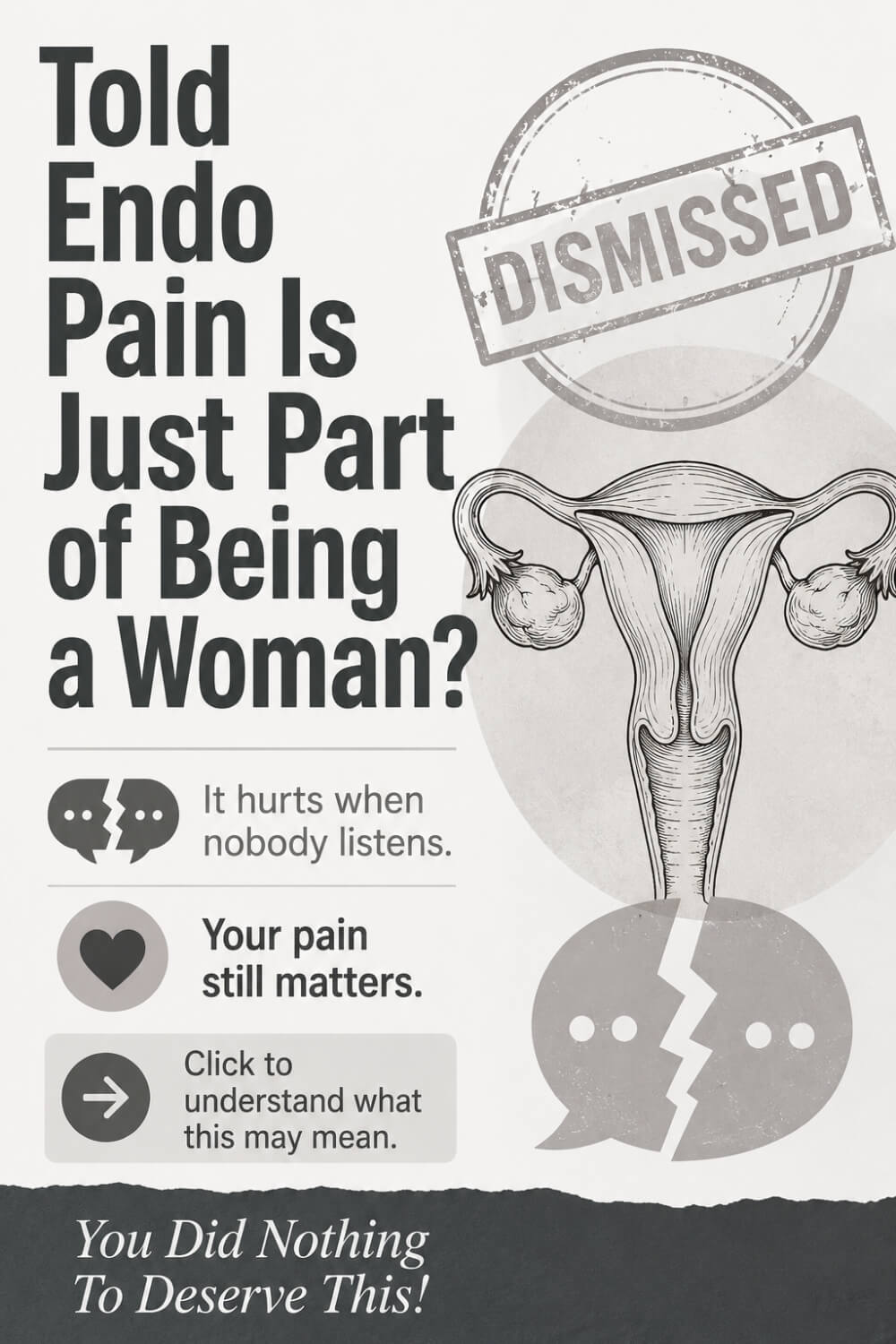
Conclusion on Being Told Endo Pain Is Just Part of Being a Woman
Being told that severe pelvic pain is part of womanhood can change how you see your body. It may teach you to wait, minimise, apologise until functioning becomes impossible. Yet pain that repeatedly stops normal activities deserves a proper, thoughtful medical review, whether endometriosis is found or another explanation emerges.
Endometriosis is complex. Symptoms vary, pain does not map neatly onto disease extent, and other conditions can cause similar problems. That uncertainty should lead to careful questions, examination, investigations and a review plan. It should not be used to turn your experience into something ordinary or unworthy of attention.
Current UK guidance matters because it offers protection against a dead end. NICE recommends ultrasound for suspected endometriosis and states that a normal examination or ultrasound does not exclude the condition. It also supports referral when symptoms persist, recur, affect daily life, or do not improve with initial treatment. Those points do not guarantee a diagnosis, but they give you questions to ask when care stalls.
Your most useful evidence may be the pattern of your life. Record timing, triggers, bleeding, bowel or bladder symptoms, pain during sex, treatment response, and the activities you lose. Describe what happened, not only what pain feels like. Ask what possibilities are being considered, what a test can and cannot show, and what will happen if the first plan fails.
If you were told endo pain is just part of being a woman, you do not need to respond by proving that every clinician was wrong. You can respond by seeking a clearer process. That may mean returning to your GP, asking for a documented review point, discussing referral, or requesting another clinical opinion when important questions remain unanswered.
Please also remember that advocacy has a cost. Prepare for appointments, but do not make yourself responsible for correcting the whole health system. Bring someone you trust if that helps. Rest afterwards. Protect the parts of your life that bring comfort, connection and identity.
As a husband, I have seen how disbelief can sit beside pain and make it heavier. I have also seen what changes when a woman hears, after years, that her symptoms are worth investigating and her limits are real. Listening does not replace medicine, but good medicine cannot begin without listening.
You are allowed to want answers without claiming certainty. You are allowed to ask for relief while investigations continue. You are allowed to change clinicians, ask for explanations, and say when a plan is not working. Most of all, you are allowed to stop measuring your strength by how much pain you can hide.
Your body is not failing a test of womanhood. Pain is not a duty, silence is not maturity, and endurance is not the price of being believed. The next step may be small, but it can still be yours: write the timeline, book the review, ask the question, and take someone supportive with you. You deserve care that remains curious until there is a safe, honest plan.
Severe or life-limiting pelvic pain is not a test of how well you cope with being a woman. Track the pattern, explain what the pain stops you doing, ask what has been considered, and leave with a clear next step. You deserve calm investigation, honest explanations and support that keeps your voice at the centre.
Share your experience in the comments, and see my free 130+ page eBook at the bottom of this post for more gentle support and practical guidance.


About Me
Hi, I’m Lucjan! The reason why I decided to create this blog was my beautiful wife, who experienced a lot of pain in life, but also the lack of information about endometriosis and fibromyalgia for men…
READ MORE
Grab a FREE eBook!
“You Did NOTHING To Deserve This!”
Finally hear the words nobody ever said to you, that your pain is real, your tears make sense, and you did nothing to deserve endometriosis, the dismissal, or the way it has rewritten your life.
Related Questions You May Be Asking About Being Told Endo Pain Is Just Part of Being a Woman
Is severe period pain ever normal?
Mild to moderate cramps can happen during menstruation, but pain that repeatedly stops school, work, sleep, movement or normal activities deserves medical review. Severity, change over time and functional impact matter. Endometriosis is one possible cause, not the only one, so assessment should consider your full pattern rather than dismissing pain as an expected part of womanhood.
Can endometriosis be present with a normal ultrasound?
Yes. NICE says normal abdominal or pelvic examination and ultrasound findings do not exclude endometriosis. Ultrasound is useful for identifying ovarian endometriomas, deep disease and other pelvic problems, but it may not show every form of endometriosis. Ongoing symptoms may still justify review, referral or further investigation, depending on your history and clinical circumstances.
Should I keep a symptom diary before seeing my GP?
A short diary can make a brief appointment more useful. Record timing, location, severity, bleeding, bowel or bladder symptoms, pain during sex, medicines used and what the symptoms stopped you doing. Two or three cycles may reveal patterns, but do not delay seeking help just to create a perfect record, especially if symptoms are severe or changing.
What if treatment helps but I still have no diagnosis?
Symptom improvement can be valuable, but it does not by itself confirm endometriosis or explain every symptom. Ask what the working diagnosis is, how long to continue the treatment, what side effects to watch for and when the plan will be reviewed. If important symptoms persist, ask what alternatives, investigations or referrals should be considered next.
Can I ask for another opinion after being dismissed?
You can ask whether another GP, gynaecology review or specialist opinion is appropriate when symptoms remain disabling, the explanation does not fit, or the plan has stalled. A second opinion may reach the same conclusion, but it offers a fresh review. Bring your timeline, reports and medicine list, and state clearly what question remains unanswered.
Being Told Endo Pain Is Just Part of Being a Woman References
- https://www.nhs.uk/conditions/endometriosis/
- https://www.nhs.uk/symptoms/period-pain/
- https://www.nhs.uk/symptoms/pelvic-pain/
- https://www.nhs.uk/conditions/heavy-periods/
- https://www.nhs.uk/conditions/ovarian-cyst/
- https://www.nhs.uk/conditions/ectopic-pregnancy/
- https://www.nhs.uk/conditions/miscarriage/
- https://www.nice.org.uk/guidance/ng73
- https://www.nice.org.uk/guidance/ng73/chapter/recommendations
- https://www.nice.org.uk/guidance/ng73/resources/endometriosis-diagnosis-and-management-pdf-1837632548293
- https://www.eshre.eu/-/media/sitecore-files/Guidelines/Endometriosis/ESHRE-GUIDELINE-ENDOMETRIOSIS-2022_2.pdf
- https://academic.oup.com/hropen/article/2022/2/hoac009/6537540
- https://www.who.int/news-room/fact-sheets/detail/endometriosis
- https://pmc.ncbi.nlm.nih.gov/articles/PMC10267318/
- https://pmc.ncbi.nlm.nih.gov/articles/PMC11113068/
- https://pmc.ncbi.nlm.nih.gov/articles/PMC12321876/
- https://kclpure.kcl.ac.uk/portal/en/publications/whats-the-delay-a-qualitative-study-of-womens-experiences-of-reac/
- https://obgyn.onlinelibrary.wiley.com/doi/10.1111/1471-0528.17719
- https://www.gov.uk/government/publications/government-response-to-the-women-and-equalities-committee-report-on-womens-reproductive-health-conditions/government-response-to-the-women-and-equalities-committees-first-report-of-session-2024-to-2025-womens-reproductive-health-conditions
- https://www.mayoclinic.org/diseases-conditions/endometriosis/symptoms-causes/syc-20354656
- https://my.clevelandclinic.org/health/diseases/10857-endometriosis
- https://en.wikipedia.org/wiki/Endometriosis
- https://worryhead.com/about-us/
- https://www.facebook.com/WorryHeadblog
