Will Endometriosis Kill You?
Have you ever searched “will endometriosis kill you” because a flare, heavy bleeding, or a frightening new symptom made you wonder whether this disease could actually take your life?
If that thought has crossed your mind at 2 a.m., when pain feels bigger than anything you have been told, I understand why the question feels so frightening. My wife tried to take her own life on two occasions, which adds another layer to the question… If you have been reassured too quickly before, you may not want another vague “you’ll be fine”; you want the truth, including the rare risks, without being scared unnecessarily.
Endo is not considered a fatal disease, and the latest meta-analysis found no significant increase in overall mortality. Rare complications can occasionally become life-threatening, however, so sudden severe symptoms should never be dismissed simply because you already have endometriosis. Endo is not considered a fatal disease even though endometriosis’s death rate is 0.1 per 100,000. 1 per million seems rare, but psychological and mental impact with suicidal thoughts, are common.
My place in this conversation is not as a clinician but as a husband, blogger, and researcher. I spent many years learning because of what my wife has lived through, so I’ve listed at the bottom the WHO, NICE, NHS, and ESHRE guidance, alongside published research, that I used for the medical and health context.
That fear also makes more sense when you see how far endometriosis can reach beyond pain alone, into work, relationships, fertility, mental health and the ordinary decisions that once felt simple.
Here is the part that gets flattened online: not usually fatal does not mean harmless. Deep endo can involve the bowel, bladder or ureter, while rare thoracic disease can affect the chest and lungs; bowel obstruction and pneumothorax are uncommon complications, but they can require urgent treatment.
Cancer deserves the same balance. ESHRE advises that endometriosis is not associated with a significantly higher risk of cancer overall, and although the absolute risk of certain cancers, particularly ovarian cancer, is higher, that increase remains low.
The newest 2026 mortality meta-analysis also found no significant increase in all-cause mortality, even though a large 2024 cohort study had reported increased premature mortality, which is exactly why one frightening study or headline should never be treated as the whole answer.
When I watched years of symptoms pile up around my wife before we understood how much endometriosis was affecting her, questions about danger stopped feeling theoretical; fear entered the room with us. I learned that supporting her properly meant doing two things at once: taking frightening symptoms seriously and refusing to let the worst possibilities become the only story we could see.
What matters now is knowing where the real risks sit, which changes should make you seek help, and which frightening claims you can finally stop carrying. Once those lines become clearer, the question itself becomes less powerful over you.
Questions about whether endometriosis can be life-threatening may come from fear, frightening symptoms or uncertainty about the future. My free eBook cannot answer an individual medical question, but it offers compassionate support for the emotional burden of living with a serious, unpredictable condition.
You Did NOTHING To Deserve This!
Endometriosis Validation for Women with Endo
- Will Endometriosis Kill You or Cause Dangerous Complications?
- Know What Is Actually an Emergency
- Notice Sudden Changes in Symptoms
- Take Heavy Bleeding Seriously
- Recognise Bowel Obstruction Warning Signs
- Watch for Urinary Tract Problems
- Do Not Ignore Chest Symptoms
- Understand Endometrioma Complications
- Keep Follow-Up for Deep Disease
- Trust New Symptoms Without Panicking
- Why Asking Will Endometriosis Kill You Can Change How You Live?
- How Can the Fear Behind “Will Endometriosis Kill You?” Affect Your Relationship?
- When to Seek Medical Help?
- Questions to Ask Your Doctor
- Final Word on Will Endometriosis Kill You?
- FREE eBook
- You Did NOTHING To Deserve This!
Will Endometriosis Kill You or Cause Dangerous Complications?
When you type will endometriosis kill you into a search bar, what you are really asking is whether this disease can ever cross the line from painful and disabling into medically dangerous. The best current evidence is reassuring because a 2026 systematic review and meta-analysis found no significant increase in overall mortality among those with endometriosis compared with the general population.
That matters, but I would never use it to tell you that every symptom is harmless simply because you already have this diagnosis. Endometriosis can infiltrate or affect structures such as the bowel, bladder and ureter, and disease outside the pelvis can also occur. NICE specifically recommends specialist endometriosis services when deep disease involves the bowel, bladder or ureter, or when endometriosis is found outside the pelvic cavity.
One reason that specialist follow-up matters is that the seriousness of a complication does not always match how dramatic your pain feels. Ureteral endometriosis, for example, may cause few or non-specific symptoms while gradually obstructing urine flow from a kidney, and delayed diagnosis can lead to hydronephrosis and loss of renal function.
Bowel disease creates a different problem because inflammation, fibrosis, adhesions or deeper lesions can narrow part of the intestine. Complete intestinal obstruction caused by endometriosis is rare, with a 2023 literature review reporting intestinal occlusion in only a small proportion of cases, but an obstruction itself is a medical problem that can become dangerous if it is not treated.
Endometriosis can also occur around the diaphragm, pleura or lungs rather than remaining confined to the pelvis. Thoracic endometriosis syndrome can present with problems including catamenial pneumothorax, haemothorax or coughing up blood, usually with symptoms connected in some way to the menstrual cycle.
These complications are uncommon, and I want to emphasise that because reading a list of rare possibilities can make an already anxious mind imagine that every flare is an emergency. The useful response is not to become frightened of your body, but to become familiar enough with your usual pattern that a genuinely new or severe change stands out.
Cancer is another fear that often appears when you search this subject, especially once you hear that endometriosis involves abnormal tissue growth. Current guidance does not treat endometriosis as cancer, and although research has found associations with a higher risk of certain ovarian cancers, the absolute increase in risk remains small and does not turn the condition into a precancerous diagnosis for most of those living with it.
What often causes the greatest harm in everyday life is therefore not a hidden expectation that the disease will become fatal, but years of untreated pain, organ-related symptoms, fertility difficulties, repeated surgery, exhaustion and the psychological weight of never knowing what the next month will bring. The practical message I wish somebody could place into every frightened person’s hands is simple: you do not need to live as though death is waiting around the corner, but neither should anyone use the words “endometriosis is not fatal” as an excuse to dismiss a symptom that needs proper assessment.
Living beside my wife’s illness taught me how enormous that difference is. I have watched fear enter our lives not because she wanted to expect the worst, but because when your body has surprised you with pain again and again, reassurance eventually means very little unless somebody is willing to take you seriously too. If I could give you the same protection I try to give the woman I love, I would want you to know these things before fear has the chance to decide for you:
- Know What Is Actually an Emergency
- Notice Sudden Changes in Symptoms
- Take Heavy Bleeding Seriously
- Recognise Bowel Obstruction Warning Signs
- Watch for Urinary Tract Problems
- Do Not Ignore Chest Symptoms
- Understand Endometrioma Complications
- Keep Follow-Up for Deep Disease
- Trust New Symptoms Without Panicking
Know What Is Actually an Emergency
One of the hardest parts of living with endometriosis is deciding when pain has crossed from a familiar flare into something needing urgent medical attention. Your usual pain can already be severe, so I would never tell you to judge danger by a number on a pain scale alone. What matters is change: pain that is suddenly different, rapidly worsening, or accompanied by fainting, repeated vomiting, difficulty breathing or very heavy bleeding deserves prompt assessment.
I learned this beside my wife because familiarity can work against you. When you have endured awful symptoms for years, you can become frighteningly good at tolerating things that someone without chronic pain would never ignore. You do not need to panic every time your pelvis hurts, but you also do not have to prove how tough you are before asking for help; a diagnosis can explain symptoms without becoming a reason to dismiss every new one.
Notice Sudden Changes in Symptoms
Your body has patterns, even when endometriosis makes those patterns messy. You may know the pulling pain before a period, the bowel discomfort that appears at a certain time of the month, or the deep ache that has become horribly familiar. A sudden change from that personal baseline matters more than whether somebody else would call the symptom “severe”.
Pay attention when pain changes location, becomes much sharper, stops settling as it normally does, or arrives with vomiting, fever, faintness, abdominal swelling, breathlessness, urinary difficulty or unusual bleeding.
A simple record of dates, cycle timing, intensity and what felt different can give a clinician something concrete to work with when months of flares blur together. I have learned that knowing my wife’s normal does not mean assuming everything is normal; sometimes loving her well means noticing when a familiar illness begins behaving unfamiliar.
Take Heavy Bleeding Seriously
Heavy bleeding can become so normalised that you judge it by whether you can still get through the day rather than by what it is doing to your body. If you are changing period protection every hour or two, bleeding through clothes or bedding, passing large clots, or becoming weak, dizzy or breathless, tell a clinician rather than simply enduring it. Repeated blood loss can contribute to iron deficiency anaemia and gradually drain your reserves.
This is personal for me because I have watched how exhausting heavy bleeding can be for the person you love. There is something painful about seeing a woman build her day around toilets, spare clothes and fatigue while quietly treating that disruption as ordinary. Please do not measure whether you deserve help by how long you have managed it; ask whether blood tests for anaemia and iron deficiency, and treatment for the bleeding itself, are appropriate for you.
Recognise Bowel Obstruction Warning Signs
Bowel symptoms are common with endometriosis, but a true bowel obstruction is different from ordinary bloating or painful bowel movements. Warning signs can include worsening cramping abdominal pain, marked swelling or distension, nausea or vomiting, and being unable to pass stool or wind. If that combination develops, especially when it is new or progressing, seek urgent medical assessment rather than waiting for your cycle to change.
I tell you this to give you clarity, not to make every episode of constipation frightening. Deep bowel disease can narrow the bowel in some cases, while adhesions from endometriosis or previous surgery may also affect the abdomen, but complete obstruction remains uncommon.
Knowing the distinction gives you a plan: you can recognise your usual digestive symptoms without dismissing a very different pattern, and explain clearly what changed when you speak to a medical professional.
Watch for Urinary Tract Problems
Endometriosis involving the bladder or ureter can be easy to underestimate because urinary symptoms do not always look dramatic. Pain when passing urine, blood in the urine, needing to urinate more often, difficulty emptying your bladder, flank or back pain, recurrent infections or a clear change in your usual pattern deserve medical discussion. Ureteral disease matters because obstruction can sometimes develop with surprisingly little pain.
A blocked ureter can cause hydronephrosis, where urine backs up towards the kidney, and prolonged obstruction can damage kidney function. That does not mean every urinary symptom signals kidney damage, but it explains why deep disease around the urinary tract deserves specialist attention. My rule from years beside my wife is simple: never let a chronic diagnosis make you smaller in the consultation room; say what changed, how long it has lasted and what it is stopping you from doing.
Do Not Ignore Chest Symptoms
Most endometriosis is found in the pelvis, but rare thoracic endometriosis can involve the diaphragm or chest and may be linked with problems such as a collapsed lung around menstruation. Sudden one-sided chest pain, new shortness of breath, difficulty breathing, faintness or coughing up blood should not be watched at home because you think it may be cycle-related. Those symptoms need medical assessment because several conditions can cause them.
For your longer-term history, timing can still be an important clue. Repeated shoulder, chest or breathing symptoms that appear around menstruation are worth documenting and raising with a specialist, even if pelvic symptoms usually receive most of the attention.
Rare does not mean impossible, but it also does not mean you should spend every month expecting catastrophe; know the warning signs, act when they appear, then give yourself permission to stop carrying the worst-case scenario everywhere.
Understand Endometrioma Complications
An endometrioma is an ovarian cyst associated with endometriosis, and most do not suddenly become emergencies!
Sudden severe pelvic pain, particularly with nausea or vomiting, is different because rupture, bleeding or ovarian torsion may need urgent assessment. Torsion means the ovary twists and its blood supply can be affected, and you cannot reliably tell these complications apart from symptoms alone.
This matters if ovarian pain is already familiar because your instinct may be to wait for it to settle as previous flares have done. Give yourself permission to respond differently when the pain itself is different, and keep the follow-up your specialist recommends. NICE advises specialist referral for an endometrioma and considers follow-up particularly when one is larger than 3 cm and surgery is not chosen, so monitoring is about informed decisions, not living nervously around your ovaries.
Keep Follow-Up for Deep Disease
Deep endometriosis deserves follow-up based on where the disease is, what symptoms it causes and the treatment decisions you have made, not just the stage written in an old operation report. NICE advises specialist services for suspected or confirmed deep disease involving the bowel, bladder or ureter, and for endometriosis outside the pelvis. Those services can bring together gynaecology, colorectal, urology, imaging and pain expertise when needed.
I know how easily life can become a sequence of appointments followed by long stretches of simply coping. After enough consultations, another scan or review can feel like one more thing to organise while you are already exhausted. But follow-up lets you ask whether known disease has changed, whether organ function needs checking and whether your current plan still fits your life; you are not difficult for wanting somebody to look beyond pain relief and consider what the disease may be affecting.
Trust New Symptoms Without Panicking
There is a middle ground between ignoring your body and becoming frightened by every sensation, and I think that is where you deserve to live. A new symptom is information, not automatic evidence that something terrible is happening. Notice it, write it down, watch whether it worsens or returns, and seek medical advice at the level of urgency it requires rather than diagnosing the worst possibility from a search result.
Years of illness can damage trust in both directions: you may stop trusting your body because it feels unpredictable, or stop trusting yourself because somebody once said you were overreacting. I have watched how cruel that uncertainty can become, and one thing I try to give my wife is a steady voice when fear gets loud: we will take this seriously, but we will not assume the worst before we know.
You deserve that same balance, because paying attention to yourself is not panic and asking for help is not fear winning.
Why Asking Will Endometriosis Kill You Can Change How You Live?
There is another kind of damage this question can cause, and it has nothing to do with mortality statistics. When your body has frightened you enough times, you can start living as though something terrible is always waiting around the next corner, even when your doctors have never told you that your life is in immediate danger.
That fear can creep into ordinary moments. You may analyse every new pain, check bleeding more closely than you used to, worry when your bowel behaves differently, or wonder whether a strange sensation is simply another flare or something you cannot afford to ignore.
This is why the question will endometriosis kill you can become much bigger than the medical answer itself. The disease may not usually threaten your life, yet uncertainty can quietly threaten your ability to feel safe inside that life.
I have seen something similar happen beside my wife, especially after years in which symptoms kept accumulating before we fully understood what was happening. Once you have learned that endometriosis can involve far more than painful periods, it becomes difficult to simply switch that knowledge off and trust every unusual symptom to disappear.
There were times when what she needed from me was not another explanation of endometriosis. She needed somebody beside her who could say, in effect, “I believe what you are feeling, we will take a change seriously, and you do not have to carry the fear of it alone.”
That distinction became incredibly important to me as her husband. Supporting her did not mean pretending nothing bad could ever happen, but it also did not mean feeding every frightening possibility until illness occupied every corner of our relationship.
You deserve the same balance from the people around you. A partner who loves you should never mock the fear created by years of unpredictable pain, but should also help you separate a symptom that needs attention from the terrifying story your mind may build around it at midnight.
There is grief in this that medical descriptions rarely capture. You can know intellectually that endometriosis is not considered a terminal disease and still mourn the version of yourself who once made plans without first wondering what your body might do.
I have watched my wife have to calculate things that a healthy person barely notices, and I wish I could give back every piece of freedom chronic illness has taken from her. I cannot remove the disease from her body, but I can make sure the woman I married never has to wonder whether becoming ill made her less lovable, less feminine, less wanted or somehow too difficult to stand beside.
That matters because survival is not the only outcome worth talking about. You deserve medical care that protects your health, but you also deserve a life in which endometriosis is something you manage rather than something that teaches you to fear your own future.
And if the thought of dying has been sitting quietly behind your symptoms, please do not feel embarrassed for having asked the question. Sometimes understanding that the overwhelming majority of people with endometriosis are not facing a fatal disease is not the end of the conversation, but the first moment you can begin reclaiming some of the safety the illness has taken from you.

How Can the Fear Behind “Will Endometriosis Kill You?” Affect Your Relationship?
Serious illness fears do not stay neatly inside the person experiencing the symptoms; they enter the relationship too, changing conversations, plans, intimacy and sometimes the way both partners imagine the future. I have learned that when my wife is frightened by something happening in her body, my job is not to immediately fix the emotion or dismiss it with reassurance, but to understand what she is actually afraid of first.
There is a big difference between saying, “Endometriosis does not normally kill you, so stop worrying,” and sitting beside the woman you love while acknowledging that years of pain can make any unusual symptom feel threatening. The first response closes the conversation, while the second tells her that she does not have to prove her fear is medically justified before she deserves comfort.
For me, supporting my wife has sometimes meant becoming the calmer person in the room when her body feels unpredictable. That does not mean I never worry, because I do, but I try not to hand that fear back to her and make her responsible for comforting me when she is the one hurting.
Endometriosis can also change the future you once assumed would unfold naturally, because holidays, work, sex, social plans and even ordinary weekends may need to bend around symptoms. If every cancelled plan begins to feel like another thing the disease has stolen, resentment can quietly grow unless both of you remember that the person with endometriosis did not choose any of this.
I never want my wife to look at me during a flare and wonder whether I would rather have a healthier version of her. I want her to know that illness can change what we do together without changing why I chose her, why I still want her beside me, or how much value she brings into my life.
At the same time, being supportive does not mean becoming controlling because you are frightened something might happen to her. There is a fine line between saying, “That symptom worries me, can we get it checked?” and slowly treating the woman you love as fragile, incapable or permanently defined by disease.
The healthiest place I have found is somewhere between protection and respect, where I can notice, help, advocate and stand beside my wife while remembering that the decisions about her body still belong to her. We face endometriosis together, but I never want the disease to become the third voice in our marriage making every decision for us.
And perhaps that is what I most want other partners, particularly men, to understand. You cannot promise the woman you love that nothing frightening will ever happen, but you can make sure she never has to face frightening moments wondering whether you will still be there when they do.
When to Seek Medical Help?
Most endometriosis symptoms do not mean that your life is in danger, and I do not want you reading this section and suddenly becoming frightened of every flare. What I do want is for you to know when something has changed enough that it deserves medical attention rather than being automatically blamed on the condition you already have.
Arrange an appointment with your GP or endometriosis specialist if your pain is becoming more frequent, your periods are becoming heavier, your usual treatment is no longer controlling your symptoms, or bowel, bladder or pelvic symptoms are beginning to interfere more with everyday life. NHS guidance specifically recommends seeing a GP when symptoms affect your daily life, work or relationships, or when treatment is no longer helping.
More urgent assessment is appropriate when your symptoms suddenly look very different from your normal pattern. Sudden severe pelvic pain, particularly when accompanied by nausea or vomiting, should be assessed promptly because conditions such as an ovarian cyst complication or ovarian torsion can produce those symptoms, and you cannot safely work out the cause from pain alone.
Please also take very heavy vaginal bleeding seriously, especially if you become faint, dizzy, unusually weak or short of breath. Severe or worsening pelvic pain together with fainting, difficulty breathing or heavy vaginal bleeding is a reason to seek emergency care rather than simply waiting to see whether another endometriosis flare settles.
Your bowel can give important warning signs too. Severe or increasing abdominal pain with repeated vomiting, a noticeably swollen abdomen, or being unable to pass stool or wind can indicate bowel obstruction and needs urgent assessment rather than another night spent hoping the bloating disappears.
Urinary changes deserve attention as well, particularly if pelvic pain comes with difficulty passing urine, blood in your urine, fever, worsening flank or back pain, or a major change in how you normally empty your bladder. Deep endometriosis can involve the urinary tract, but another condition such as infection or a kidney problem can cause similar symptoms, which is precisely why a new change should be assessed rather than self-diagnosed.
And although endometriosis affecting the chest is uncommon, do not sit at home trying to decide whether sudden chest pain, significant breathlessness or coughing up blood is “just endometriosis”. The NHS recognises that endometriosis can occasionally cause chest symptoms, but difficulty breathing itself is a symptom that warrants urgent medical attention regardless of its eventual cause.
One lesson I have learned beside my wife is that chronic pain can distort your idea of what is reasonable to tolerate. When you have survived hundreds of difficult days, your instinct can become, “I have felt awful before, so I will wait,” when the more useful question is, “Is this normal for me, or has something clearly changed?”
You do not need to rush to A&E because your familiar endometriosis pain has returned exactly as it usually does. But you are equally entitled to seek help when your body behaves differently, because having endometriosis should never become a reason for you, your partner or a medical professional to dismiss a genuinely new warning sign.
If you are in the UK and you are unsure how urgently you need to be seen, NHS 111 can help direct you to the appropriate level of care. For severe worsening pelvic or abdominal pain, fainting, heavy bleeding, significant breathing difficulty or another rapidly deteriorating symptom, seek emergency medical care.
The aim is not to teach you to fear your body. It is to help you know it well enough that you can live without expecting catastrophe while still trusting yourself when something does not feel right.
Questions to Ask Your Doctor
Fear becomes much easier to manage when you leave an appointment knowing what doctors are watching for, rather than simply hearing, “Endometriosis is not life-threatening.” That sentence may be reassuring medically, but if nobody explains what is happening in your body, what needs monitoring and which changes matter, you can walk home with exactly the same questions you arrived with.
I have learned from supporting my wife that the most useful appointments are often the ones where you arrive with specific questions. You do not need to sound medically knowledgeable or prove that you have researched everything. You simply need enough information to understand your own situation and what should happen next.
Could my endometriosis be affecting any organs?
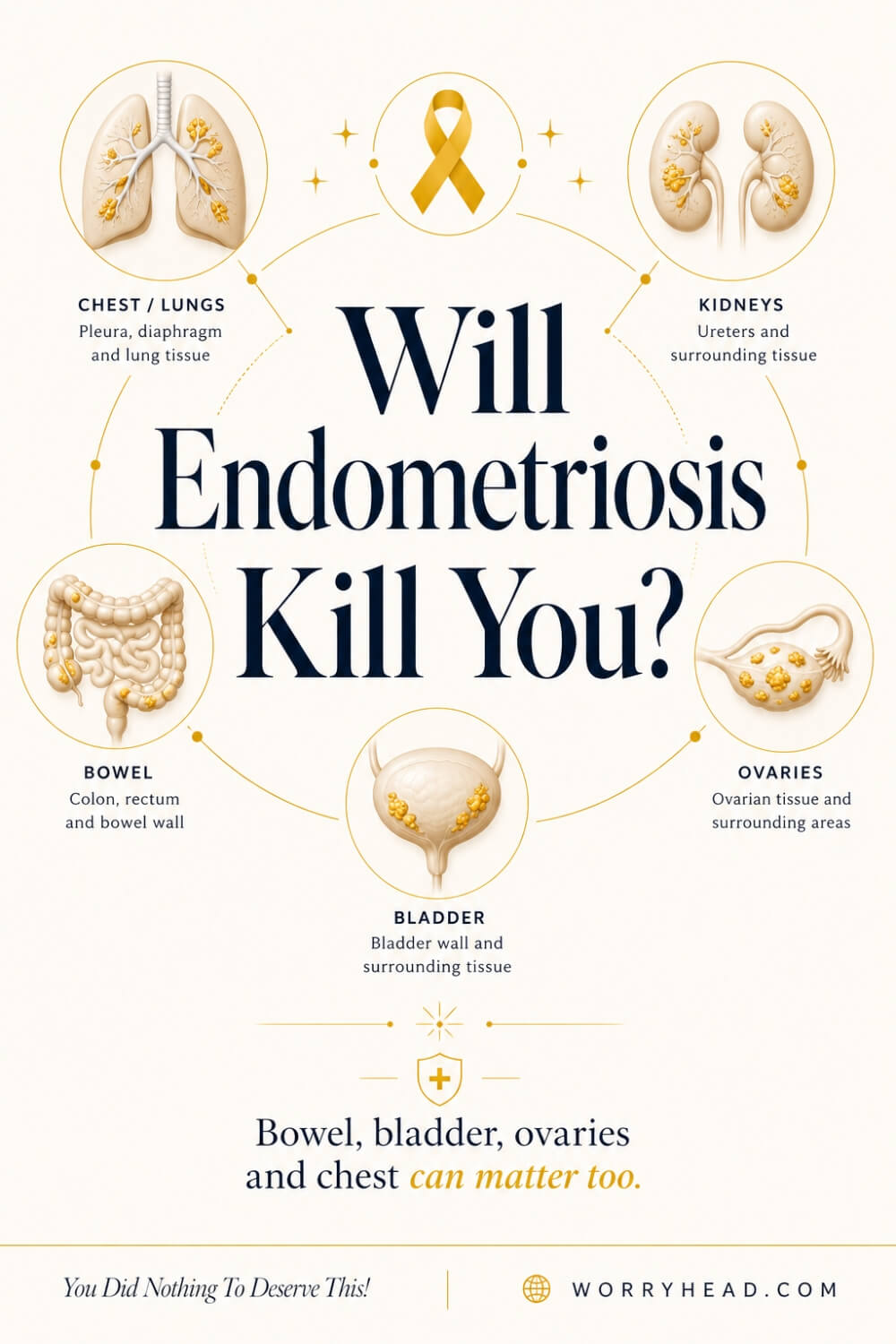
Ask where your known or suspected disease is located and whether the bowel, bladder, ureters, ovaries, diaphragm or other structures may be involved. The answer can change what symptoms deserve attention and whether you would benefit from assessment within a specialist endometriosis service.
Do any of my current symptoms concern you?
Tell your doctor what has changed rather than only listing everything you have experienced for years. You might say that pain has become sharper, bleeding has become heavier, urination feels different, bowel symptoms have changed or you are experiencing something completely new. Asking directly whether any particular symptom needs investigation can produce a much clearer answer than simply asking whether your endometriosis is “bad”.
Which symptoms should make me seek urgent help?
I think this is one of the most valuable questions you can ask because the answer gives you a plan for the frightening days. Ask what would warrant contacting your GP, calling NHS 111, attending urgent care or going directly to A&E based on your own medical history.
Write that advice down if you need to. When you are frightened and in severe pain, it is much harder to remember a conversation you had months earlier.
Could an endometrioma cause problems for me?
If you have an ovarian endometrioma, ask about its size, appearance and whether your clinician recommends monitoring, treatment or further assessment. You can also ask what sudden symptoms could suggest a complication and whether there are circumstances in which you should seek urgent care.
Knowing an ovarian cyst is there can make every stab of pelvic pain frightening. A clear monitoring plan can stop you from having to make those decisions entirely on your own.
Could my bowel symptoms need further investigation?
If you experience painful bowel movements, constipation, diarrhoea, rectal pressure, cyclical bowel symptoms, abdominal swelling or other significant digestive changes, explain exactly what happens and when. Ask whether your symptoms suggest possible bowel involvement and whether imaging or specialist assessment would be useful.
Also ask what would distinguish your ordinary bowel symptoms from something requiring urgent attention. That distinction is far more useful than being told simply to expect digestive problems because you have endometriosis.
Should my urinary tract or kidneys be checked?
This is particularly worth asking if you have bladder symptoms, pain when urinating, blood in your urine, flank pain, difficulty emptying your bladder or known deep endometriosis near the urinary tract. Ask whether your ureters or kidneys need imaging or other assessment and whether there is any concern about obstruction.
Not every urinary problem is caused by endometriosis, which is another reason not to assume that a new symptom automatically belongs to your existing diagnosis.
Do I need specialist endometriosis care?
If deep endometriosis is suspected or confirmed, ask whether your care would be better coordinated through a specialist service. Depending on where disease is located, that may involve clinicians with experience in advanced gynaecological surgery, colorectal surgery, urology, radiology or pain management.
You are not being difficult by asking whether you are seeing the right person for your particular disease. Endometriosis varies enormously from one person to another, and complex disease sometimes needs more than one type of expertise.
What monitoring do I actually need?
Ask whether any scans, blood tests, kidney checks, reviews or other follow-up are recommended for your individual circumstances. Then ask why they are being done and what clinicians are looking for.
That second question matters. Monitoring feels much less frightening when you understand that it is there to keep an eye on something rather than because somebody secretly expects the worst.
Does endometriosis change my cancer risk?
If cancer is the fear sitting underneath your questions, say it plainly. Ask your doctor to explain your personal risk rather than trying to calculate it from frightening headlines about ovarian cancer and endometriosis.
The overall message from current evidence is reassuring: endometriosis is not cancer, and any increase in the absolute risk of certain cancers remains small. Your own age, family history, ovarian findings and other factors can matter, so a personal conversation is much more useful than assuming a population-level statistic predicts what will happen to you.
What else could be causing this new symptom?
This may be the question I would most want my own wife to remember. Once endometriosis becomes part of your medical history, there is a danger that you, your partner or even a clinician begins putting every new symptom into the same box.
Sometimes it will be endometriosis. Sometimes it will be something completely unrelated that deserves its own investigation.
You are still allowed to develop ordinary illnesses, infections, ovarian problems, bowel conditions, urinary problems and every other medical issue somebody without endometriosis could develop. A chronic diagnosis should add context to new symptoms, not close the investigation before it begins.
And if appointments make you anxious, take somebody you trust if you can. I have learned that a supportive partner can listen when pain makes concentration difficult, remember details afterwards, help explain changes they have witnessed, and quietly remind you of the question you were too overwhelmed to ask.
But the person beside you should never speak over you. If I am supporting my wife in a medical conversation, I want my presence to make her voice stronger, not replace it.
Before you leave, there is one final question worth asking: “What should I do if this gets worse?”
A good answer should leave you knowing what to watch, who to contact and when waiting is no longer sensible. You deserve more than reassurance without a plan; you deserve enough understanding to go home feeling informed rather than frightened.
Final Word on Will Endometriosis Kill You?
The question will endometriosis kill you comes from fear, not curiosity. It often appears after years of pain, frightening bleeding, unexpected symptoms, difficult appointments, or a moment when your body feels less predictable than it used to. If you have asked it, you are not being dramatic. You are trying to understand whether the disease that already affects so much of your life can also threaten life itself.
The reassuring answer is that endometriosis is not generally considered a fatal disease. Most people with it will not die because of endometriosis, and current research does not show an increase in overall mortality. That matters, because fear can become another burden on top of pain, fatigue, bowel problems, bladder symptoms, fertility worries, surgery, and all the weight that can come with living in a body you cannot always predict.
But reassurance should never become dismissal. Rare complications involving the bowel, urinary tract, ovaries, chest, or other organs can become serious, and a new symptom should not automatically be labelled “just endometriosis”. Sudden severe pain, heavy bleeding with weakness or faintness, repeated vomiting, inability to pass stool or wind, difficulty breathing, coughing up blood, or major urinary changes deserve assessment.
The most useful thing you can take from this is not a list of frightening possibilities. It is the confidence to know your normal pattern and recognise when something is different. You do not need to live watching your body for disaster, but you also do not need to become so accustomed to suffering that you ignore a warning sign simply because you have endured worse before.
Watching my wife live with severe endometriosis taught me that the hardest part is sometimes not knowing what the next day will bring. I have seen her continue when pain would have stopped many people, and I have seen how easily that strength can make others underestimate what she is carrying. I never want her courage to become the reason anyone expects her to tolerate more.
That is something I want you to hear too. You do not have to earn medical attention by reaching breaking point. You do not have to convince everyone around you that your pain is real before you are allowed to ask questions. And you do not need to apologise for being frightened when a disease has already taught you how unpredictable a body can feel.
As a husband, I cannot promise my wife that nothing difficult will ever happen. What I can promise is that she will not face it alone, that I will listen when something feels wrong, and that I will never reduce her to a diagnosis. If you have someone beside you, I hope they give you that same safety.
Endometriosis may change plans, relationships, work, intimacy, confidence, and the way you see your own body. It can take a great deal from you. But it does not get to decide your worth, and fear does not have to become the way you measure your future.
Endometriosis can be painful, disabling and, in rare situations, medically serious, but it is not generally a fatal disease. Know your normal, respect meaningful changes, seek help when something feels wrong, and never let anyone convince you that being reassured means you must also be silent about what your body is telling you.
If this has reflected something you have been carrying quietly, I would love you to leave a comment and share your experience. You can also find my FREE 130+ page eBook at the bottom of this post, written for the moments when you need validation, understanding, and a reminder that you did nothing to deserve this.


About Me
Hi, I’m Lucjan! The reason why I decided to create this blog was my beautiful wife, who experienced a lot of pain in life, but also the lack of information about endometriosis and fibromyalgia for men…
READ MORE
Grab a FREE eBook!
“You Did NOTHING To Deserve This!”
Finally hear the words nobody ever said to you, that your pain is real, your tears make sense, and you did nothing to deserve endometriosis, the dismissal, or the way it has rewritten your life.
Related Questions You May Be Asking About “Will Endometriosis Kill You?”
1. Can Stage 4 Endometriosis Be Life-Threatening?
Stage 4 endometriosis means extensive disease, which may include deep lesions, adhesions and ovarian endometriomas, but the stage itself does not mean your life is threatened. What matters more medically is where the disease is located and whether organs such as the bowel, bladder or ureters are affected. Severe disease deserves specialist management without assuming the worst outcome.
2. Can Endometriosis Damage Your Organs?
Yes, endometriosis can sometimes affect organs, particularly the ovaries, bowel, bladder and ureters. Deep disease around a ureter can obstruct urine flow and potentially damage a kidney if left untreated, while bowel involvement can occasionally cause significant narrowing. These complications are uncommon, but they explain why persistent or changing organ-related symptoms deserve proper investigation rather than being dismissed as ordinary pelvic pain.
3. Can Endometriosis Turn Into Cancer?
Endometriosis itself is not cancer and does not normally “turn into” cancer. Research has found a small association between endometriosis and certain ovarian cancer subtypes, particularly clear-cell and endometrioid ovarian cancers, but the absolute risk remains low. Having endometriosis therefore does not mean you should expect cancer, although individual concerns can be discussed with your doctor.
4. Can an Endometrioma Become an Emergency?
Most ovarian endometriomas do not become emergencies, but complications can occasionally occur. Sudden severe pelvic pain, especially with nausea, vomiting, weakness or feeling faint, deserves prompt medical assessment because ovarian cysts can rupture, bleed or be associated with ovarian torsion. You cannot reliably identify the cause yourself from the intensity of pain, particularly when severe pelvic pain is already familiar.
5. Does Endometriosis Shorten Your Life Expectancy?
Current evidence does not show that endometriosis generally shortens life expectancy or significantly increases overall mortality. That does not make the condition harmless, because severe pain, organ involvement, repeated treatment and its psychological and social effects can profoundly affect quality of life. The important distinction is that a disease can be seriously disabling without usually being a disease that causes premature death.
Will Endometriosis Kill You References
- https://pubmed.ncbi.nlm.nih.gov/42127730/
- https://www.nice.org.uk/guidance/ng73/chapter/Recommendations
- https://www.eshre.eu/Guidelines-and-Legal/Guidelines/Endometriosis-guideline.aspx
- https://www.eshre.eu/-/media/sitecore-files/Guidelines/Endometriosis/ESHRE-GUIDELINE-ENDOMETRIOSIS-2022_1.pdf
- https://pubmed.ncbi.nlm.nih.gov/29278234/
- https://pubmed.ncbi.nlm.nih.gov/37835020/
- https://pubmed.ncbi.nlm.nih.gov/31427853/
- https://pubmed.ncbi.nlm.nih.gov/42355685/
- https://www.nhs.uk/conditions/endometriosis/
- https://www.nhs.uk/conditions/ovarian-cyst/
- https://www.nhs.uk/conditions/heavy-periods/
- https://www.nhs.uk/symptoms/pelvic-pain/
- https://www.nhs.uk/conditions/hydronephrosis/
- https://www.nice.org.uk/guidance/qs172/chapter/quality-statement-3-referral-for-deep-endometriosis
- https://www.dgft.nhs.uk/pil/bowel-obstruction/
