Endometriosis Pain Scores with Your Partner: When a Number Needs More Words
Have you given your partner a pain number and still felt that the important part of the message was missing? Endometriosis pain scores with your partner can become frustrating when a quick shorthand is treated as the whole conversation. You are allowed to add context, use different words or ask for support without having to make a number do all the explaining.
A pain number can be a starting point for a conversation, but it does not cover every feeling, difficulty or need. Tell your partner what you want them to understand and what help would be useful. Agree on a shorthand only if it helps you, and keep support separate from proving a particular score.
I am a husband, blogger and researcher rather than a clinician. I draw on years of learning alongside my wife, with pain-definition and communication sources listed below; this is a guide to conversation, not clinical pain assessment.
This article continues the discussion about talking about endometriosis without starting a fight. It focuses on the everyday meaning of a number between partners, not interpreting a medical scale or deciding what treatment or healthcare response a score requires.
If explaining yourself has started to feel like proving yourself, my free eBook, You Did NOTHING To Deserve This!, offers understanding. You deserve to be heard even when the words or numbers available feel incomplete.
You Did NOTHING To Deserve This!
Endometriosis Validation for Women with Endo
- What Endometriosis Pain Scores with Your Partner Leave Unsaid
- Ask What Endometriosis Pain Scores with Your Partner Are Meant to Communicate
- Give Endometriosis Pain Scores with Your Partner More Context
- When Endometriosis Pain Scores with Your Partner Become a Debate
- Useful Check-Ins Involve More Than Endometriosis Pain Scores with Your Partner
- Revisit Endometriosis Pain Scores with Your Partner After a Misunderstanding
- Life Beyond Endometriosis Pain Scores with Your Partner
- Final Word on Endometriosis Pain Scores with Your Partner
- You Did NOTHING To Deserve This!
- FREE eBook
What Endometriosis Pain Scores with Your Partner Leave Unsaid
A number is brief, which can make it convenient. It can also leave out what you most want someone to know: whether you want company, whether a household task needs changing or whether you are too occupied by the experience to hold a conversation. A partner may hear the number and still not understand what response you are asking for.
The International Association for the Study of Pain describes pain as a personal experience and emphasises that a person’s report should be respected. That principle matters in a relationship. A partner’s impression should not replace your account, and difficulty finding words does not make the experience less deserving of attention.
This does not mean a number is useless. You may find it a convenient part of your own vocabulary. The question is whether it helps the two of you communicate or creates another hurdle. A tool that was useful at one point can be discussed and changed if it no longer fits the way you want to be heard.
As a husband, I would want to resist treating a number as an answer key. My role in an ordinary support conversation is to listen and clarify what would help, not decide whether my wife’s expression, activity or tone matches the score I expected her to give.
Ask What Endometriosis Pain Scores with Your Partner Are Meant to Communicate
Consider why the question is being asked. Is your partner checking in, trying to understand a change or deciding how to arrange the evening? Those purposes may call for different follow-up questions. If the practical question is about dinner, asking what you can manage may be more useful than stopping after a number.
You can explain what you want the number to do. “I use it as a quick way to tell you how things feel to me; I still need you to ask what would help” sets a clear expectation. It prevents the shorthand from being mistaken for a complete instruction or an objective description of everything happening in your day.
If you do not want to give a number, you can say so in a personal conversation. “Words are easier for me right now” is enough. That preference is separate from any scale a clinician has asked you to use in a healthcare setting. This article is not asking you to replace an agreed clinical assessment with a household system.
The person listening can also explain uncertainty without challenging the report. “I hear you; I am not sure what you want me to do next” is different from “That cannot be right.” One invites clarification about support. The other asks the person experiencing pain to defend the legitimacy of what they have just said.

Give Endometriosis Pain Scores with Your Partner More Context
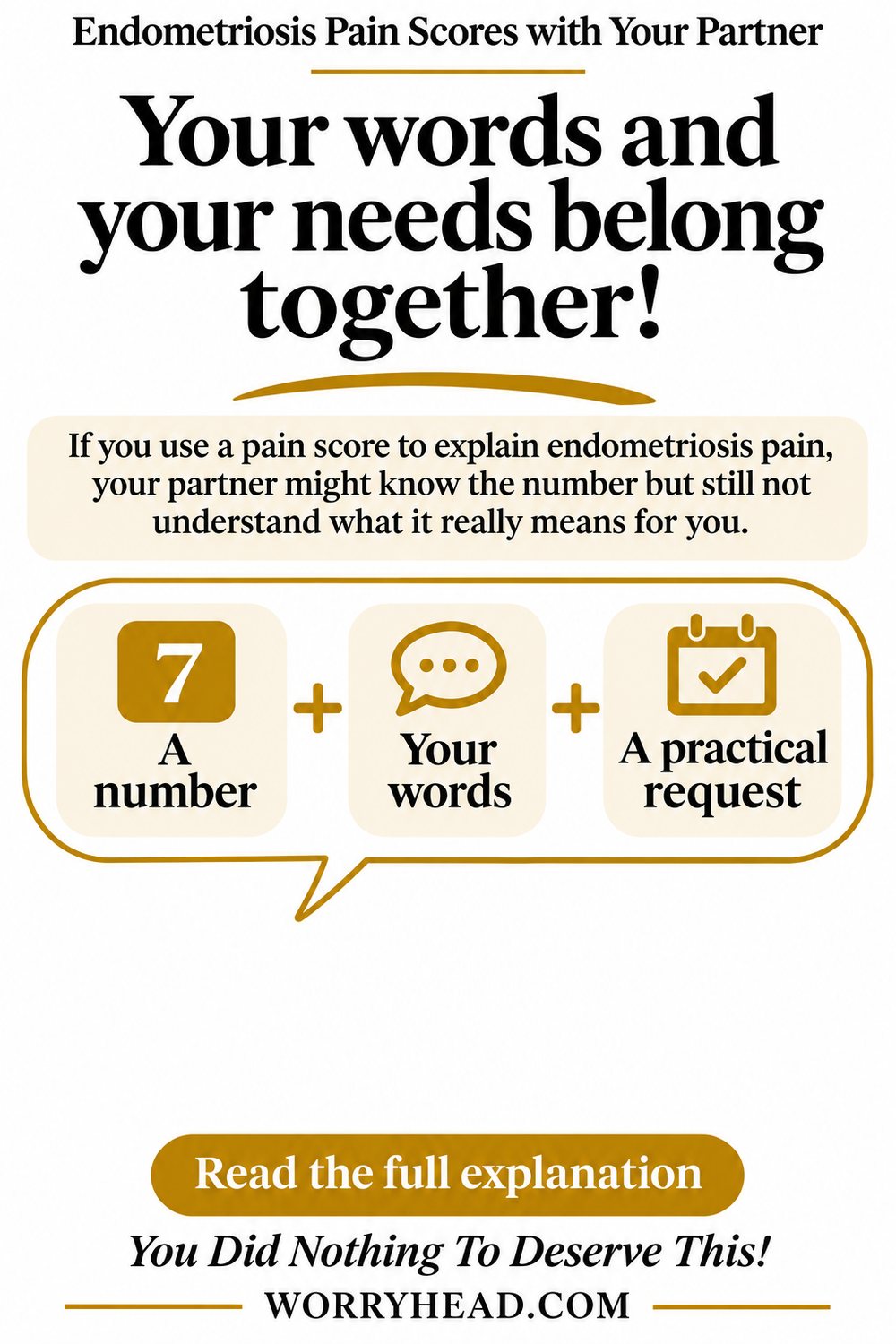
Choose the detail that matters to the current conversation. You might want to explain that talking feels difficult, that you would like help bringing something closer or that you want the room quieter. The aim is not to produce a complete symptom report. It is to communicate the part your partner needs to understand in order to respond appropriately to your request.
You can use your own ordinary language. “I cannot concentrate on this conversation” or “I would like you to sit with me” may be more useful than searching for a dramatic description. You do not have to choose words that make another person feel exactly what you feel before they can listen respectfully.
Keep description and request distinct where that helps. First say what you want understood, then name the practical help: “This is taking a lot of my attention. Could you deal with the delivery?” The request should not require your partner to decode a hidden instruction from the intensity of your wording.
Some moments will not allow that much explanation. A brief phrase, gesture or agreed message may be what you prefer. The IASP notes that verbal description is only one way pain can be expressed. In everyday support, leave room for the person to communicate in the way available to them without making eloquence a condition of being taken seriously.
When Endometriosis Pain Scores with Your Partner Become a Debate
A conversation can become unhelpful when the number starts being negotiated. “Are you sure?” or “It looked worse yesterday” may be intended to understand, but can sound like an invitation to reduce the report until it matches the listener’s expectation. Ask what the person means rather than trying to select a more acceptable number for them.
If you feel drawn into defending it, return to your purpose. “I am describing my experience, not asking you to grade it. What I need help with is this.” That sentence can be shortened or softened to fit you. The important point is that practical support should not depend on winning an argument about a personal description.
Do not make affection, company or ordinary assistance conditional on reaching a threshold you invented together without appropriate clinical context. A household conversation is not a diagnostic system. Someone can want help with a task for several reasons, and a pain rating does not automatically describe all of them.
Equally, a partner may have a genuine limit on what they can do. That limit can be discussed honestly without questioning the report. “I cannot do that immediately, but I can do this” addresses availability. It does not require the listener to prove that the other person’s experience is less serious than they say.
Useful Check-Ins Involve More Than Endometriosis Pain Scores with Your Partner
Repeatedly asking for a number may feel caring to one person and intrusive to the other. Discuss how you want check-ins to work. You may prefer to initiate an update, welcome a brief question at certain moments or want your partner to ask about practical needs instead. There is no single frequency that suits every relationship.
Ask what makes a check-in feel supportive. It may be the tone, the timing or what happens after the answer. A question followed by attentive listening can feel different from one asked while the person is distracted or already preparing to argue with the response. The number itself may not be the main issue.
You can agree on a short phrase for occasions when you do not want to explain more. For example, “I have told you what I can for now” can signal a limit on conversation. Agree on the meaning together rather than expecting a phrase to carry instructions that have never been discussed.
I would want to remember that my uncertainty is mine to manage respectfully. Asking the same question again and again does not necessarily create useful information. Sometimes the better next step is to follow through on the practical request already made, while leaving the person free to update me if they want to.
Revisit Endometriosis Pain Scores with Your Partner After a Misunderstanding
If a number led to a misunderstanding, identify the missing information rather than deciding the whole system has failed. Perhaps one person thought it was simply an update while the other expected a change in plans. You can say, “When I gave that answer, I also meant that I needed help with the evening.”
The listener can acknowledge the gap: “I heard the number, but I did not ask what you needed.” That is more useful than explaining at length that they were only trying to help. Good intentions can be true while a response still needs adjusting. The conversation can hold both without making either person the villain.
Relate’s guidance on communication encourages people to take turns speaking and listening without interruption. If this has become a recurring source of tension, choose a time when both of you can focus. Discuss the communication pattern separately from the immediate moment in which one person is trying to describe a difficult experience.
Choose one practical change. You might agree that a number is followed by “What would help?” or decide to use ordinary words at home instead. Keep the change open to review. A shared shorthand should serve the people using it, rather than becoming a rule that must be maintained because it once seemed sensible.
Life Beyond Endometriosis Pain Scores with Your Partner
It can be tiring if every conversation begins with a rating. You may want to talk about an idea, a television programme, a friend or something that made you laugh. Let your partner know if health updates have begun to crowd out the rest of your relationship. Wanting an ordinary conversation does not mean you are hiding or denying difficulty.
If you are the person offering support, stay curious about more than symptoms. Ask what the other person wants to discuss, and allow them to lead sometimes. You can care about their experience without making every interaction an assessment. A relationship contains companionship, affection and interests as well as practical care.
Do not interpret a change of subject as proof that everything is fine. Someone may choose to talk about something else while still wanting an agreed adjustment. The practical plan can remain in place without requiring the person to keep demonstrating the reason for it throughout the evening.
For me, listening well means keeping both realities in view: the experience my wife describes and the whole person describing it. A number can be useful information if she wants to use it. It should never become the only thing I notice or the condition on which I decide whether she deserves attention.
Final Word on Endometriosis Pain Scores with Your Partner
You do not have to make a number carry your whole experience. Use it if it helps, add words where they matter and ask directly for the practical support you want. A conversation can become clearer without turning into an argument about whether your account is correct.
Start with a question you can answer together: “What do we want this shorthand to help us understand?” My free eBook, You Did NOTHING To Deserve This!, is there if being heard has too often felt like passing a test. You are a person asking to be understood, not a score to be judged.


About Me
Hi, I’m Lucjan! The reason why I decided to create this blog was my beautiful wife, who experienced a lot of pain in life, but also the lack of information about endometriosis and fibromyalgia for men…
READ MORE
Grab a FREE eBook!
“You Did NOTHING To Deserve This!”
Finally hear the words nobody ever said to you, that your pain is real, your tears make sense, and you did nothing to deserve endometriosis, the dismissal, or the way it has rewritten your life.
Related Questions You May Be Asking About Endometriosis Pain Scores with Your Partner
Do I Have to Use a Number at Home?
You can discuss the language you prefer in personal conversations. That is separate from any assessment a clinician asks you to complete. Use this article to clarify communication, not to reinterpret clinical instructions.
Can My Partner Ask What a Number Means to Me?
Yes, if the question is respectful and useful. Asking about your meaning is different from arguing that you should choose another number or demanding proof that your description is accurate.
What if I Only Want Company, Not a Solution?
Say that if you can: “I would like you to sit with me.” Your partner does not have to solve the experience in order to offer the kind of company you have requested.
Endometriosis Pain Scores with Your Partner References
- https://www.iasp-pain.org/resources/terminology/
- https://www.relate.org.uk/get-help/trouble-communicating
