Saying You Are Tired with Endometriosis: You Do Not Have to Win a Comparison
Do you sometimes swallow the words “I am tired” because you expect someone to tell you they are tired too? Saying you are tired with endometriosis can feel strangely difficult when an ordinary sentence turns into a comparison. You are allowed to describe how you feel without proving that nobody else has had a demanding day.
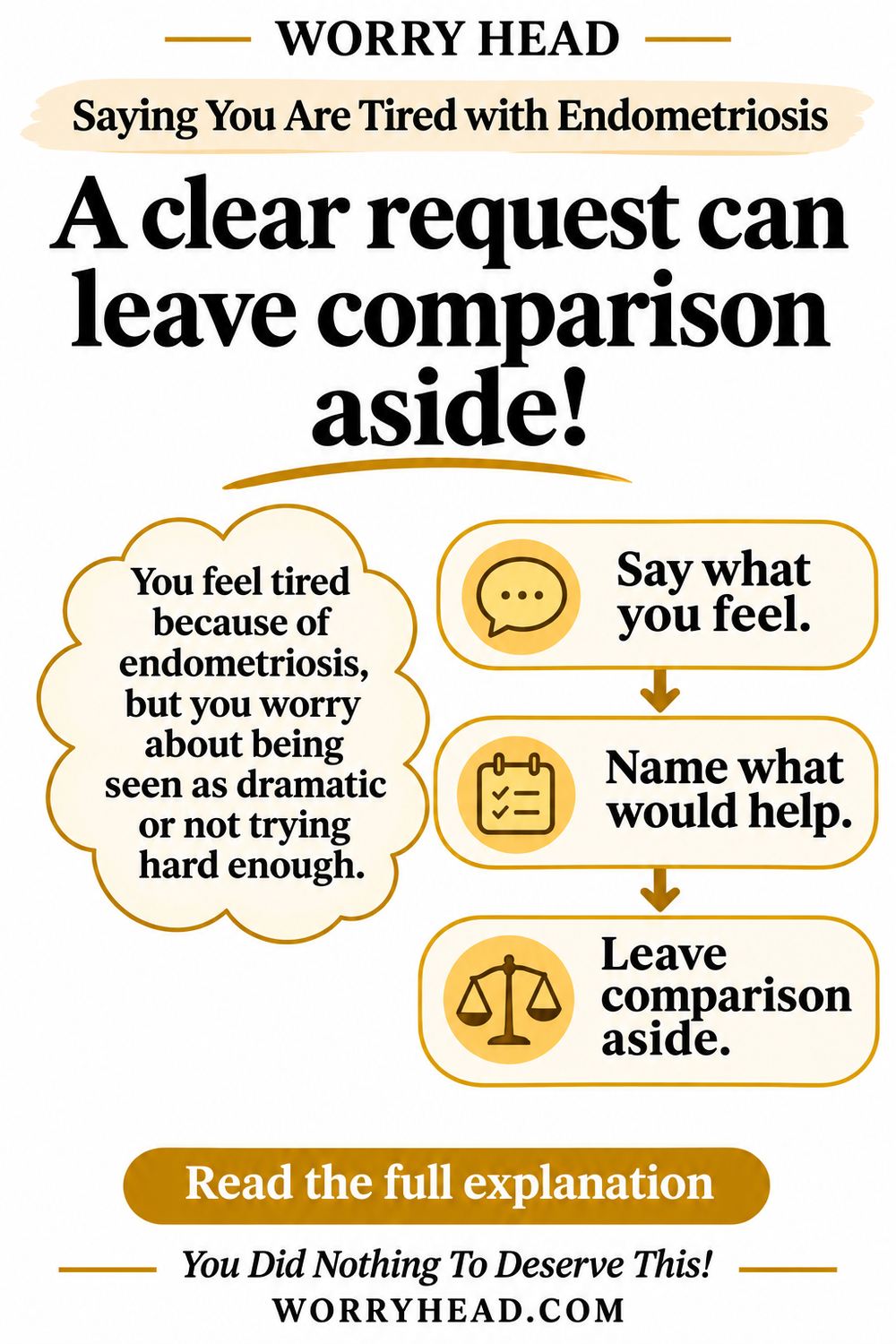
You can say you are tired without competing for permission to rest. Describe what you mean, name practical help you want and choose how much to explain. Another person’s tiredness can be real without cancelling yours; support does not require deciding whose day was harder or who deserves it more.
These are reflections from a husband, blogger and researcher, not a clinician. I draw on years of learning beside my wife, with the factual background linked in the references below.
This article sits within the wider discussion of why endometriosis fatigue is not your flaw. Here, the focus is the conversation itself: saying you are tired, being heard and asking for a change without entering a contest.
If you have learnt to minimise ordinary needs, my free eBook, You Did NOTHING To Deserve This!, offers understanding beyond the moment. You do not have to become more exhausted before your words count.
You Did NOTHING To Deserve This!
Endometriosis Validation for Women with Endo

- Why Saying You Are Tired with Endometriosis Can Feel Risky
- Decide What Saying You Are Tired with Endometriosis Means Today
- Respond to Comparison When Saying You Are Tired with Endometriosis
- Add Useful Detail When Saying You Are Tired with Endometriosis
- Let Saying You Are Tired with Endometriosis Change the Plan
- Keep Privacy While Saying You Are Tired with Endometriosis
- Make Room for Saying You Are Tired with Endometriosis
- Final Word on Saying You Are Tired with Endometriosis
- You Did NOTHING To Deserve This!
- FREE eBook
Why Saying You Are Tired with Endometriosis Can Feel Risky
“Tired” is a familiar word, but people can hear different things in it. One person may hear a passing comment; another may hear a request to stop, leave or receive help. If you have previously been met with comparison or disbelief, you may begin rehearsing your explanation before you have said anything at all.
Endometriosis UK includes fatigue among possible symptoms of endometriosis. That context matters, but this article is not trying to identify the cause of any individual person’s tiredness. The question here is simpler: how can a conversation make room for what you are reporting without requiring you to defend your whole health history?
You might worry that repeating the same words makes you sound negative. Yet a continuing experience does not become less real because somebody has heard about it before. A weather forecast is allowed to describe rain on consecutive days. You should not need a fresh, dramatic phrase every time you want someone to understand that your available energy is limited.
As a husband, I want to notice the difference between listening and immediately comparing. My own tiredness may be relevant to a practical plan, but it does not have to be the first thing I place beside my wife’s words. I can hear her before explaining what I can manage.
Decide What Saying You Are Tired with Endometriosis Means Today
Before explaining more, consider what you want from the conversation. You may want simple acknowledgement, a pause in an activity, help with a task or permission to change a shared plan. You might not know yet. Naming that uncertainty can be more useful than forcing a request because someone asks what they are supposed to do.
For acknowledgement, a sentence such as “I am not asking you to fix it; I just want to say how today feels” may fit. For practical help, you could say, “I am tired and would appreciate you clearing up after dinner.” These are examples to adapt, not a test of whether you can communicate perfectly while already worn out.
If you only need to stop an optional activity, you can state that directly: “I am going to leave this for now.” You do not have to present the decision as a question unless somebody else’s agreement is genuinely needed. Explaining a choice and seeking permission for every basic need are different things.
At the same time, shared responsibilities may need a brief practical discussion. If a task still has to happen, identify what can wait, what can be shared and what needs another arrangement. That conversation should be about the task, rather than a trial of whether your tiredness is sufficiently impressive.

Respond to Comparison When Saying You Are Tired with Endometriosis
“Everyone is tired” may be intended as solidarity, even when it lands as dismissal. You can respond to the effect without claiming to know the person’s intention. For example: “I know tiredness is common. I am trying to explain what I can manage today.” This brings the conversation back to your circumstances rather than debating the whole category.
If someone says they are tired too, both experiences can remain in the room. You might answer, “I believe you. Can we work out what is realistic for both of us?” That does not require you to withdraw your original statement. It moves from deciding whose experience wins towards identifying what can actually happen next.
Sometimes comparison keeps returning despite a clear response. You can limit the discussion: “I do not want to compare. I have told you how I feel, and I am going to pause this now.” A boundary does not need to persuade the other person that your interpretation is correct before you can use it.
There may also be moments when you have no energy for any reply. Silence, a short acknowledgement or leaving a nonessential conversation can be a valid choice. You do not owe every dismissive comment an educational response, and choosing not to challenge it does not mean you agree with it.
Add Useful Detail When Saying You Are Tired with Endometriosis
If someone genuinely wants to understand, describe the practical effect rather than searching for the strongest adjective. “I can talk for a little while, but I cannot take on another task” gives different information from “I am exhausted.” Neither sentence is more truthful by default; one may simply help with the decision you are making together.
You could explain which part of the plan is difficult: travelling, staying late, concentrating on a conversation or managing the preparation afterwards. Be as specific as you want to be. This is not an invitation for someone else to inspect every activity and decide whether your description adds up.
Avoid feeling obliged to provide a complete record of the day. You may have done something enjoyable earlier and still need to stop now. A photograph, a laugh or a completed task is not an agreement to remain equally available for the rest of the evening. Your current words deserve to be heard in the present tense.
If the detail becomes an argument, return to the actual request. “We do not need to agree on how tired I look. I am asking whether this can wait until tomorrow.” The aim is useful understanding, not a perfect explanation that prevents every possible misunderstanding or guarantees the response you want.
Let Saying You Are Tired with Endometriosis Change the Plan
Being believed matters, but practical follow-through matters too. If somebody says they understand and then continues the original plan unchanged, you may still be left carrying the same demand. Clarify the connection: “Thank you for hearing me. What I need to change is the amount I am doing tonight.”
For a shared household task, the options might include postponing a nonessential part, dividing it differently or asking somebody else. You do not need to solve every future evening in one discussion. Focus on the decision in front of you, then revisit recurring difficulties at a time when there is room for a fuller conversation.
Where both people have limited capacity, be honest about that. A supportive answer does not have to be an unlimited yes. “I cannot do all of it, but I can do this part” can be useful if it is clear and followed through. The difference is whether a limit is discussed respectfully or used to discredit the need itself.
I would want my help to reduce work, including the work of arranging the help. If I take on a task, I should clarify what I have agreed to do and keep track of it myself. A person who has said they are tired should not automatically become the manager of everybody else’s contribution.
Keep Privacy While Saying You Are Tired with Endometriosis
Not every person needs the same explanation. With a trusted partner, you may want to describe the fuller experience. With a colleague, neighbour or acquaintance, you may prefer a simple statement about availability. You can choose the level of detail according to the relationship and the situation, rather than treating openness as an obligation.
“I do not have the energy for that today” can be enough for an optional invitation. You do not have to mention endometriosis if you do not want to. If someone asks a personal question, you can say, “I would rather keep the health details private, but thank you for understanding the change.”
You may feel differently on another day. Being open once does not create permanent permission for people to ask for updates, and choosing privacy later is not inconsistency. It is a decision about what you want to share at that moment. You can also ask a partner not to expand your explanation on your behalf.
Formal situations can have their own requirements, which are beyond this article’s scope. For everyday conversations, though, useful information often concerns what is possible and what needs to change. A detailed medical account should not be the default price of declining a nonessential activity or asking someone to listen.
Make Room for Saying You Are Tired with Endometriosis
If you are the person hearing this, begin by checking what is being asked of you. “Would you like me to listen, help with something or give you some quiet?” offers possibilities without assuming the answer. Leave room for “I do not know” as well. The person may be finding words for the experience as they speak.
Try to resist a reflexive list of solutions. Sleep, food, organisation and positive thinking can become an unwanted lecture when somebody simply reports how they feel. Ask before offering ideas. You can care about the problem without making the person explain why each suggestion is not what they need from you right now.
Believe the report without turning yourself into an assessor. You do not need to compare their expression with yesterday, count the things they completed or ask why they managed one activity but not another. If a shared task creates a practical problem, discuss the arrangement directly rather than questioning the legitimacy of their experience.
For me, the useful question is whether my response makes honesty easier next time. A person should be able to say a small, ordinary sentence before reaching the point where everything is too much. A calm acknowledgement and one realistic adjustment can make more room for that honesty than a debate about who has earned rest.
Final Word on Saying You Are Tired with Endometriosis
You do not need the most demanding day in the room to speak truthfully about your own. You can acknowledge another person’s limits and still keep yours. You can ask for help, change an optional plan or simply be heard without presenting tiredness as a competition.
If the words feel difficult, begin with the smallest accurate sentence: “I am tired, and this is what I need now.” There is no prize for making the need disappear. My free eBook, You Did NOTHING To Deserve This!, is there if you want a little more understanding around that truth.


About Me
Hi, I’m Lucjan! The reason why I decided to create this blog was my beautiful wife, who experienced a lot of pain in life, but also the lack of information about endometriosis and fibromyalgia for men…
READ MORE
Grab a FREE eBook!
“You Did NOTHING To Deserve This!”
Finally hear the words nobody ever said to you, that your pain is real, your tears make sense, and you did nothing to deserve endometriosis, the dismissal, or the way it has rewritten your life.
Related Questions You May Be Asking About Saying You Are Tired with Endometriosis
What if I Do Not Know What Help I Want?
You can say that. Being unsure about the next step does not make your experience invalid. You may want someone to listen first and discuss practical options later.
Do I Have to Mention Endometriosis Every Time?
No. In an ordinary personal conversation, you can choose how much health information to share. A statement about your present availability may be all you want to offer.
Can I Acknowledge My Partner’s Tiredness without Withdrawing Mine?
Yes. You can believe them and ask them to believe you. A practical plan can take both people’s limits into account without ranking whose experience is more deserving.
Saying You Are Tired with Endometriosis References
