Endometriosis Preprints: How to Read Early Research Without Treating It as a Final Answer
Have you opened an exciting research headline and then noticed a small warning that the paper is a preprint? Endometriosis preprints can offer an early look at research while leaving important questions about review, versions and reliability. You do not have to choose between dismissing the work entirely and treating it as an answer for your own health.
A preprint shares research before formal journal peer review, so check the version, review status and any linked publication. Read what was studied, what was found and what remains uncertain. Early findings can be worth following without becoming a diagnosis, a treatment recommendation or a promise.
I am a husband, blogger and researcher rather than a clinician. Years spent learning alongside my wife have made careful reading important to me; the publishing and research-literacy sources I used are listed below.
This guide builds on how to read endometriosis research, with a narrower focus on recognising a preprint and keeping track of its status. It is about understanding a research document, not deciding whether a treatment or test is right for you.
Research can bring hope and uncertainty into the same afternoon. My free eBook, You Did NOTHING To Deserve This!, offers understanding for the person doing all that searching. You deserve support even when the evidence has not answered your questions yet.
You Did NOTHING To Deserve This!
Endometriosis Validation for Women with Endo

- What Endometriosis Preprints Tell You About Publication Status
- Check the Current Version of Endometriosis Preprints
- Separate Screening from Peer Review in Endometriosis Preprints
- Find the Actual Question Inside Endometriosis Preprints
- Read the Limits Alongside the Results of Endometriosis Preprints
- Share Endometriosis Preprints Without Turning Hope into Certainty
- Keep a Small Record of Endometriosis Preprints You Want to Follow
- Final Word on Endometriosis Preprints
- You Did NOTHING To Deserve This!
- FREE eBook
What Endometriosis Preprints Tell You About Publication Status
PLOS describes a preprint as a scientific manuscript made public before formal peer review. This can allow researchers to share work and receive feedback earlier. A preprint is a stage in communicating research; the label does not, by itself, tell you whether the underlying study was well designed or whether its conclusions will remain the same.
Start with the document’s own page rather than the headline that brought you there. Look for the title, authors, date, version and any statement about peer review. A screenshot may omit precisely those details. Saving the page link gives you a better route back than keeping only an image of an exciting sentence.
Do not confuse a polished appearance with a completed review process. A manuscript can contain professional figures, institutional names and a detailed reference list while still being a preprint. Equally, early availability is not a reason to assume the authors have done poor work. The useful response is to identify its status accurately.
For your notes, a simple description is enough: “Early research manuscript; review status checked on this date.” You are not being asked to certify the science yourself. You are preserving a distinction that can disappear when a paper travels through social media, a news story and a conversation with someone you love.
Check the Current Version of Endometriosis Preprints
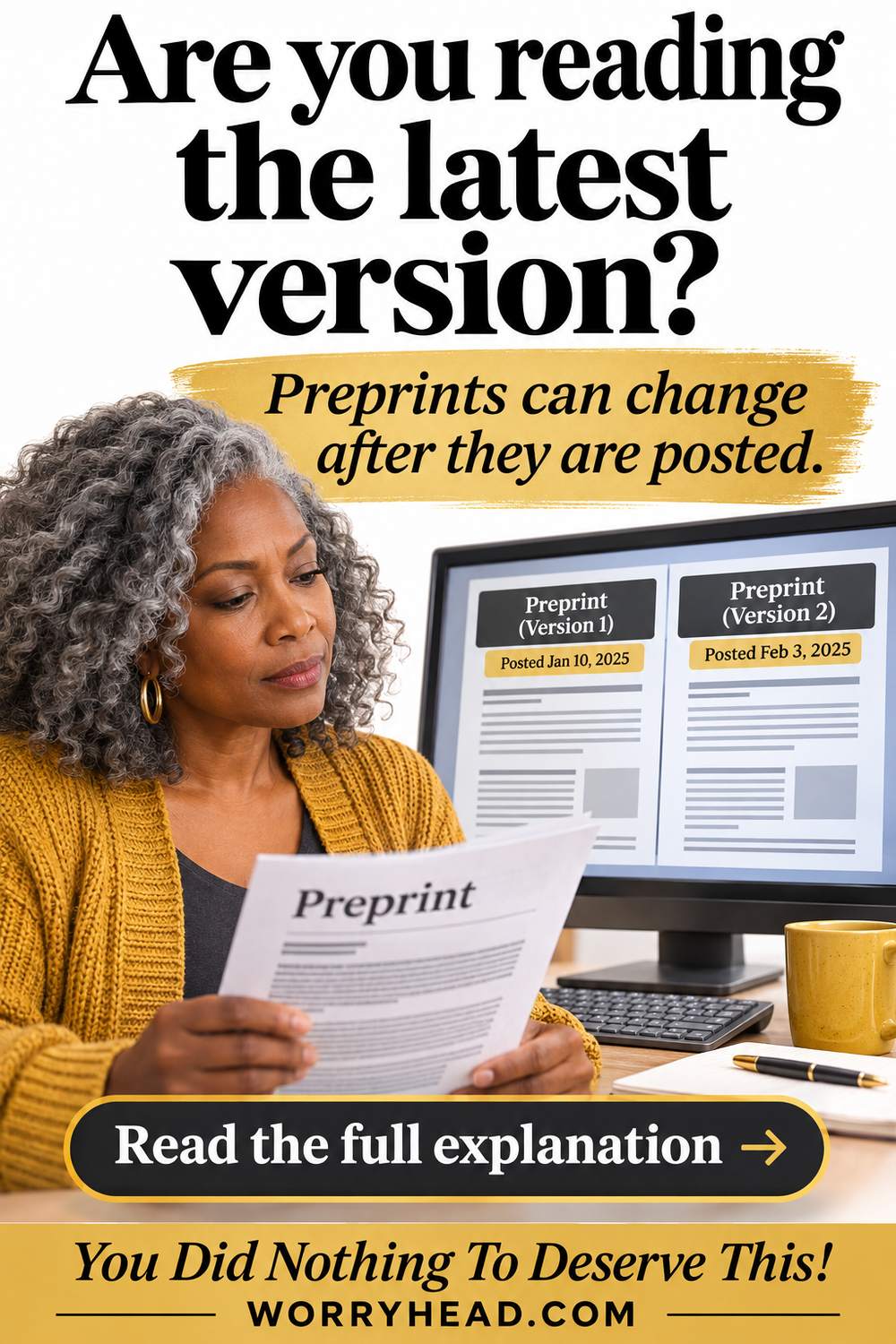
A preprint page can remain available after the work moves forward. PLOS explains that authors can submit revisions and that a later published article may link back to the preprint. Peer-review information can also appear alongside a manuscript. Therefore, check what is available now rather than assuming the earliest status remains the whole story.
Look for a version history or a link to a journal publication. If you find one, compare the title and authors carefully, then read the current page’s notices. A change of title does not necessarily mean a different study. Conversely, similar titles do not prove that two papers are successive versions of the same work.
You do not need to compare every line. For an initial check, note whether the main conclusion, participant numbers or stated limitations appear different. If a change affects the claim that interested you, keep that uncertainty visible. A short note saying “later version available; conclusion needs checking” is more honest than silently combining details from both versions.
Keep dates attached to your own summary. “I read version one last month” tells another person something useful about the limits of your information. It also gives you permission to revise your understanding later. Updating a view when the document changes is careful reading, not an admission that you should never have been interested.
Separate Screening from Peer Review in Endometriosis Preprints
Preprint servers may screen submissions before posting them. PLOS distinguishes those checks from a journal’s editorial assessment and peer review. Passing a server’s screening does not mean the manuscript has completed the same process as a journal article. The word “checked” needs a follow-up question: checked for what, and by whom?
medRxiv explains that its submissions are not certified by scientific peer review before posting. It also notes that some manuscripts may be undergoing review and that review material can become available alongside them. That is why a precise status description is more useful than a permanent label attached to every copy of the work.
Peer review involves expert assessment, but it is not a guarantee that a conclusion is final or error-free. A reviewed paper still needs to be understood in relation to its methods, limitations and other evidence. Avoid turning the distinction into a simple “unsafe before, proven afterwards” switch. Publication status is one important question among several.
If a post says a paper was “approved”, return to the original document and see what that word refers to. It might describe ethics approval, acceptance by a journal or permission to post a manuscript. Those are different claims. If you cannot establish which one is meant, leave the uncertainty in your notes rather than guessing.
Find the Actual Question Inside Endometriosis Preprints
Before focusing on the conclusion, write down the question the authors tried to answer. Was the work about people’s reported experiences, a laboratory measurement, a possible association or a comparison between groups? The presence of “endometriosis” in the title does not mean the paper answers every question a person with endometriosis might bring to it.
The US National Center for Complementary and Integrative Health explains that an abstract summarises a paper’s objectives, methods, results and interpretation. Use that structure to locate the claim, then check the fuller text where necessary. A short abstract is a starting point, not a substitute for details that determine what the result means.
Imagine a hypothetical headline about an “early clue”. Your reading note could say: “The researchers measured X in Y; they reported Z.” Keeping those spaces separate prevents an easy slide from a measurement to a promise. If you cannot fill one in, that identifies a question to ask rather than a gap you must fill with enthusiasm or fear.
Be especially careful about whose experience is represented. A result from one group, setting or research model may not answer your personal question. You can find a study interesting while recognising that the people, materials or circumstances studied differ from your own. That is a limit of relevance, not a judgement about whether your concerns matter.
Read the Limits Alongside the Results of Endometriosis Preprints
Johns Hopkins’ guide to reading research highlights the discussion and limitations as useful places to understand how findings should be interpreted. Limits may involve study design, duration, who took part or how information was collected. Look for the authors’ own explanation before accepting a summary that presents only the most striking result.
Try making two short notes: “What this study reports” and “What this study does not establish.” For a hypothetical association study, the second note might include uncertainty about why the relationship appeared. For a small exploratory project, it might include the need to see whether the finding holds elsewhere. The wording should match the actual paper, not a generic checklist applied blindly.
Also notice whether the authors describe their work as preliminary, exploratory or requiring further investigation. Those words are part of the finding’s meaning. Removing them to make a cleaner headline can change what is being claimed. You can explain a result in plain English without stripping away the uncertainty that belongs with it.
If the methods or statistics are beyond what you can assess, say so. You are allowed to stop at “I understand the question, but I cannot judge how strong the evidence is.” Asking a knowledgeable person to help with a specific uncertainty is often more useful than forcing yourself to deliver a confident verdict on the entire paper.
Share Endometriosis Preprints Without Turning Hope into Certainty
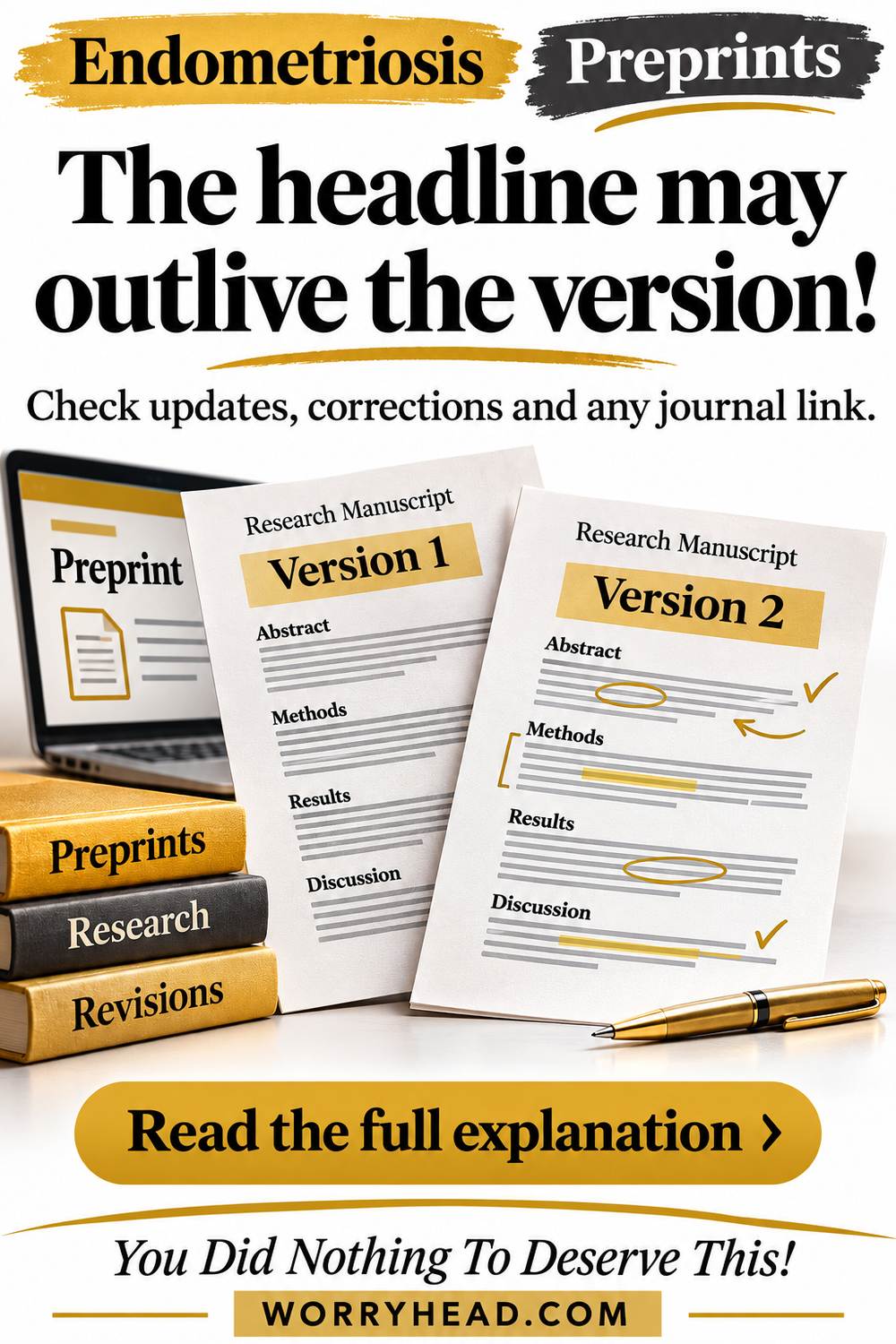
When sharing a link, include its status in the same message as the finding. For example: “This is early research that I found interesting. I have not established whether a reviewed version is available.” Adapt that sentence to what you actually checked. Do not say a paper is unreviewed if you have already found a later reviewed publication.
Link to the document rather than passing on a detached chart. A chart without its caption, population or methods can invite conclusions it was never designed to support. If you share one point, explain what question it addresses and leave the reader a route to the surrounding information.
Avoid attaching a personal promise to the link. “This will explain your symptoms” or “this means help is coming next year” goes beyond simply sharing research. You can say, “I thought you might want to see this,” while leaving room for the other person to decline. Someone living with illness does not owe every new paper their attention.
As a husband, I want my interest in research to support my wife rather than create another burden for her. That means asking whether she wants a link, a brief explanation or no research conversation today. Hope should leave room for choice, uncertainty and a life that continues while studies are being assessed.
Keep a Small Record of Endometriosis Preprints You Want to Follow
If a paper matters to you, save a modest record: its title, link, version or date, the claim that interested you and one unanswered question. You can add a link to a later publication when you find it. This is a way to preserve context, not a requirement to build a personal research database.
For example, your question might be, “Did the later paper keep the same conclusion?” or “Was this result examined in a different group?” One clear question can make a future check more focused. It also helps distinguish genuine new information from another article repeating the same early finding.
Consider how much attention you want to give it. You might save the link for a future conversation rather than checking daily. You might decide the topic is too emotionally difficult right now. Neither choice changes the value of the research or your right to understand it when you are ready.
medRxiv cautions that preliminary reports should not guide clinical practice or health-related behaviour. Reading can help you form questions for an appropriate professional; it should not become a reason to change care on the strength of an early manuscript alone. The practical outcome may simply be a better question, with the uncertainty still attached.
Final Word on Endometriosis Preprints
You can be interested without being convinced, hopeful without making a prediction, and careful without dismissing researchers’ work. Check the current document, preserve its status and ask what it actually establishes. Those small habits help keep a promising idea from becoming a claim the evidence cannot yet carry.
You also do not have to become an expert to deserve answers and support. My free eBook, You Did NOTHING To Deserve This!, is there for the human side of living alongside uncertainty. A paper may still be unfinished; your need to be heard is already real.


About Me
Hi, I’m Lucjan! The reason why I decided to create this blog was my beautiful wife, who experienced a lot of pain in life, but also the lack of information about endometriosis and fibromyalgia for men…
READ MORE
Grab a FREE eBook!
“You Did NOTHING To Deserve This!”
Finally hear the words nobody ever said to you, that your pain is real, your tears make sense, and you did nothing to deserve endometriosis, the dismissal, or the way it has rewritten your life.
Related Questions You May Be Asking About Endometriosis Preprints
Does a DOI Mean a Preprint Has Passed Peer Review?
No. PLOS notes that preprints can receive a DOI, which identifies the document. Check the stated review and publication status separately rather than treating the identifier as a quality certificate.
Is the Newest Version Always the Final Answer?
No. A newer version may contain useful revisions, but it still needs to be read with its status and limitations. A date alone cannot establish how strong a conclusion is.
Can I Take a Preprint to an Appointment?
You can bring a specific question and the source link. Explain what interested you and ask about its relevance. A research discussion is different from assuming the paper justifies a particular change in care.
Endometriosis Preprints References
- https://plos.org/open-science-publishing/
- https://journals.plos.org/plosone/s/preprints
- https://www.medrxiv.org/about/faq
- https://www.medrxiv.org/submit-a-manuscript
- https://www.nccih.nih.gov/health/know-science/how-to-make-sense-of-a-scientific-journal-article/abstract-and-main-section
- https://publichealth.jhu.edu/2025/how-to-understand-a-research-study
