Hospital Passport for Endometriosis: Making Your Needs Easier to Share
Could a hospital passport for endometriosis help you explain what you need when speaking feels difficult? Repeating personal information can be tiring, especially when you are already in pain or worried about being misunderstood. You deserve care that recognises the person speaking, including the support that makes a conversation possible.
A hospital passport can summarise your communication preferences, support needs and important personal information for staff caring for you. Ask your service which format it uses, keep your copy current and show it when needed. It supports discussion but does not replace clinical records or consent.
I am Lucjan, a husband, blogger and researcher, not a clinician; years of learning because of my wife’s illness shape my perspective, and the NHS, NICE and professional guidance used here are listed in the References.
If previous appointments have left you questioning whether your experience was heard, my wider guide to endometriosis medical gaslighting explores that concern.
This is a guide to a personal communication document, not a claim that there is one official endometriosis passport everyone must complete. Local names, templates and ways of storing information differ.
NHS England’s health and care passport guidance focuses particularly on people with a learning disability and autistic people, while recognising that others may benefit. You can ask your service whether a passport or a shorter personal-needs summary would be useful in your circumstances.
My wife’s endometriosis and overlapping conditions have taught me that a condition name cannot explain her whole life. Wanting to support her means listening for the details that only she can give.
We will look at what belongs in the document, how to share it and how to keep your voice central when somebody helps you prepare it.
If having to explain yourself repeatedly has left you feeling small, my free 130+ page eBook, You Did NOTHING To Deserve This!, offers reassurance from a husband’s perspective. It can sit beside the practical preparation here while your healthcare team remains responsible for your assessment and care.
You Did NOTHING To Deserve This!
Endometriosis Validation for Women with Endo

What a Hospital Passport for Endometriosis Can Help You Share
A passport gives staff a concise way to learn something important about you. Its value comes from the information being relevant and usable, rather than from filling every available space.
Some documents are called hospital passports and others health and care passports. The names overlap in everyday use, although a hospital document may be designed specifically for that setting.
You do not need to assume that a new template is better than an existing document that works. Ask how your current information can be used before creating another version to maintain.
The passport can help explain what makes communication easier. That could concern the format of information, the pace of a discussion or support you already use.
It can also describe how you show discomfort or ask for help. Staff still need to assess what is happening now rather than treating the page as a diagnosis of new symptoms.
A supporting person may help you prepare the document if you want them to. Their involvement should make your wishes clearer, rather than replace them with what somebody else thinks is most convenient.
Sharing a passport does not mean it will automatically appear in every hospital system. Ask where it will be kept and what you should bring to the next appointment.
The document also cannot do the whole job of a conversation. It should make it easier for staff to speak with you, check understanding and respond to your present needs.
As a husband, I want any preparation I help with to make my wife’s account more visible. These steps keep the task focused on information that someone can use, without asking you to write a complete history of your life.
- Choose a Format You Can Use
- Put Immediate Needs First
- Explain How You Communicate
- Describe Pain in Your Words
- Name Support Without Losing Choice
- Keep Clinical Information Separate
- Share It Through Agreed Routes
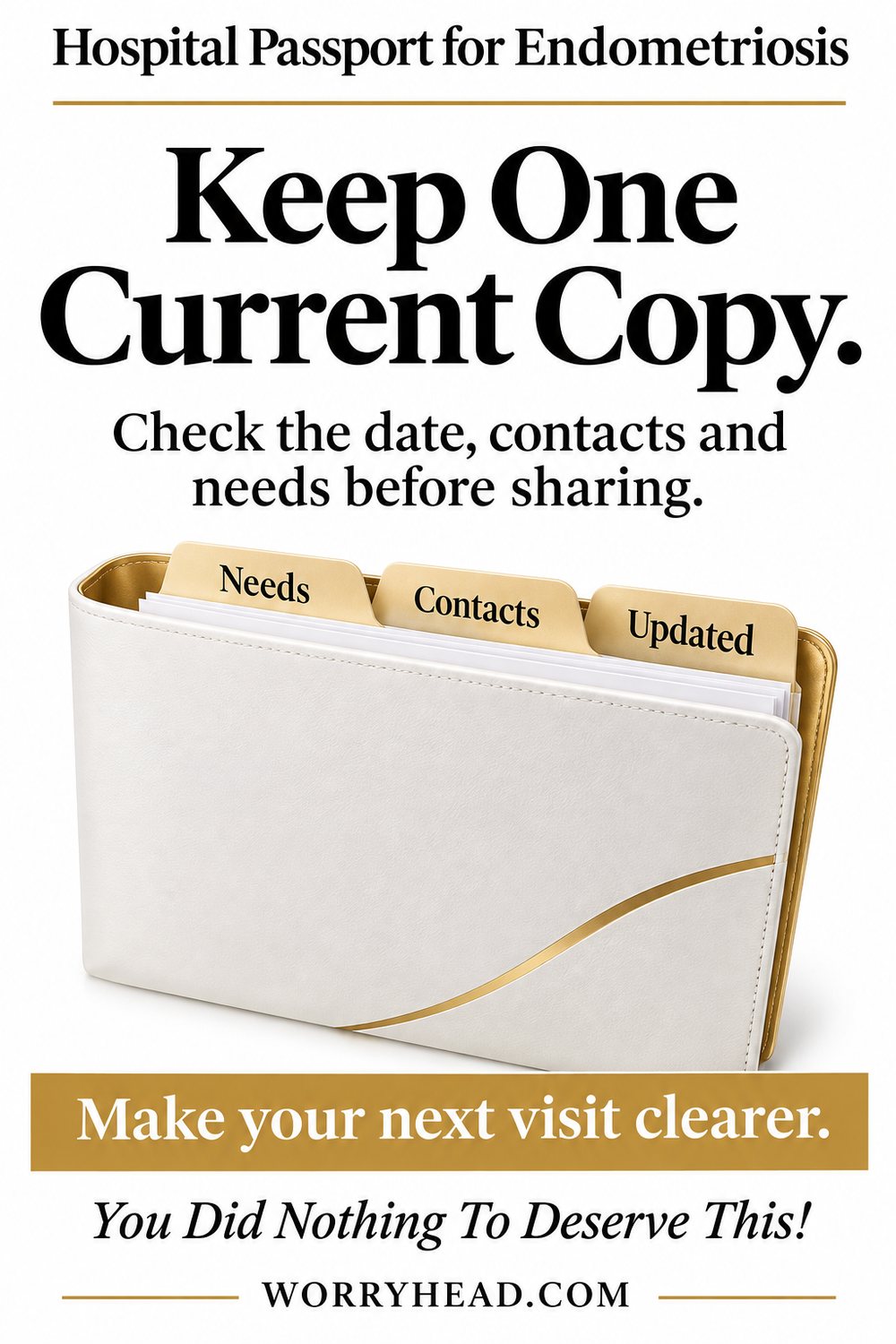
- Date and Review Your Copy
Choose a Format You Can Use
Ask the hospital or relevant service whether it has a preferred passport and who can help you complete it. A local form may be designed for a particular group, so check whether it fits your needs rather than assuming every downloadable template is intended for everybody.
Consider whether paper, a digital copy or both will be manageable for you. An elaborate document that is difficult to find when you need it may be less useful than a clear version you can readily share.
You can ask for help with reading, writing or choosing a suitable format. I would not want my wife’s access to support to depend on how polished a document looks.
If you already have a useful passport, ask how it can be recognised instead of beginning again just because another organisation uses a different design. The aim is to carry your needs into the conversation, not create a second administrative job that exhausts you before the appointment.
Put Immediate Needs First
Decide which information a member of staff needs to notice quickly. That might be a particular communication need or a brief pointer to an existing care plan, depending on your circumstances and the purpose of the template.
Use short, specific points rather than placing the most important detail inside a long account of previous appointments. You can refer staff to the relevant clinical record or professional plan when the detail belongs elsewhere.
This is not an invitation to leave out information that the team needs for safe care. Ask a clinician if you are unsure how to distinguish a personal preference from a clinical instruction.
I know how much can sit behind a short sentence about illness; making the first page easy to scan does not mean your longer story is unimportant. It simply helps you decide what needs attention first, while keeping further information available through the right person or record when it is needed.
Explain How You Communicate
Describe what helps you understand information and give an answer, including any aids or support you normally use. If communication changes when you are unwell, explain that difference instead of assuming staff will recognise it from your usual manner.
You might need written information, a quieter conversation or time to process one question before the next. Only include what is true for you, and ask the service how a requested adjustment can be arranged.
A passport does not arrange an interpreter or another support service by itself. Contact the relevant team early if something needs booking, and ask whether the need has been recorded for the appointment.
I would want my wife to have room to think without somebody interpreting a pause as agreement. A practical description of what helps can support that space, while leaving staff responsible for checking understanding rather than merely seeing that a form has been completed.
Describe Pain in Your Words
Explain how you tend to express pain and what helps you describe it accurately. If a number alone does not convey what is happening, add information about the effect on an ordinary task or the words you usually find useful.
Avoid writing as though everybody with endometriosis shows pain in the same way. NICE recognises that pain can be expressed differently, and your own account should remain specific to you rather than imitate an expected patient response.
A description of your usual experience must not become a reason to overlook something new. Tell staff when the current pain differs, and seek appropriate help for urgent symptoms instead of waiting to update the passport.
As a husband, I cannot measure my wife’s pain from how composed she appears. The document can remind others to ask, but it should never be treated as permission to assume that quietness means comfort or that a familiar diagnosis explains every change.
Name Support Without Losing Choice
Identify whom you would like involved and what you want that person to help with. Taking notes, locating a document and helping you remember a question are different roles from answering every question on your behalf.
You can explain that you want staff to address you directly, even when somebody is sitting beside you. You can also ask for time alone with the clinician when a subject is private or you would find it easier to speak without another person present.
Being a partner does not create a general right to your medical records or remove your own decision-making role. I want my presence to support my wife, not make her feel that she has become a topic discussed between other people.
Check contact details and talk about what involvement you actually want, rather than relying on a relationship label to explain it. A helpful supporter can accept a limited role without interpreting that boundary as a rejection of their care.
Keep Clinical Information Separate
Use the passport to point towards important professional information without turning it into a new treatment plan. Clinical advice, prescribing decisions and current records still need to come from the appropriate healthcare team.
Some local templates ask for medicines or allergies, while others direct staff to existing records. Follow the template’s purpose and check uncertain information with a clinician or pharmacist, rather than copying an old list because it is convenient.
If a medicine or plan has changed, make that clear when you attend. Do not alter treatment on the basis of wording in a personal passport, and do not assume a statement you wrote will override a clinical assessment.
I would rather help my wife locate an accurate source than make a document look complete by guessing. Keeping the distinction clear makes the passport easier to trust as an account of personal needs while protecting the separate work of checking medicines, risks and clinical decisions.
Share It Through Agreed Routes
Ask the service how it receives passports and whether someone will add the relevant information to its records. If a digital route is offered, check the destination and instructions through the service before sending personal information.
A copy may contain private health details and other people’s contact information. Keep it somewhere appropriate, and avoid treating an open social-media message or an unverified address as a suitable place to send it.
Bring the copy you expect to use and tell staff that you have it. Ask which points they have noted and whether anything needs to be discussed now, rather than assuming an attachment has been read because it was sent.
I know how discouraging repeated explanations can feel, but a short check can expose a practical gap before the appointment moves on. Sharing should lead to a clearer conversation, with an agreed way to handle the information, rather than leave you wondering who has seen it.
Date and Review Your Copy
Add a clear update date and check the details when something relevant changes. A contact who is no longer available, an outdated support preference or a reference to an old plan can make an otherwise helpful document confusing.
You can choose a manageable review point, such as preparing for a planned visit, rather than checking the whole document every day. Local services may give their own advice about keeping the version they hold current.
Ask what to do with an older copy already on the hospital system. Do not assume that changing a file on your phone updates the information other staff can see.
I would want any help I give my wife with paperwork to reduce future uncertainty, not leave several competing versions behind. A brief final check of the date, key changes and sharing route can make the next use easier while leaving you free to spend your energy on something other than maintaining a perfect health document.
Making a Hospital Passport for Endometriosis Personal and Useful
A useful passport does not need to sound like a medical report. Ordinary language may explain a practical need more clearly than terminology chosen to sound authoritative.
Begin with what you want a member of staff to understand. Then consider whether the wording tells them what would help in the situation you are describing.
A broad statement about finding appointments difficult may be true. Adding the relevant difficulty can make it easier to discuss a response.
That does not mean you must disclose every painful experience. You can ask for a private conversation where the background is sensitive or the detail does not belong on a document shared more widely.
Your needs may also differ between an ordinary day and a difficult one. Explaining that variation can prevent a description of your usual independence from hiding the support you sometimes require.
You remain more than the barriers you are trying to explain. Preferences, important relationships and the way you like to be addressed can help staff meet you as a person.
My wife values feeling needed, and both of us still work. I would not want a document about support to erase those parts of her identity or imply that illness is all there is to know.
When you write about a difficulty, consider adding what makes the situation more manageable. For example, a need for time to process information is more useful when accompanied by the approach that helps you respond, if you already know it.
Treat any example in this guide as a prompt for reflection, not a suggested symptom to adopt. A passport should not become more dramatic in an attempt to make somebody take it seriously, and you should not have to minimise it to appear easy to care for.
If you are unsure which information is necessary, ask the service to explain the purpose of the section. It is reasonable to want to know who will use the information and what it is intended to help them do.
You can also distinguish a continuing need from a request for one appointment. A temporary difficulty may belong in a current message to the booking team rather than remain indefinitely in the document as though it never changes.
Take a pause if completing the page begins to feel like another account of everything illness has taken. The task can be divided into smaller pieces, and a trusted person can help with the writing while you retain control over the meaning.
I began researching because I wanted to understand my wife better. That same attitude matters here: helping someone prepare should begin with curiosity about their experience, rather than confidence that being close to them means you already know every answer.
Using a Hospital Passport for Endometriosis During Your Visit
Let the relevant member of staff know that you have a passport. Ask when and how they would like to review the points that matter for this visit.
You may need to draw attention to an immediate communication need before a longer discussion begins. Waiting until the end can leave you trying to repair a misunderstanding that affected the whole appointment.
Check that the version being used is current. If something has changed since you sent it, explain the change directly rather than expecting staff to discover it by comparing files.
The conversation should still include you. A passport is useful when it opens space for questions, rather than becoming a reason for somebody to stop asking what you think.
As a husband, I would want the document to bring my wife’s voice into the room. I would not want it to become another page people discuss while she waits for a chance to speak.
A need written down in advance may still require a practical arrangement on the day. Ask what is possible now, what needs to be organised separately and whom to contact if an important requirement has not been met.
If staff have not seen the passport, identify the most pressing point rather than feeling obliged to read the entire document aloud immediately. You can then ask how the remaining information will be considered as the appointment continues.
Before an examination or treatment, the appropriate clinician should explain what is proposed and discuss consent. A general statement that a certain approach usually helps you is not a substitute for that discussion or permission for every future procedure.
If you need a pause, clarification or an alternative way to receive information, say so in the way available to you. The document can support that request, but it should not restrict you to the preferences you wrote on a different day.
If an important need remains unaddressed, ask the clinical team to explain the next step. PALS can help with concerns about hospital services and the relevant process, while an urgent clinical problem still needs the clinical team or emergency care.
At the end, check what needs updating and whether the service will keep a copy. If you are being referred elsewhere, ask what information will be passed on and what you should bring yourself, rather than assuming every system shares the same document.
When to Seek Medical Help Alongside a Hospital Passport for Endometriosis?
Do not wait to finish a passport before seeking help for a new or worsening health problem. Tell the person assessing you what is happening now, even if the document describes a different usual pattern.
For ongoing endometriosis symptoms that are affecting daily life or not improving with your current care, contact your GP or treating team. Ask about the appropriate review route and explain any communication support you need to take part.
NHS advice treats severe or worsening pelvic pain, or pelvic pain with faintness, breathing difficulty, shoulder-tip pain, heavy vaginal bleeding or sudden confusion, as requiring emergency attention. Call 999 or go to A&E as appropriate, and do not drive yourself.
Pelvic pain with fever, vomiting, unusual bleeding or discharge, difficulty passing urine or stool, or possible pregnancy also needs urgent advice, such as NHS 111. An existing diagnosis does not establish the cause of a new symptom.
I do not want preparation to become another reason a woman feels she must wait until she can explain herself perfectly. Bring useful information if you can, but immediate care must not depend on having the neatest document or remembering every detail unaided.
Questions to Ask Your Doctor About a Hospital Passport for Endometriosis
Ask whether your current passport or personal-needs summary is useful for the service you are attending. If the team prefers another format, ask how to transfer the important points without creating unnecessary work or losing information that matters to you.
Clarify where current clinical information should be found. If the passport refers to a care plan, medicine list or allergy record, ask how staff can check the authoritative version and whom you should contact about an uncertainty.
Ask what support would help you participate in the appointment and how it should be arranged. A note in a passport can describe the need, but booking an interpreter or organising a particular adjustment may require a separate conversation with the service.
Discuss how you want a partner or another supporter involved. You can explain that you welcome help with remembering information while still wanting questions addressed to you and sensitive subjects discussed privately.
Ask how the team will respond if your usual way of communicating changes when you are unwell. You do not have to predict every future situation; the aim is to make useful information available and leave room for clinical judgement and a fresh conversation.
My role is to support my wife’s understanding, not make decisions sound settled before she has had time to consider them. A good question at this stage may be the simple one that reveals who needs to do what before the next visit.
Keeping Your Hospital Passport for Endometriosis Within Your Control
Your document can be helpful without containing every detail of your health or relationship. Think about the purpose of a point before including it, particularly when it concerns somebody else’s private information as well as your own.
If someone helps write the passport, read through the result together in a way you can use. Check that the words still reflect what you wanted to communicate and that a helpful suggestion has not quietly become a decision made for you.
You can change a preference when your circumstances or feelings change. A previous version should not be treated as a permanent promise that you will always want the same person involved or the same approach to a conversation.
I know that my wife’s need for support can coexist with a strong wish for independence. Respecting both means asking what she wants today, instead of assuming that help offered with love is automatically help she wants in every situation.
Keep the task proportionate to what it is meant to achieve. The passport is there to help a service understand you; your life does not need to become organised around proving that you have explained yourself well enough to deserve care.
Conclusion on Hospital Passport for Endometriosis
Preparing a personal document can be a hopeful step when healthcare conversations have felt tiring or uncertain. It gives you somewhere to put the details that are easy to forget when you are uncomfortable, rushed or trying to understand unfamiliar information. Yet its purpose should remain gentle and practical: helping another person understand what matters, while leaving you at the centre of the conversation about your own care.
A hospital passport is not an official endometriosis certificate or a replacement for clinical records. Different services may use different documents, and the most useful starting point is to ask how your information can be shared.
You do not need to abandon something that already works simply because a new template exists. What matters is whether the relevant people can find, understand and use the current information when it is needed.
Keep the content grounded in your actual experience. Describe how you communicate, what helps you understand, how you show pain and what support you want from another person.
Include the points that make a practical difference, while directing clinical questions towards the appropriate professional records and advice. You do not have to write a dramatic account to justify help, and you should not have to make your needs smaller to appear agreeable.
If a partner helps with preparation, let that help make your voice clearer. You can welcome someone beside you and still want staff to speak directly to you, ask before sharing private information or give you space alone.
I want my wife to feel supported without feeling managed. Her wishes remain hers, even when I have spent years learning about the conditions that affect our shared life and trying to be useful.
Using the document also means checking what happens after it is handed over. Ask which points have been noted, what arrangements need to be made and whether the service has the current version.
If an important need has not been addressed, seek a clear next step rather than assuming that sending a file completed the process. The document should support an active conversation, not leave you silently hoping that somebody has understood.
Keep a manageable way to review it when relevant details change. A date, accurate contact information and a clear reference to the right care plan can be more useful than repeatedly rewriting every sentence.
Most importantly, do not delay urgent help because the document is unfinished or unavailable. Your current symptoms and safety matter more than presenting information in a particular format, and staff still need to assess what is happening now.
You deserve care that recognises both your health needs and your individuality. A passport may help create that understanding, but it does not create your right to be treated with respect.
Start with the details that matter most, ask for the support needed to share them and leave room for your wishes to change. The aim is a clearer conversation in which you remain a person, not merely the subject of a form.
Your voice belongs in the room even when it needs time, support or another way to be heard. Choose the information that helps, keep the next step small and let someone assist without taking over. You do not have to explain your whole life perfectly before your comfort, privacy and choices deserve attention from the people caring for you.
If you wish, share what makes healthcare communication easier for you in the comments, without posting private medical details. My free 130+ page eBook, You Did NOTHING To Deserve This!, offers reassurance for the feelings that can sit behind preparing to be heard.


About Me
Hi, I’m Lucjan! The reason why I decided to create this blog was my beautiful wife, who experienced a lot of pain in life, but also the lack of information about endometriosis and fibromyalgia for men…
READ MORE
Grab a FREE eBook!
“You Did NOTHING To Deserve This!”
Finally hear the words nobody ever said to you, that your pain is real, your tears make sense, and you did nothing to deserve endometriosis, the dismissal, or the way it has rewritten your life.
Related Questions You May Be Asking About Hospital Passport for Endometriosis
Is There One Official Endometriosis Passport?
This guide does not describe a single official condition-specific document. Hospitals and other services may use different passport templates or personal-needs summaries. Ask what your service recognises and whether your existing document is suitable. The purpose is to share useful information about you, not to obtain a certificate proving your condition or entitlement.
Can I Use One Without a Learning Disability?
NHS England’s guidance particularly supports people with a learning disability and autistic people, while recognising that others may benefit. Some hospital services explicitly offer passports more broadly. Ask whether a passport or another personal-needs summary suits your circumstances and how it will be used, rather than assuming every local template has the same audience.
Does My Partner Have to Complete It?
No. You may be able to complete it yourself, with help if you want or need it. Agree what assistance is useful and check that the result reflects your wishes. Naming a partner as a supporter does not automatically give them control over your decisions or general access to your medical records.
Does Sending It Mean Staff Have Read It?
Not necessarily. Ask the service how passports are received, stored and brought to the attention of the relevant team. Bring the version you intend to use and mention the most important current needs. If something requires an arrangement before the appointment, contact the service separately instead of relying only on an attachment.
Should I Wait Until It Is Finished?
No. A passport is a communication aid, not a requirement you must complete before getting care. Seek appropriate medical help for urgent or changing symptoms and explain the immediate concern in whatever way you can. You can improve or update the document later; an unfinished form should not delay assessment of a new problem.
Hospital Passport for Endometriosis References
- https://www.england.nhs.uk/long-read/health-and-care-passports-implementation-guidance/
- https://www.england.nhs.uk/long-read/health-and-care-passport-plain-english/
- https://www.royalsurrey.nhs.uk/hospital-passport-who-can-have-a-hospital-passport/
- https://hiowhealthcare.nhs.uk/your-care-and-information/health-care-passports
- https://www.leedsth.nhs.uk/services/learning-disability-and-autism/health-passport/
- https://www.uhbristol.nhs.uk/patients-and-visitors/information-for-patients/hospitalpassport/
- https://www.uhd.nhs.uk/uploads/services/docs/learning-disability/health_passport_guide_a4_2022.pdf
- https://www.england.nhs.uk/long-read/accessible-information-standard-implementation-guidance/
- https://www.england.nhs.uk/long-read/good-communication-with-patients-waiting-for-care/
- https://www.nice.org.uk/guidance/cg138/chapter/Recommendations
- https://www.nice.org.uk/guidance/ng73/chapter/Recommendations
- https://www.gmc-uk.org/professional-standards/the-professional-standards/confidentiality/using-and-disclosing-patient-information-for-direct-care
- https://www.nhs.uk/tests-and-treatments/consent-to-treatment/
- https://www.nhs.uk/nhs-services/hospitals/what-is-pals-patient-advice-and-liaison-service/
- https://www.nhs.uk/symptoms/pelvic-pain/
