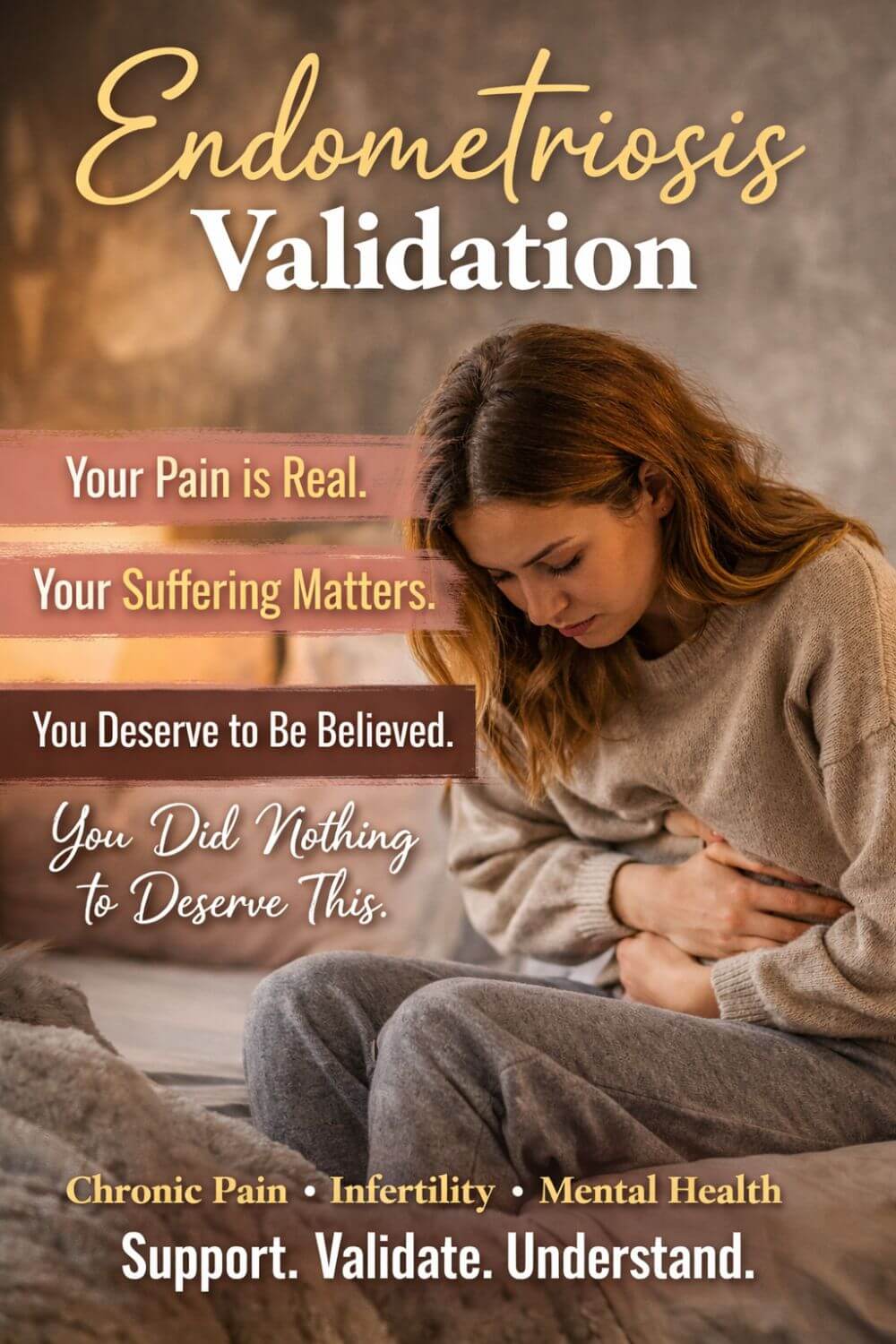
Endometriosis Validation
Have you ever needed endometriosis validation so badly that being believed felt almost as important as pain relief itself? Have you ever started wondering whether your body was telling the truth even when your symptoms kept disrupting your life?
Yes. Endometriosis validation means being believed when painful periods, pelvic pain, fatigue, bowel or bladder symptoms, and the mental toll are real. That matters because endometriosis affects about 1 in 10 people of reproductive age, and in the UK diagnosis still often takes close to nine years.
What breaks my heart is that validation should not be some rare gift. Endometriosis can affect the ovaries, bowel, bladder, and sometimes even areas outside the pelvis, and yet many women still get told it is just stress, just bad periods, or something they should push through quietly. Newer guidance has tried to improve earlier recognition and imaging, but the gap between symptoms and being truly heard is still painfully real.
I started writing about this because I watched my wife carry pain that was real long before the world around her knew how to name it properly. Over time, I learned that what many women are starving for is not only information, but women’s pain validation, chronic pain validation, and the simple relief of hearing: your pain is real.
If this is where your heart feels tired, I’d love to invite you to grab my free 130+ page eBook, You Did Nothing To Deserve This! It was written to help women with endometriosis feel validated, and when you join us through that freebie, you also join our community, where we share more freebies, meaningful discounts on our books, and gentle emails full of support for the new normal chronic illness can bring to a relationship and to life.
The book is filled with 20 chapters of gentle validation for women with endo, written by yours truly, as I have seen it up close…
It’s my way of telling you, in much more detail, that your pain, your complex response to treatment, and your emotions around all of it are real, understandable, and never your fault.
It’s not a medical guide but a human one. Here’s what you will find inside:
- This Was Never Your Fault
- The Girl You Used To Be
- When Your Own Body Feels Like an Enemy
- The Invisible Battles Nobody Sees
- Am I Just Lazy? – The Lie You Have Been Taught
- Gaslighting, Dismissal and the Trauma of Not Being Believed
- Guilt: The Weight You Were Never Meant to Carry
- Love in the Middle of Pain
- Intimacy When Your Body Hurts
- The Loneliness of Being the Strong One
- You Are Allowed To Take Up Space
- Tiny, Gentle Hopes (Not Toxic Positivity)
- If You Could Hear My Voice Every Flare Day
- You Deserve Partners, Not Witnesses
- When You Wish He Understood
- Motherhood, Fertility and the Grief Nobody Sees
- When Anger Is the Only Honest Feeling
- Learning to Trust Your Body Again
- Building a Life That Fits Your Reality
- You Did Nothing To Deserve This
You Did NOTHING To Deserve This!
Endometriosis Validation for Women with Endo
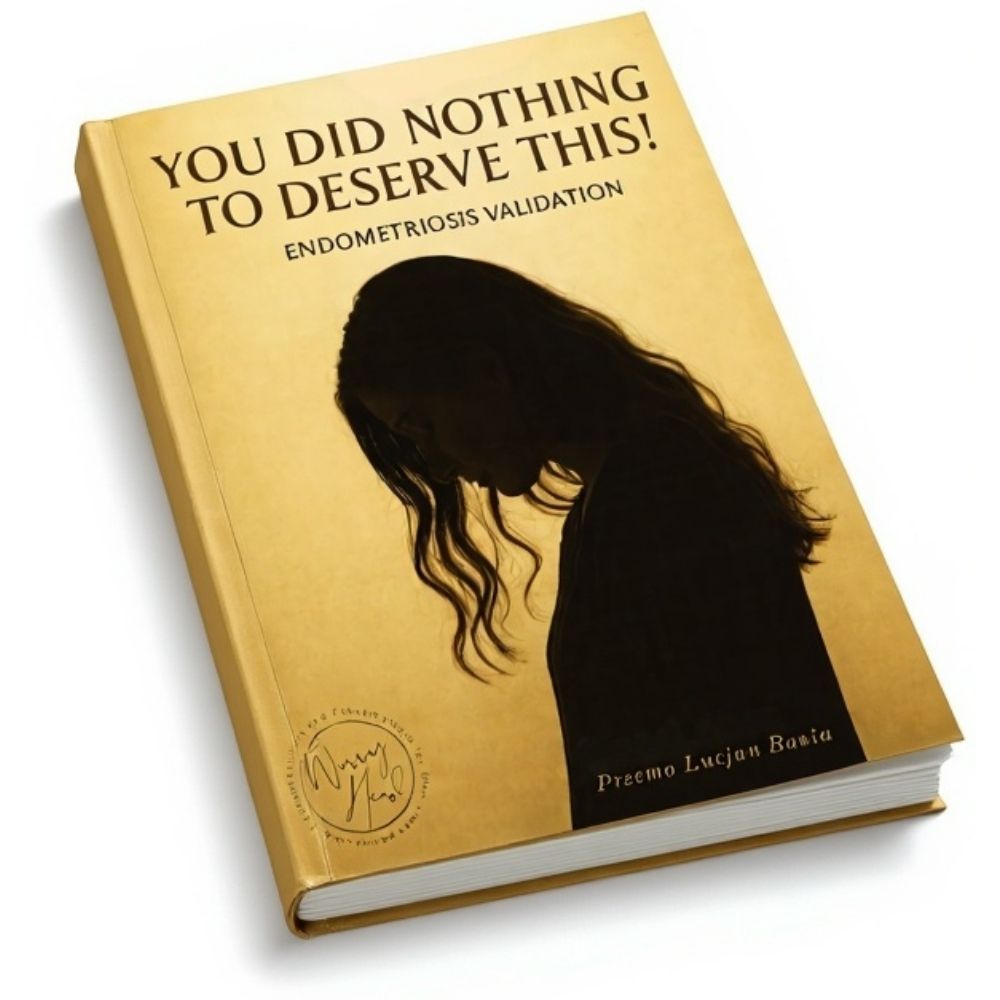
- FREE eBook
- You Did NOTHING To Deserve This!
- Why Endometriosis Validation Matters So Much?
- The Emotional Cost of Missing Endometriosis Validation
- How to Rebuild Trust Through Endometriosis Validation?
- Final Word On Endometriosis Validation
- Frequently Asked Questions About Endometriosis Validation
- Endometriosis Validation References
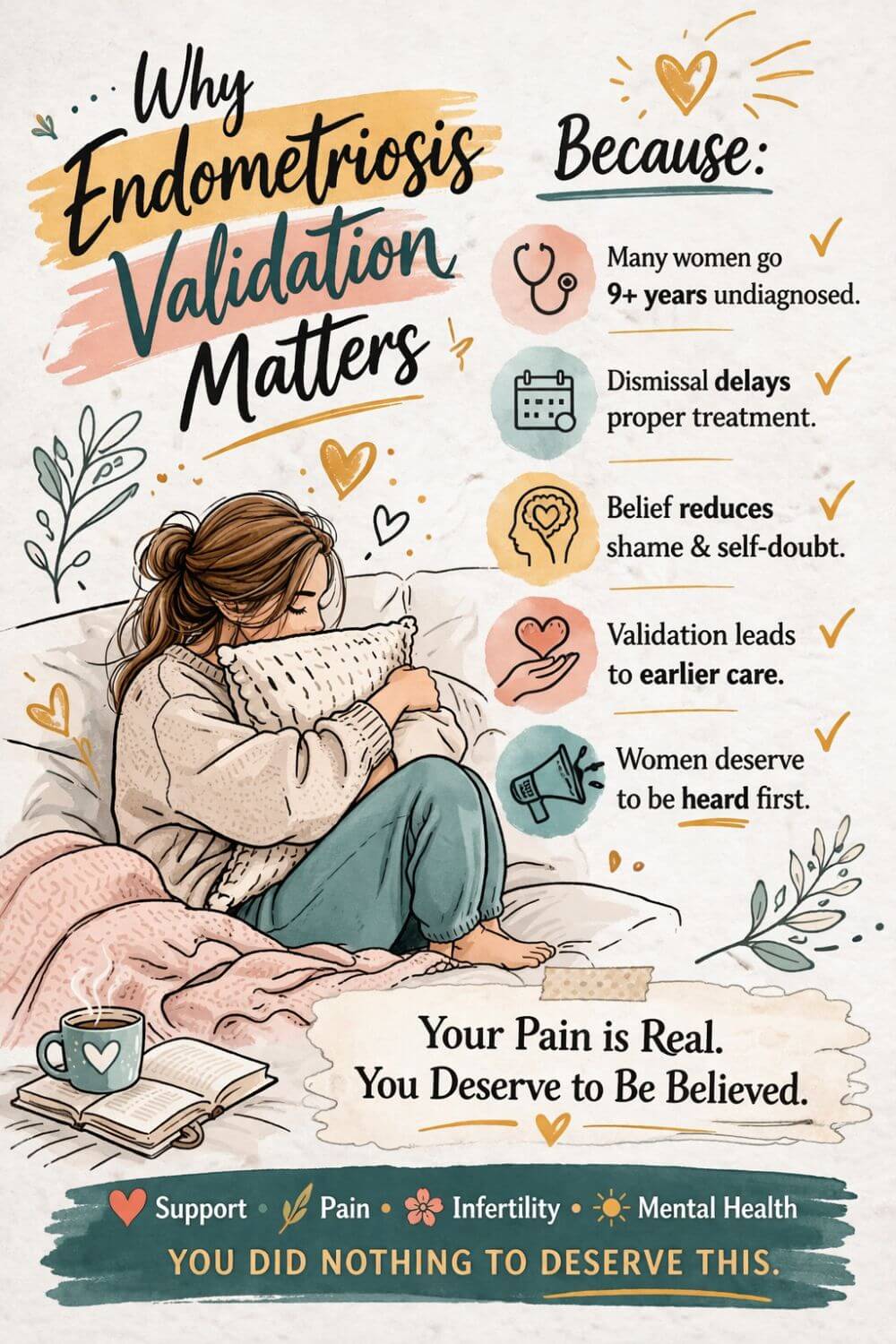
Why Endometriosis Validation Matters So Much?
One of the cruelest parts of this illness is that many women are forced to prove pain that is already disrupting their whole life. Endometriosis is not rare, and major health bodies estimate it affects about 1 in 10 women and girls of reproductive age, yet people still get treated as if they are describing something unusual or exaggerated.
That gap between how common it is and how often it is dismissed is where so much damage begins. A woman can be dealing with painful periods, chronic pelvic pain, bowel pain, bladder pain, pain during sex, fatigue, nausea, heavy bleeding, low mood, and even fertility worries, and still walk out of an appointment feeling smaller than when she walked in.
What makes this worse is time. In the UK, Endometriosis UK reported in March 2026 that the average diagnosis time has reached 9 years and 4 months, and that number is even worse than the figure reported a few years earlier.
Think about what that really means in human terms. It means years of second-guessing your body, years of being told it might just be stress or normal period pain, years of planning life around flares, toilets, heating pads, cancelled plans, and the fear of not being believed.
This is why endometriosis validation is not some soft extra. It is often the first step that helps a woman stop blaming herself for symptoms that were never her fault in the first place.
When proper validation happens, something shifts. The conversation moves from “maybe you are overreacting” to “these symptoms fit a known disease and deserve proper assessment,” and that changes how fast someone gets referred, investigated, and supported. NICE has updated its guidance to improve earlier recognition and reduce the symptom-to-diagnosis gap, which matters because being heard sooner can change the whole path that follows.
I also think validation matters because endometriosis does not always look the way people expect. It can involve the bowel, the bladder, deep tissues in the pelvis, and in some cases even areas outside the pelvis, so a woman’s symptom pattern may sound messy or confusing when in fact it is deeply consistent with the disease.
That is where medical gaslighting becomes especially dangerous. Once a woman starts hearing “you look fine” or “it cannot be that bad,” she may begin trimming her own truth down into something easier for other people to hear, and that can delay help even more.
I have seen how much damage disbelief can do before treatment even begins. Pain is one wound, but being made to feel dramatic, lazy, weak, or emotionally unstable because of that pain can become another wound sitting right on top of it.
My wife taught me that validation is not only about saying the right sentence. It is about noticing patterns, believing what keeps happening, protecting her dignity on hard days, and not making her carry the extra burden of defending her suffering to the person who is meant to love her most.
So many women do not need another cold explanation first. They need someone to say your pain is real, your symptoms are real, your exhaustion is real, and you deserve to be believed.
I still remember seasons when my wife was carrying more than pain alone. She was carrying the mental weight that comes when a body keeps breaking your routine, your confidence, your work, your intimacy, and your sense of safety, and I learned the hard way that tenderness is not weakness in a relationship like this, it is part of survival.
That is why the next part matters so much to me. I want to give you practical things that can help a woman feel seen instead of questioned, safe instead of cornered, and loved instead of reduced to her symptoms.
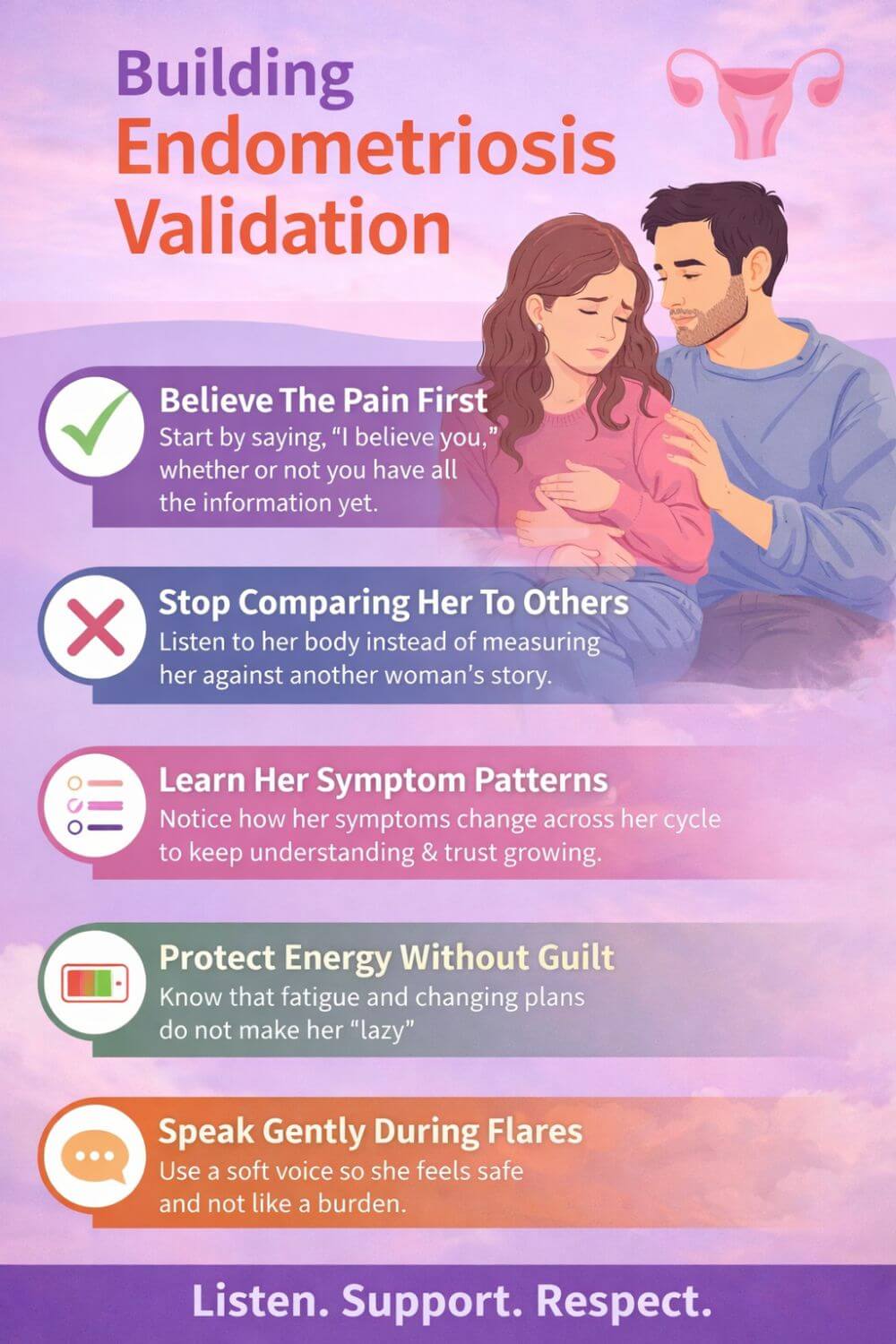
- Believe the pain first
- Stop comparing her to others
- Learn her symptom patterns
- Protect energy without guilt
- Speak gently during flares
- Help at appointments calmly
- Validate grief and anger
- Support intimacy with patience
- Stay steady when she doubts herself
Believe The Pain First
The first thing I want to say to any partner, doctor, friend, employer, or family member is to believe her before you fully understand every detail. Endometriosis can cause painful periods, chronic pelvic pain, pain during sex, pain when using the toilet, fatigue, nausea, heavy bleeding, and fertility problems, but symptoms do not always arrive in a neat little pattern that makes other people comfortable. That does not make them less real.
I learned that one of the deepest injuries in this disease is not only the pain itself, but the way a woman starts to doubt her own body after enough people question it. If the woman you love says something hurts, start there.
Start with trust. You do not need to become a specialist overnight to offer women’s pain validation. Sometimes the most healing sentence in the room is simply, “I believe you.” That sentence can steady a heart that has spent years shaking. And when disbelief has followed her from appointment to appointment, hearing it at home can feel like finally being allowed to breathe again.
Stop Comparing Her to Others
Comparison is one of the quietest forms of invalidation, and many people do it without even noticing. They say things like, “My sister has bad periods too,” or, “Other women still go to work,” as if pain becomes less serious when somebody else carries a different version of it. But endometriosis is a complex disease with a very wide range of symptoms and severity, and even the amount of visible disease does not always match the amount of suffering someone feels.
My wife taught me that comparing women to each other is cruel because it erases the body in front of you. It erases her threshold, her inflammation, her fear, her exhaustion, her bowel symptoms, her sleeplessness, and the emotional toll of living inside a body that feels unsafe.
Validation for women starts when you stop measuring her pain against somebody else’s story and start listening to her own. You are not helping by shrinking her reality into something more convenient. You help when you let her experience stand on its own feet, without forcing it to compete for permission to matter.
Learn Her Symptom Patterns
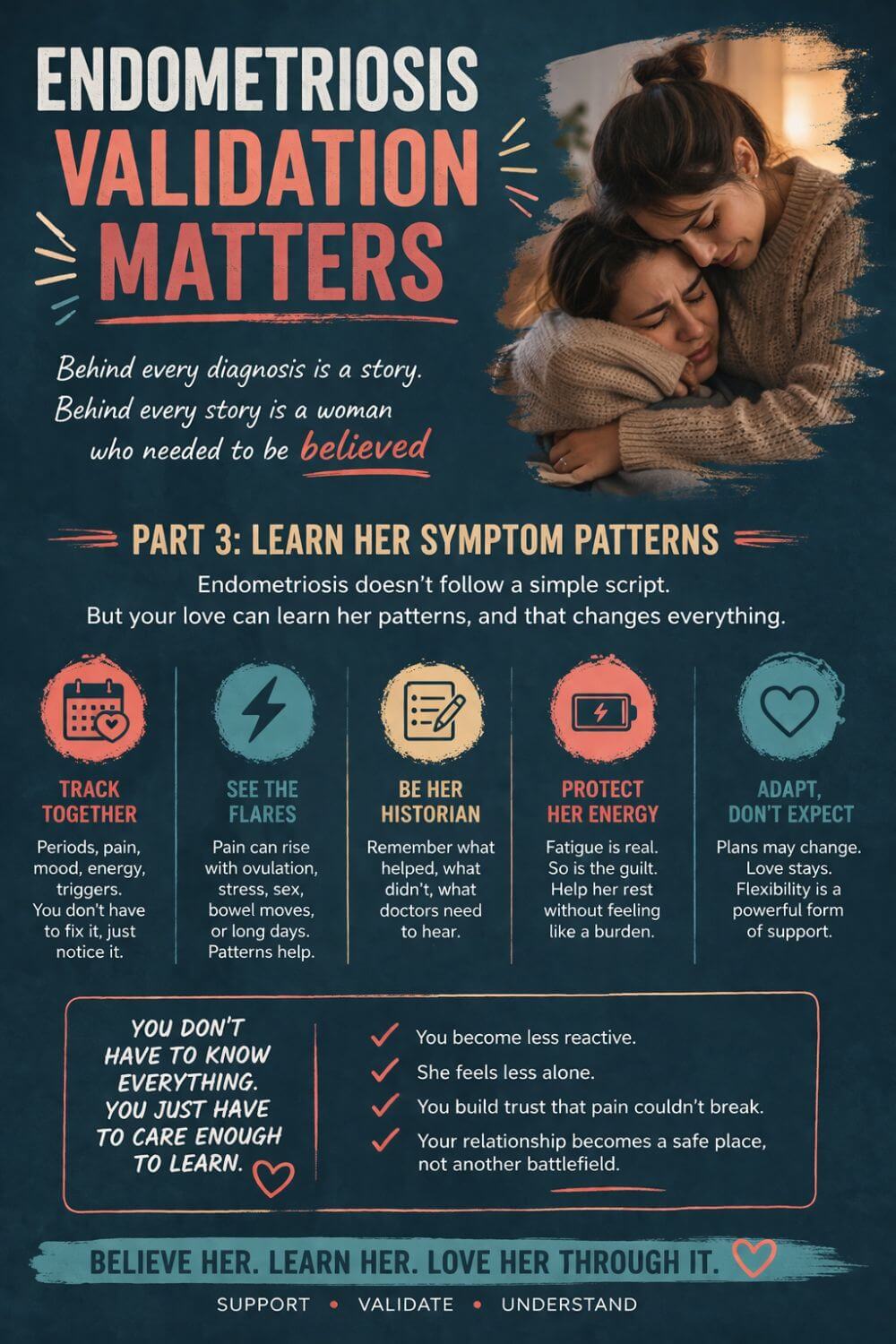
One of the most loving things I ever learned to do was stop treating symptoms as random complaints and start noticing patterns. Endometriosis can flare around periods, ovulation, sex, bowel movements, urination, stress, poor sleep, and even after long days of pushing through pain.
Some women have endo belly, some have lower back pain, some have bladder symptoms, some have bowel symptoms, and some are hit hardest by crushing fatigue and nausea. The point is not to force every woman into the same picture. The point is to study the picture her body keeps painting.
When I began noticing my wife’s patterns, I became less reactive and more useful. I could see when a flare was building instead of waiting until she was already overwhelmed. That changed the tone of our home. It created chronic illness support instead of chaos. It also helped me understand that validation is practical, not only emotional.
When you learn her pattern, you stop acting surprised by the same storm every month, and that alone can make a woman feel less alone in her own life. She should not have to be the only historian of her pain.
Protect Energy Without Guilt
Fatigue and endometriosis can be a brutal combination because exhaustion is one of the symptoms people are quickest to judge. If a woman looks “fine,” the world often assumes she should still perform normally, smile normally, socialise normally, and recover normally. But endometriosis is a chronic condition that can affect physical health, emotional wellbeing, daily routine, and work, and forcing the body to act healthy does not magically reduce inflammation or pain.
I wish more women heard this without shame attached to it, that protecting their energy is not laziness and rest is not failure. Cancelling plans, sitting down, asking for help, or doing less on a flare day is not weakness.
My wife has had days when the bravest thing she did was stop pretending she could carry the day the way healthy people can. I think endo validation has to include that truth. Your exhaustion is real, your body is not betraying you because it needs limits. Sometimes the kindest thing a partner can do is remove guilt from the room and make rest feel safe instead of something that must be earned.
Speak Gently During Flares
A flare changes the whole emotional temperature of a room. Pain narrows patience, steals language, and can make even simple questions feel heavy. During bad symptoms, a woman may not need solutions first. She may need softness first. That matters because endometriosis is not only linked with pain and fatigue, but also low mood and anxiety, especially when symptoms are repeated, severe, and poorly understood by others.
I had to learn that my tone mattered almost as much as my effort.
A sharp voice, too many questions, or acting frustrated with changed plans can make a woman feel like she is now managing your emotions on top of her own pain. Gentle speech is a form of pelvic pain validation. It says, “You are safe with me even when your body is hard to live in.”
My wife did not need me to become dramatic. She needed me to become steady, speak slower, ask less, offer water, heat, quiet, food, medication, or space without making her feel like a burden. On some days, tenderness is more useful than problem-solving.
Help At Appointments Calmly
Medical appointments can be draining because many women arrive already expecting dismissal. That fear is not irrational…
Diagnosis delays remain far too long, and NICE has had to update guidance to improve earlier recognition, imaging, referral, and care. Even now, many women spend years between first symptoms and a diagnosis, which means some walk into clinics carrying not only questions, but a long history of disappointment.
A calm, prepared partner can make a real difference. I do not mean taking over her voice. I mean helping her hold onto it. Write symptoms down. Note timing, bleeding, bowel pain, bladder pain, painful sex, fatigue, and what makes symptoms worse. Help her remember what she wanted to ask. Stay grounded if she becomes upset.
Good support in that moment is not performance. It is quiet backup. It is saying, “You do not have to carry this whole conversation alone.” For women who have experienced medical gaslighting, having one steady person beside them can feel like borrowed strength until their own returns.
Validate Grief and Anger
There is grief woven through this illness that many people never see. It is the grief of lost normality, lost confidence, lost spontaneity, lost work, lost intimacy, lost energy, and sometimes lost fertility or fear around it. WHO and NHS information both reflect that endometriosis can affect fertility, daily life, emotional wellbeing, and mental health, and that means grief is not an overreaction to pain. It is often a reasonable response to repeated loss.
I think women are too often expected to carry this grief beautifully, quietly, and without making anyone uncomfortable. But anger can be valid. Sadness can be valid. Numbness can be valid. Tears can be valid.
When my wife struggled, I learned not to rush her toward gratitude or positivity just because pain made me feel helpless. Invisible illness validation sometimes looks like making room for emotions that do not fit a neat recovery story. Let her mourn what this disease has taken. Let her be angry at what it has interrupted. Love does not always fix grief, but it can stop her from feeling ashamed of having it.
Support Intimacy with Patience
Painful sex is one of the symptoms that can wound in two directions at once. It hurts physically, and then it can hurt emotionally because it touches closeness, confidence, femininity, desire, and the fear of disappointing the person you love. NHS and other clinical sources list pain during or after sex as a common symptom, especially when deeper tissues are involved.
For some women, this is not occasional discomfort. It is a real part of living with endometriosis. This is where a partner can either deepen the wound or protect her heart.
Patience matters, and pressure destroys safety. If intimacy becomes something she braces for, then love has to slow down and rebuild trust around her body, not demand access to it.
My wife taught me that real closeness is not proven by how much you take, but by how safe you make her feel when pain interrupts what both of you wanted. Endometriosis support inside a relationship means remembering that tenderness, reassurance, and emotional closeness are not lesser forms of intimacy. Sometimes they are the form of love that keeps everything else from breaking.
Stay Steady When She Doubts Herself
Years of dismissal can teach a woman to talk herself down before anybody else gets the chance. She may say she is being dramatic, weak, lazy, oversensitive, or impossible, even while her symptoms are still controlling large parts of her life. That is one of the cruelest effects of a misunderstood illness. The pain does not only live in the pelvis. It can start living inside identity.
This is why steady love matters so much. Not loud speeches, not forced positivity, but steady truth. Remind her gently that her pain is real, her symptoms are real, her exhaustion is real, and she deserves to be believed. Remind her on ordinary days too, not only on the worst ones.
I wrote about endometriosis awareness because I saw how often women were given facts without comfort. But comfort counts. A stable partner can become the voice that slowly challenges the cruel script she has learned from years of being dismissed. Sometimes she will borrow your belief before she can fully hold her own. And sometimes that borrowed belief is exactly what gets her through the next day.
The Emotional Cost of Missing Endometriosis Validation
There is a kind of loneliness that grows when pain keeps showing up, but belief does not come with it. The NHS is clear that endometriosis can affect work, relationships, fertility, mood, and everyday life, yet many women still spend years trying to explain symptoms that already fit a known condition.
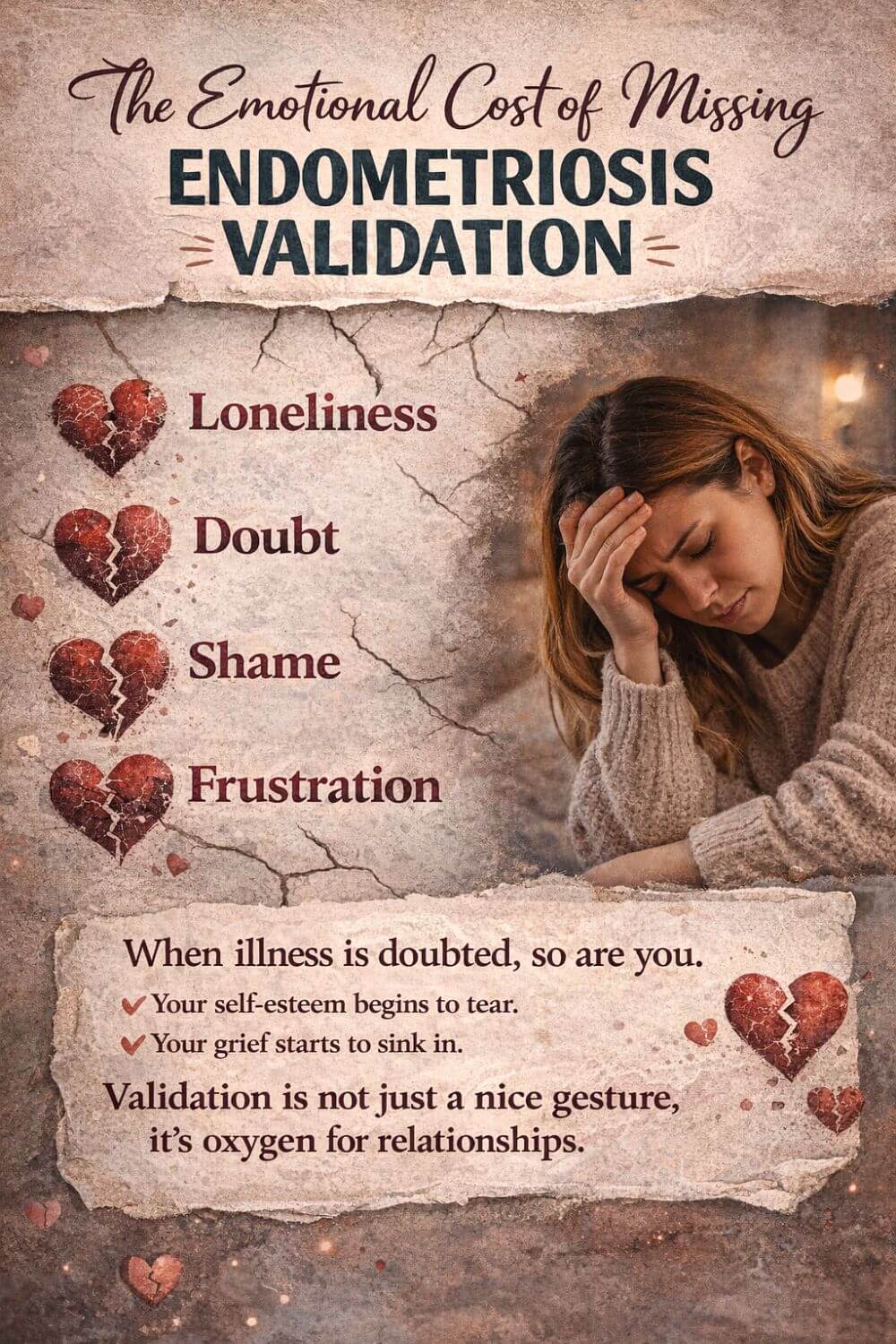
That mismatch can start changing the way a woman sees herself. She may begin to wonder whether she is dramatic, difficult, weak, lazy, or too sensitive, when in truth she may be living with painful periods, pelvic pain, pain when using the toilet, fatigue, painful sex, or heavy bleeding that medicine itself recognises as part of this disease.
What hurts me is that this suffering often becomes layered. There is the physical pain, then the waiting, then the explaining, then the disappointment, and after enough of that, shame starts attaching itself to symptoms that were never a character flaw.
That is why endometriosis validation is not only about hearing the right words in a clinic. It is also about protecting a woman from the quiet self-erasure that can happen when her body keeps interrupting life and the world keeps acting as if she should manage it more gracefully.
NICE guidance has tried to improve recognition, referral, and diagnosis, and that matters because earlier recognition does more than open the door to tests or treatment. It can interrupt years of self-doubt before that self-doubt hardens into identity.
I think many people do not realise how much emotional damage comes from being forced to translate pain into something acceptable for others. A woman starts editing her sentences, softening her symptoms, smiling through distress, and apologising for the inconvenience of her own suffering.
My wife carried that kind of weight for far too long. I watched her try to stay composed on days when her body was clearly asking for mercy, and I saw how dangerous it becomes when a woman feels she must look calm enough to be believed.
That does something to a relationship too. If the person beside her becomes impatient, dismissive, or solution-obsessed too quickly, home stops feeling like shelter and starts feeling like another place where she has to prove herself.
I had to learn that love was not only helping with tasks or researching symptoms. Sometimes love was making sure she did not feel emotionally abandoned inside her own pain.
Worry Head grew from those lessons. On my about page, I say I built this space for partners who want to support the woman they love without losing themselves, and for women who need to feel deeply seen by a man who is genuinely trying to understand.
That part matters to me deeply, because women often receive facts in a cold voice, while what they needed first was dignity, tenderness, and someone steady enough to say, “I am not frightened off by what this illness has done to your life.”
I still think about the hardest nights with my wife, the quiet grief after plans we could not keep, the fear in the room, and the way pain can make even a loved woman feel unwanted if the people around her do not handle it with care. No woman should have to earn compassion by becoming easier to look at.
And that is where this story has to go next, because once a woman begins to feel believed, another question appears right behind it: how do you actually rebuild safety, trust, and closeness inside a relationship that chronic illness has already shaken?
How to Rebuild Trust Through Endometriosis Validation?
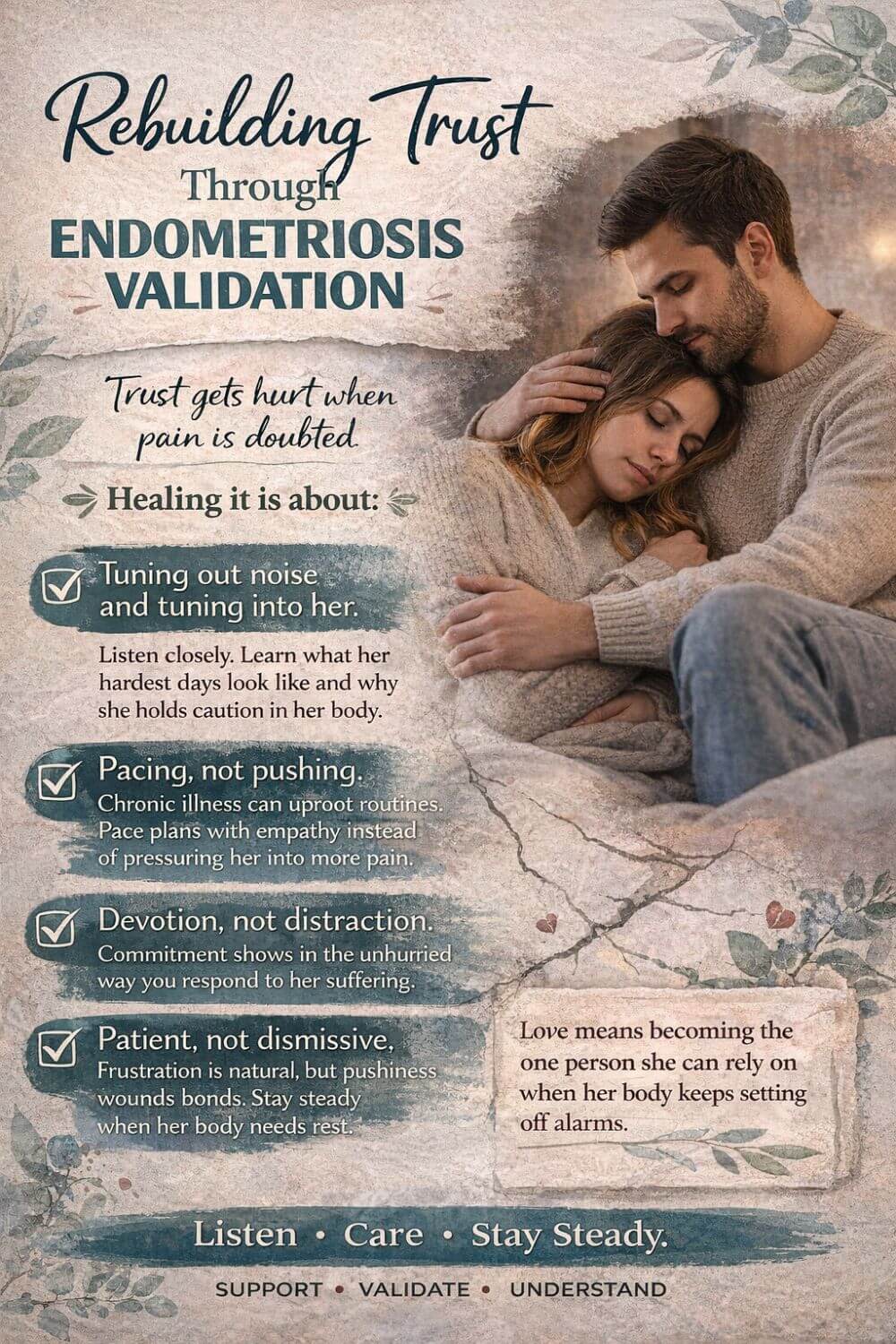
One thing I have learned the hard way is that once a woman has been dismissed enough times, pain is no longer the only problem in the room. Trust gets hurt too. This illness can affect daily life, work, relationships, fertility, mood, and anxiety, so when disbelief is added on top, the damage can spread far beyond the body.
That is why endometriosis validation matters so much inside a relationship. It helps a woman stop feeling like she has to perform her suffering well enough to earn care.
Trust is rebuilt in small moments more than big speeches. It is rebuilt when you believe her before she has perfect words, when you do not act irritated by changed plans, and when you stop treating symptoms like an inconvenience that ruined the day.
I saw this with my wife. On the hardest days, what steadied her most was not me pretending I could fix everything, but me staying present, calm, and gentle enough that home still felt safe.
The truth is, chronic illness can make a woman feel as if her body has become a problem for everyone around her. That feeling can quietly touch intimacy, confidence, routine, and even the way she sees her own worth.
So I think support has to become very practical. Listen carefully. Keep note of patterns. Help her pace without making her feel guilty. Ask what would help instead of assuming. Let your consistency speak louder than one perfect sentence.
The NHS also notes that treatment and support may include help for long term pain, fatigue, fertility concerns, and mental health, and I think partners need to understand that this disease is rarely only about cramps.
It can shape the whole emotional climate of a home. That means your patience matters, your tone matters, and your ability to stay steady matters more than you may realise.
I say that as a husband who has watched the woman he loves carry pain, fear, and exhaustion at the same time. There were moments when I knew that if I responded with frustration instead of tenderness, I would be adding weight to a body already struggling to carry enough.
So if you love a woman with this illness, do not underestimate the healing power of making her feel safe, wanted, and believed. Sometimes the relationship starts breathing again not when the pain disappears, but when she no longer feels alone inside it.
And if you are the woman reading this, I want you to know this from the bottom of my heart: needing reassurance does not make you needy, and needing care does not make you difficult. My wife has taught me that behind so much fear is a woman who is not asking for too much at all, only for the kind of love and steadiness that should have met her pain much earlier.
Final Word On Endometriosis Validation
When I think about endometriosis validation, I do not think first about a slogan. I think about a woman sitting in pain, already tired, already second-guessing herself, already wondering whether she has explained it badly because people keep hearing her symptoms but not truly hearing her.
Endometriosis affects around 1 in 10 women and girls of reproductive age worldwide, and it can bring pelvic pain, heavy bleeding, fatigue, nausea, painful sex, bowel or bladder symptoms, and fertility struggles. It can also affect mental health, work, education, and relationships, which means the need to be believed is not some emotional extra. It is part of proper care.
That is why this topic matters to me so deeply. I did not build Worry Head because women were lacking cold facts. I built it because I kept seeing how many women had already been handed information, yet still went home feeling unseen.
On my own site, I explain that this space is for partners trying to support the woman they love, but also for her, because chronic illness touches both people. That has always been the heart of my story. I started writing after watching my wife carry not only pain, but the emotional wreckage that can grow around years of symptoms, fear, and being misunderstood.
What I have learned from loving my wife is that validation does not mean pretending everything is okay. It means telling the truth more gently and more bravely. It means saying, “I believe your pain,” before the scan, before the referral, before the perfect explanation.
It means not making a woman shrink her symptoms into something easier for other people to tolerate. It means understanding that if endometriosis can take years to diagnose, then many women are living through a long period where their body is speaking clearly while the world answers back with doubt. That gap can wound confidence just as much as symptoms wound the body.
I also want men reading this to understand something important. Support is not only practical. Yes, help with appointments, chores, medication, food, rest, and planning matters, but emotional steadiness matters too.
A woman with chronic pelvic pain should not have to manage her body and then manage your disbelief on top of it. She should not have to earn softness by hiding how badly she hurts. Some of the strongest support I have ever given my wife did not look dramatic from the outside. It looked like patience, a calm tone, changed plans without resentment, and reminding her that her symptoms were real on the days she started doubting herself.
That kind of love can become a lifeline inside a hard season.
So if you are the woman reading this, I want to leave you with this. You are not weak, you are not lazy, you are not overreacting.
Your pain is real, your exhaustion is real. Your grief is real, and you deserve to be believed long before you learn how to explain your suffering in a way that makes other people comfortable. If you are the partner reading this, please remember that belief is not a small gift. For many women living with endometriosis, it is one of the first real places healing begins.
This illness can steal ease, energy, confidence, and peace, but it does not get to decide your worth. Being believed can change the whole emotional weight of this journey, and sometimes that one shift is what helps a woman breathe again, ask for help again, and feel human again.
If this spoke to your heart, please leave a comment and tell me your experience. And please check out the free chapter of my eBook, You Did Nothing To Deserve This!, if you need a little more validation, comfort, and support today.


About Me
Hi, I’m Lucjan! The reason why I decided to create this blog was my beautiful wife, who experienced a lot of pain in life, but also the lack of information about endometriosis and fibromyalgia for men…
READ MOREFrequently Asked Questions About Endometriosis Validation
1. What does endometriosis validation actually mean?
It means a woman is believed when she says her pain, bleeding, fatigue, bowel symptoms, bladder symptoms, painful sex, or emotional distress are real and affecting her life. It also means she is not dismissed as dramatic, weak, lazy, or overreacting while trying to explain symptoms that match a recognised chronic condition. Endometriosis affects about 1 in 10 women and girls of reproductive age worldwide, so validation should not be rare.
2. Why is validation such a big part of endometriosis care?
Because delayed belief often delays help. NICE says the guideline aims to improve recognition, referral, diagnosis, and management, and updated guidance highlights earlier ultrasound and clearer referral pathways for suspected endometriosis. When a woman is believed sooner, she is more likely to get properly assessed instead of spending years doubting her own body.
3. Can someone have endometriosis even if tests were normal before?
Yes. NICE guidance makes clear that ultrasound can help identify ovarian endometriomas and deep endometriosis, but normal imaging does not automatically rule the condition out. In some cases, laparoscopy is still considered to diagnose endometriosis, especially when symptoms continue and the picture remains suspicious.
4. Is endometriosis only about painful periods?
No. Painful periods are common, but the condition can also cause chronic pelvic pain, heavy bleeding, painful sex, fatigue, nausea, infertility, abdominal bloating, bowel symptoms, bladder symptoms, and pain that can continue outside the period itself. WHO also notes that endometriosis most commonly occurs in the pelvis but can sometimes occur elsewhere in the body.
5. How can a partner give real endometriosis support?
Start by believing her. Then learn her symptom patterns, speak gently during flares, help her prepare for appointments, protect rest without making her feel guilty, and do not make her keep proving her pain to you. A partner cannot remove the disease, but he can help make home feel like the one place where her symptoms are not questioned.
Endometriosis Validation References
- https://www.who.int/news-room/fact-sheets/detail/endometriosis
- https://www.nhs.uk/conditions/endometriosis
- https://www.nice.org.uk/guidance/ng73
- https://www.nice.org.uk/guidance/ng73/resources/visual-summary-on-first-presentation-initial-management-diagnosis-referral-and-ongoing-care-of-pdf-13559822461
- https://www.endometriosis-uk.org/endometriosis-uk-release-new-report-highlighting-alarming-increase-endometriosis-diagnosis-times