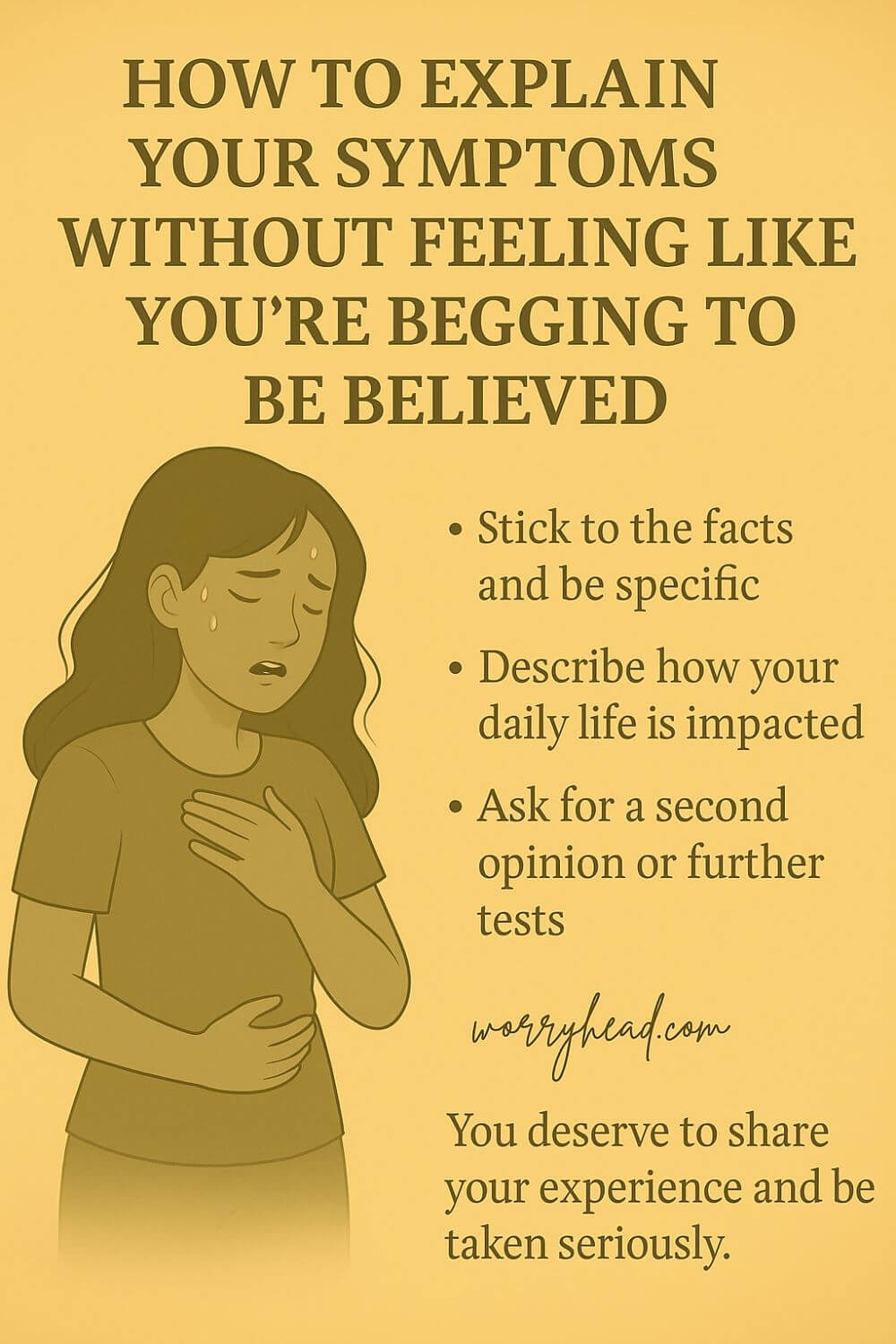
Feeling Like You’re Begging to Be Believed
I’ve watched my wife walk into appointment after appointment with quiet dignity, and still come home looking crushed, like her pain had to earn permission to exist. Have you ever left a doctor’s room feeling like you’re begging to be believed, even though you know your body is telling the truth?
This feeling usually comes from repeated dismissal: symptoms are minimized, tests fail to capture what you live with, or you are told it’s anxiety. It’s a common result of medical gaslighting and long diagnostic delays, especially with endometriosis and fibromyalgia, and it can erode self-trust.
And that erosion is the cruel part, because it doesn’t just steal answers, it steals confidence. You start rehearsing your pain like a performance, editing your words, timing your tears, trying to sound “reasonable” enough to deserve help.
In the rest of this article, I’ll show you how to walk in a grounded way, speak clearly without overexplaining, and protect your nervous system from that familiar spiral of shame and doubt.
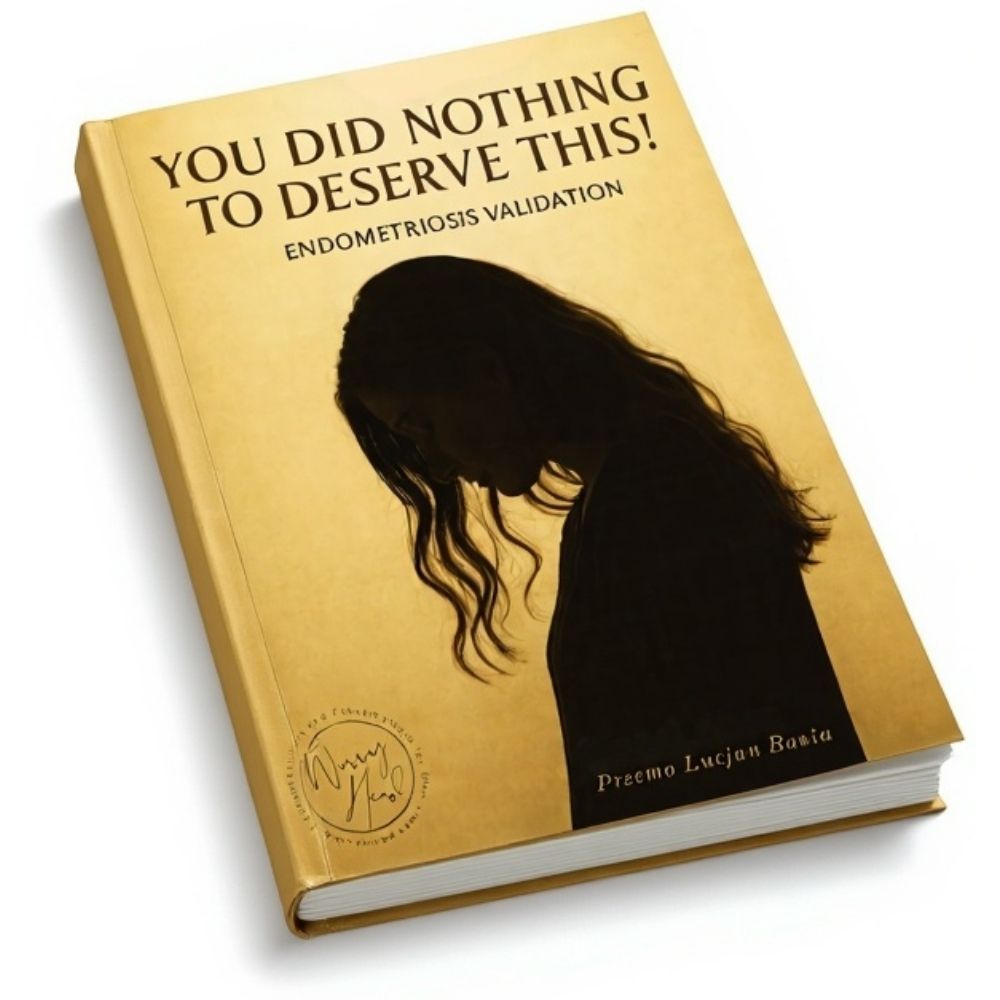
If all of this touches something in you and you need deeper validation, I’ve put my heart into a completely FREE 130+ pages eBook: “You Did Nothing To Deserve This” – filled with 20 chapters of gentle validation for women with endo, written by a husband who’s seen it up close.
It’s my way of telling you, in much more detail, that your pain, your complex response to treatment, and your emotions around all of it are real, understandable, and never your fault.
It’s not a medical guide. It’s a human one. Here’s what’s inside:
- This Was Never Your Fault
- The Girl You Used To Be
- When Your Own Body Feels Like an Enemy
- The Invisible Battles Nobody Sees
- Am I Just Lazy? – The Lie You Have Been Taught
- Gaslighting, Dismissal and the Trauma of Not Being Believed
- Guilt: The Weight You Were Never Meant to Carry
- Love in the Middle of Pain
- Intimacy When Your Body Hurts
- The Loneliness of Being the Strong One
- You Are Allowed To Take Up Space
- Tiny, Gentle Hopes (Not Toxic Positivity)
- If You Could Hear My Voice Every Flare Day
- You Deserve Partners, Not Witnesses
- When You Wish He Understood
- Motherhood, Fertility and the Grief Nobody Sees
- When Anger Is the Only Honest Feeling
- Learning to Trust Your Body Again
- Building a Life That Fits Your Reality
- You Did Nothing To Deserve This
You Did NOTHING To Deserve This!
Endometriosis Validation for Women with Endo
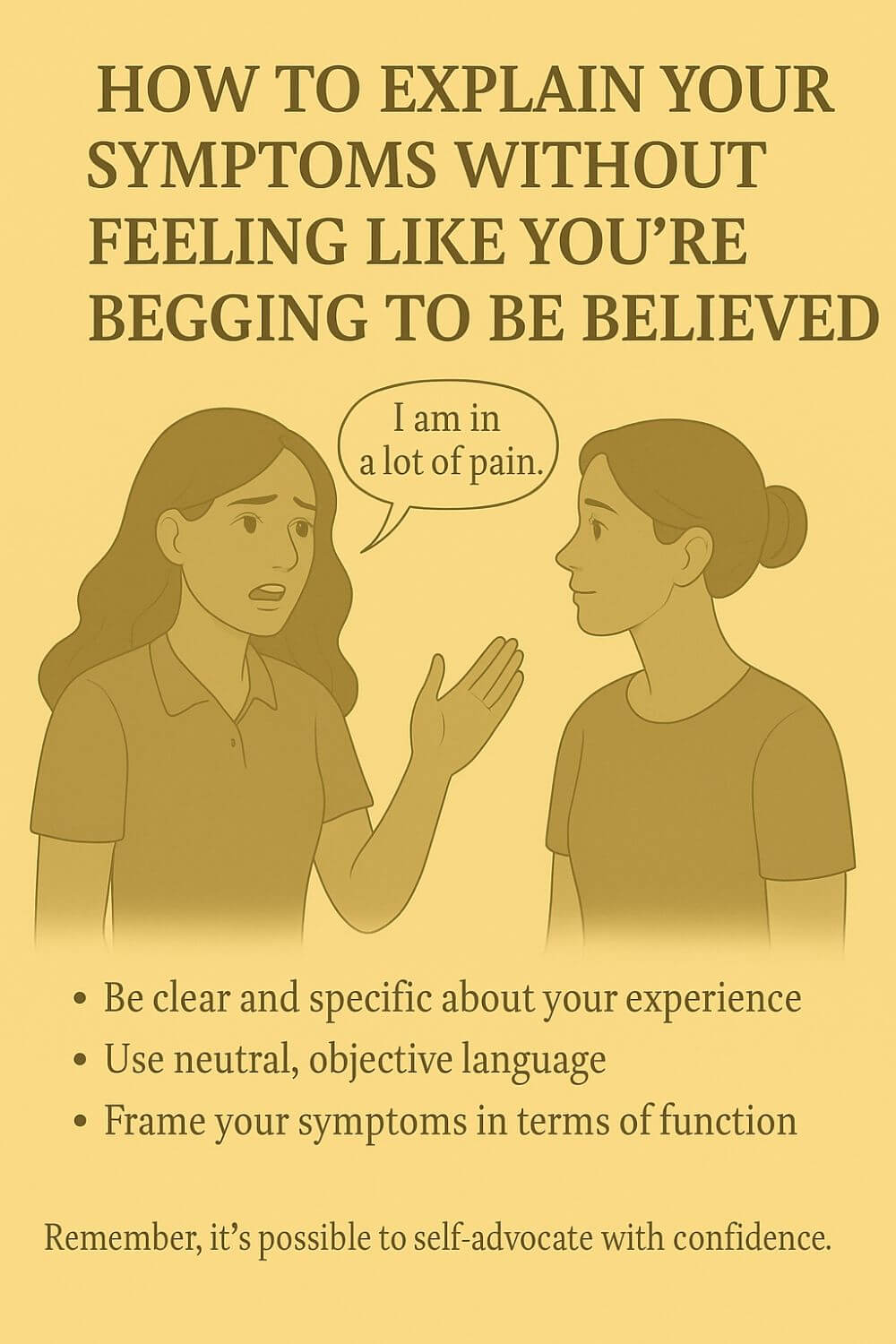
Feeling Like You’re Begging to Be Believed
The hardest part is not even the pain itself. It’s the way you start preparing for an appointment, like a courtroom, collecting evidence for a reality you already live inside.
I’ve seen my wife do it with endometriosis and fibromyalgia, and I’ve seen what it does to a person over time. You begin translating symptoms into “acceptable” language because you’re scared the truth will sound messy, emotional, or “too much.”
What most people don’t realize is that many chronic illness symptoms are real, even when they’re not easy to measure in a ten-minute visit. Pain can be severe without a clear lab result, fatigue can flatten you without a neat explanation, and flares can come and go like the weather.
When the system is rushed, complex stories get simplified, and you end up feeling like you have to earn the right to care.
So you start shrinking yourself. You downplay, then you overexplain, then you leave the room wondering if you imagined everything. This is where preparation can become protection, not performance. Not to prove you deserve help, but to keep your story clear when nerves kick in, and your mind goes blank.
When I built our work-from-home life through blogging, it wasn’t only about money. It was about creating a world where her hardest days didn’t require permission, and where rest didn’t have to be justified.
You deserve that same sense of steadiness when you speak to professionals, friends, or even family. Not perfect words, just grounded words that match your reality.
Because your body is not a debate topic. And your suffering does not need to be dramatic to be valid.
I’m saying this as a husband who has held my wife after appointments where she tried so hard to be “easy” and came home feeling smaller. I’ve watched tears fall not from pain, but from the humiliation of having to persuade someone to take her seriously.
In the next section, I’ll give you practical ways to walk in stronger, speak clearly, and protect your heart while you ask for the care you deserve.
- Write a one-page symptom timeline
- Bring photos, logs, and specifics
- Practice a calm opening script
- Name your worst functional losses
- Ask for differential diagnosis notes
- Request referrals to proper specialists
- Take someone with you inside
- Decide your non-negotiables beforehand
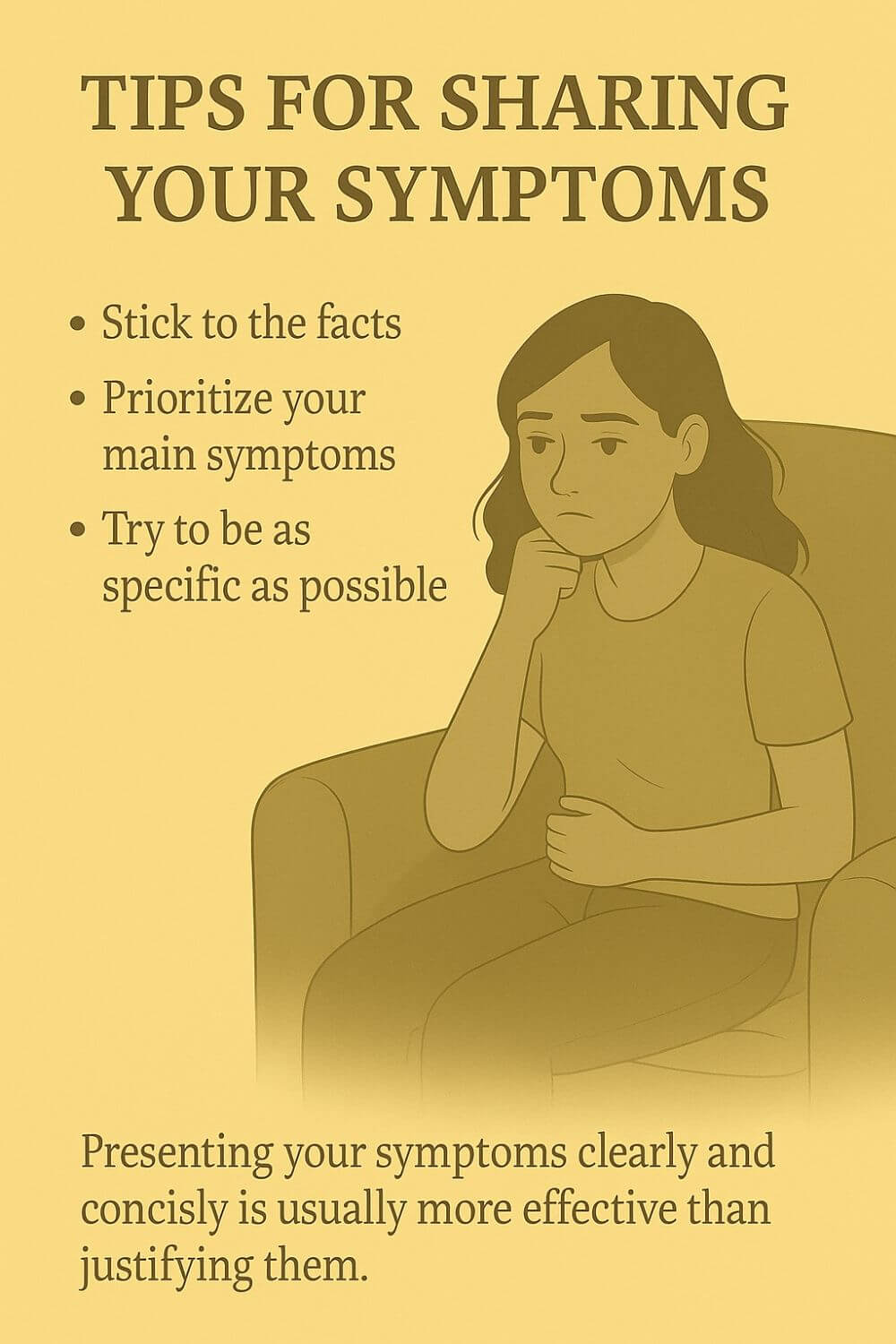
Write a One-Page Symptom Timeline
A one-page timeline is not you trying to impress anyone. It’s you protecting yourself from the moment your mind goes blank, your throat tightens, and suddenly you forget the last six months because you’re sitting under fluorescent lights trying to sound calm.
Keep it simple: when symptoms started, what changed, what makes it worse, what helps, and what the pattern looks like. Include surgeries, scans, medications, and big flare windows. The point is not perfection, it’s clarity.
With my wife, the timeline was the first thing that stopped her from feeling like she had to tell her whole life story just to be taken seriously. It gave her a steady handhold when fear and shame tried to take over. And it made appointments feel less like begging, more like stating facts.
Bring Photos, Logs, and Specifics
If your symptoms come in waves, a ten-minute appointment is a terrible window to capture your reality. Photos of bloating, swelling, rashes, bruising, or post-flare exhaustion can show what words struggle to explain.
Short logs help too, but not the kind that turns your life into a spreadsheet. Just enough detail to show frequency, triggers, and impact. A few lines per day, or even per flare, is enough.
I’ve watched my wife doubt herself because a “good day” happened to land on appointment day. Proof is not about convincing a good clinician; it’s about anchoring your own truth when you’re scared you’ll be dismissed again.
Practice a Calm Opening Script
When someone has been dismissed repeatedly, the body learns to enter danger mode in medical settings. Your heart races, you talk faster, you overshare, or you freeze. That’s not weakness, that’s a nervous system trying to survive.
A calm opening script gives you a path through that stress. Something like: what your main concern is, how long it’s been happening, and what you need from the visit. One minute, clear and steady.
My wife used to start with apologizing. Now she starts with facts. The change is small on paper, but emotionally it’s huge. It turns panic into direction, and it keeps you from leaving the room thinking you failed.
Name Your Worst Functional Losses
Pain and fatigue are real, but many clinicians respond fastest to function. What can’t you do anymore? What daily tasks cost you? What work, sleep, intimacy, or movement looks like now compared to before?
Choose three to five examples that matter most. Not dramatic ones, honest ones. “I can’t stand long enough to cook,” or “I miss work twice a month,” or “I can’t walk without pelvic pressure,” or “I wake up exhausted every day.”
I learned this by watching my wife. When she described only pain, she got sympathy. When she described what the pain stole, she got action. You’re not exaggerating. You’re translating your life into language the system can’t ignore.
Ask for Differential Diagnosis Notes
If you feel brushed off, you can ask a simple, firm question: “What are you ruling out, and why?” That pushes the conversation toward reasoning instead of opinion. It also creates a record of what was considered.
If a clinician insists it’s stress or anxiety, you can ask for that to be documented alongside your reported symptoms and your request for further evaluation. The goal is not confrontation. It’s accountability and clarity.
My wife used to leave with vague reassurance and no plan. This one shift helped her leave with either a next step or a clear reason why not. And when you’ve felt unheard for years, a clear plan is a form of safety.
Request Referrals to Proper Specialists
Not every doctor is trained deeply in endometriosis, pelvic pain, fibromyalgia, dysautonomia, or complex chronic illness. Sometimes, the most loving thing you can do for yourself is stop trying to be understood by someone who is not equipped.
Ask directly what specialist would be most appropriate, and what pathway gets you there fastest. If you suspect endometriosis, ask about imaging with someone experienced or referral to an endometriosis-excision specialist. If fibro is part of the picture, ask about pain clinics, rheumatology, or neurology, depending on your symptoms.
I’ve watched my wife change when she finally met a clinician who didn’t treat her like a puzzle, but like a person. You deserve that kind of care. You deserve a team, not a debate.
Take Someone with You Inside
If you can, bring a person who makes you feel safe. A partner, friend, family member, or anyone who can sit beside you and quietly hold the thread of the conversation when you’re overwhelmed.
They can take notes, remind you of points you forget, and witness what happens so you don’t later question your memory. Dismissal often makes people doubt their own reality. A witness helps protect you from that psychological whiplash.
I’ve been that person for my wife. I’ve watched her shoulders drop when she realized she didn’t have to carry the whole conversation alone. Sometimes support is not speaking for you. It’s simply being there so you don’t feel like you’re pleading in isolation.
Decide Your Non-Negotiables Beforehand
Before you go in, decide what you need from the visit. Not a miracle, not a perfect doctor, just a minimum outcome. A test. A referral. A medication trial. A follow-up plan. A documented note. Something concrete.
When you already know your non-negotiables, it’s easier to stay steady when the conversation drifts. It also helps you recognize when an appointment is going nowhere, so you can stop pouring your energy into someone who isn’t listening.
My wife and I learned this the hard way. There’s a special kind of heartbreak in walking out with nothing, again. Non-negotiables don’t guarantee perfect care, but they protect your dignity. And dignity matters when you’ve spent too long feeling like you had to beg to be seen.
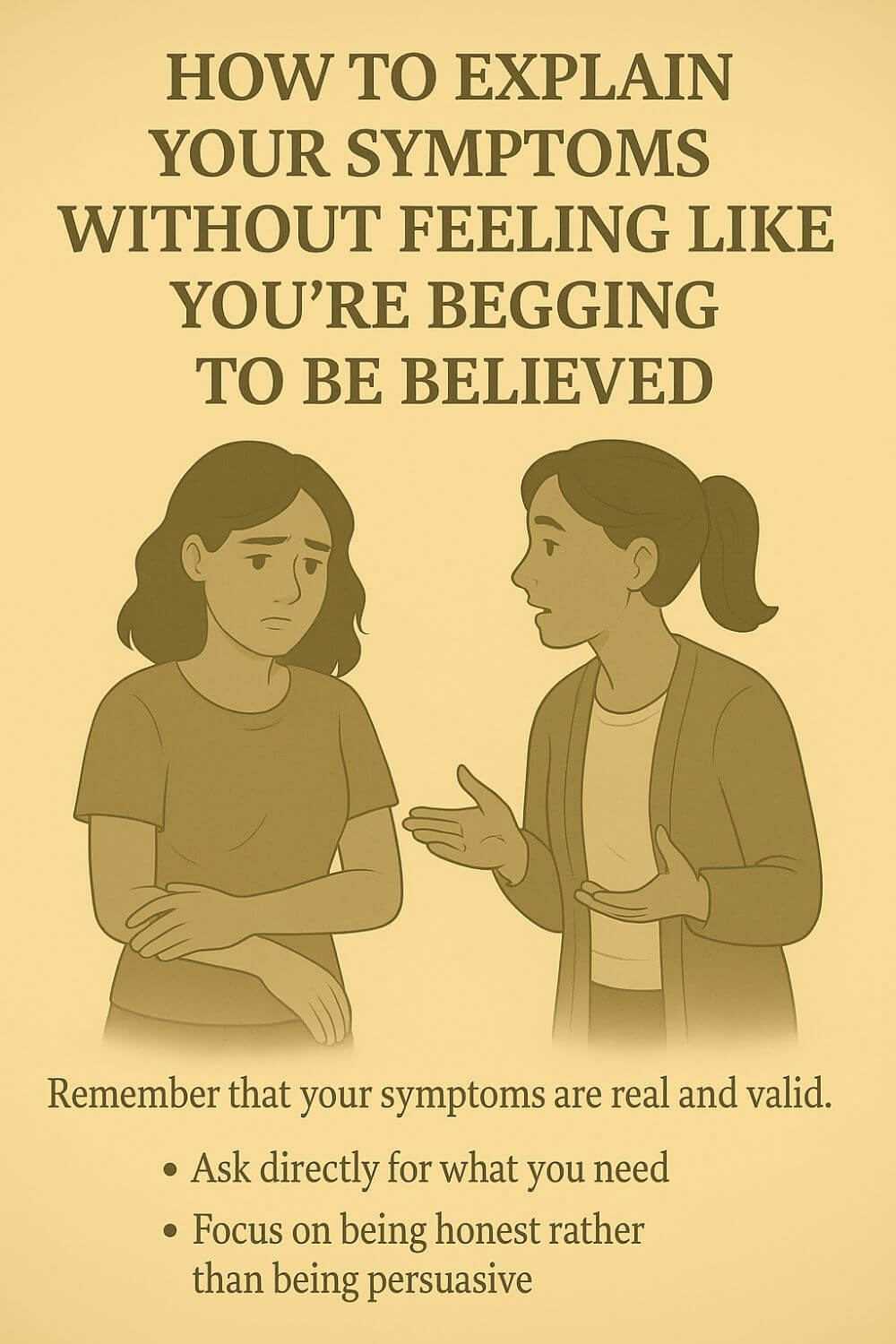
Protect Your Heart When Feeling Like You’re Begging to Be Believed
After you’ve done everything “right” and you still meet a blank stare, it can feel like your whole body is on trial. You might walk out calm on the outside, then unravel in the car, because you can’t understand why telling the truth keeps costing so much.
I’ve watched my wife go quiet after dismissal, not because she had nothing to say, but because she was trying not to fall apart. When you’re repeatedly minimized, your nervous system starts to treat appointments like danger, and even a neutral comment can land like a threat.
That’s why emotional protection matters just as much as preparation. It’s okay to pause mid-visit and ask for a moment, or to say you need the plan written down, because stress makes memory unreliable. It’s okay to ask for a clear next step and a follow-up date, so you don’t leave with vague reassurance and no path forward.
If the conversation turns dismissive, you can bring it back gently: “I hear you, but my daily function is declining.” You can also ask, “What would you do if this were happening to someone you love?” Not as a punch, but as a mirror.
There were seasons when my wife felt ashamed for needing help at all. Those are the moments I held her and told her the same truth I’m telling you now: needing care is not neediness. It’s survival.
And here’s the part nobody says out loud: sometimes the bravest move is to stop trying to be understood in that room and choose a different room. A different clinician. A different system. A different approach. You’re allowed to protect your energy because you need it to live.
Building our work-from-home life didn’t cure her pain, but it gave her a soft place to land after hard days like these. It gave us time, space, and options when the world kept asking her to prove what was already obvious.
If you’re reading this with tired eyes, still trying to find the words that will finally make someone listen, I want you to know I believe you. And I know how heavy it is to carry symptoms and disbelief at the same time.
I’ve seen my wife cry from the humiliation of being questioned while she was already fighting to breathe through pain. If you’ve ever felt that same crushing loneliness, please hear me: you were never meant to do this alone, and you don’t have to keep bleeding your dignity just to receive basic care.
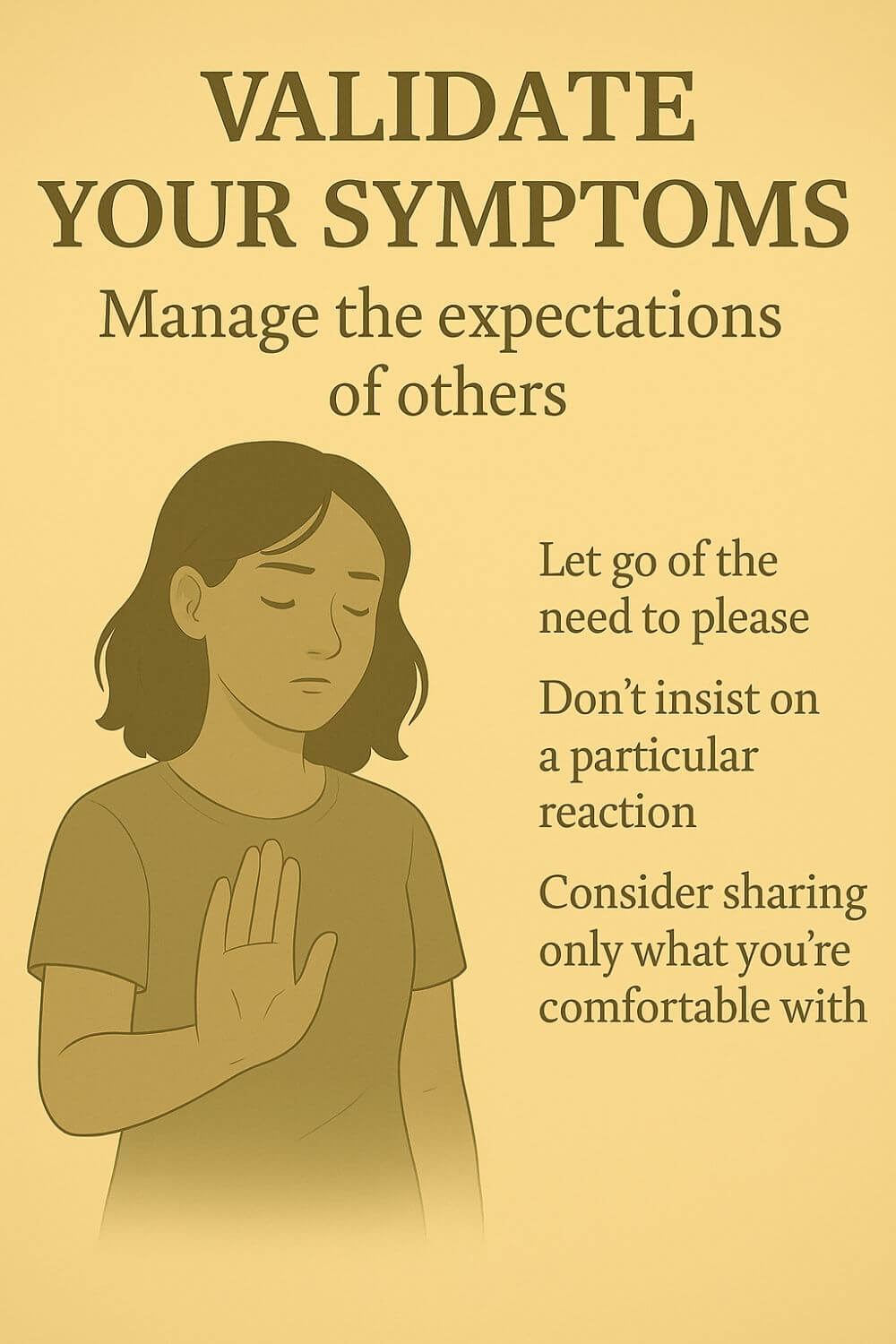
Final Word on Feeling Like You’re Begging to Be Believed
There’s a kind of exhaustion that doesn’t come from pain alone. It comes from the extra layer that pain forces on you: having to explain, justify, prove, and perform your suffering so someone else will take it seriously.
I didn’t understand that fully until I watched my wife live it. She wasn’t walking into appointments looking for sympathy. She was looking for help. She was looking for a name for what was happening, a plan, a path forward, something that didn’t leave her feeling like she’d failed just because her symptoms didn’t fit neatly into a checkbox.
When you’ve been dismissed enough times, your body starts to brace before you even leave the house. You rehearse what you’ll say. You debate whether to mention the harder symptoms. You wonder if you’ll be labeled dramatic. You try to look “well” enough to be respected, but not so well that they assume you’re fine. It’s a trap, and it’s cruel.
The truth is, chronic illness often refuses to behave in a way that makes other people comfortable. Endometriosis can hide, spread, inflame, and cause pain that doesn’t match what a quick exam suggests. Fibromyalgia can make the whole nervous system louder, turning normal sensations into alarms.
Both can come with fatigue, brain fog, anxiety, depression, and that deep, private fear that you’ll be abandoned by the very people who are supposed to help. None of that is a character flaw. None of it means you’re exaggerating. It means your body is carrying more than most people can imagine.
So what do you do with that reality when you still need care?
You start by protecting your own truth. Not with rage, not with drama, but with steadiness. A one-page timeline. A few specific examples of functions you’ve lost. A calm opening script. Clear questions that move the conversation from opinion to reasoning. A request for the next step, written down. If needed, a referral. And if the room is unsafe, the courage to choose another room.
This isn’t about winning an argument. It’s about leaving each interaction with your dignity intact.
I also want to say something that matters deeply, especially if you’ve been doing this for years: the goal is not to become the perfect patient. The goal is to get your life back in pieces, even while you’re still searching for answers.
That’s part of why I built my life around working from home. It wasn’t because I wanted a shiny online business story. It was because I wanted my wife to have options. The option to rest without guilt. The option to work in safety. The option to travel when her body allowed it, like going to Italy, where she feels that part of herself come alive again. The option to not be trapped in a world that punishes you for being unwell.
I’ve seen what happens when a woman is forced to push through a job that doesn’t care whether she’s bleeding, shaking, nauseous, or barely standing. It doesn’t just drain the body; it breaks the spirit.
If you’re in that place right now, I won’t pretend a blog post fixes it. But I will tell you this: you are not weak for needing help, and you are not wrong for wanting to be treated like your pain matters. You’re allowed to take up space in medical rooms. You’re allowed to need clarity. You’re allowed to ask for a plan. You’re allowed to refuse to be minimized.
And if you have a partner who tries, who learns, who shows up even when it’s messy, please know this: you deserve that kind of love. The kind that doesn’t make you feel like a burden. The kind that doesn’t require you to be “easy” to be cherished. The kind that believes you the first time.
I’m writing this as a man who has held my wife on the floor after a flare, who has watched her body steal a day she was excited for, who has seen her smile in public and crumble in private. I’ve watched how disbelief hurts in a different way than pain, because it tells you you’re alone in your own reality. I don’t want you carrying that alone anymore.
So take what helps from this. Build your script. Write your timeline. Decide your non-negotiables. Bring someone with you. Switch doctors if you need to. And please, when the voice in your head starts whispering that you’re “too much,” answer it with the truth: you’re not too much. You’ve just been asked to carry too much without enough support.
You deserve care that feels like partnership, not interrogation. You deserve to be heard without having to bleed your dignity to earn it. And you deserve a life that doesn’t revolve around proving your suffering.
You’re not begging. You’re advocating. And that is a form of strength. You don’t have to become louder to be valid. You just have to stay true to your reality, one steady sentence at a time.
If any part of this felt like your life, I’d really love to hear from you in the comments. And don’t forget about your FREE book!


About Me
Hi, I’m Lucjan! The reason why I decided to create this blog was my beautiful wife, who experienced a lot of pain in life, but also the lack of information about endometriosis and fibromyalgia for men…
READ MORE