Endometriosis and Relationships
Have you ever looked at your partner through tears and wondered why endometriosis and relationships can feel so painfully complicated when all you want is to be loved gently? Have you ever feared that endo and relationship mean pain will slowly change your intimacy, your marriage, your confidence, and the way you see yourself as a woman?
Endometriosis can change love by adding pain, fear, guilt, distance, and emotional strain, but it does not make you hard to love. With understanding, communication, patience, and real partner support, a relationship can become safer, softer, and stronger.
I know this because I have watched my wife live with stage IV deep infiltrating endo, fibro, and now adenomyosis too, and I have seen how chronic pain can enter a relationship without knocking. It can affect sex, sleep, work, mood, plans, touch, confidence, fertility fears, and even the quiet moments when you sit beside each other but both feel miles apart.
Endometriosis impacted our intimacy, but I have also learned that love does not have to disappear when illness enters the room; it simply has to become more honest, more patient, and more protective.
Please keep reading, because if endometriosis has made you feel like a burden, unwanted, misunderstood, or afraid of losing the person you love, I want to show you what I wish more partners understood before pain was allowed to speak louder than love.
- FREE eBook
- You Did NOTHING To Deserve This!
- How Endometriosis and Relationships Can Change the Way Love Feels?
- 1. How Endometriosis Affects Relationships?
- 2. Endometriosis and Emotional Intimacy
- 3. Endometriosis Sexless Marriage
- 4. Endometriosis and Marriage Struggles
- 5. Supporting a Partner with Endometriosis
- 6. Endometriosis and Feeling Like a Burden
- 7. Endometriosis and Painful Intimacy
- 8. Endometriosis and Partner Misunderstanding
- 9. Endometriosis and Loneliness
- 10. Endometriosis and Communication Problems
- 11. Endometriosis and Relationship Resentment
- 12. Endometriosis and Fertility Fears
- How Endometriosis and Relationships Can Still Become Stronger with the Right Love
- Final Word on Endometriosis and Relationships
- FAQ About Endometriosis and Relationships
Before we continue, if you ever needed to feel heard and seen, I wrote an eBook that you can download for FREE today. It consists of 130+ pages of value you will rarely see, if at all.
The book is filled with 20 chapters of gentle validation for women with endo, written by yours truly, as I have seen it up close...
It’s my way of telling you, in much more detail, that your pain, your complex response to treatment, and your emotions around all of it are real, understandable, and never your fault.
It’s not a medical guide but a human one. Here’s what you will find inside:
- This Was Never Your Fault
- The Girl You Used To Be
- When Your Own Body Feels Like an Enemy
- The Invisible Battles Nobody Sees
- Am I Just Lazy? – The Lie You Have Been Taught
- Gaslighting, Dismissal and the Trauma of Not Being Believed
- Guilt: The Weight You Were Never Meant to Carry
- Love in the Middle of Pain
- Intimacy When Your Body Hurts
- The Loneliness of Being the Strong One
- You Are Allowed To Take Up Space
- Tiny, Gentle Hopes (Not Toxic Positivity)
- If You Could Hear My Voice Every Flare Day
- You Deserve Partners, Not Witnesses
- When You Wish He Understood
- Motherhood, Fertility and the Grief Nobody Sees
- When Anger Is the Only Honest Feeling
- Learning to Trust Your Body Again
- Building a Life That Fits Your Reality
- You Did Nothing To Deserve This
You Did NOTHING To Deserve This!
Endometriosis Validation for Women with Endo
How Endometriosis and Relationships Can Change the Way Love Feels?
Love can feel simple when life is calm, but chronic pain has a way of testing the parts of a relationship that most couples never have to explain out loud. It can turn ordinary things like planning a weekend, sharing a bed, going out for dinner, or being physically close into something that needs patience, sensitivity, and emotional awareness.
Communication in a relationship where endometriosis impacts both of you is very important, if not the most important part.
When I first began to understand my wife’s pain more deeply, I realised that the illness was not only affecting her body.
It was affecting her confidence, her safety, her mood, her energy, her trust in her own body, and sometimes the way she saw herself as a wife.
That is something many partners miss. They think the pain is only about the painful day, the cancelled plan, the difficult night, or the intimacy that did not happen, but there is often a much deeper story underneath, sometimes even divorce because of endo.
There can be guilt on both sides. You may feel guilty for needing rest, needing reassurance, avoiding touch, cancelling sex, cancelling plans, or needing more support than you wish you needed.
Your partner may feel guilty too, especially if he loves you but does not know how to help without saying the wrong thing. That is where endometriosis and relationships become such an emotional topic, because it is not just about pain; it is about two hearts trying to stay close while one body keeps being forced into survival mode.
I have seen my wife push through pain because she did not want to disappoint me, and honestly, that broke something in me.
Not because I felt burdened, but because I realised how often women with chronic illness carry emotional pressure on top of physical suffering.
No woman should have to perform wellness to feel worthy of love. No wife should have to prove her pain is real before she is treated with tenderness.
When endo affects love, it often does so quietly at first. A little less touch, a little more fear, a few more cancelled plans, a few more misunderstandings, a few more moments where both people are hurting but neither knows how to say it properly.
That is why partner understanding matters so much. A supportive partner does not have to fix every flare-up, cure every symptom, or always know the perfect words.
He has to be willing to learn, listen, believe, adjust, protect the emotional safety of the relationship, and never make you feel like your illness makes you less lovable. That kind of love does not remove the pain, but it can remove the loneliness around it.
The parts we will walk through together are:
- how endometriosis affects relationships
- endometriosis and emotional intimacy
- endometriosis sexless marriage
- endometriosis and marriage struggles
- supporting a partner with endometriosis
- endometriosis and feeling like burden
- endometriosis and painful intimacy
- endometriosis and partner misunderstanding
- endometriosis and loneliness
- endometriosis and communication problems
- endometriosis and relationship resentment
- endometriosis and fertility fears
1. How Endometriosis Affects Relationships?
Endometriosis can affect a relationship long before anyone outside the home notices that something has changed. It can show up in the way you hesitate before making plans because you do not know what your body will do tomorrow, or in the way your partner slowly realises that love now needs more flexibility than he ever expected.
When my wife flares, it is not just pain that enters the room. It is tiredness, worry, frustration, fear, silence, disappointment, and sometimes that awful emotional heaviness that makes both people feel helpless in different ways.
This is where endometriosis and relationships become so real, because chronic pain not only asks a woman to manage symptoms, it asks a couple to keep choosing each other through changed routines, changed intimacy, changed expectations, and changed emotional needs. You may grieve the version of yourself who could be spontaneous, playful, sexual, energetic, or carefree without calculating the cost afterwards.
Your partner may grieve too, but his grief must never become blame. A good man learns that your cancelled plans are not rejection, your low energy is not laziness, your painful intimacy is not lack of love, and your need for rest is not weakness.
The relationship can suffer when pain is misunderstood, but it can also deepen when both people stop fighting each other and start fighting the loneliness together. That shift matters because you should not have to beg to be believed inside the one place where you are meant to feel safest.
2. Endometriosis and Emotional Intimacy
Emotional intimacy can become one of the most fragile parts of a relationship when pain keeps interrupting the life you both wanted to build. It is not only about talking more, sharing feelings, or saying the right words at the right time.
It is about whether you still feel emotionally safe when your body cannot keep up. It is about whether your partner can sit beside you in the hard moments without rushing you, correcting you, doubting you, or making you feel guilty for being honest.
I have learned with my wife that closeness is not always physical. Sometimes closeness is making her a cup of tea when she is too exhausted to ask, noticing when her face changes because pain has arrived, or accepting that a quiet evening at home can still be love, even when the world tells couples they should always be out doing more.
This is why endometriosis and relationships need more than practical support. It needs tenderness, because chronic pain can make you feel as if you are slowly becoming less fun, less desirable, less easy to be with, and less like the woman you were before the illness became louder.
But you are not less. You are carrying more.
A loving partner should understand that emotional intimacy grows when you are believed without having to explain every symptom like evidence in court. It grows when your tears are not treated as drama, your silence is not treated as attitude, and your need for reassurance is not treated as weakness.
You deserve a relationship where you can say, “I am scared today,” and your partner does not pull away from that truth.
You deserve to be held emotionally, even on the days when being touched physically feels too painful.
3. Endometriosis Sexless Marriage
A sexless marriage can feel terrifying when you love your partner, but your body has started to associate intimacy with pain, fear, pressure, or exhaustion. You may want closeness deeply, yet still feel your whole body tense when you think about what might happen afterwards.
This is one of the cruellest parts of endometriosis and relationships, because pain during sex can make a woman feel guilty for protecting herself, while her partner may quietly feel confused, rejected, or unsure how to approach her without making things worse.
But painful intimacy is not a character flaw, and it is not a failure of love.
I have seen how quickly a woman can blame herself when her body says no, even when her heart still says, “I love you.” That is why a good husband, partner, or boyfriend must learn the difference between being unwanted and being with someone whose nervous system is trying to keep her safe.
Sex should never become proof that you are trying hard enough. Marriage should never become a place where your pain is negotiated against someone else’s needs.
A loving relationship can still have affection, warmth, loyalty, tenderness, laughter, kissing, hand-holding, emotional closeness, and deep partnership while physical intimacy is being rebuilt carefully. The goal is not to force your body back into performance, but to create enough safety that love does not feel like another demand.
If your relationship has become sexless because of endometriosis, it does not mean you are broken, undesirable, or impossible to love. It means your relationship needs honesty, patience, medical support, emotional safety, and a partner mature enough to protect you rather than pressure you.
In the next part, I want to talk about marriage struggles, because chronic illness can expose weak places in a relationship, but it can also reveal what kind of love is truly standing beside you.
4. Endometriosis and Marriage Struggles
Marriage struggles can become heavier when endometriosis keeps changing the rhythm of everyday life. It may affect sleep, work, money, intimacy, social plans, household chores, emotional energy, and the simple freedom to say yes without checking your body first.
This is where endometriosis and relationships can feel painfully unfair, because marriage is already hard enough without one person having to fight chronic pain while the other tries to understand a battle he cannot physically feel. I have had moments with my wife where I could see pain in her eyes before she said a word, and I knew the day we planned was no longer the day her body could manage.
That does not make her difficult. It makes the situation difficult.
A marriage can start to strain when both partners are exhausted but expressing it differently. You may become quieter because you feel guilty, scared, or emotionally worn down, while your partner may become practical, withdrawn, overly positive, or frustrated because he does not know what to do with his helplessness.
But helplessness must never become harshness. A man can feel tired without becoming unkind, and he can feel disappointed without making the woman he loves feel responsible for the illness that took so much from her.
Marriage with endometriosis needs more than romance. It needs emotional discipline, forgiveness, adaptation, honest conversations, softer expectations, and the courage to keep choosing each other when life looks different from what you imagined.
I believe one of the strongest things a couple can say is not “we are fine,” but “this is hard, and we are still on the same side.”
That one sentence can save two people from turning pain into blame.
5. Supporting a Partner with Endometriosis
Supporting a partner with endometriosis begins with believing her before you fully understand everything she is trying to describe. A man does not need to feel the pain himself to respect it, and he does not need to have all the answers before he becomes a safe place for her to land.
This is where endometriosis and relationships can either become more fragile or more deeply bonded, because support is not only about saying, “I am here.” It is about showing up when she is flaring, when she is scared, when she is grieving her old body, when intimacy feels complicated, and when she is tired of explaining pain that others have dismissed for years.
With my wife, I learned that support is often found in the small things that do not look heroic from the outside. It is noticing when she needs rest before she has to ask, lowering the emotional pressure around sex, helping with practical tasks, learning about deep-infiltrating endometriosis and adenomyosis, and not treating her symptoms like an inconvenience.
It is also learning when to speak and when to simply sit beside her. Sometimes the most loving sentence is not advice, but “I believe you, and we will get through this together.”
A supportive husband or partner should educate himself because she should not have to be the teacher every time she is also the one in pain. Read about flare-ups, painful intimacy, fatigue, bowel symptoms, bladder symptoms, fertility worries, medical gaslighting, and the emotional impact of living with an invisible illness.
But support also needs balance. A man must protect his own emotional steadiness too, not by withdrawing from her, but by becoming grounded enough that his stress does not become another thing she has to carry.
Real support says, “Your illness changes some parts of our life, but it does not change your worth to me.” And for many women with endometriosis, that kind of love can feel like breathing for the first time after years of holding everything in.
6. Endometriosis and Feeling Like a Burden
Feeling like a burden can become one of the quietest pains in a relationship, because it often lives behind the words you do not say. You may smile when you are hurting, apologise when you need rest, or pretend you are okay because you fear your partner is getting tired of your body needing so much.
This is one of the most heartbreaking parts of endometriosis and relationships, because the illness can make you feel guilty for things you did not choose. You did not choose the flare-ups, the pain, the exhaustion, the painful intimacy, the cancelled plans, the fear around fertility, or the emotional weight of wondering whether love will become harder because your body is suffering.
I have seen this kind of guilt in my wife, and I wish I could take every piece of it away from her. Not because I see her as weak, but because I know how much strength it takes to keep going when your own body keeps interrupting your life.
Needing help does not make you a burden. Needing patience does not make you difficult.
A burden is something someone resents carrying. A woman you love is not a burden because her body needs tenderness, flexibility, practical help, and emotional safety.
A good partner should never make you feel that support is a favour he is keeping score of. Love should not turn your pain into debt. You are allowed to need care and still be deeply lovable. You are allowed to receive support without apologising for existing in a body that is fighting more than anyone can see.
In the next part, I want to talk about painful intimacy, because your body saying “this hurts” should be met with protection, not pressure.
7. Endometriosis and Painful Intimacy
Painful intimacy can change the emotional temperature of a relationship very quickly, because it touches something deeply personal in both of you. You may want to feel close, wanted, attractive, and loved, but at the same time, your body may remember pain before your heart has time to relax.
This is why endometriosis and relationships need so much compassion around sex, because pain during sex is not only physical.
It can affect your confidence, your sexual confidence, your trust in your body, your sense of womanhood, and your fear that your partner will eventually stop seeing you with the same desire.
I have learned through my wife’s journey that intimacy should never be treated like a test a woman has to pass. If touch makes your body tighten, if penetration causes deep pelvic pain, if certain positions trigger a flare, or if your nervous system panics before anything even happens, that deserves care, not criticism.
A loving partner should slow down before you have to shut down. He should care more about your safety than his expectations.
There are other ways to stay close while you seek answers, treatment, pelvic floor support, emotional healing, or simply time. Gentle affection, honest reassurance, kissing without pressure, lying together, being playful without expectation, and speaking openly about fear can protect the bond while your body is asking for patience.
You are not rejecting love when you protect yourself from pain. And a man who truly loves you should want your “yes” to feel safe, not forced, frightened, or given just to keep the peace.
8. Endometriosis and Partner Misunderstanding
Partner misunderstanding can hurt almost as much as the physical pain, because it can make you feel alone beside the person who is supposed to be closest to you. You may explain the flare-ups, the fatigue, the bowel pain, the bladder pressure, the painful sex, the cancelled plans, the anxiety, and still feel as if your words are being quietly measured against doubt.
This is where endometriosis and relationships can become emotionally heavy, because being misunderstood at home can feel like medical gaslighting has followed you into your own bedroom. When your partner says, “But you looked fine yesterday,” or “Maybe you are thinking about it too much,” it can make you shrink inside.
I do not say that to shame men who are learning. I say it because I was not born knowing how to support my wife perfectly either, but I had to understand that confusion is not an excuse for carelessness.
A good partner learns before his misunderstanding becomes another wound. He asks better questions, listens without defending himself, reads about endometriosis, and stops expecting your illness to make sense only when it is convenient for him.
Pain that changes from day to day is still real. A woman who smiles in public can still collapse in private. You should not have to suffer to be believed. You should not have to prove your pain by losing your softness, your patience, or your hope. When your partner begins to understand, the relationship can finally breathe again. Not because everything becomes easy, but because you no longer have to fight for basic emotional validation from the person you love.
9. Endometriosis and Loneliness
Loneliness inside a relationship can feel confusing, because from the outside it may look like you have someone beside you. But inside, you may still feel unseen, unheard, untouched, or emotionally far away from the person you love.
This is one of the saddest parts of endometriosis and relationships, because chronic pain can make you feel isolated even when you are not physically alone. You may sit on the sofa next to your partner while carrying pain, fear, guilt, exhaustion, and silent questions that he does not know are living inside you.
I have seen how illness can make my wife withdraw, not because she wants distance, but because explaining everything again can feel like another job on top of surviving the day. And I have learned that when a woman goes quiet, a man should not always assume she wants space.
Sometimes she wants to be noticed without having to ask. Sometimes she wants him to move closer, not physically in a demanding way, but emotionally, with patience and gentleness.
Relationship loneliness grows when pain becomes the only thing being managed, while the heart behind the pain is forgotten. You still need laughter, reassurance, affection, softness, conversation, and moments where you are treated as a woman, not only as a patient.
A loving partner should remember that you are not just symptoms, appointments, flares, medication, and limitations. You are still you, and you deserve to feel chosen even on the days your body cannot give much back.
In the next part, I want to talk about communication problems, because many couples do not fall apart from a lack of love, but from not knowing how to speak safely when both hearts are tired.
10. Endometriosis and Communication Problems
Communication problems often begin when both people are trying to protect themselves, but neither person knows how to say what they truly need. You may say, “I’m fine,” because you do not want to sound negative again, while your partner may say very little because he is scared of saying the wrong thing.
This is where endometriosis and relationships can become painfully complicated, because silence can start to feel safer than honesty. But silence does not always protect love; sometimes it only teaches both of you to suffer separately.
I have learned with my wife that a difficult conversation is much better than quiet emotional distance. It is better for her to tell me, “I feel scared you will get tired of this,” than to carry that fear alone and let it grow into shame.
It is better for me to say, “I want to understand, but I don’t know how to help today,” than to pretend I am calm while becoming distant. Real communication is not about perfect words; it is about creating a home where truth is not punished.
You may need gentle phrases that make hard moments safer, like “I need comfort, not solutions,” or “I am not rejecting you, I am in pain.” Your partner may need to learn to ask, “Do you want advice, help, space, or just my presence?”
When you both learn to speak before resentment builds, the relationship becomes less about guessing and more about understanding. And when understanding grows, love has more room to breathe, even on the days endometriosis makes everything feel heavier than it should.
11. Endometriosis and Relationship Resentment
Resentment can grow quietly in a relationship when pain keeps taking things from both of you, but neither of you feels safe enough to say what hurts. You may resent your body for changing intimacy, plans, energy, confidence, and freedom, while your partner may quietly resent the situation because he misses the life you both imagined.
This is where endometriosis and relationships need honesty without cruelty, because resentment is not always a sign that love has gone. Sometimes it is a sign that disappointment has nowhere safe to go.
I have learned with my wife that the illness itself must remain the problem, not the woman living with it. A man can feel tired, sad, or helpless without turning those feelings against the person he loves.
And you, as the woman in pain, are allowed to feel frustrated too. You are allowed to grieve the dates you cancelled, the intimacy you miss, the version of yourself you wish you could still access, and the emotional effort it takes to keep explaining a condition you never asked for.
Resentment becomes dangerous when it turns into scorekeeping. When love becomes “I did this for you, so you owe me,” the relationship stops feeling safe.
A healthier way is to name the hurt early, gently, and honestly, before it becomes distant. You are not fighting each other; you are trying to protect the relationship from a chronic illness that already takes enough.
12. Endometriosis and Fertility Fears
Fertility fears can sit in the heart very quietly, even when nobody brings them up at the dinner table. You may be trying to manage pain, fatigue, painful intimacy, appointments, surgery decisions, and daily life, while another part of you is silently asking, “What if this also changes my future?”
This is where endometriosis and relationships become deeply emotional, because fertility worries are not only medical concerns. They can touch your identity, your marriage, your dreams, your timing, your body confidence, your sexual confidence, and the way you imagine being loved if things do not happen easily.
I have seen how endometriosis can place pressure on conversations that should feel tender. A couple may love each other deeply, yet still feel scared to speak honestly about children, infertility fears, treatment options, disappointment, grief, or the possibility that life may not follow the path they once pictured.
A supportive partner should never make fertility feel like your responsibility alone. Your body is not a project, and your worth is not measured by whether you can carry a pregnancy, how quickly it happens, or how complicated the journey becomes.
If you are scared, you do not need a partner who minimises it with empty positivity. You need someone who can hold the fear with you, learn with you, attend appointments when possible, protect your emotional safety, and remind you that you are loved now, not only in some imagined future.
A relationship becomes stronger when fertility fears are spoken about with gentleness instead of being hidden behind shame.
Whether the future brings children, treatment, grief, acceptance, or a different kind of life, you should not have to walk into that uncertainty feeling alone.
In the next part, I want to gently bring everything together, because endometriosis may change parts of love, but it should never convince you that you are less worthy of being loved well.
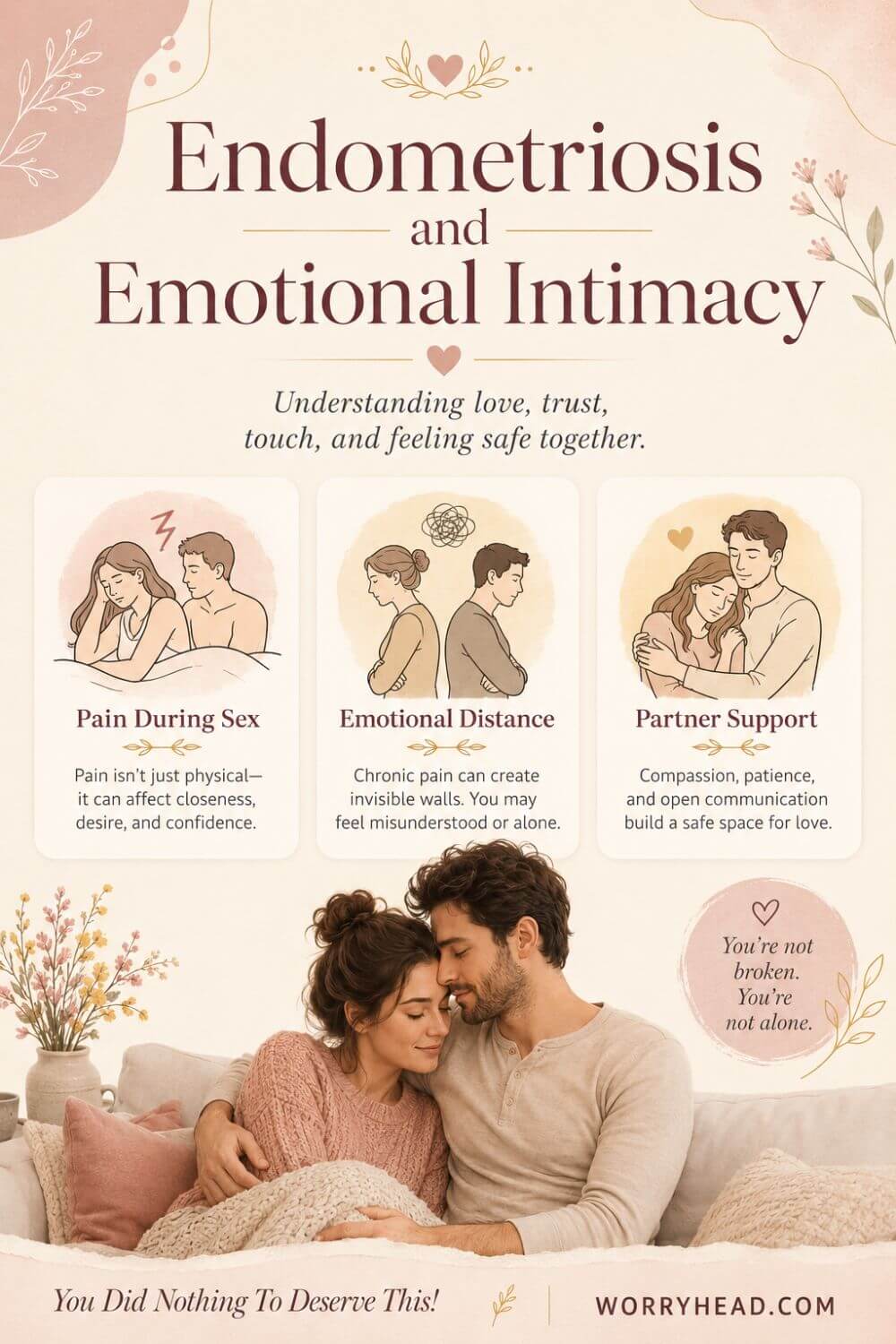
How Endometriosis and Relationships Can Still Become Stronger with the Right Love
I believe the strongest relationships are not the ones untouched by pain, but the ones where both people refuse to let pain become the only voice in the room. When I look at my wife’s journey, I do not see a woman who is difficult to love; I see a woman who has had to fight harder than most people will ever understand.
You may have intimacy struggles, fertility fears, communication problems, relationship guilt, emotional distance, or days when you wonder whether your partner truly understands what this illness has taken from you. But I want you to remember that chronic illness partnership is not about perfection, it is about protection, honesty, softness, and learning how to love each other in the real life you have, not only the life you once imagined.
If you are a woman living with endometriosis, you are not alone because you need patience. If you are the man loving her, your role is not to save her from every symptom, but to make sure she never feels abandoned inside them. This is where endo and relationships can become something deeper than romance alone.
Not easy, not painless, not fair, but real, loyal, and rooted in the kind of love that says, “Your body may struggle, but you are still wanted, still chosen, and still safe with me.”
Final Word on Endometriosis and Relationships
When I think about endometriosis and relationships, I do not think only about the pain, the cancelled plans, the sex that becomes complicated, the tears after another hard conversation, or the fear that love might slowly become tired. I think about the quiet moments nobody sees, the woman lying in bed trying not to feel guilty, the man sitting beside her wishing he could take it away, and the relationship standing in the middle trying to survive something neither person chose.
Endometriosis can change intimacy, but it should never change your worth. It can make physical closeness more difficult, but it should never make you feel unwanted. It can affect marriage, dating, communication, fertility dreams, emotional safety, and daily life, but it does not mean you are broken, difficult, dramatic, or impossible to love.
I have watched my wife live with stage IV deep infiltrating endometriosis, fibromyalgia, and adenomyosis. I have seen how pain can steal confidence from a woman who already carries more than enough. I have seen how quickly she can apologise for needing rest, for struggling, for not being able to do what she once did, even when none of it is her fault.
And I want to say this clearly to you, whether you are the woman in pain or the partner trying to understand her: chronic illness must not become a courtroom inside your relationship. She should not have to prove her pain every day. He should not wait until he understands every symptom before he chooses compassion. Love grows when both people stop treating the illness like a personal failure and start treating it like something they face together.
If intimacy has changed, speak gently. If resentment is building, name it before it becomes distance. If fertility fears are living in your heart, do not carry them alone. If you feel like a burden, please remember that needing support is not the same as being too much.
A good relationship will not always know the perfect words, but it will keep trying to become safer. A good partner will not always understand immediately, but they will stay willing to learn. A good man will not make your pain about his inconvenience. He will see the woman behind the symptoms, the heart behind the fear, and the love still present even when your body cannot respond the way you wish it could.
Endometriosis may change how love looks. It may ask for slower intimacy, softer communication, stronger boundaries, more patience, and a deeper kind of loyalty. But it should never convince you that you are less lovable. You are not hard to love because your body hurts. You are not less of a woman because intimacy is painful. You are not failing your relationship because you need care.
- You deserve love that does not disappear when life becomes inconvenient.
- You deserve to be believed before you break.
- You deserve a partner who understands that protecting your heart is part of loving your body.
And if you are the partner reading this, please remember this: sometimes the greatest gift you can give her is not fixing everything. It is making sure she never has to wonder whether her pain has made her less loved. You are still worthy of tenderness, loyalty, desire, patience, and a relationship where your pain is met with protection, not pressure. Endometriosis may change parts of your love story, but it does not have to steal the love itself. With honesty, understanding, and gentle support, you can still build something deeply safe.
I would love you to leave a comment and share which part of relationships endometriosis has affected most for you. And if you need more support, you can also check out the FREE eBook, written with love for women who deserve to feel believed, wanted, and never alone.


About Me
Hi, I’m Lucjan! The reason why I decided to create this blog was my beautiful wife, who experienced a lot of pain in life, but also the lack of information about endometriosis and fibromyalgia for men…
READ MORE
Grab a FREE eBook!
“You Did NOTHING To Deserve This!”
Finally hear the words nobody ever said to you, that your pain is real, your tears make sense, and you did nothing to deserve endometriosis, the dismissal, or the way it has rewritten your life.
FAQ About Endometriosis and Relationships
1. Can Endometriosis Ruin a Relationship?
Endometriosis can put serious pressure on a relationship, but it does not automatically ruin love. What often hurts the relationship most is not only the pain itself, but misunderstanding, silence, guilt, painful intimacy, emotional distance, and a lack of partner support. When both people learn to communicate gently, believe each other, and face the illness as a team, the relationship can still become safe, loyal, and deeply connected.
2. How Does Endometriosis Affect Intimacy?
Endometriosis can affect intimacy because pain during sex, fatigue, pelvic tension, fear of flares, low confidence, and emotional exhaustion can make closeness feel complicated. A woman may still love and desire her partner, but her body may associate intimacy with pain or anxiety. This is why patience, reassurance, pressure-free affection, and honest communication matter so much.
3. What Should a Partner Not Say to Someone With Endometriosis?
A partner should avoid saying things like “you looked fine yesterday,” “maybe you are overthinking it,” “we never have sex anymore,” or “are you using this as an excuse?” These words can make a woman feel doubted, rejected, and emotionally alone. A better approach is to say, “I believe you,” “how can I support you today?” or “we will work through this together.”
4. How Can a Husband Support His Wife With Endometriosis?
A husband can support his wife by believing her pain, learning about endometriosis, helping during flare-ups, reducing pressure around sex, attending appointments when possible, and protecting emotional safety at home. Support does not mean fixing everything. Sometimes it means noticing when she is struggling, offering comfort without judgment, and reminding her that she is still wanted, loved, and not a burden.
5. Can a Relationship Survive a Sexless Marriage Caused by Endometriosis?
Yes, a relationship can survive a sexless marriage caused by endometriosis, but both partners need honesty, patience, and emotional closeness. A lack of sex does not always mean a lack of love. When painful intimacy is involved, the focus should be on safety, tenderness, medical support, and rebuilding closeness without pressure or blame.
