Guilt of Fertility with Endometriosis
The guilt of fertility with endometriosis can feel like a private grief, especially when endo has already taken from you years of comfort, intimacy, certainty, and hope from you. I want you to know before anything else that you are not selfish, you are not broken, and you did not fail because your body needed more help than other bodies.
Guilt around fertility with endometriosis is not proof that you are broken, selfish, late, or to blame. It is a grief response to pain, infertility fear, surgery, lost choices, delayed diagnosis, and a body that may need help to conceive, especially with severe deep infiltrating disease too.
I am not a clinician, but I write as a husband, blogger, and researcher who has spent years learning beside my wife, and at the bottom of this article I have attached the medical sources I used to understand the health facts, including WHO, NICE, NHS, ESHRE, and medical studies.
What makes this guilt so cruel is that endometriosis can affect your fertility in more than one way. It may involve inflammation, adhesions, ovarian endometriomas, blocked or distorted tubes, deep infiltrating disease, pain during intimacy, many surgery decisions, hormone treatments that pause ovulation, and the emotional exhaustion of trying to plan a future while your body is still fighting today.
And yet, the part nobody talks about enough is the silence around it. You may smile when someone announces a pregnancy, then cry later because you are happy for them and devastated for yourself at the same time. You may love your partner deeply, yet secretly fear you are taking something away from them. You may hear “just relax” or “you still have time” while your heart is screaming because your body, your age, your disease, your surgeries, and your fear all feel like they are standing in the same room.
I know this fear because I have watched it live in my wife’s eyes. Her stage IV deep infiltrating endometriosis made fertility feel less like a simple life choice and more like a wound we both had to learn how to hold gently, without blaming her body, her womanhood, or our love.
There were moments when I could see she was not only grieving the possibility of infertility, but also grieving the version of herself she thought she was supposed to be. And all I wanted her to understand was that I did not love her for a womb, neither her pregnancy, or a perfect future.
Whenever she felt like a burden to me, it did not matter. I loved her because she was her, and I always will. Endometriosis is not her fault, she isn’t to blame here!
If you have ever looked at your body, your relationship, your future, and quietly wondered why fertility has to carry so much guilt when you are already carrying so much pain, I created a FREE 130+ pages eBook called “You Did Nothing To Deserve This!”, written to validate the feelings of women with endometriosis when the world makes them feel guilty, dismissed, or difficult to love.
When you grab it, you also join our Worry Head community, where I send more free support, gentle discounts on our books, and honest emails to help you and your relationship adjust to the new normal chronic illness can bring.
This book is filled with 20 chapters of gentle validation for women with endo, including the topic of fertility and motherhood…
- This Was Never Your Fault
- The Girl You Used To Be
- When Your Own Body Feels Like an Enemy
- The Invisible Battles Nobody Sees
- Am I Just Lazy? – The Lie You Have Been Taught
- Gaslighting, Dismissal and the Trauma of Not Being Believed
- Guilt: The Weight You Were Never Meant to Carry
- Love in the Middle of Pain
- Intimacy When Your Body Hurts
- The Loneliness of Being the Strong One
- You Are Allowed To Take Up Space
- Tiny, Gentle Hopes (Not Toxic Positivity)
- If You Could Hear My Voice Every Flare Day
- You Deserve Partners, Not Witnesses
- When You Wish He Understood
- Motherhood, Fertility and the Grief Nobody Sees
- When Anger Is the Only Honest Feeling
- Learning to Trust Your Body Again
- Building a Life That Fits Your Reality
- You Did Nothing To Deserve This
You Did NOTHING To Deserve This!
Endometriosis Validation for Women with Endo
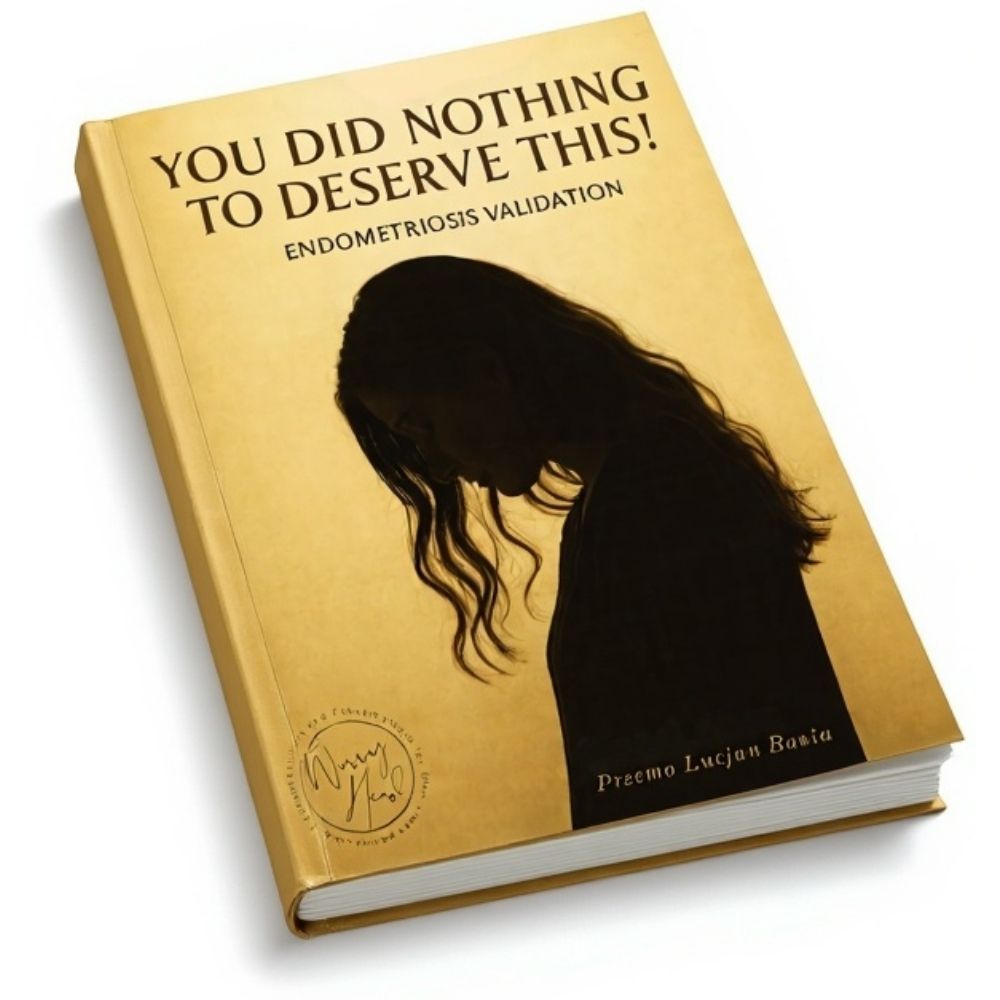
- You Did NOTHING To Deserve This!
- Why the Guilt of Fertility with Endometriosis Hurts So Deep?
- How the Guilt of Fertility with Endometriosis Changes Relationships?
- When the Guilt of Fertility with Endometriosis Becomes Self-Blame
- Final Word on the Guilt of Fertility with Endometriosis
- FAQ About Fertility Guilt and Endometriosis
- Guilt of Fertility with Endometriosis References
- FREE eBook
Why the Guilt of Fertility with Endometriosis Hurts So Deep?
The guilt of fertility with endometriosis hurts because it is not only about trying to have a baby, it is about feeling as if your body has placed your love, your future, and your relationship under pressure without your permission.
Endometriosis can affect fertility through inflammation, scar tissue, ovarian endometriomas, adhesions, distorted anatomy, pain during intimacy, and sometimes damage around the ovaries, tubes, bowel, bladder, or pelvic nerves.
But the emotional part is often heavier than the medical words.
You may be told about follicles, tubes, egg quality, ovarian reserve, surgery, IVF, hormones, waiting lists, and percentages, but nobody sits with you long enough to say, “I know this is breaking your heart.”
That is the missing piece.
Women with endometriosis are often expected to become experts in their own disease while also staying calm, hopeful, romantic, productive, grateful, and emotionally strong.
That is too much to ask from a body already living through pain.
If you have stage IV deep infiltrating endometriosis, the fear can feel even more frightening because the disease is not just “bad periods” or “some pelvic pain”. It can mean deep disease, adhesions, organs pulled out of place, endometriomas, repeated surgery discussions, fertility appointments, and the quiet terror of hearing that time matters when you already lost years being dismissed.
This is why infertility fear does not always appear as one big breakdown.
Sometimes it looks like avoiding baby announcements, crying after a pregnancy test, feeling guilty after sex because it became painful or clinical, or wondering whether your partner secretly wishes life was easier with someone else.
I want you to hear this from me as a husband, I believe that the right partner should never measure your worth by your ability to conceive.
Your body may need help, but your body is not a betrayal. Your illness may affect choices, timing, intimacy, finances, energy, and hope, but it does not make you less loving, less feminine, less worthy, or less enough. And if you have ever blamed yourself for not giving your partner the family you imagined, I wish I could sit across from you and say that love is not a transaction, and you are not a failed promise.
My wife and I know the ache of infertility being tied to stage IV deep infiltrating endometriosis, and I have seen how silently that fear can sit between two people who love each other deeply. There were moments when I did not need to fix anything, explain anything, or make some grand speech; I simply needed to make sure she never felt alone inside a grief that was never her fault.
That is why the next section matters, because you deserve practical, human things you can hold onto when fertility guilt begins to twist your thoughts, your relationship, and your sense of self.
- Separate fertility from your worth
- Name the grief without shame
- Stop carrying his feelings alone
- Make intimacy feel safe again
- Ask doctors clearer fertility questions
- Protect yourself from careless comments
- Let hope and grief coexist
- Build a future beyond one outcome
Separate Fertility from Your Worth
The first thing I want you to hold close is that your fertility is part of your story, but it is not the measure of your value. Endo may affect conception, pregnancy plans, intimacy, timing, and treatment choices, but it does not decide whether you are lovable, feminine, complete, or worthy of devotion.
I have seen what happens when illness makes a woman feel as if she has to apologise for a body she never chose to struggle with. My wife never needed to apologise to me for pain, for infertility fears, for stage IV disease, or for the life we had to adjust to together. What she needed was safety, tenderness, and the reassurance that my love was not waiting for her body to perform.
Please do not reduce yourself to test results, surgery notes, scans, ovarian reserve numbers, or someone else’s idea of womanhood. You are still you. You are still the woman who deserves to be held gently, spoken to kindly, desired fully, and loved without conditions attached to your womb.
Name the Grief without Shame
Fertility grief can be confusing because you may not even know exactly what you are grieving yet. You might be grieving a child you hoped for, a timeline you imagined, a pregnancy announcement you wanted to make one day, or the simple innocence of believing it would be easy when the time came.
That grief is real even if you are still trying. It is real even if you have not started treatment. It is real even if someone tells you, “At least you still have options.” Sometimes options still hurt because every option carries fear, cost, waiting, procedures, hormones, hope, disappointment, and the ache of wondering what your body will do next.
From a husband’s heart, I believe one of the most loving things a partner can do is not rush this grief. I learned that my wife did not always need me to make it positive. Sometimes she needed me to stop trying to brighten the room and simply sit with her in the darkness long enough for her to feel less alone.
Stop Carrying His Feelings Alone
One of the quietest pains I have noticed in women with endometriosis is the way they try to carry their partner’s sadness before he has even spoken it. You may imagine his disappointment, his fear, his frustration, his lost dreams, and then punish yourself for feelings he may not even be placing on you.
Please hear this gently: it is not your job to suffer twice. You are already carrying pain, medical uncertainty, body changes, fatigue, and the fear of infertility. You should not also have to carry an imagined version of his grief in silence while pretending you are fine.
A loving partner must learn to carry his own emotions with maturity, not hand them back to you as blame. I have had to learn this myself. Supporting my wife never meant I had no feelings, but it meant my feelings could not become another weight on her chest. A man who loves you should be able to say, “This hurts me too, but you are not the cause of my pain. We are facing this together.”
Make Intimacy Feel Safe Again
When fertility becomes frightening, intimacy can stop feeling simple. Sex can become painful because of endometriosis, emotionally loaded because of conception pressure, or heavy because every touch carries the question of whether your body will cooperate this month.
That can break your heart because intimacy is supposed to feel like closeness, not a medical deadline. It is supposed to remind you that you are wanted, not make you feel inspected, timed, or responsible for an outcome. If pain, bleeding, fear, or pressure have changed that part of your relationship, it does not mean you are failing as a woman or as a partner.
I have learned that tenderness matters more than performance. Sometimes love is not about pushing through pain to prove you are still “normal”. Sometimes love is stopping, listening, changing pace, holding each other, and remembering that your body deserves respect even when you both long for something more. Fertility should never be allowed to steal the safety of being touched with care.
Ask Clearer Fertility Questions
Doctors can be helpful, but appointments can feel rushed, especially when you are emotional, tired, or afraid of hearing bad news. That is why it helps to go in with clear questions that protect your heart and your future, not because you are difficult, but because your body and your choices matter.
You may want to ask how your endometriosis location could affect fertility, whether there are signs of endometriomas, adhesions, tubal involvement, or deep disease, and whether imaging, fertility testing, or referral to a specialist would be appropriate.
You can also ask how surgery might help pain or fertility, but also what risks it may carry for ovarian reserve, especially if the ovaries are involved.
I wish more women were told that asking questions is not being demanding. It is self-protection.
When my wife faced frightening medical conversations, I learned that information can soften fear, not because it removes uncertainty, but because it gives you something solid to stand on when your mind is spinning.
Protect Yourself from Comments
Few things cut deeper than careless fertility comments. “When are you having children?” “Just relax.” “My friend got pregnant naturally.” “Maybe it is not meant to be.” People may think they are helping, but those words can land like stones on a heart already bruised by pain and fear.
You are allowed to protect yourself from conversations that make you feel smaller. You do not owe anyone your diagnosis, your surgery history, your sex life, your fertility plans, your losses, your treatment decisions, or the private grief you carry behind your smile. A simple answer can be enough: “That is personal, and I am not discussing it.”
I know this can feel hard because many women are trained to be polite even when they are bleeding inside emotionally.
But kindness does not mean giving everyone access to your wound. Sometimes the most loving thing you can do for yourself is to close the door gently and stop explaining your pain to people who only want a quick answer.
Let Hope and Grief Coexist
You do not have to choose between hope and grief. You can still hope for pregnancy, treatment success, better care, better pain control, or a different future, while also grieving what endometriosis has already taken from you. Both can live in the same heart.
Some days you may feel strong and informed. Other days a baby photo, a period, a failed cycle, a painful flare, or one sentence from a doctor may pull you back into sadness. That does not mean you are negative. It means you are human, and you are trying to build hope in a body that has already been through too much.
I have seen my wife carry hope with tired hands. Not loud hope, not easy hope, not the kind people post online with neat little quotes, but the quiet kind that wakes up again after disappointment. If that is you, please do not judge yourself for crying while still hoping.
Tears do not cancel hope. They prove how much this matters.
Build Beyond One Outcome
This is one of the hardest truths to write with tenderness: your life still deserves meaning, love, beauty, intimacy, purpose, and gentleness, whatever happens with fertility. That does not mean pretending infertility fear does not hurt. It means refusing to let one outcome become the only place where your worth is allowed to live.
A future can still be built with love at the centre. It may include children, fertility treatment, adoption, a child-free life, a slower life, a different dream, or a version of family that looks nothing like what you once imagined.
None of those paths should be treated as lesser when they are walked with love, grief, honesty, and courage.
As a husband, I never wanted my wife to feel she had to give me a child to keep me beside her. I wanted her to know that she was not a waiting room for my happiness. She was my home. And you deserve someone who sees you that way too, especially on the days your body makes the future feel uncertain.
How the Guilt of Fertility with Endometriosis Changes Relationships?
The guilt of fertility with endometriosis can quietly change the way you speak, touch, plan, argue, hope, and even sit beside each other in silence.
It can make you feel as if every future conversation has a hidden question underneath it, even when your partner is only asking how you are. You may begin to over-read his face, his mood, his tiredness, or the way he reacts when someone else announces a pregnancy.
That is an exhausting way to live, because you are not only dealing with endometriosis, pain, appointments, and uncertainty, you are also trying to protect his heart while yours is breaking.
I have seen this kind of fear in my own marriage, and I know how easily love can become quiet when both people are trying not to hurt each other. My wife’s deep infiltrating endo did not only affect her body, it affected the rooms we sat in, the plans we postponed, the words we avoided, and the future we once thought would arrive more easily.
There were moments when I could feel that she was carrying guilt she had never deserved to carry. Not because I placed it on her, but because illness has a cruel way of making a woman apologise for things that were never her fault. And as her husband, I had to learn that reassurance could not be lazy.
It was not enough for me to say, “Don’t worry,” because she needed more than a quick comfort phrase.
She needed to see, again and again, that I was still choosing her in the ordinary moments, not only in the dramatic ones. She needed to know that infertility fear did not make her less of a woman to me, less of a wife to me, or less of the person I wanted to build my life with.
This is where many partners must grow up emotionally, because love cannot be conditional on the body producing the future we imagined.
A man can grieve too, but he must never turn his grief into blame, distance, pressure, resentment, or silence that makes you feel unsafe. And you, the woman reading this, deserve to be loved in a way that lets your nervous system breathe, because your heart has already been carrying enough.
When the Guilt of Fertility with Endometriosis Becomes Self-Blame
The guilt of fertility with endometriosis can become especially painful when it turns into self-blame, because then you are no longer only grieving what may be difficult, you are accusing yourself of causing it.
That is where my heart hurts for women like my wife, because stage IV deep infiltrating endometriosis is not a choice, not a moral failure, and not something a woman brings into a marriage to make life harder.
I have watched my wife carry pain in her body and then still worry about the pain it caused me, as if she had to apologise for needing patience, support, tenderness, and a different kind of future.
That is the cruelty of this disease.
It can make the person who is suffering most feel responsible for everyone else’s sadness.
For her, infertility fear was never just medical, because it touched identity, womanhood, intimacy, marriage, and the silent question of whether her body had stolen something from both of us.
For me, it meant learning to separate my own grief from her worth, because if I was careless with my sadness, she could easily mistake it for disappointment in her.
For both of us, it meant learning that love had to become bigger than the original picture we had in our minds.
There were days when I could see she needed reassurance not once, but many times, because one kind sentence cannot always undo years of pain, dismissal, surgery, fear, and private shame. So I learned to say it with my actions too: staying close, listening properly, not rushing her emotions, not making fertility the centre of her value, and not letting silence make her imagine the worst.
And if you are reading this with that same ache in your chest, please let this sentence land softly: you are not a burden because your body is complicated, and you are not less deserving of love because your path to motherhood may be painful, uncertain, or different.
The right love does not make you earn safety by producing a perfect future; it stays, adapts, grieves honestly, protects tenderness, and reminds you that you were already enough before any pregnancy, any treatment, any answer, or any outcome.

Final Word on the Guilt of Fertility with Endometriosis
If there is one thing I want you to take from this article, it is that you’re not guilty because your body has struggled with fertility, pain, disease, surgery, fear, or uncertainty.
You are not guilty because endometriosis entered your life before you understood what it was doing.
You are not guilty because doctors missed it, dismissed it, minimised it, delayed it, or gave you answers only after the disease had already shaped parts of your life.
You are not guilty because intimacy became painful, because trying became exhausting, because fertility conversations made you cry, or because you sometimes felt jealous, sad, angry, numb, frightened, or ashamed when someone else seemed to get easily what your heart longed for so deeply.
That does not make you bitter.
It makes you human.
And I say this as a husband who has seen stage IV deep infiltrating endo take things from my wife that no woman should ever have to lose quietly.
I have seen how it can make a woman question her body, her womanhood, her marriage, her future, and even her right to be loved without apology. I have also seen something else. I have seen that a woman is not made beautiful by how well her body performs.
- She is not made worthy by how easily she conceives.
- She is not made lovable by how little support she needs.
- She is not made strong by pretending she is not grieving.
- My wife did not need to become less ill for me to love her more.
- She did not need to give me the future we once imagined in order to deserve my loyalty.
- She did not need to hide the sadness in her eyes so I could feel more comfortable.
- She needed me to understand that this disease had already taken enough, and that my role was not to become another source of pressure.
That is what I want partners to understand too. If you love a woman with endo, do not make her carry your disappointment as if she caused it. Do not make fertility the test of her value. Do not go quiet in a way that makes her imagine she has failed you.
- Speak.
- Reassure.
- Learn.
- Go to appointments if she wants you there.
- Hold her after difficult conversations.
- Protect her from cruel comments.
- Let her cry without trying to rush her back into hope.
- And remind her, not once but often, that you chose her as a person, not as a promise of pregnancy.
To the woman reading this, I know this may hurt. I know you may have blamed yourself in ways nobody else can see. But your body has not been attacking your worth. It has been trying to survive a disease that should have been taken seriously much sooner.
You are still whole, even if your future looks different. You are still feminine, even if fertility has become complicated. You are still loved, even if grief sits beside you. And you are still deserving of a life that feels gentle, meaningful, safe, intimate, and yours.
Endometriosis may affect the path. It does not get to decide your value.
Your pain deserves care. Your grief deserves space. Your love deserves protection.
And you, exactly as you are today, deserve to stop apologising for a body that has already carried far too much. You did nothing to deserve this! You never did. You never will.
Your fertility fears are not proof that you are broken. They are proof that you loved, hoped, imagined, and cared deeply. Whatever your future becomes, you are still worthy of tenderness, partnership, respect, and a life where your body is met with compassion, not blame.
If this touched something tender in you, leave a comment and share what part of fertility guilt has been hardest to carry. You can also check out the FREE chapter of my eBook, created to remind you that you did nothing to deserve this, and you should never have had to carry it alone.


About Me
Hi, I’m Lucjan! The reason why I decided to create this blog was my beautiful wife, who experienced a lot of pain in life, but also the lack of information about endometriosis and fibromyalgia for men…
READ MORE
Grab a FREE eBook!
“You Did NOTHING To Deserve This!”
Finally hear the words nobody ever said to you, that your pain is real, your tears make sense, and you did nothing to deserve endometriosis, the dismissal, or the way it has rewritten your life.
FAQ About Fertility Guilt and Endometriosis
1. Can endometriosis make me feel guilty about fertility?
Yes, and that guilt can feel painfully real even though it is not deserved. Endometriosis can affect fertility through inflammation, adhesions, endometriomas, distorted pelvic anatomy, painful intimacy, surgery decisions, and years of delayed diagnosis, but none of that means you caused it.
What often hurts most is not only the medical side, but the emotional meaning attached to it. You may feel guilty for your partner, guilty for needing help, guilty for not knowing earlier, guilty for waiting, or guilty for feeling sad when others become pregnant.
But guilt does not mean you did something wrong. Sometimes guilt is grief wearing the wrong name.
2. Does stage IV deep infiltrating endometriosis always mean infertility?
No, stage IV deep infiltrating endometriosis does not automatically mean a woman can never conceive, but it can make fertility more complicated for some. The impact depends on where the disease is, whether the ovaries or tubes are involved, whether there are endometriomas, how much scarring or adhesions exist, age, ovarian reserve, sperm factors, previous surgery, and general health.
This is why proper specialist care matters. Some women conceive naturally, some need fertility treatment, some need surgery first, and some face heartbreaking outcomes despite doing everything they can.
But whatever happens, infertility is not a personal failure. It is a medical and emotional challenge that deserves care, not blame.
3. Why do I feel like I am failing my partner?
You may feel that way because fertility is often tied to love, marriage, womanhood, family expectations, and the future you imagined together. When endometriosis threatens that future, your mind may turn the pain inward and tell you that you are the problem.
But you are not failing your partner because your body is unwell. A loving relationship should not make you feel as if you must produce a child to deserve loyalty, tenderness, or safety.
As a husband, I believe the partner’s role is to make sure you never feel reduced to your fertility. He may have grief too, but he must carry it maturely, not place it on your shoulders.
4. How can I stop blaming myself for infertility fear?
Start by separating responsibility from reality. The reality may be that endometriosis has affected your fertility path, but that does not make you responsible for the disease, the delay in diagnosis, the severity of symptoms, or the emotional consequences.
It may help to speak the truth plainly: “My body is struggling, but I did not choose this.” That sentence matters because shame grows in silence and confusion.
Also, try not to punish yourself for needing support. You deserve honest conversations, medical clarity, emotional reassurance, and a partner who reminds you that your worth was never dependent on pregnancy.
5. What should my partner understand about fertility guilt with endometriosis?
Your partner should understand that fertility guilt is not something you can simply “think positive” your way out of. It can touch your body image, intimacy, confidence, mental health, grief, jealousy, fear, and your sense of safety in the relationship.
He should know that reassurance needs to be repeated, not because you are needy, but because endometriosis can make you doubt things you once felt secure about. He should avoid pressure, cold silence, careless jokes, comparisons, and comments that make you feel like a disappointment.
Most of all, he should remind you with words and actions that he chose you, not an outcome. You deserve to feel loved as a woman, not measured as a fertility result.
Guilt of Fertility with Endometriosis References
- https://my.clevelandclinic.org/health/diseases/10857-endometriosis
- https://www.who.int/news-room/fact-sheets/detail/endometriosis
- https://www.nice.org.uk/guidance/ng73
- https://www.nice.org.uk/news/articles/nice-updated-guideline-to-improve-the-diagnosis-of-endometriosis
- https://www.eshre.eu/Guideline/Endometriosis
- https://pubmed.ncbi.nlm.nih.gov/35350465/
- https://www.ncbi.nlm.nih.gov/books/NBK604070/
- https://pmc.ncbi.nlm.nih.gov/articles/PMC8939234/
- https://www.mdpi.com/2077-0383/13/23/7349
- https://www.mayoclinic.org/diseases-conditions/endometriosis/symptoms-causes/syc-20354656
