The Lie That You Are Too Much!
Have years of endometriosis ever made you believe the lie that you are too much for the people you love? Maybe you apologise when pain changes plans, feel guilty for needing rest, or swallow what you need because you are frightened that one more flare, one more appointment, or one more tear will exhaust everyone around you.
When your body keeps asking for things you never wanted to need, it can become frighteningly easy to confuse having needs with being a burden.
You are not “too much” because endometriosis makes you need rest, reassurance, practical help or medical care. Pain and fatigue can disrupt work, intimacy and plans, while repeated dismissal and stigma can turn those real losses into guilt, shame and fear of burdening the people you deeply love.
I am not a clinician; I write as a husband, blogger and researcher who has spent years learning because endometriosis changed my wife’s life, and at the bottom I have listed the medical and health sources I used, including WHO, NICE, NHS, ESHRE and published research where relevant.
If endometriosis has trained you to turn every cancelled plan, flare or need for help into evidence against yourself, I want you first to understand why this illness was never your fault, because shame grows easily when symptoms are mistaken for personal failure.
Something I wish more women were told is that feeling like a burden is not merely a private insecurity you invented. Qualitative research on endometriosis has documented women describing themselves as inadequate, weak, or burdensome, with some becoming reluctant to ask for support or speak up for what they needed.
That matters because the injury is not only what pain stops you from doing; it is also what repeated disbelief can teach you to believe about yourself. WHO, NICE and ESHRE recognise that endometriosis can affect emotional wellbeing, relationships, work, intimacy and social life, while stigma and the normalisation of severe pain can make that burden heavier.
I have watched this happen close enough to hurt: my wife never chose endometriosis, yet I have seen how illness can make a woman carry guilt simply because she needs more patience, understanding or help than she once did. Repeating “you did nothing to deserve this” to my wife taught me something I wish every woman with endometriosis heard sooner: needing love, reassurance and practical support does not make you harder to love.
If endometriosis has taught you to apologise for your pain, shrink your needs or worry that love has a limit you are approaching, I want to help you separate what this illness has taken from who you actually are. Once you recognise how that belief was built, it becomes much harder for guilt to keep speaking as if it were the truth.
Being called too much can make you feel guilty for needing rest, reassurance or support. My free eBook challenges that painful message and gives space to the feelings you may have learned to hide.
You Did NOTHING To Deserve This!
Endometriosis Validation for Women with Endo
- How Endometriosis Builds the Lie That You Are Too Much?
- Separate Symptoms From Self-Worth
- Stop Apologising for Necessary Care
- Name Guilt Before Obeying It
- Ask for Help Without Shame
- Set Boundaries Around Dismissive Behaviour
- Explain Flares Before Crisis Hits
- Let Safe People Show Up
- Protect Intimacy From Performance Pressure
- Measure Yourself by Different Standards
- How the Lie That You Are Too Much Changes the Way You See Yourself?
- How the Lie That You Are Too Much Affects Love and Relationships?
- When to Seek Medical Help?
- Questions to Ask Your Doctor
- Final Word on the Lie That You Are Too Much
- FREE eBook
- You Did NOTHING To Deserve This!
How Endometriosis Builds the Lie That You Are Too Much?
The hardest part of this belief is that it often does not arrive as one cruel sentence from somebody else. It grows quietly through hundreds of small moments: cancelling dinner, needing another day in bed, asking your partner to take over, leaving work early, avoiding sex because it hurts, or trying to explain pain that nobody can see.
When those moments repeat, you can begin to read your symptoms as evidence about your character instead of evidence that you are living with a chronic disease. You may call yourself unreliable when your body is unpredictable, selfish when you protect your energy, or difficult when you ask to be taken seriously. That is how the lie that you are too much starts to feel believable even though the conclusion is wrong.
Research into endometriosis describes a much wider psychosocial burden than pelvic pain alone, including effects on emotional wellbeing, work, relationships, intimacy, social life and quality of life. Studies examining stigma also describe invalidation, shame, withdrawal and the fear of being judged, helping us understand why you might start making yourself smaller long before anybody actually asks you to.
What worries me most as a husband is what can happen after that message has been repeated enough: you start doing the dismissing for other people. You say, “I’m fine” before anybody has complained, apologise before asking for help, or push yourself through a flare because resting somehow feels like letting somebody down.
That is not proof that your needs are unreasonable; it can become a learned way of trying to remain acceptable, useful and easy to love. The problem is that silencing yourself has a cost, because the less you say, the less chance the people who genuinely love you have to understand what support actually helps. It can also leave your partner guessing, and guessing is a poor substitute for honest information when pain, fatigue and plans can change from one day to the next.
A healthy relationship does not require you to perform wellness so the person beside you is never inconvenienced. It requires both of you to make room for reality, including the days when endometriosis changes what you can give and the days when your partner has limits too.
I believe this distinction matters enormously: being supported is not the same as being helpless, and needing accommodation is not the same as demanding that everybody revolve around you. You can have boundaries, responsibility, consideration and gratitude while still refusing to apologise for symptoms you did not choose.
I learned this beside my wife, not from a neat paragraph in a textbook; I have watched plans disappear because pain won that day, and I never once looked at the woman beside me and thought her value had disappeared with them. What hurt me was seeing how easily illness could make her feel she had to explain herself when what I wanted most was for her to know that she did not have to earn care from me. So I want to give you the practical things I wish every woman with endometriosis, and every partner who loves her, understood before guilt was allowed to take up so much space:
- Separate Symptoms From Self-Worth
- Stop Apologising for Necessary Care
- Name Guilt Before Obeying It
- Ask for Help Without Shame
- Set Boundaries Around Dismissive Behaviour
- Explain Flares Before Crisis Hits
- Let Safe People Show Up
- Protect Intimacy From Performance Pressure
- Measure Yourself by Different Standards
Separate Symptoms From Self-Worth
One of the cruelest things endometriosis can do is make you judge yourself by what your body could manage that day. If you cancel plans, miss work, need to lie down or cannot be intimate, it is easy to turn a physical limit into a personal verdict. But pain is not a character flaw, fatigue is not laziness, and needing recovery time does not make you less dependable or less loving.
I have watched my wife have days when her body simply would not cooperate with what she wanted to do. The woman I love did not become less valuable because she needed the sofa instead of the outside world. Try separating the sentence “my symptoms stopped me today” from “I failed today.” Those are not the same thing. Your worth does not rise on productive days and fall on painful ones, even if illness has trained you to measure yourself that way.
Stop Apologising for Necessary Care
There is a difference between being considerate and apologising for existing with a chronic illness. Saying sorry every time you need pain relief, a slower pace, a cancelled plan or help around the house can quietly teach you that your care needs are an inconvenience. You can still acknowledge that plans changed without making yourself the guilty party.
I have learned that the words we use at home matter. “I’m sorry I ruined tonight” lands very differently from “I’m disappointed too, but my body needs rest.” One carries shame; the other tells the truth. Endometriosis already takes enough from you without taking your right to be cared for. Necessary care is not indulgence. It is part of managing a disease that can affect pain, energy, sleep, bowels, bladder, intimacy and daily function. You do not need to apologise for responding sensibly to what your body is asking of you.
Name Guilt Before Obeying It
Guilt can sound sensible when you have lived with it for long enough. It says you should push through, attend anyway, cook anyway, have sex anyway, smile anyway, because somebody else might be disappointed. Before you obey that voice, name it. Ask yourself whether you have actually done something wrong or whether you simply feel guilty because endometriosis has changed what you can offer today.
That pause can protect you from making decisions against your own body just to avoid feeling uncomfortable for five minutes. I have seen how quickly guilt can make someone with pain ignore limits that are already obvious. Sometimes the most responsible choice is the one guilt dislikes: resting, saying no, changing plans or asking for help. Feelings can be powerful without being accurate. Guilt deserves to be heard, but it does not automatically deserve the final decision.
Ask for Help Without Shame
Asking for help can feel exposing, especially if you were once the person who handled everything without thinking. Endometriosis may change that, sometimes temporarily and sometimes for longer stretches, but needing support does not erase your independence. In fact, asking clearly for what you need can be far healthier than struggling in silence until you reach breaking point.
Try making the request specific instead of apologetic: “Could you make dinner tonight?” “Can you come with me to this appointment?” or “I need an hour without having to explain how I feel.” Clear requests give the people who love you something useful to do. As a husband, I would rather know what genuinely helps my wife than watch her suffer because she is afraid of being demanding. Love is not weakened by being allowed to participate. Sometimes letting somebody help is one of the most trusting things you can do.

Set Boundaries Around Dismissive Behaviour
Not everybody deserves unlimited access to you, especially when they repeatedly minimise your pain. Comments such as “everyone gets cramps,” “you always cancel,” or “surely it cannot be that bad” can make you question yourself even when you know exactly what your body is doing. A boundary is not punishment; it is a limit around how you are willing to be spoken to.
You can say that jokes about your symptoms are not acceptable, that you will not debate whether your pain is real, or that you need distance from conversations that leave you ashamed. You do not have to produce medical evidence every time somebody lacks empathy. I have learned that protecting my wife sometimes means supporting her right not to explain herself again. The people closest to you should not require you to shrink your reality to keep them comfortable. Respect is not too much to ask for.
Explain Flares Before Crisis Hits
One practical lesson I wish more couples were taught is to talk about flares when the flare is not happening. Pain can make communication harder, patience shorter and decisions more emotional, so it helps to agree in calmer moments what support looks like when symptoms suddenly worsen. That might mean who cancels plans, what household tasks can wait, when you want company and when you need quiet.
For us, understanding patterns has always been more useful than expecting every difficult day to look the same. Endometriosis can be unpredictable, so a plan should be flexible rather than rigid. You might create a simple phrase that means “I need you to take over for a bit” without having to explain everything from scratch. Planning is not admitting defeat. It is removing unnecessary pressure from a moment when your body is already asking enough of you.
Let Safe People Show Up
When you have been dismissed enough times, it can become tempting to stop telling anyone what you need. You may decide it is safer to expect nothing than risk another eye roll, awkward silence or piece of unwanted advice. But protecting yourself from unsafe responses can accidentally shut out the people who would actually show up with care.
Notice who believes you without interrogation, who adapts without making a performance of it, and who can sit beside you without trying to fix everything. Those are the people worth letting closer. My wife never needed me to solve endometriosis, because I could not. What I could do was believe her, learn, help practically and make home feel less like another place where she had to defend herself. You are allowed to be selective about support. Trust should be earned by how someone treats your reality, not by how loudly they claim to care.
Protect Intimacy From Performance Pressure
Endometriosis can place enormous pressure on intimacy because pain may affect sex, desire, confidence and the sense that your body is safe. If you start believing that saying no makes you disappointing or difficult, intimacy can become another place where you perform instead of connect. That can damage closeness far more than an honest conversation ever will.
A loving partner should care about whether you feel safe, wanted and comfortable, not whether your body can provide a particular kind of sex on demand. Intimacy can also mean touch, conversation, lying together, affection, humour, massage or simply being close without expectation. I have always believed that my wife’s pain matters more than any timetable of what a relationship is “supposed” to look like. Your body is not a service you owe someone. Real closeness makes room for consent, adaptation and tenderness.
Measure Yourself by Different Standards
Chronic illness can make old standards cruel. If you still measure yourself by how much you achieved before pain, how many social plans you kept, how spotless the house was or how much energy you gave everyone else, you may feel as though you are constantly losing. Sometimes the standard needs to change before your self-respect can recover.
A good day might now mean that you listened to your body early, attended one appointment, answered one important message or rested before pain became unbearable. That is not lowering your value; it is measuring success against the reality you are actually living.
I have seen my wife accomplish things that would look small to somebody outside our home but required enormous strength from inside it. You deserve standards that recognise effort, not just output. Your life may need to be built differently, but differently does not mean less.
How the Lie That You Are Too Much Changes the Way You See Yourself?
There is another layer to this that can be harder to notice because it happens inside you long before anybody else sees it. You can become so used to monitoring whether you are inconveniencing others that you start watching yourself from the outside instead of simply living your life.
You notice how long you have been talking about your pain, how many plans you have cancelled lately, whether your partner looks tired, whether somebody sighed when you asked for help, and whether you should pretend you feel better than you do. Eventually, the lie that you are too much can make you treat normal human needs as evidence that you are becoming difficult to love.
That constant self-monitoring can change the choices you make. Instead of asking, “What does my body need today?” you start asking, “What can I force myself to do so nobody gets fed up with me?”
I have seen how dangerous that question can become because endometriosis does not reward you for pretending it is not there. You can push through dinner, work, housework, social plans or intimacy to protect somebody else from disappointment, only to pay for it later when the person you were trying to protect may never have wanted you to suffer in the first place.
Watching my wife taught me something that still stays with me: sometimes the woman you love is fighting two battles at once. One is the pain in her body, and the other is the fear that the pain is slowly making her less lovable.
As her husband, that second battle breaks my heart in a completely different way. I can understand why she might hate what endometriosis does to her life, but I never want her to confuse what the illness does with who she is.
There have been times when plans changed because she could not manage them, times when I had to do more because her body could not, and times when our life looked nothing like the version we might once have imagined. None of those moments made me look at my wife and see less of the woman I chose.
If anything, they made me understand how much courage can hide inside an ordinary-looking day. Getting dressed when you hurt, explaining yourself again at an appointment, saying no to something you desperately wanted to do, or allowing somebody to help you can require far more strength than the outside world ever notices.
This is why I wish you would be very careful about calling yourself needy, dramatic, difficult or exhausting. Those words can become an identity if you repeat them often enough, when the truth may simply be that you are adapting to a disease that keeps demanding adjustments from your life.
You are still allowed to be funny, ambitious, loving, sexual, intelligent, stubborn, complicated, hopeful and completely yourself while also needing support. Endometriosis may change what your days require, but it does not reduce the amount of space you deserve to occupy in the lives of people who genuinely love you.
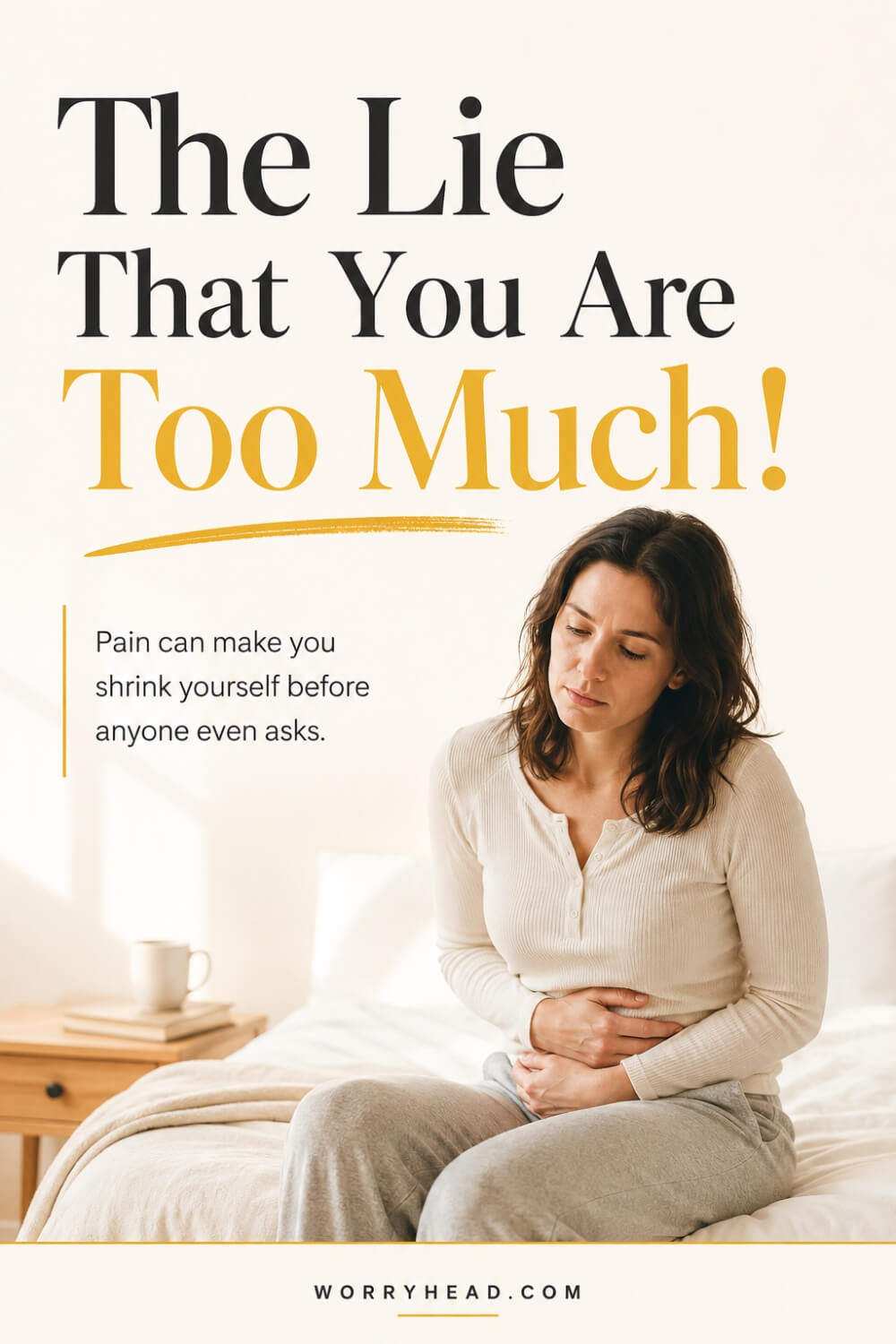
How the Lie That You Are Too Much Affects Love and Relationships?
Endometriosis can reach into a relationship without either person inviting it in, changing plans, intimacy, routines, responsibilities and sometimes even the way you speak to each other. When pain keeps interrupting ordinary life, you may begin worrying that your partner is tired of adapting, while your partner may be worrying that nothing he does is enough to make things easier.
Over time, that fear can create distance even inside a loving relationship because both of you may start protecting each other with silence. The lie that you are too much may make you hide how badly you are hurting, while the person beside you senses something is wrong but does not know what you actually need.
I have seen this with my wife, and one of the hardest things for me has never been doing more when she cannot; it has been knowing that she might feel guilty for needing me to do it. From my side, carrying shopping, changing plans, taking over practical things or simply staying close when she is struggling does not make me think less of her, because helping the woman I love is not a debt I quietly add up.
I have learned, though, that support works best when neither person disappears inside the illness. That does not mean expecting you to push through pain so your partner has an easier life, and it does not mean your partner should ignore his own exhaustion, responsibilities or feelings either.
It means building a relationship where you can say, “I cannot manage this today,” and he can say, “I am struggling too,” without either sentence becoming an accusation. For both of us, some of the strongest moments have come not from pretending everything is fine, but from recognising that endometriosis is something affecting our life together rather than something my wife has somehow done to our life.
A relationship can survive changed plans, difficult seasons, less predictable intimacy and unequal days far better than it can survive resentment, guilt and unspoken fear. The goal is not for you to become easier to care for; it is for both of you to become safer with the truth, so love is measured less by what your body can provide and more by how you continue to treat, protect and choose one another when life becomes difficult.
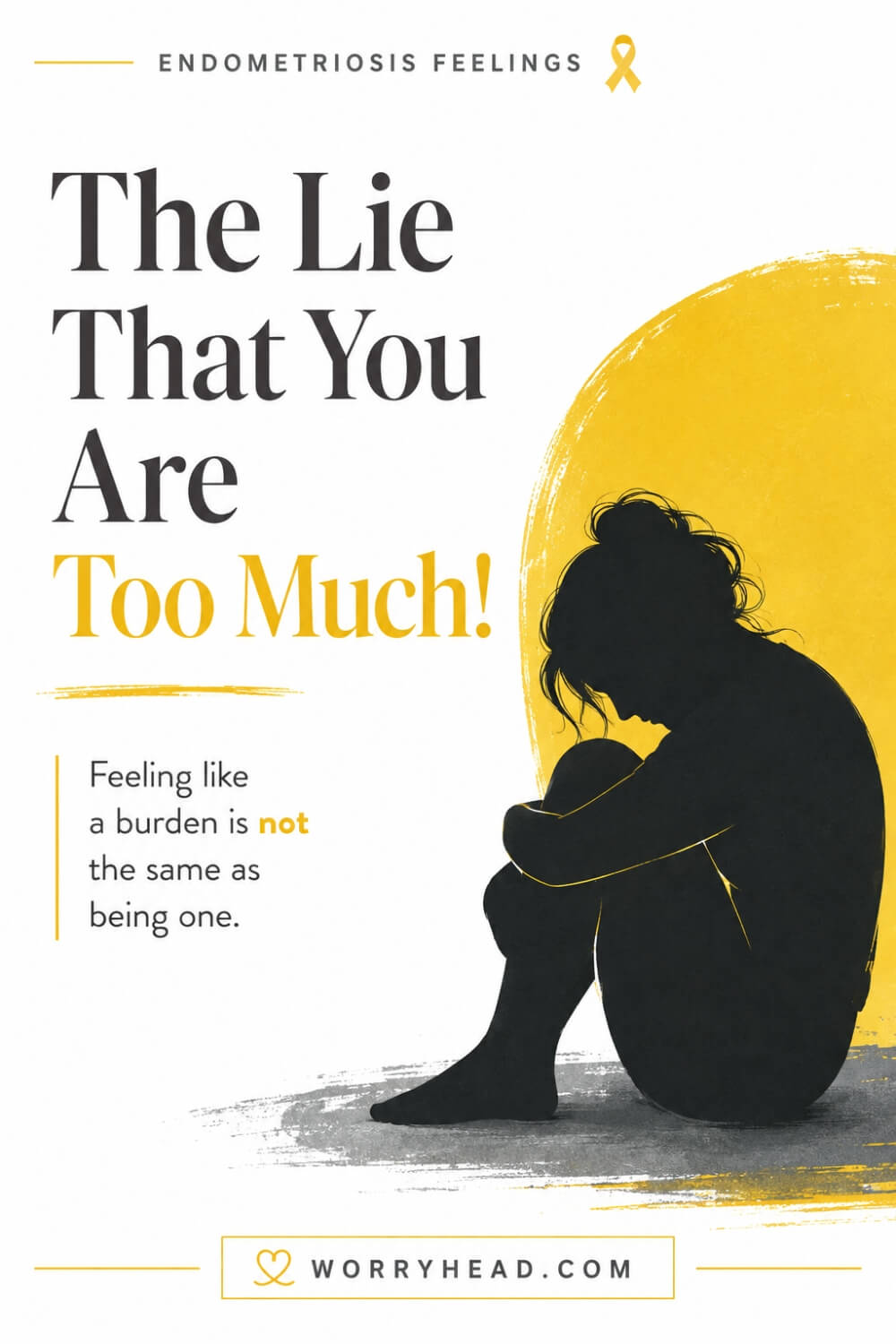
When to Seek Medical Help?
Feeling guilty, frustrated or emotionally worn down by endometriosis does not automatically mean something is wrong with your mental health. There will be days when pain ruins something you were looking forward to, when you cry because you have had enough, or when you hate needing help again. Those feelings can be completely understandable responses to living with an illness that keeps interfering with your life.
What I would not want you to do is normalise emotional suffering simply because endometriosis has been difficult for a long time. If feeling like a burden is becoming persistent, if you are withdrawing from people you love, losing interest in things that normally matter to you, struggling with ongoing anxiety or low mood, or repeatedly thinking that everybody would be better off without your needs, tell your GP or another healthcare professional.
You do not have to wait until you are completely overwhelmed. Mental health support can be appropriate alongside gynaecological care, pain management and other endometriosis treatment, because the emotional and physical sides of chronic illness do not live in separate boxes.
It is also worth asking for a medical review if the feelings are being driven by symptoms that are no longer adequately controlled. Pain that is becoming harder to manage, increasing fatigue, worsening bleeding, painful sex, or bowel and bladder symptoms that are disrupting everyday life deserve reassessment rather than another attempt to simply tolerate more. Your emotional distress may be telling you something important about how much your illness is affecting your life.
When you speak to your doctor, describe the consequences rather than only giving your pain a number. Explain if you are missing work, avoiding intimacy, cancelling social plans, struggling to sleep, becoming frightened of your period or flare days, or feeling guilty because you increasingly depend on somebody else. Those details show what endometriosis is actually doing to your life and can help your clinician see the bigger picture.
And please take thoughts of self-harm or suicide seriously. If you are thinking about harming yourself, tell a GP or mental health professional as soon as you can; if you feel you may act on those thoughts, have seriously harmed yourself, or cannot keep yourself safe, seek emergency help immediately. In the UK, that can mean calling 999 or going to A&E, while NHS 111 can direct you to urgent mental health support when you need help quickly but there is no immediate danger.
I say this as a husband who has learned that love and reassurance matter enormously, but they are not replacements for professional care when somebody is becoming psychologically unsafe. A partner can listen, believe you, sit beside you, help you through appointments and remind you of who you are when illness has blurred that picture, but there are moments when loving you properly also means helping you reach for more support.
Most importantly, do not use the fact that somebody else may have “worse” endometriosis as a reason to stay silent. You do not need to reach some imaginary level of suffering before you qualify for help. If pain, shame, guilt or the fear of being too much is changing how you live, how you see yourself or whether you feel safe with your own thoughts, that is already worth talking about.
Questions to Ask Your Doctor
It can be surprisingly difficult to explain the emotional side of endometriosis in a medical appointment. You may arrive intending to talk about how overwhelmed you feel, then find yourself discussing bleeding, pain scores, medication and scans until the emotional part disappears completely.
If you already worry that you are “too much”, you may even minimise what is happening because you do not want to sound dramatic. I would encourage you to go in with a few questions written down, because what endometriosis is doing to your confidence, relationships and daily life deserves to be part of the conversation too.
You do not need to ask every question below. Choose the ones that reflect what you are actually experiencing.
- Could my endometriosis symptoms be affecting my mental health?
This opens the door to talking about anxiety, low mood, fear, frustration, guilt or feeling emotionally exhausted without suggesting that the physical illness is somehow “all in your head”. - My pain is affecting how I see myself. What support is available for that?
Sometimes the hardest part is not only hurting. It is becoming ashamed of needing rest, cancelling plans or depending on other people. Your doctor may be able to discuss psychological support, counselling, pain services or other appropriate options alongside your physical treatment. - Could better symptom control improve how I am coping emotionally?
If your emotional wellbeing has worsened because pain, fatigue, bleeding or other symptoms are poorly controlled, it is reasonable to ask whether your current endometriosis management still meets your needs. - Should my current symptoms be reassessed?
If you have gradually accepted a worse quality of life because you think you are supposed to cope, say so. Tell your doctor if symptoms are interfering with work, sleep, social life, exercise, relationships or ordinary daily tasks. - How can we look at the impact on my whole life, not only my pain score?
A number from zero to ten cannot describe cancelling another family occasion, fearing intimacy, missing work or spending days recovering from a flare. Give examples of what the illness prevents you from doing, because function can communicate what a pain score cannot. - Painful sex is affecting my relationship. Can we talk about it properly?
You should not have to hide this because it feels embarrassing. Pain during or after sex can affect desire, confidence, closeness and the fear of disappointing your partner, and it deserves the same seriousness as other symptoms. - Would specialist endometriosis or pain support be appropriate for me?
If your symptoms are complex, persistent or significantly affecting your life, ask whether further specialist assessment would be useful. You are not being demanding by asking what options exist. - Could I be referred for psychological support alongside my endometriosis care?
Asking for emotional support does not mean your pain is psychological. Living with chronic pain and uncertainty can be exhausting in its own right, and sometimes having somewhere safe to process that burden can make an enormous difference. - What should I do if my mental health becomes much worse?
Ask who you should contact, what urgent services are available locally and what signs should prompt you to seek help quickly. Having that information before a crisis can remove one more decision from an already frightening moment. - Can I bring my partner to future appointments?
If you want him there, another pair of ears can help. A supportive partner can remember details, describe changes he has noticed, take notes and help you advocate for yourself when pain or anxiety makes it difficult to absorb everything being said.
One thing I learned from accompanying and supporting my wife is that you do not have to present the perfect medical case to deserve a useful appointment. You are allowed to say, “I am struggling with this more than I let people see,” even if you cannot explain neatly where the physical burden ends and the emotional one begins.
And if you become tearful while explaining it, that does not make your symptoms less credible. If anything, it may finally show how much energy you have been spending trying to look as though you are coping.
A good consultation should leave room for the person living inside the symptoms, not only the disease written in the notes. You are not wasting anybody’s time by asking how endometriosis is affecting your confidence, your relationship, your ability to function or the way you think about yourself.
If you are frightened that asking several questions will make you seem difficult, take the most important three with you and start there. You are not asking for special treatment. You are asking for your health to be understood properly.
Final Word on the Lie That You Are Too Much
Endometriosis can change more than what happens in your body. It can change how you plan, work, rest, love, ask for help, and how you speak to yourself when a day arrives. That is why this conversation matters.
You may have spent years believing that needing patience makes you demanding, that cancelling plans makes you unreliable, or that asking your partner to carry more on a day makes you a burden. But those conclusions do not describe your character. They describe what happens when chronic illness forces you to adapt.
The lie that you are too much becomes powerful when pain, dismissal, guilt and disappointment blend until you no longer know which thoughts belong to you and which were learned from years of trying not to inconvenience anybody. Breaking that pattern does not mean pretending endometriosis is easy. It means refusing to turn its consequences into evidence against yourself.
I have watched my wife live through days when her body changed our plans, demanded rest and made things harder than they should have been. What I saw was not a woman becoming less worthy of love. I saw someone using enormous energy to live inside a body that could be unpredictable, painful and exhausting.
As her husband, I do not believe support means rescuing her from every difficult feeling or pretending I never become tired. It means being honest, staying present, learning what helps, respecting her limits and making sure illness does not become another reason for her to doubt whether she is wanted.
That matters for partners too. You can love someone while having limits of yours, and you can communicate those limits without making her feel guilty for being ill. Healthy support is not martyrdom. It is two people protecting the relationship from shame, silence and resentment while recognising that the disease, not the person living with it, is the problem you are trying to manage together.
For you, the work may begin with something small. Perhaps you stop apologising for resting. Perhaps you tell somebody that a dismissive comment hurt. Perhaps you explain what a flare does to you instead of saying, “I’m fine.” Perhaps you ask your doctor for help because the emotional weight has become too heavy to carry privately.
Those choices may look ordinary from the outside, but they can be acts of self-respect. Every time you respond to your needs without treating them as a moral failure, you weaken the belief that love must be earned through constant usefulness.
Endometriosis may take spontaneity, energy, comfort and certainty from you. Please do not hand it your sense of worth as well. You are allowed to need care and still be strong, to have limits and still be loving, to grieve what has changed and still build a life with meaning.
And on days when you cannot believe that for yourself, borrow the belief from someone who can see you clearly. The right people will not require you to disappear in order to stay loved.
You are not difficult because endometriosis changes what you can give. You are not a burden because some days require more care. The people who truly love you will not measure your worth by productivity, pain tolerance or how little help you need. You deserve support without shame, love without performance, and a life that still feels like yours.
If this spoke to something you have been carrying quietly, I would genuinely love to hear your story in the comments. And if you need more of this kind of validation, you can also find my FREE 130+ page eBook, “You Did Nothing To Deserve This!”, at the bottom of this post.

About Me
Hi, I’m Lucjan! The reason why I decided to create this blog was my beautiful wife, who experienced a lot of pain in life, but also the lack of information about endometriosis and fibromyalgia for men…
READ MORE
Grab a FREE eBook!
“You Did NOTHING To Deserve This!”
Finally hear the words nobody ever said to you, that your pain is real, your tears make sense, and you did nothing to deserve endometriosis, the dismissal, or the way it has rewritten your life.
Related Questions You May Be Asking About the Lie That You Are Too Much
1. Can Endometriosis Really Make You Feel Like a Burden?
Yes. Endometriosis can affect much more than pain, including emotional wellbeing, relationships, work, intimacy and social life. When you repeatedly need to cancel plans, rest, ask for help or explain symptoms, you may start feeling guilty for having needs. That feeling can become powerful, but it is not proof that you are actually a burden.
2. Why Do I Keep Apologising for My Endometriosis?
You may apologise because repeated disruption has taught you to take responsibility for things you did not choose. Saying sorry can become a way of trying to prevent disappointment, conflict or rejection before it happens. A useful question is: did I actually do something wrong, or did endometriosis simply force another change today? Those are very different situations.
3. Can Endometriosis Change How I See Myself?
Yes. Chronic pain, unpredictable symptoms, changes to work and intimacy, and repeated dismissal can affect confidence and the way you recognise yourself. You may compare yourself with who you were before symptoms became severe. Try measuring yourself by values such as kindness, courage, honesty and effort rather than productivity alone. Your abilities can change without your human worth changing with them.
4. How Do I Tell My Partner I Feel Like Too Much?
Start with what you need rather than trying to justify every symptom. You might say that you are frightened of becoming a burden, even though you know the illness is not your choice. Tell your partner what helps during flares and what makes things harder. Honest conversations give love somewhere useful to go, while silence often leaves both of you guessing.
5. When Should I Get Help for These Feelings?
Consider speaking to your GP or another healthcare professional if guilt, anxiety or low mood persists, causes you to withdraw, affects sleep or relationships, or makes daily life harder to manage. Seek help urgently if you are thinking about harming yourself or feel unable to stay safe. Emotional support can sit alongside endometriosis treatment rather than replacing physical care.
The Lie That You Are Too Much References
- https://www.who.int/news-room/fact-sheets/detail/endometriosis
- https://www.nhs.uk/conditions/endometriosis/
- https://www.nice.org.uk/guidance/ng73/chapter/Recommendations
- https://www.nice.org.uk/guidance/ng73/evidence/full-guideline-pdf-4550371315
- https://www.eshre.eu/Guidelines-and-Legal/Guidelines/Endometriosis-guideline
- https://www.eshre.eu/-/media/sitecore-files/Guidelines/Endometriosis/ESHRE-GUIDELINE-ENDOMETRIOSIS-2022_1.pdf
- https://pmc.ncbi.nlm.nih.gov/articles/PMC12159396/
- https://pmc.ncbi.nlm.nih.gov/articles/PMC10465859/
- https://pmc.ncbi.nlm.nih.gov/articles/PMC9543695/
- https://pmc.ncbi.nlm.nih.gov/articles/PMC5850214/
- https://pubmed.ncbi.nlm.nih.gov/37744486/
- https://pubmed.ncbi.nlm.nih.gov/34352799/
- https://pubmed.ncbi.nlm.nih.gov/34077695/
- https://en.wikipedia.org/wiki/Endometriosis
