Endometriosis and Background Noise: Asking for a Quieter Home Without Feeling Difficult
Have you wanted the television turned down but worried that asking would make you seem controlling or unfriendly? Endometriosis and background noise can become part of an ordinary household conversation when you are already dealing with a difficult day. You are allowed to ask for a more comfortable environment without making a medical argument for every preference.
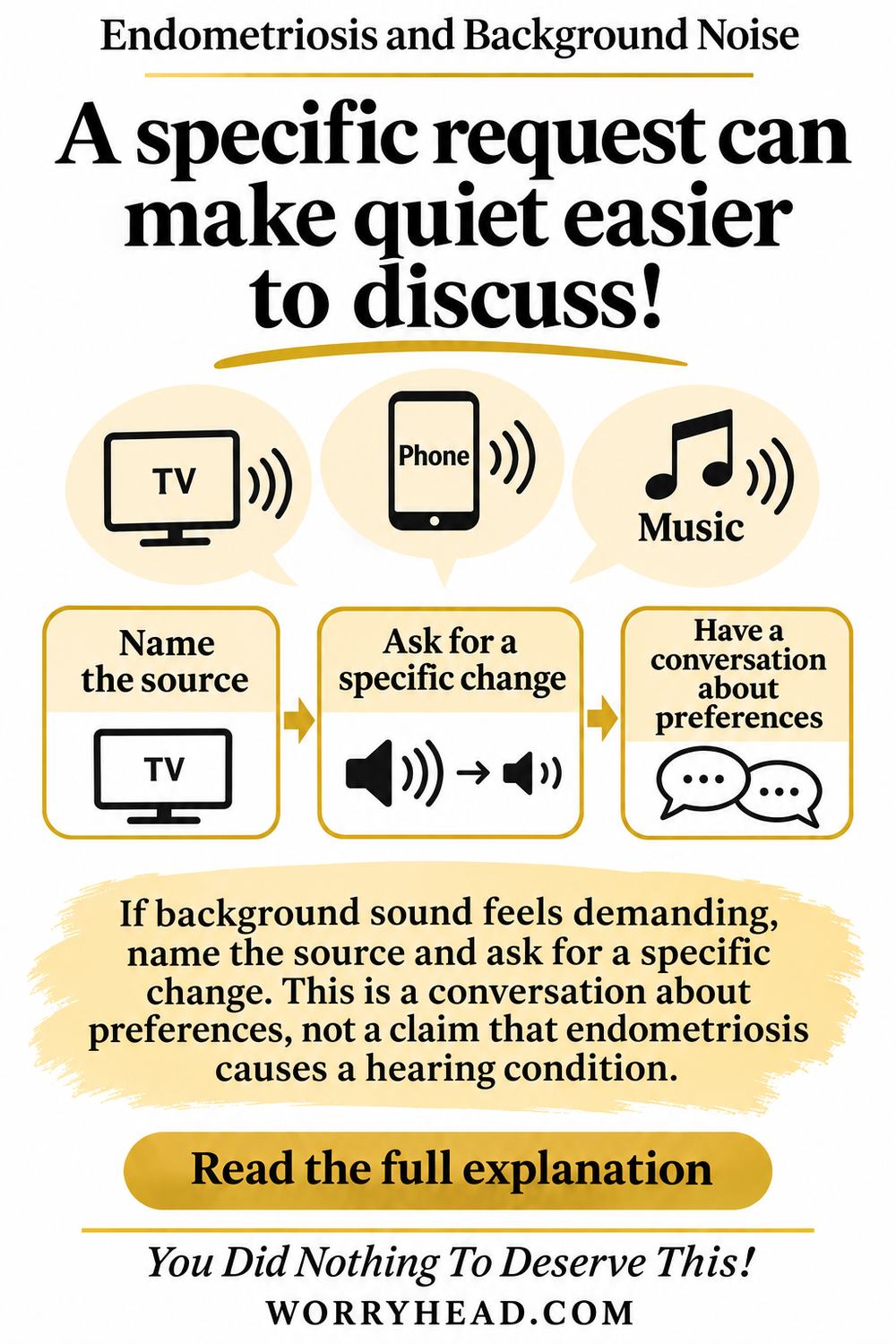
You can ask for less background noise by naming the sound, the change you want and the time it would help. A quieter room is a practical preference to discuss, not something you must earn. Agree an arrangement that respects shared space, and distinguish wanting less noise from wanting less company.
I am a husband, blogger and researcher, not a clinician. These practical reflections come from years of learning alongside my wife, with the communication resources I used listed below.
This is a small, everyday part of the mental toll of endometriosis. The focus is asking for quiet at home, not explaining a hearing condition or claiming that endometriosis causes a particular response to sound.
If you often make your needs smaller to keep the peace, my free eBook, You Did NOTHING To Deserve This!, may offer some understanding. You can value the people around you and still want the room to feel less demanding.
You Did NOTHING To Deserve This!
Endometriosis Validation for Women with Endo

- What Endometriosis and Background Noise Mean in Your Home
- Discuss Endometriosis and Background Noise Through a Specific Request
- Quiet Is Not Rejection in Endometriosis and Background Noise
- Where Endometriosis and Background Noise Meet Shared Space
- Endometriosis and Background Noise Need Not Mean Repeated Negotiation
- When Endometriosis and Background Noise Lead to Disagreement
- Keep Choice at the Centre of Endometriosis and Background Noise
- Final Word on Endometriosis and Background Noise
- You Did NOTHING To Deserve This!
- FREE eBook
What Endometriosis and Background Noise Mean in Your Home
“Everything is too loud” may describe the moment accurately, but it can leave the other person unsure what to change. If you can, identify the sound that is bothering you: a television nobody is watching, a phone playing videos, music over a conversation or several things happening at once. Specificity gives the request somewhere practical to go.
You do not need to explain why that sound feels different today. The purpose of the conversation is to discuss a manageable change in a shared environment. People can have preferences about volume, timing and competing sounds without proving a universal rule about how everyone with the same illness should feel.
Notice whether you want less sound, fewer simultaneous sounds or a break from conversation. Those are different requests. Turning off the television may help with one situation, while moving a phone call to another room may address another. If you are not sure, you can suggest trying one small change and seeing whether it suits you.
As a husband, I would rather hear “Could we turn that down?” than expect my wife to wait until she can deliver a complete explanation. A shared home should allow ordinary requests. Listening to one does not require me to agree that the sound would bother me in exactly the same way.
Discuss Endometriosis and Background Noise Through a Specific Request
A useful request can name the sound, the change and the immediate context. “Could you turn the television down while we talk?” is clearer than hoping someone notices that you keep losing the thread. “Would you use headphones for that video?” offers a possible adjustment without telling the other person they must stop enjoying it altogether.
If timing matters, make it concrete without promising more than you know. You might ask for a quiet room while you rest or for music to pause during a conversation. You can say you will check in later rather than giving an exact time if you do not know when you will want the arrangement to change.
Use wording that fits the relationship. Some households prefer a straightforward “Please lower that”; others find a fuller explanation useful. You do not need to apologise repeatedly before making a reasonable request. Courtesy can be brief, and a need does not become more legitimate because you present it in the most agreeable possible tone.
The other person can ask a practical question too: “Would lower volume be enough, or do you want it off?” That should help clarify the request rather than become a cross-examination. If the first change does not fit, you can revise it together without treating the attempt as a failed test of whether you really needed quiet.

Quiet Is Not Rejection in Endometriosis and Background Noise
Someone close to you may hear a request for quiet as a request for them to leave. If that is not what you mean, say so. “I would like your company; I just do not want the television on as well” keeps the relationship and the sound separate. It can prevent an assumption from becoming a hurt feeling neither of you intended.
You might enjoy sitting together while each person does something quietly. You might prefer a short conversation followed by time alone. You may want no company at that moment. These are different preferences, and none needs to be disguised as another to avoid disappointing someone. An accurate request gives the other person a better chance of understanding.
If you do want time alone, make the boundary about the present situation rather than issuing a judgement on the relationship. “I need some quiet by myself now; I will let you know when I want to talk” may fit. Only promise a later conversation if you intend to have it and can discuss a realistic arrangement.
Relate’s communication guidance encourages couples to make time to speak without interruption. That is useful context for separating a conversation from the background around it. It does not mean every room must be silent or that one person should always control the environment. The aim is a workable exchange in which both people can say what they need.
Where Endometriosis and Background Noise Meet Shared Space
A shared home contains different routines, preferences and responsibilities. Someone may need to take a work call, practise an instrument or help a child with an activity. A request for quiet can sit alongside those realities. Start by identifying which sounds are optional now and which require a more thoughtful arrangement.
Where space allows, different activities can happen in different rooms. Where it does not, timing or headphones may be more realistic. These are possibilities, not assumptions about what you can afford or how much room you have. A useful plan starts with the home you actually live in rather than an idealised layout.
Consider who keeps having to move. If the person asking for quiet is always sent elsewhere, the arrangement may begin to feel like exclusion from the shared space. There may be good practical reasons on a particular occasion, but it is worth noticing the pattern. A conversation about fairness can include whose preferences are being treated as the default.
Likewise, quiet should not become a rule that prevents everyone else from using their home. Try to define the request closely enough that people know what has been agreed. “No phone videos in this room while we talk” is a different arrangement from an unspoken expectation that nobody may make any sound whenever you are present.
Endometriosis and Background Noise Need Not Mean Repeated Negotiation
If the same issue happens often, a small household agreement may save repeated negotiation. Perhaps the television stays off unless someone is watching it, or phone videos use headphones in shared rooms. Choose an agreement both people understand rather than relying on one person to notice, ask and explain every time.
Keep the rule easy to remember and possible to revise. You do not need a detailed chart of permitted sounds. One or two clear habits may be enough for the specific problem you have identified. If the arrangement creates a different difficulty, talk about that openly instead of treating revision as evidence that the original request was unreasonable.
It can help to distinguish routine preferences from a request that is unusual for that day. A short phrase such as “Could we make this a quieter evening?” can signal that you want to discuss a temporary change. Agree what that phrase means together; do not assume the other person can infer an entire plan from it.
I would also want to remember the agreement myself. If I have agreed to use headphones, my wife should not have to become the person who reminds me every time a video starts. Practical support includes noticing my own habits and following through on a small change without turning it into another responsibility for her.

When Endometriosis and Background Noise Lead to Disagreement
Sometimes the other person will not understand why the sound matters. You can acknowledge that it may not bother them while keeping your request intact. “I know it feels quiet enough to you. It is still more than I want right now” describes a difference without claiming that one of you must be wrong about your own experience.
If they cannot make the requested change, ask what is possible. A call might need to continue, but the speakerphone could be turned off. Music practice might have an agreed end time. A task might be moved later. A clear limit and a practical alternative give you more information than a dismissive “you are too sensitive”.
Relate advises choosing a time when both people can focus if a discussion is becoming an argument. For a recurring household issue, that may mean separating the immediate request from the wider conversation about habits. You can ask for a small change now and discuss the pattern later, when neither person is trying to talk over the sound itself.
You do not have to prove that quiet will solve the whole difficult day. A request can be worthwhile because it makes one part more comfortable for you. Equally, if reducing the noise does not feel useful after all, you can say that honestly. An adjustment is an option to explore, not a promise of a particular result.
Keep Choice at the Centre of Endometriosis and Background Noise
If you are supporting someone, ask before deciding that they need silence. Automatically turning everything off or sending people away can remove choices they still want. A person may enjoy music, conversation or a lively household at one time and prefer quiet at another. Let the current request guide you rather than creating a permanent identity around it.
Avoid using quiet as a reason to exclude the person from ordinary family life. They may want to stay in the room with one sound reduced, not be left alone elsewhere. Ask what kind of company feels welcome. The answer can be specific, and it can change without needing a defence of every previous preference.
You can also check whether a proposed solution actually fits. Headphones may suit the person watching a video; they should not automatically become something the person asking for quiet must buy or wear. Keep responsibility connected to the activity where that is practical, and discuss any limitations honestly.
The larger point is ordinary respect. You do not have to share the same preference to take it seriously. A home can make room for requests, limits and compromise without turning every adjustment into a judgement about who is difficult, who is caring or whose way of using the room should always win.
Final Word on Endometriosis and Background Noise
You can ask for a quieter room in plain words. Name what you want changed, explain the practical context if useful and leave room for an arrangement that works for the people sharing the space. Wanting less sound does not have to mean wanting less connection.
Start with the specific moment rather than a case you must prove about your whole life. My free eBook, You Did NOTHING To Deserve This!, is there if making ordinary requests has started to feel like asking too much. Your preferences are allowed to be part of the conversation.


About Me
Hi, I’m Lucjan! The reason why I decided to create this blog was my beautiful wife, who experienced a lot of pain in life, but also the lack of information about endometriosis and fibromyalgia for men…
READ MORE
Grab a FREE eBook!
“You Did NOTHING To Deserve This!”
Finally hear the words nobody ever said to you, that your pain is real, your tears make sense, and you did nothing to deserve endometriosis, the dismissal, or the way it has rewritten your life.
Related Questions You May Be Asking About Endometriosis and Background Noise
Does Wanting Quiet Mean Endometriosis Has Caused a Sound Problem?
This article does not make that claim. It concerns everyday preferences and household communication, not identifying the cause of a response to sound or assessing a hearing condition.
What if I Want Company without Conversation?
You can say exactly that. Sitting together quietly is one option if it suits both people. Ask for the kind of company you want rather than assuming quiet must mean being alone.
Do We Need a Permanent Quiet-time Rule?
Only if you both find one useful. A temporary request may be enough. If the same difficulty keeps returning, a simple agreement can be discussed and revised together.
Endometriosis and Background Noise References
- https://www.relate.org.uk/get-help/trouble-communicating
- https://www.relate.org.uk/get-help/we-cant-stop-arguing
