Endometriosis and Receiving Compliments: When Looking Lovely Is Mistaken for Feeling Well
Have you ever enjoyed a compliment and then worried that accepting it would make your pain harder to explain? Endometriosis and receiving compliments can bring mixed feelings when “you look lovely” quietly becomes “you must be better”. You are allowed to appreciate being noticed without letting an observation about your appearance rewrite what you are experiencing.
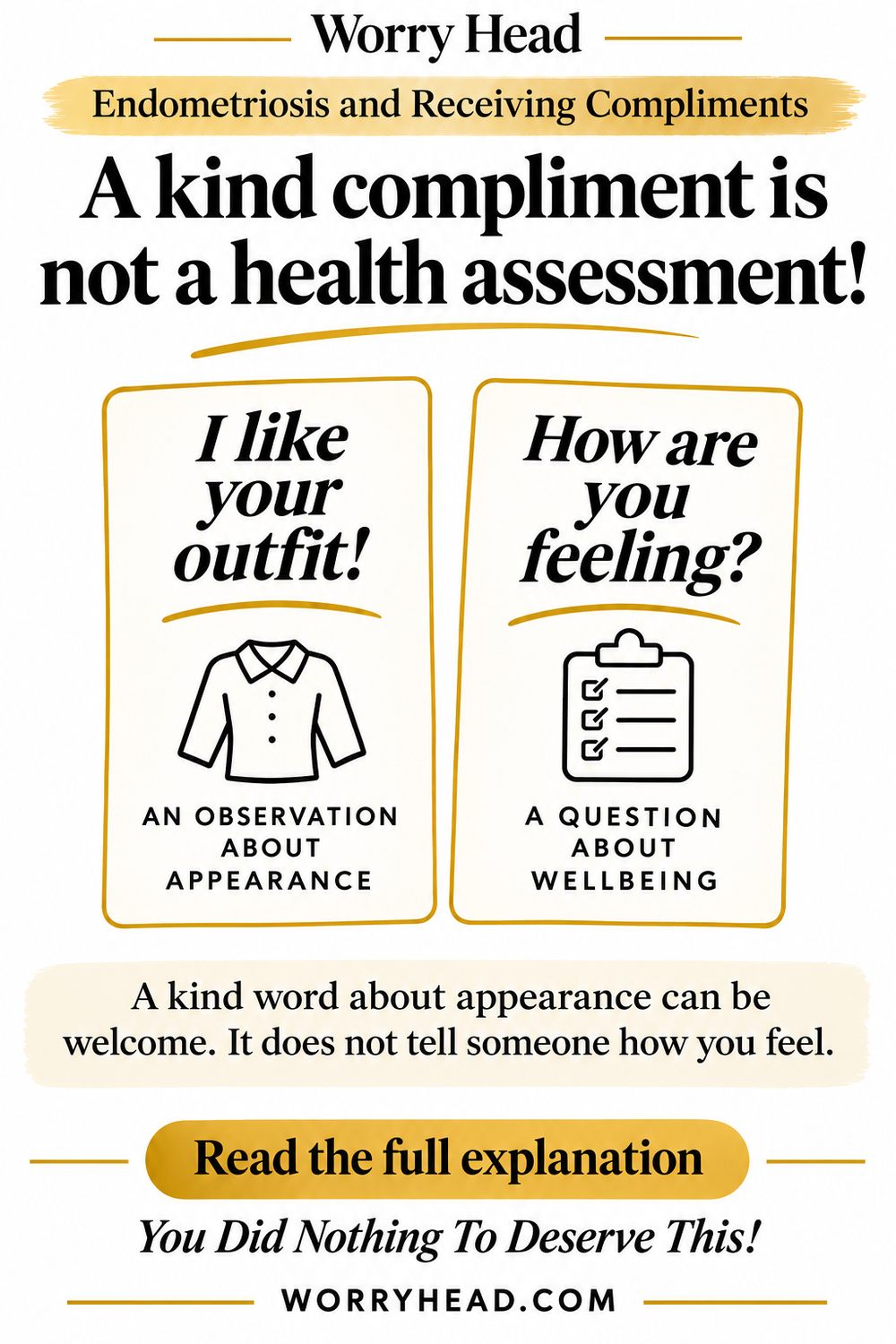
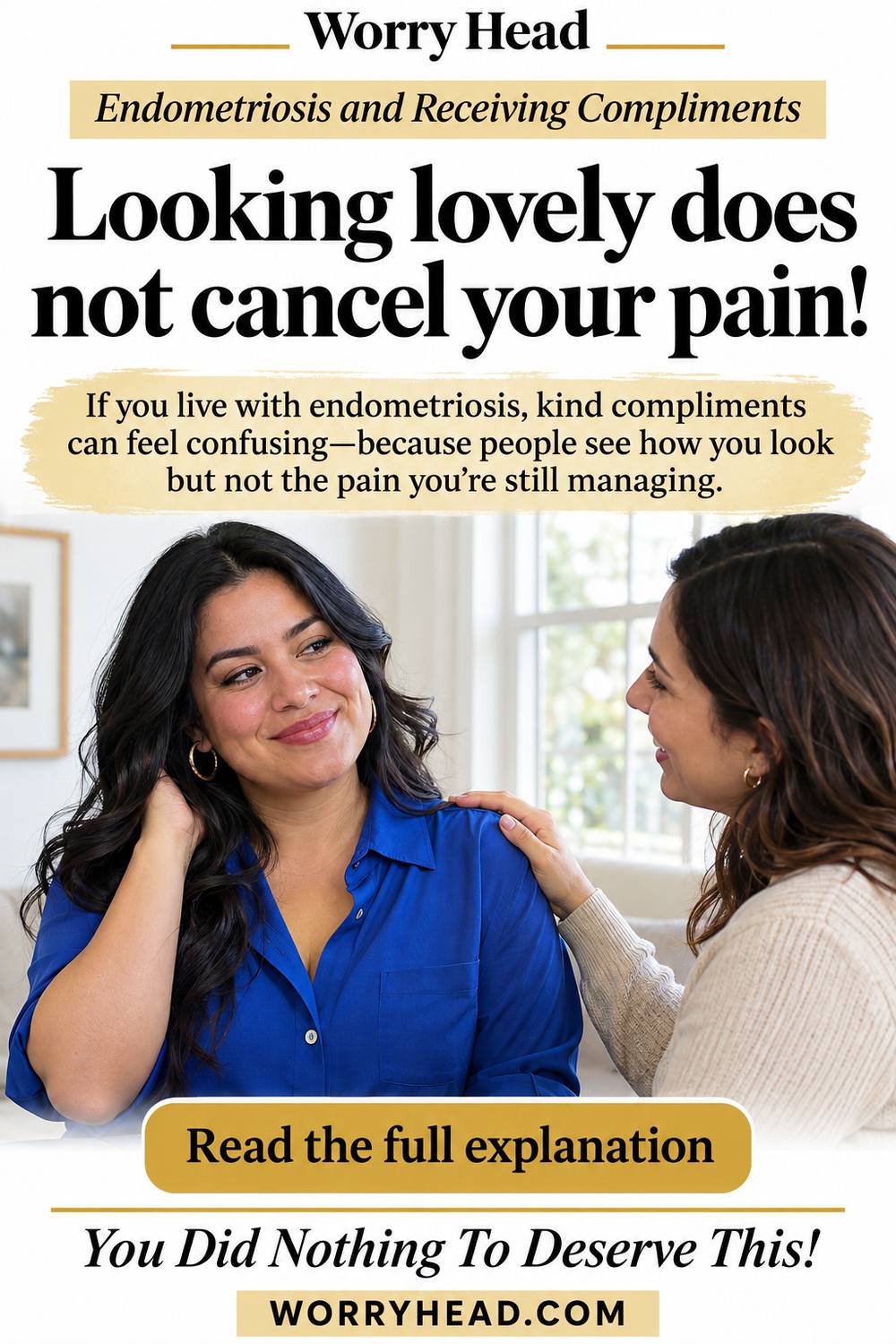
You can accept a compliment without confirming that you feel well. A kind observation about your appearance and an honest account of your needs can exist together. Thank someone if you want to, clarify any mistaken assumption and keep the health details private when you do not wish to explain more.
I write as a husband, blogger and researcher, not a clinician, drawing on years alongside my wife. The sources below support the wider relationship context; the suggested wording is offered as practical reflection.
This article develops one everyday part of looking fine with endometriosis when you are not. It focuses on appearance-based compliments, especially when you want to enjoy a kind moment without being mistaken for someone who no longer needs support.
If being seen and being believed sometimes pull in different directions, my free eBook, You Did NOTHING To Deserve This!, offers understanding. You do not have to choose between feeling attractive and being taken seriously.
You Did NOTHING To Deserve This!
Endometriosis Validation for Women with Endo
- Why Endometriosis and Receiving Compliments Can Bring Mixed Feelings
- Where Endometriosis and Receiving Compliments Meet Assumptions
- Keep Your Response Small with Endometriosis and Receiving Compliments
- Endometriosis and Receiving Compliments Should Not Remove Support
- Discuss Endometriosis and Receiving Compliments with Someone Close
- What Endometriosis and Receiving Compliments Ask of the Listener
- Endometriosis and Receiving Compliments Can Coexist with Feeling Unwell
- Final Word on Endometriosis and Receiving Compliments
- You Did NOTHING To Deserve This!
- FREE eBook
Why Endometriosis and Receiving Compliments Can Bring Mixed Feelings
A compliment can be welcome, uncomfortable or both. Perhaps you enjoyed choosing an outfit and are pleased someone noticed. Perhaps the effort involved was considerable, and the comment feels disconnected from the day you are having. You do not need to settle on a single correct emotion before responding.
Endometriosis UK’s couples resource recognises that body confidence can be affected in the context of relationships. That does not tell us how any particular compliment will land. It does remind us to leave room for a person’s own relationship with their body rather than assuming that praise always has one simple, positive effect.
It may help to identify the part that feels difficult. Is the comment itself unwelcome, or are you anticipating what might follow? “I love that colour on you” may feel different from “you look so healthy now”. The first notices a detail; the second draws a conclusion that the speaker may not be able to make.
You are also allowed to enjoy the compliment without analysing it. Not every kind exchange needs to become a conversation about illness. The aim is to protect your choice, including the choice to smile, say thank you and continue with the day without providing a balancing account of what hurts.
Where Endometriosis and Receiving Compliments Meet Assumptions
An observation concerns what somebody can see: your clothes, haircut, expression or style. An assumption goes further and decides what that appearance means about your health or capacity. Keeping those apart can make the conversation clearer without requiring you to reject the kindness in the original comment.
For example, you might say, “Thank you, I like this outfit too. I am still having a difficult day physically.” Both sentences can stand. You do not have to undo the first one to make the second believable. Looking a way you enjoy does not create a promise about what you can manage afterwards.
If someone says, “You must be feeling better,” you can answer the assumption directly: “I am glad to see you, but my appearance does not tell the whole story.” Add more only if you want to. The other person may simply have used an easy social phrase without thinking through the conclusion it carried.
Sometimes no assumption has actually been made. If you find yourself preparing a defence after a straightforward compliment, pause and notice that possibility too. You may be responding to earlier experiences rather than the present person’s words. That does not make the feeling wrong; it gives you another option besides explaining yourself automatically.
Keep Your Response Small with Endometriosis and Receiving Compliments
You do not need an elegant speech. “Thank you” can be complete. So can “That is kind of you” or a smile if speaking feels like more than you want to do. Accepting a compliment does not sign away your right to ask for a seat, leave early or change a plan later.
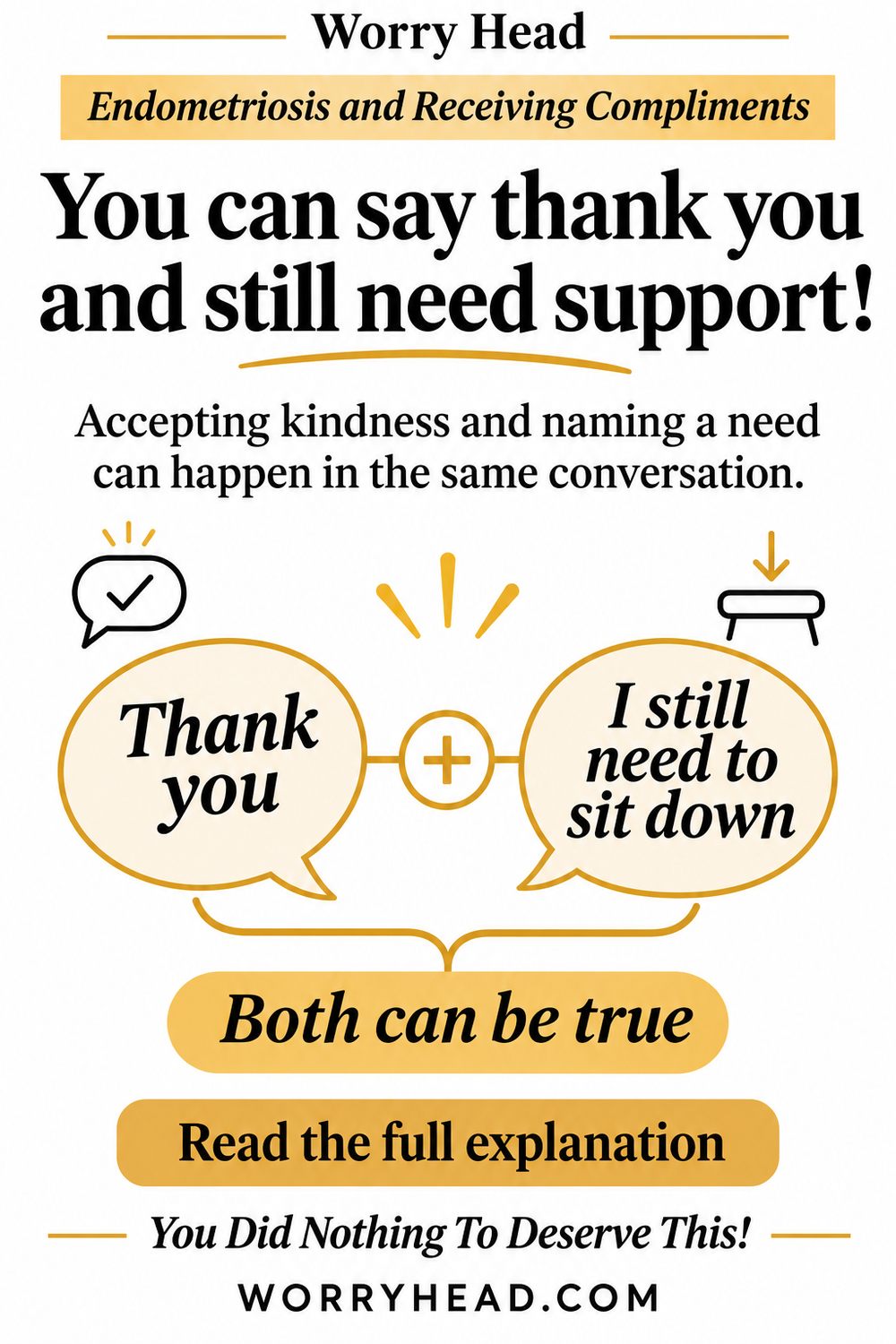
If a practical clarification matters immediately, attach it to the present situation. “Thank you. I still need to sit down for this conversation” is short and useful. It keeps the compliment and the need alongside each other, instead of inviting a debate about whether a person who looks well should require that adjustment.
When you would rather avoid health details, try “I appreciate that; appearances are only part of the picture.” You can then move the conversation to something else. A boundary can be warm, direct or very brief. It does not have to carry enough explanation to satisfy every possible follow-up question.
If you freeze or respond in a way you later dislike, you have not failed. Social exchanges happen quickly. You can clarify later if it matters, or let a minor moment pass. The goal is not to become flawless at receiving praise while managing an illness; it is to have a few options that feel like yours.
Endometriosis and Receiving Compliments Should Not Remove Support
The most difficult part may come after the compliment. Someone who had offered help may assume you no longer need it, or a shared plan may quietly become more demanding. Address that change directly. “I am glad I look brighter, but I still need the help we agreed” keeps the practical arrangement visible.
Try not to feel obliged to make yourself appear more unwell to preserve support. You should be able to wear makeup, choose a favourite dress or laugh at a joke without worrying that these choices invalidate your next honest sentence. Support can respond to what you report and what you have agreed, rather than a visual impression alone.
If someone genuinely wants to know whether the plan has changed, they can ask. “Would you still like me to carry that?” is more useful than silently deciding that you look capable enough. The answer may be yes or no. Asking leaves the decision with you instead of making appearance the deciding factor.
As a husband, I would want a compliment to add something kind to the day, not remove something necessary. I can appreciate how my wife looks and still listen carefully to what she says she needs. Those are compatible forms of attention; one should not replace the other.
Discuss Endometriosis and Receiving Compliments with Someone Close
With someone close to you, you can explain what kinds of comments feel welcome. You may enjoy hearing about your style, humour, ideas or the way you have expressed yourself. You may prefer less attention to your body. There is no universal rule that every person with endometriosis will share.
Be specific if that makes the conversation easier: “I like hearing that you enjoy my outfit. I find comments about looking recovered harder, because they suggest something about my health.” This gives the person information they can use without requiring them to guess which part of a familiar phrase has become uncomfortable.
You can change your preference. A comment that felt reassuring at one point may feel intrusive later, and the reverse can happen too. Close relationships can make room for updated information. You do not need to defend the change as perfectly consistent with every response you have given in the past.
Avoid turning this into a compulsory list of approved phrases for every acquaintance. It may be worth a fuller conversation with a partner or friend who repeatedly makes an assumption. With a passing interaction, a short reply may be enough. Spend your explanation where it is useful to you, not simply where somebody expects access to it.
What Endometriosis and Receiving Compliments Ask of the Listener
If you are offering a compliment, keep it honest and specific. You might appreciate someone’s choice of colour, a thoughtful observation or something they have made you laugh about. There is no need to attach a prediction about recovery, a comparison with how unwell they looked before or an assessment of how well they are coping.
Let the person receive it in their own way. A quiet response does not necessarily mean your comment failed, and you do not need to demand that they believe it. “You never accept compliments” can turn a kind intention into pressure to perform gratitude. Offer the thought, then allow them room.
You can also ask how they are feeling as a separate question. Keep the answer open rather than leading with “You look better, so you must be feeling good.” The separation matters because it allows their account to differ from your impression. You are learning about their experience instead of asking them to confirm your guess.
I would want to keep noticing the whole person without making every conversation about appearance or illness. Curiosity about an opinion, an interest or an ordinary part of the day can offer another kind of recognition. A person can be seen in many ways, including on days when they would rather not discuss their body at all.
Endometriosis and Receiving Compliments Can Coexist with Feeling Unwell
After repeated disbelief, enjoyment itself can start to feel risky. You may worry that looking pleased, dressing up or accepting praise will be used as evidence against a later need. That is a difficult position to be in. You should not have to make your outward presentation into a continuous demonstration of illness.
If you want to enjoy a compliment, you can let it belong to the part of life it actually describes. Someone liked your earrings. A friend noticed your haircut. Your partner found you attractive. None of those observations has to become a statement about symptom severity or a prediction about the rest of your week.
Equally, you do not have to find a positive lesson in an uncomfortable exchange. You can decide that a particular person is not someone with whom you want to discuss health or appearance. You can keep a response brief and move towards company that makes fewer assumptions. Your choice of conversation is part of your privacy.
There is room for a simple middle ground: accept what feels kind, correct what is inaccurate and leave the rest alone. Some days you may do only one of those things. You are not responsible for turning every social moment into a perfectly balanced account of beauty, pain, gratitude and resilience.
Final Word on Endometriosis and Receiving Compliments
You can look lovely and need support. You can enjoy being noticed and dislike an assumption that follows. A compliment does not require you to confirm that you are well, and an honest account of difficulty does not require you to reject every kind observation.
Keep the distinction close: appearance is something another person observes; your experience is something you get to describe. My free eBook, You Did NOTHING To Deserve This!, offers more understanding if being seen has too often meant being misunderstood.


About Me
Hi, I’m Lucjan! The reason why I decided to create this blog was my beautiful wife, who experienced a lot of pain in life, but also the lack of information about endometriosis and fibromyalgia for men…
READ MORE
Grab a FREE eBook!
“You Did NOTHING To Deserve This!”
Finally hear the words nobody ever said to you, that your pain is real, your tears make sense, and you did nothing to deserve endometriosis, the dismissal, or the way it has rewritten your life.
Related Questions You May Be Asking About Endometriosis and Receiving Compliments
Is It Dishonest to Say Thank You When I Feel Unwell?
No. You are acknowledging a compliment, not confirming a medical conclusion. You can thank someone and still describe your needs accurately whenever that becomes relevant.
What if I Genuinely Like Comments about My Appearance?
That is your preference to have. This is not a rule against compliments. It is about keeping them separate from assumptions and allowing you to decide what feels welcome.
Do I Need to Correct Every “you Look Well”?
No. Consider whether the assumption affects anything important to you. You may clarify a practical need, offer a brief reply or leave a passing comment alone.
Endometriosis and Receiving Compliments References
