Is It Your Fault Endometriosis Was Diagnosed So Late?
Have you ever wondered whether it is your fault endometriosis was diagnosed so late, especially after spending years trying to make sense of symptoms nobody seemed able to explain?
You may be replaying old appointments, the times you stayed home instead of asking again, the pain you dismissed because somebody had taught you it was “normal”, or the moments you wondered whether you should have fought harder. And when a diagnosis finally gives those years a name, hindsight can make you judge the younger version of yourself with knowledge she simply did not have.
No. A late endometriosis diagnosis is not your fault. Delays often result from symptoms being normalised or mistaken for other conditions, limited awareness, test limits, referral and waiting-time barriers, and years of being dismissed. You were responsible for surviving, not diagnosing yourself.
I am not a clinician; I write as a husband, blogger and researcher who began studying this because of what my wife lived through, and at the bottom I have listed the WHO, NICE, NHS, ESHRE and published research I used whenever I explain medical or health context.
And if those lost years have made you question yourself far beyond the timing of your diagnosis, I want you to understand why none of this began with you, because having endometriosis and having it recognised late are two different burdens, and neither says anything about your worth or character.
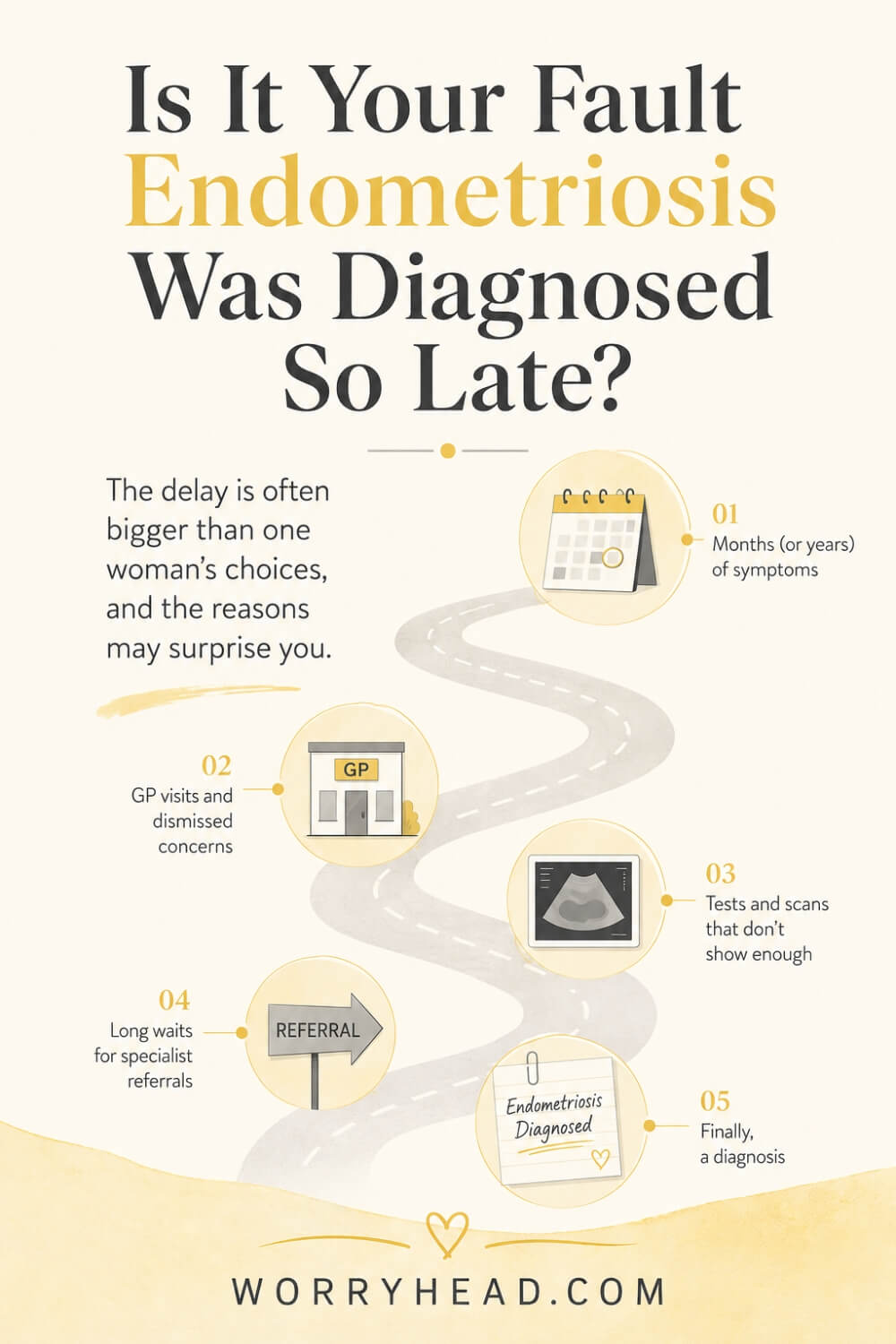
Here is something I wish more women were told: diagnostic delay does not run on one single clock. In an international study involving 2,017 respondents from 63 countries, the average time between symptom onset and first presenting symptoms to a doctor was 3.7 years, but the average healthcare-related delay after that first presentation was another 5.8 years.
Even after you ask for help, a normal examination or ultrasound does not automatically rule out endometriosis; NICE specifically warns against excluding the condition on that basis, while ESHRE explains that ultrasound and MRI cannot detect every lesion. In a UK survey of 4,371 diagnosed people, 47% said they had visited their GP ten or more times with symptoms before diagnosis, which is why I struggle with the idea that a woman should look backwards and punish herself with the question, “Why didn’t I just go sooner?”
With my wife, I watched symptoms and their consequences pile up for years before we properly understood how much endometriosis was affecting her life, and I know how tempting it is to look backwards once you finally know more and think about everything you might have recognised sooner. But loving her taught me something I want you to give yourself too: you cannot fairly judge the woman you were then using information, understanding and answers you only received later.
What I want you to understand next is where responsibility for those lost years really sits, what can quietly stretch the road to diagnosis, and why recognising those forces can help you look back at your younger self with far less blame and far more fairness.
- Why It Is Not Your Fault Endometriosis Was Diagnosed So Late?
- Why You May Think It Was Your Fault Endometriosis Was Diagnosed So Late?
- How Believing It Was Your Fault Endometriosis Was Diagnosed So Late Affects Your Relationship?
- When to Seek Medical Help?
- Questions to Ask Your Doctor
- Final Word on Whether It Was Your Fault Endometriosis Was Diagnosed So Late?
- FREE eBook
Why It Is Not Your Fault Endometriosis Was Diagnosed So Late?
If you still catch yourself wondering whether it was your fault endometriosis was diagnosed so late, I want you to separate what you knew then from what medicine knows now. Endometriosis does not arrive with one unmistakable warning sign; it can show up through painful periods, pelvic pain, pain during sex, bowel or bladder symptoms, fatigue, or fertility problems, and several of those symptoms overlap with other conditions.
The NHS specifically notes that symptoms can resemble adenomyosis, fibroids, pelvic inflammatory disease and irritable bowel syndrome, which helps explain why the first label you are given may not be the final one.
That overlap can send you through different doors in healthcare instead of along one clean path to gynaecology.
One appointment may focus on bowel pain, another on bleeding, another on urinary symptoms, and nobody initially sees the whole pattern that you have been living inside every day. A 2025 systematic review found that diagnostic delay is shaped by patient-related, clinician-related and healthcare-system factors, so reducing years of uncertainty to one woman’s choices is simply not supported by the evidence.
Researchers have repeatedly identified symptom normalisation, stigma, limited awareness, misdiagnosis, gaps in clinician knowledge and system barriers as contributors to delay. A separate systematic review found that although delays can occur before and after someone seeks care, longer delays were typically found on the physician side of the pathway. That does not mean every clinician fails you; it means the evidence itself does not support placing the whole burden of a late diagnosis on your shoulders.
Age can make recognition harder too, because symptoms may begin in adolescence, when severe menstrual pain is especially easy to dismiss as a difficult but normal period.
ESHRE now includes specific guidance for adolescents and young adults, reflecting the need to consider endometriosis earlier rather than waiting until years of symptoms have accumulated. I think that matters emotionally because many women are eventually diagnosed as adults and then look back at their teenage selves as though that frightened young woman should somehow have known what experienced professionals did not yet recognise.
The diagnostic pathway itself is also more nuanced than the old idea that one test will give a simple yes or no answer. ESHRE’s current guideline changed the role of diagnostic laparoscopy, while NICE advises that a normal examination or ultrasound should not close the door on endometriosis when symptoms still point towards it. NICE also recommends that investigation, referral where needed and initial treatment can happen in parallel rather than making you complete one step before the next begins.
That matters because taking painkillers, trying hormonal treatment, accepting an early alternative diagnosis, or trusting a reassuring scan does not make you responsible for a disease remaining unrecognised. You were allowed to trust the information you were given at the time, especially when you were exhausted, frightened or simply trying to get through another painful month. The fairer question is not “Why didn’t I diagnose this sooner?” but “What information, recognition and access would have helped me get the right answer sooner?”
I have had to learn this personally, watching my wife live through years of symptoms before we understood how much endometriosis had been shaping her life. There are moments I wish I could stand beside the younger version of my wife and tell her that the pain she was learning to live around deserved answers, and that she never had to earn the right to be believed. I cannot give those years back to her, but I can help you protect what comes next, and these are the practical things I wish every woman had when self-blame starts creeping in:
- Stop Blaming Your Younger Self
- Separate Symptoms from Personal Failure
- Build a Clear Symptom Timeline
- Track Patterns Instead of Guessing
- Ask What Normal Tests Miss
- Request Referral When Symptoms Persist
- Bring Someone Who Knows You
- Name Dismissal When It Happens
- Protect Yourself After Diagnosis

Stop Blaming Your Younger Self
You cannot ask the younger version of yourself to have recognised a disease you had never been taught to recognise. She only knew what she was told, what she had seen around her, and what she was able to cope with at the time. If painful periods had been described as normal, if you were told to toughen up, or if every appointment ended without answers, it made sense that you learned to doubt yourself before you learned to question the system around you.
When guilt appears now, answer it with the facts you actually had then. You did not have today’s knowledge, the benefit of hindsight, or a confirmed diagnosis sitting in front of you. I have looked back at my wife’s earlier years and wished we had understood more, but wishing is not the same as blame. The woman you were deserved guidance, not judgement, and the kindest thing you can do now is stop punishing her for surviving with incomplete information.
Separate Symptoms from Personal Failure
Pain can change the way you see yourself if it keeps interfering with work, relationships, sex, sleep, exercise, plans and ordinary daily life. After enough cancelled days, unfinished tasks or moments when your body forces you to stop, it is very easy to turn a physical problem into a character judgement and start calling yourself weak, unreliable or difficult. None of those words explain what was happening inside your body.
Try to describe the symptom before you describe yourself. Instead of saying, “I was lazy”, say, “I was exhausted and in pain”; instead of “I overreacted”, say, “the symptom was severe enough to frighten me”. That small change matters because language can either deepen shame or help you see your history more accurately. I have watched my wife judge herself for things her body simply would not allow, and I learned that compassion begins when we stop confusing limitation with failure.
Build a Clear Symptom Timeline
A symptom timeline can give shape to years that otherwise feel like one long blur of pain, appointments and unanswered questions. Start with the earliest symptoms you remember, then add changes in periods, pelvic pain, bowel or bladder problems, pain with sex, fertility concerns, time off work, emergency visits, scans, treatments and referrals. You do not need perfect dates; even approximate ages, school years, jobs or life events can help you place things in order.
This is not about proving that you were ill enough or building a case against anybody. It is about helping you and your clinician see patterns that may have been scattered across different records and different stages of your life. When I think about my wife’s story, individual symptoms once looked disconnected, but the timeline makes the accumulation much harder to ignore. Seeing it on paper can also remind you how much you carried before anyone gave it a name.
Track Patterns Instead of Guessing
Your memory is not a medical chart, especially when pain, fatigue, stress and poor sleep have been part of life for a long time. A simple symptom diary can help you notice when pain appears, where it is felt, what makes it worse, whether it changes around your cycle, and how it affects eating, bowel movements, urination, sex, movement, sleep or work. Keep it realistic enough that you will actually use it rather than turning it into another exhausting job.
Patterns can make conversations with clinicians clearer because you are bringing more than a vague memory of “bad pain”. You may notice that a symptom is cyclical, that certain days consistently disrupt your life, or that several symptoms rise together. My wife taught me how easy it is to normalise what happens repeatedly; once something becomes routine, you stop realising how abnormal the burden has become. Tracking gives you a way to see your own experience from the outside.
Ask What Normal Tests Miss
A reassuring test result can feel like good news, but it can also leave you confused when your symptoms are still very real. If an examination, ultrasound or other investigation is reported as normal, ask what that test was designed to detect, what it cannot reliably exclude, and what the next step is if your symptoms continue. You are not challenging the clinician by asking; you are trying to understand the limits of the information in front of you.
I would also write the answers down, because it is difficult to remember everything when you are anxious or hurting. Ask whether the imaging was performed with endometriosis in mind, whether specialist assessment could add anything, and what symptoms would justify further review. One of the hardest traps is believing that “nothing showed up” means “nothing is wrong”. Your symptoms still deserve an explanation, even when the first investigation does not provide one.
Request Referral When Symptoms Persist
If treatment is not helping, symptoms are interfering with daily life, or you keep returning with the same unresolved problem, it is reasonable to ask what would justify referral to gynaecology or an endometriosis service. You do not have to wait until you are completely broken before asking for another level of assessment. Be specific about what the symptoms are stopping you from doing because function often tells the story more clearly than a pain score alone.
You can say that the problem is persistent, explain what has already been tried, and ask what the plan is if the current approach fails. If a referral is not recommended, calmly ask why and what review point has been set. I wish more women knew that persistence is not being difficult; sometimes it is simply what happens when a persistent condition has not yet been properly explained. Asking again does not make you demanding, it means the first answer has not solved the problem.
Bring Someone Who Knows You
Appointments can become strangely difficult when you have spent years explaining symptoms and still feel you need to sound calm, reasonable and believable. Bringing a partner, relative or trusted friend can help because that person may remember details you forget, take notes while you speak, or describe changes they have witnessed in your everyday life. Their role is not to speak over you, but to help make sure your voice does not disappear when you are tired, frightened or overwhelmed.
I have been that person beside my wife, and I know how different a symptom can look from the outside when you see what happens after the appointment, after the workday, or when the front door closes. A good supporter can say, “I see what this costs her,” when you are too used to minimising it yourself. If you go alone, you can still prepare notes beforehand, but you never have to prove strength by carrying every appointment alone.
Name Dismissal When It Happens
Dismissal is not always dramatic. Sometimes it is being interrupted before you finish, having severe pain reduced to “just periods”, being told stress explains everything without proper assessment, or leaving an appointment with no clear plan despite symptoms that continue to disrupt your life. When that happens, naming what you need can bring the conversation back to the problem without turning it into a confrontation.
You might say, “I understand that this may have several possible causes, but I am still living with symptoms that affect my daily life. What is the next step?” Ask for the reasoning behind the decision, what alternatives are being considered, and when you should return if nothing improves. I have seen how quickly repeated dismissal can make a woman start editing her own story. Please do not make yourself smaller to make an appointment easier for somebody else; your experience belongs in the room too.
Protect Yourself After Diagnosis
A diagnosis can bring relief, but it can also open a painful second chapter when you realise how long you lived without an explanation. You may feel angry, cheated, relieved, frightened and grateful all in the same week, and none of that means you are handling the diagnosis badly. Give yourself permission to process the lost time without making your entire future answerable to it.
Protecting yourself now can mean learning enough to make informed decisions, keeping copies of important records, asking questions before agreeing to treatment, finding clinicians you can communicate with, and allowing yourself to seek emotional support if the years before diagnosis still hurt. My wife cannot reclaim the years before we understood her endometriosis, and I cannot rewrite them for her. What I can do is stand beside her now, take her seriously, and remind her that late recognition never made her suffering less real.
Why You May Think It Was Your Fault Endometriosis Was Diagnosed So Late?
A late diagnosis does not end the moment a doctor finally says the word endometriosis. For many women, that moment begins another kind of reckoning, because the answer brings relief while also forcing you to look back at years that suddenly make painful sense. You may remember the school days, shifts, relationships, family occasions or ordinary mornings you pushed through because you believed everybody else coped better than you did.
It is also important not to turn that delay into another certainty you can use against yourself: endometriosis varies enormously, symptom severity does not neatly match the extent of disease, and nobody can look backwards and tell you with certainty exactly what an earlier diagnosis would have changed.
When you finally have a name for years of symptoms, it can be frighteningly easy to decide it was somehow your fault endometriosis was diagnosed so late. That thought can damage your trust in yourself long after the medical uncertainty has changed, because you start treating every past decision as evidence that you failed.
Yet hindsight is cruel precisely because it gives you today’s knowledge and then asks yesterday’s version of you why she did not use it. I have seen this kind of looking backwards in my wife, and it hurts because I know how hard she was already trying just to keep life moving. She was not sitting around ignoring her body; she was adapting to symptoms, working around pain and carrying on because life does not stop and hand you a medical textbook when something is wrong.
There were things we understood only later, and I can wish I had known more without turning that regret into an accusation against her or against myself. A delayed diagnosis can also affect the way you enter future appointments, because once you have spent years not being understood, you may become afraid that every new symptom will be doubted again. Some women become intensely alert to every change in their body, while others minimise symptoms because they have learned that speaking up does not always lead to answers.
Neither response makes you difficult; both can be understandable ways of protecting yourself after a long period of uncertainty. What matters now is rebuilding a relationship with your own judgement in which pain can be taken seriously without every sensation becoming a reason to panic.
If I could give my wife one thing from those earlier years, it would not be a perfect diagnosis date, because I cannot rewrite time; it would be the certainty that she never needed to prove her suffering to deserve care, tenderness and belief.

How Believing It Was Your Fault Endometriosis Was Diagnosed So Late Affects Your Relationship?
A late diagnosis can quietly enter a relationship because the years before it often taught you to apologise for needs that were never unreasonable. You may say sorry for cancelling plans, needing rest, avoiding sex when it hurts, asking for help, or becoming exhausted by things you once managed more easily. When that happens often enough, your partner may need to remind you that receiving support is not the same as becoming a burden.
I have seen this with my wife, and one of the things I had to learn was that loving her properly sometimes meant refusing to accept the harsh judgement she placed on herself. When she blamed herself for what her body could not do, I could see the effort behind the scenes that she could no longer recognise because pain had changed her measure of what counted as enough. The thought that it was your fault endometriosis was diagnosed so late can deepen that pattern because you may begin believing that your partner is now dealing with consequences you somehow caused.
From my side of our marriage, that is not how I see it at all. I do not look at my wife and calculate what life might have been like if she had recognised everything earlier; I look at the woman I love and think about how much she managed while living without the explanation she deserved. Supporting her means helping where I can, learning when she needs practical help and when she simply needs me to listen, and never making her feel that illness has reduced what she means to me.
That does not mean chronic illness never affects the healthy partner, because of course it changes plans, responsibilities, intimacy and the rhythm of a shared life. But there is an enormous difference between acknowledging those realities together and making the ill person feel guilty for them, and I believe good partners learn that difference. My wife and I cannot control everything endometriosis takes from an ordinary day, but we can control whether our home becomes another place where she has to defend herself.
For me, that is one of the most important lessons a late diagnosis has taught us: when medicine has already taken years to provide an answer, love should not demand another explanation from you before you are allowed to feel believed.
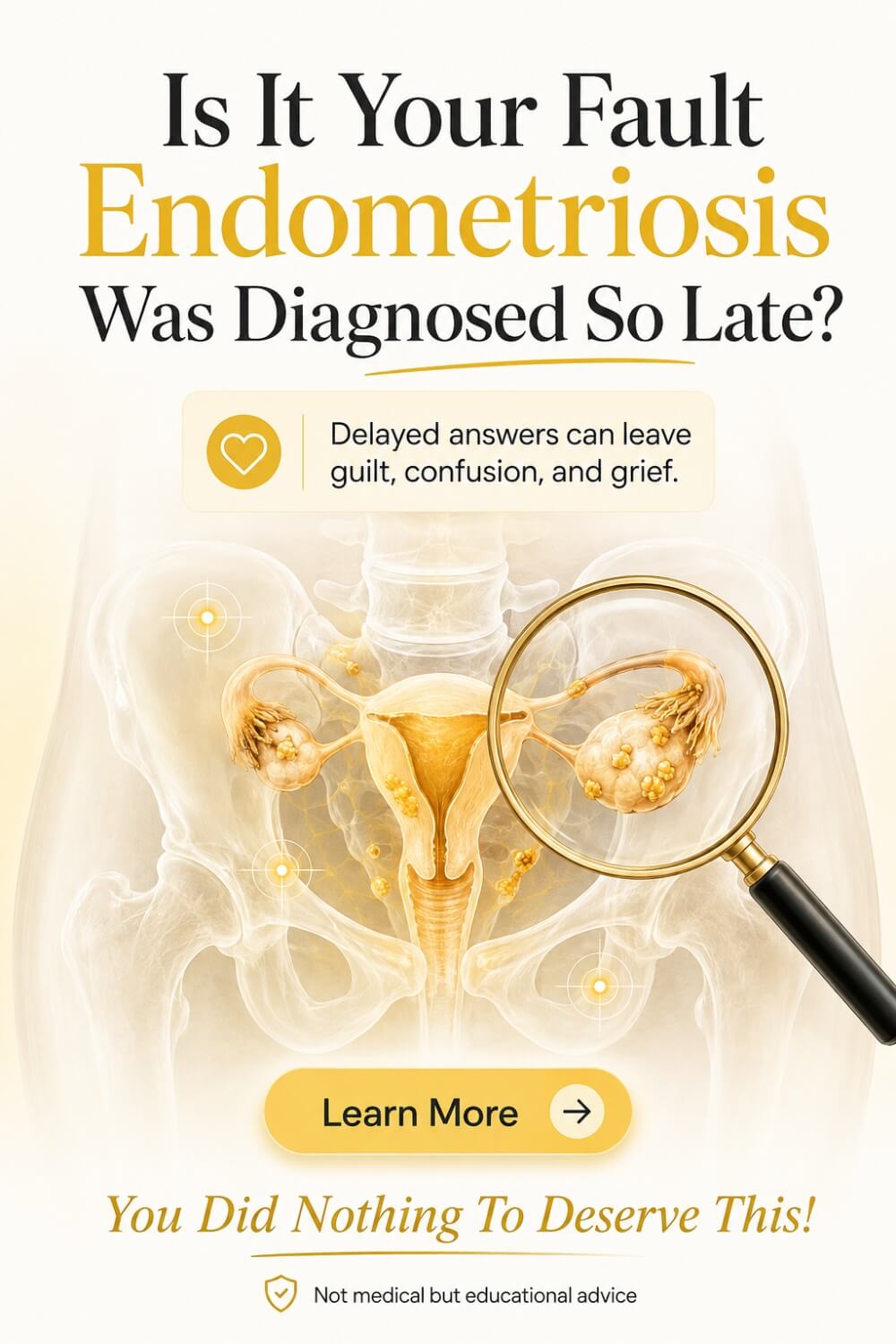
When to Seek Medical Help?
If reading about diagnostic delay has made you realise that you are still putting off symptoms because you are frightened of being dismissed again, please do not turn the past into another reason to wait. You do not need to reach some imaginary level of suffering before you are allowed to ask for medical help.
Book an appointment with your GP if pelvic pain, painful periods, pain during or after sex, bowel or bladder symptoms, heavy bleeding, fatigue or other symptoms are repeatedly affecting your work, sleep, relationships, movement or ordinary daily life. The NHS advises speaking to a GP when you have symptoms that could be endometriosis, while NICE guidance is clear that persistent or recurrent symptoms and symptoms affecting everyday life deserve further assessment.
Go into that appointment with one simple aim: describe what is happening to your life, not just how much it hurts. Saying, “My pain is seven out of ten” gives one piece of information; saying, “For two days every month I cannot stand long enough to cook, I miss work and pain wakes me during the night” shows what that pain actually costs you.
And please remember something especially important if you have already been investigated. A normal examination or ultrasound does not automatically exclude endometriosis. NICE specifically says that endometriosis should not be ruled out solely because the pelvic examination or ultrasound is normal, and referral may still be appropriate when symptoms continue.
If treatment has been tried but your symptoms remain difficult to manage, keep returning for review rather than assuming you simply have to tolerate them. Ask what the next step is, whether another explanation needs considering, and whether referral to gynaecology is appropriate. When an endometrioma or deep endometriosis involving areas such as the bowel, bladder or ureter is suspected, NICE recommends referral to a specialist endometriosis service.
There is also a difference between symptoms that deserve a routine medical appointment and symptoms that need urgent assessment. If pelvic pain suddenly becomes severe or is rapidly worsening, particularly if you feel faint, dizzy or collapse, have heavy vaginal bleeding, shoulder-tip pain, difficulty breathing or feel seriously unwell, seek urgent medical help rather than assuming it is simply another endometriosis flare. Those symptoms can have causes other than endometriosis that need prompt assessment.
If pregnancy is possible, new pelvic or lower abdominal pain with vaginal bleeding, dizziness, fainting or shoulder-tip pain also needs urgent medical advice because conditions such as ectopic pregnancy have to be considered. This is not something I say to frighten you. It is simply one of those situations where it is safer not to explain a new symptom away because you already carry an endometriosis diagnosis.
I would also speak to your GP if heavy periods have been going on for some time, are affecting your life, or are accompanied by severe pain, bleeding between periods, bleeding after sex, or pain with urination, bowel movements or sex. Heavy menstrual bleeding deserves assessment in its own right, including consideration of its cause and the effect ongoing blood loss may be having on you.
One thing my wife’s experience changed in me is how I think about asking for help. I no longer see another appointment as an admission that something has gone terribly wrong or as evidence that the previous appointment was pointless. Sometimes another appointment is simply the next piece of information needed to understand a complicated body.
So if part of you is thinking, “I waited too long before, perhaps I should just cope with this now”, I want you to challenge that thought. The fact that your diagnosis came late does not mean you should become responsible for recognising every future medical problem yourself. Your job is to notice when something is affecting you, describe it as clearly as you can and ask for help when you need it; diagnosing what is happening is not a burden you were ever supposed to carry alone.
Questions to Ask Your Doctor
After a late endometriosis diagnosis, appointments can feel different. You may know far more than you once did, yet still find yourself worrying that you will ask the wrong thing, take too much time, sound difficult, or discover that something important was missed again.
You do not need to walk into the room knowing medicine. Your job is to explain what you are experiencing and ask questions until you understand the plan. NICE guidance also makes clear that investigation and referral can continue even when an examination or ultrasound is normal, so a reassuring test result does not mean you have to stop asking why symptoms persist.
I would not try to ask every question below in one appointment. Pick the ones that match what is happening to you now, write them down beforehand, and leave space beside each one for the answer.
“Based on my symptoms and history, what do you think is happening now?”
This is a much better starting point than trying to prove how ill you are. It gives your doctor room to explain their current thinking and gives you something concrete to respond to. If several possible causes are being considered, ask which are most likely and why.
“Could any of my current symptoms still be related to endometriosis?”
Once you finally have a diagnosis, it can be tempting to attribute absolutely everything to it, but the opposite mistake can happen too. New or changing symptoms deserve proper consideration rather than automatically being dismissed as something you simply have to live with.
“Is there anything else that could explain these symptoms?”
I like this question because it keeps the conversation open. Endometriosis can overlap with other causes of pelvic, bowel, bladder or menstrual symptoms, and asking about alternatives does not undermine your diagnosis. It helps make sure another treatable problem is not hidden behind a condition already written in your notes.
“What did my scan actually show, and what could it not tell us?”
Do not be embarrassed to ask somebody to explain imaging in ordinary language. Ask where endometriosis was seen, whether an endometrioma or deep disease was suspected, whether anything else was found, and what the limitations of that particular investigation are. NICE specifically advises that endometriosis should not be excluded simply because examination and ultrasound findings are normal.
“Do my symptoms justify seeing an endometriosis specialist?”
This is particularly worth asking if symptoms continue despite treatment, significantly interfere with daily life, or there is concern about an endometrioma or deep endometriosis. Current NICE recommendations contain clearer referral pathways for these circumstances, including specialist services where appropriate.
“What are my treatment options, and what is each one trying to achieve?”
Do not settle for simply being given the name of a medication or procedure. Ask whether the aim is pain control, suppression of symptoms, management of fertility concerns, surgery, improving daily function, or some combination of these. Then ask what benefits are realistic, what side effects or disadvantages matter, and what happens if that option does not help you.
“How long should we try this before reviewing it?”
A plan feels very different when it has a next step attached to it. Ask when you should expect improvement, when you should come back, and what would make your doctor change direction sooner. You should not have to spend another indefinite stretch of your life wondering whether you are supposed to continue tolerating something that clearly is not working.
“What changes should make me contact you sooner?”
This gives you a practical safety net. Rather than going home and wondering whether worsening pain, bleeding, bowel symptoms or another change is “bad enough”, ask what your clinician specifically wants you to watch for and where you should seek help if it happens.
“Could you explain that again in ordinary language?”
Please use this sentence whenever you need it. Medical terminology can become especially overwhelming when you are anxious, hurting or trying to absorb information you waited years to receive. Understanding your own care is not a test of intelligence, and asking for a clearer explanation is not wasting anybody’s time.
“Can we write down what happens next?”
Before the appointment ends, try to know what the actual plan is. Are you trying treatment, having another investigation, waiting for a referral, monitoring symptoms, or returning after a certain period? If you leave knowing exactly what happens next, you are far less likely to spend the following weeks wondering whether you misunderstood something.
There is one more question I think matters after a delayed diagnosis, although it may never appear on a medical checklist:
“Given what I knew at the time, was there realistically anything I should have done differently?”
You may be surprised by how much you need to hear the answer from someone involved in your care. Sometimes you have carried responsibility for years because nobody ever clearly told you that recognising endometriosis was never supposed to be your job.
When I think about my wife, I do not wish she had been better at being a patient. I wish the road towards understanding what was happening to her had been shorter, clearer and kinder. There is a huge difference between those two things.
So take your questions into the room without apologising for them. You are not asking for special treatment because your diagnosis came late; you are trying to make sure the years ahead contain more understanding than the years behind you.
Final Word on Whether It Was Your Fault Endometriosis Was Diagnosed So Late?
A late diagnosis can leave you carrying two histories at once: the years when you had symptoms without an answer, and the years after diagnosis when you finally understood what those symptoms may have meant. That second history can be painful because knowledge changes the way you look backwards. Things you once accepted, minimised or worked around suddenly seem obvious, and that can make you unfairly judge the woman you were before you had the information you have now.
If you still wonder whether it was your fault endometriosis was diagnosed so late, I want you to remember that recognising a complex condition is not a test you failed. You were never expected to know which symptoms mattered, which ones overlapped with other conditions, what imaging could or could not show, when a referral should happen, or how long you should keep pushing after being reassured. You were a person living inside a body that was hurting, not a clinician standing outside it with years of training and hindsight.
There is also something important about the word responsibility. You can take responsibility for your health today without accepting blame for what happened yesterday. You can track symptoms, ask better questions, request explanations, seek another opinion when appropriate, and learn more about your condition without turning that new knowledge into a weapon against your younger self.
I have had to learn the same distinction beside my wife. There are things I wish we had understood earlier, conversations I wish had happened sooner, and signs that make more sense to me now. But when I look at her, I do not see a woman who failed to get diagnosed quickly enough. I see somebody who kept getting up, kept working, kept trying to live, and kept carrying symptoms before we understood the full picture.
That is why I would never ask her, “Why didn’t you do more?” I know how much she was already doing simply to function. And if the woman I love deserves that fairness from me, you deserve to offer the same fairness to yourself.
A diagnosis can explain the past, but it should not imprison you there. Grief over lost time is real. Anger can be real. Relief can sit beside both of them. You may need time to process what happened, especially if you spent years feeling dismissed or doubting yourself, but healing emotionally does not require pretending those years did not matter.
It means refusing to let those years become evidence against you.
You did not need to be louder to deserve help. You did not need to collapse before your symptoms counted. You did not need the perfect vocabulary, the perfect diary or the perfect doctor appointment to prove that something was wrong.
What matters now is that you know more, you can ask more, and you can protect your future without punishing your past. The diagnosis may have come late, but compassion for yourself does not have to. You are allowed to begin today.
You were not responsible for recognising a disease that can be difficult to identify, nor for every delay that happened before you finally received an answer. Your past deserves understanding, not punishment. Take what you know now, use it to protect your future, and leave the blame where it belongs: outside your sense of worth.
If something in your own diagnosis journey connected with you, I would genuinely love you to leave a comment below. And if you need more of this kind of validation, you can also find my FREE 130+ page eBook at the bottom of this post.


About Me
Hi, I’m Lucjan! The reason why I decided to create this blog was my beautiful wife, who experienced a lot of pain in life, but also the lack of information about endometriosis and fibromyalgia for men…
READ MORE
Grab a FREE eBook!
“You Did NOTHING To Deserve This!”
Finally hear the words nobody ever said to you, that your pain is real, your tears make sense, and you did nothing to deserve endometriosis, the dismissal, or the way it has rewritten your life.
Related Questions You May Be Asking About Whether It Was Your Fault Endometriosis Was Diagnosed So Late
1. Can endometriosis be missed on an ultrasound?
Yes. A normal ultrasound does not automatically rule out endometriosis. NICE specifically advises clinicians not to exclude the condition simply because examination or ultrasound findings are normal, because some forms of disease can be difficult to identify on imaging. If your symptoms continue, the result should be interpreted alongside your history rather than used as proof that nothing is wrong.
2. Why is endometriosis sometimes mistaken for another condition?
Because endometriosis can produce symptoms that overlap with several other conditions. Pelvic pain, bowel problems, bladder symptoms, painful periods, fatigue and pain during sex can point clinicians in different directions, particularly when they appear separately. The NHS notes that endometriosis can resemble conditions including adenomyosis, fibroids, pelvic inflammatory disease and irritable bowel syndrome, which can complicate the route to diagnosis.
3. Does worse pain mean more extensive endometriosis?
No. The amount of pain you experience does not provide a reliable map of how extensive endometriosis is, and symptoms vary greatly from one person to another. That is why comparing yourself with somebody else’s experience can be so misleading. Severe pain deserves assessment whether disease later appears limited or extensive, and milder symptoms do not automatically reveal how much disease is present.
4. Can endometriosis symptoms begin during your teenage years?
Yes. Endometriosis symptoms can begin during adolescence, yet recognition may come much later because severe period pain and other symptoms can be normalised or attributed to other causes. ESHRE includes specific guidance for adolescents and young adults, reflecting the importance of considering endometriosis earlier. Looking back, a teenager should never be blamed for not identifying a complex medical condition herself.
5. Could hormonal treatment have contributed to my late diagnosis?
Hormonal treatment can reduce endometriosis-related symptoms for some people, but taking treatment you were offered does not make a later diagnosis your fault. NICE allows hormonal treatment for suspected endometriosis while investigation and referral continue alongside it. If medication made symptoms easier to live with for a time, you were responding reasonably to the care available to you, not hiding a disease you were expected to diagnose yourself.
Fault Endometriosis Was Diagnosed So Late References
- https://pubmed.ncbi.nlm.nih.gov/39373298/
- https://obgyn.onlinelibrary.wiley.com/doi/10.1111/1471-0528.17719
- https://pmc.ncbi.nlm.nih.gov/articles/PMC12321876/
- https://www.nice.org.uk/guidance/ng73
- https://www.nice.org.uk/guidance/ng73/chapter/Recommendations
- https://www.nice.org.uk/guidance/ng73/resources/visual-summary-on-first-presentation-initial-management-diagnosis-referral-and-ongoing-care-of-pdf-13559822461
- https://www.nice.org.uk/guidance/ng73/resources/endometriosis-diagnosis-and-management-pdf-1837632548293
- https://www.nice.org.uk/guidance/ng73/evidence/full-guideline-pdf-4550371315
- https://www.nhs.uk/conditions/endometriosis/
- https://www.nhs.uk/symptoms/pelvic-pain/
- https://www.nhs.uk/conditions/ectopic-pregnancy/
- https://www.nhs.uk/conditions/heavy-periods/
- https://www.eshre.eu/Guideline/Endometriosis
- https://www.eshre.eu/Guidelines-and-Legal/Guidelines/Endometriosis-guideline
- https://www.endometriosis-uk.org/diagnosis-report
