
Understanding Your Endometriosis Clinic Letter and What Happens Next
Does your endometriosis clinic letter leave you with more questions than the appointment itself? You may recognise your name at the top while barely recognising the account of what living in your body feels like. A few unfamiliar words can follow you around all evening, especially when nobody has explained what you are supposed to do next.
An endometriosis clinic letter summarises a consultation, the clinician’s assessment and the intended care plan. Check what is confirmed, what remains uncertain, medicine changes and who will arrange follow-up. Ask the clinic to explain unclear wording or review factual errors before acting on them.
Years of trying to understand my wife’s health have made me a husband who researches and writes, not a clinician, and the NHS and NICE sources supporting this discussion are listed at the bottom.
If the wording makes you feel dismissed, understanding the wider experience of medical gaslighting around endometriosis can help you separate an unclear document from a pattern that deserves to be challenged.
A letter can record something considered during an appointment without saying that it has been diagnosed. Equally, a plan can describe an intended referral without confirming that another service has accepted it.
Those differences matter when you are trying to work out whether to wait, contact someone or ask for another conversation. You should not have to become fluent in hospital shorthand to understand your own care.
Watching my wife live with endometriosis has taught me that the effort continues long after an appointment ends. The paperwork can become another task carried by someone who was already exhausted before opening the envelope.
There is a way to read this document in smaller pieces, keeping your own experience in view while finding the practical information you need.
If a clinic letter leaves you questioning yourself, the feelings it brings up deserve room too. My free eBook offers reassurance alongside the practical work of understanding your care.
You Did NOTHING To Deserve This!
Endometriosis Validation for Women with Endo

- Finding the Plan in Your Endometriosis Clinic Letter
- When Your Endometriosis Clinic Letter Feels Dismissive
- Turning an Endometriosis Clinic Letter Into a Shared Plan
- When to Seek Medical Help Beyond an Endometriosis Clinic Letter
- Questions to Ask About Your Endometriosis Clinic Letter
- Final Word on Your Endometriosis Clinic Letter
- You Did NOTHING To Deserve This!
- FREE eBook
Finding the Plan in Your Endometriosis Clinic Letter
Start with the date of the consultation rather than assuming the date printed at the top describes your current situation. A letter written or received later may reflect an earlier discussion, before a medicine was changed or a new symptom appeared.
Your endometriosis clinic letter usually brings together several different kinds of information, and reading them as if they were all equally certain can create unnecessary fear. There may be a summary of what you reported, an account of examination findings, an interpretation of available tests and a proposed next step.
The symptoms you described remain important even when the examination was brief or a particular investigation did not explain them. A clinician’s summary is necessarily selective, but it should still help another professional understand the concern that brought you there.
Look for the action paragraph first if reading the whole document feels overwhelming. It may be headed plan, management, recommendations or follow-up, although services use different formats and some put these details within ordinary paragraphs.
Write down what you understand the next step to be in your own words, without trying to decode every abbreviation immediately. Then check whether the document identifies who will take that step and whether there is a timescale or a way to ask about progress.
An intended scan, for example, is different from an appointment that has actually been booked. A suggested medicine is also different from a prescription that has been issued with instructions specific to you.
This is why I would rather see you ask one clear question than spend hours worrying that you have failed to understand something obvious. Clear communication is part of healthcare, and you are allowed to say that a sentence has left you unsure.
You do not need to annotate every line, prepare a formal complaint or decide immediately whether the entire consultation was satisfactory. The first useful outcome may simply be knowing what happens next and whom to contact if it does not happen.
My wife’s illness has made me protective of the limited energy left after all the necessary health tasks. These eight checks are meant to reduce that load, not turn your kitchen table into another clinic you must run yourself.
- Check the Relevant Dates
- Separate Findings From Possibilities
- Translate Unfamiliar Medical Words
- Confirm Any Medicine Changes
- Identify Who Takes Action
- Check the Follow-Up Arrangements
- Raise Important Factual Differences
- Keep One Usable Copy
Check the Relevant Dates
Find the consultation date, the date the letter was written and any date attached to a test being discussed. They may describe different points in your care, particularly if there has been a delay in sending the letter. I would begin here because an old medicine list or symptom description can otherwise look like a new instruction.
If you have since spoken to the team, keep that later advice alongside the letter and ask which plan is current where they differ. Do not assume the newest envelope automatically cancels a more recent telephone conversation. A short question such as whether the plan reflects your latest review is usually more useful than trying to reconstruct everything alone.
Keep the dates visible when you contact the clinic. It helps staff locate the right encounter and saves you from retelling the whole history just to identify the document.
Separate Findings From Possibilities

Words such as suspected, possible and consistent with express a level of uncertainty that can disappear when you read quickly while frightened. A differential diagnosis is a set of explanations being considered, rather than a list of conditions you definitely have. I would underline the precise sentence and ask what evidence supports it in your own case.
The same care applies to reassuring wording. A normal finding usually refers to the particular examination or test described, not a declaration that every possible cause of your symptoms has been excluded. Ask what the result does and does not answer if the distinction is unclear.
Try separating your notes into what the team knows and what it is still investigating. That small distinction can stop one uncertain phrase becoming a conclusion that neither you nor the clinician intended.
Translate Unfamiliar Medical Words
You are allowed to ask for everyday language, even if you understood the general conversation in the room. An abbreviation can have different meanings in different settings, so an internet search may produce an explanation that has nothing to do with your letter. Copy the complete sentence when asking the clinic rather than sending only three unexplained letters.
Ask what the term means for your care, as well as what it stands for. Knowing the expanded name of a test does not necessarily tell you why it was requested or what decision it may help the team make. I find that practical question much kinder than expecting you to learn a new medical vocabulary while tired.
If reading is difficult because of sight, language or concentration needs, ask about an accessible version or a conversation. Understanding should not depend on your ability to manage dense text unaided.
Confirm Any Medicine Changes
Check whether the letter records your existing medicines, proposes a future change or gives instructions the team expects you to follow now. These are different jobs, and a medicine name appearing on the page does not by itself tell you which applies. Ask the prescriber or pharmacist to clarify a discrepancy before changing how you take something.
You may need to know who will issue the prescription, when the change starts and what to do with the medicine it replaces. Include non-prescription medicines and supplements when discussing the complete list, particularly if different teams are involved. I would not want you guessing because everyone assumed somebody else had explained it.
If you are close to running out, say so clearly and give the date. A general query about a letter may be handled differently from an immediate problem obtaining an established medicine.
Identify Who Takes Action
A sentence beginning with recommend can leave the responsibility hidden. Is the hospital arranging the investigation, asking your GP to consider it, or asking you to contact another service yourself? Look for an action owner rather than assuming every recommendation has already become a booking.
Write one short line for each important step, naming the task, the responsible team and anything you need to do. This is a practical organising method, not a substitute for the service explaining its own plan. When the owner is missing, ask the clinic to identify them and to say whether the request has actually been sent.
Partners can help with this small piece of administration if you want us involved. We should not quietly take over every conversation or make you report progress to us. The purpose is to make the next step clearer while keeping you in charge of your information.
Check the Follow-Up Arrangements
Follow-up may mean a booked review, a request for another appointment, contact after a result or instructions to return if a particular problem continues. Ask which arrangement applies instead of treating the word follow-up as a promise that a date will arrive automatically. The difference becomes important when several weeks pass without news.
Find out what to do if the expected contact does not happen. A named service, telephone number or agreed review point is more useful than a vague instruction to wait. I would also ask who will explain results if the letter mentions an investigation but says nothing about the conversation afterwards.
If the plan is discharge to your GP, clarify what that means for ongoing symptoms and re-accessing specialist advice. Ending a clinic episode should not leave you unsure where to take the next problem or change in your health.
Raise Important Factual Differences

Focus first on information that could change care, such as an allergy, medicine, operation, symptom pattern or decision you did not agree to. Quote the wording and explain what you believe is inaccurate, with a date or supporting detail where helpful. A clear request to review a specific entry is easier to act on than a message saying everything is wrong.
There is a difference between a factual error and a clinical opinion with which you disagree. Ask the service how it handles each, and request that your concern or account is recorded if the disagreement remains. Do not assume that the original entry will simply disappear.
You can challenge a significant omission without apologising for having symptoms. I would want my wife’s account to be represented accurately, not rewritten into something easier for another person to read at the cost of her reality.
Keep One Usable Copy
Keep the letter somewhere you can find it when you need care, together with any later clarification that changes its meaning. A paper folder or a secure digital copy can both work, depending on what is easiest for you. You do not need a complicated filing system or several apps to do this well.
If you make notes, keep your own questions separate from the original document so another clinician can distinguish them. Mark which questions have been answered and when, rather than leaving a growing page of worries with no visible resolution. I would prioritise the current plan over collecting every possible scrap of information.
Be careful where you share photographs of letters. Names, dates of birth, addresses and reference numbers can appear in several places, and a support group does not need your complete clinical correspondence to understand that you are having a difficult day.
When Your Endometriosis Clinic Letter Feels Dismissive

The emotional impact can arrive before you have worked out whether there is a factual problem, because wording about your body is rarely neutral when you have spent years asking to be understood. Your endometriosis clinic letter may use professional shorthand that sounds colder than the conversation, or it may genuinely leave out something important that you tried hard to explain.
Give yourself permission to notice that reaction without deciding immediately what it proves about the clinician’s intentions. Feeling hurt is real, while establishing what needs correcting usually benefits from looking at the specific wording once you have enough space to do so.
For example, a description of you appearing comfortable during a brief appointment does not capture how much pain you experienced travelling home or recovering afterwards. If that observation has been used to imply that symptoms are absent or unimportant, ask the team how the account of your daily limitations has been considered.
Similarly, a reference to anxiety should not become an explanation for every physical symptom without appropriate assessment and a clear discussion. It can be reasonable to acknowledge emotional distress and still require an explanation of the physical care plan, including what remains uncertain and why.
You may find it useful to separate three questions on paper, covering what is inaccurate, what is missing and what you need explained. That approach gives each concern a purpose instead of leaving you to defend your entire experience in one exhausted message.
I know from our life together that illness can consume energy that other people never see, and I do not want advocacy to become another impossible performance demanded from you. A partner can help organise the request, read it back or sit beside you while you send it, if that is the kind of help you actually want.
If the response does not address the concern, ask about the service’s patient advice or complaints route and keep a record of what you have already requested. You are allowed to seek an explanation calmly, firmly or with support, without proving that you are sufficiently composed to deserve accurate communication.
Turning an Endometriosis Clinic Letter Into a Shared Plan
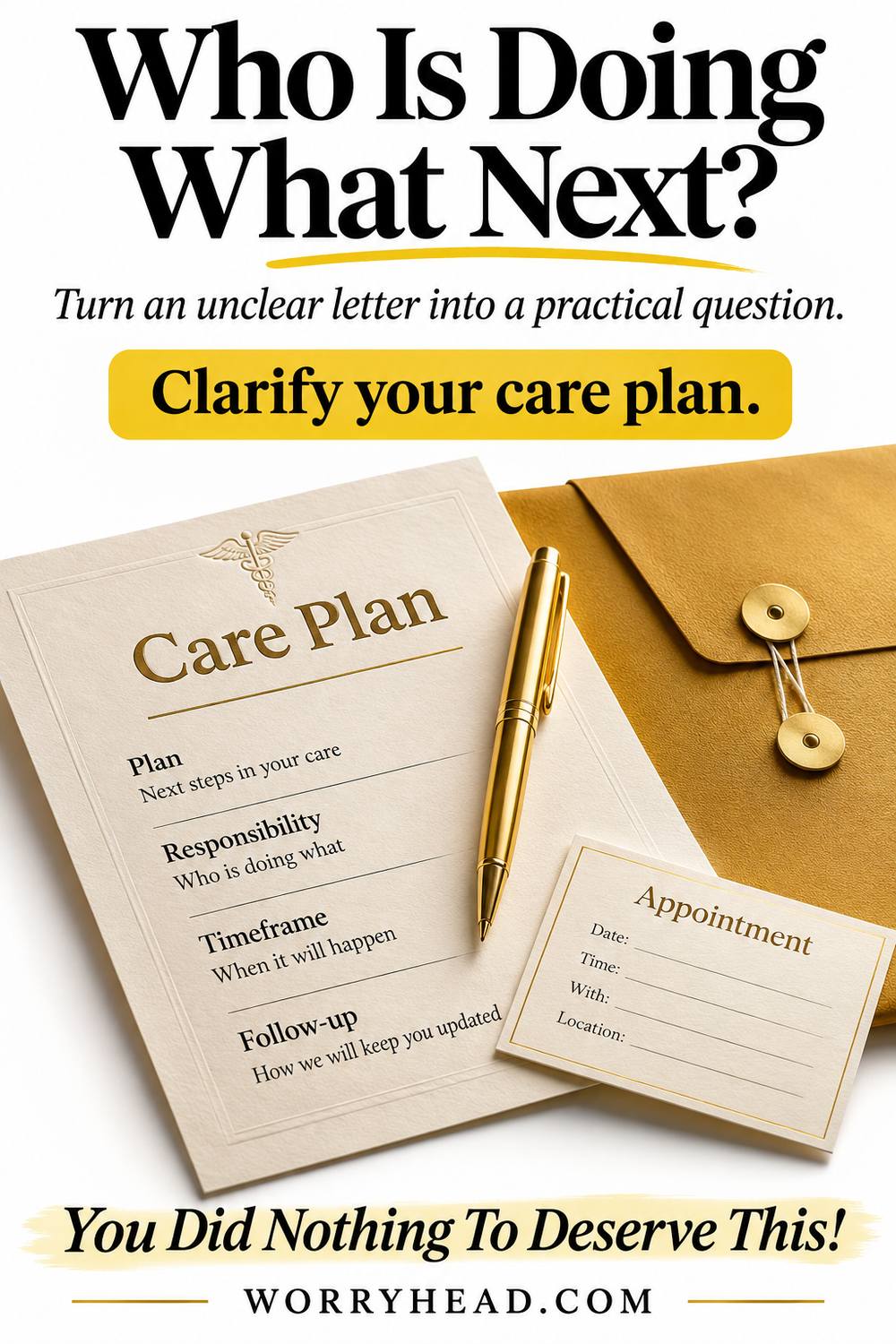
Once the immediate questions are clearer, your endometriosis clinic letter can become a useful reference for the people involved in your care, provided everyone understands which parts remain current. That does not mean you must hand the entire document to a manager, relative or partner simply because they are interested or offer to help.
Choose the information each person actually needs, such as an appointment date, a practical restriction or a request for transport, and keep private details private if that is your preference. As a husband, I see support as something my wife should be able to shape, not an entitlement to every line of her correspondence.
If you want someone to help with a call, agree beforehand whether they are listening, taking notes or asking a particular question, so their involvement does not accidentally replace your voice. It can also help to tell the clinic that you consent to their involvement and ask what identification or permission process the service uses.
For another healthcare appointment, bring the relevant letter and a short update about what has changed since it was written, especially medicines, symptoms or investigations completed elsewhere. A new clinician may not have access to every hospital system, and the existence of a digital record does not guarantee that the particular correspondence is visible to them.
At home, keep the practical plan small enough to use, perhaps with one confirmed next step and one date for checking progress rather than a wall of unfinished tasks. The aim is to give you more room for ordinary life, including rest and time with the person you love, while the healthcare system carries its own responsibilities.
When to Seek Medical Help Beyond an Endometriosis Clinic Letter
A letter records a point in time. It cannot assess a new episode of pain, a medicine reaction or a change that has happened since the consultation, and you do not have to wait for an administrative reply before seeking help with those problems.
In the UK, severe or worsening pelvic pain with faintness, breathing difficulty or heavy bleeding needs emergency assessment through 999 or A&E. Pelvic pain with possible pregnancy, fever, difficulty passing urine or stool, or blood in urine or stool warrants urgent advice through NHS 111 or an appropriate urgent clinical service.
For symptoms that are continuing rather than suddenly dangerous, contact your GP or treating team and explain what has changed in your ability to function. Give a concrete example, such as being unable to finish a shift, sleep for more than short periods or manage a previously tolerable journey.
This is not about using dramatic language to get attention. It is about providing information a clinician can use to decide whether the existing plan still fits, rather than letting an old summary stand in for a current assessment.
Medicine discrepancies deserve their own clear route. If a letter conflicts with the label on a prescription, or you are unsure whether two medicines should be taken together, ask a pharmacist or prescriber rather than choosing the version that looks most recent.
Explain whether you have already taken the medicine and whether you feel unwell. The urgency depends on the actual situation, so an administrative inbox may not be the right place for an immediate safety question.
There is also a difference between distress caused by a document and a need to resolve the document itself. If worry is stopping you sleeping or functioning, tell a healthcare professional about that impact while you continue seeking an explanation of the letter.
I do not see those as competing needs. My wife’s experience has shown me how physical symptoms and emotional strain can occupy the same day, and support should be able to recognise both without using one to erase the other.
Questions to Ask About Your Endometriosis Clinic Letter
You do not need to send the clinic every possible question at once. Begin with the uncertainty that changes what you should do now, then the questions that will help you understand the longer plan.
One useful opening is to identify the consultation date and say that you would like clarification of the written plan. That gives the person receiving your message a starting point without requiring you to retell your complete history.
Ask whether the diagnosis named in the letter is confirmed, suspected or still being investigated. If a result is described as normal, ask which question that test addressed and what explanation is being considered for the symptoms that remain.
For treatment, ask who is prescribing, whether a change starts now and when its effects or problems will be reviewed. If the plan depends on another team, ask whether the request has been sent and who will tell you when it has been accepted.
For follow-up, ask what should happen next and what you should do if you have not heard by the expected point. You can also ask who will discuss results with you, rather than receiving them without a conversation about their meaning.
If a factual detail differs from what you reported, identify the sentence and ask for the record to be reviewed. Where a significant symptom has been omitted, explain why it matters to the care decision rather than feeling obliged to write a detailed account of every bad day.
When a phrase feels judgemental, you can ask what it was intended to communicate and how it affects the plan. The answer may clarify shorthand, reveal a misunderstanding or show that further discussion is needed.
A hypothetical message might say that the letter lists a medicine you no longer take, that you need to know who is arranging the scan, and that you would like the follow-up route confirmed. It is an example you can adapt, not a script you must deliver perfectly to earn help.
Before ending a telephone conversation, repeat your understanding in ordinary language and ask whether you have it right. Write down the staff member’s role, the date and the agreed action, so that the next contact builds on the last one instead of starting from the beginning.
If the reply is still unclear, say which part remains unresolved. I would rather you have one answer you can use than a longer exchange full of reassuring words that never actually tells you what happens next.
Final Word on Your Endometriosis Clinic Letter
An endometriosis clinic letter should help you understand your care, not leave you feeling that the appointment has continued without you in a language you were never taught. If the document is confusing, that does not mean you listened badly, asked the wrong questions or failed to be a good patient. It means there is information that still needs to be communicated in a usable way. You are allowed to ask for that conversation, even when the clinic is busy and even when the letter sounds confident about something you do not understand.
Begin with the practical pieces that affect your next step. Check the relevant dates, separate confirmed findings from possibilities, and establish whether a medicine change or referral is actually being arranged. Identify who owns each action and how you will hear about the outcome. You do not have to solve every abbreviation before you can ask who will contact you. A clear question can be the most useful thing you do with a document that felt bigger than your capacity to manage it.
Keep your experience beside the clinical summary rather than letting the summary replace it. A brief observation during an appointment cannot describe every painful journey, interrupted night or difficult working day. If something important is missing or inaccurate, explain the particular difference and ask for it to be reviewed. Where the issue is a clinical opinion, ask for the reasoning and for your concerns to be recorded. You can respect professional knowledge while still wanting an account of your health that recognises what you reported.
As a husband, I want the work of understanding to be shared in ways that make life easier for my wife. That may mean helping organise a question or simply accepting that she does not want to discuss medical correspondence over dinner. Support does not require turning every evening into a review of symptoms and outstanding tasks. It requires noticing when there is enough energy for the next step and when a person needs to be loved without another question being asked of her.
Remember that the document is not an emergency service and it is not a permanent judgement on your body. New or worsening symptoms deserve appropriate clinical attention, even if an earlier letter sounded reassuring. Unclear medicine instructions deserve clarification from someone qualified to give it. You do not need to wait for an administrative correction before seeking care for a problem that needs attention now. The route and the emotional impact can both matter at the same time.
My hope is that you finish with a clearer sense of what belongs to you and what belongs to the service. You can explain your concern, ask for clarification and choose who helps you. The team remains responsible for communicating its assessment and plan. You deserve to leave that exchange with something more useful than another document to worry about. You deserve information that helps you live, make choices and find your next step with less uncertainty.
You are allowed to ask what the words mean, what happens next and whether the record reflects your experience. Your questions do not make you difficult. Take the letter one useful piece at a time, let someone help if you want them to, and remember that the person living this story matters more than the paperwork describing it.
If you wish, share the part of clinic correspondence you find hardest without posting private medical details, and find my free 130+ page eBook, You Did NOTHING To Deserve This!, below for a little more understanding alongside the practical work.


About Me
Hi, I’m Lucjan! The reason why I decided to create this blog was my beautiful wife, who experienced a lot of pain in life, but also the lack of information about endometriosis and fibromyalgia for men…
READ MORE
Grab a FREE eBook!
“You Did NOTHING To Deserve This!”
Finally hear the words nobody ever said to you, that your pain is real, your tears make sense, and you did nothing to deserve endometriosis, the dismissal, or the way it has rewritten your life.
Related Questions You May Be Asking About Your Endometriosis Clinic Letter
Can I ask for a copy if the letter only went to my GP?
Ask the clinic how to obtain your correspondence and whether it can be sent directly to you in future. Availability through an app or portal varies between services. Check that your contact details are correct, and request an accessible format if the standard letter is difficult for you to use.
Does a diagnosis listed in the letter mean it is definitely confirmed?
Not necessarily. Read the surrounding wording and ask whether the condition is confirmed, suspected or one possible explanation being considered. A problem list can include working diagnoses or historical information. The clinician should explain how the term relates to the evidence available and the next step in your own care.
Should I post the letter in a support group for help interpreting it?
It is safer to ask the clinical team about the medical meaning, especially when treatment depends on it. Community support can help with the feelings the letter brings up. Avoid sharing identifying details or complete correspondence, and remember that another person’s apparently similar wording may refer to a different situation.
What if the letter arrives after my treatment has already changed?
Check which consultation it summarises and keep any later instructions alongside it. If the documents conflict, contact the relevant prescriber or clinical team to establish the current plan. Do not switch medicines simply because an older consultation has appeared in a newly delivered letter or a recently updated patient portal.
Can my partner contact the clinic about the letter for me?
You can ask for help, but the service may need your permission before discussing confidential information with another person. Tell the clinic whom you want involved and ask how to record that choice. Agree with your partner which questions they will raise, while keeping decisions and information sharing under your control.
Endometriosis Clinic Letter References
- https://www.nice.org.uk/guidance/ng197/resources/shared-decision-making-the-importance-of-writing-clinical-letters-directly-to-the-patient-15365325421/chapter/Outcomes-and-learning
- https://apps.worcsacute.nhs.uk/KeyDocumentPortal/Home/DownloadFile/3386
- https://www.england.nhs.uk/long-read/good-communication-with-patients-waiting-for-care/
- https://digital.nhs.uk/services/messaging-best-practice
- https://www.nhs.uk/symptoms/pelvic-pain/
