
Blood Tests for Endometriosis: Understanding What Your Results Can Tell You
Are blood tests for endometriosis meant to explain your symptoms, or are you still unsure what the request actually means? It is understandable to want a clear answer after carrying pain, uncertainty and appointments for so long. You deserve an explanation that connects the test to your care.
Routine blood tests cannot confirm or rule out endometriosis, and NICE advises against using CA125 to diagnose it. Tests may investigate other concerns, including anaemia, alongside your assessment. Ask what each test is for, how results will be explained and what happens if your symptoms continue.
I am Lucjan, a husband, blogger and researcher rather than a clinician, and years of learning through my wife’s experience have led me to the NHS, NICE, ESHRE and MedlinePlus sources listed at the bottom of this guide.
For the wider assessment pathway, my guide to the diagnosis of endometriosis explains how different parts of your care fit together.
A blood request can feel reassuring because something concrete is finally happening. It can also create a frightening expectation that one result will decide whether your experience is believed. Understanding the question behind the test helps separate what it measures from what you hope it might explain.
My wife’s endometriosis and iron-loss anaemia have made me careful about treating every health concern as one single problem. Her experience is not a diagnostic rule for you, but it reminds me why clear explanations matter.
We will work through the purpose, preparation and follow-up of testing, including what to ask when a result is normal but you are still struggling.
If medical uncertainty has left you feeling that you must prove your suffering, my free 130+ page eBook, You Did NOTHING To Deserve This!, offers companionship from my perspective as a husband. It is an invitation to feel less alone while you continue getting appropriate care, not a guide to interpreting laboratory results.
You Did NOTHING To Deserve This!
Endometriosis Validation for Women with Endo

What Blood Tests for Endometriosis Can Actually Answer
A test is most useful when you know which clinical question prompted it. The phrase blood tests can cover very different measurements, so the name of the requested test matters. An appointment about pelvic symptoms does not make every sample an endometriosis diagnostic test.
A full blood count examines blood cells and can help investigate anaemia. That may be relevant to a separate concern such as tiredness or bleeding, depending on your history. It does not tell a clinician where endometriosis is growing.
You might understandably hear that a result is normal and wonder whether the whole investigation has ended. Before drawing that conclusion, ask which question the result has answered. There can still be an unresolved question about your symptoms.
The reverse deserves care as well, because an abnormal result is not a complete explanation on its own. It needs interpretation in the context of the reason for testing and the rest of your assessment. Reading a highlighted number without that context can leave you with more fear than useful information.
As a husband, I am interested in what an explanation allows you to do next. Being given a number is different from understanding whether there is treatment to discuss, a review to arrange or another assessment to consider. The practical effect should not depend on you becoming a laboratory specialist overnight.
You can keep a small record of the test name, the question being investigated and the agreed follow-up. This is a communication aid, not a system for diagnosing yourself. It should make an appointment easier to navigate without adding another demanding task to an already difficult week.
Learning alongside my wife has taught me to value questions that make care clearer rather than questions that merely sound technical. The following roadmap keeps that distinction in view, with room for your own needs and preferences.
- Name the Question Being Investigated
- Separate Blood Counts From Diagnosis
- Understand the Limits of CA125
- Follow Your Own Preparation Instructions
- Make the Appointment More Manageable
- Read Results With Clinical Context
- Keep Continuing Symptoms in View
- Agree Who Explains the Next Step
Name the Question Being Investigated
Before the appointment, find out which tests have actually been requested and why. You do not need to memorise every abbreviation; a plain explanation of the concern being checked is more useful than a long list you cannot connect to your symptoms.
You could make a short note beside each test name, leaving space for the clinician’s explanation later. Keep questions about the sample itself separate from questions about what happens after the result, because the person taking blood may not be responsible for your treatment plan.
I would want my wife to leave with a clearer understanding rather than another piece of paperwork to decode alone. If you are unsure whether a request relates to tiredness, bleeding, medicines or a different concern, say that openly. Asking for the purpose is a reasonable part of understanding your care, not a challenge to the professional’s competence.
Separate Blood Counts From Diagnosis
A blood count and an endometriosis assessment are not interchangeable. A clinician may investigate anaemia or another concern while also considering pelvic symptoms, and finding one problem does not automatically explain every other difficulty you have described.
My wife’s iron-loss anaemia is one reason I try not to collapse her experience into a single label. That personal experience cannot tell us the cause of your tiredness, but it does help me recognise the importance of asking which symptoms a finding might explain.
When discussing a result, separate what has been identified from what remains uncertain. Ask whether the original pelvic concern still needs attention and what the plan is for it. You should not have to decide for yourself whether one line on a report replaces an earlier discussion about pain, bleeding or the effect on your daily life.
Understand the Limits of CA125
CA125 is a protein measured in blood, and NICE advises against using it to diagnose endometriosis. Its name can be alarming when an internet search brings up cancer, but a raised value has several possible explanations and does not establish a diagnosis by itself.
MedlinePlus explains that endometriosis and some other non-cancerous circumstances can raise it. A normal value also cannot provide a universal cancer exclusion, so neither reassurance nor alarm should rest on your own reading of one number.
If this test has been requested, ask the clinician what they are investigating in your particular situation. I would resist giving my wife a confident interpretation copied from a website, however much I wanted to relieve her worry. A useful next step is an explanation of the result, any other findings and the follow-up recommended for you.
Follow Your Own Preparation Instructions
Preparation depends on the tests requested, not simply on the fact that blood will be taken. Follow the instructions from your service, and check with them if you have not received any or if two messages seem to disagree.
Do not decide to fast or stop prescribed medicines just because somebody online prepared that way. Tell the service about relevant medicines or supplements and ask whether anything needs to change for your particular appointment; the answer belongs to the team arranging your care.
I know that extra uncertainty can make a small task feel much larger when you are already exhausted. A brief call to clarify instructions can be more useful than spending an evening comparing strangers’ routines. Keep the answer somewhere you can find easily, and ask whom to contact if you cannot follow an instruction safely or comfortably before the appointment.

Make the Appointment More Manageable
Tell the person taking blood if you are worried about needles, have felt faint during previous tests or need help making the appointment manageable. You do not have to minimise that concern because the procedure is routine for the staff member.
Think about the practical details that matter to you, such as getting there, clothing that allows access to your arm and whether you would value someone accompanying you. Check local arrangements rather than assuming every clinic offers the same appointment system or support.
As a partner, I would start by asking what help is welcome instead of taking over the conversation. You may want company, help keeping track of instructions or simply space afterwards. Those preferences are yours, and support is more useful when it follows them rather than becoming another decision someone makes on your behalf.
Read Results With Clinical Context
Laboratory reports may show a reference range, units and flags beside some measurements. MedlinePlus explains that ranges can differ between laboratories and that a result outside a range does not, by itself, identify a disease; a result inside it does not answer every health question either.
Use the report associated with your own sample when asking for an explanation. Comparing a number with a screenshot from another person can introduce different units, methods or circumstances that you cannot reliably untangle yourself.
I understand the urge to search immediately when a result appears without a message. A more useful note might record what you do not understand and what you need the clinician to explain. Keep the distinction between seeing a result and receiving its interpretation, especially when you are unsure whether any action is expected from you.
Keep Continuing Symptoms in View
If the concern that prompted testing is still affecting you, describe that clearly at follow-up. A normal routine blood result does not rule out endometriosis, and your discussion should return to the clinical question rather than ending with the colour of a laboratory flag.
You can explain what has continued or changed without claiming to know its cause. Choose a few concrete details about the effect on everyday activities, and avoid feeling that you must provide a perfect diary before your experience deserves attention.
My wife’s health has taught me that daily consequences can be much easier to understand than a general description of having a bad time. Your account might concern work, sleep, getting out or another activity that matters to you. Ask how those ongoing difficulties fit into the assessment and when you should seek another review.
Agree Who Explains the Next Step
Before leaving, ask when results are expected and who will explain them. Different tests and services have different timescales, so a clear local plan is more helpful than assuming that a friend’s experience tells you when yours should arrive.
Check what to do if you hear nothing by the agreed time, and whether you should book a discussion yourself. If several teams are involved, clarify which one requested the test and which one is responsible for acting on the result.
I see this as a way of reducing avoidable uncertainty, not a demand that you supervise the entire health service. A short note with the responsible team and a contact route can save effort later. Where the plan remains unclear, say what you need clarified before you leave rather than relying on silence to mean that everything has been reviewed.
When Blood Tests for Endometriosis Leave You Without an Explanation
A result can arrive before you have had a chance to discuss what it means. That gap may feel especially difficult if earlier appointments have left you doubting whether your symptoms were understood. It is reasonable to want the explanation as well as the measurement.
Try separating three questions on your own notes. The first is what the result shows, the second is what it means for the concern being investigated, and the third is what happens next. You do not need to answer those questions yourself before contacting the team.
A clinician may explain that a result is reassuring for one concern while recommending further assessment for another. Those statements can sit together without contradicting each other. The important point is knowing which concern each statement refers to.
I would not want reassurance to become a polite way of ending a conversation that has left my wife confused. Equally, I would not want her frightened by a result whose significance has not yet been explained. Both reactions are understandable, but neither should have to carry the responsibility for medical interpretation.
If you receive a short administrative message, ask whether there is an accompanying clinical plan. Explain what you still need to understand rather than assuming the person answering the phone knows the whole history. You can be concise and still be clear that the original difficulty has not disappeared.
For a planned review, choose the most important unresolved issue first. You might need to understand whether another appointment is required, whether an existing plan continues or whether the team wants to reassess a symptom. Keeping that priority visible can help you avoid leaving with several smaller answers while the main concern remains untouched.
There is also a difference between asking for an explanation and asking for every possible test. More information is not automatically more useful if you do not know what decision it will change. Ask how any proposed additional investigation fits the question your clinician is trying to answer.
If you feel overwhelmed, taking a trusted person to a discussion may help, if that is what you want. They can help you remember your questions or make notes with your agreement. Your own priorities should still guide the conversation, and you can decide what you want to discuss privately.

Keeping Blood Tests for Endometriosis in the Wider Care Plan
Endometriosis assessment involves more than a laboratory request. Current NICE guidance considers symptoms, examination and imaging, with further investigation or referral according to the clinical circumstances. Normal examination and ultrasound findings do not necessarily exclude the condition.
That does not mean every person needs every investigation. It means the next decision should be explained in relation to your situation. Ask what the team is considering and how the proposed next step may help.
My role as a husband is not to choose investigations from a list. It is to support my wife’s understanding and make room for the questions that matter to her. I want her to feel involved rather than pushed towards an answer I have decided she needs.
The same distinction matters if you already have an endometriosis diagnosis. A blood test might address another health concern without measuring the extent of your endometriosis. Ask what is being monitored instead of assuming a changing number is a score of how much disease you have.
This is particularly helpful when several conditions are part of your life. My wife’s endometriosis, fibromyalgia and iron-loss anaemia remind me that one label does not describe every aspect of her health. That is a personal reason to value careful assessment, not evidence that your own symptoms have the same combination of causes.
When you prepare a question, connect it to the decision you need to understand. For example, you may want to know whether an existing review remains planned or whether a new concern needs separate attention. That keeps the conversation focused on your care rather than on collecting test names.
New diagnostic announcements also deserve a careful reading. NICE’s September 2026 update concerned draft guidance for a saliva-based technology with further evidence generation, not approval of a routine diagnostic blood test. A news headline about one sample type should not be used to interpret a different test on your own request form.
Research and recommendations can change, so discuss any advertised test with a clinician who can explain its current status and relevance to you. The useful questions are what evidence supports it, what it would change and what follow-up is offered. You should not feel obliged to purchase a test because uncertainty has made you desperate for a clear answer.
Blood Tests for Endometriosis and When to Seek Medical Help
Waiting for a laboratory explanation should not delay help for a new or urgent problem. An earlier result is not a promise about how you will feel later. Pay attention to a significant change rather than trying to make it fit a reassuring message from a previous appointment.
For pelvic pain that is severe or worsening, or comes with faintness, difficulty breathing or heavy vaginal bleeding, NHS guidance advises emergency help through A&E or 999. Do not drive yourself to A&E. Seek urgent advice through NHS 111 for pelvic pain with symptoms such as difficulty passing urine or stool, fever, unusual vaginal discharge or possible pregnancy.
These are reasons to get assessed, not a way to decide the cause yourself. Tell the service what is happening now, including any recent test if relevant. You do not need to wait until you have collected all the paperwork before asking for urgent help.
For continuing symptoms without an emergency, arrange a clinical review rather than using this article to judge your results. Explain the change or ongoing impact and ask what the follow-up plan should be. If a clinician has already given you specific safety advice, keep that available and follow it.
As someone who loves a person with several health conditions, I understand why new symptoms can quickly become tangled with familiar ones. I try to remember that familiarity is not the same as certainty. Neither you nor the person supporting you should have to diagnose a change before deciding that professional advice is needed.
It can help to separate an administrative problem from a clinical concern when contacting a service. Chasing an expected result is one request; reporting a new symptom is another. Make the clinical concern clear at the start so it is not lost inside a conversation about when a report will appear.

Questions to Ask Your Doctor About Blood Tests for Endometriosis
You do not need to ask everything at once. Choose the questions that connect most closely to what you are waiting to understand. A short discussion with a clear purpose may be easier to manage than a page of technical terms.
Start with the test request itself. Ask which concern it is investigating, what preparation applies to you and whether the result is expected to change any part of your current care. If an answer contains unfamiliar language, ask for a plain explanation rather than pretending it has made sense.
At the results discussion, ask what the finding means in your own circumstances. You can also ask what it does not tell you and whether the original symptoms need further assessment. This leaves room for uncertainty without treating uncertainty as a reason to abandon your questions.
Before the conversation ends, establish who is responsible for the next step. Ask about the expected timing, how you will be contacted and what to do if symptoms change while you wait. Those practical details may matter more to your week than remembering the full name of every measurement.
If CA125 appears on the request, ask why it was chosen in your situation and how the team will interpret it alongside other findings. Avoid asking someone to make a diagnosis from the number in isolation. The useful outcome is understanding the clinical plan, including whether any further assessment has been recommended.
You can also say when a previous explanation has left you anxious or uncertain. That does not require an accusation or a long defence of your feelings. It simply gives the clinician a chance to address the part of the conversation that has not yet helped you understand your care.
I would encourage a partner to listen for what you want answered, not to bring a competing agenda into the appointment. My own research helps me prepare questions, but it does not make me the authority on my wife’s results. Support should make your voice easier to hear, including when you prefer to speak without anyone beside you.
Conclusion on Blood Tests for Endometriosis
A blood test can be a useful part of looking after your health without being the answer to every question about endometriosis. Understanding that distinction can protect you from both false reassurance and unnecessary fear. You deserve to know why a sample was requested, what the result means and how it connects with the difficulties you brought to the appointment.
I cannot interpret your results, and I would not want this guide to give you the impression that a website can replace that conversation. What I can offer is a way to prepare for it. Begin with the question being investigated, keep the explanation connected to your own experience and make sure there is a clear next step before the discussion ends.
My wife’s health has taught me to be cautious about simple explanations that try to fit everything into one box. Endometriosis and iron-loss anaemia are both part of her experience, but that does not tell us what is happening in your body. It reminds me to leave space for more than one concern and to value a clinician’s explanation of how the different pieces relate.
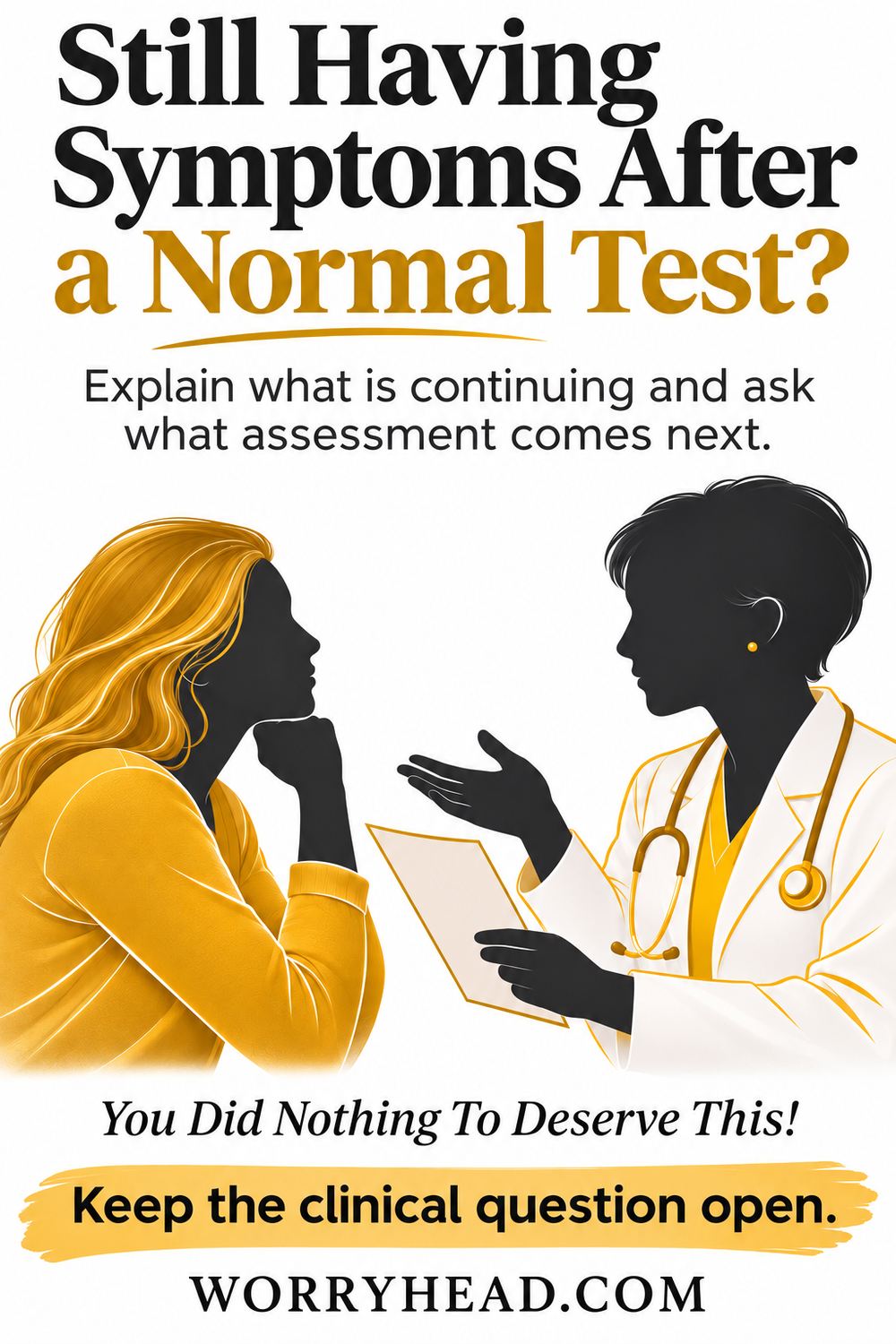
If a result is normal and you still feel unwell, you do not have to choose between accepting the result and describing your symptoms honestly. Both can be part of the same discussion. Explain what continues, what has changed and what remains difficult in daily life, then ask how that information affects the assessment or the follow-up that has been planned.
If a number is flagged, try to keep the report with the question it was meant to answer rather than allowing a search result to supply a diagnosis. You can write down what you want clarified while leaving interpretation to your care team. Wanting an explanation is reasonable, and needing that explanation in clear language is not a sign that you have failed to understand your health.
The details matter too: preparation instructions, the appointment itself, expected result timing and a contact route when something is unclear. These details will not remove every uncertainty, but knowing them can reduce the amount you have to guess. Ask for help with the parts that feel difficult, whether that means clarifying an instruction or choosing someone to accompany you if you want support.
As a husband, I want support to make life lighter rather than turn illness into another project my wife must manage for someone else. Your preferences belong at the centre of this process. You may want company, privacy, a written explanation or time to think, and it is worth saying which of those would help you understand and participate in the next conversation about your care.
Take one manageable question from this guide rather than feeling obliged to master everything today. The aim is not to become your laboratory interpreter. It is to understand the purpose of your tests, keep unresolved concerns visible and know where to turn for the clinical explanation you need, without having to prove that you deserve it.
You deserve an explanation that respects both the result and the life you are living around it. Start with one question, ask for the next step in clear language and let someone you trust help if you want them to. Your uncertainty is a reason for a thoughtful conversation, not a reason to feel ashamed of asking for one.
If you would like to comment, you can share which part of the testing process you wish had been explained more clearly, without posting private results. For companionship through the uncertainty, you are welcome to my free 130+ page eBook, You Did NOTHING To Deserve This!


About Me
Hi, I’m Lucjan! The reason why I decided to create this blog was my beautiful wife, who experienced a lot of pain in life, but also the lack of information about endometriosis and fibromyalgia for men…
READ MORE
Grab a FREE eBook!
“You Did NOTHING To Deserve This!”
Finally hear the words nobody ever said to you, that your pain is real, your tears make sense, and you did nothing to deserve endometriosis, the dismissal, or the way it has rewritten your life.
Related Questions You May Be Asking About Blood Tests for Endometriosis
Can a Normal Blood Test Rule Out Endometriosis?
No. Routine blood results cannot exclude endometriosis, so ask which concern the test was intended to investigate. If symptoms continue, discuss their impact and the next assessment step with your clinician. A result may be reassuring for one question without resolving every concern that brought you to the appointment.
Does a Raised CA125 Mean I Have Endometriosis?
No. CA125 can be raised for several reasons and NICE advises against using it to diagnose endometriosis. Ask why it was requested in your circumstances and how it fits with other findings. Avoid interpreting it alone, whether the number appears high or falls within the range on your report.
Should I Fast Before My Appointment?
Follow the instructions for your own requested tests. Do not assume fasting is needed, and do not change prescribed medicines without appropriate advice. If instructions are missing or unclear, contact the service arranging the test before the appointment. Explain any difficulty following the preparation so the team can advise you safely.
Who Should Explain a Result I Can See Online?
Ask the team that requested the test who will provide the clinical explanation and any follow-up plan. Seeing a result in an app is not the same as having it interpreted for your situation. If no discussion is arranged, contact the service and explain the particular question you still need answered.
Can My Partner Help Without Interpreting Results?
Yes, if you want that support. Your partner can help write down questions, accompany you where arrangements allow or remember the agreed next step with your consent. They do not need to interpret numbers to be useful. You can also choose privacy, or ask for a different kind of help at another stage.
Blood Tests for Endometriosis References
- https://www.nice.org.uk/guidance/ng73/chapter/Recommendations
- https://www.nice.org.uk/guidance/ng73/chapter/Rationale-and-impact
- https://doi.org/10.1093/hropen/hoac009
- https://www.nhs.uk/tests-and-treatments/blood-tests/
- https://www.nhs.uk/conditions/iron-deficiency-anaemia/
- https://medlineplus.gov/lab-tests/ca-125-blood-test-ovarian-cancer/
- https://medlineplus.gov/lab-tests/how-to-understand-your-lab-results/
- https://www.medlineplus.gov/lab-tests/fasting-for-a-blood-test/
- https://www.imperial.nhs.uk/our-services/blood-tests/patient-information
- https://www.nhs.uk/symptoms/pelvic-pain/
- https://nice-newsroom.prgloo.com/news/embargoed-nice-updates-draft-guidance-on-diagnosing-endometriosis-in-primary-care
