
Occupational Therapy for Endometriosis: Preparing for an Assessment
Could occupational therapy for endometriosis help you explain why everyday tasks have become so difficult? It can feel exhausting to translate a painful, unpredictable day into a few appointment notes. You deserve space to describe the things you miss, the help you need and the choices you want to keep.
Occupational therapy explores how health affects everyday activities and what support may help. Prepare by noting difficult tasks, changing symptoms and your priorities. Access depends on local services and assessed needs; it complements medical care and does not diagnose or cure endometriosis.
Years of learning alongside my wife’s illness shape my writing as a husband, blogger and researcher, not a clinician, and the NHS and NICE guidance informing this discussion is listed at the bottom.
Practical support can sit alongside the medical options for managing endometriosis, with each addressing a different part of what you need.
An assessment is not simply a question of whether you can complete a task once. The time it takes, the help involved and what happens afterwards can all be useful parts of your account.
You might also want to explain why one activity matters more to you than another. A tidy list of difficulties can miss the meaning of getting dressed in privacy or making something for someone you love.
My wife still works, and working from home helps her continue to feel needed. That has taught me to take the value of an activity seriously, rather than seeing only the effort it costs.
There is a way to prepare that leaves room for both the practical details and the person living through them. You do not need a perfect diary to begin.
If describing your needs leaves you feeling guilty, my free 130+ page book, You Did NOTHING To Deserve This!, offers the understanding I wanted my wife to feel. You can use the invitation below if that kind of company would help while you prepare.
You Did NOTHING To Deserve This!
Endometriosis Validation for Women with Endo

What Occupational Therapy for Endometriosis Can Explore
The word occupation includes the everyday activities that fill your life, not just paid employment. Washing, preparing food, managing a routine and joining in something enjoyable can all matter when illness changes what feels manageable.
An occupational therapist considers the relationship between you, an activity and the setting in which it happens. That means a conversation may explore the way a task is arranged as well as the difficulty you experience doing it.
Occupational therapy for endometriosis may be relevant when symptoms interfere with daily activities, but a diagnosis does not guarantee access to a particular service. Your GP or local council can explain possible routes, and services assess needs within their own remit.
Some appointments happen in a clinic, while others may involve a home assessment or another agreed arrangement. Ask which service you are seeing and what the appointment is intended to cover before spending energy preparing the wrong information.
The assessment should give you an opportunity to explain what you want help with, including activities that other people do not notice. It is reasonable to describe privacy, comfort and having enough capacity for something meaningful as priorities in their own right.
Possible discussions can include different ways of approaching tasks, suitable equipment or changes to an environment, depending on the assessment. None of those possibilities means you must buy something, accept a particular suggestion or demonstrate that your illness has disappeared.
This is distinct from an investigation to establish the cause of pelvic pain or a decision about endometriosis medication or surgery. If an activity has become harder because symptoms are new or changing, the medical question still needs attention alongside the practical one.
As a husband, I want support to make room for my wife’s choices, rather than turn every part of her life into a task someone else manages. You can bring that same expectation to an appointment, even if the first goal is simply to explain one difficulty clearly.
Seeing my wife lose her dancing life has made me wary of assuming that any replacement activity has the same meaning. The following preparation points are ways to help someone understand your priorities, without asking you to prove your worth through what you can do.
- Choose Your Most Important Activities
- Describe What The Task Involves
- Show How Your Days Vary
- Include What Happens Afterwards
- Explain Your Home And Support
- Bring Relevant Health Information
- Ask About Assessment Choices
- Agree What Happens Afterward
Choose Your Most Important Activities
Start with two or three activities that you most want the therapist to understand. These might be personal care, a part of your workday or something enjoyable that has become difficult to manage.
Explain what makes each activity important rather than ranking everything by how useful it looks to somebody else. Wanting enough privacy to wash without help can matter just as much as wanting to prepare a meal or spend time with a friend.
I would also leave a little space for something you have quietly stopped doing, because an abandoned activity can disappear from an otherwise accurate daily list. You are not committing to getting it back immediately by mentioning it; you are showing the therapist what has changed and giving them a better starting point for a conversation about your own priorities.
Describe What The Task Involves
A task name can conceal several different difficulties, so try describing the part that causes trouble. Getting ready might involve reaching for clothes, standing at a sink, bending, concentrating or moving between rooms.
You can explain which part you manage yourself, where you pause and whether somebody currently helps. There is no need to force yourself through an uncomfortable demonstration merely to make your description seem more convincing.
From my side of a relationship, I know it is easy to notice that a task was completed and miss the effort that made it possible. A useful note might therefore record what you changed, what you left unfinished and what support you used, without turning the page into a scorecard or suggesting that needing help makes the completed activity less valuable.

Show How Your Days Vary
Describe a more manageable day and a more difficult day if your experience changes over time. Include the practical difference, such as needing help with one stage of a task or having to leave it until later.
Avoid presenting your best day as the standard you should always meet, but do not feel obliged to hide the things you can sometimes do. An honest account of variation gives more information than choosing a single version of yourself to represent every week.
If you notice a pattern, describe it as something you have observed rather than proof of what causes your symptoms. I would want my wife to be heard when a day goes better as well as when it goes badly, because support should be able to accommodate change without making her defend the reality of her illness each time.
Include What Happens Afterwards
Finishing an activity is only one part of your account, so mention whether you need to stop or change plans afterwards. You can describe tiredness, discomfort or another symptom in your own words, without assigning a medical explanation to it.
If a brief activity note would help, keep it simple enough to use without creating another burden. A few examples of activities, breaks and how you felt may be more useful to you than a detailed diary you cannot sustain.
Tell the therapist about other diagnosed conditions that affect activity, including ME/CFS if that applies to you. Advice must fit your circumstances; it should not become an automatic instruction to increase activity each week, and new or concerning symptoms still deserve medical review rather than being explained away as the expected price of doing something.
Explain Your Home And Support
Think about the setting in which a difficult task happens, including space, stairs, storage or the position of things you use. You do not need to have identified a solution before describing what makes the activity awkward.
Explain what help is available and whether that help is reliable, comfortable for you and sustainable for the person providing it. Living with someone does not mean that person can always be there or that you want assistance with every personal task.
I care about supporting my wife, but my willingness to help cannot replace a clear account of her needs and wishes. If the assessment involves your home, ask what the therapist will need to see and whether any photographs or measurements would be useful before collecting or sharing private information unnecessarily.
Bring Relevant Health Information
Have the appointment letter and a short account of relevant diagnoses, symptoms and current care available if you can. Mention recent changes, planned treatment or advice from another professional that may affect what you can safely do.
You do not need to bring your entire medical history unless the service asks for it. A concise note can help you remember the details you want to discuss, particularly when pain or tiredness makes an unfamiliar conversation harder.
Ask whether the therapist has received the referral information and correct anything important that is missing or inaccurate. I would treat this as sharing context rather than presenting a case for being believed, and I would keep questions about the cause of symptoms or changes to medicines for the appropriate clinician rather than expecting an activity assessment to answer them.

Ask About Assessment Choices
Contact the service before the appointment if travel, waiting, communication or the proposed format creates a difficulty. Explain the practical issue and ask what adjustments or alternative arrangements they can offer.
You can also ask whether a trusted person may attend and decide what role you would like them to have. They might help you remember a point or take notes, while leaving you space to describe your own experience and preferences.
Consent matters throughout an assessment, including when somebody suggests observing an activity or entering a private part of your home. You can ask what is involved, explain discomfort and discuss another way of providing information; support should not depend on silently agreeing to something you have not understood or do not feel ready to do.
Agree What Happens Afterward
Before the conversation ends, ask what has been agreed and which person or service is responsible for each next step. If something is being considered rather than arranged, make sure that distinction is clear in your notes.
Ask how to raise a concern if a suggested change is uncomfortable, impractical or does not fit your circumstances. A plan is more useful when there is a way to discuss what happened, rather than an expectation that every suggestion will work first time.
I would also ask whether you will receive a written summary and when any review is expected. You can use that summary to check that your priorities were understood, and seek clarification about equipment, referrals or waiting times without having to reconstruct the whole appointment from memory after a tiring day.
Preparing for Occupational Therapy for Endometriosis Without Proving Yourself
Preparation can become painful when you feel that every appointment requires evidence of how much you are struggling. I would separate the notes that help you communicate from the idea that you owe anyone a performance of distress.
Your examples can be specific without being exhaustive, and they can include a task you avoid as well as one you attempt. If you have stopped preparing a particular meal because it is difficult, explaining that change may reveal a need that a list of completed activities would miss.
A short activity diary is one possible aid, and some occupational therapy services use diaries to explore patterns in activities and symptoms. Ask whether the service has a preferred format, and tell them if recording a full week is unrealistic or makes you focus on symptoms in a way you find unhelpful.
For occupational therapy for endometriosis, the purpose of your notes is to make everyday difficulties easier to discuss, not to establish a diagnosis from a pattern on paper. You can leave gaps, use approximate descriptions and explain that you cannot remember something accurately rather than filling the space with a guess.
My wife’s experience has taught me that the things lost to illness can be much larger than the tasks a person still manages. The absence of dancing from a daily routine, for example, tells a different story from a neat list of washing, working and eating.
If emotion makes it hard to explain a priority, you might write a sentence about why it matters and ask the therapist to read it. You can then decide whether you want to discuss the feeling itself, the practical difficulty or both, without having to tell your whole life story in one appointment.
There is no preparation method that guarantees a particular service or outcome, but a manageable account can help the conversation begin in the place that matters to you.
Making Occupational Therapy for Endometriosis Fit Your Real Life
A suggestion can sound straightforward in a consultation and still be difficult to use in the place where you live. Limited space, other people in the household, money, work commitments and your own preferences can all affect whether a proposed change is practical.
If equipment or an adaptation is discussed, ask what the assessment has identified, what choices are available and who would arrange the next step. Availability and funding depend on the service and circumstances, so clarify the local process before buying something on the assumption that it will be supplied or reimbursed.
Occupational therapy for endometriosis should be considered alongside the other care you receive, particularly when another condition affects activity or recovery. NICE guidance for ME/CFS supports an individual approach within a person’s energy limits and rejects programmes based on fixed increases in activity, so make an existing diagnosis and any relevant specialist advice known.
I mention that distinction because my wife’s health involves more than one condition, and a plan that ignores that complexity can miss the person it is meant to help. Your therapist and medical team may need to clarify which advice applies, rather than expecting you to reconcile apparently conflicting recommendations alone.
A partner can help describe the support they currently provide, with your agreement, but should not decide your priorities on your behalf. Both my wife and I still work, and the practical limits on our time matter without making either of us less committed to the other.
If the first suggestion does not fit, explain the reason as clearly as you can and ask whether a different approach or further assessment is appropriate. That conversation is part of finding usable support, not evidence that you have failed to cooperate.

Occupational Therapy for Endometriosis: When to Seek Medical Help?
An activity assessment cannot establish why pelvic pain has changed, and it should not delay medical advice. Contact your GP about pelvic pain that persists or keeps coming back, or a change that is affecting your life and has not been assessed.
Seek urgent advice from NHS 111 if pelvic pain occurs with features such as difficulty passing urine or stool, a high temperature or feeling shivery, or if you are pregnant or could be pregnant. Explain the symptoms and any relevant diagnosis, rather than assuming that an existing endometriosis diagnosis accounts for everything.
Call 999 or go to A&E for pelvic pain that is severe or getting worse, or occurs with fainting, difficulty breathing or heavy vaginal bleeding. Do not drive yourself to emergency care, and follow the advice of the emergency service about what to do next.
These are reasons to seek help, not predictions about what your symptoms mean. I know how easily familiar illness can make a new difficulty feel like something you are supposed to manage quietly, but you do not have to wait for a therapy appointment to ask whether a change needs medical attention.
For a non-urgent practical problem, the occupational therapy service may be the right first contact once you have a plan. For example, you can report that an agreed arrangement does not fit the space available or that you have not understood how a suggested aid should be used.
If using an aid or trying an activity causes new pain, feels unsafe or produces a concerning change, stop that attempt and seek appropriate advice. Do not keep repeating it merely to gather evidence for a review, and do not change a prescribed treatment because a practical adjustment has been suggested.
You can ask each service which concerns belong with them and which should go to your GP or specialist. Having those boundaries written down can reduce the burden of deciding where to turn when you are already tired, while keeping responsibility for medical assessment with the professionals qualified to provide it.
Questions to Ask Your Doctor About Occupational Therapy for Endometriosis
If you are unsure where to begin, ask your doctor whether an occupational therapy assessment could be relevant to the daily activities you are finding difficult. Give one or two concrete examples so the conversation is about the support you need, rather than a referral name alone.
You might ask which local service would be appropriate and whether you can contact it yourself or need a professional referral. Ask what information the referral should include, particularly if your difficulties fluctuate or another diagnosed condition changes the advice that would be suitable for you.
It can help to ask what this assessment would add to your current care and what it would not address. A question about making a task more manageable is different from a question about worsening symptoms, and you should not be left believing that one referral replaces the medical review you need.
If you already have an appointment, ask the therapist what preparation would be useful and what will happen during the session. You can ask whether any activities will be observed, how consent will be discussed and what alternatives might be possible if something is painful or too tiring on the day.
For any proposed change, ask what problem it is intended to address and how you will judge whether it helps in your own circumstances. You might also ask who to contact if it does not help, whether there is a review date and whether another service needs to be involved.
Where equipment or home adaptations are mentioned, ask who assesses suitability, who supplies or fits an item and what costs or permissions may apply. Those details are worth clarifying before you make a purchase or alter something in your home, even when the suggestion itself sounds simple.
As a partner, I would ask my wife which questions she wants help remembering, rather than arriving with a separate agenda for her appointment. You can choose a similar role for someone accompanying you, or attend alone if that gives you more room to speak honestly.
You do not have to cover every question in one conversation. Choosing the most pressing uncertainty, then asking for the next step in writing, can be a useful and manageable outcome from an appointment that has already taken a great deal of effort to attend.
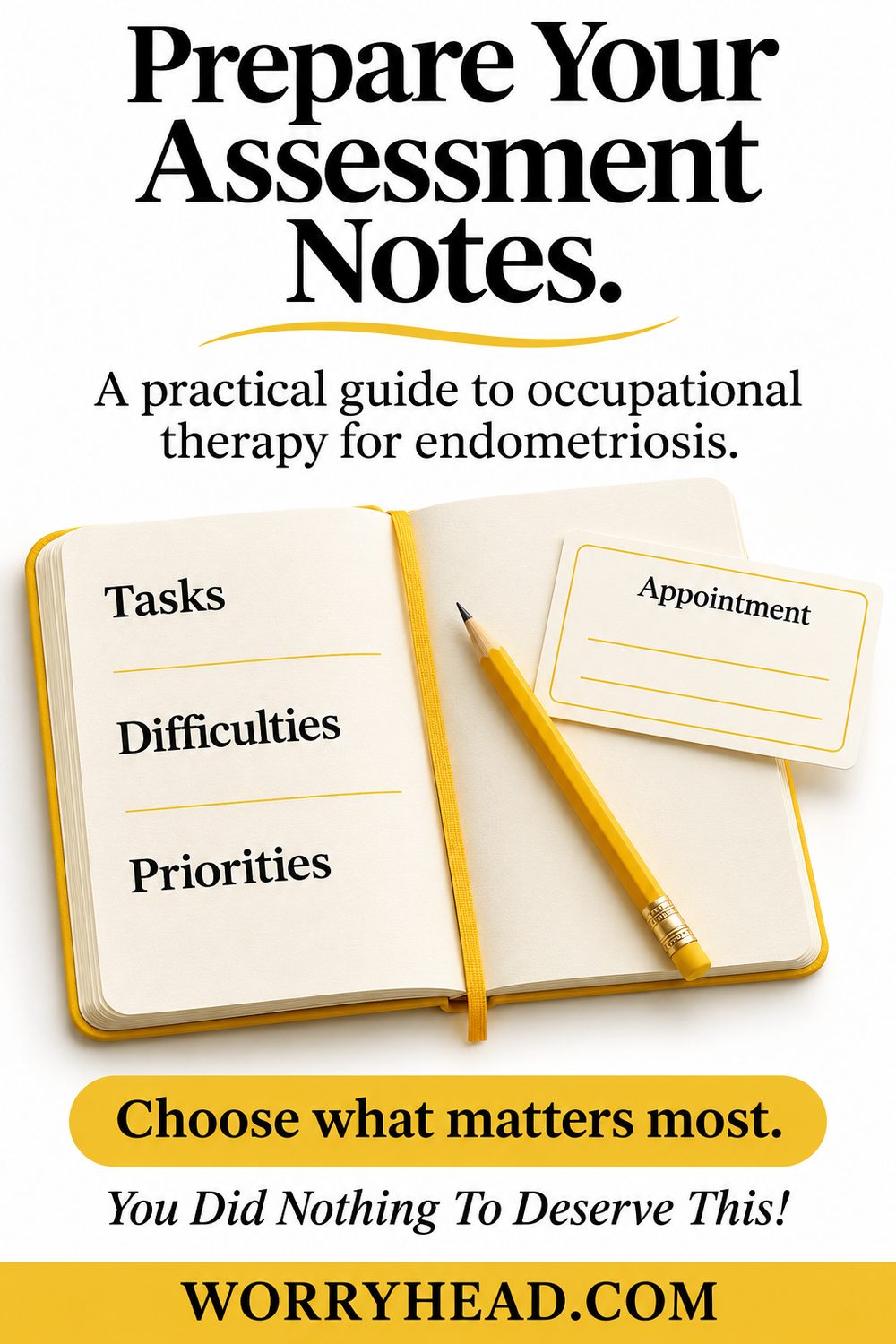
Conclusion on Occupational Therapy for Endometriosis
An assessment begins with a life, not a list of things a person can no longer do. You bring preferences, responsibilities, relationships and activities that mean something to you, even when illness has changed how you approach them. Those details deserve room in the conversation, alongside the practical difficulties that led you to seek support.
Preparing for occupational therapy for endometriosis can therefore start with one honest example. Choose an activity you want to discuss, describe the part that is difficult and explain what happens before, during or afterwards. If your experience varies, say so, without trying to compress every day into one tidy account that does not really represent you.
You can also name the things you have stopped doing. A routine that looks manageable from the outside may have become manageable only because something valuable has disappeared from it. I think about my wife’s lost dancing life when I consider that difference, and I would never want a completed household task to erase the meaning of what she misses.
The appointment is an opportunity to explore support, rather than a promise that every difficulty will have a simple solution. Local services have different roles, and any equipment, adaptation or practical approach needs to fit your assessed needs and circumstances. Asking questions about those limits can help you leave with clearer expectations about what is actually being offered.
Your medical care remains important alongside that practical discussion. New symptoms, a concerning change or uncertainty about treatment should reach the appropriate clinician, rather than being folded into an assumption that daily life simply needs reorganising. Tell the therapist about relevant diagnoses and other advice, especially when a condition affects how you respond to activity or recover afterwards.
There is room for support from a partner or another trusted person, but your voice belongs at the centre. Someone can help remember a detail, explain the assistance they provide or take notes if you want them to. Their presence should make it easier for you to be understood, not replace your preferences with their own account of what would be best.
I want my wife to feel loved without having to demonstrate that she is managing well enough to deserve that love. That feeling matters here too, because needing help with an everyday activity can touch privacy, pride and the way you see yourself. A useful assessment should be able to discuss practical needs without reducing you to those needs.
Before you leave, check what has been agreed, who will do what and how you can ask for clarification; keep any written summary somewhere you can find it, and allow yourself to revisit a suggestion that does not work as expected. You do not need to solve your whole day in one appointment; understanding one important difficulty and identifying a sensible next step can be a worthwhile beginning, especially when you have spent a long time trying to manage quietly. Your description can be enough to start, even when it feels unfinished.
Your daily life matters, including the parts that nobody else sees. You can ask for support without apologising for needing it, and describe a difficult task without turning it into a test of your character. Start with what feels most important to you, let the assessment make room for your choices, and take the next step at a pace that fits your circumstances.
If you would like to, leave a comment about what you wish an assessment could understand about your day, without sharing private medical details; my free 130+ page eBook, You Did NOTHING To Deserve This!, is also offered below for a little more understanding along the way.


About Me
Hi, I’m Lucjan! The reason why I decided to create this blog was my beautiful wife, who experienced a lot of pain in life, but also the lack of information about endometriosis and fibromyalgia for men…
READ MORE
Grab a FREE eBook!
“You Did NOTHING To Deserve This!”
Finally hear the words nobody ever said to you, that your pain is real, your tears make sense, and you did nothing to deserve endometriosis, the dismissal, or the way it has rewritten your life.
Related Questions You May Be Asking About Occupational Therapy For Endometriosis
Is occupational therapy only for people who have a job?
No. In this context, occupation means activities that make up everyday life, including personal care, household tasks, leisure and paid or unpaid work. You can ask about an assessment because daily activities are difficult even if you are not employed. The relevant service will consider your needs and its own referral criteria.
Will I need to show the therapist every room in my home?
Not necessarily. The setting and scope depend on the service and purpose of the assessment. Ask what the therapist needs to see and why, and explain any privacy concerns beforehand. You can discuss consent and alternatives rather than assuming that a home visit requires unrestricted access to every part of your home.
Can I ask for help before I know which equipment I need?
Yes. You can describe the activity and the difficulty without choosing an item or knowing the solution. An assessment can consider whether equipment, a different approach or another form of support is appropriate. Avoid buying something simply because it helped another person; suitability depends on your own needs, environment and circumstances.
Does an occupational therapy referral mean my symptoms are psychological?
No. A referral concerns the effect of health on daily activities and possible practical support; it does not establish the cause of your symptoms. It should not replace appropriate assessment or treatment of endometriosis or another condition. If the reason for the referral is unclear, ask your referring clinician what question the service is being asked to address.
What if I feel better on the assessment day?
Explain that your experience varies and describe examples from more difficult days as well as the day of the appointment. Brief notes may help you remember the difference. You do not need to make symptoms worse to demonstrate a problem, and you can ask how the assessment will take account of fluctuation over time.
Occupational Therapy For Endometriosis References
- https://www.nhs.uk/tests-and-treatments/occupational-therapy/
- https://www.nice.org.uk/guidance/ng73/chapter/Recommendations
- https://www.cuh.nhs.uk/patient-information/activity-diary/
- https://www.nhs.uk/social-care-and-support/care-services-equipment-and-care-homes/household-gadgets-and-equipment-to-make-life-easier/
- https://www.nhs.uk/social-care-and-support/care-services-equipment-and-care-homes/home-adaptations/
- https://www.nice.org.uk/guidance/ng206/chapter/Recommendations
- https://www.nhs.uk/symptoms/pelvic-pain/
