Hysteroscopy With Endometriosis: Preparing for the Test and Your Choices
Have you been offered a hysteroscopy with endometriosis and wondered why you need another test? An unfamiliar procedure can feel like one more thing to carry when you already live with pain. You deserve an explanation that takes both your symptoms and your concerns seriously.
A hysteroscopy examines the inside of the womb to investigate problems such as unusual bleeding or a suspected polyp. It does not rule out endometriosis outside the womb. Before the test, discuss its purpose, pain relief, anaesthetic options and consent, including your right to stop the procedure.
Years of learning alongside my wife’s illness shape my writing as a husband, blogger and researcher, not a clinician; the NHS, NICE and RCOG sources I used for this guide’s health information are listed at the bottom.
Making sense of the different investigations for endometriosis can help you see where this particular examination fits and which questions it leaves open.
The name sounds similar to several other gynaecological procedures, but the area examined matters. A camera looking inside the womb answers a different question from a camera looking around the pelvis.
An appointment may also involve an offer of a biopsy or treatment, rather than simply a look. Knowing that beforehand gives you space to discuss choices while you are dressed, comfortable and able to think.
My wife lives with endometriosis and adenomyosis, and that experience is why I care about explanations that do not squeeze every symptom into one diagnosis. I want you to have room for your questions without feeling that you are delaying everyone else.
You can approach this appointment with a clearer idea of its purpose, the support you want and the decisions that still belong to you.
If another examination has left you feeling that your comfort comes second, my free 130+ page eBook, You Did Nothing To Deserve This!, offers the validation behind this blog. You can find it here while you prepare your own questions and decide what support would help.
You Did NOTHING To Deserve This!
Endometriosis Validation for Women with Endo

What Can a Hysteroscopy With Endometriosis Actually Show?
The useful starting point is the question your clinician wants the examination to answer, rather than the fact that you already have a chronic condition. A hysteroscopy with endometriosis may be offered because bleeding needs investigation, something has appeared inside the womb on a scan, or another specific concern needs a closer look.
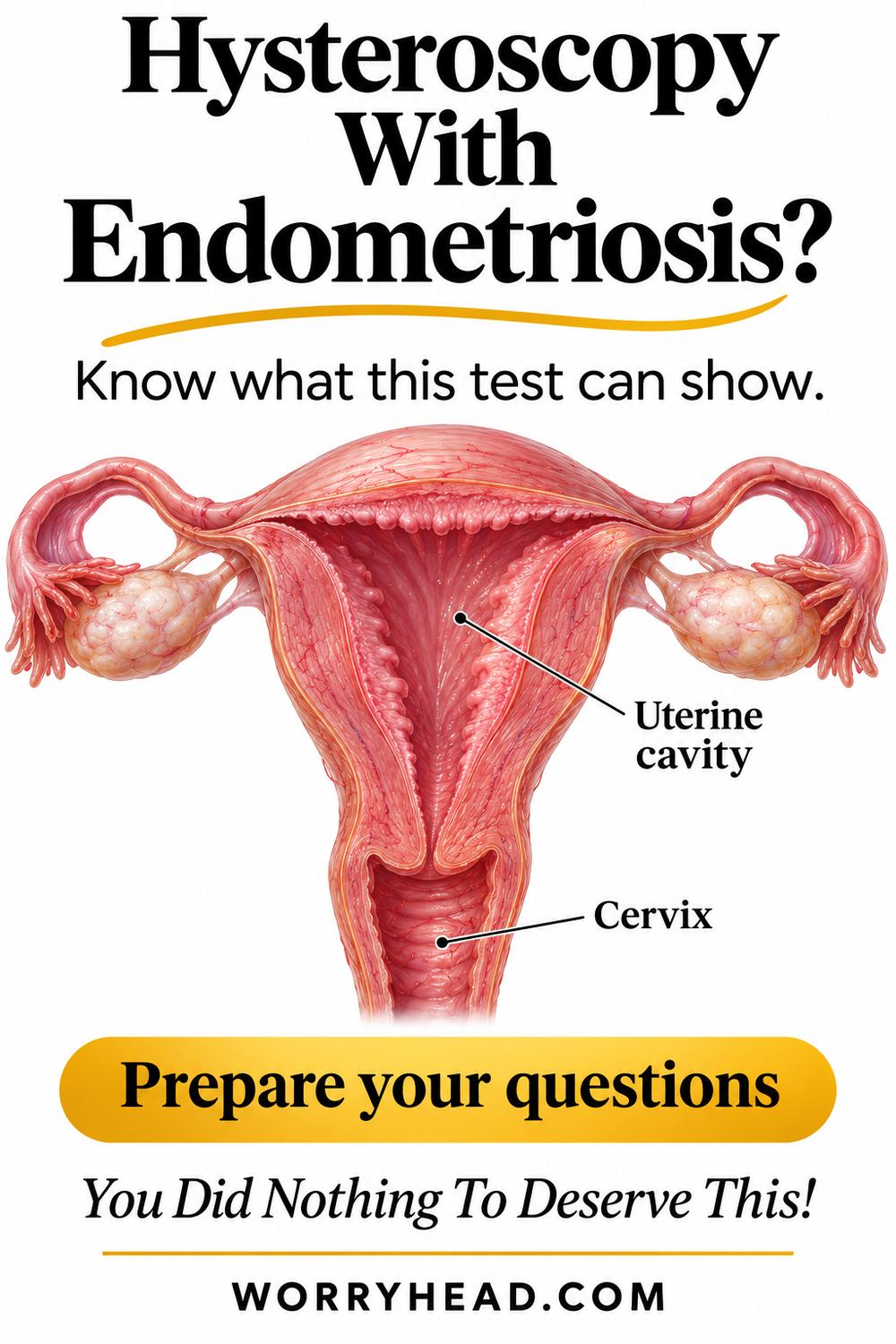
The womb has an inner space called the uterine cavity, surrounded by a lining and a muscular wall. The examination reaches that space through the vagina and cervix, using a thin viewing instrument called a hysteroscope.
Fluid helps the clinician see the cavity, and the camera sends its view to a screen. This is different from laparoscopy, which involves small abdominal cuts and allows examination within the pelvis.
Endometriosis involves tissue similar to the womb lining growing outside the womb, so a view of the cavity cannot inspect all the places where it may occur. A reassuring finding inside the womb therefore needs to be explained within the limits of that particular test.
Sometimes the team wants to investigate a polyp or a fibroid projecting into the cavity, while at other times the concern is a pattern of bleeding. You can ask the person arranging the procedure to put its purpose into one ordinary sentence that relates to your own referral.
The appointment may include an offer to take a sample of the lining, which is called an endometrial biopsy. That sample is not automatically the same as a biopsy of suspected endometriosis taken from elsewhere during surgery.
Finding one explanation for bleeding does not automatically explain every pain or bowel symptom you have described. Equally, having endometriosis does not mean every new symptom must be caused by it, or that a separate investigation is unnecessary.
As a husband, I find that distinction helpful because it protects two things at once: taking existing illness seriously and staying open to another explanation. You should leave understanding what has been checked, what remains uncertain and who will help with the symptoms that continue.
Living alongside my wife’s conditions has taught me how much energy can disappear into trying to make medical information fit together. These are the practical points I would want you to have in front of you, so that remembering everything does not become another demand.
- Ask What the Test Is Checking
- Share What Previous Examinations Were Like
- Discuss Pain Relief Before Attending
- Ask About Another Setting
- Separate Looking From Additional Treatment
- Agree How You Will Stop
- Plan the Journey and Recovery
- Leave Knowing Who Explains Results
Ask What the Test Is Checking
Start with the reason written on your referral and ask what the team hopes to learn from looking inside your womb. If the letter simply says investigation, you are allowed to ask for more detail before agreeing to an examination.
You might want to know whether the concern is bleeding, a finding on a scan or something else entirely. Those answers help you understand why the test is being offered alongside care for a condition you already know about.
I would also ask what happens if nothing unusual is seen, because an empty space in the explanation can leave you wondering whether your symptoms have been dismissed. Write the answer in your own words, including which symptoms still need attention afterwards.
This is preparation for a conversation, not a requirement to become an expert. You can arrive with one clear question and let the clinician explain the rest.
Share What Previous Examinations Were Like
Tell the clinic beforehand if vaginal examinations have been very painful, if period pain has made you faint, or if an earlier experience makes this appointment feel difficult. You can describe what support you need without giving a detailed personal history to every person you meet.
A short written note may be easier than explaining everything aloud in a busy room. Include anything practical that affects positioning, communication, getting changed or feeling able to ask for a pause.
My wife’s experience makes me wary of treating a person’s ability to endure discomfort as proof that an examination suits her. Being quiet, polite or determined does not tell the team what you are feeling inside.
Ask who will read your note and how the agreed adjustments will reach the person doing the procedure. That small handover matters more than having to find the perfect words.

Discuss Pain Relief Before Attending
Ask what pain relief is available at your particular clinic and what the team recommends for you, taking your current medicines and health history into account. Do not assume that advice on a general leaflet means every medicine is suitable for every reader.
Pain during hysteroscopy varies, and it can be severe for some people. RCOG recognises that this is difficult to predict, so neither reassurance nor a previous painful experience can promise exactly how your own appointment will feel.
Find out what the plan would be if the initial approach did not provide enough comfort. Local anaesthetic, inhaled pain relief and other arrangements are not interchangeable, and availability can differ.
I would want the discussion to happen while there is time to consider the answer. Asking in advance gives the team a chance to explain your choices before the examination begins.
Ask About Another Setting
If you do not want an awake outpatient procedure, tell the clinician and ask about hysteroscopy with an anaesthetic or sedation. RCOG describes these choices, and NICE recommends offering general or regional anaesthesia when someone declines outpatient hysteroscopy for heavy menstrual bleeding.
The arrangements may involve another appointment, assessment or a different service. Ask about the benefits, risks and practical requirements of the options that are actually available to you.
Choosing a different setting is not a moral judgement about bravery, and I would never want my wife to feel she had to earn comfort by first struggling through an unsuitable plan. What matters is an informed discussion that respects your circumstances.
You can also ask about alternatives to the investigation itself. The team should explain what information each alternative might miss, as well as what it could provide.
Separate Looking From Additional Treatment
Ask whether the appointment is intended only to inspect the cavity or whether a biopsy, polyp removal or another treatment may be offered. A procedure that sounds like a quick look can involve further decisions, and you deserve to understand them before they arise.
The purpose, possible discomfort, risks and recovery instructions may change when something additional is planned. You can ask which parts you are agreeing to and whether a separate appointment is an option for anything else.
As a partner, my role would be to help someone remember her questions, not to answer on her behalf or hurry her towards agreement. The fact that a treatment can sometimes be done during the same visit does not remove the need for consent.
Keep a note of what has been discussed. If the plan changes, ask for the change to be explained in language that you can understand.
Agree How You Will Stop
Before the procedure, agree how you will tell the clinician that you want it stopped and who will be supporting you throughout. You can ask to stop at any time, including after you have signed a consent form.
Some people find an agreed word or hand signal useful, especially if they worry that pain or distress will make speaking harder. The team can explain how they will respond and what would happen next if the examination cannot be completed.
I do not see this as planning for failure; I see it as making sure your choices remain usable when you are in a vulnerable position. A consent conversation should help you understand your control over the appointment, not leave you feeling committed to enduring anything.
If you need longer to decide, say so before starting. Ask how rescheduling or another approach would affect the next step in investigating your symptoms.

Plan the Journey and Recovery
Check the instructions for your own appointment, because an awake outpatient visit and a procedure with sedation or anaesthesia have different preparation requirements. Ask about eating, drinking, medicines and transport rather than borrowing instructions from someone else’s experience.
Arrange the level of support you want for getting home and the hours afterwards. If you have sedation or general anaesthesia, you will need someone to collect you and must follow the team’s restrictions, including their advice about driving.
My wife and I both still work, so I understand why even a short hospital visit can affect a whole day of responsibilities. Leaving room in the diary is a practical kindness, not a prediction that recovery will be difficult.
Bring pads if advised and ask for written aftercare information before leaving. Make sure you know who to contact if your recovery does not follow the expected pattern.
Leave Knowing Who Explains Results
Ask what the clinician can tell you from the view on the day and whether any laboratory result will arrive separately. If a sample is taken, clarify who will explain it, how you will hear and when to contact the service if nothing arrives.
Keep the contact details with the appointment information rather than relying on memory after a tiring visit. You can ask for a copy of the findings and a plain explanation of any unfamiliar wording.
I would also ask which team remains responsible for symptoms outside the scope of this examination. Knowing that one part of the investigation is complete should not leave you unsure where to take continuing pain or another concern.
A useful result includes a next step, even when that step is reassurance or a discussion of other options. You do not need to work out a new care plan alone from a line in a letter.
Making Room for Choice Before Hysteroscopy With Endometriosis
There is a difference between being given information and having enough space to use it, especially when the subject is an intimate examination and you already feel worn down. Preparing for a hysteroscopy with endometriosis can include asking for a conversation before the appointment, so that the important decisions are not squeezed into the moment before you get changed.
You may feel comfortable with an outpatient approach after discussing it, or you may prefer to explore another setting with the team. Neither response tells anyone how much pain you usually manage, how committed you are to your health, or how appreciative you are of the care being offered.
For me, supporting my wife means respecting that she is the person whose body is involved, even when I have read a great deal about a procedure. Research can help me ask better questions, but it cannot give me permission to decide what she should tolerate or which arrangement should feel acceptable to her.
If you bring someone with you, explain beforehand what you want their role to be, such as taking notes, remembering a question or simply staying beside you. You can also ask them to wait outside for part of the discussion, because support does not have to mean sharing every detail of your care.
Written questions can make this easier when you are worried about losing your train of thought, and they do not need to look polished or medically sophisticated. A few words about your biggest concern may be more useful than a long list copied from the internet that leaves no room for what matters to you.
If two explanations seem to conflict, ask the team to clarify which instructions apply to the procedure you have actually been booked for and who can resolve the uncertainty. Keep the answer with your appointment details, especially if you receive a revised plan or another letter after the first conversation.
I want the practical result of this preparation to be a little less pressure on you, rather than another assignment you must finish to deserve considerate care. You can ask for help understanding the choices at any stage, including when you thought you had understood them earlier but have since developed another question.
After Hysteroscopy With Endometriosis, Keep the Wider Picture
The first conversation after a hysteroscopy with endometriosis should distinguish what was seen from what, if anything, still needs laboratory examination or another clinical discussion. If the person says that the cavity looks normal, ask what that means for the reason you were referred and for any symptoms the procedure was not designed to explain.
It can help to keep three separate notes: the findings, the agreed next step and the person or service responsible for that step, without trying to interpret every medical term yourself. That small separation prevents a reassuring comment about one part of the body from becoming a much wider conclusion that nobody actually intended to make.
My wife’s overlapping conditions have made me value explanations that leave room for complexity without making her responsible for solving it. A person can be relieved that a particular abnormality was not found and still need help with pain, bleeding or the impact those symptoms have on ordinary life.
If your report includes a biopsy result, ask what tissue was sampled and how the finding relates to the question the clinician was investigating. A result from the womb lining should be interpreted as a result from that sample, alongside the rest of your history, rather than as a universal verdict on every possible source of symptoms.
Make a note of any treatment or medicine changes that the team has actually agreed with you, and check anything that does not match the written instructions you receive. If a partner is helping with the practical arrangements, sharing that agreed plan can reduce confusion without turning them into the person who manages your decisions.
When the immediate appointment is over, it is reasonable to ask how and when continuing symptoms will be reviewed, particularly if they are still affecting work, sleep or daily activities. I would rather you have a clear route back to the right team than feel that a completed test means you must quietly close the subject yourself.

When to Seek Medical Help Around Hysteroscopy With Endometriosis?
Before the appointment, contact the clinic if you could be pregnant, have become unwell or are unsure whether the preparation instructions fit your situation. Do not quietly guess about medication changes or fasting because you are worried about bothering someone.
Hysteroscopy must not be performed during pregnancy. If pregnancy is possible, discuss this with the team before the procedure and follow their advice about preventing pregnancy before the appointment and testing when needed.
Ask in advance what symptoms after your particular procedure should prompt a call and whether you will receive a direct contact number. The instructions may differ if you have had an additional treatment, so keep the information that relates to your actual visit.
Some cramping and light bleeding can happen afterwards, but worsening symptoms deserve attention. Contact the clinic urgently, or use NHS 111 if you cannot reach the team, for increasing bleeding, worsening abdominal pain that is not helped by the recommended pain relief, a high temperature or unpleasant-smelling discharge.
Oxford University Hospitals also advises urgent assessment if you feel very unwell, faint or dizzy after the procedure. If you are severely unwell or in immediate danger, seek emergency help rather than waiting for an administrative callback.
I would not want you to compare a worrying new symptom with years of familiar pain and decide that you should simply manage it alone. Tell the clinician what has changed, when you had the procedure and whether a biopsy or treatment was also carried out.
You do not need to decide whether a symptom means infection, another complication or something less concerning before asking for advice. The point of the contact is to get help deciding what assessment is needed, not to present a diagnosis you have already worked out.
For continuing symptoms that are not urgent, arrange the review agreed with your usual team. A hysteroscopy with endometriosis should sit within ongoing care, and it is reasonable to ask who will review problems that the examination did not explain.
Keep a brief record of the advice you receive, including whom you spoke to and what should happen next. If you are supporting someone, help with that record if she wants you to, while allowing her to describe her own symptoms in her own words.
Questions to Ask Your Doctor About Hysteroscopy With Endometriosis
I would begin with the question that makes the rest of the appointment understandable: what are you looking for in my case? Ask the clinician to connect the reason for the referral to your symptoms or scan findings, rather than giving only a general description of the procedure.
Then ask what a normal result would mean and what it would leave unanswered. That is particularly useful when you have several symptoms and worry that one reassuring finding might end a conversation you still need to have.
For a hysteroscopy with endometriosis, I would ask which concerns need to be discussed with the hysteroscopy team and which remain with the clinician managing the wider condition. Clear responsibility can spare you the frustration of being sent between services without knowing who should answer.
Ask whether a biopsy or treatment is expected, optional or only a possibility depending on what is found. You can also ask what recovery or risks would change if you agreed to an additional procedure, and whether there would be time to discuss it separately.
Your comfort questions can be specific: what pain relief can this service offer, what would happen if it was not enough, and what alternatives are available if I do not want the examination while awake? Ask who can arrange a further conversation if the person booking the appointment cannot answer those clinical questions.
Practical questions belong here too, including whether you can bring someone, what adjustments can be made and which preparation instructions apply to your booking. If the written leaflet and the advice given to you differ, ask for clarification rather than trying to choose between them on your own.
Before leaving, ask how results will reach you, whether you need to book follow-up and whom to contact if the expected update does not arrive. An approximate timeframe with a contact route is more useful than being left to check repeatedly without knowing what you are waiting for.
As a husband, I would want to help make space for these questions rather than make the appointment longer with my own priorities. If you feel overwhelmed, choose the two or three answers you need most and ask whether the rest can be provided in writing.
Finally, explain what a useful outcome would look like for you, whether that is understanding unusual bleeding, feeling able to consent or knowing how another result fits your existing care. Your priorities help the conversation stay connected to your life instead of becoming a list of technical details.

Final Word on Hysteroscopy With Endometriosis
A hysteroscopy with endometriosis can be easier to approach when you understand the particular question it is meant to answer. You do not need to arrive knowing every instrument, medical term or possible finding.
You need a clear explanation of why the examination has been offered to you, what choices are available and how the team will help you make those choices. That is a reasonable starting point for care, especially when you already carry the daily demands of a painful condition.
The distinction between looking inside the womb and investigating the wider pelvis matters because it keeps the meaning of a result honest. A useful finding may explain one symptom without explaining another.
A reassuring finding may be welcome without bringing every outstanding concern to an end. You are allowed to ask how the result fits the rest of your history and what happens to the questions that remain. Understanding the limits of a test is part of understanding its value.
Pain relief and consent deserve the same attention as the technical purpose of the examination. You can describe earlier painful experiences, ask about another setting and agree how to request that the procedure stops.
You do not have to prove that you are sufficiently anxious or sufficiently brave to have that conversation. The person providing care needs to know what matters to you, and the discussion should leave you better informed about the options that fit your circumstances.
My wife’s experience is the reason I keep returning to the human part of these appointments. Illness already asks so much of her energy, and I do not want the search for answers to become another place where she feels she must minimise herself.
I cannot know exactly how your visit will feel, and our story cannot predict your result. What I can do is encourage preparation that protects your voice instead of adding pressure to it.
If someone is supporting you, decide together what would make the day easier. That might mean a lift, a written question, help with work arrangements or quiet company afterwards.
It might also mean privacy for part of the appointment. Good support follows your wishes and makes room for them to change. A partner can help carry practical tasks without taking ownership of the decisions, and affection does not require an explanation for every boundary you need.
Before the visit ends, try to leave with the findings you can be told now, the results still awaited and a clear route for further help. Keep the aftercare instructions somewhere easy to find and ask when uncertainty needs a call.
Then allow yourself to step away from researching for a while if that is what you need. You remain a whole person beyond this appointment, with work, relationships and ordinary wishes that deserve room alongside your care. The aim is not to manage every detail perfectly, but to have enough understanding and support to take the next step without feeling that you must take it alone.
You deserve an explanation you can understand, choices you can consider and support that respects your body. Take the question that matters most to you into the appointment, ask for the next step in writing, and let someone help with the practical load if you want them to. Your comfort and your voice belong in this conversation.
If you feel comfortable, you are welcome to share which appointment question helped you most in the comments, without sharing private medical details; my free 130+ page eBook, You Did Nothing To Deserve This!, is below for the days when you need a reminder that asking for considerate care is reasonable.


About Me
Hi, I’m Lucjan! The reason why I decided to create this blog was my beautiful wife, who experienced a lot of pain in life, but also the lack of information about endometriosis and fibromyalgia for men…
READ MORE
Grab a FREE eBook!
“You Did NOTHING To Deserve This!”
Finally hear the words nobody ever said to you, that your pain is real, your tears make sense, and you did nothing to deserve endometriosis, the dismissal, or the way it has rewritten your life.
Related Questions You May Be Asking About Hysteroscopy With Endometriosis
Is hysteroscopy the same as laparoscopy?
No. Hysteroscopy looks inside the womb through the vagina and cervix, while laparoscopy uses small abdominal cuts to examine within the pelvis. They answer different questions. Ask which procedure you have been offered, why it is needed and whether any additional investigation is planned alongside it for your particular symptoms.
Can I ask for the procedure to stop after signing consent?
Yes. Signing a consent form does not remove your ability to ask for the procedure to stop. Agree beforehand how you will communicate that request and who will support you. If the examination is stopped, ask the clinician to explain the next options, including another setting or further discussion before proceeding.
Does a normal hysteroscopy exclude endometriosis?
No. A hysteroscopy examines the uterine cavity, so a normal view does not rule out endometriosis elsewhere. Ask what the result means for the specific reason you were referred and what remains to be assessed. Continuing symptoms should be discussed with the appropriate clinician within your wider care plan, rather than interpreted from this test alone.
Should I cancel if my period starts?
Contact the clinic for advice rather than cancelling automatically. RCOG says it is generally best to keep the appointment, although heavier bleeding can sometimes make the examination difficult. Explain your bleeding and any other concerns so the team can advise about your booking, including whether the planned procedure can still go ahead.
Will a biopsy result be available straight away?
The clinician may explain what they can see during the examination, but a tissue sample sent to a laboratory needs separate assessment. Ask who will communicate the result, the expected timeframe and whom to contact if you do not hear. Keep that plan with your aftercare information so you are not left guessing afterwards.
Hysteroscopy With Endometriosis References
- https://www.nhs.uk/tests-and-treatments/hysteroscopy/
- https://www.rcog.org.uk/for-the-public/browse-our-patient-information/outpatient-hysteroscopy/
- https://www.rcog.org.uk/guidance/browse-all-guidance/good-practice-papers/pain-relief-and-informed-decision-making-for-outpatient-hysteroscopy-good-practice-paper-no-16/
- https://www.nice.org.uk/guidance/ng88/chapter/recommendations
- https://www.nice.org.uk/guidance/ng88/chapter/rationale-and-impact
- https://www.nice.org.uk/guidance/ng73/chapter/Recommendations
- https://www.nhs.uk/conditions/endometriosis/
- https://www.cuh.nhs.uk/patient-information/hysteroscopy-outpatient-aftercare-advice/
- https://www.ouh.nhs.uk/services/departments/gynaecology/hysteroscopy/after/
