
Endometriosis and Blood Donation: Checking What Is Right for You
Does thinking about endometriosis and blood donation leave you unsure whether you can offer something helpful without asking too much of your own body? You may want a straightforward answer while also managing pain, medicines, heavy bleeding or investigations. Wanting to help other people does not make those concerns any less important.
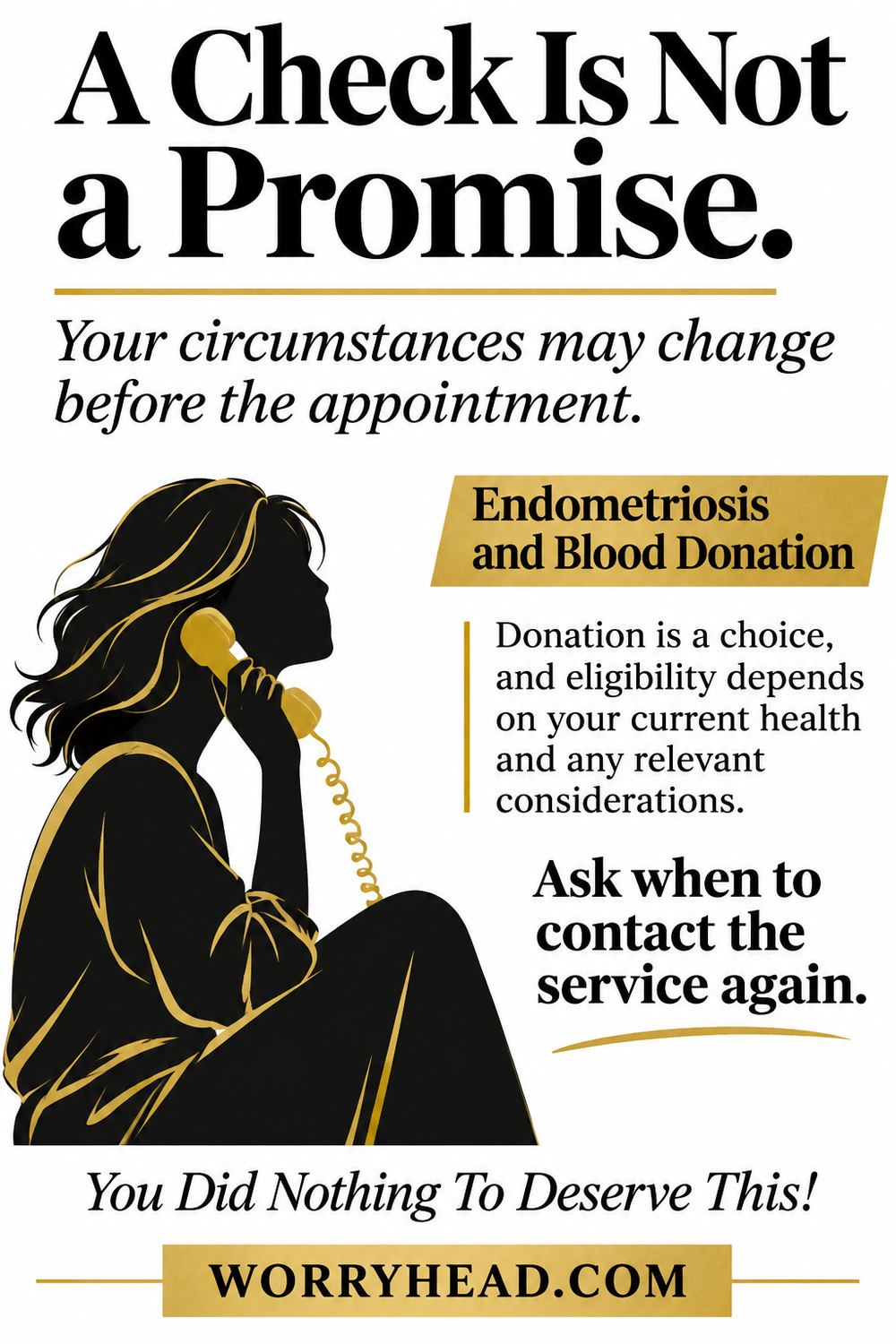
Endometriosis and blood donation require an individual eligibility check, not a decision from the diagnosis alone. Your current health, anaemia, medicines, investigations and procedures can affect whether you may donate. Contact your blood service before booking, and put your own treatment first.
I am Lucjan, a husband, blogger and researcher rather than a clinician, and years of learning through my wife’s illnesses have shaped my questions; the NHS, NHS Blood and Transplant and UK donor-selection guidance used here are listed at the bottom.
The wider impact of endometriosis on daily life can include reconsidering something you hoped to do for somebody else, even when your intention has not changed.
This article helps you prepare a useful conversation with the blood service. It cannot clear you to donate or replace the assessment made for your circumstances on the day.
The practical examples below mainly use NHS Blood and Transplant information for England, alongside UK professional donor-selection guidance. If you live elsewhere, check directly with your own national blood service because its current instructions are the ones you need.
My wife has experienced iron-loss anaemia alongside her other illnesses, so I do not see protecting your own health as a small consideration. Her experience is not evidence about anyone else’s eligibility, but it explains why I want the question approached carefully.
You can value blood donation while deciding that today, or this stage of your health, is not the right time for you.
If needing care yourself makes it difficult to accept a limit on what you can give, my free eBook, You Did NOTHING To Deserve This!, offers emotional reassurance. It is a companion for the guilt and unseen work of illness, not a guide to donor eligibility or a replacement for medical advice.
You Did NOTHING To Deserve This!
Endometriosis Validation for Women with Endo

- Understanding Endometriosis and Blood Donation Before Booking
- Why Iron Matters in Endometriosis and Blood Donation
- Making an Informed Choice About Endometriosis and Blood Donation
- When to Seek Medical Help With Endometriosis and Blood Donation
- Questions to Ask Your Doctor About Endometriosis and Blood Donation
- Final Word on Endometriosis and Blood Donation
- You Did NOTHING To Deserve This!
- FREE eBook
Understanding Endometriosis and Blood Donation Before Booking
A blood donation is a clinical process with checks intended to protect both the donor and the person receiving blood. Your wish to help is welcome, but it does not replace those checks.
The diagnosis name is only one part of the information the service needs. Current symptoms and treatment may change the answer even if you have donated before.
Contact the service with your actual circumstances rather than relying on another person’s experience online. A useful answer needs enough detail to distinguish your situation from theirs.
NHS Blood and Transplant assesses health and lifestyle at each appointment. An earlier donation therefore does not act as permanent clearance for every future visit.
Tell the service about investigations, recent procedures and any planned treatment. Explain what is happening now, including a test or follow-up whose purpose you do not fully understand.
Mention anaemia or treatment for it explicitly. Do not assume that an apparently manageable level of fatigue tells you whether donation is suitable.
Bring accurate medicine information and answer the screening questions honestly. If you are uncertain, ask before attending rather than leaving out a detail that feels inconvenient.
You can also decide not to donate even when you are eligible. An invitation is not an obligation to spend energy or take part on a day that does not feel right.
Living beside my wife has made me attentive to the pressure people can feel to remain useful despite illness. I would want a donation decision to begin with clear information and freedom to choose, so these are the points I would work through with her agreement.
- Contact the Right Blood Service
- Describe Your Current Health
- Explain Anaemia and Iron Treatment
- List Medicines and Their Purpose
- Give Accurate Procedure Dates
- Clarify What Screening Can Tell
- Prepare Only After Eligibility Advice
- Leave Room to Change Plans
Contact the Right Blood Service
Start with the service that would collect your donation, using its current eligibility information and contact route. Explain that you have endometriosis and say what you need clarified before booking. If you are offered a general answer that does not cover your circumstances, ask whether the clinical donor-support team should advise.
Keep a short note of the information you gave and the advice you received. This is particularly helpful if your health changes before the appointment. I would want my wife to avoid repeating a complicated history while wondering whether an earlier answer still applies.
Confirm whether the advice concerns whole blood, platelets or another donation type. The rules are not interchangeable in every situation. Ask what change would mean you should contact the team again, and do not treat a booking confirmation as proof that every clinical question has already been resolved.
Describe Your Current Health
Explain how you are feeling now, rather than only naming the diagnosis written in your records. Mention symptoms being investigated and any change since your last contact with the service. You do not have to decide for yourself which detail matters before asking the question.
If you are unwell, contact the service instead of trying to appear well enough at the appointment. A wish to keep a commitment can make cancelling feel harder than it needs to be. I would rather an honest conversation protect my wife’s health than have politeness determine what she attempts.
Distinguish your usual symptoms from anything new or unexplained, and seek healthcare advice where needed. Donation screening is not a substitute for that assessment. The practical aim is to give the team a clear picture, without either minimising your difficulties or assuming that every symptom automatically rules you out forever.
Explain Anaemia and Iron Treatment
Tell the blood service if you have anaemia, are being investigated for it or are receiving treatment. UK donor-selection guidance excludes donation during investigation or treatment for anaemia. A previous history needs assessment of its cause, current position and treatment, rather than a guess based on how long ago it occurred.
Explain why you take iron if it is on your medicines list. Treatment for current anaemia and medication intended to prevent recurrence after successful treatment are not necessarily assessed in the same way. The donor team should make that distinction using the relevant information.
My wife’s iron-loss anaemia makes this point personal to me, but I would never use her circumstances to decide yours. Keep taking prescribed treatment as directed. Do not stop it, alter the dose or hide it to obtain a different answer from the screening process; your recovery matters more than qualifying for an appointment.
List Medicines and Their Purpose
Write down the names, doses and reasons for your medicines, including products you take only occasionally. Include non-prescription pain relief and supplements so the donor team does not have to work from an incomplete picture. If you cannot remember a detail, check the packaging or ask your pharmacist.
Eligibility can depend on the condition being treated as well as the medicine itself. Some medicines also matter differently for platelet donation, so ask about the donation type you are considering. Taking several medicines is not, by itself, a complete explanation of eligibility.
I would want my wife to receive advice about her actual treatment rather than a frightening general statement about all medication. Ask which information the service still needs and who can provide it. Continue prescribed care unless your usual clinician advises a change for your health; do not rearrange treatment simply to try to meet a donor rule.
Give Accurate Procedure Dates
Tell the service what procedure you had, when it happened and whether recovery or follow-up is continuing. If you are awaiting surgery or another investigation, mention that as well. The word operation can cover very different circumstances, so a date without the procedure details may not be enough.
Use your discharge letter if you are unsure what was done. Ask the donor team to explain any waiting period and the other conditions that must be met before returning. Reaching a date on the calendar is not the same as confirming that you are recovered and otherwise eligible.
I know how easily administrative questions can become another burden after treatment. A partner can help find the paperwork if you want that support, while leaving the clinical explanation to the appropriate team. Report any transfusion history too, even if it happened years ago, rather than assuming that it is irrelevant to a current donation decision.
Clarify What Screening Can Tell
Before donation, the service checks haemoglobin to help assess whether taking blood would be safe. That is not the same as a full investigation of iron stores or a general health assessment. Passing the screening test does not explain every reason for fatigue or replace a blood test requested by your doctor.
If the result is too low for donation, listen to the advice about what to do next. Ask whether you need to contact your GP and what information should be passed on. Do not turn the result into either a diagnosis you make yourself or a verdict on how well you have looked after your body.
I would want my wife to understand what a test answers and what remains uncertain. Keep any written advice and follow the recommended next step. If symptoms continue despite a result that seemed reassuring, discuss them through your usual healthcare service instead of using donation screening as repeated reassurance.
Prepare Only After Eligibility Advice
Once the service has advised that you can attend, follow its preparation instructions for that donation. NHS Blood and Transplant advises eating beforehand, staying hydrated and allowing for rest. If your own care includes fluid or dietary restrictions, clarify how the advice applies before trying to follow a general instruction.
Think about transport and what you have planned afterwards, including work or caring responsibilities. A diary that looks spacious may still involve effort that is not written down. I would want support to include the journey home and any tasks that can reasonably wait.
Tell staff about previous fainting or an uncomfortable donation experience. Ask how to communicate if you feel unwell, and follow the advice given at the session. Preparation can make an appropriate appointment more manageable, but it cannot turn an unsuitable donation into a safe one or override a clinical decision to defer it.
Leave Room to Change Plans
Your health can change between booking and attending, and you can contact the service when it does. A flare, new investigation or change in treatment may mean that earlier advice needs reviewing. Explain the change rather than assuming that the existing appointment commits you to going ahead.
If you are deferred, ask whether the reason is temporary and what would need to be checked before you return. Some reasons require a different outcome, and the team should explain the relevant advice. You do not have to decide immediately how you feel about that answer.
I know that another restriction can hurt when illness has already narrowed daily life. A donation decision is still not a measure of generosity or personal worth. You can leave the conversation with a practical next step, take time to absorb the information and choose what happens next without promising a future appointment to soften somebody else’s disappointment.

Why Iron Matters in Endometriosis and Blood Donation
Blood donation removes red blood cells and some of the iron your body uses to make haemoglobin. Replacing what has been donated draws on the body’s resources over time.
This is why a conversation about endometriosis and blood donation should include relevant bleeding and iron history. It should not assume that everyone with endometriosis has anaemia or that everyone without a diagnosis of anaemia has the same reserves.
Heavy periods can contribute to iron deficiency anaemia. Other causes exist, and symptoms need appropriate assessment rather than being attributed automatically to menstruation or endometriosis.
My wife’s experience has taught me to take the impact of blood loss seriously. It has not given me a way to estimate another person’s haemoglobin or iron stores from their appearance.
If you are receiving care for low iron or anaemia, tell the donor team what the treatment is for. Let your usual clinician guide treatment and monitoring instead of trying to prepare for donation by improvising supplements.
A period alone does not answer every eligibility question. How you feel, relevant investigations and the service’s current criteria still need to be considered together.
The safest next step is a specific question with your actual history available. That gives the service something more useful than a general request for reassurance about the diagnosis name.
There is also an emotional difference between being told that a test is satisfactory and feeling fully recovered. You may still be struggling with work, travel or ordinary tasks. Describe that reality to your healthcare team rather than assuming that one acceptable result means every difficulty has been explained or resolved.
Conversely, feeling more energetic does not prove that a course of treatment is finished. Follow the plan you have been given, including any repeat testing. A good day can be enjoyed without making it carry the additional job of demonstrating eligibility for something else.
If fatigue is familiar, it can be tempting to treat it as background noise. I understand why a person might stop mentioning a symptom that has become part of daily life. Yet a change in its pattern, new breathlessness or other concerns deserves a fresh conversation rather than being folded automatically into the old explanation.
There is no moral reward for getting through a donation while withholding information. The staff need an honest account so that the process protects you too. You do not owe a more optimistic version of your health because the service needs donors or because somebody else found their appointment easy.
Ask for the reason behind a deferral if you do not understand it. Knowing whether the issue is a screening result, ongoing investigation or something else can help you follow the correct next step. It also prevents you from spending energy trying to solve the wrong problem, such as changing your diet when the actual question concerns a procedure or medical history.
A partner can support this conversation by helping you gather information, if invited. That might mean finding a letter or writing down the question you want answered. It should not mean persuading you to donate, interpreting your results without expertise or turning your decision into a test of confidence.

Making an Informed Choice About Endometriosis and Blood Donation
You may have donated regularly before illness became part of your life. Losing or pausing that routine can feel more significant than an appointment removed from a calendar.
Perhaps donation represented something dependable that you could offer to people you would never meet. It is understandable if uncertainty about returning brings disappointment as well as practical questions.
Endometriosis and blood donation should still be approached through current information. A meaningful past experience does not remove the need to check what is appropriate now.
You can ask for a clear explanation without trying to negotiate away a safety requirement. Understanding the decision and disagreeing with the fact that illness has complicated life are different things.
I have watched my wife live with losses that cannot be repaired by telling her to stay positive. I would not want another limitation dismissed just because someone else considers it a small matter.
At the same time, your contribution to other people is not measured in appointments completed. There is room to value what donation means while refusing to make it a condition of feeling useful.
If a workplace, friend or family member is organising a group visit, you can give a brief answer about your own plans. You do not have to disclose intimate symptoms, treatment details or a screening result to justify not joining. A private health decision can remain private even when the invitation is public and well intended.
Some people prefer to say that they are checking eligibility and will make their own arrangements. Others would rather decline without explaining the medical background. Choose wording that leaves you with less work to do, especially if you already spend a great deal of time explaining endometriosis to people who do not understand it.
Do not assume that another donation type is a simple substitute if whole blood is unsuitable. Platelet and plasma donation have their own requirements, and the service must assess them. A change of procedure should follow appropriate advice, not an attempt to find a route around a decision made to protect health.
Equally, you are not required to find another charitable task immediately. Rest does not need to be balanced by a new promise of usefulness. If you want to support a cause in another way, let that be a choice that fits your circumstances, rather than a debt created by being unable to donate.
For a future appointment, keep any advice somewhere you can find it without rebuilding the whole story. Note the circumstances it was based on and any instructions about contacting the service again. That small administrative step can make a later decision clearer without turning health into a permanent project you must manage perfectly.
The aim is a decision you understand, with the right people answering the clinical questions. You should know what is confirmed, what remains uncertain and what action, if any, is needed next. You can then make a personal choice within that advice, including deciding that an eligible appointment is not something you want to undertake now.
When to Seek Medical Help With Endometriosis and Blood Donation
If you think you may have anaemia, arrange a GP assessment rather than booking donation to obtain a screening result. Tiredness, reduced energy, palpitations and breathlessness can have different causes. Your clinician can decide which investigations are appropriate and how to interpret them in your circumstances.
Seek urgent advice through NHS 111 for new or worsening breathing difficulty, including being more breathless than usual. Severe difficulty breathing, a tight or heavy chest, pain spreading to the arms, back, neck or jaw, or sudden confusion needs emergency help: call 999. Do not drive yourself to A&E.
At a donation session, tell staff immediately if you feel faint or unwell. If you become faint after leaving, NHS Blood and Transplant advises telling someone and lying down with your legs raised if you can. Follow the service’s aftercare advice and obtain medical help if symptoms are severe, persist or concern you, rather than assuming that donation explains everything.
Keep urgent healthcare separate from questions about returning to donate. A donor helpline can explain donation-related advice, but it is not a replacement for emergency assessment. New symptoms deserve attention even when you had expected the day to be straightforward.
I would want my wife to feel able to ask for help without worrying about making a fuss or disrupting a session. The same applies to you. It is better to describe what is happening than to decide silently that it is probably too minor to mention.
Questions to Ask Your Doctor About Endometriosis and Blood Donation
Begin with the part of your health that remains unclear. If you have been treated for anaemia, ask what the current treatment and follow-up are intended to establish. Your doctor can explain your clinical position, while the blood service applies its donor criteria; those are related conversations with different responsibilities.
If heavy bleeding or fatigue is continuing, describe its impact on ordinary life rather than only asking whether you can donate. The care you need matters in its own right. I would not want my wife’s health reduced to a question about whether it meets the requirements of an activity she hopes to undertake.
You can ask what information would help the donor team understand recent surgery, an investigation or a medicine. A clear procedure name or explanation of treatment may be more useful than a vague statement that everything is fine. If you need a document, ask what is available before assuming you must arrange a separate appointment or pay for a letter.
Discuss iron supplements through your usual care if you are unsure why you are taking them or how long treatment should continue. Ask about side effects and monitoring rather than stopping because the tablets complicate an eligibility question. Your clinician can help you follow a tolerable treatment plan without making donation the goal of recovery.
Before ending the conversation, make sure you understand the next step. That might be a clinical review, a test already planned or contacting the donor team with clearer information. You deserve an answer that tells you what to do, not just a broad instruction to be careful while you work out the details alone.

Final Word on Endometriosis and Blood Donation
Wanting to give blood can come from a generous part of you that illness has not taken away. You may remember being able to make plans without first checking symptoms, treatment or recovery.
It can hurt when another intention becomes a question you must research. That disappointment deserves room, even when you understand why the checks exist and agree that they are necessary. You do not have to pretend the decision means nothing simply because the answer is sensible.
Endometriosis and blood donation are best approached with your current circumstances in view. Give the blood service information, ask what it needs to know and follow the advice that applies to you.
Do not use somebody else’s successful donation as evidence that you should manage the same thing. Do not assume that a temporary difficulty defines every future possibility either. A careful answer can leave room for uncertainty without asking you to turn that uncertainty into a promise about what your body will do next.
My wife’s experience of illness has changed how I think about being useful. I see the effort involved in continuing to work, managing symptoms and making space for relationships while carrying things that other people cannot easily see.
None of that needs to be balanced by another act of giving before it counts. If your body needs treatment, rest or further investigation, those needs are not competing unfairly with somebody else’s. They belong in the decision from the beginning, without apology.
If donation is suitable and you want to proceed, prepare with the service’s instructions and a realistic plan for the day. If it is not suitable, ask what the decision means and what, if anything, should happen next.
Keep the explanation separate from the story you tell yourself about your worth. A deferral is a clinical outcome, not a judgement on your intentions. You can feel disappointed while still accepting advice that protects you, and you can need time before deciding whether to revisit the question.
For partners, support begins by listening to what the decision means to the person living with the condition. Offer practical help with information or arrangements when it is wanted.
Do not rush to replace a lost option with another task, or suggest that determination will solve a medical restriction. Sometimes the helpful response is simply to respect the choice and leave the person free to feel whatever they feel. Their generosity has not disappeared because their circumstances have become more complicated.
Take the next useful step, whether that is contacting the donor team, clarifying treatment with your doctor or deciding to leave the question for another time. You do not need to settle every future possibility today.
Accurate information can guide a choice, but it cannot tell you what you are worth. Your health deserves care before, during and after any decision about giving blood. You remain a person with something to offer, including on the days when the most reasonable thing you can do is receive support yourself.
Start with your actual health, not the pressure to prove you can still do everything. Ask the blood service for advice, keep your treatment on track and allow yourself an honest choice. Giving is meaningful, but your wellbeing matters too. You do not become less generous when you respect a limit or need support yourself.
If you wish, share what helped you navigate a change in what you felt able to give in the comments. My free 130+ page eBook, You Did NOTHING To Deserve This!, offers reassurance when illness makes your sense of usefulness feel uncertain.


About Me
Hi, I’m Lucjan! The reason why I decided to create this blog was my beautiful wife, who experienced a lot of pain in life, but also the lack of information about endometriosis and fibromyalgia for men…
READ MORE
Grab a FREE eBook!
“You Did NOTHING To Deserve This!”
Finally hear the words nobody ever said to you, that your pain is real, your tears make sense, and you did nothing to deserve endometriosis, the dismissal, or the way it has rewritten your life.
Related Questions You May Be Asking About Endometriosis and Blood Donation
Does Endometriosis Automatically Prevent Blood Donation?
Do not decide from the diagnosis name alone. Contact your blood service with current symptoms, treatment, investigations and procedure history so it can advise.
Eligibility also depends on the service’s other criteria and screening at the appointment. A previous donation or another person’s experience cannot establish whether donating is suitable for you now.
Can I Donate While Being Treated for Anaemia?
UK donor-selection guidance says not to donate while under investigation or receiving treatment for anaemia. Tell the team about your treatment and follow your clinician’s advice. A past history or medication to prevent recurrence may be assessed differently after treatment, but the service needs to make that decision from your circumstances.
Is the Donation Test a Full Iron Check?
The pre-donation screening checks haemoglobin, rather than providing a complete assessment of iron stores or the causes of tiredness. Do not use it instead of medical investigation. If you have persistent symptoms or concerns about iron, speak to your GP and follow any testing or treatment plan already arranged for you.
What If I Have Recently Had Surgery?
Give the donor team the procedure name, date, recovery information and details of any continuing treatment or follow-up. Mention planned procedures and transfusions too.
Waiting periods and other requirements depend on the circumstances, so do not assume that reaching a particular date automatically means you can donate. Ask for advice specific to your situation.
Should I Stop Medicines So I Can Donate?
Do not change prescribed treatment to try to qualify for donation. Tell the service what you take and why, including occasional pain relief and supplements.
The condition and the medicine may both matter, and requirements can differ by donation type. Your own clinician should guide treatment decisions for your health.
Endometriosis and Blood Donation References
- https://www.blood.co.uk/who-can-give-blood/
- https://my.blood.co.uk/eligibility/health/article?id=e09&title=Endometriosis
- https://www.jpac.org.uk/guidelines/wb/index/anaemia/
- https://www.jpac.org.uk/guidelines/wb/index/drug-treatment/
- https://www.jpac.org.uk/guidelines/wb/index/surgery/
- https://www.blood.co.uk/the-donation-process/donation-advice-and-information/haemoglobin-and-iron/
- https://www.blood.co.uk/the-donation-process/after-your-donation/how-your-body-replaces-blood/
- https://my.blood.co.uk/eligibility/health/article?id=00046p08&title=Period+Pains+%2F+Cramps+%3A+Periods
- https://www.blood.co.uk/the-donation-process/preparing-to-donate/
- https://www.blood.co.uk/the-donation-process/donation-advice-and-information/if-youve-just-donated/feeling-faint/
- https://www.nhs.uk/conditions/iron-deficiency-anaemia/
- https://www.nhs.uk/symptoms/shortness-of-breath/
- https://questions-statements.parliament.uk/written-questions/detail/2024-12-09/18643
