How to Read Endometriosis Research Without Being Misled
Have you ever seen an endometriosis headline promise a breakthrough, only to discover that the study involved cells, mice or a small group unlike you? Learning how to read endometriosis research helps you separate an interesting signal from a result that should change care. Curiosity is valuable; certainty must be earned.
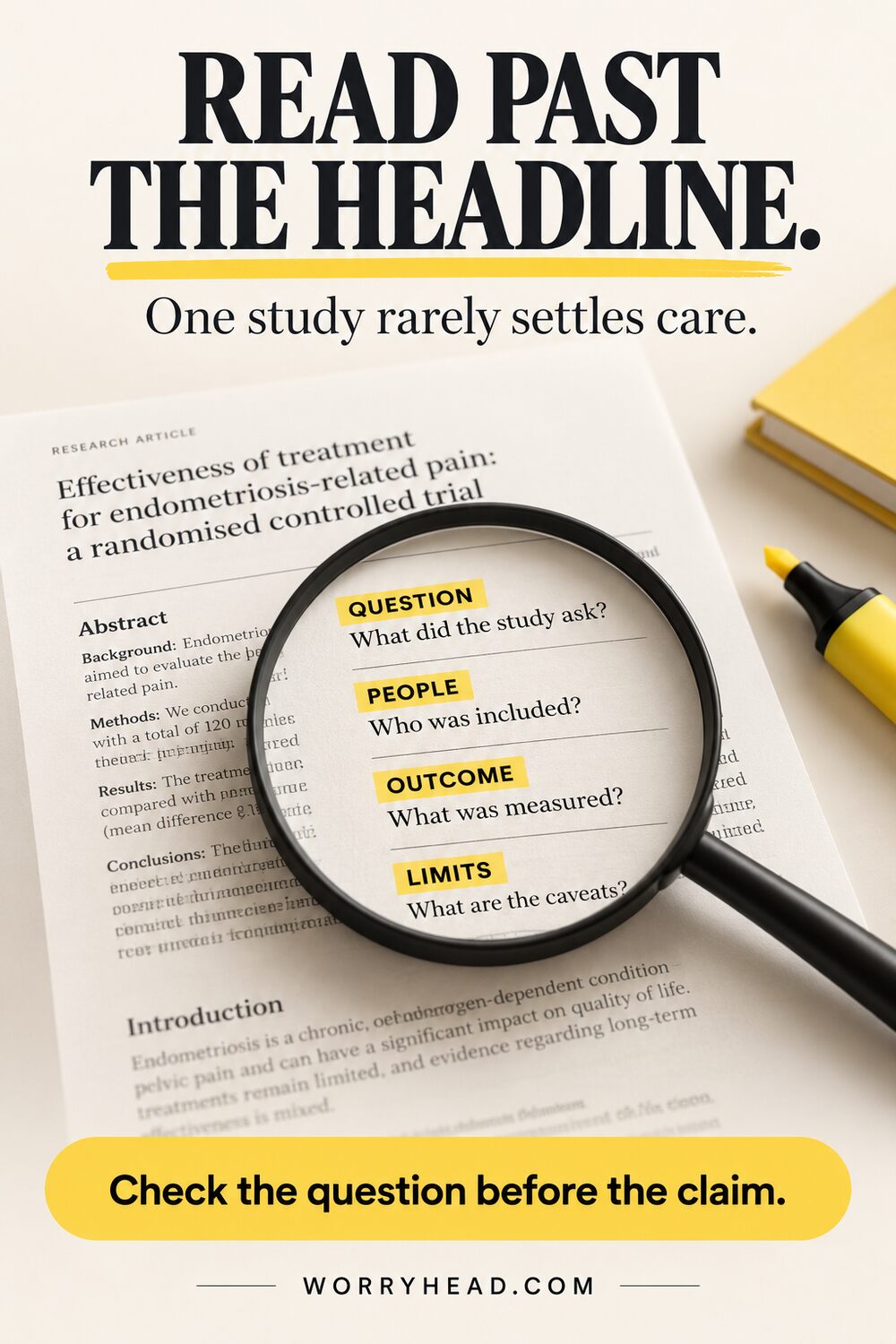
To read endometriosis research well, identify the question, design, participants, comparison, outcomes, effect size, uncertainty, bias and limitations. One study rarely settles care. Compare it with systematic reviews and current guidance, then discuss personal treatment decisions with a clinician.
I am a husband, blogger and researcher, not a clinician; years of learning through my wife’s experience shaped this guide, and the NICE, ESHRE, Cochrane and reporting-method sources actually used are listed at the bottom.
Our parent page on the research and future of endometriosis maps broader directions in diagnosis and treatment. This article has a narrower job: showing you how to examine one claim before you let it shape hope, fear or a clinical conversation.
I began researching because I wanted to understand what my wife was facing and become better support to her. Writing gave that learning somewhere to go and became an informal kind of therapy for me, but it did not turn me into a clinician. The more papers I read, the more I learned to respect uncertainty instead of treating every abstract as an answer.
This guide does not tell you which treatment to choose. It gives you a repeatable way to examine claims, spot missing context and bring better questions to a qualified clinician. Individual decisions depend on symptoms, priorities, other conditions, past treatment, risks and the full evidence—not one online article.
If frightening or overconfident health claims have made you blame yourself, my free eBook, You Did NOTHING To Deserve This!, offers a steadier emotional companion. It sits alongside the evidence-reading tools here; neither replaces medical care.
You Did NOTHING To Deserve This!
Endometriosis Validation for Women with Endo

- Start How to Read Endometriosis Research with the Exact Question
- Use Study Design When Learning How to Read Endometriosis Research
- Check Bias and Funding in How to Read Endometriosis Research
- Keep Effect Size and Uncertainty Central to How to Read Endometriosis Research
- Compare Headlines and Abstracts When Learning How to Read Endometriosis Research
- Apply Reviews and Guidelines to How to Read Endometriosis Research
- Turn How to Read Endometriosis Research into Better Clinical Questions
- Use Replication and Transparency in How to Read Endometriosis Research
- Include Lived Experience in How to Read Endometriosis Research
- Final Word on How to Read Endometriosis Research
- You Did NOTHING To Deserve This!
- FREE eBook
Start How to Read Endometriosis Research with the Exact Question
Before judging a result, write down what the study actually asked. Was it testing diagnosis, pain relief, fertility, recurrence, quality of life, surgical outcomes or a biological mechanism? These questions are related, but they are not interchangeable. A study that improves one outcome does not automatically improve all the others.
Use a simple frame: population, intervention or exposure, comparison and outcome. Researchers often call this PICO. In plain language, ask: who took part, what happened to them, what was it compared with and what was measured? If one of those pieces is missing from a headline, the claim may already be broader than the research.
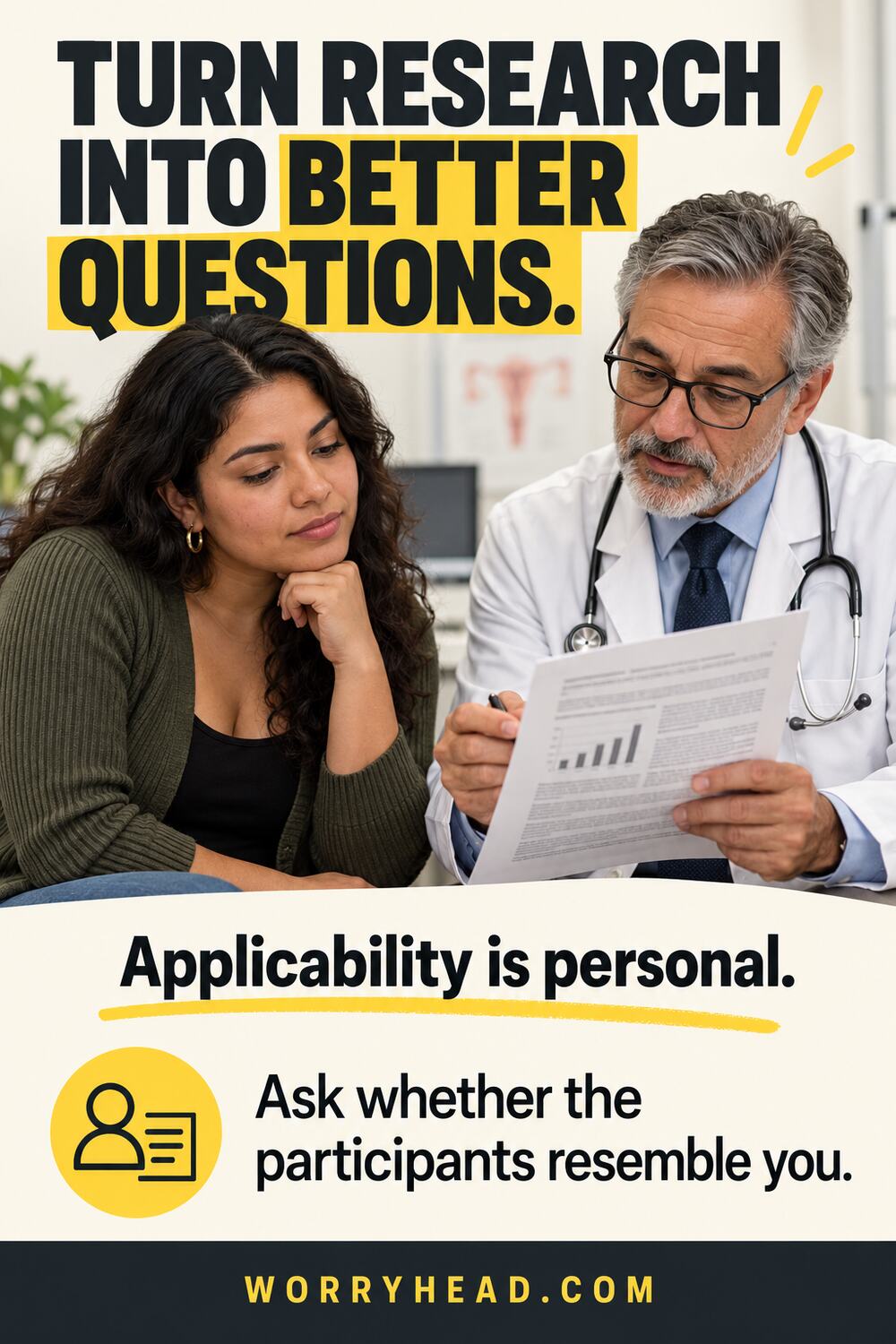
The population matters immediately. People with suspected endometriosis are not the same as people with surgically confirmed disease. Adolescents, people trying to conceive, people after hysterectomy and people with deep disease may have different needs. A result can be valid for the studied group without applying neatly to everybody.
I keep this discipline because fear makes it easy to read a title as if it were written directly about my wife. Her endometriosis sits alongside adenomyosis, fibromyalgia, ME, chronic fatigue and iron-loss anaemia. A paper with narrow eligibility criteria may exclude the very complexity that shapes real decisions in our home.
Look at the outcome definition too. “Pain improved” might mean a change on a rating scale at twelve weeks. It may not tell you whether work, sleep, fatigue, intimacy or medication use improved. Patient-relevant outcomes deserve attention because a statistically neat change may still leave daily life almost untouched.
Use Study Design When Learning How to Read Endometriosis Research
Study design determines what a result can reasonably show. A laboratory study may explain a mechanism worth investigating, but it cannot prove a treatment helps people. An animal study can support biological plausibility while still failing to predict human benefit or harm. Early science is not bad science; it is simply early.
Case reports and small case series can reveal unusual patterns and generate questions. They usually cannot tell you how common an outcome is or whether the intervention caused it. Without a comparison group, improvement may reflect natural fluctuation, other treatment, selection or chance.
Observational studies follow or compare people without assigning treatment. They are valuable for prevalence, associations, longer-term outcomes and questions that cannot ethically be randomised. Their central limitation is confounding: groups may differ in ways that affect the outcome, even after statistical adjustment.
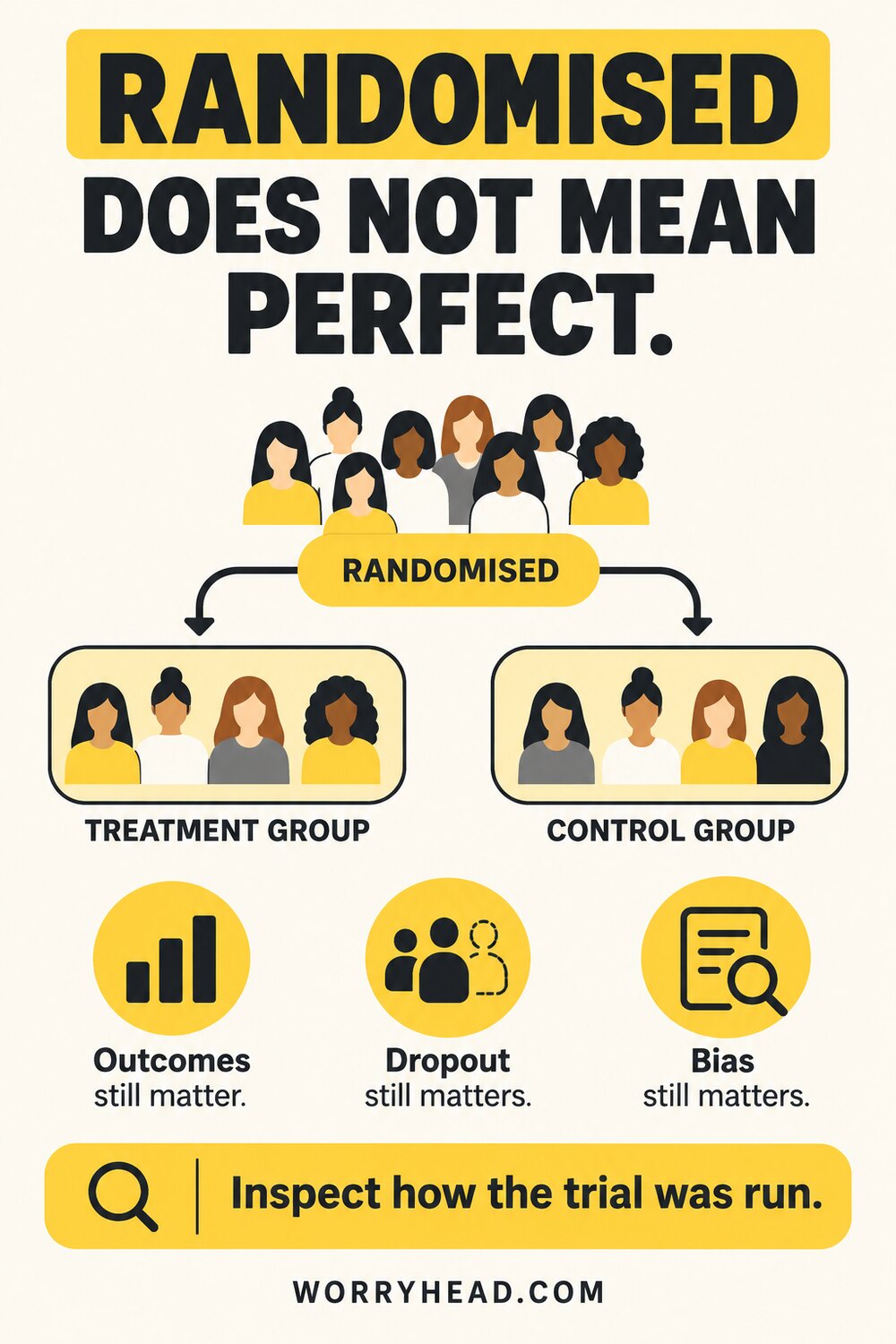
A randomised controlled trial assigns participants to groups by chance, helping balance known and unknown differences. It is often strong for estimating treatment effects, but randomisation does not rescue a poorly chosen outcome, high dropout, weak blinding, selective reporting or a study too small to detect important effects.
Systematic reviews use explicit methods to find, assess and synthesise multiple studies. A meta-analysis may combine numerical results. These can sit high in evidence hierarchies, yet their reliability still depends on the included studies, search methods, risk-of-bias assessment and whether pooling genuinely similar studies makes sense.
Guidelines such as NICE and ESHRE go beyond collecting studies. They consider the balance of benefits and harms, certainty, values, implementation and clinical context. Guidelines can still differ or become outdated, so check the publication date and update process. Their recommendation is not proof that every individual should make the same choice.
Check Bias and Funding in How to Read Endometriosis Research
Bias is a systematic process that pushes a result away from the truth. It is not the same as accusing researchers of dishonesty. Randomisation problems, lack of blinding, missing data, selective outcome reporting and measurement choices can introduce bias even when the team acts in good faith.
For trials, look for a prospectively registered protocol or trial record. Registration lets readers compare what researchers planned with what they reported. If the primary outcome changed after results were known, or unfavourable outcomes disappeared, the published story may be incomplete.
Missing data deserve more attention than they receive in headlines. If many participants leave a study, ask whether dropout differed between groups and why. People may leave because treatment did not help, side effects were difficult or life made follow-up impossible. Analyses cannot automatically replace the information that vanished.
Funding and conflicts of interest should be reported. Industry funding does not make a study false, and independent funding does not make it flawless. The useful question is whether the sponsor influenced design, analysis, interpretation or publication, and whether methods protect against that influence.
Publication bias occurs when positive or striking results are more likely to appear than neutral or negative results. Small studies with dramatic findings can therefore create an inflated impression. Systematic reviewers may look for missing-study patterns, but those tests are imperfect, especially when few studies exist.
Cochrane risk-of-bias tools encourage structured judgement rather than a vague label of “good” or “bad.” You do not need to score every paper yourself. You can read how a trustworthy review judged randomisation, deviations, missing outcomes, measurement and reporting, then see which concerns materially affect confidence.
Keep Effect Size and Uncertainty Central to How to Read Endometriosis Research
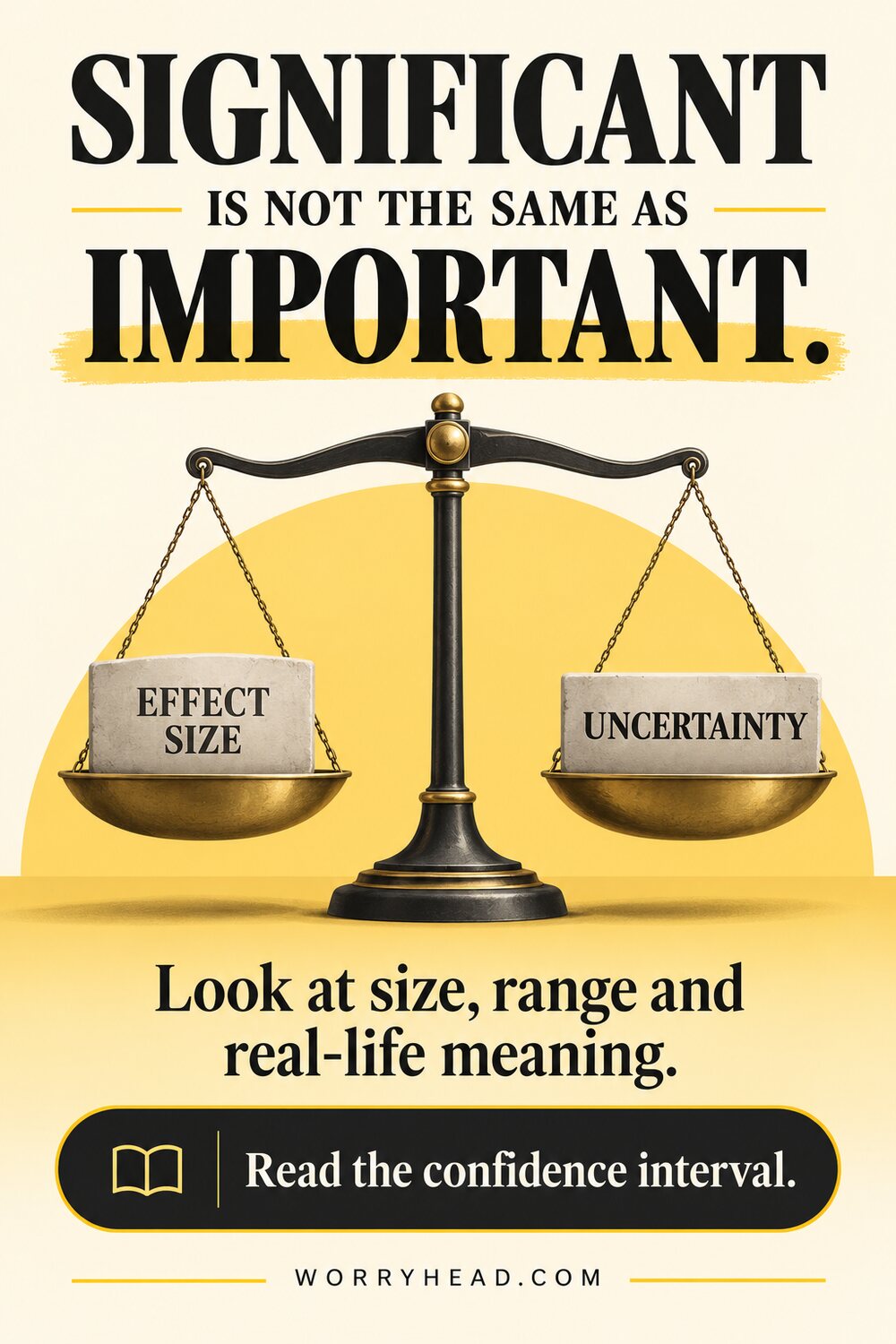
A p-value does not tell you whether an effect is large, important or likely to apply to you. It addresses a narrower statistical question under assumptions. A small p-value can accompany a clinically trivial difference, especially in a large study. A larger p-value can occur when a useful effect remains uncertain because the study is small.
Look for the effect estimate and confidence interval. The estimate tells you the result observed; the interval shows a range of values compatible with the data and model. A wide interval means greater uncertainty. If it includes meaningful benefit and meaningful harm, the study has not given a precise answer.
Relative effects can sound dramatic. A “50% reduction” might mean risk changed from two people in one thousand to one in one thousand. Ask for absolute numbers, baseline risk and the time period. For continuous outcomes such as pain scales, ask whether the change is large enough to matter in daily life.
Statistical significance and clinical importance are different. Researchers may define a minimally important difference, but that threshold can vary by outcome and population. Ask whether participants noticed a meaningful change in function, sleep, work or quality of life—not only whether a calculation crossed a conventional line.
Harms need the same scrutiny as benefits. Small trials and short follow-up may miss uncommon or delayed adverse events. “No significant difference in harms” is not the same as proof of equal safety. Check how harms were collected, how long participants were followed and whether numbers were sufficient.
When I read research for my wife, uncertainty can feel emotionally unsatisfying because we want a clear next step. Still, false precision is not kindness. A careful range, an honest limitation and a clinician who understands her full history are safer than a confident number stripped from its context.
Compare Headlines and Abstracts When Learning How to Read Endometriosis Research
A headline is written to win attention, not to preserve every limitation. Translate verbs carefully. “Linked with” or “associated with” does not establish causation. “May help” signals uncertainty. “Breakthrough” has no fixed scientific meaning. “Cure” requires far stronger evidence than a laboratory mechanism or early trial.
Read beyond the press release when possible. Start with the abstract, then examine methods, participant flow, outcomes, limitations and funding. Abstracts have little space and can emphasise favourable results. The full paper may reveal exclusions, secondary analyses or adverse events that alter the impression.
Watch for surrogate outcomes. A biomarker, lesion measurement or laboratory signal may be useful, but it is not automatically the same as less pain, better fertility or improved quality of life. A surrogate must be well validated for the decision being made; otherwise it can improve while the outcome people care about does not.
Subgroup findings deserve caution. If researchers test many subgroups, some differences can appear by chance. Ask whether the subgroup was planned, whether there was a credible interaction test and whether the pattern appears elsewhere. A result in one small subgroup should not be advertised as a personalised treatment without replication.
Correlation can also run in several directions. If an observational study finds an association between endometriosis and another condition, that does not show one caused the other. Shared biology, healthcare use, diagnostic patterns or unmeasured factors may contribute. Good authors state these alternatives; headlines often omit them.
Social media compresses nuance even further. Before sharing a post, open the source, check whether it is a paper, preprint, conference abstract or opinion, and compare the claim with the actual conclusion. Pausing before sharing is not scepticism for its own sake; it protects people who may make decisions under stress.
Apply Reviews and Guidelines to How to Read Endometriosis Research
One study becomes more informative when placed beside the whole evidence base. Search for a recent systematic review, evidence-based guideline or high-quality health-service summary. Agreement across independent studies using different methods can increase confidence. Consistent limitations across the literature should lower it.
Check whether the review question matches yours. A review of postoperative hormone treatment cannot answer every question about first-line pain management. A review may be current on the day it searches but age as new trials appear. Record the search date, not only the publication date.
The GRADE approach used in many guidelines considers certainty across risk of bias, inconsistency, indirectness, imprecision and publication bias. Evidence may be rated low without being useless. The rating tells you how likely future research is to change confidence, not whether people’s experiences are unimportant.
Recommendations can be strong or conditional. A conditional recommendation often means benefits and harms are closely balanced, evidence is uncertain or individual preferences vary. This is exactly where a shared decision with a knowledgeable clinician matters most.
NICE guidance is written for the UK context, while ESHRE serves a broader European clinical audience. Differences may reflect healthcare systems, evidence cut-offs or judgement. When recommendations diverge, do not average them yourself; ask what evidence and circumstances produced the difference.
Living alongside multiple chronic conditions has taught me that guidelines simplify by necessity. They cannot contain every combination of symptoms, medication, work pressure and personal priority. Their value is as a transparent evidence framework, not a substitute for the person sitting in the consultation.

Turn How to Read Endometriosis Research into Better Clinical Questions
Bring the claim rather than a demand. You can ask, “I read this study; does its population resemble me, and does it change what you would recommend?” This invites a clinician to examine applicability, not simply defend authority or approve an online conclusion.
Ask what outcome matters for your decision. Pain, fertility, bleeding, fatigue, recurrence, side effects and recovery time may point in different directions. Rank your priorities before the appointment if you can. A treatment that performs well on one outcome may be a poor fit for the outcome you most need to improve.
Ask about alternatives, including doing nothing immediately, and what happens if the first plan fails. Clarify expected benefit, common harms, serious harms, time to judge response and what monitoring is needed. Write down the answers or take a trusted person if that helps and the service permits it.
I started blogging partly to understand enough to support my wife better, not to replace her voice in appointments. A supportive partner can help organise questions, remember details and recognise the pressure she is under. The person receiving care still deserves control over what is discussed and decided.
Be cautious when a commercial site turns a single study into a product claim. Check regulatory status, evidence for the exact product and dose, interactions, contraindications and whether testimonials are doing more work than comparative data. “Natural” and “research-backed” are marketing terms unless the supporting evidence is specific.
If a paper creates urgent fear, pause before changing medication or abandoning treatment. Contact the clinician or pharmacist responsible for your care. Abrupt changes can carry risks that the headline never mentions, and an online reader cannot safely reconstruct your complete medical context.
Use Replication and Transparency in How to Read Endometriosis Research
A single result becomes more convincing when independent teams can reproduce it. Replication does not mean every number must be identical. It means the direction and approximate size of the finding survive different settings, samples and reasonable methods. If only one small study reports a dramatic effect, treat it as a question worth testing rather than a settled answer.
Distinguish a replication from a repeated analysis of the same dataset. Several papers can come from one group of participants, sometimes answering different questions. That work may be useful, but it does not provide several independent confirmations. Check participant dates, locations, trial registration numbers and author notes to see whether samples overlap.
Preprints are manuscripts shared before formal peer review. They can make findings available quickly, but the methods and conclusions may change after reviewers examine them. A preprint is not automatically poor and a journal article is not automatically correct. Label the stage honestly and look for the later reviewed version before treating it as stable evidence.
Peer review is quality control, not a guarantee. Reviewers may identify major errors, ask for clearer reporting or recommend rejection, but they do not usually rerun the whole analysis or inspect every raw record. After publication, corrections, expressions of concern and retractions can change how a paper should be read. Check the journal page for updates.
Open data, code and detailed protocols can make scrutiny easier. They allow qualified researchers to understand decisions and sometimes reproduce analyses. Privacy and consent can legitimately restrict health data, so a closed dataset is not proof of wrongdoing. Transparency should be judged alongside ethical responsibilities, not as a slogan.
Sample size planning matters because studies need enough information to estimate effects with useful precision. A tiny study can still answer a narrow feasibility question, but it may produce unstable effect sizes. Very large datasets can detect tiny differences that have little clinical value. Size should fit the question, design and expected outcome.
Multiplicity appears when researchers examine many outcomes, time points, models or subgroups. The more tests performed, the greater the chance that something looks positive by chance. Good reports identify primary outcomes, explain adjustments and distinguish confirmatory analysis from exploration. An unplanned pattern can inspire future research without becoming immediate clinical proof.
Research waste also occurs when outcomes are measured in incompatible ways, studies remain unpublished or reports omit essential detail. Core outcome sets and reporting standards aim to make studies easier to compare. When a review says evidence cannot be pooled, read why; the obstacle may reveal what the field still needs to improve.
For me, transparency is a reason for measured trust rather than automatic suspicion. I want researchers to show what they planned, what changed and what remains uncertain. That honesty gives patients, partners and clinicians a firmer foundation than a perfect-looking story with no visible seams.
Include Lived Experience in How to Read Endometriosis Research
Numbers answer some questions well, while qualitative research explores experiences, meanings and processes through interviews, focus groups or observations. A qualitative study is not a failed clinical trial. It may show why people delay seeking care, how dismissal affects trust or which outcomes researchers have overlooked.
Judge qualitative work by whether recruitment fits the question, data collection is described, analysis is systematic, researchers reflect on their influence and interpretations are supported by participants’ accounts. The aim is depth and credibility, not estimating how many people in the whole population share one view.
Patient involvement in setting priorities and designing studies can improve relevance. It does not remove the need for rigorous methods, and one representative cannot speak for everyone. Look for clear reporting of who was involved, what decisions changed and whether different experiences were included.
Consider whose experience is absent. Research limited by geography, language, ethnicity, income, age, gender identity, disability or access to specialist care may miss barriers faced by other groups. Authors should state those limits. Readers should avoid turning a narrow sample into a universal patient story, even when the findings feel emotionally recognisable.
Qualitative findings can also guide better quantitative outcomes. If interviews show that fatigue, dismissal or recovery time dominate daily life, future trials can measure those consequences instead of relying only on outcomes chosen for convenience. That is one practical way lived experience can strengthen rather than compete with evidence.
My wife’s life cannot be reduced to a pain score, yet her experience alone cannot establish a treatment effect. Respecting both truths is central to how I read. Lived experience helps define the questions and consequences that matter; comparative research helps test benefits and harms; thoughtful care needs both.
Final Word on How to Read Endometriosis Research
Good evidence reading is not about becoming cynical or pretending only perfect trials matter. It is about matching confidence to the methods. A small early study can be hopeful; a systematic review can still be uncertain; a guideline can be useful while leaving room for individual choice.
The habit I value most is asking one more question before turning a result into a promise. Who was studied? What changed? Compared with what? How certain is it? What was not measured? Those questions protect hope from being exploited without demanding that you abandon hope.
If you would like, tell me in the comments below which research phrase or headline you find hardest to interpret. Do not post private medical details. If misleading certainty has left you feeling blamed or broken, my free eBook, You Did NOTHING To Deserve This!, offers a compassionate final step after the fact-checking.


About Me
Hi, I’m Lucjan! The reason why I decided to create this blog was my beautiful wife, who experienced a lot of pain in life, but also the lack of information about endometriosis and fibromyalgia for men…
READ MORE
Grab a FREE eBook!
“You Did NOTHING To Deserve This!”
Finally hear the words nobody ever said to you, that your pain is real, your tears make sense, and you did nothing to deserve endometriosis, the dismissal, or the way it has rewritten your life.
Related Questions You May Be Asking About How to Read Endometriosis Research
Is a Randomised Trial Always Better Than an Observational Study?
Not for every question. Randomised trials are strong for many treatment effects, while observational studies can be more appropriate for prevalence, rare harms, long-term outcomes or exposures that cannot be assigned. Quality and relevance still matter within each design.
Does Statistical Significance Mean a Treatment Works Well?
No. Statistical significance does not describe the size, importance or certainty of an effect by itself. Examine the effect estimate, confidence interval, absolute numbers, harms and whether the measured change matters in daily life.
Can I Trust a Systematic Review About Endometriosis?
A systematic review is useful when its question fits yours and its methods are transparent, but it is only as reliable as its search, bias assessment, included studies and synthesis. Check the search date and the reviewers’ certainty judgement.
Should I Change Treatment Because of a New Study?
Do not change prescribed treatment from a headline alone. Read the study in context and discuss its relevance, benefits, harms and alternatives with the clinician or pharmacist responsible for your care.
How to Read Endometriosis Research References
- https://www.nice.org.uk/guidance/ng73
- https://www.eshre.eu/Guideline/Endometriosis
- https://www.cochrane.org/about-us/our-policies-and-guidelines/cochrane-risk-bias-tool
- https://www.bmj.com/content/372/bmj.n71
- https://training.cochrane.org/handbook/current
Sources checked on 22 October 2026. NICE and ESHRE provide current endometriosis guidance; Cochrane materials cover systematic-review methods and risk of bias; the PRISMA 2020 statement supports transparent review reporting. This article explains evidence concepts and does not make individual treatment recommendations.
