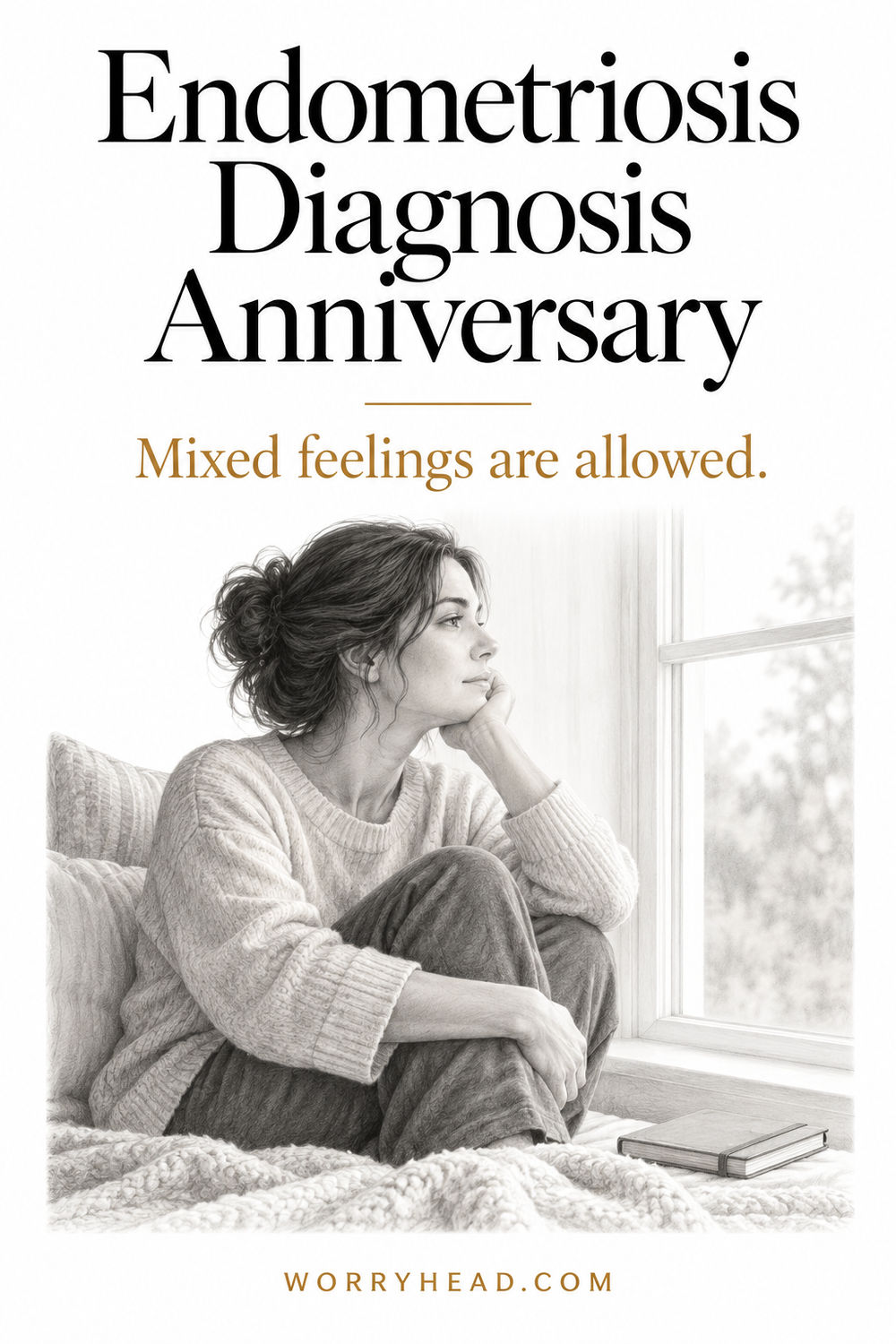
Endometriosis Diagnosis Anniversary: Making Room for Mixed Feelings
Does a date on the calendar bring back more than you expected? Your endometriosis diagnosis anniversary may hold relief, grief or memories that other people cannot see. You do not have to settle on one feeling or explain why an ordinary-looking day feels different to you.
An endometriosis diagnosis anniversary can bring relief, grief, anger or mixed feelings. You do not have to celebrate or mark the date. Acknowledging what it means to you, choosing privacy or asking for support are valid options; persistent distress deserves support from a qualified professional.
I’m not a clinician, but a husband, blogger and researcher whose years of learning began with my wife’s endometriosis, and I’ve listed the NHS, WHO, Endometriosis UK and published research used for this article’s health context in the references below.
If your endometriosis diagnosis anniversary brings mixed feelings, you do not have to choose one acceptable emotion. Relief, sadness, anger, gratitude and indifference can all have a place. This is a practical reflection on getting through a personally meaningful date, rather than a claim that everyone has an anniversary reaction or a guide to diagnosing one.
I write as a husband whose wife lives with endometriosis, not as someone who knows what it feels like inside your body. I can recognise that an illness affects much more than appointments without assuming that my wife’s memories are yours. If the bigger issue is the life you miss, my article on missing your old life with endometriosis explores that wider grief.
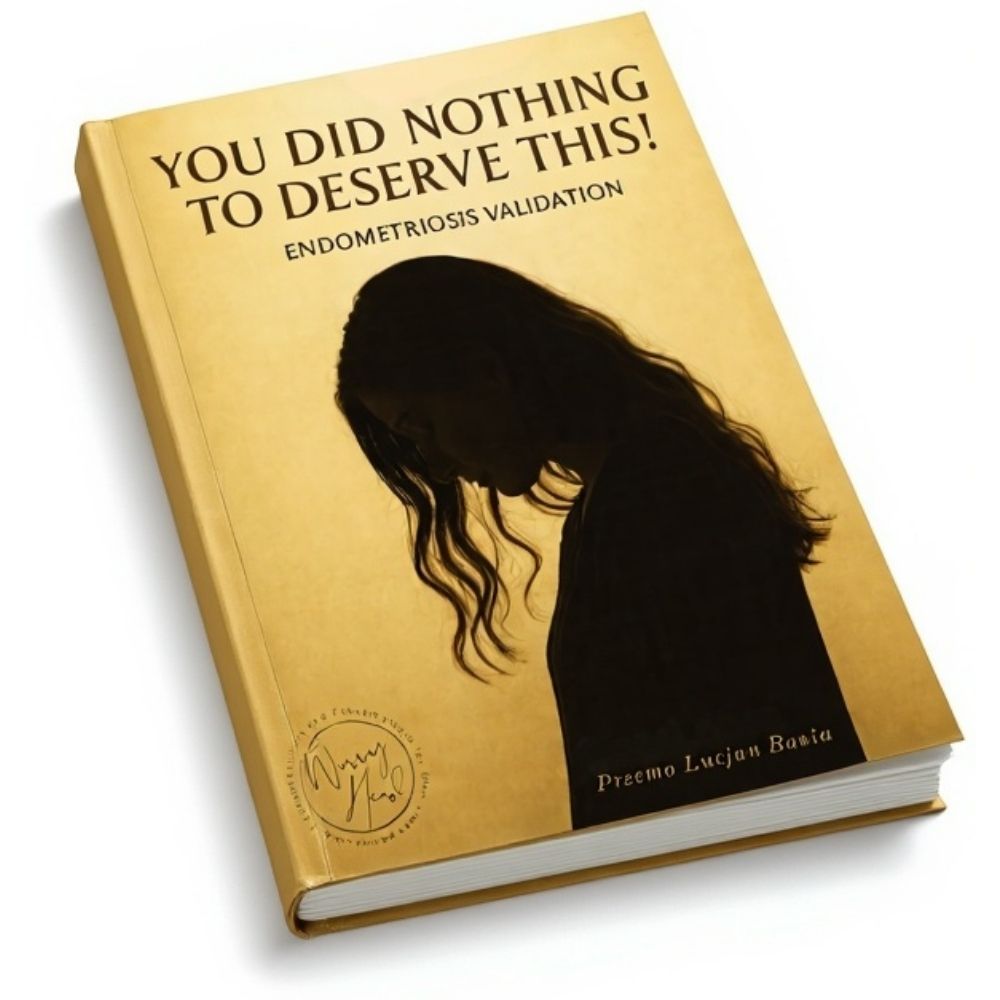
If a diagnosis date brings back relief, grief or the ache of being dismissed, you deserve words that make room for all of it. My FREE eBook, You Did NOTHING To Deserve This!, offers emotional understanding for the person living beyond that date.
You Did NOTHING To Deserve This!
Endometriosis Validation for Women with Endo
- Why an Endometriosis Diagnosis Anniversary Can Bring Mixed Feelings
- What You Need on Your Endometriosis Diagnosis Anniversary
- Choosing How to Mark Your Endometriosis Diagnosis Anniversary
- Your Endometriosis Diagnosis Anniversary Is Not a Performance Review
- Asking for Support on Your Endometriosis Diagnosis Anniversary
- Making Flexible Plans for Your Endometriosis Diagnosis Anniversary
- Keeping Your Endometriosis Diagnosis Anniversary Private
- When Your Endometriosis Diagnosis Anniversary Brings Lasting Distress
- A Gentle Plan for Your Endometriosis Diagnosis Anniversary
- You Did NOTHING To Deserve This!
- FREE eBook
Why an Endometriosis Diagnosis Anniversary Can Bring Mixed Feelings
Perhaps the date means that you were finally believed. Perhaps it reminds you how long you spent asking for help. Perhaps you left with a name for your symptoms but very little explanation of what would happen next. Those meanings do not cancel each other out, and you do not need to turn a complicated memory into a neat recovery story.
The medical context matters here. WHO recognises the social and emotional impact of endometriosis, as well as its physical effects. A diagnosis can help explain an experience without immediately resolving every difficulty connected to it. That distinction leaves room for gratitude about an answer and disappointment about what remains hard.
Research also describes difficult diagnostic experiences. A mixed-methods study published in BJOG in 2024, based on responses recruited through online patient support groups, reported experiences of dismissal and diagnostic delay. Its recruitment limits how broadly we can generalise, and it did not establish how diagnosis anniversaries affect people. I am drawing a boundary between that evidence and the personal reflection offered here.
What You Need on Your Endometriosis Diagnosis Anniversary
Before making a plan, try finishing a simple sentence: “The part of this date that feels hardest is…” Your answer might be the wait before diagnosis, a lost opportunity, a frightening conversation, or the pressure to demonstrate that you are doing better now. You can keep the answer private. Understanding it does not require publishing it.
Then ask what would make the day slightly more manageable. You might want company without questions, a normal evening, help with dinner, or time to write something nobody else will read. A small, concrete need is often easier to explain than asking someone to understand the whole history at once.
You may discover that the date means very little this year. That is allowed too. Forgetting it, remembering late, or feeling neutral does not mean your illness mattered less. You are under no obligation to maintain an annual emotional appointment with something that has already taken enough of your attention.
Choosing How to Mark Your Endometriosis Diagnosis Anniversary
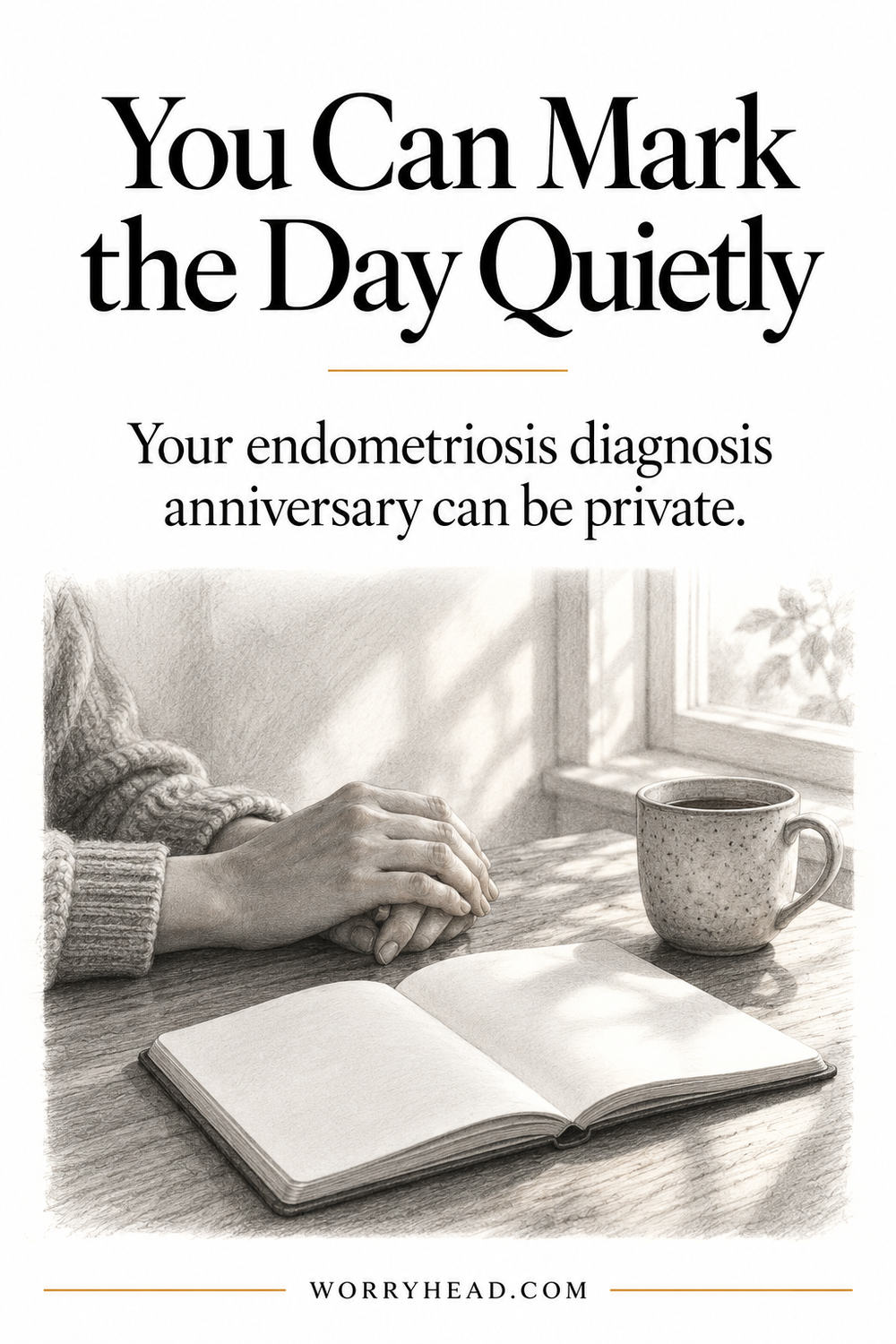
You Can Acknowledge It Quietly
Acknowledgement can be as ordinary as telling someone, “This date is on my mind.” You could write a few lines about what you wish you had known, save a song you enjoy, or choose a familiar meal. None of these suggestions is a treatment or a task you need to complete. They are options if having a small point of recognition would suit you.
A useful limit is to decide how much of the day you want the anniversary to occupy. You might give yourself a little space in the morning and then return to ordinary plans. You might prefer the opposite. The aim is to make a choice that belongs to you, rather than follow an imagined rule about how a significant date should look.
You Can Leave It Unmarked
You do not owe anyone an anniversary post, a photograph, a fundraising activity or a declaration of strength. If remembering publicly feels exposing, you can keep the date to yourself. If a friend wants to celebrate your resilience, you can appreciate their intention while asking them not to organise anything.
Choosing an ordinary day does not mean denying your experience. You may simply want space for the other parts of yourself. Watching a programme, working, chatting about something unrelated or doing very little can all be reasonable choices. There is no obligation to make pain meaningful on demand.
Your Endometriosis Diagnosis Anniversary Is Not a Performance Review
An anniversary can invite a difficult comparison: “I thought I would be further along by now.” You may measure yourself against the hopes you had at diagnosis and overlook the circumstances you have actually been managing. Waiting for care, finding something unhelpful or needing more support is not a moral failure.
Try separating what you hoped for from what you controlled. You can acknowledge that you wanted fewer disruptions without blaming yourself for not producing that outcome. You can feel disappointed about a year without deciding that you wasted it. Disappointment deserves an honest sentence, not an accusation aimed at yourself.
If reflection feels useful, consider quieter questions. What did you learn to describe more clearly? Which boundary protected your privacy? Who listened without making you prove everything? These questions are not a requirement to find a silver lining. They simply offer alternatives to judging an entire year by symptoms or productivity.
Asking for Support on Your Endometriosis Diagnosis Anniversary
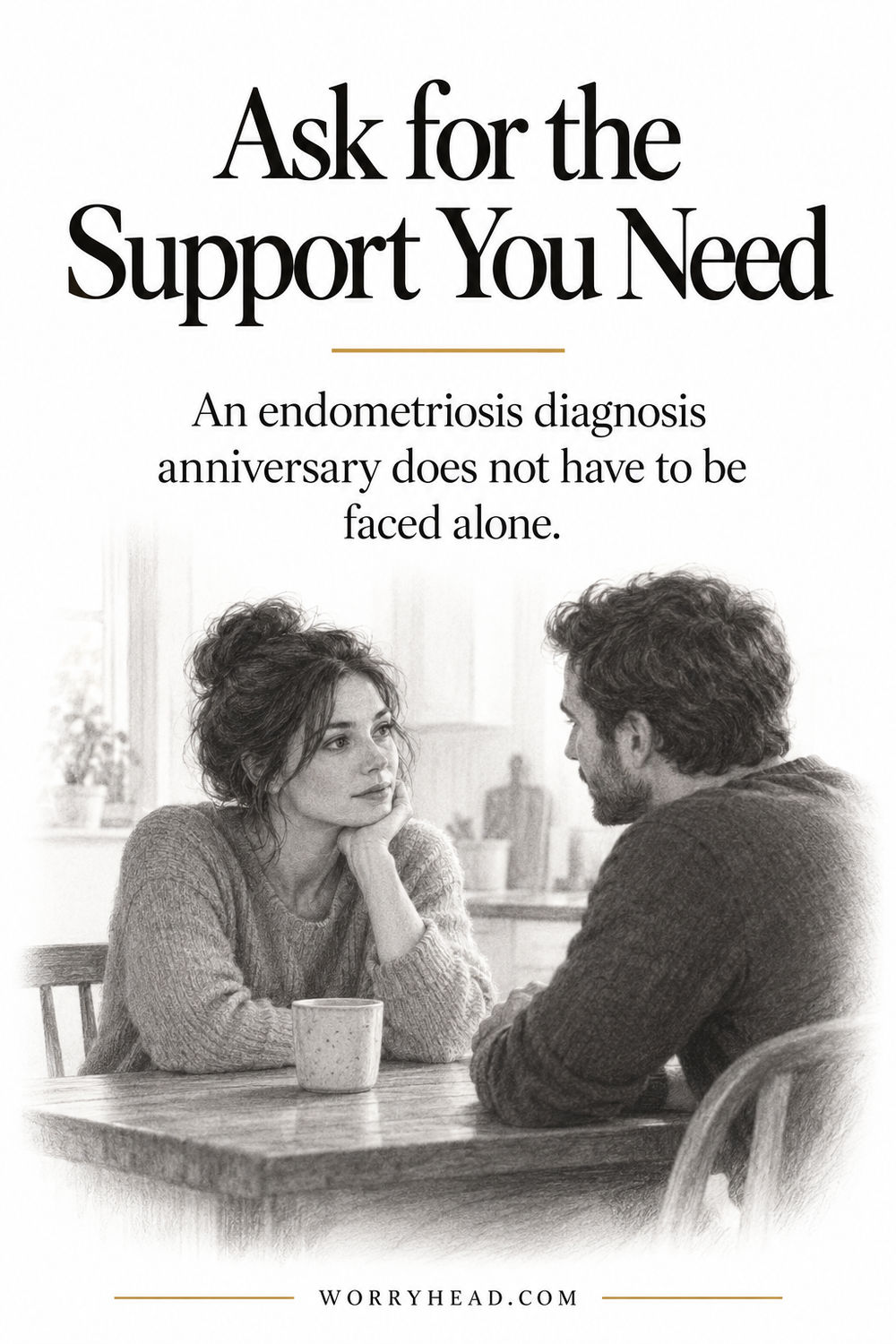
Someone who loves you may remember the date differently or not know that it matters. If you want their support, a specific request can reduce guesswork. The following are suggested phrases, not conversations I am claiming happened in my marriage: “Please remember that today feels complicated,” or “I would like company, but I do not want to discuss treatment tonight.”
You could also say, “Please do not ask whether I am better than last year,” or “Could you handle dinner so I have one less thing to organise?” A practical request does not make your feelings less important. Sometimes being spared an ordinary demand creates more space than a long conversation you are too tired to have.
As a husband, I want to be careful about deciding what support should look like for someone else. A partner can offer attention, ask what would help and accept the answer without turning the date into a demonstration of their own devotion. Your experience should remain at the centre, including your right to change your mind.
Making Flexible Plans for Your Endometriosis Diagnosis Anniversary
You might plan a quiet evening and then want company. You might expect to feel upset and find yourself absorbed in something pleasant. You might feel more affected the day before or after. None of those possibilities means you have reacted incorrectly, and none proves that a particular psychological explanation applies to you.
It can help to make a flexible arrangement rather than a large commitment. You could ask a friend whether a brief message would be welcome if you need one, or tell your partner that you may want to change the evening’s plan. Keep any arrangement realistic for both people. Support works better when the promise is something the other person can actually keep.
If the day passes without the moment of closure you hoped for, you have not failed the exercise. There may be no tidy conclusion available. You can stop reflecting, put the notebook away and attend to the rest of your day without extracting a lesson from it.
Keeping Your Endometriosis Diagnosis Anniversary Private
Before posting, consider what you want from sharing. Are you seeking acknowledgement, recording something for yourself, or trying to explain a difficult year? Different needs may suit different audiences. A message to one trusted person can sometimes feel more comfortable than a public post whose responses you cannot predict.
If you do share, you can decide what stays private. You do not need to include surgical photographs, intimate symptoms, fertility details or your complete medical history to justify why the date matters. You can also change notification settings or leave replies for another day. Sharing a moment does not create an obligation to remain available afterwards.
It is worth asking before a partner posts about the anniversary too. Love does not automatically grant permission to tell your story publicly. Our article on what your partner may share about your endometriosis explores that privacy question in more detail.
When Your Endometriosis Diagnosis Anniversary Brings Lasting Distress
You do not have to handle persistent distress alone simply because it has an understandable context. If your mood, anxiety, sleep or ability to manage everyday life is troubling you, consider discussing it with your GP or a qualified mental health professional. The NHS includes mental health support among the care needs associated with endometriosis.
That support should make room for the reality of your illness. Asking for help with distress does not mean your physical symptoms are imagined. Equally, a difficult anniversary should not be used to explain away a new physical concern. Emotional support and appropriate medical assessment can both matter.
You can begin with a straightforward description: what you are experiencing, how long it has been happening, and what it is affecting. You do not have to arrive with a diagnosis for your feelings. If writing is easier than speaking, taking a short note can help you explain what you want the appointment to address.
A Gentle Plan for Your Endometriosis Diagnosis Anniversary
If you want something practical to take away, choose one person, one manageable request and one permission you are giving yourself. The person might be a friend who listens well. The request might be help with an ordinary task. The permission might be to leave the date unmarked, to feel sad without apologising, or to enjoy something without explaining why.
You do not need all three. This is a menu, not homework. If planning itself feels like another demand, you can simply decide that you will respond to the day as it comes. Your worth does not depend on preparing beautifully for a difficult feeling.
The wider experience of losing parts of your old identity with endometriosis deserves patience beyond a single date. An anniversary may bring that experience into view, but it does not get to decide who you are now or how the next year must unfold.
You were a whole person before the diagnosis, and you remain one afterwards. You can remember what happened without making it the only story you are allowed to tell about yourself. Whatever this particular date means to you, you do not have to earn gentleness by showing that you have moved on.


About Me
Hi, I’m Lucjan! The reason why I decided to create this blog was my beautiful wife, who experienced a lot of pain in life, but also the lack of information about endometriosis and fibromyalgia for men…
READ MORE
Grab a FREE eBook!
“You Did NOTHING To Deserve This!”
Finally hear the words nobody ever said to you, that your pain is real, your tears make sense, and you did nothing to deserve endometriosis, the dismissal, or the way it has rewritten your life.
Related Questions You May Be Asking About Endometriosis Diagnosis Anniversary
Do I Have to Celebrate Getting a Diagnosis?
No. You may feel relieved about having an explanation while also grieving the circumstances around it. Celebration is an option if it feels right to you, not an expectation. You can acknowledge the date privately, do something ordinary or ignore it altogether.
What If My Partner Does Not Remember?
If you want the date acknowledged, explain its significance and ask for something specific. Forgetting a date alone does not tell you everything about someone’s care. What matters in the conversation is whether your feelings and reasonable requests are treated respectfully.
Does Feeling Upset Mean I Have Gone Backwards?
A feeling on one day is not a complete assessment of your life or coping. You can notice sadness without turning it into a verdict. If distress is persistent or affecting daily life, it deserves support rather than pressure to prove that you are progressing.
Endometriosis Diagnosis Anniversary References
This article offers practical reflection and general emotional support. Its suggestions are not a tested psychological intervention, a diagnosis or a substitute for individual care. Sources checked on 19 October 2026.
- https://www.nhs.uk/conditions/endometriosis/
- https://www.endometriosis-uk.org/resources/emotional-support-endometriosis
- https://www.who.int/news-room/fact-sheets/detail/endometriosis
- https://pubmed.ncbi.nlm.nih.gov/37961031/
