
Feeling Unreliable with Endometriosis Does Not Make You Untrustworthy
Have you started doubting your own promises because your body can change faster than your plans? Feeling unreliable with endometriosis can make every altered arrangement feel like evidence against your character. It is painful to care deeply about people and responsibilities while knowing that tomorrow’s capacity cannot be guaranteed.
Feeling unreliable with endometriosis does not mean you lack care or integrity. Pain, fatigue and treatment can change capacity after plans are made. Offer honest limits, confirm what remains possible, repair practical impact, and judge your character by truthfulness, not attendance or output alone.
I am not a clinician; I write as a husband, blogger and researcher who has spent years learning because of my wife’s experience, and the NHS, WHO, ESHRE and published studies used for health context are listed at the bottom.
The parent guide on feeling like a burden with endometriosis explores the broader fear of costing others too much. Here the focus is narrower: how to keep trusting your integrity when symptoms make availability uncertain.
I have watched my wife carry guilt when symptoms disrupt what she hoped to do. Her endometriosis exists alongside adenomyosis, fibromyalgia, ME, chronic fatigue and iron-loss anaemia, so I cannot reduce every difficult day to one diagnosis. What I can say is that unpredictability does not cancel the care behind her intentions.
This article is about honest commitments, practical repair and protecting self-trust. It does not promise that every employer, friend or relative will respond well, and it cannot replace advice about work, treatment or mental health from qualified professionals who know your situation.
If a changed plan has become a verdict on who you are, my free eBook, You Did NOTHING To Deserve This!, offers a compassionate place to loosen that shame. It is an invitation to feel understood, not a medical solution or a demand to think positively.
You Did NOTHING To Deserve This!
Endometriosis Validation for Women with Endo

- Why Feeling Unreliable with Endometriosis Can Become an Identity Wound
- Make Smaller Promises When Feeling Unreliable with Endometriosis
- Repair the Impact of Feeling Unreliable with Endometriosis Without Taking All the Blame
- At Work, Feeling Unreliable with Endometriosis Needs Clear Evidence and Boundaries
- Rebuild Self-Trust After Feeling Unreliable with Endometriosis
- Final Word on Feeling Unreliable with Endometriosis
- You Did NOTHING To Deserve This!
- FREE eBook
Why Feeling Unreliable with Endometriosis Can Become an Identity Wound
Reliability is often treated as a simple moral quality: dependable people arrive, finish and remember. Chronic illness exposes the missing part of that definition. A person can be sincere, organised and loving while pain, bleeding, fatigue, poor sleep or treatment effects make the promised task impossible.
The NHS lists pelvic pain, pain during or after sex, fatigue, low mood and anxiety among possible endometriosis experiences. WHO describes wider effects on work, relationships and quality of life. These sources do not decide what any one person can do, but they show why fluctuating capacity deserves more context than a label such as careless.
When cancellations accumulate, the mind may stop describing events and start describing the self. “I had to change the plan” becomes “I always let people down.” The second sentence sounds definite, yet it erases all the occasions when you communicated, adapted, tried again or kept a quieter promise.
Character is better measured by honesty and repair than by pretending you control the uncontrollable. You can acknowledge real inconvenience without accepting a false conclusion that your whole presence is the problem.
There is also a difference between being unavailable and being uncaring. You may be unable to attend while still remembering the person, asking how it went or making contact later. Reliability has relational forms that do not depend on occupying the same place at the planned hour.
Make Smaller Promises When Feeling Unreliable with Endometriosis
A promise becomes safer when it reflects the information you actually have. Instead of committing to an entire event, you might confirm closer to the time, attend for a shorter period or agree which part matters most. This is not lowering your moral standard. It is making the agreement more truthful.
Separate preference, possibility and certainty. You may want to go, believe it is reasonably possible and still be unable to guarantee it. Saying all three parts prevents optimism from being mistaken for certainty. People who care about you then have information they can use rather than a confident answer you felt pressured to give.
For practical responsibilities, name the earliest point at which someone else needs to know. A changed dinner plan may be flexible; a work handover or lift to an appointment may need a backup. Planning the communication threshold before a flare reduces the number of decisions you must make while already overwhelmed.
My wife values feeling needed and still works, with working from home making some demands more manageable. I have learned not to turn that commitment into evidence that she should always be available. A sustainable promise leaves room for the body that must carry it.
You do not need to add a long apology to every limit. Give the relevant fact, the practical effect and the next step. Brevity can be kinder to everyone than forcing yourself to prove that the change hurts you enough to be permitted.
Review the pattern without using it as evidence for prosecution. If one kind of plan repeatedly fails, change the plan type, timing or backup. Adaptation is information in action. It says the agreement needs redesign, not that you have been exposed as someone who cannot be trusted.
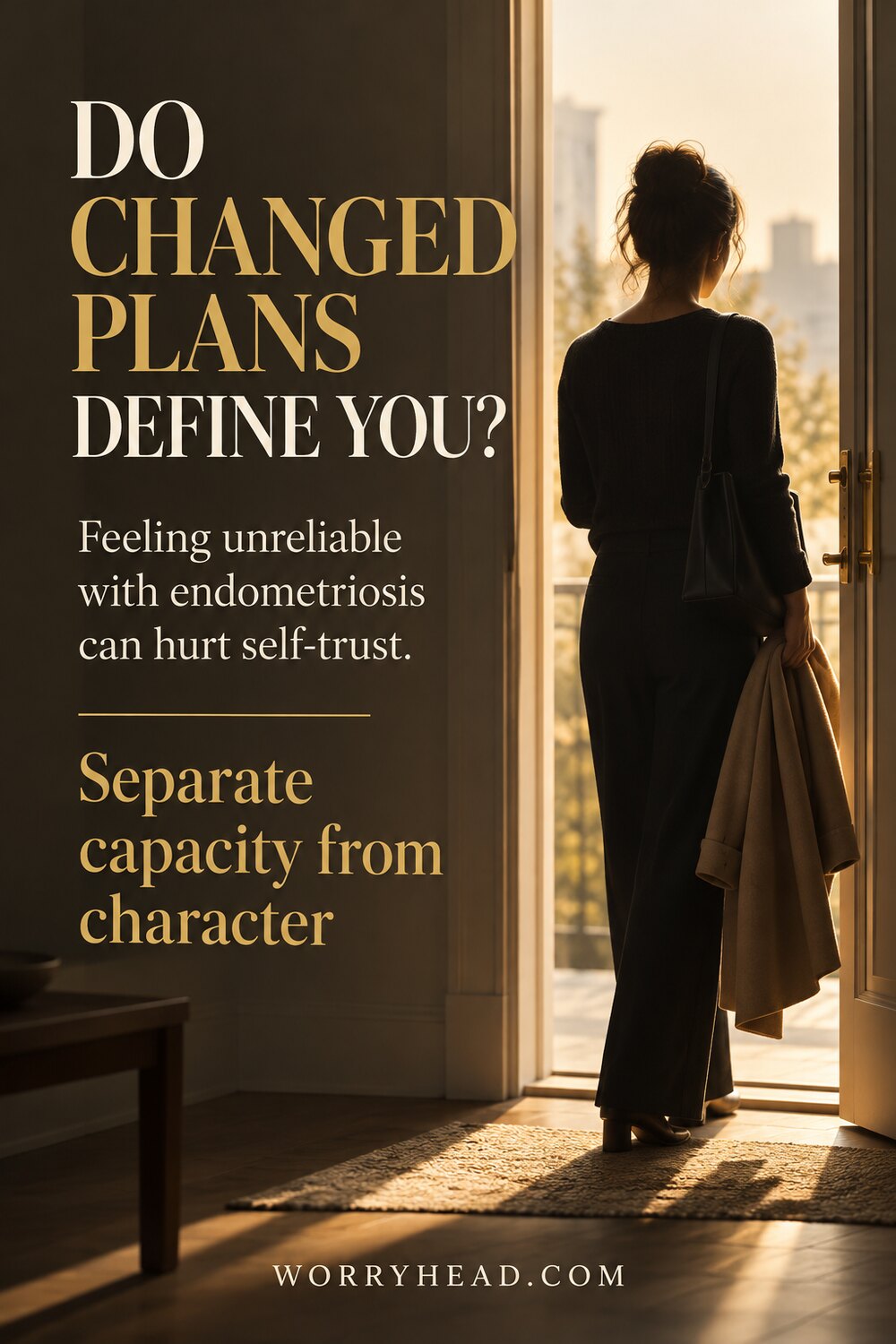
Repair the Impact of Feeling Unreliable with Endometriosis Without Taking All the Blame
A changed commitment can have a real effect on another person. Validation does not require pretending otherwise. You can recognise the missed time, extra work or disappointment while keeping cause and character separate. “I know this left you covering the task” is accountable; “I ruin everything” is not useful repair.
Offer only a next step you can genuinely sustain. That might be rescheduling, sending information, contributing later or accepting that the opportunity has passed. An impossible make-up promise usually creates a second cycle of pressure and shame.
In our marriage, practical help works best when it is not kept as a debt. My wife can feel guilty or like a burden despite my love. I want her to know that partnership is not an invoice, while also being honest if I need us to adjust a plan together. Both truths can exist in the same conversation.
If someone is repeatedly affected, ask what information would make planning easier. They may need earlier notice, a backup person or permission to continue without you. Their need for predictability is not proof that you are bad, and your need for flexibility is not proof that they are uncaring.
Repair should restore connection or function, not stage a trial about whether your symptoms are legitimate. If a conversation becomes contemptuous, coercive or frightening, ordinary communication tips are not enough; seek appropriate professional or trusted support.
At Work, Feeling Unreliable with Endometriosis Needs Clear Evidence and Boundaries
Work adds money, performance measures and power differences to the fear of unreliability. Keep records that help you understand what is happening: dates, functional effects, communications and agreed adjustments. The purpose is accuracy, not building a case against yourself.
Describe the work impact rather than disclosing more health information than you want to share. You can clarify which deadline is at risk, what is complete and what handover is needed. Employment rights and suitable adjustments depend on circumstances and jurisdiction, so seek advice from an employer, occupational health service, union or qualified adviser where relevant.
I am building blogs in the hope that they can ease or replace some of my wife’s income pressure so she can rest more, but both of us still work. I do not present that project as guaranteed income or a completed escape. It is one practical direction shaped by the limits we already live with.
Avoid promising to compensate for every low-capacity day with an exhausting high-capacity one. That pattern may hide the problem briefly while making future reliability harder. Sustainable work often depends on realistic pacing and explicit priorities rather than heroic recovery sprints.
If symptoms are changing or substantially limiting daily life, speak with an appropriate clinician. A supportive article can help you name shame, but it cannot assess pain, bleeding, fatigue, anaemia, medication effects or other causes that may need individual attention.
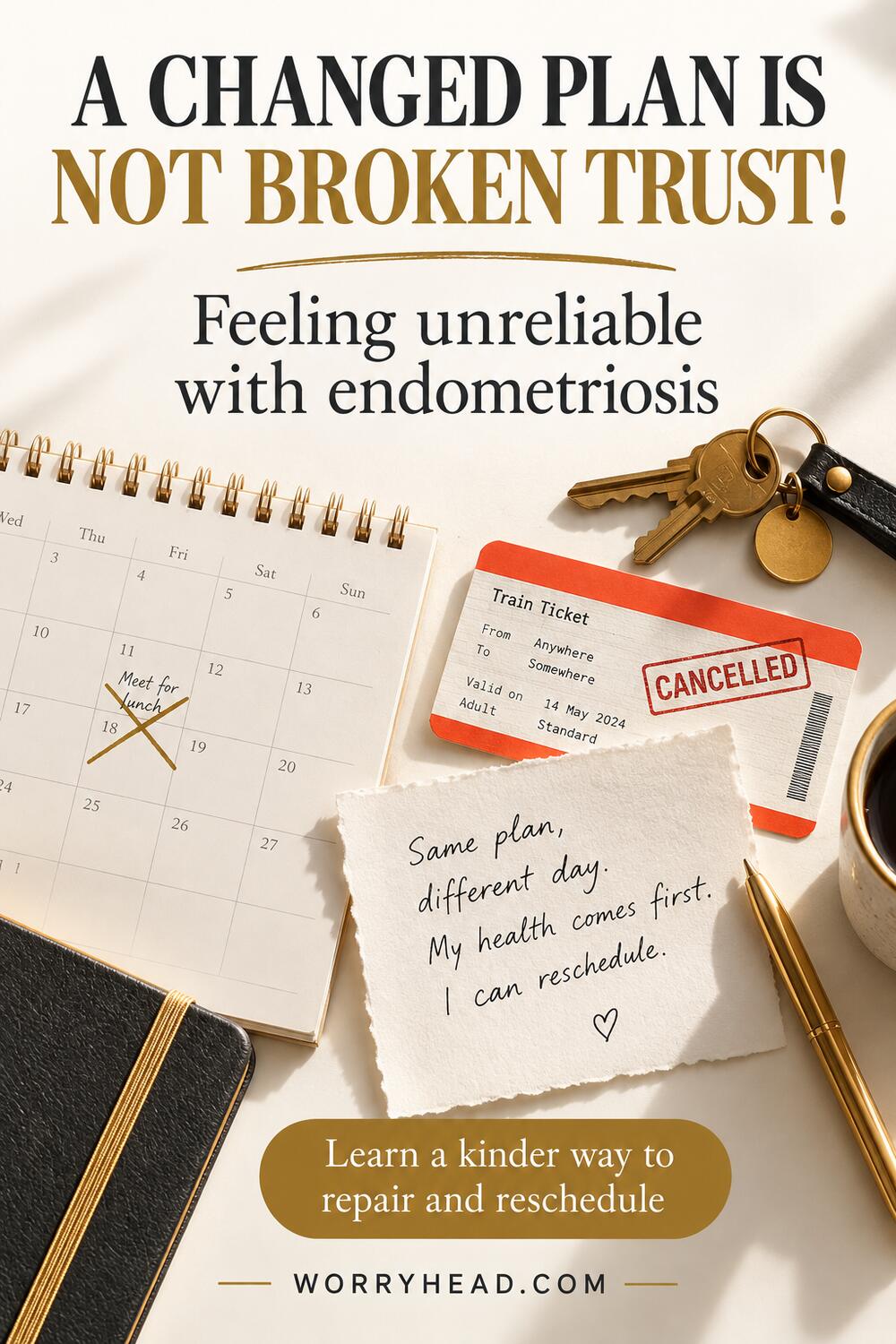
Rebuild Self-Trust After Feeling Unreliable with Endometriosis
Self-trust does not require predicting every flare. It grows when you believe you will respond honestly to new information. You can trust yourself to notice, communicate, adjust and seek help even when you cannot trust the body to follow a timetable.
Keep a brief record of promises you handled well, including the quiet ones: you sent the message early, used the backup plan, rested before the situation became unsafe or declined rather than disappearing. Shame remembers disruption and forgets competence; written evidence can rebalance that memory.
Use language that leaves room for change. “I plan to come and will confirm on the day” may feel less satisfying than certainty, yet it is more dependable than forcing a yes. Consistent conditional language can help other people learn the reality of fluctuating illness without requiring you to explain it from the beginning each time.
Some people will still misunderstand. Their reaction can hurt without becoming the final authority on your character. Choose relationships where flexibility travels in both directions and where your presence is valued beyond what you can produce or attend.
You are not asking the world to ignore consequences. You are asking for a truthful measure of reliability—one that includes communication, care, adaptation and the physical limits you did not choose.
Final Word on Feeling Unreliable with Endometriosis
Feeling unreliable is often the emotional cost of trying to live by fixed expectations in a fluctuating body. You can make narrower promises, communicate sooner and repair practical effects without describing yourself as the failure. Integrity can remain steady even when capacity does not.
If you would like, share in the comments what helps you make plans without overpromising, while keeping private details private. When shame still says that every change proves you are too much, my free eBook, You Did NOTHING To Deserve This!, offers a gentler final reminder.


About Me
Hi, I’m Lucjan! The reason why I decided to create this blog was my beautiful wife, who experienced a lot of pain in life, but also the lack of information about endometriosis and fibromyalgia for men…
READ MORE
Grab a FREE eBook!
“You Did NOTHING To Deserve This!”
Finally hear the words nobody ever said to you, that your pain is real, your tears make sense, and you did nothing to deserve endometriosis, the dismissal, or the way it has rewritten your life.
Related Questions You May Be Asking About Feeling Unreliable with Endometriosis
Does Cancelling Plans Mean I Am Unreliable?
A cancellation has an impact, but it does not define your character. Notice why the plan changed, communicate as early as you reasonably can, offer a realistic next step and avoid promising certainty your health cannot provide.
How Can I Apologise Without Blaming Myself for Endometriosis?
Acknowledge the practical effect and the other person’s feelings, then state what you can do next. You can be sorry that the situation affected them without apologising for existing or claiming control over symptoms you did not choose.
Can I Trust Myself to Make Plans with Endometriosis?
Yes, but trust may mean believing you will respond honestly rather than predicting your body perfectly. Use conditional plans, backup options and clear confirmation points so the promise matches what you truly know.
Feeling Unreliable with Endometriosis References
- https://www.nhs.uk/conditions/endometriosis/
- https://www.who.int/news-room/fact-sheets/detail/endometriosis
- https://www.eshre.eu/Guideline/Endometriosis
- https://pubmed.ncbi.nlm.nih.gov/42588228/
- https://pubmed.ncbi.nlm.nih.gov/37283994/
Sources checked on 23 October 2026. NHS, WHO and ESHRE provide current condition and quality-of-life context; the cited qualitative studies describe self-esteem, perceived reliability and daily-life impacts. Practical communication suggestions are editorial guidance, not clinical or legal advice.
