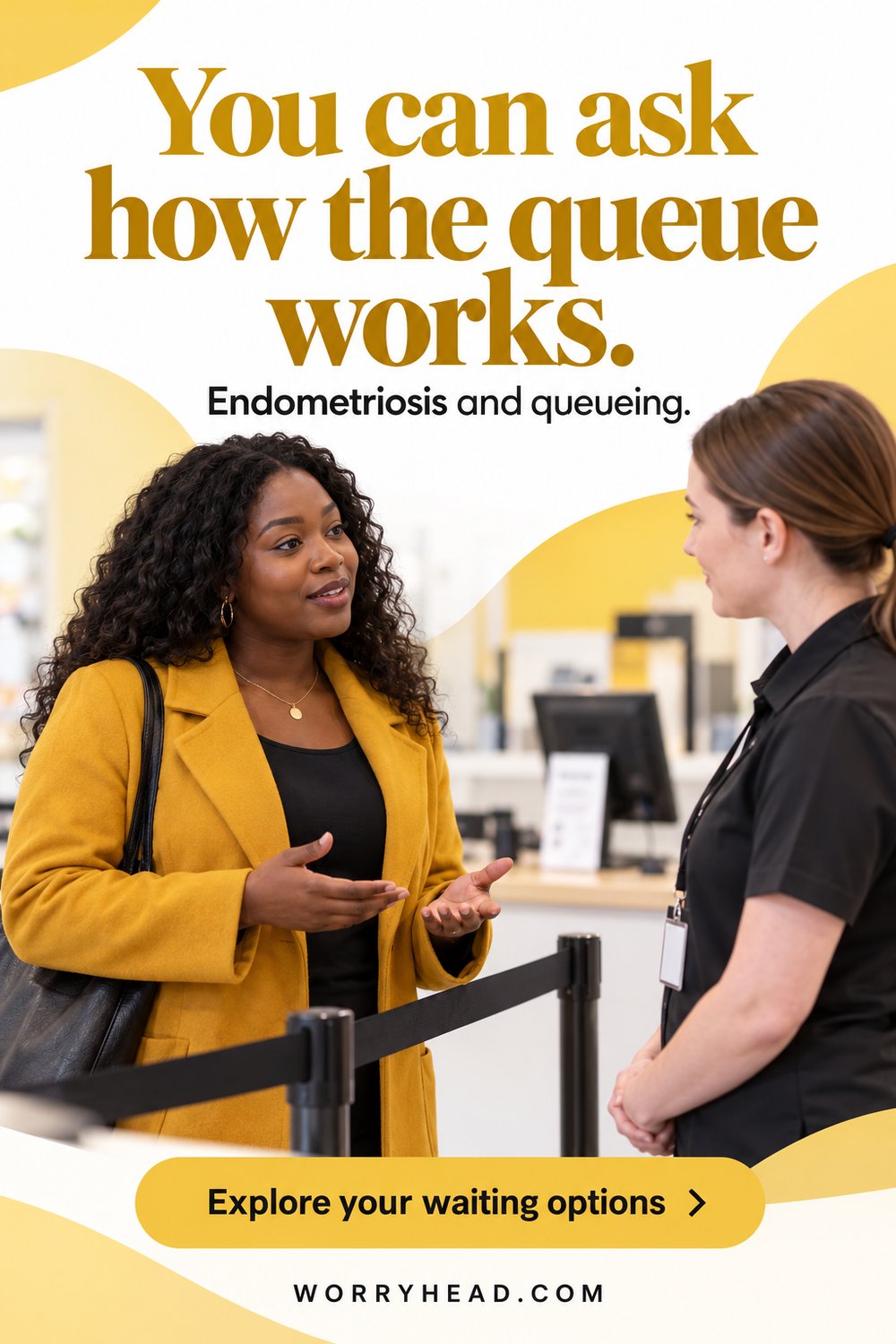
Endometriosis and Queueing: Keeping Your Options When the Line Is Not Moving
Have you ever stayed in a queue because leaving felt like wasting all the effort it took to get there? Endometriosis and queueing can turn a simple errand into a series of decisions about standing, uncertainty and whether you can step away. You do not have to wait until everyone can see you struggling before asking what other arrangements are possible.
When queueing becomes difficult, ask staff what options are available before assuming you must keep standing. Check how your place would be kept, how you would be called and whether a companion can help. You can share only the practical need and leave if the arrangement no longer works for you.
I am a husband, blogger and researcher, not a clinician, and learning alongside my wife shapes these practical reflections, with the NHS source for general symptom context listed in the references below.
The pressure can be sharper when you look fine while feeling unwell. This article focuses on a moving queue in a shop, at a service desk or at an event: keeping track of your turn, checking alternatives and deciding whether the errand still works for you.
An ordinary task can leave you feeling judged for needs nobody else can see. My free eBook, You Did NOTHING To Deserve This!, offers understanding for that hidden effort. You deserve consideration even when you do not have a polished explanation ready.
You Did NOTHING To Deserve This!
Endometriosis Validation for Women with Endo

- Why Endometriosis and Queueing Can Be Harder Than They Look
- Before Joining, Check the Options for Endometriosis and Queueing
- Make One Clear Request About Endometriosis and Queueing
- Agree How Your Turn Works with Endometriosis and Queueing
- Protect Your Privacy Around Endometriosis and Queueing
- When Endometriosis and Queueing Mean Changing the Errand
- After Endometriosis and Queueing, Keep the Useful Details
- Final Word on Endometriosis and Queueing
- You Did NOTHING To Deserve This!
- FREE eBook
Why Endometriosis and Queueing Can Be Harder Than They Look
A queue is more than time spent standing. You may be moving a few steps at a time, carrying something, watching for your turn and wondering how long the wait will last. Leaving the line can feel risky when you do not know whether you will have to begin again.
The NHS lists pain and fatigue among possible symptoms of endometriosis and recognises its effect on everyday life. That provides general context for why an errand may be demanding. It does not tell you how long you should be able to stand or establish the cause of every difficulty you experience.
I try to remember that arriving somewhere has already required effort from my wife. Reaching the back of a line does not mean the rest of the task is automatically manageable. The useful question is what the situation is asking now, not whether someone else thinks the errand looks easy.
You might need less standing, a clearer estimate, somewhere to wait or help carrying an item. Those are separate needs. Naming the immediate problem gives staff something specific to respond to and helps you judge whether the option offered actually addresses it.
Before Joining, Check the Options for Endometriosis and Queueing
Look for the service’s own information about how the queue operates. There may be a ticket system, a booked collection time or a staff member organising the line. There may also be no alternative in that setting. Ask what is available rather than building a plan around a facility you have not confirmed.
If the line is already long, you can ask for an estimate before joining. Treat an estimate as information, not a promise. A line that looks short may involve complicated transactions, while a longer one may move quickly; the number of people alone cannot tell you what the wait will feel like.
For an errand you can arrange in advance, check whether the task needs an in-person visit at all. A collection appointment or another supported route may be possible, but availability and any costs need checking with the actual service. You do not need to purchase an extra service simply to prove that you planned properly.
I would rather make one useful enquiry than give my wife a long preparation checklist. If there is only energy for one question, it could be: “If standing in the queue becomes difficult, who should I speak to?” Knowing where to ask can be more useful than trying to predict every possible delay.
Make One Clear Request About Endometriosis and Queueing
You can begin with the practical difficulty: “I have a health condition that makes standing in this line difficult. Is there another way I can wait?” This is suggested wording to adapt, not a remembered conversation. You can shorten it or write it on your phone if that is easier.
You do not need to start by asking to go ahead of everybody else. Your question might be about waiting nearby, returning at an agreed point or using a system already available. Staff can explain what they can arrange. This article does not promise priority access or describe a legal entitlement.
Keep the request connected to what would help. If you cannot stand comfortably but can wait somewhere suitable, say so. If carrying a basket is the difficulty, explain that part. A general statement that you are unwell may be harder for another person to translate into a useful action.
As a husband, I want support to preserve my wife’s voice. A companion can offer to ask, but should not automatically take over or announce a diagnosis. You can welcome help with the words while still choosing which details are shared and which arrangement you are willing to use.

Agree How Your Turn Works with Endometriosis and Queueing
If staff offer somewhere else to wait, clarify the practical details before leaving the line. How will your place be recorded? Who will call you? Will you need to be within hearing distance or watch a display? A kind offer becomes more useful when you both understand what happens next.
If the service uses a ticket, keep it where you can reach it and check which number or instruction matters. If it uses a message, ask what to do if you cannot receive it. Do not assume that every venue has the same system or that a phone notification will always replace being nearby.
A companion may be able to hold your place, but check the arrangement with staff, especially where barriers, admission checks or individual tickets are involved. Do not rely on a promise from another person in the queue if only staff can confirm the procedure.
I would want to remove uncertainty rather than simply move my wife to a different location. Being seated but worrying that you will miss your turn can create a new problem. A brief check of who will do what is often the part that makes an offered adjustment usable.
Protect Your Privacy Around Endometriosis and Queueing
A public line can feel like the worst place to discuss intimate symptoms. You can ask to speak to a member of staff more privately, or describe the limitation without naming endometriosis. The immediate question is how to manage the wait, not whether strangers understand your whole medical history.
If someone nearby challenges an arrangement, you do not have to turn the queue into a debate about your body. You might say that you have agreed it with staff and direct questions back to them. If the exchange feels hostile, focus on getting assistance or moving away rather than winning an argument.
Other people’s needs may be invisible too. Avoid asking another customer to justify why they are seated or receiving assistance. You can explain what you need without deciding who is most unwell. The service is better placed to explain its arrangements than a comparison between people waiting.
My wife’s privacy matters even when I am frustrated on her behalf. I would not want to make a public scene that leaves her managing my reaction as well as her own discomfort. Useful support should reduce what she has to carry, including the social pressure around a simple request.

When Endometriosis and Queueing Mean Changing the Errand
You can reassess after joining. Perhaps the line has stopped moving, the estimate has changed or the arrangement offered is not helping. The time already spent waiting does not require you to keep adding more. Ask what leaving would mean for this particular transaction or booking.
For a shop purchase, that might mean asking staff what to do with items you no longer want to carry. For a collection or event, it might mean checking whether you can return and what would happen to your order or ticket. Do not assume that leaving automatically preserves your place, payment or booking.
If somebody else could complete the errand, check what the service actually permits and what information or authorisation it requires. Handing over a task should not involve casually sharing passwords, payment credentials or private records. Sometimes the answer is that you need to return yourself; knowing that lets you make an informed choice.
Leaving may be disappointing, especially when the journey took effort. I will not call every unfinished errand a positive experience. But deciding that the next part costs too much is a decision about your present limits, not evidence that the effort you made was foolish or that you should have tried harder.
After Endometriosis and Queueing, Keep the Useful Details
If an arrangement worked, you can make a short note of the actual service, what was agreed and whom to ask next time. Avoid treating one helpful encounter as a guarantee at every location. Staff, facilities and procedures can differ, even within the same organisation.
If it did not work, identify the practical barrier: no way to retain your place, an unclear call system, an unsuitable waiting area or a response you found dismissive. Those details are more useful for feedback than a general conclusion that you are bad at going out.
You can give feedback later if you want to, without making it another obligation on a difficult day. Keep it factual and describe what would have helped. You do not need to publish intimate health details or identify another customer’s circumstances to explain the problem with the service.
I would also leave room for the feeling afterwards. Being helped may bring relief; having to ask may still have felt exposing. We do not need to turn every errand into a lesson about courage. Sometimes the useful outcome is simply knowing which part could be made easier next time.
Final Word on Endometriosis and Queueing
Before assuming the only options are standing silently or abandoning everything, ask how the queue works and what arrangements are possible. Clarify how your turn will be kept, protect the information you want private and keep the option to change your plan.
Living beside my wife has taught me to take ordinary limitations seriously without waiting for a visible crisis. I want you to receive that same consideration. You do not need to make a stranger understand every part of endometriosis before your practical difficulty is worth hearing.
If you would like to comment, share an arrangement that helped with a queue, without identifying staff or other customers. For the self-blame that an ordinary errand can leave behind, my free eBook, You Did NOTHING To Deserve This!, offers another place to feel understood.


About Me
Hi, I’m Lucjan! The reason why I decided to create this blog was my beautiful wife, who experienced a lot of pain in life, but also the lack of information about endometriosis and fibromyalgia for men…
READ MORE
Grab a FREE eBook!
“You Did NOTHING To Deserve This!”
Finally hear the words nobody ever said to you, that your pain is real, your tears make sense, and you did nothing to deserve endometriosis, the dismissal, or the way it has rewritten your life.
Related Questions You May Be Asking About Endometriosis and Queueing
Does Endometriosis Automatically Let Me Skip a Queue?
Do not assume that. Ask the particular service what arrangements it offers and how they work. This article describes practical questions, not a guarantee of priority or advice about legal rights.
Can a Friend Hold My Place While I Sit Nearby?
Possibly, but check with staff first. Admission rules, ticket checks and queue systems differ. Agree how you will rejoin and what your companion should do if the line moves before you return.
Do I Need to Tell Everyone My Diagnosis?
No. You can describe difficulty standing or another practical need without giving the whole queue personal information. Ask staff about a more private conversation if you want one.
What If I Have Already Waited a Long Time?
You can still reconsider. Ask what leaving means for your specific order, booking or place, then decide using your present needs. Time already spent waiting does not make continuing an obligation.
Endometriosis and Queueing References
