Endometriosis and Separate Leisure Plans: Making Room for Time Apart and Time Together
Does a partner’s evening out sometimes bring both relief and a painful reminder of what you cannot easily join? Endometriosis and separate leisure plans can create mixed feelings even when neither person wants to stop the other enjoying life. You are allowed to discuss support, fairness and connection without turning every outing into a test of love.
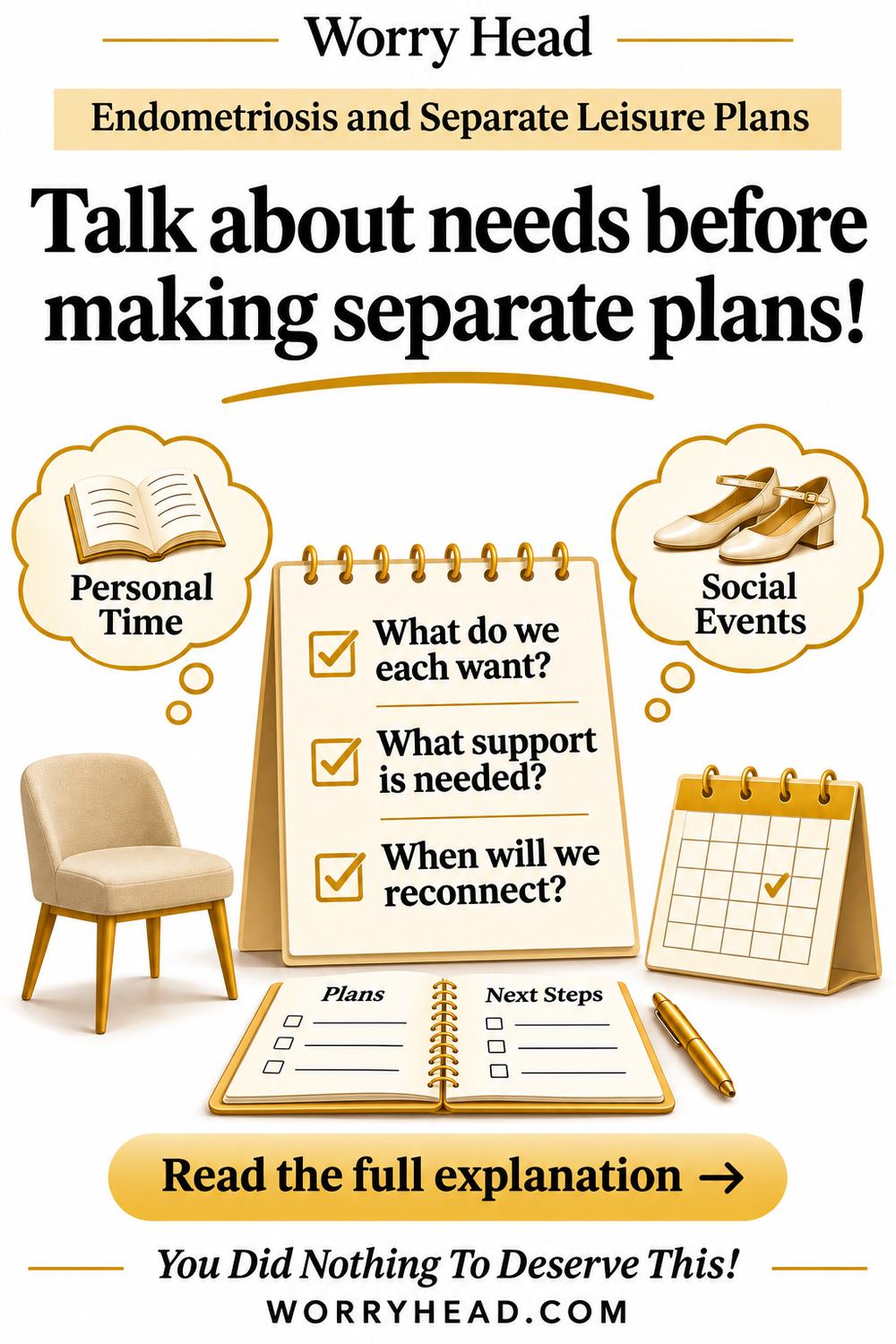
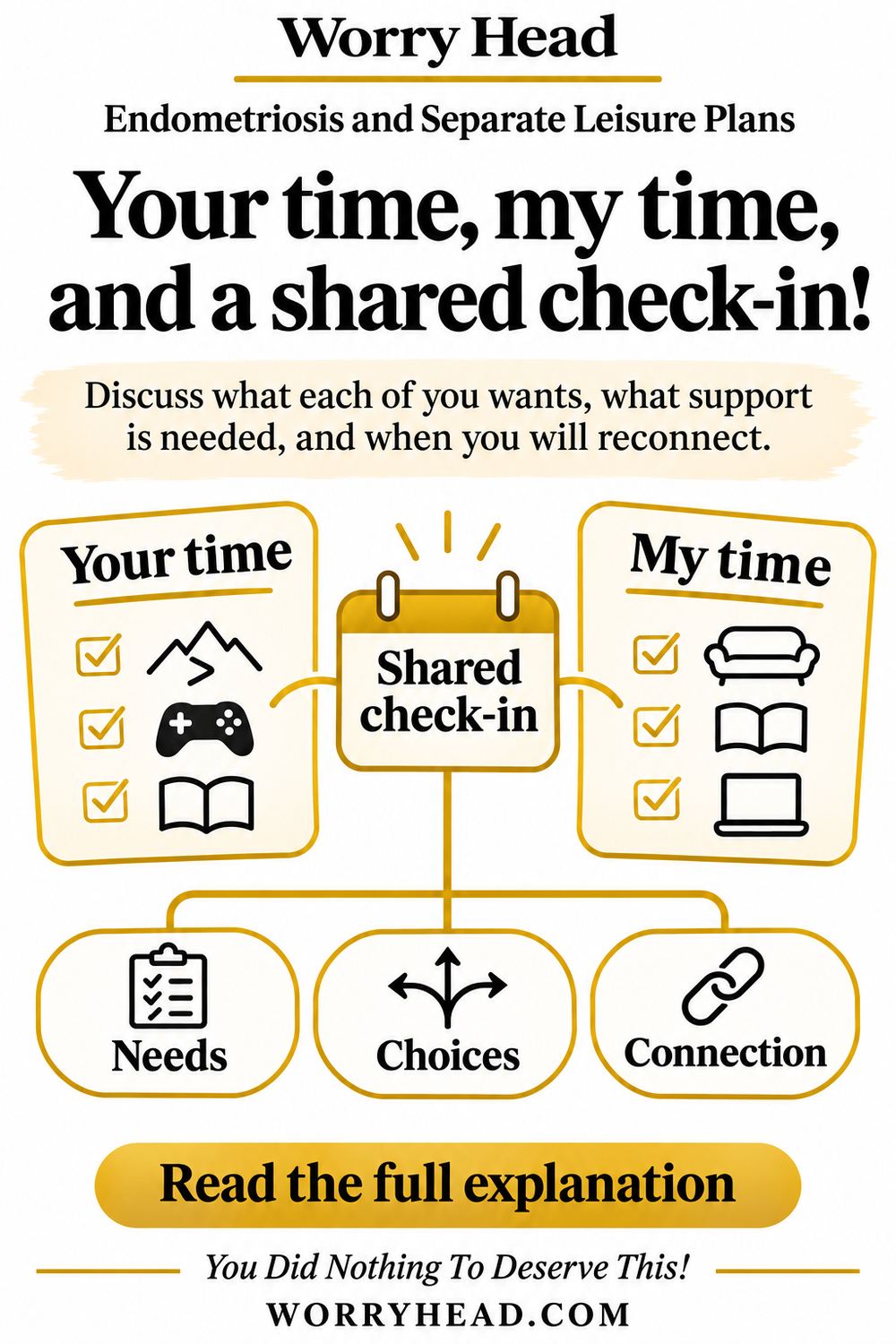
Separate plans can work when both people can express what they want, clarify practical support and agree how to reconnect. Time apart does not have to prove distance, and staying home does not automatically mean free time. Discuss the arrangement without making either person guess or feel guilty.
I write as a husband, blogger and researcher, not a clinician or relationship therapist. Years beside my wife inform these reflections, with the relationship resources behind the wider context listed below.
This article builds on talking about endometriosis without starting a fight. The specific question is how to discuss separate hobbies, outings and social time when the opportunities and practical demands are not the same for both partners.
If a simple plan brings up a much bigger feeling, my free eBook, You Did NOTHING To Deserve This!, offers understanding for that experience. You can want your partner to enjoy life and still need your own disappointment to be heard.
You Did NOTHING To Deserve This!
Endometriosis Validation for Women with Endo
- Why Endometriosis and Separate Leisure Plans Bring Mixed Feelings
- Rest Is Not Always Leisure in Endometriosis and Separate Leisure Plans
- Support Matters When Discussing Endometriosis and Separate Leisure Plans
- Discuss Endometriosis and Separate Leisure Plans Without a Permission System
- How Endometriosis and Separate Leisure Plans Can Include Reconnection
- When Endometriosis and Separate Leisure Plans Reveal a Pattern
- Keep Invitations Open Within Endometriosis and Separate Leisure Plans
- Final Word on Endometriosis and Separate Leisure Plans
- You Did NOTHING To Deserve This!
- FREE eBook
Why Endometriosis and Separate Leisure Plans Bring Mixed Feelings
A separate outing can mean different things to each person. One may see a chance to see friends, exercise or enjoy a familiar interest. The other may see another evening they cannot share, a practical gap or an unequal amount of choice. Neither interpretation should be assumed from the fact that one person is going out and the other is staying home.
Endometriosis UK recognises that restrictions on social life and feelings of loss can affect both partners. That is useful context, but it does not tell you which arrangement is right for your relationship. Start with the particular evening and the feelings it brings up, rather than assuming that every separate plan carries the same meaning.
You might say, “I want you to enjoy it, and I am sad that joining is difficult for me.” Those feelings can coexist. The sadness is not automatically a request for the outing to be cancelled. Equally, saying you support the plan does not mean you have no practical needs to discuss before it happens.
As a husband, I would want to hear the fuller sentence rather than only the part that makes my decision easy. If I ask how my wife feels, I need to leave room for an answer that contains disappointment as well as goodwill. Listening does not require turning every difficult feeling into a problem she must quickly remove.
Rest Is Not Always Leisure in Endometriosis and Separate Leisure Plans
Being at home does not necessarily mean having a free evening. You may be resting, dealing with symptoms, managing household tasks or waiting for something practical to happen. Calling all of that “your time” can miss the difference between choosing an enjoyable activity and having limited options about how to spend the hours.
Talk about the actual choices each person has. One partner may have a regular hobby outside the home while the other would like protected time for an interest indoors. The aim is not to make every hour identical. It is to notice whether both people have some say in how their time is used.
For example, a person who stays home may still be treated as automatically available for messages, chores or family arrangements. If that is happening, say so directly. “I would like this time to be mine too, rather than the time when I handle everything left over” identifies a practical imbalance without accusing the other person of enjoying themselves too much.
Be careful with simple scorekeeping. Equal numbers of outings may not reflect equal opportunity, effort or enjoyment. A fair conversation can include what each person values, what is currently possible and what support would create more choice. The answer may be different activities with different arrangements rather than a matching timetable.
Support Matters When Discussing Endometriosis and Separate Leisure Plans
If the outing affects practical support, discuss that before the person leaves. Identify what you actually need, what can be arranged in advance and what remains uncertain. This is different from assuming that a partner must always be available or that the person staying home should never need anything during leisure time.
A request might concern a meal, a household task, transport or help setting something up. Keep it specific and realistic. “Could we sort this before you go?” gives the conversation a concrete focus. If the answer is no, you can discuss another arrangement rather than discovering the gap after the plan is already under way.
Do not treat a casual promise as a complete plan. “Message me if you need anything” may sound reassuring, but the person may not be able to respond or return. Clarify what is actually possible. Honest limits are more useful than a broad offer that leaves both people with different expectations.
This article is about everyday arrangements, not replacing an established care plan. Where support involves essential care, use the appropriate agreed arrangements rather than improvising around an outing. For ordinary household needs, though, a short practical discussion can separate genuine logistics from the emotional meanings that might otherwise become tangled with them.
Discuss Endometriosis and Separate Leisure Plans Without a Permission System
Try to avoid a permission dynamic in which one person must formally approve the other’s enjoyment. A shared plan can still require consideration, discussion and compromise. The difference is whether the conversation treats both adults as people with choices and responsibilities, rather than one as the gatekeeper of the other’s life.
“I would like to go; can we talk about how it affects the evening?” opens a different discussion from announcing a finished plan and asking for reassurance afterwards. It gives the other person a chance to raise practical concerns while there is still room to respond. Timing can matter as much as the wording.
If you are the person staying home, you can be clear about what you are asking. Is it a change to the plan, help beforehand or simply acknowledgement that the situation feels hard? You may want more than one thing. Naming it reduces the chance that a partner hears every feeling as an instruction to cancel.
If you are the person going out, do not demand a cheerful response as proof that the plan is acceptable. Someone can support your choice while feeling sad about their own limitations. You can acknowledge that sadness without making them responsible for reassuring you repeatedly until you feel entirely free of discomfort.
How Endometriosis and Separate Leisure Plans Can Include Reconnection
Time apart can feel different when there is a clear opportunity to reconnect. That might be a brief conversation after the outing, a quiet moment the next morning or another shared activity. Choose something that both people actually want. Reconnection should not become an additional performance expected from someone who is already tired.
Ask how much detail the other person would enjoy. They may want to hear about the evening, see a photograph or talk about something unrelated. On another occasion, hearing a long account of an event they missed may feel painful. A quick “Would you like to hear about it now?” leaves room for an honest answer.
Do not hide ordinary enjoyment as though it is inherently hurtful. Secrecy can create its own distance. At the same time, avoid presenting the outing as a lesson in what the other person should try harder to do. Sharing a good experience and comparing your lives are different kinds of conversation.
I would want time together to have its own value, rather than treating it as compensation for having gone out. A relationship can contain shared interests and separate ones. What matters is whether both people continue to be noticed, included in decisions and able to ask for connection in a form that fits them.
When Endometriosis and Separate Leisure Plans Reveal a Pattern
One awkward evening may need a small adjustment. A repeated pattern may need a wider conversation: perhaps one person’s plans always take priority, practical tasks regularly fall to the other, or shared time keeps disappearing. Name the pattern with concrete examples rather than turning every outing into evidence of a global failure to care.
Relate encourages couples to make space for both people to speak and listen without interruption. For this discussion, that may mean choosing a time away from the doorway, the departure deadline or the immediate disappointment. Each person needs a chance to describe the effect of the arrangement, not only defend their intentions.
Ask what change would make the next plan more workable. It might be earlier notice, a clearer division of tasks, protected time for the other person’s interest or a more reliable opportunity to reconnect. Choose a change you can actually test in everyday life rather than making a sweeping promise to become perfectly balanced.
Then notice whether the change happens. A caring conversation matters, but it should lead to something observable if the problem is practical. If the same difficulty continues, return to the agreement itself. You do not need to escalate the language every time in order to justify asking for follow-through.
Keep Invitations Open Within Endometriosis and Separate Leisure Plans
Separate plans should not automatically mean that one person stops being invited. You may be unable or unwilling to join a particular outing and still want the choice next time. Explain what kind of invitation feels helpful: an early mention, clear information about the event or an option to decide without pressure.
If you are inviting your partner, provide useful details rather than deciding for them. They may want to know about seating, travel or the likely timing. Offer what you know and be honest about what you do not. An invitation can be caring without becoming a campaign to persuade them to attend.
Respect a no without turning it into a verdict on the relationship. Also respect a yes that comes with a different arrangement, if that arrangement is possible. One person may attend for part of an event while the other stays longer. Discuss the practical details clearly instead of assuming that being a couple requires identical participation.
You can also create shared time that is not built around recovering a missed outing. Ask what each person enjoys now. The answer may be familiar or new, active or quiet. It does not need to imitate what other couples do, and it does not have to erase the grief attached to activities that remain difficult.
Final Word on Endometriosis and Separate Leisure Plans
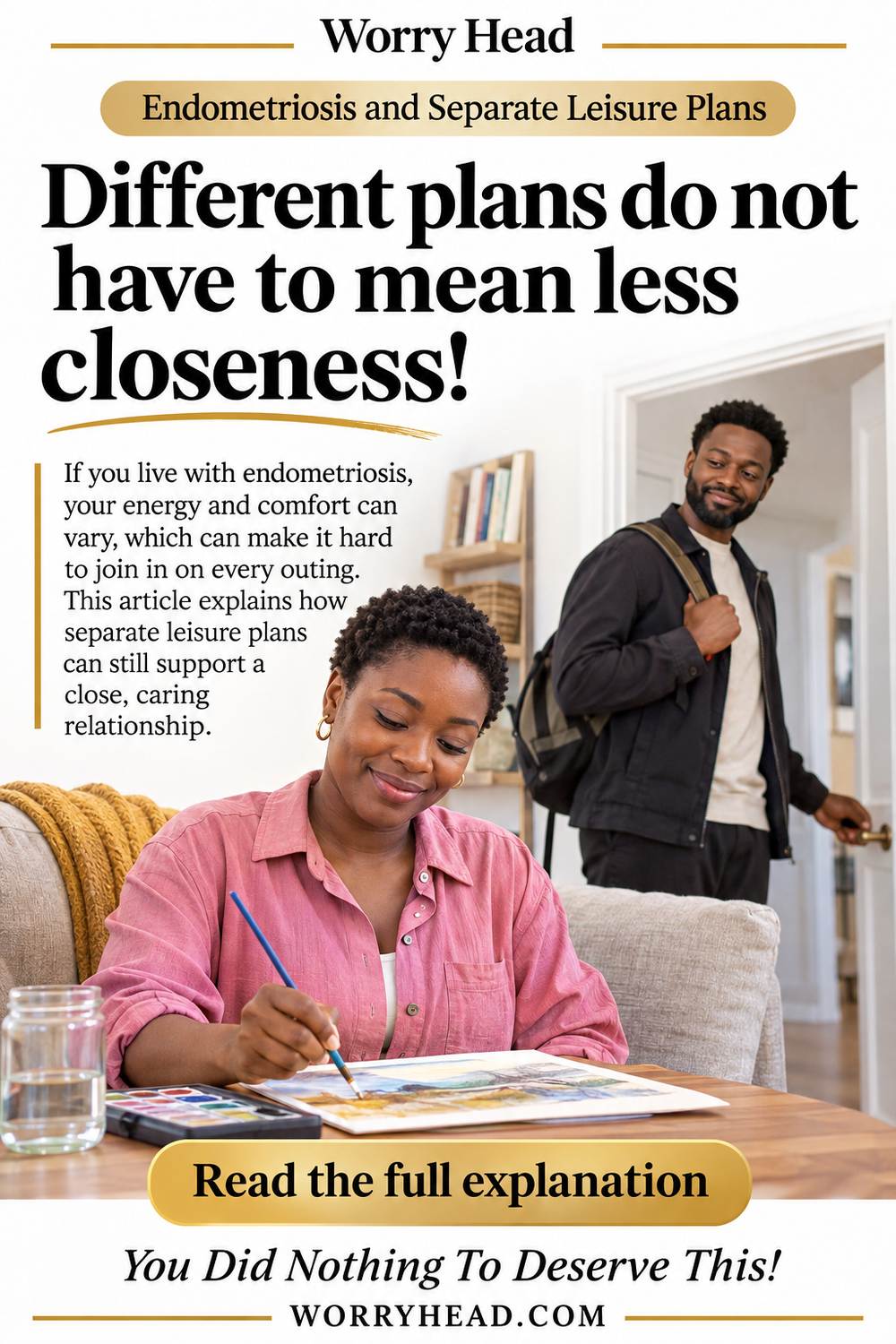
Different plans do not have to mean less closeness. They do need honest information about what each person wants, what support is required and how the arrangement affects shared life. Neither guilt nor guesswork is a reliable substitute for that conversation.
You can make room for enjoyment and disappointment at the same time. Start with the next real plan, rather than trying to settle the whole future of the relationship. My free eBook, You Did NOTHING To Deserve This!, is there for the feelings that practical arrangements alone cannot answer.


About Me
Hi, I’m Lucjan! The reason why I decided to create this blog was my beautiful wife, who experienced a lot of pain in life, but also the lack of information about endometriosis and fibromyalgia for men…
READ MORE
Grab a FREE eBook!
“You Did NOTHING To Deserve This!”
Finally hear the words nobody ever said to you, that your pain is real, your tears make sense, and you did nothing to deserve endometriosis, the dismissal, or the way it has rewritten your life.
Related Questions You May Be Asking About Endometriosis and Separate Leisure Plans
Is It Unfair to Feel Sad When My Partner Goes Out?
The feeling itself is not a demand or a wrongdoing. You can describe it while being clear about whether you want a practical change, acknowledgement or simply space to feel disappointed.
Should We Have Exactly Equal Time for Hobbies?
Identical hours are not the only way to discuss fairness. Consider choice, responsibilities and what each person finds meaningful. Look for an arrangement both people can describe as workable.
What if I Want to Be Invited Even When I Usually Decline?
Tell your partner that the choice matters to you. You can agree on invitations that include useful details and allow a no without pressure, disappointment being used against you or repeated persuasion.
Endometriosis and Separate Leisure Plans References
- https://www.endometriosis-uk.org/resources/endometriosis-and-couples
- https://www.relate.org.uk/get-help/trouble-communicating
