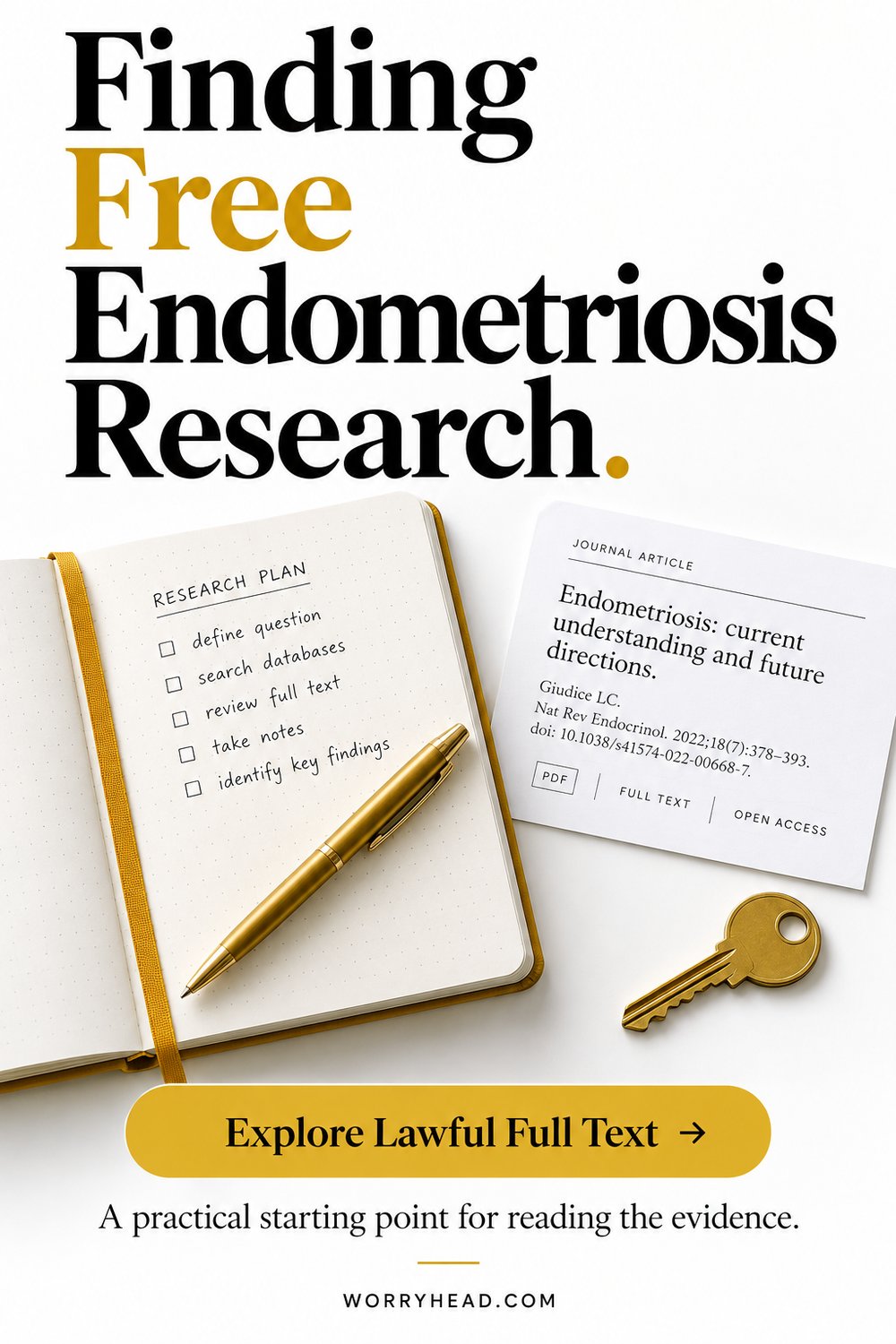
Finding Free Endometriosis Research Without Paying for Every Paper
Have you found a hopeful research headline, only to discover that the paper itself costs money to open? Finding free endometriosis research can give you a clearer starting point without turning every unanswered question into another expense. You deserve to know what you can read, which version you have found and when it is reasonable to stop searching.
Finding free endometriosis research starts with the exact paper title. Check PubMed for full-text links, look for a lawful copy in PMC and note which version you find. Free access does not prove study quality; if only an abstract is available, save the citation and state what you could not read.
I am not a clinician; as a husband, blogger and researcher, I have spent years learning because of my wife’s experience, and the National Library of Medicine and PMC sources I used for this guide are listed at the bottom.
Understanding what a paper actually says becomes easier when you can see more than its headline. My guide to reading endometriosis research critically can help you examine the evidence once you have a copy in front of you.
I began researching because I wanted to understand my wife’s experience and support her more thoughtfully. Learning can be a form of care, but collecting papers is not a measure of how much you love someone. This is a practical access guide, not advice about which treatment to choose.
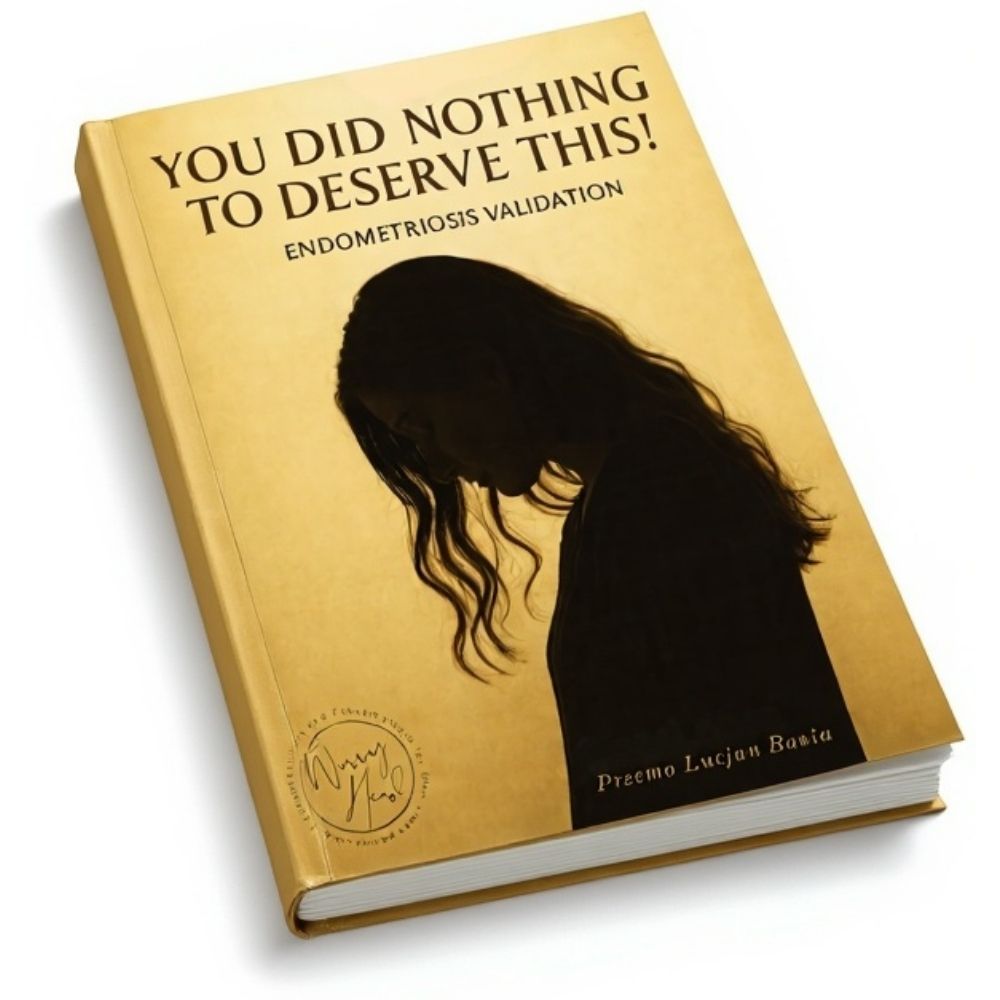
Searching for a paper can leave you carrying more questions than answers. My free eBook, You Did NOTHING To Deserve This!, offers understanding for the emotional weight of living alongside illness. It is companionship, not a research service or a medical solution.
You Did NOTHING To Deserve This!
Endometriosis Validation for Women with Endo
- Start Finding Free Endometriosis Research with the Exact Citation
- Use PubMed Links When Finding Free Endometriosis Research
- Finding Free Endometriosis Research Through PMC
- Check the Version While Finding Free Endometriosis Research
- Ask for Help When Finding Free Endometriosis Research Gets Difficult
- Set a Stopping Point for Finding Free Endometriosis Research
- Conclusion on Finding Free Endometriosis Research
- You Did NOTHING To Deserve This!
- FREE eBook
Start Finding Free Endometriosis Research with the Exact Citation
Before opening more tabs, save the details of the paper you actually want. PubMed’s guide says you can search using the article title or citation information such as an author, journal and year. That helps you check whether the paper behind a headline is the same one you have found.
My suggestion is to make a small note containing the title, first author, journal, year and any identifier already supplied. Add the headline or post that led you there separately. Keeping those two things apart stops someone else’s interpretation from becoming the paper’s identity in your notes.
You do not need to build a complicated reference system. A plain document can be enough. Give each paper a few lines rather than saving screenshots without context. Your future self should be able to recognise why you kept it without reconstructing an entire evening of searching.
Try a note like this: title; publication details; where I found the record; whether I opened the full paper; and my question. Leave any unknown field empty. An incomplete but honest note is more useful than a polished citation assembled from guesses.
There is an emotional reason for this small pause too. When illness has already changed so much, a promising sentence can feel urgent. I understand wanting something useful to bring to the person you love. Writing down the exact question gives that urgency a direction without asking you to solve everything immediately.
Use PubMed Links When Finding Free Endometriosis Research
PubMed is a way to find research records; appearing there does not mean every paper can be read free of charge. Its user guide explains how to follow available full-text links. A link to a publisher may lead to free material or to a request for payment.
For one specific paper, start with its title rather than a broad search such as endometriosis cure. Check the details against your note before following a full-text link. The first result that sounds encouraging is not necessarily the paper you intended to locate.
If you are exploring a subject rather than locating a known paper, the free-full-text filter can help you find accessible reading. Keep its purpose in perspective: it narrows by availability. It does not tell you which study should influence your own care, and it does not rank papers by personal relevance.
I would keep two questions separate in your notes: can I open this, and is this useful for my question? Finding an accessible page answers the first question only. You still have permission to decide that an open paper is too technical, too indirect or simply unnecessary for what you need today.
Avoid paying just because a search has become frustrating. You might choose to buy access, but you can also pause, keep the citation and investigate another lawful route. Neither choice proves that you are a more serious patient or a more caring partner.
Finding Free Endometriosis Research Through PMC
PubMed Central, usually shortened to PMC, is a free full-text archive. It is different from the PubMed search index. A paper may have a PMC link in its record, but not every record will offer one.
When you reach a copy, take a moment to identify it rather than downloading and forgetting it. Check the title and authors against the citation you saved. Look for information describing the version. Save the page address as well as the file so you have a route back to its record.
For your own organisation, a filename can be simple: author, year and a short title. If you later save another version, add a distinguishing label rather than quietly replacing the earlier copy. You are trying to prevent confusion, not earn marks for a perfect filing system.
I started blogging to make sense of what I was learning and share it with others. That has taught me the value of being able to retrace a statement. A saved document without its source can leave you with words you remember strongly but cannot put back into context.
Finding a free copy can feel like progress, and it is useful progress. It is still only access. You do not have to understand every table before the search has been worthwhile, and the absence of a free copy says nothing about whether your concern deserves an answer.
Check the Version While Finding Free Endometriosis Research
PMC explains that an accepted author manuscript has undergone peer review and been accepted by a journal, but generally lacks the journal’s final copyediting and formatting. That is different from a preprint that has not yet been peer reviewed. Read the version information instead of relying on how professional the document looks.
In your note, write the label you can actually see. If it says accepted manuscript, record that. If it says preprint, keep that distinction visible. If the version is unclear, mark it unclear rather than upgrading it in your memory because the findings feel convincing.
An archive page may also link to a correction or retraction. PMC describes those links as part of its manuscript records. Follow any notice attached to the paper before carrying a claim into a conversation. Do not treat the oldest downloaded file as a permanently complete account.
My practical rule is to keep the document and its current record together. If you share a paper with someone, send the source page and explain which version you read. That makes the conversation easier to revisit if a detail changes or someone notices an important limitation.
Careful wording protects hope as well as accuracy. There is a difference between saying you found something worth asking about and saying that research has settled a question. You can be interested without being certain, and you can bring uncertainty to a clinician without apologising for it.
Ask for Help When Finding Free Endometriosis Research Gets Difficult
You can ask a librarian whether they can help locate a lawful copy. Services, eligibility and possible charges vary, so ask what is available before assuming that a local, university or workplace library can supply it. This is an option to explore, not a guarantee of access.
Suggested wording might be: I am trying to read this particular paper. Here are its title, author, journal and year. Can you tell me whether a lawful free copy or a document-supply service is available, and whether there would be a charge? You can adapt that request without explaining your medical history.
If you are helping your partner, ask whether she wants the paper found, the citation saved or the search left alone for now. Those are different forms of support. Research can become another task landing in someone’s lap when what she wanted was room to rest.
Both my wife and I still work, and I know that time and energy have to stretch around ordinary responsibilities as well as illness. I do not want this guide to suggest that good support requires hours of unpaid searching. One clear request for help may be the most useful next step.
You can also save a question for a future appointment without obtaining every paper yourself. For example: I saw this study mentioned; is it relevant to my situation? That is a request for professional interpretation, not a claim that you have already assessed the evidence.
Set a Stopping Point for Finding Free Endometriosis Research
Sometimes you will only obtain an abstract. Write that down plainly. A summary is not a substitute for the methods, full results and limitations you have not seen. Do not let a tool, a social post or your own understandable hopes fill those gaps with invented detail.
One manageable stopping rule is to check the original record, follow an available lawful full-text route and save the citation if access remains unavailable. You can decide whether asking for help is worth another step. You do not have to exhaust every possible route before you are allowed to close the browser.
Consider writing two short lines at the end of your note: what I actually read, and what I still need to ask. That leaves a useful handover for another day. It also makes it less likely that a remembered abstract becomes a paper you believe you read in full.
I want research to help you feel more informed, not become another test you can fail. My love for my wife is not measured by a folder of downloaded studies. It shows in whether learning helps me listen and support her, including recognising when more information is not what she needs from me.
Conclusion on Finding Free Endometriosis Research
Finding free endometriosis research starts with identifying the right paper, looking for lawful full text and keeping the version clear. If access stops at an abstract, saying so is a careful decision. It is not evidence that you did too little.
You can take one useful step today: save a citation, label the copy you already have or ask someone for help. Leave the rest for a time when you have capacity. Information should have a place in your life without claiming every spare moment of it.
If you would like to comment, you are welcome to share which part of finding papers feels confusing; please avoid posting private medical details. And if searching for answers has left you feeling alone, my free eBook, You Did NOTHING To Deserve This!, offers a little understanding alongside the questions that research cannot answer for you.


About Me
Hi, I’m Lucjan! The reason why I decided to create this blog was my beautiful wife, who experienced a lot of pain in life, but also the lack of information about endometriosis and fibromyalgia for men…
READ MORE
Grab a FREE eBook!
“You Did NOTHING To Deserve This!”
Finally hear the words nobody ever said to you, that your pain is real, your tears make sense, and you did nothing to deserve endometriosis, the dismissal, or the way it has rewritten your life.
Related Questions You May Be Asking About Finding Free Endometriosis Research
Is an Accepted Manuscript the Same as a Preprint?
No. Keep the document’s stated version in your notes. An accepted author manuscript and an unreviewed preprint represent different points in publication.
Does Free Access Mean a Study Is Better?
No. Access and evidence quality answer different questions. Use the linked research-reading guide to begin examining what a paper can support.
What If I Can Only Find the Abstract?
Keep the citation and record that limitation. You can ask for help or stop without inventing the details you could not read.
Finding Free Endometriosis Research References
