
Endometriosis and Shared Calendars Without Turning Care into Monitoring
A date on a screen can look wonderfully certain when the day itself is anything but. Endometriosis and shared calendars become complicated when a practical arrangement starts to feel like a promise that your body must keep.
A shared calendar can organise appointments, responsibilities and flexible plans when endometriosis affects daily life. Decide together what belongs there, who updates entries and how changes are communicated. Keep private health details separate, and never treat an empty day as proof of capacity.
My perspective comes from years of trying to understand my wife’s experience as a husband, blogger and researcher rather than a clinician, with the NHS and Endometriosis UK sources used for the health context listed below.
Learning how to build a happy marriage alongside endometriosis includes finding practical arrangements that leave both people feeling respected. A calendar should serve that relationship, not become a running assessment of how well you are coping.
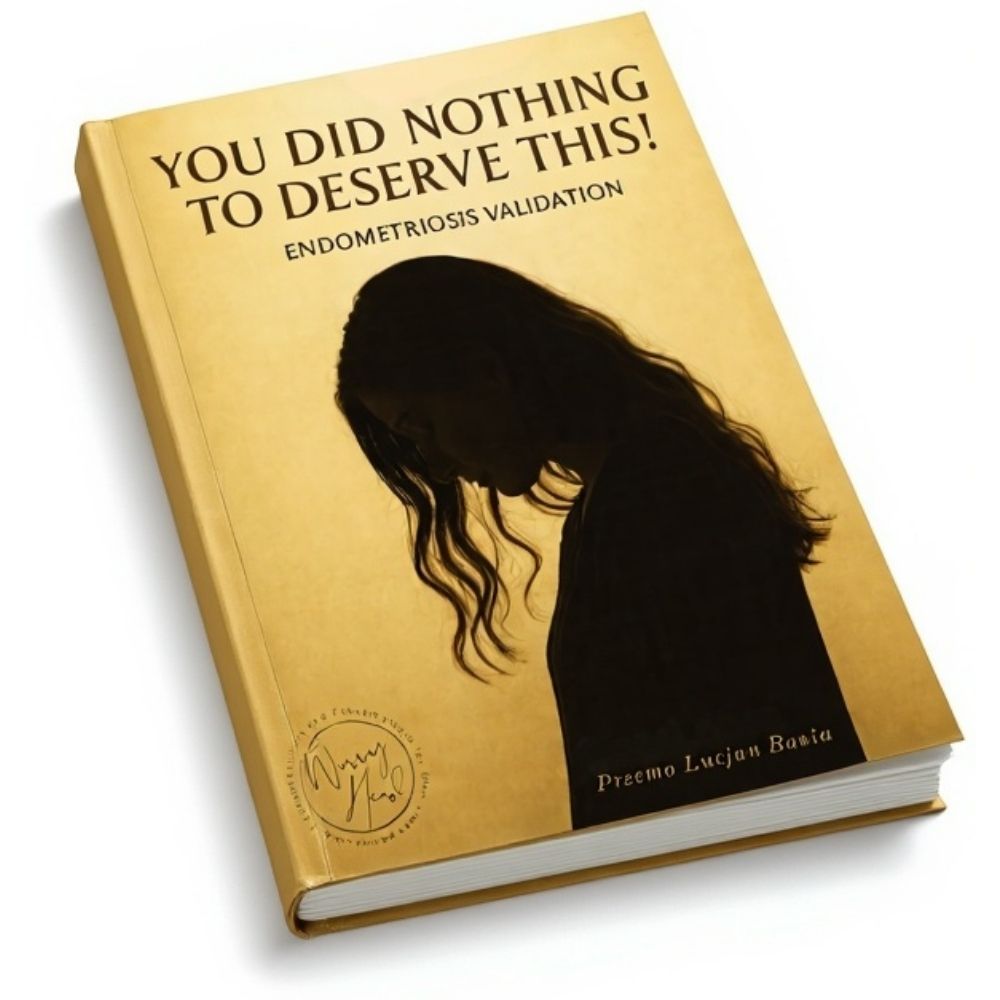
If organising everyday life has begun to feel like another test you can fail, my free eBook You Did NOTHING To Deserve This! offers a gentler place to pause. It is written for the person carrying feelings that a neat weekly plan cannot show.
You Did NOTHING To Deserve This!
Endometriosis Validation for Women with Endo
- Start Small with Endometriosis and Shared Calendars
- What Belongs in Endometriosis and Shared Calendars?
- Keep Privacy Intact with Endometriosis and Shared Calendars
- Let Endometriosis and Shared Calendars Allow Uncertainty
- Share the Upkeep of Endometriosis and Shared Calendars
- Changing Plans in Endometriosis and Shared Calendars
- When Endometriosis and Shared Calendars Add More Pressure
- Final Word on Endometriosis and Shared Calendars
- You Did NOTHING To Deserve This!
- FREE eBook
Start Small with Endometriosis and Shared Calendars
Before choosing colours or reminders, name the problem you actually want to solve. Perhaps appointment lifts keep getting muddled, both of you assume the other has bought groceries, or an invitation is accepted before you have spoken. Those are different problems, and they do not require a complete record of your life.
I began writing because I wanted to understand my wife better. That matters here: a useful tool should support understanding, rather than let me believe that knowing her timetable means knowing how she feels. A screen can show an appointment; it cannot tell me what that appointment costs her emotionally.
Start with one shared responsibility for a short trial. Put the arrangement somewhere both people can comfortably access, whether that is paper or an existing digital calendar. There is no need to buy an app or create a complicated system before you know whether the simplest version helps.
Agree what success would look like. Fewer missed arrangements, fewer repeated questions or clearer ownership are practical aims. A week without symptoms or changed plans is not a fair test of whether either of you used the calendar properly.
What Belongs in Endometriosis and Shared Calendars?
An entry is most useful when it tells somebody what they need to do. A time, a place, the person responsible and any agreed flexibility may be enough. Avoid filling every box simply because there is room to write more.
For example, an imaginary appointment entry could say: “Tuesday, 2pm, clinic; Sam driving; confirm collection time by message.” That records a transport agreement. It does not require examination details, a symptom score or an explanation of why the appointment matters.
You might include a grocery collection, a repair visit or a social invitation that needs discussion. Keep commitments that are fixed for an outside reason separate from activities you would like to do if the day allows. “Possible lunch, decide Saturday morning” communicates something different from a confirmed booking.
Living alongside my wife’s illness has made me wary of tidy arrangements that quietly create more work for her. If adding an event takes five minutes of explanation, simplify the entry. The information should make the next action easier, not demand another polished account of living with pain.
Keep Privacy Intact with Endometriosis and Shared Calendars
Sharing a household does not mean sharing every detail of healthcare. You can agree to display “private appointment” while keeping the clinician’s name, the reason for attending and any personal notes elsewhere. Consent can also change: information that felt comfortable to share last month may feel too exposed now.
Check who else can see the calendar before adding anything sensitive. A work account, a family group or a screen in a shared room may have a wider audience than intended. Use the service’s own sharing information to establish access, and leave health details out while that is uncertain.
I want to support my wife without turning closeness into a claim over her information. It would be easy for a husband to describe constant visibility as reassurance. The more useful question is whether the person being supported actually wants that visibility.
Agree boundaries in plain language: no private medical notes in shared entries, no adding another person’s appointments without asking, and no forwarding details to relatives by default. These are suggestions for a conversation, not a universal set of rules that every couple must adopt.
Let Endometriosis and Shared Calendars Allow Uncertainty
The NHS describes symptoms that can affect ordinary activities and may occur outside periods. An event placed three weeks ahead therefore cannot guarantee how you will feel on that particular day. Planning can reserve an opportunity without making your future health a commitment.
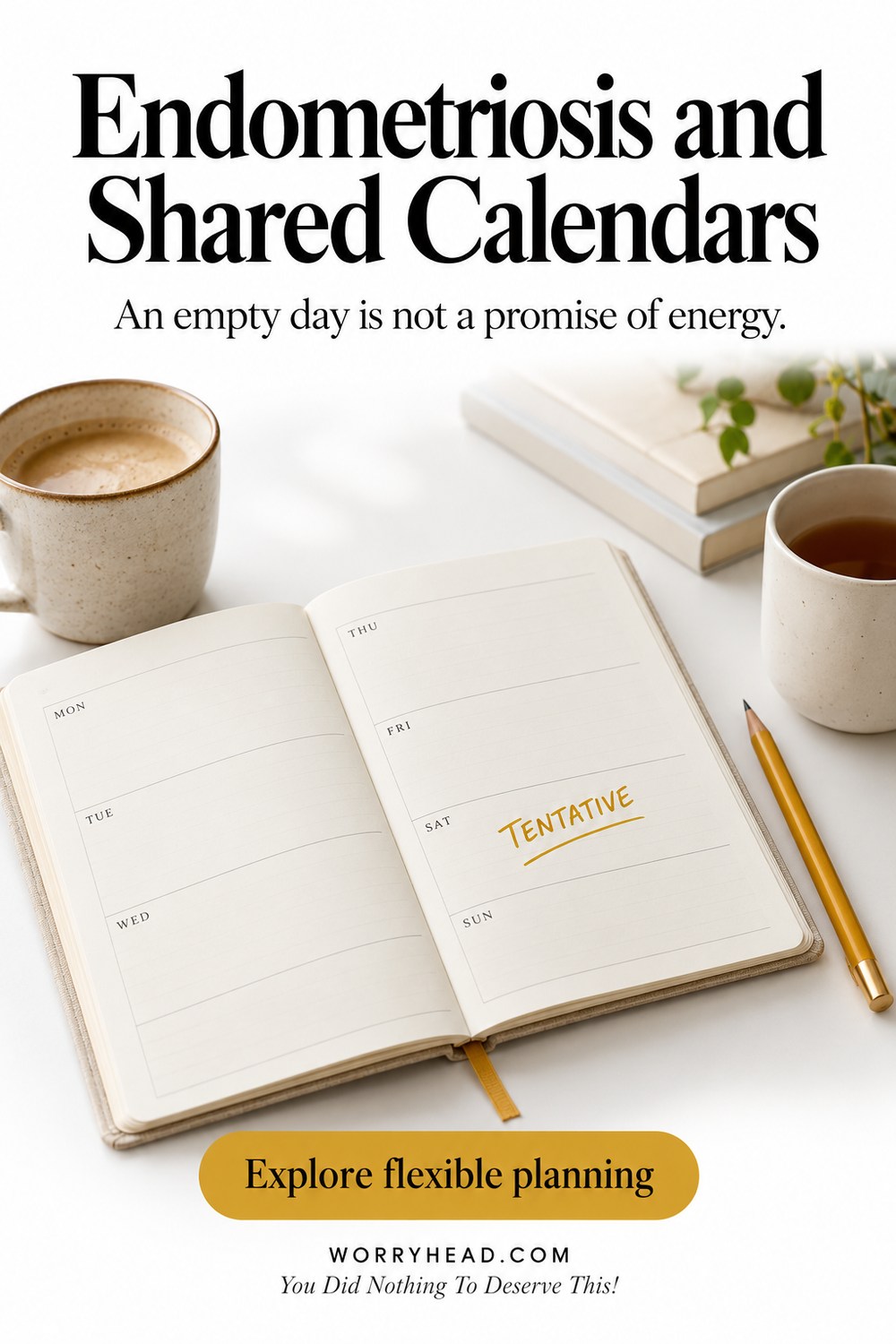
Choose a small number of understandable labels. “Confirmed arrangement”, “tentative plan” and “check together” may be enough. If colours help, use them for those meanings rather than rating your body as good, bad or disappointing.
An empty afternoon might be deliberately unallocated. It does not automatically mean you can take on a visit, a household task or another person’s errand. I would not want my wife’s unbooked time treated as spare capacity that belongs to whoever notices it first.
Consider an imaginary Saturday lunch marked tentative. Agree when to check whether it is workable, who will contact the other person if it changes, and what happens to any booking. That prepares the practical decision without requiring you to predict symptoms or apologise in advance for them.
Share the Upkeep of Endometriosis and Shared Calendars
A shared tool can still leave one person doing all the remembering. Entering dates, noticing clashes, checking transport and chasing responses are tasks in their own right. Simply giving a partner access does not distribute that work.
Both my wife and I still work. Her wish to feel useful matters to me, and so does recognising when a supposedly helpful arrangement adds another responsibility to her day. Fairness needs a conversation about what each person can actually take on, rather than a neat fifty-fifty division on paper.
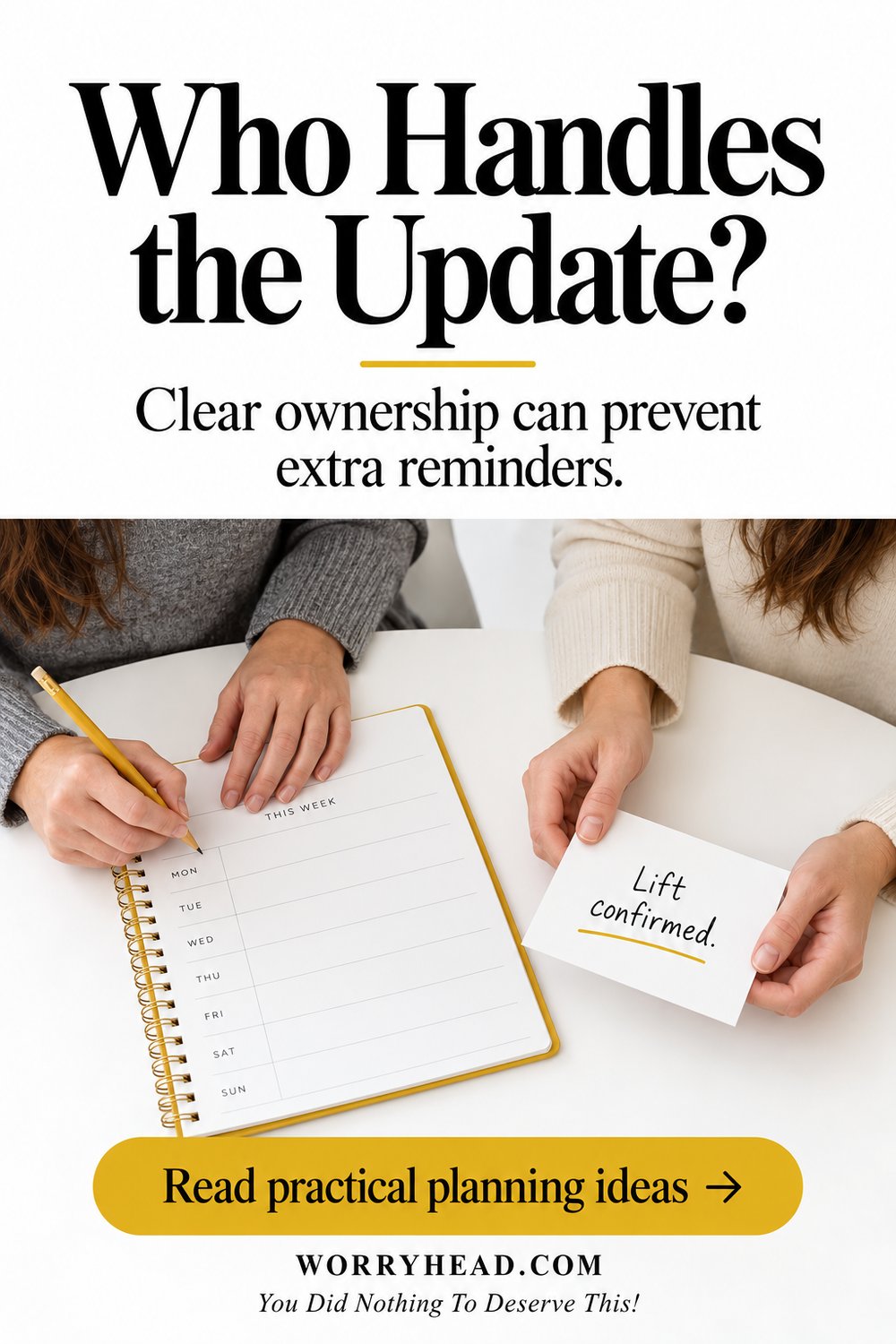
Assign ownership to the practical task, not to the illness. If your partner agrees to arrange a lift, that includes checking the details and updating the arrangement. It should not depend on you remembering to remind them about every step.
You can also agree a fallback for a day when updating anything is too much. A brief message such as “Please handle today’s changes” might be sufficient if you have already discussed what it authorises. It should not silently give someone permission to cancel private appointments or make healthcare decisions for you.
Changing Plans in Endometriosis and Shared Calendars
Choose how urgent changes will be communicated before you need to make one. Moving an event may not notify the other person, and a notification may not be seen. For something time-sensitive, use the direct contact method you have agreed instead of assuming the edited box has done the job.
Keep the practical update brief: what has changed, what needs to happen next, and who is handling it. You do not need to attach a detailed defence of your symptoms to every alteration. A conversation about disappointment can happen separately from arranging a taxi or cancelling a table.
That separation feels important to me as a husband. I can have feelings about a changed evening without making my wife responsible for comforting me before her practical needs are addressed. Care becomes harder when every update opens a second task of proving that the change was unavoidable.
Do not use old entries to build a case against each other. If reliability, resentment or workload is becoming a recurring problem, talk about that directly. A collection of crossed-out plans cannot explain the whole relationship, and it certainly cannot measure how much either person loves the other.
When Endometriosis and Shared Calendars Add More Pressure
Notice whether the system is doing the opposite of what you intended. Repeated checking, arguments about empty time or pressure to enter private information are reasons to pause and reconsider it. The calendar is optional; access to support should not depend on using it.
Endometriosis UK describes the strain that the condition can place on shared daily life and encourages couples to communicate about support. That gives useful context, but it does not establish that a calendar is a treatment or that every couple needs one. The practical examples here are options to adapt, not a clinically tested programme.
You might reduce the calendar to transport arrangements, keep separate calendars and discuss one shared commitment, or stop the trial altogether. I would rather have a simpler arrangement my wife feels comfortable with than a beautifully organised one that makes her feel watched.
Review the trial using concrete questions. Did it prevent confusion? Did one person gain extra administration? Were boundaries respected? Keep what helped, remove what did not, and avoid turning the review itself into another demanding weekly ritual.
Final Word on Endometriosis and Shared Calendars
The aim is to make room for a life together, including the parts that cannot be confirmed in advance. A calendar can hold the address and the time. It cannot replace asking how you are, listening to the answer or accepting that the answer may have changed.
I want practical support to leave my wife with more room to be herself. That is the standard I would bring to any shared tool: does it help the person, or has the person become responsible for keeping the tool happy?
If you would like to comment, you could share one detail that made planning easier, without posting any private appointment information. For the feelings that remain even when the week is organised, my free eBook You Did NOTHING To Deserve This! offers companionship beyond the calendar.


About Me
Hi, I’m Lucjan! The reason why I decided to create this blog was my beautiful wife, who experienced a lot of pain in life, but also the lack of information about endometriosis and fibromyalgia for men…
READ MORE
Grab a FREE eBook!
“You Did NOTHING To Deserve This!”
Finally hear the words nobody ever said to you, that your pain is real, your tears make sense, and you did nothing to deserve endometriosis, the dismissal, or the way it has rewritten your life.
Related Questions You May Be Asking About Endometriosis and Shared Calendars
Do We Need to Share Medical Details?
No. An agreed appointment time and a transport request may be all the other person needs. Decide what you want visible, check who can access it, and keep sensitive details out if you are uncertain about sharing settings.
Should a Partner Add Plans on My Behalf?
Only within what you have agreed. Entering an already discussed arrangement is different from accepting an invitation or changing an appointment for you. If the boundary is unclear, discuss it before treating a new entry as a joint decision.
What If I Forget to Update an Event?
Deal with the immediate practical problem first. Then consider whether fewer entries, clearer ownership or a different contact method would help. Forgetting an update is not evidence that you do not care, and an occasional mistake does not justify constant checking.
Can We Use Paper Instead of an App?
Yes, if both people can use it comfortably and its visibility suits your privacy needs. Digital reminders are optional. The useful part is an agreed arrangement that you can find and change, rather than a particular technology or subscription.
Does Planning Mean I Should Be Able to Attend?
No. A plan records an intention or an arrangement, not a prediction of health. Agreeing how to handle uncertainty can help with logistics, but it cannot remove symptoms or turn a difficult day into a failure of organisation.
Endometriosis and Shared Calendars References
