Endometriosis and Old Clothes: Keeping Memories Without Putting Your Body on Trial
Have you opened your wardrobe for something ordinary and found yourself grieving the life connected to a particular outfit? Endometriosis and old clothes can bring together comfort, identity, money and memories in a surprisingly small space. You are allowed to find that difficult without turning your wardrobe into another test of how well you cope.
You can keep, store, alter or release old clothes without making a promise about your future body. Start with what feels useful and manageable today. A garment can hold a meaningful memory without remaining in daily view, and choosing comfort does not mean abandoning your style or your history.
As a husband, blogger and researcher rather than a clinician, I bring years of learning alongside my wife to this conversation about identity, using the NHS reference below only for general endometriosis context.
These wardrobe moments can belong to the broader experience of struggling with endometriosis and body image. Here, the question is what to do with clothes you already own when wearing, seeing or parting with them brings up complicated feelings.
An outfit can carry a version of life that you miss, and a tidy wardrobe does not automatically settle that grief. My free eBook, You Did NOTHING To Deserve This!, offers understanding for the feelings beneath everyday decisions. You deserve kindness while deciding what stays close and what can wait.
You Did NOTHING To Deserve This!
Endometriosis Validation for Women with Endo
- Why Endometriosis and Old Clothes Can Carry So Much Meaning
- Today's Comfort Matters in Endometriosis and Old Clothes
- Endometriosis and Old Clothes Offer More Than Two Choices
- Keep the Memory in Endometriosis and Old Clothes on Your Terms
- What Cost and Choice Mean for Endometriosis and Old Clothes
- Answer Comments About Endometriosis and Old Clothes
- Final Word on Endometriosis and Old Clothes
- You Did NOTHING To Deserve This!
- FREE eBook
Why Endometriosis and Old Clothes Can Carry So Much Meaning
A dress might remind you of an evening when getting ready felt uncomplicated. Work trousers might represent a routine you valued. A coat may connect you to a holiday, a friendship or simply a colour you loved wearing. The feeling is not necessarily about the garment’s size. It may be about what seemed possible when you bought it.
Endometriosis can affect everyday life, as the NHS explains, but that general fact cannot tell us what any particular wardrobe means to you. Clothes may feel different for many reasons. This article does not explain changes in your body or offer advice about weight, symptoms or treatment. It is about the choices and feelings around possessions.
As a husband, I do not want to mistake a difficult wardrobe decision for a request to solve my wife’s body. “We can buy something else” might address a practical gap while missing the memory completely. Listening to what the item represents gives me a better chance of offering the kind of help she actually wants.
You can begin by naming the connection privately. Perhaps you miss dancing, feeling spontaneous or having a reliable outfit for work. That makes the decision more specific than “I cannot cope with my clothes.” It also leaves room for the possibility that you want to keep a memory without keeping every item attached to it.
Today’s Comfort Matters in Endometriosis and Old Clothes
Try separating what you want to wear now from what you want to decide about later. Those are different tasks. Finding a comfortable outfit for this morning does not require resolving the future of an entire wardrobe. If one item repeatedly makes getting dressed harder emotionally, you can move it out of your immediate view without making a permanent decision.
You do not need to try everything on to prove that it belongs in one category or another. Repeated checking may be tiring or upsetting, and you can choose not to do it. You already know enough to say that a garment is not useful to you today. That is a practical observation, not a forecast about your body.
If you want a simple arrangement, consider a small everyday section containing items you currently reach for. Keep uncertain pieces somewhere separate if you have the space. The point is easier access, not a perfect system or an attractive storage project. A bag on an existing shelf may be enough; buying organisers is not required.
Limited space can make this harder. You may not have a spare cupboard or another room, and advice to store everything can sound unrealistic. Choose the smallest change available: moving one item, folding something out of sight or asking someone to help with a single drawer. An imperfect arrangement can still reduce an uncomfortable daily encounter.
Endometriosis and Old Clothes Offer More Than Two Choices
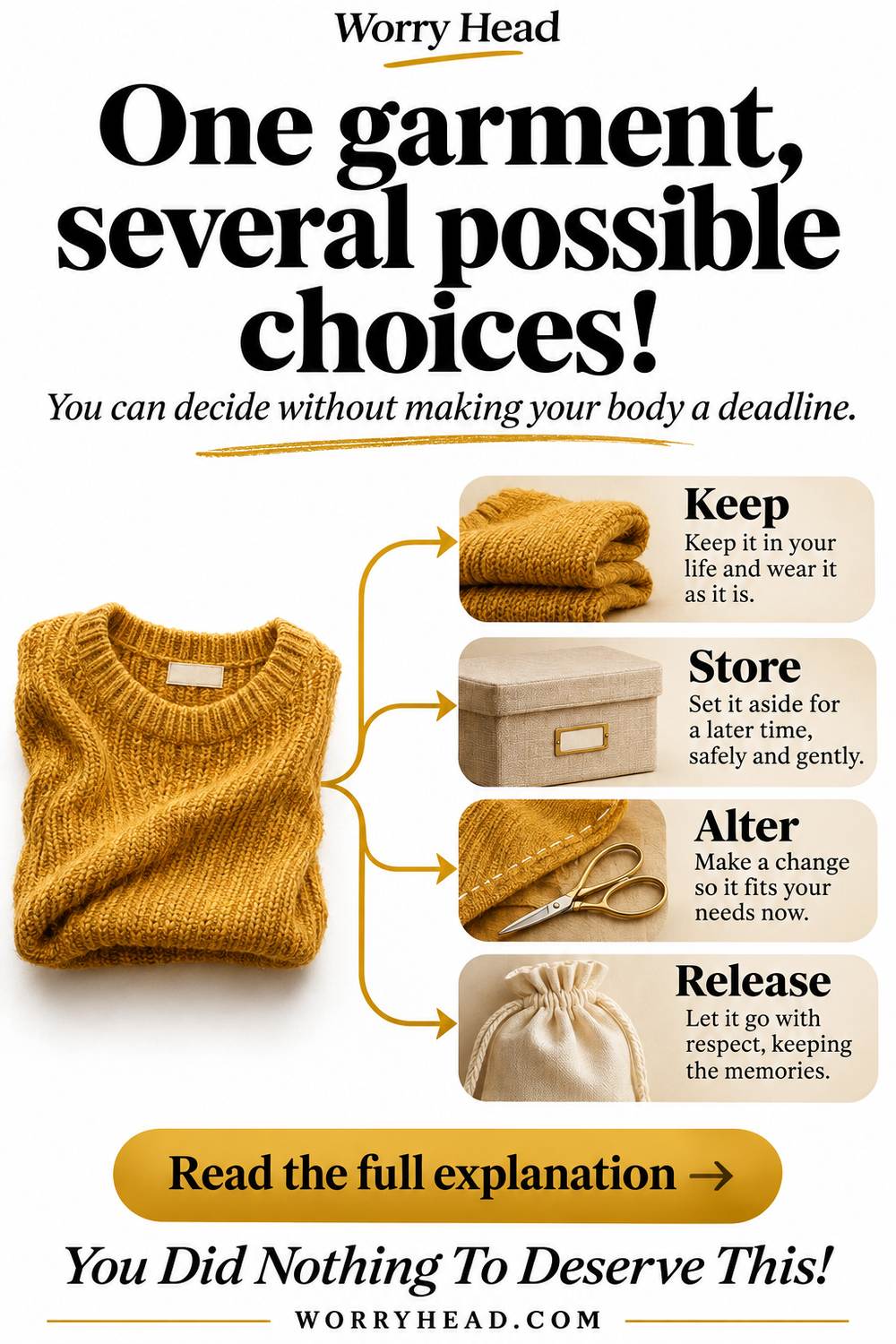
Keeping and discarding are not the only options. You might store a garment, alter it if that is feasible, lend it with clear agreement, sell it, donate it or keep a small number of meaningful pieces. None is automatically the healthiest or most positive choice. The right option depends on your wishes, resources and attachment to that particular item.
Before paying for an alteration, consider whether you actually want to wear the garment or feel obliged to rescue it. A piece can be beautiful and still not be something you want in your daily life. Equally, wanting to keep it does not mean you are refusing to accept change. Avoid turning either decision into evidence about your character.
You can also defer a decision deliberately. Write a simple label such as “Undecided” rather than “When I am better” if the latter feels like a promise or demand. You may choose a time to revisit the bag, but you do not have to create a deadline that becomes another source of pressure.
If someone else is helping, explain which decisions remain yours. They can carry a box, sort hangers or photograph an item for a listing without choosing what leaves. Ask them not to describe clothes as unrealistic, pointless or a waste of space. Practical help should make the task easier without taking over its emotional meaning.
Keep the Memory in Endometriosis and Old Clothes on Your Terms
Some people like taking a photograph of an item before letting it go. Others find the picture no more comforting than the garment. You can try that option if it appeals to you, but it is not a required step or a guaranteed way to feel ready. A memory does not need to be documented to remain meaningful.
You might keep one piece because of what it represents, even if you do not expect to wear it. There is no rule that every possession must justify itself through regular use. The practical question is whether keeping it works for your space and your feelings, rather than whether somebody else considers it sensible.
Be cautious about demanding a positive interpretation immediately. You may feel sad after donating something you chose to release. That sadness does not automatically mean the decision was wrong. It may simply reflect the fact that the item mattered. You can acknowledge a loss without reversing every choice or telling yourself you should feel liberated.
For partners, avoid making the garment a symbol before the person has done so herself. An old dress may be deeply meaningful, or it may just need a new zip. Ask whether she wants company, practical help or time alone. Let her tell you what the decision is about instead of supplying a story of recovery or reinvention.
What Cost and Choice Mean for Endometriosis and Old Clothes
Replacing clothes costs money, and keeping them may be a practical necessity. Advice to discard anything uncomfortable can ignore that reality. You do not need a completely new wardrobe to make one kinder choice. Work with what you own and what you can afford, without treating spending as evidence of self-care.
If you are considering selling an item, remember that listing, photographing, answering messages and arranging collection are tasks too. You may decide the likely return is worth that work, ask someone to help or choose another option. There is no moral ranking between selling, donating and keeping when circumstances differ.
Avoid making purchases to prove that you have accepted a changed body or a changed life. You can want one useful item without adopting a new identity. You can also enjoy fashion for its own sake. Comfort and personal style are preferences you can explore, rather than opposing sides in an argument about how illness should make you dress.
When someone offers to buy you something, be clear about whether you want that help. A surprise replacement may feel thoughtful or may feel like pressure to give up an old item. A question such as “Would choosing something together help?” leaves more room for your answer than assuming that a shopping trip will settle the feeling.
Answer Comments About Endometriosis and Old Clothes
Other people may offer confident opinions about what you should keep. “You will fit into it again” can sound reassuring while attaching hope to a particular bodily outcome. “Just get rid of it” can dismiss a connection that matters. You can redirect both comments without having to explain the full history of the garment.
A short response might be, “I am deciding what works for me now, without predicting my body.” Another is, “This one has a memory attached, so I want to take my time.” These are examples you can adapt, not scripts you must deliver perfectly. You can also choose to finish the sorting privately.
If your partner is unsure what to say, tell them what would help. Perhaps you want them to notice the colour you love, acknowledge that the decision is sad or simply carry the bag. Specific support can be more useful than a general assurance that you look beautiful, particularly when appearance is not the main issue.
You are also allowed to stop a conversation that becomes a discussion of weight or health predictions. “I am not looking for advice about my body” names that boundary. Keeping the focus on the wardrobe decision may protect you from being drawn into a debate you did not agree to have.
Final Word on Endometriosis and Old Clothes
Your wardrobe does not have to become a record of success or failure. You can keep a beloved item, put an uncertain one away and choose something comfortable for today. Those decisions can coexist without forming a statement about whether you have accepted illness, remained hopeful or moved on enough.
I want the practical help I offer as a husband to leave room for the person behind the possessions. Sometimes that means listening to a memory. Sometimes it means carrying a bag without commenting on what is inside. The useful response is the one that respects the choice being made, including the choice to wait.
If you would like to comment, share an approach that made a wardrobe decision gentler, without posting body measurements or photographs. My free eBook, You Did NOTHING To Deserve This!, offers another place for the feelings that an ordinary item can uncover.

About Me
Hi, I’m Lucjan! The reason why I decided to create this blog was my beautiful wife, who experienced a lot of pain in life, but also the lack of information about endometriosis and fibromyalgia for men…
READ MORE
Grab a FREE eBook!
“You Did NOTHING To Deserve This!”
Finally hear the words nobody ever said to you, that your pain is real, your tears make sense, and you did nothing to deserve endometriosis, the dismissal, or the way it has rewritten your life.
Related Questions You May Be Asking About Endometriosis and Old Clothes
Does Keeping Clothes Mean I Am in Denial?
One decision about a garment cannot establish that. You may value its memory, expect to use it or simply be undecided. Consider whether keeping it works for you without turning it into a psychological label.
Do I Have to Try Everything on before Sorting?
No. You can decide that an item is not useful today without testing it repeatedly. Choose a process that fits your available energy, privacy and comfort.
What if I Cannot Afford Replacements?
That is a real constraint. You can organise what you already have, keep uncertain pieces or make one small change. A complete wardrobe replacement is not a requirement for treating yourself kindly.
Can I Feel Sad after Choosing to Donate Something?
Yes, a chosen decision can still involve a meaningful loss. Sadness does not by itself show that you chose incorrectly or that you need to force yourself to feel positive about it.
Endometriosis and Old Clothes References
