
Asking Twice for Help with Endometriosis: When a Reminder Feels Like More Work
Have you finally asked for help, heard a yes and then found yourself wondering whether you must ask all over again? Asking twice for help with endometriosis can feel exhausting when the request itself already took effort. You are allowed to want a clear answer and reliable follow-through without calling yourself demanding.
You can follow up on an agreed task without apologising for still needing it. Clarify what was understood, when it can happen and who will keep track. A single misunderstanding and a repeated pattern need different conversations; a reminder should not make you responsible for managing all the help.
I write as a husband, blogger and researcher rather than a clinician, drawing on years beside my wife and the sources below while offering practical reflections on everyday support and communication.
This article continues the conversation about asking your partner for help during an endo flare. The focus is what happens after a request has already been made, especially when a vague yes leaves you waiting, reminding or doing the task yourself.
The second request can reopen the feeling that your needs are too much. My free eBook, You Did NOTHING To Deserve This!, offers understanding for that quieter burden. You deserve practical support that does not depend on making yourself endlessly agreeable.
You Did NOTHING To Deserve This!
Endometriosis Validation for Women with Endo

- Why Asking Twice for Help with Endometriosis Can Hurt
- Before Asking Twice for Help with Endometriosis, Check the Agreement
- Let Asking Twice for Help with Endometriosis Lead to a Clear Next Step
- When Asking Twice for Help with Endometriosis Becomes a Pattern
- Keep Both People's Limits Visible When Asking Twice for Help with Endometriosis
- Choose Your Words for Asking Twice for Help with Endometriosis
- Final Word on Asking Twice for Help with Endometriosis
- You Did NOTHING To Deserve This!
- FREE eBook
Why Asking Twice for Help with Endometriosis Can Hurt
The task may look small from the outside: bringing something upstairs, making a meal or collecting an item. What hurts might be the uncertainty around it. You cannot settle into something else because you do not know whether help is coming. You may be weighing up whether to wait, remind your partner or attempt the task despite having asked for support.
Endometriosis UK recognises that the condition can affect household tasks and couples’ everyday lives. That provides context for the conversation, but it does not explain any individual partner’s behaviour. A forgotten request cannot tell us whether somebody cares, what they understood or what else was happening. Those questions need an actual conversation rather than an instant conclusion.
As a husband, I would not want my intention to be helpful to become the only thing that counts. If I say yes and leave my wife uncertain, the practical effect matters too. Caring about someone and completing an agreed task are connected, but one does not automatically prove the other has happened.
Notice what the second request means to you. Perhaps it feels like begging, supervising or proving that the original need was real. Naming that meaning can help you explain why “just remind me” does not always feel like a simple solution. The reminder itself may be part of the work you were hoping to share.
Before Asking Twice for Help with Endometriosis, Check the Agreement
Start with what was actually agreed. “Could you sort dinner?” may mean buying ingredients to one person and having food ready by a particular time to another. Clarifying that difference does not mean you caused the misunderstanding or must learn perfect wording. It gives both of you something concrete to work with now.
You might say, “When you said yes, I understood that you would do it before six. Is that still possible?” This names your understanding and asks for a current answer. It avoids guessing whether your partner forgot, postponed the task or assumed you no longer needed it. You can be disappointed while still asking a straightforward question.
If you did not agree a time, add one where timing matters. Explain the practical consequence: “I need to know before I make another arrangement.” A task can be genuinely helpful at one point and no longer useful later. Saying that clearly is different from insisting that every request must be completed immediately.
The person accepting the task has a responsibility to clarify too. They can ask what is needed, say what they can manage or explain that they are unsure. A supportive arrangement should not depend entirely on the person needing help anticipating every possible misunderstanding before the conversation begins.

Let Asking Twice for Help with Endometriosis Lead to a Clear Next Step
Try to end the follow-up with a decision rather than another vague reassurance. The answer might be that the task will happen at a certain time, that part of it is possible or that your partner cannot do it today. An honest limit may disappoint you, but it gives you more usable information than an uncertain promise.
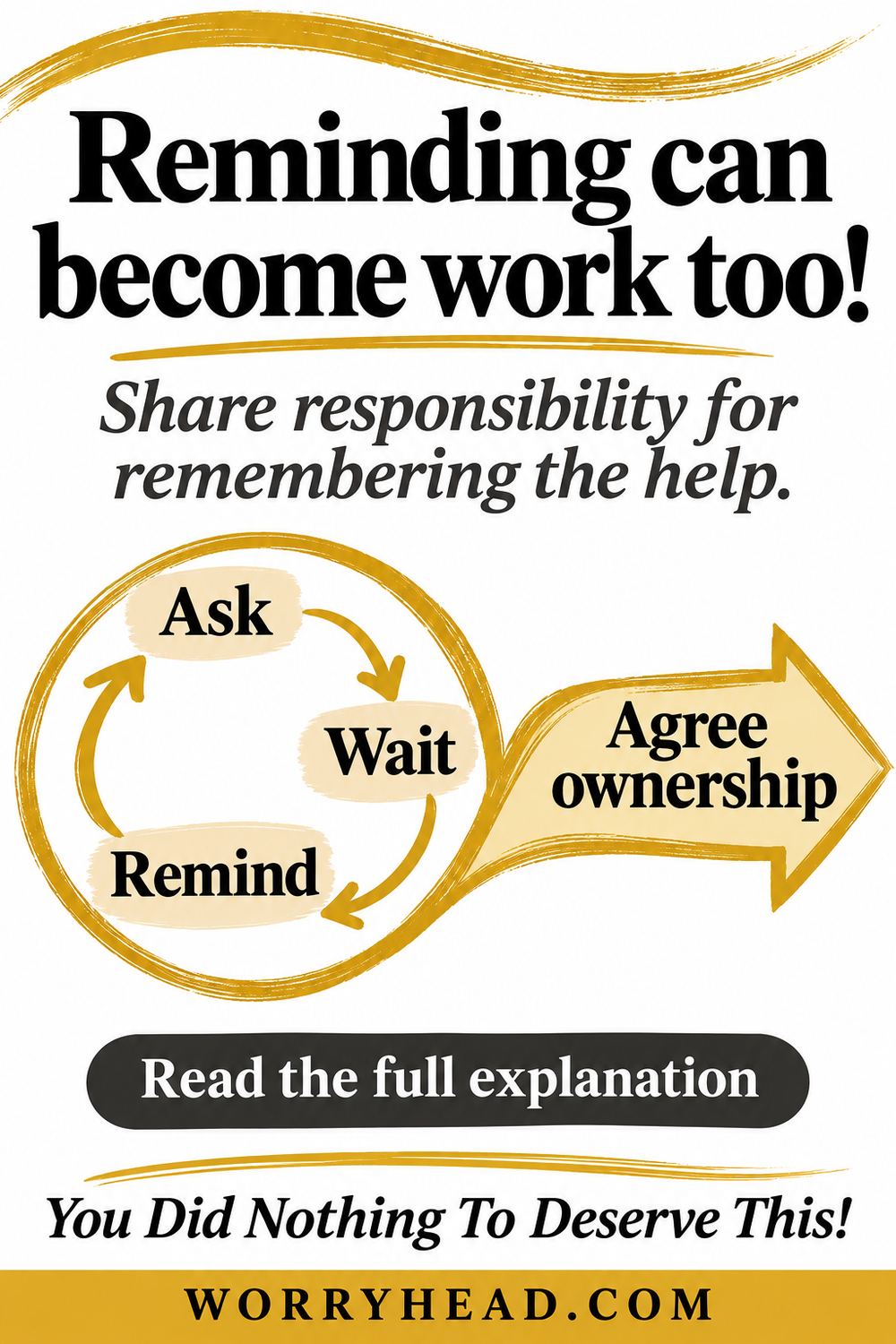
If your partner needs to remember something later, ask them to choose their own reminder. They might use a phone alert, a note or an existing routine. The important point is who owns that step. You do not have to become the person who creates, checks and repeatedly refreshes a reminder for the help you requested.
Agree what counts as completion where that is unclear. Collecting a parcel may include bringing it home; preparing food may include making sure you know it is ready. Keep the detail proportionate to the task. A short shared understanding is useful, while an elaborate instruction manual for every household action can create even more work.
You can also ask for a brief update if the plan changes. “Please tell me if you cannot do it, rather than leaving me to find out” is a practical request. It allows the person helping to have limits while recognising that their change of plan affects yours as well.
When Asking Twice for Help with Endometriosis Becomes a Pattern
Everyone can miss a message or misunderstand a request. A single incident may need a quick clarification and a completed task. You do not have to turn it into a discussion about the whole relationship. Equally, you do not have to pretend that repeated incidents are isolated when the same difficulty keeps returning.
If there is a pattern, discuss it outside the immediate task. Use a small number of concrete examples rather than an exhaustive list intended to win a case. Explain the effect: you keep monitoring, cannot rely on the answer or end up doing work you had asked to share. That effect is worth discussing even if each individual task seems minor.
Ask what arrangement your partner can reliably take responsibility for. It may be more useful to agree ownership of one recurring task than to negotiate the same request every day. Ownership includes noticing, planning and completing it, within whatever limits both of you have actually discussed. This is an option to explore, not a rule that every couple must divide tasks identically.
Then notice whether anything changes. A sincere conversation can matter, but a practical problem also needs practical follow-through. You are allowed to say that an arrangement remains unreliable. Repeating the same discussion indefinitely is not the only way to show patience, and finding different words cannot guarantee another person’s response.
Keep Both People’s Limits Visible When Asking Twice for Help with Endometriosis
Your partner may be tired, unwell, working or carrying responsibilities you cannot see in that moment. Those limits deserve honesty. They do not make your needs disappear, just as your illness does not make your partner’s capacity unlimited. The useful question is what can happen with the resources actually available.
Avoid turning the conversation into a competition over who has had the harder day. Two people can both be struggling while a particular task still needs an answer. You might simplify it, postpone something nonessential or seek another option if one exists. None of those suggestions is a promise that outside help is available or affordable.
If your partner says no after previously agreeing, ask for clarity about the current situation. You can recognise their limit and still explain the difficulty caused by the late change. Understanding why something happened does not require pretending that it had no consequence for you. Both parts can be true in the same conversation.
For husbands reading, a clear no or a smaller offer can be kinder than a yes you cannot honour. Do not leave your partner to discover your limit through waiting. State it, help clarify the next step where possible and take responsibility for any agreement you do make.
Choose Your Words for Asking Twice for Help with Endometriosis
If the main issue is uncertainty, try, “Can you let me know whether you are still able to do that?” If timing matters, try, “I need it by this evening; can you manage that?” If the pattern is the problem, try, “I am finding that I have to keep track after you agree, and I need us to change that.”
These examples have different purposes. Choose the one that fits instead of adding every concern to the same sentence. You can speak plainly without performing perfect calm. A reasonable need does not become unreasonable because you sound tired, although a conversation may go more usefully when both people can listen.
If either of you becomes defensive, return to the concrete task and the next decision. You can revisit the wider pattern later. That is different from agreeing never to discuss it. A pause should leave a route back to the issue, rather than making the person who raised it responsible for forgetting it to restore peace.
Communication suggestions assume that both people are willing to engage respectfully. They cannot make a persistently dismissive partner cooperate, and you should not judge yourself by whether a particular phrase works. If you need support thinking about a repeated relationship difficulty, you can seek an appropriate independent conversation rather than endlessly refining the same request alone.
Final Word on Asking Twice for Help with Endometriosis
You can ask for clarity without apologising for the original need. Find out what was understood, agree the next step and let the person who accepted the task take responsibility for remembering it. If the problem keeps repeating, it deserves a conversation about the arrangement itself, not simply another instruction to remind them.
From my side as a husband, I want my yes to mean something practical. That includes being honest when I cannot help and communicating when circumstances change. My wife should not have to make her needs smaller so that I can continue thinking of myself as supportive without looking at what actually happens.
If you would like to comment, share a phrase that made a follow-up clearer without identifying or criticising somebody publicly. For the guilt that can accompany another request, my free eBook, You Did NOTHING To Deserve This!, offers understanding beyond the household task.


About Me
Hi, I’m Lucjan! The reason why I decided to create this blog was my beautiful wife, who experienced a lot of pain in life, but also the lack of information about endometriosis and fibromyalgia for men…
READ MORE
Grab a FREE eBook!
“You Did NOTHING To Deserve This!”
Finally hear the words nobody ever said to you, that your pain is real, your tears make sense, and you did nothing to deserve endometriosis, the dismissal, or the way it has rewritten your life.
Related Questions You May Be Asking About Asking Twice for Help with Endometriosis
Does Forgetting a Task Mean My Partner Does Not Care?
One forgotten task cannot establish that. Ask what happened and look at the wider pattern. The practical effect still matters, even when the intention was caring.
Should I Set Every Reminder for My Partner?
You can agree a shared system, but accepting a task can include taking responsibility for remembering it. Discuss whether the current arrangement actually reduces your work or simply changes its form.
Can I Ask for a Definite Time?
Yes, especially when timing affects another plan. Explain the need and ask what is realistic. An honest answer is more useful than a promise made only to end the conversation.
What if the Same Problem Keeps Happening?
Discuss the repeated arrangement at a calmer time, using concrete examples and a specific change you want. Words alone cannot guarantee cooperation; notice whether agreed changes happen in practice.
Asking Twice for Help with Endometriosis References
